


 |
市場調查報告書
商品編碼
2132671
全球α放射性配體療法市場:趨勢與預測(至2035年)Global Alpha-Emitting Radioligand Therapy Market - Trends and Forecast Till 2035 |
||||||

α粒子放射性配體治療市場概述
根據 Roots Analysis 的研究,今年全球 α 放射性配體治療市場價值為 7.5 億美元,預計到 2035 年將達到 30.1 億美元。這意味著在預測期內,複合年成長率將達到 16.7%。
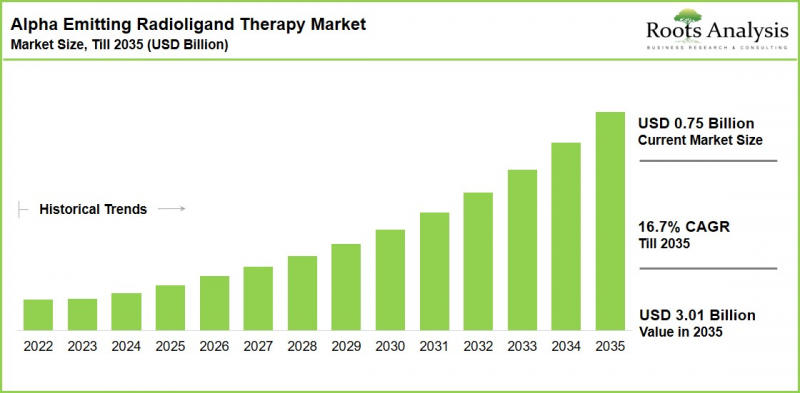
α粒子放射性配體治療市場:成長與趨勢
在全球範圍內,癌症發生率的上升,尤其進行性前列腺癌、神經內分泌腫瘤和難治性固體癌的發生率,正在加速對高效、短程標靶治療的需求。 α放射性配體能夠在極短的路徑上以高線性能量轉移(LET)傳遞輻射,從而實現精準殺傷癌細胞,同時保護周圍健康組織。這使得α放射性配體能夠作為現有BETA放射性配體療法(例如鎦-177製劑)的補充,或成為下一代治療選擇。
關鍵趨勢包括錒-225、鉛-212和鐳-223偶聯物的臨床研發管線不斷擴展,同位素生產能力投資增加,以及將診斷成像和治療性α射線輸送相結合的治療診斷學(治療-診斷)方法的整合。隨著製造商追求更高的產量和更低的單劑量成本,連續製程整合、一次性系統的應用以及專用放射性藥物生產基礎設施正從新概念轉變為實際營運需求。地緣政治因素和供應鏈挑戰也推動同位素生產和成品製造向更靠近主要終端市場的地區轉移。
隨著標靶α療法成為精準腫瘤學中一個成熟的組成部分,在市售產品和後期臨床開發管線資產的共同推動下,市場有望實現持續的長期成長。
成長驅動力:支持市場擴張的因素
市場需求主要源自於對有效治療微轉移瘤和放射抗性疾病的臨床迫切需要,而α粒子的高相對生物效應使其在這些領域具有顯著優勢。製藥和生物技術公司可以利用專業的同位素生產、螯合化學和符合GMP規範的放射性藥物配製能力,而無需承擔建造現場核設施所需的大量資金負擔。營運的柔軟性使贊助公司能夠根據臨床和商業性需求調整生產規模,同時將資金重新投入研發和拓展適應症。
其他促成因素包括擴大已通過核准藥物的保險覆蓋範圍、對放射性藥物開發過程的監管支持、PSMA 和 SSTR 標靶療法的廣泛採用,以及向個性化和影像引導腫瘤學的廣泛轉變。
市場挑戰:阻礙進展的主要障礙
儘管基本面強勁,但該市場仍面臨諸多限制因素。具體而言,這些限制因素包括關鍵α放射性同位素(尤其是錒-225)供應有限且地理集中;專用生產和處理基礎設施需要大量資金和監管支援;半衰期短,導致物流和調度複雜;以及對訓練有素的核醫學專業人員的需求。嚴格的輻射安全標準和GMP需求、其他療法(例如BETA放射性藥物和抗體藥物複合體(ADC))的競爭,以及產能擴張帶來的短期不確定性,都進一步增加了成本和複雜性。對於希望最大限度掌握該市場機會的相關人員而言,穩定同位素供應、擴大生產規模以及進行跨學科培訓至關重要。
α粒子放射性配體療法市場:關鍵洞察
本報告詳細分析了全球α放射性配體治療市場的現狀,並為分銷仲介業者、銷售管道和專業物流供應商指明了潛在的成長機會。主要發現包括:
- 開發α放射性配體療法的公司主要依靠與製造商簽訂的直接同位素供應合約和長期放射性同位素撤回協議,儘管已經建立了像傳統藥品經銷商那樣的冷鍊和受監管的物料處理網路,但該領域的可見性仍然有限。
- 鑑於砹-211 和鉛-212 等同位素的半衰期極短(幾小時到幾天),專業的放射性藥物網路和核醫學認證的物流供應商開始在 α 放射治療供應鏈中發揮至關重要的作用。
- 希望進入該領域的經銷商和物流合作夥伴必須證明其擁有符合 NRC/IAEA 標準的放射性物質許可證、檢驗的屏蔽運輸基礎設施以及符合 GMP 標準的存儲歷史文件,這反映了對釋放 α 粒子的藥品施加的嚴格安全和監管要求。
- 在 NorthStar Medical Radioisotopes、Niowave、Orano Med 和 Eckert & Ziegler 等大型公司的主導,北美和歐洲的錒-225 和鉛-212 產能迅速擴張,推動了對能夠遵守放射性物質運輸法規的區域分銷和即時物流合作夥伴的需求。
- 隨著大型製藥企業斥資數十億美元收購α射線療法領域的生技公司,產業整合正在加速推進,提高了小規模企業的進入門檻。然而,這也為擁有特定同位素或適應症專業知識的利基經銷商和物流公司創造了新的商機。
- 我們的分銷和銷售管道合作夥伴不僅在物流成本方面展開日益激烈的競爭,而且在附加價值服務方面也展開了激烈的競爭,例如協助輻射安全文件編制、溫度和屏蔽控制運輸、劑量校準調整以及治療中心的庫存管理。
- 除了針對 PSMA 和 SSTR2 的錒-225 療法的後期臨床管線不斷擴展外,預計新的鉛-212 和砹-211 候選材料的出現將在整個預測期內維持對專業同位素分銷基礎設施不斷成長的需求。
近期交易趨勢顯示投資者情緒高漲。
- Niowave 和 Ratio Therapeutics 達成了一項供應協議,根據該協議,Niowave 將供應符合 cGMP 標準的錒-225,以支持 Ratio 的臨床階段靶向放射治療產品線。
- NorthStar Medical Radioisotopes 和 QSA Global 已達成一項多年戰略服務協議,以確保鐳-226 的穩定供應,從而支持 NorthStar 的商業規模「無載體」錒-225 生產。
- ITM Isotope Technologies Munich 和 Alpha-9 Oncology 已達成一項供應協議,將從 ITM 和 Canadian Nuclear Laboratories 的合資企業 Actineer 採購錒-225,以支援 Alpha-9 的放射性藥物研發管線。
- 阿斯特捷利康已完成對 Fusion Pharmaceuticals 的收購,收購金額約為 24 億美元,獲得了 FPI-2265(一種基於錒-225 的 PSMA標靶治療),並且還延長了與 NioWave 的長期錒-225 供應協議。
- 百時美施貴寶以 41 億美元收購了 RayzeBio,獲得了基於錒-225 的放射性藥物平台,包括 III 期臨床試驗資產 RYZ101,以及其自身的生產能力。
- 禮來公司以約14億美元收購了POINT Biopharma公司,獲得了α和BETA放射性配體資產及生產能力。同時,諾華公司透過收購Mariana Oncology公司以及與PeptiDream公司達成授權協議,進一步加強了其在錒-225領域的佈局。
這些交易共同凸顯了投資者和策略性收購公司對α放射性配體療法的持續信心,同位素供應穩定性已成為一項關鍵策略資產,這一主題與考慮進入市場的經銷商和物流合作夥伴直接相關。
α放射性配體療法的市場區隔
市場規模和機會分析是根據以下參數進行細分的:
同位素類型
- 錒-225 (Ac-225)
- 鉛-212 (Pb-212)
- 鐳-223(Ra-223)
- 砹-211(At-211)
- 釷-227 (Th-227)
- 其他α放射性同位素
依產品類型
- 市售α射線放射性配體療法
- 開發平臺/臨床階段候選藥物
透過標靶分子
- 單株抗體
- 胜肽
- 低分子化合物
- 抗體片段/其他構建體
適應症
- 前列腺癌(mCRPC)
- 神經內分泌腫瘤(GEP-NETs)
- 骨轉移
- 肝細胞癌
- 骨髓惡性腫瘤(AML)
- 其他固體癌
最終用戶
- 醫院及專科癌症中心
- 核子醫學/治療診斷學中心
- 門診靜脈輸液治療及門診治療中心
透過分銷管道
- 由直接向醫療機構供貨的製造商進行分銷
- 第三方放射性藥物分發網路
- 專業冷鏈/放射性物質物流公司
按地區
- 北美洲
- 美國
- 加拿大
- 歐洲
- 德國
- 英國
- 法國
- 義大利
- 西班牙
- 其他歐洲國家
- 亞太地區
- 中國
- 日本
- 印度
- 韓國
- 澳洲
- 亞太其他地區
- 中東和北非
- 沙烏地阿拉伯
- 阿拉伯聯合大公國
- 拉丁美洲
- 巴西
- 阿根廷
- 其他拉丁美洲國家
其他好處
- 免費PPT洞察包
- 一個免費的Excel資料包,支援報告中的所有分析模組。
- 我們提供內容客製化15%的折扣。
- 調查團隊將進行詳細的報告說明。
- 如果您的目前版本已超過 6-12 個月,我們將免費為您提供最新版本報告。
目錄
第1章:序言
第2章:調查方法
第3章 市場動態
第4章 宏觀經濟指標
第5章執行摘要
第6章:引言
第7章 α放射性配體療法:市場概況
第8章 臨床試驗分析
第9章:公司簡介
- 各章節概要
- AstraZeneca(Fusion Pharmaceuticals)
- Actinium Pharmaceuticals
- Bristol Myers Squibb Company(RayzeBio)
- Bayer
- Convergent Therapeutics
- Eli Lilly(POINT Biopharma)
- ITM Isotope Technologies Munich
- Novartis
- NorthStar Medical Radioisotopes
- Orano Med
- Perspective Therapeutics
- Telix Pharmaceuticals
第10章:夥伴關係與合作研究
第11章:資金籌措與投資分析
第12章 專利分析
第13章案例研究:細胞療法的生產
第14章 成本分析
第15章 市場影響分析:促進因素、阻礙因素、機會與挑戰
第16章:全球α粒子放射性配體治療市場
第17章 α放射性配體治療市場:依同位素分類
第18章 α粒子放射性配體治療市場:依產品類型分類
第19章:α粒子放射性配體治療市場:依標靶部分分類
第20章:α放射性配體治療市場:依適應症分類
第21章 α粒子放射性配體治療市場:依最終使用者分類
第22章 α放射性配體治療市場:依通路分類
第23章:α粒子放射性配體治療市場:區域分佈
第24章:α粒子放射性配體療法市場:藥品銷售預測
第25章:α粒子放射性配體治療市場:主要公司的銷售預測
第26章經營團隊洞見
第27章概要
第28章附錄一:表格形式數據
第29章 附錄二:公司與組織列表
第30章 附錄三:資金籌措與投資清單
ALPHA-EMITTING RADIOLIGAND THERAPY MARKET: OVERVIEW
As per Roots Analysis, the global alpha-emitting radioligand therapy market is valued at USD 0.75 billion in the current year and is projected to reach USD 3.01 billion by 2035, representing a CAGR of 16.7% during the forecast period.
Alpha-Emitting Radioligand Therapy Market: Growth and Trends
Rising global cancer incidence, particularly advanced prostate cancer, neuroendocrine tumors, and treatment-resistant solid tumors, is accelerating demand for highly potent, short-range targeted therapies. Alpha-emitting radioligands deliver high linear-energy-transfer radiation over a very limited path length, enabling precise tumor-cell kill while sparing surrounding healthy tissue. This positions alpha emitters as a complementary or next-generation modality to established beta-emitting radioligand therapies such as lutetium-177 products.
Key trends include expanding clinical pipelines for actinium-225, lead-212, and radium-223 conjugates; growing investment in isotope production capacity; and increasing integration of theranostic approaches that pair diagnostic imaging with therapeutic alpha delivery. Continuous process intensification, single-use systems, and specialized radiopharmacy infrastructure are moving from emerging concepts to operational necessities as manufacturers seek higher yields and lower per-dose costs. Geopolitical and supply-chain considerations are also prompting onshoring of isotope production and finished-dose manufacturing closer to major end markets.
As targeted alpha therapy becomes an accepted component of precision oncology, the market is positioned for sustained, long-term expansion driven by both commercial products and late-stage pipeline assets.
Growth Drivers: Factors Fueling Market Expansion
Demand is propelled by the clinical need for therapies effective against micrometastases and radio-resistant disease, where alpha particles' high relative biological effectiveness offers clear advantages. Pharmaceutical and biotech companies gain access to specialized isotope production, chelation chemistry, and GMP radiopharmacy capabilities without the full capital burden of in-house nuclear facilities. Operational flexibility allows sponsors to scale manufacturing in line with clinical and commercial demand while redirecting capital toward R&D and indication expansion.
Additional drivers include expanding reimbursement for approved agents, regulatory support for radiopharmaceutical development pathways, rising adoption of PSMA and SSTR-targeted approaches, and the broader shift toward personalized, image-guided oncology.
Market Challenges: Critical Barriers Hindering Progress
Despite strong fundamentals, the market faces constraints, such as limited and geographically concentrated supply of key alpha-emitting isotopes (especially actinium-225), high capital and regulatory requirements for specialized production and handling infrastructure, short half-lives that complicate logistics and scheduling, and the need for trained nuclear-medicine personnel. Stringent radiation-safety and GMP expectations, competition from beta emitters and other modalities such as antibody-drug conjugates, and near-term uncertainty around capacity expansion all add cost and complexity. Addressing isotope supply security, manufacturing scale-up, and cross-disciplinary training will be essential for stakeholders seeking to capture the full opportunity.
Alpha-Emitting Radioligand Therapy Market: Key Insights
The report delves into the current state of the global alpha-emitting radioligand therapy market and identifies potential growth opportunities for distribution partners, channel intermediaries, and specialty logistics providers. Some key findings include:
- Alpha-emitting radioligand therapy developers predominantly rely on direct-to-manufacturer isotope supply agreements and long-term radioisotope offtake contracts, limiting the visibility that conventional pharmaceutical distributors have into this segment despite their established cold-chain and controlled-substance handling networks.
- Specialty radiopharmacy networks and nuclear-medicine-certified logistics providers are emerging as critical enablers of the alpha-therapy supply chain, given the extremely short half-lives (hours to a few days) of isotopes such as astatine-211 and lead-212.
- Distributors and logistics partners seeking entry into this space must demonstrate NRC/IAEA-aligned radioactive materials licensing, validated shielded-transport infrastructure, and GMP-compliant chain-of-custody documentation, reflecting the stringent safety and regulatory requirements attached to alpha-particle-emitting drug products.
- Rapid capacity build-out for actinium-225 and lead-212 production across North America and Europe, led by companies such as NorthStar Medical Radioisotopes, Niowave, Orano Med, and Eckert & Ziegler, is increasing demand for regional distribution and just-in-time logistics partners capable of navigating radioactive materials transport regulations.
- Consolidation among large pharmaceutical sponsors through billion-dollar acquisitions of alpha-therapy biotechs is raising barriers to entry for smaller players, while simultaneously creating openings for niche distributors and logistics providers with isotope-specific or indication-specific expertise.
- Distribution and channel partners increasingly compete on value-added services, including radiation-safety documentation support, temperature- and shielding-controlled transport, dose-calibration coordination, and treatment-center inventory management, rather than on logistics cost alone.
- The expanding late-stage pipeline of PSMA and SSTR2-targeted actinium-225 therapeutics, together with emerging lead-212 and astatine-211 candidates, is expected to sustain elevated demand for specialized isotope distribution infrastructure through the forecast period.
Recent Deal Activity Signaling Investor Momentum
- Niowave and Ratio Therapeutics signed a supply agreement under which Niowave will provide cGMP actinium-225 to support Ratio's clinical-stage targeted radiotherapeutic pipeline.
- NorthStar Medical Radioisotopes and QSA Global entered a multi-year strategic services agreement to secure the radium-226 target supply that underpins NorthStar's commercial-scale, no-carrier-added actinium-225 production.
- ITM Isotope Technologies Munich and Alpha-9 Oncology signed a supply agreement for actinium-225 sourced from Actineer, the ITM-Canadian Nuclear Laboratories joint venture, to support Alpha-9's radiopharmaceutical pipeline.
- AstraZeneca completed its approximately USD 2.4 billion acquisition of Fusion Pharmaceuticals, gaining the actinium-225-based PSMA-targeted asset FPI-2265 and extending a long-term actinium-225 supply agreement with Niowave.
- Bristol Myers Squibb completed its USD 4.1 billion acquisition of RayzeBio, adding an actinium-225-based radiopharmaceutical platform, including the Phase III asset RYZ101, along with in-house manufacturing capability.
- Eli Lilly acquired POINT Biopharma for approximately USD 1.4 billion, adding alpha- and beta-emitting radioligand assets and manufacturing capacity, while Novartis advanced its actinium-225 focus through the acquisition of Mariana Oncology and a licensing arrangement with PeptiDream.
Collectively, these transactions underscore sustained investor and strategic-acquirer confidence in the alpha-emitting radioligand therapy modality, with isotope supply security emerging as the primary strategic asset being acquired, a theme directly relevant to distributors and logistics partners evaluating exposure to this market.
Alpha-Emitting Radioligand Therapy Market Segments
The market sizing and opportunity analysis has been segmented across the following parameters:
By Isotope Type
- Actinium-225 (Ac-225)
- Lead-212 (Pb-212)
- Radium-223 (Ra-223)
- Astatine-211 (At-211)
- Thorium-227 (Th-227)
- Other Alpha-emitting Isotopes
By Product Type
- Marketed Alpha-emitting Radioligand Therapies
- Pipeline / Clinical-stage Candidates
By Targeting Moiety
- Monoclonal Antibodies
- Peptides
- Small Molecules
- Antibody Fragments / Other Constructs
By Indication
- Prostate Cancer (mCRPC)
- Neuroendocrine Tumors (GEP-NETs)
- Bone Metastases
- Hepatocellular Carcinoma
- Hematological Malignancies (AML)
- Other Solid Tumors
By End User
- Hospitals and Specialized Cancer Centers
- Nuclear Medicine / Theranostic Centers
- Ambulatory Infusion and Outpatient Treatment Centers
By Distribution Channel
- Direct-to-Center Manufacturer Distribution
- Third-Party Radiopharmacy Networks
- Specialty Cold-Chain / Radioactive Logistics Distributors
By Geographical Regions
- North America
- US
- Canada
- Europe
- Germany
- UK
- France
- Italy
- Spain
- Rest of Europe
- Asia-Pacific
- China
- Japan
- India
- South Korea
- Australia
- Rest of Asia-Pacific
- Middle East and North Africa
- Saudi Arabia
- UAE
- Latin America
- Brazil
- Argentina
- Rest of Latin America
Alpha-Emitting Radioligand Therapy Market: Key Segments
Actinium-225 Leads the Isotope-Type Landscape
Based on Roots Analysis research, actinium-225-based candidates account for the highest share of the active alpha-emitting radioligand therapy market. This leading position reflects Ac-225's favorable four-alpha-particle decay chain, established radiolabeling chemistry, and its adoption as the lead isotope across the RayzeBio, Fusion Pharmaceuticals, and Novartis actinium programs. Lead-212 is expected to register the fastest CAGR through 2035 as accelerator-based generator systems mature and reduce dependence on the constrained actinium-225 supply chain.
Prostate Cancer Remains the Dominant Indication
According to our analysis, mCRPC accounts for the largest indication-wise share of the alpha-emitting radioligand therapy pipeline. This highest share is underpinned by the large post-Pluvicto patient pool and multiple PSMA-targeted actinium-225 candidates in late-stage development. Neuroendocrine tumors represent the second-largest segment, led by RYZ101, and are projected to grow at a robust CAGR as sponsors pursue post-Lutathera treatment settings.
North America Dominates the Market and Asia-Pacific Registers a High CAGR
North America currently accounts for the largest share of global alpha-emitting radioligand therapy market. This high share is supported by the concentration of isotope production capacity, the presence of leading sponsors (Bristol Myers Squibb, AstraZeneca, Eli Lilly, Novartis), a mature theranostics infrastructure, and favorable reimbursement pathways. Europe follows, aided by isotope production hubs in Germany and the ITM-Canadian Nuclear Laboratories partnership, while Asia-Pacific is expected to post the fastest regional CAGR as China, Japan, and South Korea expand nuclear medicine capacity and cyclotron-based isotope production.
Nuclear Medicine and Theranostic Centers Lead by End User
Specialized nuclear medicine and theranostic centers currently administer the majority of alpha-emitting radioligand doses, given the radiation-safety infrastructure, dosimetry expertise, and PET-based patient selection capabilities required. Community hospital and ambulatory infusion settings are expected to expand their share as isotope supply stabilizes and simplified administration protocols are established.
Example Players In The Alpha-Emitting Radioligand Therapy Market
- AstraZeneca (Fusion Pharmaceuticals)
- Actinium Pharmaceuticals
- Bristol Myers Squibb (RayzeBio)
- Bayer
- Convergent Therapeutics
- Eli Lilly (POINT Biopharma)
- ITM Isotope Technologies Munich
- Novartis
- NorthStar Medical Radioisotopes
- Orano Med
- Perspective Therapeutics
- Telix Pharmaceuticals
ALPHA-EMITTING RADIOLIGAND THERAPY MARKET: RESEARCH COVERAGE
- Market Sizing and Opportunity Analysis: An in-depth analysis of the market focusing on key segments, including isotope type, product type, targeting moiety, indication, end user, distribution channel, and geographical regions.
- Isotope Supply Chain Landscape: A detailed assessment of active and emerging actinium-225, lead-212, and other alpha-isotope producers, featuring production route, capacity, and supply-agreement information.
- Company Profiles: In-depth profiles of prominent players engaged in alpha-emitting radioligand therapy development and isotope production, covering pipeline assets, manufacturing capabilities, and recent initiatives.
- Case Study (Alpha versus Beta Emitters): A concise comparison of alpha- and beta-emitting radioligand therapies, highlighting decay characteristics, manufacturing complexity, and clinical trade-offs.
- Partnerships and Collaborations: An analysis of isotope supply agreements, licensing deals, and manufacturing collaborations, based on parameters such as year of partnership, type of agreement, and most active players.
- Funding and M&A Analysis: A detailed analysis of funding rounds and acquisitions in this domain, based on year, deal value, purpose, geography, and most active acquirers and investors.
- Capacity and Demand Analysis: A comprehensive assessment of global installed isotope production capacity and projected clinical demand across major geographic regions.
- SWOT Analysis: A strategic assessment evaluating the market's key strengths, weaknesses, opportunities, and threats, with actionable insights into competitive positioning.
KEY QUESTIONS ANSWERED IN THIS REPORT
- Which are the leading companies in the alpha-emitting radioligand therapy market?
- Which isotope type and indication dominate the current pipeline, and which are growing fastest?
- What is the current and projected market size, and what is the CAGR through 2035?
- What are the key drivers, trends, and challenges shaping this market?
- How is the actinium-225 and lead-212 supply chain structured, and where are the bottlenecks?
- What opportunities exist for distributors, radiopharmacies, and logistics partners entering this space?
- Which region dominates the market, and which region is projected to grow fastest?
- How is market opportunity distributed across isotope type, indication, end user, and distribution channel?
REASONS TO BUY THIS REPORT
This report is designed to give distributors, channel partners, and investors a decisive analytical edge in a fast-consolidating, supply-constrained market. Its core differentiators include:
- Top-Down and Bottom-Up Triangulated Forecasting: Market estimates are built using a hybrid methodology that cross-validates macro-level assessments against bottom-up, program-level clinical and capacity data, minimizing forecast bias.
- Isotope-Specific Segmentation: Granular segmentation by isotope type (Ac-225, Pb-212, Ra-223, At-211, Th-227) enables precise opportunity sizing tied to production capacity and supply-agreement activity.
- Primary Research-Backed Insights: Findings are informed by direct engagement with executives across isotope producers, radiopharmaceutical sponsors, and logistics providers, ensuring insights reflect real operating conditions.
- Actionable Multi-Parameter Segmentation: Seven-parameter segmentation (isotope type, product type, targeting moiety, indication, end user, distribution channel, geography) enables precise opportunity sizing for any go-to-market or investment thesis.
ADDITIONAL BENEFITS
- Complementary PPT Insights Pack
- Complementary Excel Data Packs for All Analytical Modules in the Report
- 15% Free Content Customization
- Detailed Report Walkthrough Session with Research Team
- Free Updated Report if the Current Edition Is 6-12 Months Old or Older
TABLE OF CONTENTS
1. PREFACE
- 1.1. Introduction
- 1.2. Market Share Insights
- 1.3. Key Market Insights
- 1.4. Report Coverage
- 1.5. Key Questions Answered
- 1.6. Chapter Outlines
2. RESEARCH METHODOLOGY
- 2.1. Chapter Overview
- 2.2. Research Assumptions
- 2.2.1. Market Landscape and Market Trends
- 2.2.2. Market Forecast and Opportunity Analysis
- 2.2.3. Comparative Analysis
- 2.3. Database Building
- 2.3.1. Data Collection
- 2.3.2. Data Validation
- 2.3.3. Data Analysis
- 2.4. Project Methodology
- 2.4.1. Secondary Research
- 2.4.1.1. Annual Reports
- 2.4.1.2. Academic Research Papers
- 2.4.1.3. Company Websites
- 2.4.1.4. Investor Presentations
- 2.4.1.5. Regulatory Filings
- 2.4.1.6. White Papers
- 2.4.1.7. Industry Publications
- 2.4.1.8. Conferences and Seminars
- 2.4.1.9. Government Portals
- 2.4.1.10. Media and Press Releases
- 2.4.1.11. Newsletters
- 2.4.1.12. Industry Databases
- 2.4.1.13. Roots Proprietary Databases
- 2.4.1.14. Paid Databases and Sources
- 2.4.1.15. Social Media Portals
- 2.4.1.16. Other Secondary Sources
- 2.4.2. Primary Research
- 2.4.2.1. Types of Primary Research
- 2.4.2.1.1. Qualitative Research
- 2.4.2.1.2. Quantitative Research
- 2.4.2.1.3. Hybrid Approach
- 2.4.2.2. Advantages of Primary Research
- 2.4.2.3. Techniques for Primary Research
- 2.4.2.3.1. Interviews
- 2.4.2.3.2. Surveys
- 2.4.2.3.3. Focus Groups
- 2.4.2.3.4. Observational Research
- 2.4.2.3.5. Social Media Interactions
- 2.4.2.4. Key Opinion Leaders Considered in Primary Research
- 2.4.2.4.1. Company Executives (CXOs)
- 2.4.2.4.2. Board of Directors
- 2.4.2.4.3. Company Presidents and Vice Presidents
- 2.4.2.4.4. Research and Development Heads
- 2.4.2.4.5. Technical Experts
- 2.4.2.4.6. Subject Matter Experts
- 2.4.2.4.7. Scientists
- 2.4.2.4.8. Doctors and Other Healthcare Providers
- 2.4.2.5. Ethics and Integrity
- 2.4.2.5.1. Research Ethics
- 2.4.2.5.2. Data Integrity
- 2.4.2.1. Types of Primary Research
- 2.4.3. Analytical Tools and Databases
- 2.4.1. Secondary Research
- 2.5. Robust Quality Control
3. MARKET DYNAMICS
- 3.1. Chapter Overview
- 3.2. Forecast Methodology
- 3.2.1. Top-down Approach
- 3.2.2. Bottom-up Approach
- 3.2.3. Hybrid Approach
- 3.3. Market Assessment Framework
- 3.3.1. Total Addressable Market (TAM)
- 3.3.2. Serviceable Addressable Market (SAM)
- 3.3.3. Serviceable Obtainable Market (SOM)
- 3.3.4. Currently Acquired Market (CAM)
- 3.4. Forecasting Tools and Techniques
- 3.4.1. Qualitative Forecasting
- 3.4.2. Correlation
- 3.4.3. Regression
- 3.4.4. Extrapolation
- 3.4.5. Convergence
- 3.4.6. Sensitivity Analysis
- 3.4.7. Scenario Planning
- 3.4.8. Data Visualization
- 3.4.9. Time Series Analysis
- 3.4.10. Forecast Error Analysis
- 3.5. Key Considerations
- 3.5.1. Demographics
- 3.5.2. Government Regulations
- 3.5.3. Reimbursement Scenarios
- 3.5.4. Market Access
- 3.5.5. Supply Chain
- 3.5.6. Industry Consolidation
- 3.5.7. Pandemic / Unforeseen Disruptions Impact
- 3.6. Limitations
4. MACRO-ECONOMIC INDICATORS
- 4.1. Chapter Overview
- 4.2. Market Dynamics
- 4.2.1. Time Period
- 4.2.1.1. Historical Trends
- 4.2.1.2. Current and Forecasted Estimates
- 4.2.2. Currency Coverage
- 4.2.2.1. Major Currencies Affecting the Market
- 4.2.2.2. Factors Affecting Currency Fluctuations
- 4.2.2.3. Impact of Currency Fluctuations on the Industry
- 4.2.3. Foreign Currency Exchange Rate
- 4.2.3.1. Impact of Foreign Exchange Rate Volatility on the Market
- 4.2.3.2. Strategies for Mitigating Foreign Exchange Risk
- 4.2.4. Recession
- 4.2.4.1. Assessment of Current Economic Conditions and Potential Impact on the Market
- 4.2.4.2. Historical Analysis of Past Recessions and Lessons Learnt
- 4.2.5. Inflation
- 4.2.5.1. Measurement and Analysis of Inflationary Pressures in the Economy
- 4.2.5.2. Potential Impact of Inflation on the Market Evolution
- 4.2.6. Interest Rates
- 4.2.6.1. Interest Rates and Their Impact on the Market
- 4.2.6.2. Strategies for Managing Interest Rate Risk
- 4.2.7. Commodity Flow Analysis
- 4.2.7.1. Type of Commodity
- 4.2.7.2. Origins and Destinations
- 4.2.7.3. Values and Weights
- 4.2.7.4. Modes of Transportation
- 4.2.8. Global Trade Dynamics
- 4.2.8.1. Import Scenario
- 4.2.8.2. Export Scenario
- 4.2.8.3. Trade Policies
- 4.2.8.4. Strategies for Mitigating the Risks Associated with Trade Barriers
- 4.2.8.5. Impact of Trade Barriers on the Market
- 4.2.9. War Impact Analysis
- 4.2.9.1. Russian-Ukraine War
- 4.2.9.2. Israel-Hamas War
- 4.2.10. COVID Impact / Related Factors
- 4.2.10.1. Global Economic Impact
- 4.2.10.2. Industry-specific Impact
- 4.2.10.3. Government Response and Stimulus Measures
- 4.2.10.4. Future Outlook and Adaptation Strategies
- 4.2.11. Other Indicators
- 4.2.11.1. Fiscal Policy
- 4.2.11.2. Consumer Spending
- 4.2.11.3. Gross Domestic Product (GDP)
- 4.2.11.4. Employment
- 4.2.11.5. Taxes
- 4.2.11.6. Stock Market Performance
- 4.2.11.7. Cross-Border Dynamics
- 4.2.1. Time Period
- 4.3. Conclusion
5. EXECUTIVE SUMMARY
6. INTRODUCTION
- 6.1. Chapter Overview
- 6.2. Overview of T-cell Immunotherapies
- 6.2.1. Historical Evolution
- 6.2.2. Key Considerations for Alpha-Emitting Radioligand Therapy
- 6.2.3. Strategies Employed for the Redirection of Alpha-Emitting Radioligand Therapy
- 6.2.4. Manufacturing of Alpha-Emitting Radioligand Therapies
- 6.3. Concluding Remarks
7. ALPHA-EMITTING RADIOLIGAND THERAPY: MARKET LANDSCAPE
- 7.1. Chapter Overview
- 7.2. Alpha-Emitting Radioligand Therapy: Market Landscape
- 7.2.1. Analysis by Type of Isotope
- 7.2.2. Analysis by Type of Product
- 7.2.3. Analysis by Target Moiety
- 7.2.4. Analysis by Indication
- 7.2.5. Analysis by End User
- 7.2.6. Analysis by Distribution Channel
- 7.3. Alpha-Emitting Radioligand Therapy: Overall Developer Landscape
- 7.3.1. Analysis by Year of Establishment
- 7.3.2. Analysis by Company Size
- 7.3.3. Analysis by Location of Headquarters
8. CLINICAL TRIAL ANALYSIS
- 8.1. Chapter Overview
- 8.2. Scope and Methodology
- 8.3. Alpha-Emitting Radioligand Therapy: Clinical Trial Analysis
- 8.3.1. Analysis by Trial Registration Year
- 8.3.2. Analysis of Enrolled Patient Population by Trial Registration Year
- 8.3.3. Analysis by Trial Phase
- 8.3.4. Analysis of Enrolled Patient Population by Trial Phase
- 8.3.5. Analysis by Trial Registration Year and Trial Phase
- 8.3.6. Analysis by Trial Status
- 8.3.7. Analysis by Patient Gender
- 8.3.8. Analysis by Therapeutic Area
- 8.3.9. Analysis by Study Design
- 8.3.10. Most Active Industry Players: Analysis by Number of Registered Trials
- 8.3.11. Most Active Non-Industry Players: Analysis by Number of Registered Trials
- 8.3.12. Analysis by Geography
9. COMPANY PROFILES
- 9.1. Chapter Overview
- 9.2. AstraZeneca (Fusion Pharmaceuticals)
- 9.3. Actinium Pharmaceuticals
- 9.4. Bristol Myers Squibb Company (RayzeBio)
- 9.5. Bayer
- 9.6. Convergent Therapeutics
- 9.7. Eli Lilly (POINT Biopharma)
- 9.8. ITM Isotope Technologies Munich
- 9.9. Novartis
- 9.10. NorthStar Medical Radioisotopes
- 9.11. Orano Med
- 9.12. Perspective Therapeutics
- 9.13. Telix Pharmaceuticals
10. PARTNERSHIPS AND COLLABORATIONS
- 10.1. Chapter Overview
- 10.2. Partnership Models
- 10.3. Alpha-Emitting Radioligand Therapy: Partnerships and Collaborations
- 10.3.1. Analysis by Year of Partnership
- 10.3.2. Analysis by Type of Partnership
- 10.3.3. Analysis by Year and Type of Partnership
- 10.3.4. Analysis by Type of Partner
- 10.3.5. Most Popular Therapies: Analysis by Number of Partnerships
- 10.3.6. Most Active Industry Players: Analysis by Number of Partnerships
- 10.3.7. Most Active Non-Industry Players: Analysis by Number of Partnerships
- 10.3.8. Analysis by Geography
- 10.3.8.1. Intercontinental and Intracontinental Agreements
- 10.3.8.2. International and Local Agreements
11. FUNDING AND INVESTMENTS ANALYSIS
- 11.1. Chapter Overview
- 11.2. Types of Funding
- 11.3. Alpha-Emitting Radioligand Therapy: Funding and Investment Analysis
- 11.3.1. Analysis by Year of Funding
- 11.3.2. Analysis of Amount Invested
- 11.3.3. Analysis by Type of Funding
- 11.3.4. Analysis by Amount Invested and Type of Funding
- 11.3.5. Analysis of Amount Invested by Year and Type of Funding
- 11.3.6. Analysis by Type of Investor
- 11.3.7. Analysis by Geography
- 11.3.8. Most Active Players
- 11.3.9. Leading Investors: Analysis by Number of Funding Instances
12. PATENT ANALYSIS
- 12.1. Chapter Overview
- 12.2. Scope and Methodology
- 12.3. Alpha-Emitting Radioligand Therapy: Patent Analysis
- 12.3.1. Analysis by Patent Publication Year
- 12.3.2. Analysis by Patent Application Year
- 12.3.3. Analysis of Granted Patents and Patent Applications by Publication Year
- 12.3.4. Analysis by Patent Jurisdiction
- 12.3.5. Analysis by CPC Symbols
- 12.3.6. Analysis by Type of Applicant
- 12.3.7. Leading Industry Players: Analysis by Number of Patents
- 12.3.8. Leading Non-Industry Players: Analysis by Number of Patents
- 12.3.9. Leading Patent Assignees: Analysis by Number of Patents
- 12.4. Patent Benchmarking Analysis
- 12.4.1. Analysis by Patent Characteristics
- 12.5. Patent Valuation
- 12.6. Leading Patents by Number of Citations
13. CASE STUDY: CELL THERAPY MANUFACTURING
- 13.1. Chapter Overview
- 13.2. Overview of Cell Therapy Manufacturing
- 13.3. Cell Therapy Manufacturing Models
- 13.3.1. Centralized Manufacturing Model
- 13.3.2. Decentralized Manufacturing Model
- 13.4. Scalability of Cell Therapy Manufacturing Processes
- 13.4.1. Scale-Up
- 13.4.2. Scale-Out
- 13.5. Types of Cell Therapy Manufacturers
- 13.6. Key Challenges Related to Manufacturing of Cell Therapies
- 13.7. Key Considerations for Cell Therapy Manufacturing
- 13.7.1. Characterization
- 13.7.2. Cost of Goods
- 13.8. Automation of Cell Therapy Manufacturing Process
- 13.9. Cell Therapy Manufacturing Supply Chain
- 13.10. Comparison of Players Having In-house Capabilities and Contract Manufacturers
- 13.11. Regulatory Landscape
- 13.12. Future Perspectives
14. COST PRICE ANALYSIS
- 14.1. Chapter Overview
- 14.2. Factors Contributing to the High Price of Cell / Gene Therapies
- 14.3. Pricing Models for T-cell Immunotherapies
- 14.3.1. Based on Associated Costs
- 14.3.2. Based on Availability of Competing Products
- 14.3.3. Based on Patient Population
- 14.3.4. Based on Opinions of Industry Experts
- 14.4. Reimbursement related Considerations for T-cell Immunotherapies
- 14.4.1. Case Study: The National Institute for Health and Care Excellence (NICE) Appraisal of CAR-T Therapies
15. MARKET IMPACT ANALYSIS: DRIVERS, RESTRAINTS, OPPORTUNITIES AND CHALLENGES
- 15.1. Chapter Overview
- 15.2. Market Drivers
- 15.3. Market Restraints
- 15.4. Market Opportunities
- 15.5. Market Challenges
- 15.6. Conclusion
16. GLOBAL ALPHA-EMITTING RADIOLIGAND THERAPY MARKET
- 16.1. Chapter Overview
- 16.2. Key Assumptions and Methodology
- 16.3. Global Alpha-Emitting Radioligand Therapy Market, Historical Trends (since 2018) and Forecasted Estimates (till 2035)
- 16.4. Scenario Analysis
- 16.4.1. Conservative Scenario
- 16.4.2. Optimistic Scenario
- 16.5. Key Market Segmentations
17. ALPHA-EMITTING RADIOLIGAND THERAPY MARKET, BY ISOTOPE TYPE
- 17.1. Chapter Overview
- 17.2. Key Assumptions and Methodology
- 17.3. Alpha-Emitting Radioligand Therapy Market: Distribution by Isotope
- 17.3.1. Alpha-Emitting Radioligand Therapy Market for Actinium-225 (Ac-225): Forecasted Estimates (till 2035)
- 17.3.1.1. Alpha-Emitting Radioligand Therapy Market for Lead-212 (Pb-212): Forecasted Estimates (till 2035)
- 17.3.1.2. Alpha-Emitting Radioligand Therapy Market for Radium-223 (Ra-223): Forecasted Estimates (till 2035)
- 17.3.1.3. Alpha-Emitting Radioligand Therapy Market for Astatine-211 (At-211): Forecasted Estimates (till 2035)
- 17.3.1.4. Alpha-Emitting Radioligand Therapy Market for Thorium-227 (Th-227): Forecasted Estimates (till 2035)
- 17.3.1.5. Alpha-Emitting Radioligand Therapy Market for Other Alpha-Emitting Isotopes: Forecasted Estimates (till 2035)
- 17.3.1. Alpha-Emitting Radioligand Therapy Market for Actinium-225 (Ac-225): Forecasted Estimates (till 2035)
- 17.4. Data Triangulation and Validation
18. ALPHA-EMITTING RADIOLIGAND THERAPY MARKET, BY PRODUCT TYPE
- 18.1. Chapter Overview
- 18.2. Key Assumptions and Methodology
- 18.3. Alpha-Emitting Radioligand Therapy Market: Distribution by Product Type
- 18.3.1. Alpha-Emitting Radioligand Therapy Market for Marketed Alpha-Emitting Radioligand Therapies: Forecasted Estimates (till 2035)
- 18.3.2. Alpha-Emitting Radioligand Therapy Market for Pipeline / Clinical-Stage Candidates: Forecasted Estimates (till 2035)
- 18.4. Data Triangulation and Validation
19. ALPHA-EMITTING RADIOLIGAND THERAPY MARKET, BY TARGET MOIETY
- 19.1. Chapter Overview
- 19.2. Key Assumptions and Methodology
- 19.3. Alpha-Emitting Radioligand Therapy Market: Distribution by Target Moiety
- 19.3.1. Alpha-Emitting Radioligand Therapy Market for Monoclonal Antibodies: Forecasted Estimates (till 2035)
- 19.3.2. Alpha-Emitting Radioligand Therapy Market for Peptides: Forecasted Estimates (till 2035)
- 19.3.2. Alpha-Emitting Radioligand Therapy Market for Small Molecules: Forecasted Estimates (till 2035)
- 19.3.2. Alpha-Emitting Radioligand Therapy Market for Antibody Fragments / Other Constructs: Forecasted Estimates (till 2035)
- 19.4. Data Triangulation and Validation
20. ALPHA-EMITTING RADIOLIGAND THERAPY MARKET, BY INDICATION
- 20.1. Chapter Overview
- 20.2. Key Assumptions and Methodology
- 20.3. Alpha-Emitting Radioligand Therapy Market: Distribution by Indication
- 20.3.1. Alpha-Emitting Radioligand Therapy Market for Prostate Cancer (mCRPC): Forecasted Estimates (till 2035)
- 20.3.2. Alpha-Emitting Radioligand Therapy Market for Neuroendocrine Tumors (GEP-NETs): Forecasted Estimates (till 2035)
- 20.3.3. Alpha-Emitting Radioligand Therapy Market for Bone Metastases: Forecasted Estimates (till 2035)
- 20.3.4. Alpha-Emitting Radioligand Therapy Market for Hepatocellular Carcinoma: Forecasted Estimates (till 2035)
- 20.3.5. Alpha-Emitting Radioligand Therapy Market for Hematological Malignancies (AML): Forecasted Estimates (till 2035)
- 20.3.6. Alpha-Emitting Radioligand Therapy Market for Other Solid Tumors: Forecasted Estimates (till 2035)
- 20.4. Data Triangulation and Validation
21. ALPHA-EMITTING RADIOLIGAND THERAPY MARKET, BY END USER
- 21.1. Chapter Overview
- 21.2. Key Assumptions and Methodology
- 21.3. Alpha-Emitting Radioligand Therapy Market: Distribution by End User
- 21.3.1. Alpha-Emitting Radioligand Therapy Market for Hospitals and Specialized Cancer Centers: Forecasted Estimates (till 2035)
- 21.3.2. Alpha-Emitting Radioligand Therapy Market for Nuclear Medicine / Theranostic Centers: Forecasted Estimates (till 2035)
- 21.3.3. Alpha-Emitting Radioligand Therapy Market for Ambulatory Infusion and Outpatient Treatment Centers: Forecasted Estimates (till 2035)
- 21.4. Data Triangulation and Validation
22. ALPHA-EMITTING RADIOLIGAND THERAPY MARKET, BY DISTRIBUTION CHANNEL
- 22.1. Chapter Overview
- 22.2. Key Assumptions and Methodology
- 22.3. Alpha-Emitting Radioligand Therapy Market: Distribution by Distribution Channel
- 22.3.1. Alpha-Emitting Radioligand Therapy Market for Direct-to-Center Manufacturer Distribution: Forecasted Estimates (till 2035)
- 22.3.2. Alpha-Emitting Radioligand Therapy Market for Third-Party Radiopharmacy Networks: Forecasted Estimates (till 2035)
- 22.3.3. Alpha-Emitting Radioligand Therapy Market for Specialty Cold-Chain / Radioactive Logistics Distributors: Forecasted Estimates (till 2035)
- 22.4. Data Triangulation and Validation1
23. ALPHA-EMITTING RADIOLIGAND THERAPY MARKET: DISTRIBUTION BY GEOGRAPHICAL REGIONS
- 23.1. Chapter Overview
- 23.2. Key Assumptions and Methodology
- 23.3. Alpha-Emitting Radioligand Therapy Market: Distribution by Key Geographical Regions
- 23.3.1. Alpha-Emitting Radioligand Therapy Market in North America: Forecasted Estimates (till 2035)
- 23.3.2. Alpha-Emitting Radioligand Therapy Market in Europe: Forecasted Estimates (till 2035)
- 23.3.3. Alpha-Emitting Radioligand Therapy Market in Asia-Pacific: Forecasted Estimates (till 2035)
- 23.3.4. Alpha-Emitting Radioligand Therapy Market in Latin America: Forecasted Estimates (till 2035)
- 23.3.5. Alpha-Emitting Radioligand Therapy Market in Middle East and North Africa: Forecasted Estimates (till 2035)
- 23.3.6. Alpha-Emitting Radioligand Therapy Market in Rest of the World: Forecasted Estimates (till 2035)
- 23.4. Data Triangulation and Validation
24. ALPHA-EMITTING RADIOLIGAND THERAPY MARKET, SALES FORECAST OF DRUGS
- 24.1. Chapter Overview
- 24.2. Key Assumptions and Methodology
- 24.3. Commercialized Alpha-Emitting Radioligand Therapy: Sales Forecast
- 24.4. Clinical Alpha-Emitting Radioligand Therapy: Sales Forecast
- 24.5. Data Triangulation and Validation
25. ALPHA-EMITTING RADIOLIGAND THERAPY MARKET: SALES FORECAST OF LEADING PLAYERS
- 25.1. Chapter Overview
- 25.2. Key Assumptions and Methodology
- 25.3. Alpha-Emitting Radioligand Therapy: Leading Players
- 25.4. Data Triangulation and Validation
26. EXECUTIVE INSIGHTS
27. CONCLUDING REMARKS
28. APPENDIX I: TABULATED DATA
29. APPENDIX II: LIST OF COMPANIES AND ORGANIZATIONS
30. APPENDIX III: LIST OF FUNDING AND INVESTMENTS

 放射性藥物市場:按類型、放射性同位素、應用、最終用戶和地區分類
 放射性配體療法:市場規模、目標族群、競爭格局與市場預測(2036 年)
 2026年全球放射性配體療法市場報告
 放射性藥物生產市場分析及預測(至2035年):類型、產品類型、服務、技術、應用、劑型、最終用戶、製程、設備、解決方案
 2026-2030年全球放射性藥物市場
 放射性藥物市場-全球產業規模、佔有率、趨勢、機會和預測:按類型、來源、最終用戶、地區和競爭格局分類,2021-2031年
 日本放射性藥物市場報告(按產品類型、應用、最終用途和地區分類,2026-2034年)
 放射性藥物市場規模、佔有率和成長分析(按類型、適應症、系統、應用、最終用戶和地區分類)—2026-2033年產業預測
 放射性藥物領域的成長機會
 全球放射性配體治療 (RLT) 市場(按產品、目標、適應症、最終用戶和地區分類)- 預測至 2035 年