

 |
市場調查報告書
商品編碼
2125139
高容量穿戴式注射器市場:趨勢與預測(至2035年)Large Volume Wearable Injectors Market - Trends and Forecast, Till 2035 |
||||||

高容量穿戴式注射器市場概述
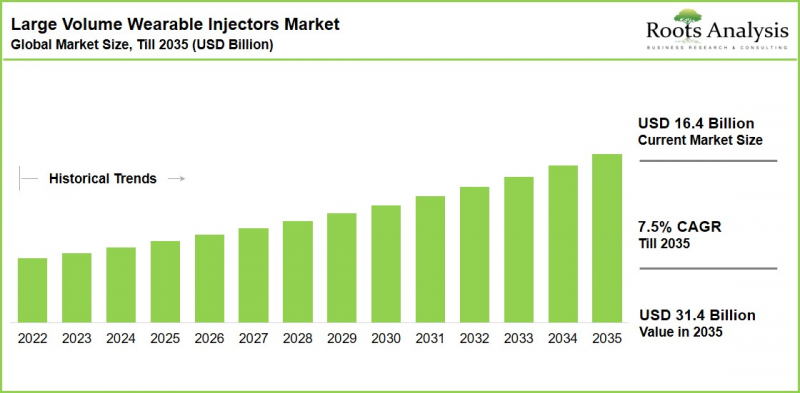
根據 Roots Analysis 的研究,全球大容量穿戴式注射器市場規模預計將從今年的 164 億美元成長到 2035 年的 314 億美元,在預測期內(到 2035 年)的複合年成長率為 7.5%。
高容量穿戴式注射器市場:成長與趨勢
全球慢性複雜疾病負擔日益加重,加上單株抗體和抗體藥物複合體(ADC)等高容量、高黏度生物製藥的研發管線不斷擴展,持續推動對穿戴式給藥方式的需求。包括穿戴式貼片幫浦和外置輸注幫浦在內的高容量穿戴式注射器,能夠在臨床環境之外進行這些藥物的基礎劑量、大劑量投藥或持續皮下給藥,從而減少對靜脈輸液的依賴。
隨著製藥公司向以患者為中心的居家照護模式轉型,穿戴式注射器作為現有生技藥品的生命週期管理工具以及後期研發管線候選藥物的差異化優勢,其重要性日益凸顯。 Enable Injections 和 West Pharmaceutical Services 等設備開發商不斷擴大與製藥公司的許可和共同開發契約,這反映出人們對高劑量、即用居家給藥系統的信心日益增強。
成長驅動力:支持市場擴張的策略因素
市場成長的促進因素包括癌症、自體免疫、心血管疾病和神經系統疾病的日益普遍,這些疾病需要定期、高劑量給藥,以及人們越來越傾向於自我給藥和居家照護。穿戴式注射器減少了病患前往醫院和輸液中心的次數,降低了治療給藥的整體成本,並提高了病患的藥物遵從性。這些優勢使其對製藥公司和保險公司更具吸引力。
穿戴式注射器市場:關鍵洞察
本報告詳細分析了穿戴式注射器市場的現狀,並指出了該行業的潛在成長機會。主要發現包括:
- 開發大容量穿戴式注射器的公司主要透過直接授權協議和共同開發契約與製藥公司合作。因此,即使是在專業醫療設備物流領域擁有現有網路的傳統經銷商,也很難掌握這一領域的趨勢。
- 由於許多穿戴式注射器與溫度敏感型生物製藥一起使用,因此專業的冷鏈和最後一公里物流合作夥伴正在成為穿戴式注射器供應鏈中的重要參與者。
- 希望進入該領域的經銷商和物流合作夥伴必須證明他們已建立符合 GMP 標準的經檢驗的處理程序,並且熟悉複合產品的監管要求。
- 隨著透過植入式設備輸送的用於治療癌症、自體免疫疾病和神經系統疾病的生物製藥產品線不斷擴大,對專業分銷基礎設施的需求預計將繼續成長。
- 從滴灌式設計向貼片幫浦設計的轉變,為小規模、更靈活的物流和銷售管道合作夥伴創造了與老牌巨頭一同進入市場的機會。
- 隨著醫療設備開發公司之間的整合不斷推進,例如 SHL Medical 收購 Weibel CDS,小規模本地企業的進入門檻越來越高,而專注於細分領域或特定療法的分銷合作夥伴則獲得了更多機會。
- 經銷商和通路夥伴之間的競爭日益激烈,不僅體現在物流成本方面,也體現在醫療設備培訓支援、病患介紹材料和庫存管理等附加價值服務。
- 人們越來越關注穿戴式注射器作為已通過核准生技藥品的生命週期管理工具,預計這將擴大需要分銷支援的製藥和醫療設備綜合體的潛在市場規模。
穿戴式注射器市場
市場規模和機會分析是根據以下參數進行細分的:
依設備類型
- 貼片幫浦
- 點滴幫浦
依用途類型
- 一次性的
- 可重複使用(使用一次性零件)
按治療區域
- 癌症
- 心血管疾病
- 神經系統疾病
- 自體免疫疾病
- 其他疾病
按地區
- 北美洲
- 美國
- 加拿大
- 墨西哥
- 歐洲
- 法國
- 德國
- 英國
- 義大利
- 西班牙
- 其他歐洲國家
- 亞太地區
- 中國
- 印度
- 日本
- 亞太其他地區
- 拉丁美洲
- 阿根廷
- 巴西
- 中東和北非
- 埃及
- 以色列
- 沙烏地阿拉伯
本報告檢視了全球大容量穿戴式注射器市場,提供了市場概況、背景、市場影響因素分析、市場規模趨勢和預測、各個細分市場的詳細分析、競爭格局以及主要公司的概況。
目錄
第1章:序言
第2章:調查方法
第3章 市場動態
第4章 宏觀經濟指標
第5章摘要整理
第6章:引言
第7章:非胰島素藥物的大容量穿戴式注射器:市場概覽
第8章:非胰島素類藥物的藥品與醫療設備組合產品:市場概覽
第9章:產品競爭力分析
第10章:開發高容量穿戴注射器的公司:公司簡介
- 章節概要
- 領先的大容量穿戴式式注射器(用於非胰島素藥物)開發商
- CCBio
- E3D Elcam Drug Delivery Devices
- Enable Injections
- Gerresheimer
- Sonceboz
- Weibel CDS (SHL Medical)
- West Pharmaceuticals
- 領先的高容量胰島素穿戴式注射器開發商
- CeQur
- Debiotech
- Eli Lilly
- Insulet
- Medtronic
- Medtrum Technologies
- PharmaSens
- Roche
- SOOIL Development
第11章:藥品與醫療設備組合產品:器材概況
第12章 夥伴關係與合作
第13章 主要收購目標
第14章 專利分析
第15章:大容量穿戴式注射器:極具潛力的候選藥物
第16章:臨床試驗分析
第17章資金籌措與投資分析
第18章 SWOT 分析
第19章案例研究:CMO在醫療設備開發供應鏈中的作用
第20章:醫療設備監管與報銷制度的現狀
第21章 市場影響分析:促進因素、阻礙因素、機會與挑戰
第22章:大容量穿戴式注射器市場
第23章:高容量穿戴式注射器市場:依設備類型分類
第24章:高容量穿戴式注射器市場:依使用模式分類
第25章:高容量穿戴式注射器市場:依治療領域分類
第26章 高容量穿戴式注射器市場:依地區分類
第27章 結論
第28章 高階主管洞察
第29章附錄一:表格形式數據
第30章 附錄二:公司與組織列表
LARGE VOLUME WEARABLE INJECTORS MARKET: OVERVIEW
As per Roots Analysis, the global large volume wearable injectors market is estimated to grow from USD 16.4 billion in the current year to USD 31.4 billion by 2035, at a CAGR of 7.5% during the forecast period, till 2035.
Large Volume Wearable Injectors Market: Growth and Trends
The rising global burden of chronic and complex diseases, coupled with the growing pipeline of high-volume, high-viscosity biologics such as monoclonal antibodies and antibody-drug conjugates, continues to drive demand for on-body delivery formats. Large volume wearable injectors, including on-body patch pumps and off-body infusion-style pumps, allow sustained basal, bolus, or continuous subcutaneous delivery of these drugs outside the clinical setting, reducing dependence on intravenous infusion.
As pharmaceutical companies shift toward patient-centric, home-based care models, wearable injectors are increasingly positioned as a life-cycle management tool for existing biologics as well as a differentiator for late-stage pipeline candidates. Device developers such as Enable Injections and West Pharmaceutical Services continue to expand licensing and co-development arrangements with pharmaceutical sponsors, reflecting rising confidence in large-volume, patient-ready delivery systems for home administration.
Growth Drivers: Strategic Enablers of Market Expansion
Market growth is being propelled by the rising prevalence of oncological, autoimmune, cardiovascular, and neurological disorders that require regular, high-volume biologic dosing, alongside the broader shift toward self-administration and home care. Wearable injectors reduce the need for hospital or infusion-center visits, lower the overall cost burden of therapy administration, and improve medication adherence. These benefits are reinforcing their appeal to both pharmaceutical sponsors and payers.
Market Challenges: Critical Barriers Impeding Progress
Despite favorable prospects, the market faces headwinds from the relatively high cost of advanced on-body devices and limited reimbursement coverage in several geographies, which restricts adoption among cost-sensitive patient populations. Prolonged regulatory review timelines for novel drug-device combination products, particularly with agencies such as the USFDA, add further cost and delay to product launches, creating near-term uncertainty for developers and their commercial partners.
Wearable Injectors Market: Key Insights
The report delves into the current state of the wearable injectors market and identifies potential growth opportunities within industry. Some key findings include:
- Large volume wearable injector developers predominantly engage pharmaceutical sponsors through direct licensing and co-development agreements. This limits the visibility that traditional distributors have into this segment, despite their established reach into specialty medical device logistics.
- Specialty cold-chain and last-mile logistics partners are emerging as critical enablers of the wearable injector supply chain, given that many of these devices are paired with temperature-sensitive biologics.
- Distributors and logistics partners seeking entry into this space must demonstrate validated GMP-aligned handling protocols and familiarity with combination-product regulatory requirements.
- The growing pipeline of oncology, autoimmune, and neurological biologics compatible with on-body delivery is expected to sustain elevated demand for specialized distribution infrastructure.
- The shift from infusion-style formats toward patch pump designs is opening opportunities for smaller, more agile logistics and channel partners to enter alongside established players.
- Consolidation among device developers, such as SHL Medical's acquisition of Weibel CDS, is raising barriers to entry for smaller regional players while creating openings for niche, modality-specific distribution partners.
- Distributors and channel partners increasingly compete on value-added services, including device training support, patient onboarding materials, and inventory management, rather than on logistics cost alone.
- Rising interest in wearable injectors as a life-cycle management tool for approved biologics is expected to broaden the addressable base of drug-device combinations requiring distribution support.
Wearable Injectors Market
The market sizing and opportunity analysis has been segmented across the following parameters:
By Type of Device
- Patch Pumps
- Infusion Pumps
By Usability
- Disposable
- Reusable (Disposable Components)
By Therapeutic Area
- Oncological Disorders
- Cardiovascular Disorders
- Neurological Disorders
- Autoimmune Disorders
- Other Disorders
By Geographical Regions
- North America
- US
- Canada
- Mexico
- Europe
- France
- Germany
- UK
- Italy
- Spain
- Rest of Europe
- Asia-Pacific
- China
- India
- Japan
- Rest of Asia-Pacific
- Latin America
- Argentina
- Brazil
- Middle East and North Africa
- Egypt
- Israel
- Saudi Arabia
Wearable Injectors Market: Key Segments
Market Share by Usability: Disposable Devices Hold the Largest Market Share
According to our proprietary market report, disposable devices account for the largest share of the global market, and this trend is expected to persist throughout the forecast period. This can be attributed to the growing preference for single-use drug delivery systems that offer enhanced convenience, improved patient safety, and simplified treatment administration, particularly in home healthcare settings.
Disposable wearable injectors eliminate the need for cleaning, sterilization, and routine maintenance, thereby reducing the burden on both patients and caregivers while minimizing the risk of device-related contamination and cross-infection. Further, the increasing adoption of self-administered therapies, coupled with the rising demand for home-based healthcare and patient-centric drug delivery solutions, is expected to support the continued dominance of the disposable devices segment during the forecast period.
Market Share by Therapeutic Area: Oncology Segment Accounts for the Largest Revenue Share
According to our market analysis, the oncology segment currently holds the largest share of the market. This dominance is primarily driven by the rising global burden of cancer, expanding commercialization of oncology biologics, and increasing preference for subcutaneous administration of large-volume therapies outside conventional clinical settings.
Large volume wearable injectors enable the controlled administration of monoclonal antibodies, immunotherapies, and supportive oncology treatments. This allows patients to receive therapy in home care settings while reducing the need for prolonged hospital visits. The growing emphasis on improving patient convenience, optimizing healthcare resources, and expanding access to home-based cancer care is further strengthening the adoption of wearable injectors within this therapeutic area.
Meanwhile, the neurological disorders segment is anticipated to register the highest CAGR during the forecast period. This lucrative growth is supported by recent regulatory approvals for wearable drug delivery technologies, increasing availability of biologic therapies for neurological conditions, and the growing adoption of home-based treatment approaches for diseases such as Parkinson's disease.
Market Share by Device Type: Patch Pumps are Expected to Witness the Fastest Growth
Based on device type, the market is segmented into patch pumps and infusion-style wearable injectors. Infusion-style wearable injectors continue to maintain a significant market presence owing to their established use in administering high-volume biologics.
On the other hand, patch pumps will grow at higher CAGR during the forecast period. The increasing adoption of patch pumps is driven by their compact, lightweight, and skin-adhered design, which enhances patient comfort, mobility, and discretion during therapy. These devices are particularly well suited for the subcutaneous administration of large-volume biologics in chronic disease management, enabling patients to receive treatment outside traditional healthcare facilities.
Continuous technological innovations, including Bluetooth connectivity, smartphone-enabled monitoring, automated dose tracking, and digital health integration, are improving treatment adherence and overall user experience. As pharmaceutical and medical device companies continue to develop next-generation wearable platforms capable of delivering high-viscosity biologics with greater precision, patch pumps are expected to gain a larger share of the market over the forecast period.
Market Share by Region: North America Holds the Largest Share, While Asia-Pacific is the Fastest-Growing Regional Market
North America accounts for the largest share of the non-insulin large volume wearable injectors market. The region's leadership is supported by its well-established healthcare infrastructure, favorable reimbursement landscape, widespread adoption of advanced drug delivery technologies, and the strong presence of leading pharmaceutical companies, and medical device manufacturers. Additionally, the increasing prevalence of chronic diseases, growing utilization of biologic therapies, and continued investments in innovative wearable drug delivery platforms are expected to sustain the region's dominant position.
In contrast, the Asia-Pacific market is projected to register the highest CAGR during the forecast period. This growth is driven by rapidly expanding healthcare infrastructure, increasing healthcare expenditure, rising disposable incomes, and improving access to advanced biologic therapies across emerging economies such as China and India. Furthermore, favorable government initiatives to strengthen healthcare systems, growing awareness of self-administered drug delivery technologies, and increasing investments by global pharmaceutical and medical device companies are expected to create significant opportunities for market expansion across the region.
Example Players in Wearable Injectors Market
- Becton Dickinson (BD)
- Enable Injections
- E3D Elcam Drug Delivery Devices
- Stevanato Group
- Ypsomed
Expert Interview and Industry Insights
The opinions and insights presented in this study were influenced by discussions conducted with multiple stakeholders. The research report features detailed transcripts of interviews held with the following industry stakeholders:
- Chief Executive Officer, Small Company, US
- Chief Executive Officer, Mid-Sized Company, US
- Chief Executive Officer, Small Company, Denmark
- Former President and Chief Executive Officer, Mid-Sized Company, US
- Vice President and Chief Scientist, Large Company, Israel
- Former Vice President and General Manager, Biologics, Very Large Company, US
- Anonymous, Large Company, Switzerland
- Engineering Project Manager / Senior System Engineer, Small Company, Switzerland
- Vice President, Marketing and Alliance Management, Mid-Sized Company, US
WEARABLE INJECTORS MARKET: RESEARCH COVERAGE
- Market Sizing and Opportunity Analysis: An in-depth analysis of the market by value and volume, focusing on key segments, including type of device, usability, therapeutic area, and geographical regions.
- Non-Insulin Market Landscape: A detailed assessment of large volume wearable injectors developed for non-insulin drugs, covering type of device, status of development, drug reservoir volume, therapeutic area, and drug container / filling attributes.
- Drug-Device Combination Landscape: An analysis of marketed and pipeline drug-device combinations built on wearable injector platforms, covering the same set of technical and commercial parameters.
- Product Competitiveness Analysis: A comparative evaluation of leading large volume wearable injectors and drug-device combinations against defined product attributes and market positioning criteria.
- Company Profiles: In-depth profiles of prominent device developers, covering year of establishment, headquarters location, company size, product portfolio, and recent developments.
- Device Profiles: Individual profiles of marketed drug-device combinations built on wearable injector platforms, including device design and intended therapeutic use.
- Partnerships and Collaborations: An analysis of partnerships inked by large volume wearable injector developers, based on year, type of partnership, type of partner, type of device, and geography.
- Key Acquisition Targets: A scoring-based assessment identifying potential acquisition targets among non-insulin drug delivery device developers.
- Patent Analysis: A review of the patent landscape, covering patent type, publication trends, jurisdiction, applicant type, and the most active players by patent filings.
- Likely Drug Candidates: An assessment of marketed and clinical-stage drugs most likely to be delivered via large volume wearable injectors, based on defined suitability criteria.
- Clinical Trial Analysis: A review of registered clinical trials evaluating large volume wearable injectors, covering trial phase, recruitment status, sponsor type, therapeutic area, and geography.
- Funding and Investment Analysis: A detailed analysis of funding instances in this domain, based on year, type of funding, amount invested, target indication, and the most active investors and players.
- SWOT Analysis and Growth Opportunities: A strategic assessment of the market's strengths, weaknesses, opportunities, and threats, along with an evaluation of future growth avenues, including life-cycle management and multi-indication use.
- Case Study: A focused assessment of the role played by contract manufacturing organizations in the wearable injector device development supply chain, including a list of active CMOs.
- Regulatory and Reimbursement Landscape: A region-wise review of the regulatory approval pathways and reimbursement frameworks applicable to combination medical devices across North America, Europe, Asia-Pacific, and the Rest of the World.
- Market Impact Analysis: An assessment of the key drivers, restraints, opportunities, and challenges shaping the evolution of the large volume wearable injectors market.
- Executive Insights: Anonymized snapshots and interview transcripts capturing perspectives from senior executives and technical leaders across device developer organizations.
KEY QUESTIONS ANSWERED IN THIS REPORT
- Which are the leading companies developing large volume wearable injectors?
- Which region dominates the market, and which is growing the fastest?
- What are the key trends observed in this market?
- What factors are likely to influence the evolution of this market?
- What are the primary challenges faced by device developers and their commercial partners?
- What is the current and future market size?
- What is the CAGR of this market through 2035?
- How is current and future market opportunity distributed across type of device, usability, therapeutic area, and geography?
- What opportunities exist for distributors and logistics partners entering this space?
REASONS TO BUY THIS REPORT
- Top-Down and Bottom-Up Triangulated Forecasting: Market estimates are built using a hybrid methodology that cross-validates top down macro assessments against bottom-up, device-level and company-level data, minimizing forecast bias.
- Distribution and Channel-Partner Lens: Unlike conventional device capability reports, this study explicitly maps the cold-chain, logistics, and value-added service opportunities available to distribution partners entering the wearable injector supply chain.
- 653 Pages Across 30 Chapters: Comprehensive coverage spanning market sizing, competitive benchmarking, patent landscape, clinical trial activity, funding and M&A analysis, and regulatory / reimbursement mapping across 20+ countries.
- Primary Research-Backed Insights: Findings are validated through direct interviews with CEOs, chief scientists, and commercial leaders across small, mid-sized, and large device developers, ensuring insights reflect real operating conditions rather than desk research alone.
- Actionable Segmentation: Four-parameter segmentation (type of device, usability, therapeutic area, geography) enables precise opportunity sizing for any go-to-market or investment thesis.
ADDITIONAL BENEFITS
- Complementary PPT Insight Packs
- Complementary Excel Data Packs for all Analytical Modules in the Report
- 15% Free Content Customization
- Detailed Report Walkthrough Session with Research Team
- Free Updated Report if the Report is 6-12 Months Old or Older
TABLE OF CONTENTS
1. PREFACE
- 1.1. Introduction
- 1.2. Report Coverage
- 1.3. Market Segmentation
- 1.4. Key Market Insights
- 1.5. Market Share Insights
- 1.6. Key Questions Answered
2. RESEARCH METHODOLOGY
- 2.1. Chapter Overview
- 2.2. Research Assumptions
- 2.2.1. Market Landscape and Market Trends
- 2.2.2. Market Forecast and Opportunity Analysis
- 2.2.3. Comparative Analysis
- 2.3. Database Building
- 2.3.1. Data Collection
- 2.3.2. Data Validation
- 2.3.3. Data Analysis
- 2.4. Project Methodology
- 2.4.1. Secondary Research
- 2.4.1.1. Annual Reports
- 2.4.1.2. Academic Research Papers
- 2.4.1.3. Company Websites
- 2.4.1.4. Investor Presentations
- 2.4.1.5. Regulatory Filings
- 2.4.1.6. White Papers
- 2.4.1.7. Industry Publications
- 2.4.1.8. Conferences and Seminars
- 2.4.1.9. Government Portals
- 2.4.1.10. Media and Press Releases
- 2.4.1.11. Newsletters
- 2.4.1.12. Industry Databases
- 2.4.1.13. Roots Proprietary Databases
- 2.4.1.14. Paid Databases and Sources
- 2.4.1.15. Social Media Portals
- 2.4.1.16. Other Secondary Sources
- 2.4.2. Primary Research
- 2.4.2.1. Types of Primary Research
- 2.4.2.1.1. Qualitative Research
- 2.4.2.1.2. Quantitative Research
- 2.4.2.1.3. Hybrid Approach
- 2.4.2.2. Advantages of Primary Research
- 2.4.2.3. Techniques for Primary Research
- 2.4.2.3.1. Interviews
- 2.4.2.3.2. Surveys
- 2.4.2.3.3. Focus Groups
- 2.4.2.3.4. Observational Research
- 2.4.2.3.5. Social Media Interactions
- 2.4.2.4. Key Opinion Leaders Considered in Primary Research
- 2.4.2.4.1. Company Executives (CXOs)
- 2.4.2.4.2. Board of Directors
- 2.4.2.4.3. Company Presidents and Vice Presidents
- 2.4.2.4.4. Research and Development Heads
- 2.4.2.4.5. Technical Experts
- 2.4.2.4.6. Subject Matter Experts
- 2.4.2.4.7. Scientists
- 2.4.2.4.8. Doctors and Other Healthcare Providers
- 2.4.2.5. Ethics and Integrity
- 2.4.2.5.1. Research Ethics
- 2.4.2.5.2. Data Integrity
- 2.4.2.1. Types of Primary Research
- 2.4.3. Analytical Tools and Databases
- 2.4.1. Secondary Research
- 2.5. Robust Quality Control
3. MARKET DYNAMICS
- 3.1. Chapter Overview
- 3.2. Forecast Methodology
- 3.2.1. Top-down Approach
- 3.2.2. Bottom-up Approach
- 3.2.3. Hybrid Approach
- 3.3. Market Assessment Framework
- 3.3.1. Total Addressable Market (TAM)
- 3.3.2. Serviceable Addressable Market (SAM)
- 3.3.3. Serviceable Obtainable Market (SOM)
- 3.3.4. Currently Acquired Market (CAM)
- 3.4. Forecasting Tools and Techniques
- 3.4.1. Qualitative Forecasting
- 3.4.2. Correlation
- 3.4.3. Regression
- 3.4.4. Extrapolation
- 3.4.5. Convergence
- 3.4.6. Sensitivity Analysis
- 3.4.7. Scenario Planning
- 3.4.8. Data Visualization
- 3.4.9. Time Series Analysis
- 3.4.10. Forecast Error Analysis
- 3.5. Key Considerations
- 3.5.1. Demographics
- 3.5.2. Government Regulations
- 3.5.3. Reimbursement Scenarios
- 3.5.4. Market Access
- 3.5.5. Supply Chain
- 3.5.6. Industry Consolidation
- 3.5.7. Pandemic / Unforeseen Disruptions Impact
- 3.6. Limitations
4. MACRO-ECONOMIC INDICATORS
- 4.1. Chapter Overview
- 4.2. Market Dynamics
- 4.2.1. Time Period
- 4.2.1.1. Historical Trends
- 4.2.1.2. Current and Forecasted Estimates
- 4.2.2. Currency Coverage
- 4.2.2.1. Major Currencies Affecting the Market
- 4.2.2.2. Factors Affecting Currency Fluctuations
- 4.2.2.3. Impact of Currency Fluctuations on the Industry
- 4.2.3. Foreign Currency Exchange Rate
- 4.2.3.1. Impact of Foreign Exchange Rate Volatility on the Market
- 4.2.3.2. Strategies for Mitigating Foreign Exchange Risk
- 4.2.4. Recession
- 4.2.4.1. Assessment of Current Economic Conditions and Potential Impact on the Market
- 4.2.4.2. Historical Analysis of Past Recessions and Lessons Learnt
- 4.2.5. Inflation
- 4.2.5.1. Measurement and Analysis of Inflationary Pressures in the Economy
- 4.2.5.2. Potential Impact of Inflation on the Market Evolution
- 4.2.6. Interest Rates
- 4.2.6.1. Interest Rates and Their Impact on the Market
- 4.2.6.2. Strategies for Managing Interest Rate Risk
- 4.2.7. Commodity Flow Analysis
- 4.2.7.1. Type of Commodity
- 4.2.7.2. Origins and Destinations
- 4.2.7.3. Values and Weights
- 4.2.7.4. Modes of Transportation
- 4.2.8. Global Trade Dynamics
- 4.2.8.1. Import Scenario
- 4.2.8.2. Export Scenario
- 4.2.8.3. Trade Policies
- 4.2.8.4. Strategies for Mitigating the Risks Associated with Trade Barriers
- 4.2.8.5. Impact of Trade Barriers on the Market
- 4.2.9. War Impact Analysis
- 4.2.9.1. Russian-Ukraine War
- 4.2.9.2. Israel-Hamas War
- 4.2.10. COVID Impact / Related Factors
- 4.2.10.1. Global Economic Impact
- 4.2.10.2. Industry-specific Impact
- 4.2.10.3. Government Response and Stimulus Measures
- 4.2.10.4. Future Outlook and Adaptation Strategies
- 4.2.11. Other Indicators
- 4.2.11.1. Fiscal Policy
- 4.2.11.2. Consumer Spending
- 4.2.11.3. Gross Domestic Product
- 4.2.11.4. Employment
- 4.2.11.5. Taxes
- 4.2.11.6. Stock Market Performance
- 4.2.11.7. Cross Border Dynamics
- 4.2.1. Time Period
- 4.3. Conclusion
5. EXECUTIVE SUMMARY
6. INTRODUCTION
- 6.1. Chapter Overview
- 6.2. Introduction to Drug Delivery Devices
- 6.3. Conventional Parenteral Drug Delivery Devices
- 6.3.1. Needlestick Injuries
- 6.3.2. Incidence and Cost Burden
- 6.3.3. Prevention of Needlestick Injuries
- 6.3.4. Government Legislations for the Prevention of Needlestick Injuries
- 6.4. Emergence of Self-Administration Devices
- 6.4.1. Key Driving Factors
- 6.4.1.1. Rising Burden of Chronic Diseases
- 6.4.1.2. Healthcare Cost Savings
- 6.4.1.3. Need for Immediate Treatment in Emergency Situations
- 6.4.1.4. Growing Injectable Drugs Market
- 6.4.1.5. Need for Improving Medication Adherence
- 6.4.1. Key Driving Factors
- 6.5. Available Self-Injection Devices
- 6.5.1. Prefilled Syringes
- 6.5.2. Pen-Injectors
- 6.5.3. Needle-Free Injectors
- 6.5.4. Autoinjectors
- 6.5.5. Large Volume Wearable Injectors
- 6.6. Regulatory Considerations
- 6.6.1. Medical Devices
- 6.6.2. Drug Device Combination Products
- 6.7. Future Perspectives
7. LARGE VOLUME WEARABLE INJECTORS FOR NON-INSULIN DRUGS: MARKET LANDSCAPE
- 7.1. Chapter Overview
- 7.2. Large Volume Wearable Injectors for Non-Insulin Drugs: Overall Market Landscape
- 7.2.1. Analysis by Type of Device
- 7.2.2. Analysis by Status of Development
- 7.2.3. Analysis by Type of Drug Delivery
- 7.2.4. Analysis by Usability
- 7.2.5. Analysis by Drug Reservoir Volume
- 7.2.6. Analysis by Type of Drug Molecule
- 7.2.7. Analysis by Type of Dose
- 7.2.8. Analysis by Dose of Drug
- 7.2.9. Analysis by Mode of Injection
- 7.2.10. Analysis by Therapeutic Area
- 7.2.11. Analysis by Type of Drug Container
- 7.2.12. Analysis by Mode of Drug Filling
- 7.3. Large Volume Wearable Injectors for Non-Insulin Drugs: Developer Landscape
- 7.3.1. Analysis by Year of Establishment
- 7.3.2. Analysis by Company Size
- 7.3.3. Analysis by Location of Headquarters
- 7.3.4. Leading Players: Analysis by Number of Large Volume Wearable Injectors Developed for Non-Insulin
8. DRUG DEVICE COMBINATIONS FOR NON-INSULIN DRUGS: MARKET LANDSCAPE
- 8.1. Chapter Overview
- 8.2. Drug Device Combinations for Non-Insulin Drugs: Overall Market Landscape
- 8.2.1. Analysis by Type of Device
- 8.2.2. Analysis by Status of Development
- 8.2.3. Analysis by Type of Drug Delivery
- 8.2.4. Analysis by Usability
- 8.2.5. Analysis by Drug Reservoir Volume
- 8.2.6. Analysis by Type of Drug Molecule
- 8.2.7. Analysis by Type of Dose
- 8.2.8. Analysis by Dose of Drug
- 8.2.9. Analysis by Mode of Injection
- 8.2.10. Analysis by Therapeutic Area
- 8.2.11. Analysis by Type of Drug Container
- 8.2.12. Analysis by Mode of Drug Filling
- 8.3. Drug Device Combinations for Non-Insulin Drugs: Developer Landscape
- 8.3.1. Analysis by Year of Establishment
- 8.3.2. Analysis by Company Size
- 8.3.3. Analysis by Location of Headquarters
- 8.3.4. Device Developers: Distribution by Number of Drug Device Combination Developed
9. PRODUCT COMPETITIVENESS ANALYSIS
- 9.1. Chapter Overview
- 9.2. Assumptions / Key Parameters
- 9.3. Methodology
- 9.4. Product Competitiveness Analysis
- 9.4.1. Product Competitiveness Analysis: Large Volume Wearable Injectors for Non-Insulin Drugs
- 9.4.2. Product Competitiveness Analysis: Drug Device Combinations for Non-Insulin Drugs
- 9.4.3. Product Competitiveness Analysis: Large Volume Wearable Injectors for Insulin
10. LARGE VOLUME WEARABLE INJECTOR DEVELOPERS: COMPANY PROFILES
- 10.1. Chapter Overview
- 10.2. Key Players Developing Large Volume Wearable Injectors for Non-Insulin
- 10.2.1. CCBio
- 10.2.1.1. Company Overview
- 10.2.1.2. Product Portfolio
- 10.2.1.3. Recent Developments and Future Outlook
- 10.2.2. E3D Elcam Drug Delivery Devices
- 10.2.3. Enable Injections
- 10.2.4. Gerresheimer
- 10.2.5. Sonceboz
- 10.2.6. Weibel CDS (Acquired by SHL Medical)
- 10.2.7. West Pharmaceuticals
- 10.2.1. CCBio
- 10.3. Key Players Developing Large Volume Wearable Injectors for Insulin
- 10.3.1. CeQur
- 10.3.2. Debiotech
- 10.3.3. Eli Lilly
- 10.3.4. Insulet
- 10.3.5. Medtronic
- 10.3.6. Medtrum Technologies
- 10.3.7. PharmaSens
- 10.3.8. Roche
- 10.3.9. SOOIL Development
11. DRUG-DEVICE COMBINATIONS: DEVICE PROFILES
- 11.1. Chapter Overview
- 11.2. Neulasta(R) (pegfilgrastim) OnPro(TM) Kit
- 11.3. D-mine(R) Pump
- 11.4. Lasix(R) ONYU
- 11.5. The LUTREPULSE(R) System
- 11.6. ND0612L Next generation patch pump
- 11.7. Unnamed (Developed by Phillips Medisize)
- 11.8. FUROSCIX(R)
- 11.9. SMT-201 Pump
- 11.10. SMT-301 Pump
- 11.11. ULTOMRIS(R) Smartdose Injector (ravulizumab-cwvz)
- 11.12. EMPAVELI(R) Injector
- 11.13. SKYRIZI(R) On Body Injector (risankizumab)
- 11.14. VYALEV(TM) Pump (foscarbidopa and foslevodopa)
- 11.15. UDENYCA(R) on-body injector
- 11.16. ONAPGO(TM)
- 11.17. Remunity(R) Pump
- 11.18. G-Lasta(R) BodyPod
- 11.19. Sarclisa (isatuximab) On-Body Injector
12. PARTNERSHIPS AND COLLABORATIONS
- 12.1. Chapter Overview
- 12.2. Partnership Models
- 12.3. Large Volume Wearable Injectors: Partnerships and Collaborations
- 12.3.1. Analysis by Year of Partnership
- 12.3.2. Analysis by Type of Partnership
- 12.3.3. Analysis by Year and Type of Partnership
- 12.3.4. Analysis by Type of Partner
- 12.3.5. Analysis by Type of Device
- 12.3.6. Most Active Players: Analysis by Number of Partnerships
- 12.3.7. Analysis by Geography
- 12.3.7.1. Local and International Agreements
- 12.3.7.2. Intercontinental and Intracontinental Agreements
13. KEY ACQUISITION TARGETS
- 13.1. Chapter Overview
- 13.2. Scope and Methodology
- 13.3. Scoring Criteria and Key Assumptions
- 13.4. Potential Acquisition Targets: Non-Insulin Drug Delivery Device Developers
- 13.5. Concluding Remarks
14. PATENT ANALYSIS
- 14.1. Chapter Overview
- 14.2. Scope and Methodology
- 14.3. Large Volume Wearable Injectors: Patent Analysis
- 14.3.1. Analysis by Type of Patent
- 14.3.2. Analysis by Patent Publication Year
- 14.3.3. Analysis by Patent Application Year
- 14.3.4. Analysis of Granted Patents and Patent Applications by Publication Year
- 14.3.5. Analysis by Jurisdiction
- 14.3.6. Analysis by Type of Applicant
- 14.3.7. Analysis by Patent Age
- 14.3.8. Analysis by CPC Symbol
- 14.3.9. Most Active Players: Analysis by Number of Patents
- 14.4. Large Volume Wearable Injectors: Patent Benchmarking Analysis
- 14.4.1. Analysis by Patent Characteristics
- 14.5. Patent Valuation
- 14.6. Leading Patents by Number of Citations
15. LARGE VOLUME WEARABLE INJECTORS: LIKELY DRUG CANDIDATES
- 15.1. Chapter Overview
- 15.2. Marketed Drugs
- 15.2.1. Most Likely Candidates for Delivery via Large Volume Wearable Injectors
- 15.2.2. Likely Candidates for Delivery via Large Volume Wearable Injectors
- 15.2.3. Less Likely Candidates for Delivery via Large Volume Wearable Injectors
- 15.2.4. Least Likely Candidates for Delivery via Large Volume Wearable Injectors
- 15.3. Clinical Stage Drugs
- 15.3.1. Most Likely Candidates for Delivery via Large Volume Wearable Injectors
- 15.3.2. Likely Candidates for Delivery via Large Volume Wearable Injectors
- 15.3.3. Less Likely Candidates for Delivery via Large Volume Wearable Injectors
- 15.3.4. Least Likely Candidates for Delivery via Large Volume Wearable Injectors
16. CLINICAL TRIAL ANALYSIS
- 16.1. Chapter Overview
- 16.2. Scope and Methodology
- 16.3. Large Volume Wearable Injectors: Clinical Trial Analysis
- 16.3.1. Analysis by Trial Recruitment Status
- 16.3.2. Analysis by Trial Registration Year
- 16.3.3. Analysis of Enrolled Patient Population by Trial Registration Year
- 16.3.4. Analysis by Trial Phase
- 16.3.5. Analysis of Enrolled Patient Population by Trial Phase
- 16.3.6. Analysis by Trial Registration Year and Trial Recruitment Status
- 16.3.7. Analysis by Study Design
- 16.3.8. Analysis by Type of Sponsor / Collaborator
- 16.3.9. Analysis by Therapeutic Area
- 16.3.10. Most Active Players: Analysis by Number of Registered Trials
- 16.3.11. Most Popular Large Volume Wearable Injectors: Analysis by Number of Registered Trials
- 16.3.12. Analysis by Geography
- 16.3.12.1. Analysis by Trial Recruitment Status and Geography
- 16.3.12.2. Analysis of Enrolled Patient Population by Trial Recruitment Status and Geography
17. FUNDING AND INVESTMENT ANALYSIS
- 17.1. Chapter Overview
- 17.2. Types of Funding
- 17.3. Large Volume Wearable Injectors: Funding and Investment Analysis
- 17.3.1. Analysis by Year of Funding
- 17.3.2. Analysis of Amount Invested by Year
- 17.3.3. Analysis by Type of Funding
- 17.3.4. Analysis by Type of Device
- 17.3.5. Analysis of Amount Invested by Year and Type of Funding
- 17.3.6. Analysis of Amount Invested by Type of Device
- 17.3.7. Analysis by Target Disease Indication
- 17.3.8. Most Active Players: Analysis by Number of Funding Instances
- 17.3.9. Most Active Players: Analysis by Amount Invested
- 17.3.10. Leading Investors: Analysis by Number of Funding Instances
- 17.3.11. Analysis by Geography
18. SWOT ANALYSIS
- 18.1. Chapter Overview
- 18.2. SWOT Analysis
- 18.2.1. Strengths
- 18.2.2. Weaknesses
- 18.2.3. Opportunities
- 18.2.4. Threats
- 18.3. Large Volume Wearable Injectors: Future Growth Opportunities
- 18.3.1. Rising Focus on Self-Administration of Drugs
- 18.3.2. Possibility of Integration with Mobile Applications
- 18.3.3. Potential Life Cycle Management Tool
- 18.3.4. Potential Usability for Multiple Therapeutic Areas
19. CASE STUDY: ROLE OF CONTRACT MANUFACTURING ORGANIZATIONS IN DEVICE DEVELOPMENT SUPPLY CHAIN
- 19.1. Chapter Overview
- 19.2. Device Development Supply Chain
- 19.3. Role of Contract Manufacturing Organizations (CMOs) in Device Development
- 19.4. List of CMOs
- 19.4.1. Geographical Distribution of CMOs
- 19.5. Medical Devices Design and Development Service Providers
20. REGULATORY AND REIMBURSEMENT LANDSCAPE FOR MEDICAL DEVICES
- 20.1. Chapter Overview
- 20.2. General Regulatory and Reimbursement Guidelines for Medical Devices
- 20.3. Regulatory and Reimbursement Landscape in North America
- 20.3.1. The US Scenario
- 20.3.1.1. Regulatory Authority
- 20.3.1.2. Review / Approval Process
- 20.3.1.3. Reimbursement Landscape
- 20.3.1.3.1 . Payer Mix
- 20.3.1.3.2 . Reimbursement Process
- 20.3.2. The Canadian Scenario
- 20.3.2.1. Regulatory Authority
- 20.3.2.2. Review / Approval Process
- 20.3.2.3. Reimbursement Landscape
- 20.3.2.3.1 . Payer Mix
- 20.3.2.3.2 . Reimbursement Process
- 20.3.3. The Mexican Scenario
- 20.3.3.1. Regulatory Authority
- 20.3.3.2. Review / Approval Process
- 20.3.3.3. Reimbursement Landscape
- 20.3.3.3.1 . Payer Mix
- 20.3.1. The US Scenario
- 20.4. Regulatory and Reimbursement Landscape in Europe
- 20.4.1. Overall Scenario
- 20.4.1.1. Overall Regulatory Authority
- 20.4.1.2. Overall Review / Approval Process
- 20.4.2. The UK Scenario
- 20.4.2.1. Regulatory Authority
- 20.4.2.2. Review / Approval Process
- 20.4.2.3. Reimbursement Landscape
- 20.4.2.3.1 . Payer Mix
- 20.4.2.3.2 . Reimbursement Process
- 20.4.3. The French Scenario
- 20.4.3.1. Regulatory Authority
- 20.4.3.2. Review / Approval Process
- 20.4.3.3. Reimbursement Landscape
- 20.4.3.3.1 . Payer Mix
- 20.4.3.3.2 . Reimbursement Process
- 20.4.4. The German Scenario
- 20.4.4.1. Regulatory Authority
- 20.4.4.2. Review / Approval Process
- 20.4.4.3. Reimbursement Landscape
- 20.4.4.3.1 . Payer Mix
- 20.4.4.3.2 . Reimbursement Process
- 20.4.5. The Italian Scenario
- 20.4.5.1. Regulatory Authority
- 20.4.5.2. Review / Approval Process
- 20.4.5.3. Reimbursement Landscape
- 20.4.5.3.1 . Payer Mix
- 20.4.5.3.2 . Reimbursement Process
- 20.4.6. The Spanish Scenario
- 20.4.6.1. Regulatory Authority
- 20.4.6.2. Review / Approval Process
- 20.4.6.3. Reimbursement Landscape
- 20.4.6.3.1 . Payer Mix
- 20.4.6.3.2 . Reimbursement Process
- 20.4.1. Overall Scenario
- 20.5. Regulatory and Reimbursement Landscape in Asia-Pacific and Rest of the World
- 20.5.1. The Australian Scenario
- 20.5.1.1. Regulatory Authority
- 20.5.1.2. Review / Approval Process
- 20.5.1.3. Reimbursement Landscape
- 20.5.1.3.1 . Payer Mix
- 20.5.1.3.2 . Reimbursement Process
- 20.5.2. The Brazilian Scenario
- 20.5.2.1. Regulatory Authority
- 20.5.2.2. Review / Approval Process
- 20.5.2.3. Reimbursement Landscape
- 20.5.2.3.1. Payer Mix
- 20.5.2.3.2. Reimbursement Process
- 20.5.3. The Chinese Scenario
- 20.5.3.1. Regulatory Authority
- 20.5.3.2. Review / Approval Process
- 20.5.3.3. Reimbursement Landscape
- 20.5.3.3.1. Payer Mix
- 20.5.3.3.2. Reimbursement Process
- 20.5.1. The Australian Scenario
21. MARKET IMPACT ANALYSIS: DRIVERS, RESTRAINTS, OPPORTUNITIES AND CHALLENGES
- 21.1. Chapter Overview
- 21.2. Market Drivers
- 21.3. Market Restraints
- 21.4. Market Opportunities
- 21.5. Market Challenges
- 21.6. Conclusion
22. LARGE VOLUME WEARABLE INJECTORS MARKET
- 22.1. Chapter Overview
- 22.2. Key Assumptions and Methodology
- 22.3. Global Large Volume Wearable Injectors Market, Historical Trends (Since 2022) and Forecasted Estimates (Till 2035) (By Value)
- 22.3.1. Scenario Analysis
- 22.3.1.1. Conservative Scenario
- 22.3.1.2. Optimistic Scenario
- 22.3.1. Scenario Analysis
- 22.4. Global Large Volume Wearable Injectors Market, Historical Trends (Since 2022) and Forecasted Estimates (Till 2035) (By Volume)
- 22.4.1. Scenario Analysis
- 22.4.1.1. Conservative Scenario
- 22.4.1.2. Optimistic Scenario
- 22.4.1. Scenario Analysis
- 22.5. Key Market Segmentations
23. LARGE VOLUME WEARABLE INJECTORS MARKET, BY TYPE OF DEVICE
- 23.1. Chapter Overview
- 23.2. Key Assumptions and Methodology
- 23.3. Large Volume Wearable Injectors Market: Distribution by Type of Device (By Value)
- 23.3.1. Wearable Patch Pump Market, Historical Trends (Since 2022) and Forecasted Estimates (Till 2035) (By Value)
- 23.3.2. Wearable Infusion Pump Market, Historical Trends (Since 2022) and Forecasted Estimates (Till 2035) (By Value)
- 23.4. Large Volume Wearable Injectors Market: Distribution by Type of Device (By Volume)
- 23.4.1. Wearable Patch Pump Market, Historical Trends (Since 2022) and Forecasted Estimates (Till 2035) (By Volume)
- 23.4.2. Wearable Infusion Pump Market, Historical Trends (Since 2022) and Forecasted Estimates (Till 2035) (By Volume)
- 23.5. Data Triangulation and Validation
24. LARGE VOLUME WEARABLE INJECTORS MARKET, BY USABILITY
- 24.1. Chapter Overview
- 24.2. Key Assumptions and Methodology
- 24.3. Large Volume Wearable Injectors Market: Distribution by Usability (By Value)
- 24.3.1. Disposable Large Volume Wearable Injectors Market, Historical Trends (Since 2022) and Forecasted Estimates (Till 2035) (By Value)
- 24.3.2. Reusable (Disposable Components) Large Volume Wearable Injectors Market, Historical Trends (Since 2022) and Forecasted Estimates (Till 2035) (By Value)
- 24.4. Large Volume Wearable Injectors Market: Distribution by Usability (By Volume)
- 24.4.1. Disposable Large Volume Wearable Injectors Market, Historical Trends (Since 2022) and Forecasted Estimates (Till 2035) (By Volume)
- 24.4.2. Reusable (Disposable Components) Large Volume Wearable Injectors Market, Historical Trends (Since 2022) and Forecasted Estimates (Till 2035) (By Volume)
- 24.5. Data Triangulation and Validation
25. LARGE VOLUME WEARABLE INJECTORS MARKET, BY THERAPEUTIC AREA
- 25.1. Chapter Overview
- 25.2. Key Assumptions and Methodology
- 25.3. Large Volume Wearable Injectors Market: Distribution by Therapeutic Area (By Value)
- 25.3.1. Large Volume Wearable Injectors Market Targeting Oncological Disorders, Historical Trends (Since 2022) and Forecasted Estimates (Till 2035) (By Value)
- 25.3.2. Large Volume Wearable Injectors Market Targeting Cardiovascular Disorders, Historical Trends (Since 2022) and Forecasted Estimates (Till 2035) (By Value)
- 25.3.3. Large Volume Wearable Injectors Market Targeting Autoimmune Disorders, Historical Trends (Since 2022) and Forecasted Estimates (Till 2035) (By Value)
- 25.3.4. Large Volume Wearable Injectors Market Targeting Neurological Disorders, Historical Trends (Since 2022) and Forecasted Estimates (Till 2035) (By Value)
- 25.3.5. Large Volume Wearable Injectors Market Targeting Other Disorders, Historical Trends (Since 2022) and Forecasted Estimates (Till 2035) (By Value)
- 25.4. Large Volume Wearable Injectors Market: Distribution by Therapeutic Area (By Volume)
- 25.4.1. Large Volume Wearable Injectors Market Targeting Oncological Disorders, Historical Trends (Since 2022) and Forecasted Estimates (Till 2035) (By Volume)
- 25.4.2. Large Volume Wearable Injectors Market Targeting Cardiovascular Disorders, Historical Trends (Since 2022) and Forecasted Estimates (Till 2035) (By Volume)
- 25.4.3. Large Volume Wearable Injectors Market Targeting Autoimmune Disorders, Historical Trends (Since 2022) and Forecasted Estimates (Till 2035) (By Volume)
- 25.4.4. Large Volume Wearable Injectors Market Targeting Neurological Disorders, Historical Trends (Since 2022) and Forecasted Estimates (Till 2035) (By Volume)
- 25.4.5. Large Volume Wearable Injectors Market Targeting Other Disorders, Historical Trends (Since 2022) and Forecasted Estimates (Till 2035) (By Volume)
- 25.5. Data Triangulation and Validation
26. LARGE VOLUME WEARABLE INJECTORS MARKET, BY GEOGRAPHICAL REGIONS
- 26.1. Chapter Overview
- 26.2. Key Assumptions and Methodology
- 26.3. Large Volume Wearable Injectors Market: Distribution by Geographical Regions (By Value)
- 26.3.1. Large Volume Wearable Injectors Market in North America, Historical Trends (Since 2022) and Forecasted Estimates (Till 2035) (By Value)
- 26.3.2. Large Volume Wearable Injectors Market in Europe, Historical Trends (Since 2022) and Forecasted Estimates (Till 2035) (By Value)
- 26.3.3. Large Volume Wearable Injectors Market in Asia, Historical Trends (Since 2022) and Forecasted Estimates (Till 2035) (By Value)
- 26.3.4. Large Volume Wearable Injectors Market in Latin America, Historical Trends (Since 2022) and Forecasted Estimates (Till 2035) (By Value)
- 26.3.5. Large Volume Wearable Injectors Market in Middle East and North Africa, Historical Trends (Since 2022) and Forecasted Estimates (Till 2035) (By Value)
- 26.4. Large Volume Wearable Injectors Market : Distribution by Geographical Regions (By Volume)
- 26.4.1. Large Volume Wearable Injectors Market in North America, Historical Trends (Since 2022) and Forecasted Estimates (Till 2035) (By Volume)
- 26.4.2. Large Volume Wearable Injectors Market in Europe, Historical Trends (Since 2022) and Forecasted Estimates (Till 2035) (By Volume)
- 26.4.3. Large Volume Wearable Injectors Market in Asia, Historical Trends (Since 2022) and Forecasted Estimates (Till 2035) (By Volume)
- 26.4.4. Large Volume Wearable Injectors Market in Latin America, Historical Trends (Since 2022) and Forecasted Estimates (Till 2035) (By Volume)
- 26.4.5. Large Volume Wearable Injectors Market in Middle East and North Africa, Historical Trends (Since 2022) and Forecasted Estimates (Till 2035) (By Volume)
- 26.5. Market Dynamics Assessment
- 26.5.1. Penetration Growth (P-G) Matrix
- 26.5.2. Market Movement Analysis
- 26.6. Data Triangulation and Validation
27. CONCLUDING INSIGHTS
28. EXECUTIVE INSIGHTS
29. APPENDIX I: TABULATED DATA
30. APPENDIX II: LIST OF COMPANIES AND ORGANIZATIONS

 2026-2035 年體外注射器市場機會、成長促進因素、產業趨勢分析及預測。
 穿戴式注射器市場:按裝置類型、自動化程度、用途、治療領域和地區分類的趨勢和預測(至 2035 年)
 穿戴式注射器市場:按類型、給藥機制、技術整合、使用模式、患者群體、應用、最終用戶和分銷管道分類——2026-2032年全球市場預測
 全球穿戴式注射器市場規模、佔有率、趨勢和成長分析報告(2026-2034年)穿戴式注射器全球市場規模、佔有率、趨勢和成長分析報告(2026-2034)
 穿戴式注射器市場規模、佔有率和成長分析:按設備類型、技術、自動化程度、易用性、治療領域/應用、最終用戶和地區分類-2026-2033年產業預測
 穿戴式注射器市場:按產品類型、應用、最終用戶和地區分類
 穿戴式注射器市場預測至2034年—按類型、應用、技術、最終用戶和地區分類的全球分析
 穿戴式注射器市場規模、佔有率、趨勢和預測:按類型、技術、應用、最終用途和地區分類,2026-2034年
 高容量自動注射器市場規模、佔有率和成長分析:按產品類型、應用、最終用戶、分銷管道和地區分類-2026-2033年產業預測