


 |
市場調查報告書
商品編碼
2112605
手術機器人市場:按開發人員產品和服務、部署模式、適用手術流程、應用、最終用戶和主要地區分類的趨勢和預測(至 2035 年)Surgical Robots Market by Offering of Surgical Robot Developers, Deployment Model, Type of Surgical Procedure Supported, Application Area, End Users and Key Geographical Regions - Trends and Forecast Till 2035 |
||||||

手術機器人市場概覽
根據 Roots Analysis 的研究,全球手術機器人市場預計將從今年的 106 億美元成長到 2035 年的 229 億美元,預測期內的複合年成長率約為 8.9%。
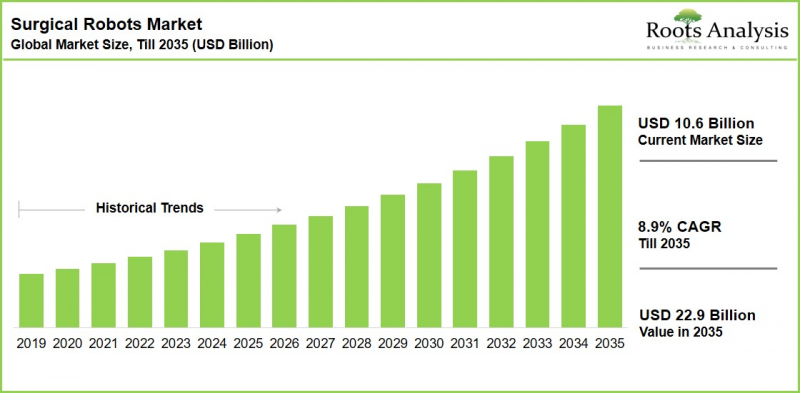
手術機器人市場:成長與趨勢
受微創手術日益普及和對更高手術精度需求不斷成長的推動,手術機器人市場正經歷強勁成長。由於其諸多優勢,例如提高手術操作性、改善臨床療效、減輕患者負擔以及加快術後康復,機器人輔助系統在普通外科、整形外科、泌尿系統以及腹部和骨盆手術中的應用日益廣泛。這些優勢使手術機器人成為現代外科醫學中不可或缺的關鍵要素。
人工智慧和先進成像技術與機器人平台的融合,透過實現即時手術導航、改進運動控制和增強術中決策支持,正在改變競爭格局。此外,遠端操作和雲端/遠端系統的出現,使得以往難以獲得專科外科醫生服務的地區也能進行機器人手術。
此外,開發人員正致力於將系統小型化,以減少手術室佔用面積和資本投入,從而擴大可採用這些系統的醫院和門診手術中心的範圍。隨著手術機器人系統在各個專科和地區的應用不斷擴展,除了設備銷售之外,耗材、配件和服務合約的持續收入在維持市場長期成長方面發揮著越來越重要的作用。
成長驅動力:支持市場擴張的因素
手術機器人市場的發展動力源自於機器人輔助手術相較於傳統開放性手術手術和腹腔鏡手術的諸多臨床優勢,包括更高的精準度、更少的出血、更低的術後感染風險以及更快的患者康復。人工智慧、機器學習和醫學影像技術的日益融合,正在不斷改進術前規劃和術中決策,進一步增強了外科醫生對這些系統的信心。
這種將服務和培訓結合的交付模式,透過降低醫院的初始資金負擔,降低了採用該模式的門檻。同時,將這些項目與設備銷售捆綁在一起,可以建立持久的合作關係,從而支持市場的長期成長。
市場規模和機會分析根據以下參數進行分類:
手術機器人開發公司提供的產品與服務
- 設備/配件
- 手術機器人系統
- 服務
按安裝模式
- 現場
- 雲端/遠端
透過外科手術
- 一般外科
- 整形外科
- 腹部及骨盆腔手術
- 泌尿系統手術
- 其他
用途別
- 治療
- 診斷
最終用戶
- 醫院
- 門診手術中心
- 診斷檢查室
按地區
- 北美洲
- 歐洲
- 亞太地區
- 中東和北非
- 拉丁美洲
手術機器人市場:關鍵細分市場分析
就產品和服務而言,設備和配件是主要促進因素。
根據Roots Analysis的市場評估,就產品和服務而言,器械及配件預計將佔最大的市場佔有率。此細分市場佔主導地位的主要原因是市場對拋棄式及可重複使用的機器人手術器械、末端執行器、縫合器、能量設備、攝影機、視覺化組件及其他類似產品的持續需求。這些產品在使用一定次數的手術後需要定期更換。
與需要一次性資本投資的機器人平台不同,手術器械和配件能夠持續產生收入,其收入與手術數量直接掛鉤,從而顯著提升製造商的長期獲利能力。此外,在一般外科、泌尿系統、婦科和整形外科等專科領域,機器人輔助手術數量的不斷成長也持續推動對這些高價值耗材的需求。
同時,服務業預計在預測期內將錄得最高的複合年成長率。這一成長主要得益於全球範圍內機器人手術系統部署數量的不斷增加,從而持續推高了對維護合約、軟體升級、技術支援和預防性保養的需求。
此外,醫院和醫療機構正增加對外科醫生認證計畫、模擬訓練和手術室人員教育的投入,以提高手術效率和病患療效。新興市場機器人手術的日益普及預計也將加速安裝、試運行和售後服務的需求,從而進一步增強該領域的成長前景。
北美市場佔主導地位,而亞太地區成長速度最快。
預計北美將佔全球手術機器人市場最大的佔有率。該地區受益於領先的機器人手術開發商、完善的醫療基礎設施、優惠的報銷機制以及微創手術的廣泛應用。高額的醫療費用支出、對先進醫療技術的早期應用以及老字型大小企業和新興製造商對機器人創新的持續投資,進一步鞏固了該地區的市場地位。此外,訓練有素的機器人外科醫生和完善的臨床培訓計畫也支持了多個外科專科手術數量的持續成長。
同時,亞太市場預計將在預測期內實現最高的複合年成長率。醫療基礎設施的快速擴張、醫療支出的成長、人們對機器人輔助手術認知度的提高以及政府支持國內醫療設備製造的利多政策,都在推動該地區的成長。中國、日本、韓國和印度等國家正在加大對機器人手術研發、製造和商業化的投入,同時,提供價格具競爭力的機器人平台的區域製造商也不斷湧現。此外,醫院網路的擴張、手術量的增加以及先進醫療技術的普及,預計將加速全部區域手術機器人系統的普及應用。
本報告對全球手術機器人市場進行了分析,提供了概述、背景、市場影響因素分析、市場規模趨勢和預測、各個細分市場的詳細分析、競爭格局以及主要公司的概況。
目錄
第1章:序言
第2章:調查方法
第3章 市場動態
第4章 宏觀經濟指標
第5章摘要整理
第6章:引言
第7章 市場狀況
第8章:企業競爭力分析
第9章:公司簡介
- 章節概要
- Abbott
- Intuitive Surgical
- Johnson &Johnson
- Medtronic
- Renishaw
- Siemens Healthineers
- SmithNephew
- Stryker
- Zimmer Biomet
- 其他主要公司
- Caranx Medical
- Freehand
- Great Robotics
- Microsure
- NDR Medical Technology
- Riverfield
- ROEN Surgical
- Sina Robotics and Medical Innovators
- Shanghai MicroPort MedBot
- Tuodao Medical
第10章 夥伴關係與合作
第11章資金籌措和投資
第12章 市場影響分析
第13章:全球手術機器人市場
第14章 手術機器人市場:依產品與服務分類
第15章 手術機器人市場:依部署模式分類
第16章 手術機器人市場:依手術類型分類
第17章 手術機器人市場:依控制機制分類
第18章 手術機器人市場:依應用領域分類
第19章 手術機器人市場:依最終用戶分類
第20章 手術機器人市場:依地區分類
第21章 高階主管洞察
第22章 結論
第23章附錄一:表格形式數據
SURGICAL ROBOTS MARKET: OVERVIEW
As per Roots Analysis, the global surgical robots market is estimated to grow from USD 10.6 billion in the current year to USD 22.9 billion by 2035, reflecting a compound annual growth rate (CAGR) of approximately 8.9% during the forecast period.
Surgical Robots Market: Growth and Trends
The surgical robotics market is witnessing robust growth, driven by the increasing adoption of minimally invasive procedures and the rising demand for greater surgical precision. Robotic-assisted systems are being increasingly integrated across general, orthopedic, urologic, abdominal and pelvic surgeries, owing to their ability to enhance dexterity, improve clinical outcomes, minimize patient trauma, and accelerate post-operative recovery. These advantages position surgical robots as a key component of modern surgical care.
The integration of artificial intelligence and advanced imaging into robotic platforms is reshaping the competitive landscape as it enables real-time surgical guidance, improved motion control and stronger intra-operative decision support. Additionally, the emergence of tele-operated and cloud / remote-enabled systems is extending robotic surgery capabilities to geographies that have historically lacked access to specialist surgeons.
Developers are also pursuing miniaturization to reduce operating-room footprint and capital intensity, broadening the addressable base of hospitals and ambulatory surgery centers. As the adoption of surgical robotic systems continues to broaden across multiple specialties and geographies, recurring revenues from consumables, accessories and service contracts are playing an increasingly important role in sustaining long-term market growth, in addition to capital equipment sales.
Growth Drivers: Factors Fueling Market Expansion
The surgical robots market is being propelled by the clinical advantages robotic-assisted procedures offer over conventional open and laparoscopic surgery, including improved precision, reduced blood loss, lower risk of post-operative infection and faster patient recovery. The growing integration of artificial intelligence, machine learning and medical imaging technologies is further strengthening surgeon confidence in these systems by improving pre-operative planning and intra-operative decision-making.
Service and training models lower adoption barriers for hospitals by reducing upfront capital burdens. At the same time, bundling these programs with equipment sales creates recurring commercial relationships that support long-term market growth.
Market Challenges: Critical Barriers Hindering Progress
Despite favorable growth prospects, the market faces several challenges that may hinder overall growth in the future. High capital costs associated with robotic systems and compatible instruments continue to limit adoption among smaller hospitals and ambulatory surgery centers, particularly in price-sensitive geographies. Reimbursement frameworks for robotic-assisted procedures also remain inconsistent across countries, creating uncertainty for developers and distribution partners evaluating market entry.
Developing autonomous surgical robots involves severe technical complexities. No fully autonomous systems yet approved by regulatory authorities, the clearance pathway for next-generation AI platforms remains uncertain. Intensifying competition from lower-cost, portable new entrants is also compressing pricing for established players, adding pressure on installed base and service revenue.
Surgical Robots Market: Key Insights
The report delves into the current state of the Surgical Robots market and identifies potential growth opportunities within the industry, particularly from a distributor and channel-partner perspective. Some key findings include:
- Surgical robot developers predominantly engage hospitals and surgical centers through direct capital-equipment sales, long-term service contracts and dedicated training programs, a model that limits the visibility traditional medical device distributors typically have into recurring accessories and consumables demand.
- Instruments and accessories represent the largest revenue pool for developers, given the need for compatible, often procedure-linked components across every robotic-assisted case. This creates a durable channel opportunity for distributors capable of managing recurring, high-frequency consumables logistics.
- Consolidation among leading developers through partnerships and acquisitions is raising barriers to entry for smaller regional players, while creating openings for niche distributors and service providers with procedure-specific or geography-specific expertise. For instance, Ronovo Surgical entered a strategic partnership with Johnson & Johnson Medical Shanghai to expand its surgical technology footprint across hospitals in China.
- Medtronic announced FDA clearance for its Hugo robotic-assisted surgery system for urologic procedures in the US.
- Panda Surgical raised USD 1.34 million to advance its handheld neurosurgical robot.
- Apollo Hospitals Chennai (India) launched the Apollo Institute of Robotics & Telesurgery, an initiative aimed at advancing robotic surgery, digital surgery and remote surgical collaboration.
Surgical Robots Market Segments
Roots Analysis segments the global Surgical Robots opportunity across the following parameters:
By Offering of Surgical Robot Developers
- Instruments / Accessories
- Surgical Robotics System
- Services
By Deployment Model
- On-Premise
- Cloud / Remote
By Type of Surgical Procedure Supported
- General Surgery
- Orthopedic Surgery
- Abdominal and Pelvic Surgery
- Urologic Surgery
- Other Surgeries
By Application Area
- Therapies / Treatment
- Diagnostics
By End Users
- Hospitals
- Ambulatory Surgery Centers
- Diagnostic Labs
By Geographical Regions
- North America
- Europe
- Asia-Pacific
- Middle East and North Africa
- Latin America
Surgical Robots Market: Key Segments Insight
Instruments / Accessories Lead the Offering Segment
According to the Roots Analysis market assessment, instruments and accessories are expected to account for the largest share of the surgical robots market. The dominance of this segment is primarily attributed to the recurring demand for disposable and reusable robotic instruments, end-effectors, staplers, energy devices, cameras and visualization components that require periodic replacement after a defined number of procedures.
Unlike robotic platforms, which represent one-time capital investments, instruments and accessories generate continuous revenue streams linked directly to procedural volumes, making them a significant contributor to manufacturers' long-term revenues. Furthermore, the increasing number of robot-assisted procedures across specialties such as general surgery, urology, gynecology and orthopedics continues to drive demand for these high-value consumables.
Meanwhile, the services segment is projected to witness the highest CAGR during the forecast period. Growth in this segment is supported by the expanding global installed base of robotic surgical systems, creating sustained demand for maintenance contracts, software upgrades, technical support and preventive servicing.
Additionally, hospitals and healthcare institutions are increasingly investing in surgeon certification programs, simulation-based training and operating room staff education to improve procedural efficiency and patient outcomes. The growing adoption of robotic surgery in emerging markets is also expected to accelerate demand for installation, commissioning and post-sales support services, further strengthening the growth prospects of this segment.
General Surgery Captures the Largest Share by Procedure Type
General surgery is anticipated to capture the largest share of the surgical robots market. This leadership is driven by the broad range of minimally invasive procedures performed within the specialty, including colorectal, bariatric, gastrointestinal, abdominal wall reconstruction and hepatobiliary surgeries. Robotic platforms offer surgeons superior dexterity, enhanced three-dimensional visualization, improved precision and greater instrument articulation, enabling complex procedures to be performed with reduced blood loss, fewer complications and shorter hospital stays. The rising global burden of gastrointestinal disorders and obesity, coupled with increasing patient preference for minimally invasive surgical techniques, continues to support widespread adoption of robotic systems in general surgery.
On the other hand, the orthopedic surgery segment is expected to register the highest CAGR over the forecast period. Growth is being fuelled by increasing adoption of robotic-assisted joint replacement procedures, particularly knee and hip arthroplasty, where robotic guidance enhances implant positioning and surgical accuracy.
Furthermore, manufacturers are introducing compact robotic platforms specifically designed for orthopedic applications, requiring smaller operating room footprints while improving workflow efficiency. The industry's gradual transition toward open-instrument business models, allowing greater compatibility with diverse implant systems and surgical tools. This transition is also encouraging broader adoption across hospitals and specialty orthopedic centres.
On-Premise Deployment Dominates and Cloud-Based Grow at Higher CAGR
The on-premise deployment segment is expected to account for the largest share of the surgical robots market. Most healthcare providers continue to favour on-site deployment owing to its ability to provide direct system control, low-latency performance, enhanced cybersecurity and seamless integration with hospital information systems, imaging infrastructure and electronic medical records. In addition, stringent regulatory requirements surrounding patient data security and surgical workflow reliability have reinforced the preference for locally deployed robotic platforms in high-acuity healthcare settings.
Conversely, the cloud / remote deployment segment is projected to grow at a higher CAGR during the forecast period. Advances in high-speed connectivity, edge computing, artificial intelligence and secure cloud infrastructure are enabling greater adoption of remote surgical assistance, tele-mentoring and tele-operated robotic procedures. These technologies have the potential to bridge geographical barriers by allowing experienced surgeons to support or perform procedures across distant locations, improving access to specialized surgical care in underserved regions. As communication networks continue to evolve and regulatory frameworks mature, cloud-enabled robotic ecosystems are expected to play an increasingly important role in expanding access to robotic surgery worldwide.
Therapies / Treatment Applications Lead the Market
The therapies / treatment segment is expected to capture the largest share of the surgical robots market and maintain its leadership throughout the forecast period. Surgical robotic systems are predominantly utilized for therapeutic interventions across multiple specialties, including oncology, cardiovascular surgery, gynecology, urology and general surgery. The growing adoption of minimally invasive procedures and the superior precision of robotic systems continue to drive demand for robotic-assisted therapeutic procedures. Increasing investments in advanced robotic technologies and expanding clinical indications further reinforce the dominance of this application segment.
The diagnostics segment is anticipated to grow at a higher CAGR during the forecast period. Robotic technologies are increasingly being integrated into image-guided biopsy procedures, endoscopic examinations and precision diagnostic interventions that require high levels of accuracy and reproducibility. Furthermore, advances in robotic imaging platforms, navigation technologies and artificial intelligence-assisted diagnostic systems are expected to expand the role of robotics beyond therapeutic applications. As healthcare providers increasingly adopt precision medicine approaches and minimally invasive diagnostic techniques, demand for robotic-assisted diagnostic solutions is likely to grow steadily.
Hospitals Remain the Dominant End User
Hospitals are expected to remain the largest end-user segment in the surgical robots market throughout the forecast period. Large tertiary care hospitals and academic medical centres account for the majority of robotic system installations owing to their higher surgical volumes, greater financial capacity and availability of specialized surgical teams. Hospitals continue to invest heavily in robotic technologies to improve clinical outcomes, reduce complication rates, shorten hospital stays and enhance overall patient satisfaction.
Ambulatory surgery centres and diagnostic labs are also gradually expanding their use of robotic technologies. However, their adoption remains comparatively limited due to higher capital investment requirements and the complexity of integrating robotic systems into outpatient settings. Nevertheless, ongoing technological advancements leading to more compact, cost-effective robotic platforms are expected to support gradual expansion into these healthcare facilities over the coming years.
North America Leads the Market and Asia-Pacific Registers the Fastest Growth
North America is expected to account for the largest share of the global surgical robots market. The region benefits from the presence of leading robotic surgery developers, strong healthcare infrastructure, favourable reimbursement frameworks and widespread adoption of minimally invasive surgical procedures. High healthcare expenditure, early adoption of advanced medical technologies and continuous investments in robotic innovation by both established companies and emerging manufacturers continue to strengthen the region's market position. In addition, the availability of highly trained robotic surgeons and well-established clinical training programmes supports sustained procedural growth across multiple surgical specialties.
Meanwhile, Asia-Pacific market is projected to register the highest CAGR during the forecast period. Rapid expansion of healthcare infrastructure, increasing healthcare expenditure, growing awareness of robotic-assisted surgery and favourable government initiatives supporting domestic medical device manufacturing are driving regional growth. Countries such as China, Japan, South Korea and India are witnessing increasing investments in robotic surgery research, production and commercialization, alongside the emergence of regional manufacturers offering competitively priced robotic platforms. Furthermore, expanding hospital networks, rising surgical procedure volumes and improving access to advanced healthcare technologies are expected to accelerate the adoption of surgical robotic systems across the region.
Example Players in Surgical Robots Market
- Abbott
- Great Robotics
- Intuitive Surgical
- Johnson & Johnson
- Medtronic
- Panasonic
- Renishaw
- Siemens Healthineers
- Smith+Nephew
- Stryker
- Zimmer Biomet
- Freehand
Expert Interview and Industry Insights
The opinions and insights presented in this study were shaped by discussions with multiple stakeholders across the value chain. The research report features detailed transcripts of interviews held with the following industry participants:
- Chief Executive Officer, Mid-Sized Company, US
- President and Co-Founder, Small Company, Israel
- Former Chief Technology Officer, Large Company, Germany
- Vice President of Clinical Affairs, Mid-Sized Company, Japan
- Former Senior Director of Global Marketing, Large Company, US
- Head of Business Development, Small Company, South Korea
- Manager, Regulatory Affairs, Mid-Sized Company, UK
SURGICAL ROBOTS MARKET: RESEARCH COVERAGE
- Market Sizing and Opportunity Analysis: An in-depth analysis of the market focusing on key segments, including offering of surgical robot developers, deployment model, type of surgical procedure supported, application area, end users, and geographical regions.
- Surgical Robot Developer Landscape: A detailed assessment of active surgical robot developers, featuring information on year of establishment, company size, location of headquarters, and offering portfolio.
- Company Competitiveness Analysis: A competitive analysis exercise comparing developers on parameters such as robot capabilities, regulatory approvals secured, and breadth of geographic reach.
- Company Profiles: In-depth profiles of prominent players engaged in the development of surgical robots, covering year of establishment, headquarters location, company size, product / service portfolio, and key recent initiatives.
- Case Study: Product and Service Portfolio Strategies: A focused assessment of how developers layer instruments, accessories and services around core robotic systems to build recurring, high-margin revenue streams.
- Case Study: Open versus Closed Instrument Ecosystems: A concise comparison of proprietary and open instrument ecosystems, and the resulting implications for distributor and channel-partner relationships.
- Patent Landscape: An analysis of patents filed and granted in this domain, based on parameters such as focus area, patent age, jurisdiction, and leading applicants.
- Partnerships and Collaborations: An analysis of partnerships and collaborations inked by surgical robot developers, based on parameters such as year of partnership, type of partnership, and most active players.
- Funding and Investment Analysis: A detailed analysis of the funding and investments made in this domain, based on parameters such as year of funding, type of funding, amount invested, geography, and leading investors.
- Market Impact Analysis: A comprehensive analysis of the factors influencing the growth of the surgical robots market, covering key market drivers, restraints, emerging opportunities and prevailing challenges. The chapter also presents an integrated assessment of the relative impact of these factors and their implications for market evolution throughout the forecast period.
Key Questions Answered in this Report
- Which are the leading companies in the surgical robots market?
- Which region dominates the market, and which is growing the fastest?
- What are the key trends observed in this market?
- What factors are likely to influence the evolution of this market?
- What are the primary challenges faced by surgical robot developers?
- What is the current and future market size?
- What is the CAGR of this market through 2035?
- How is current and future market opportunity distributed across key segments?
- What opportunities exist for distributors and channel partners entering this space?
Reasons to Buy this Report
This report has been specifically developed to support distributors, channel partners, and business development teams evaluating entry into the Surgical Robots market.
- Top-Down and Bottom-Up Triangulated Forecasting: Market estimates are built using a hybrid methodology that cross validates top-down macro assessments against bottom-up, company-level capacity and demand data, minimizing forecast bias.
- Distribution and Channel-Partner Lens: Unlike conventional device-capability reports, this study explicitly maps the consumables, service, and value-added opportunities available to distribution partners entering the surgical robotics supply chain.
- 220 Pages of Comprehensive Coverage: Coverage spans market sizing, competitive benchmarking, patent landscape, funding and M&A analysis, and regulatory mapping across five major geographical regions.
- Primary Research-Backed Insights: Findings are validated through direct interviews with CEOs, CTOs and commercial leaders across small, mid-sized and large surgical robot developers, ensuring insights reflect real operating conditions rather than desk research alone.
- Actionable Segmentation: Multi-parameter segmentation (offering, deployment model, procedure type, application area, end users, geography) enables precise opportunity sizing for any go-to-market or investment thesis.
Additional Benefits
- Complementary Insights Pack
- Complementary PPT Insights Pack
- Complementary Excel Data Packs for all Analytical Modules in the Report
- 15% Free Content Customization
- Detailed Report Walkthrough Session with Research Team
- Free Updated report if the report is 6-12 months old or older
TABLE OF CONTENTS
1. PREFACE
- 1.1. Introduction
- 1.2. Market Share Insights
- 1.3. Key Market Insights
- 1.4. Report Coverage
- 1.5. Key Questions Answered
- 1.6. Chapter Outlines
2. RESEARCH METHODOLOGY
- 2.1. Chapter Overview
- 2.2. Research Assumptions
- 2.2.1. Market Landscape and Market Trends
- 2.2.2. Market Forecast and Opportunity Analysis
- 2.2.3. Comparative Analysis
- 2.3. Database Building
- 2.3.1. Data Collection
- 2.3.2. Data Validation
- 2.3.3. Data Analysis
- 2.4. Project Methodology
- 2.4.1. Secondary Research
- 2.4.1.1. Annual Reports
- 2.4.1.2. Academic Research Papers
- 2.4.1.3. Company Websites
- 2.4.1.4. Investor Presentations
- 2.4.1.5. Regulatory Filings
- 2.4.1.6. White Papers
- 2.4.1.7. Industry Publications
- 2.4.1.8. Conferences and Seminars
- 2.4.1.9. Government Portals
- 2.4.1.10. Media and Press Releases
- 2.4.1.11. Newsletters
- 2.4.1.12. Industry Databases
- 2.4.1.13. Roots Proprietary Databases
- 2.4.1.14. Paid Databases and Sources
- 2.4.1.15. Social Media Portals
- 2.4.1.16. Other Secondary Sources
- 2.4.2. Primary Research
- 2.4.2.1. Types of Primary Research
- 2.4.2.1.1. Qualitative Research
- 2.4.2.1.2. Quantitative Research
- 2.4.2.1.3. Hybrid Approach
- 2.4.2.2. Advantages of Primary Research
- 2.4.2.3. Techniques for Primary Research
- 2.4.2.3.1. Interviews
- 2.4.2.3.2. Surveys
- 2.4.2.3.3. Focus Groups
- 2.4.2.3.4. Observational Research
- 2.4.2.3.5. Social Media Interactions
- 2.4.2.4. Key Opinion Leaders Considered in Primary Research
- 2.4.2.4.1. Company Executives (CXOs)
- 2.4.2.4.2. Board of Directors
- 2.4.2.4.3. Company Presidents and Vice Presidents
- 2.4.2.4.4. Research and Development Heads
- 2.4.2.4.5. Technical Experts
- 2.4.2.4.6. Subject Matter Experts
- 2.4.2.4.7. Scientists
- 2.4.2.4.8. Doctors and Other Healthcare Providers
- 2.4.2.5. Ethics and Integrity
- 2.4.2.5.1. Research Ethics
- 2.4.2.5.2. Data Integrity
- 2.4.2.1. Types of Primary Research
- 2.4.3. Analytical Tools and Databases
- 2.4.1. Secondary Research
- 2.5. Robust Quality Control
3. MARKET DYNAMICS
- 3.1. Chapter Overview
- 3.2. Forecast Methodology
- 3.2.1. Top-down Approach
- 3.2.2. Bottom-up Approach
- 3.2.3. Hybrid Approach
- 3.3. Market Assessment Framework
- 3.3.1. Total Addressable Market (TAM)
- 3.3.2. Serviceable Addressable Market (SAM)
- 3.3.3. Serviceable Obtainable Market (SOM)
- 3.3.4. Currently Acquired Market (CAM)
- 3.4. Forecasting Tools and Techniques
- 3.4.1. Qualitative Forecasting
- 3.4.2. Correlation
- 3.4.3. Regression
- 3.4.4. Extrapolation
- 3.4.5. Convergence
- 3.4.6. Sensitivity Analysis
- 3.4.7. Scenario Planning
- 3.4.8. Data Visualization
- 3.4.9. Time Series Analysis
- 3.4.10. Forecast Error Analysis
- 3.5. Key Considerations
- 3.5.1. Demographics
- 3.5.2. Government Regulations
- 3.5.3. Reimbursement Scenarios
- 3.5.4. Market Access
- 3.5.5. Supply Chain
- 3.5.6. Industry Consolidation
- 3.5.7. Pandemic / Unforeseen Disruptions Impact
- 3.6. Limitations
4. MACRO-ECONOMIC INDICATORS
- 4.1. Chapter Overview
- 4.2. Market Dynamics
- 4.2.1. Time Period
- 4.2.1.1. Historical Trends
- 4.2.1.2. Current and Forecasted Estimates
- 4.2.2. Currency Coverage
- 4.2.2.1. Major Currencies Affecting the Market
- 4.2.2.2. Factors Affecting Currency Fluctuations
- 4.2.2.3. Impact of Currency Fluctuations on the Industry
- 4.2.3. Foreign Currency Exchange Rate
- 4.2.3.1. Impact of Foreign Exchange Rate Volatility on the Market
- 4.2.3.2. Strategies for Mitigating Foreign Exchange Risk
- 4.2.4. Recession
- 4.2.4.1. Assessment of Current Economic Conditions and Potential Impact on the Market
- 4.2.4.2. Historical Analysis of Past Recessions and Lessons Learnt
- 4.2.5. Inflation
- 4.2.5.1. Measurement and Analysis of Inflationary Pressures in the Economy
- 4.2.5.2. Potential Impact of Inflation on the Market Evolution
- 4.2.6. Interest Rates
- 4.2.6.1. Interest Rates and Their Impact on the Market
- 4.2.6.2. Strategies for Managing Interest Rate Risk
- 4.2.7. Commodity Flow Analysis
- 4.2.7.1. Type of Commodity
- 4.2.7.2. Origins and Destinations
- 4.2.7.3. Values and Weights
- 4.2.7.4. Modes of Transportation
- 4.2.8. Global Trade Dynamics
- 4.2.8.1. Import Scenario
- 4.2.8.2. Export Scenario
- 4.2.8.3. Trade Policies
- 4.2.8.4. Strategies for Mitigating the Risks Associated with Trade Barriers
- 4.2.8.5. Impact of Trade Barriers on the Market
- 4.2.9. War Impact Analysis
- 4.2.9.1. Russian-Ukraine War
- 4.2.9.2. Israel-Hamas War
- 4.2.10. COVID Impact / Related Factors
- 4.2.10.1. Global Economic Impact
- 4.2.10.2. Industry-specific Impact
- 4.2.10.3. Government Response and Stimulus Measures
- 4.2.10.4. Future Outlook and Adaptation Strategies
- 4.2.11. Other Indicators
- 4.2.11.1. Fiscal Policy
- 4.2.11.2. Consumer Spending
- 4.2.11.3. Gross Domestic Product (GDP)
- 4.2.11.4. Employment
- 4.2.11.5. Taxes
- 4.2.11.6. Stock Market Performance
- 4.2.11.7. Cross-Border Dynamics
- 4.2.1. Time Period
- 4.3. Conclusion
5. EXECUTIVE SUMMARY
6. INTRODUCTION
- 6.1. Chapter Overview
- 6.2. Introduction to Surgical Robots
- 6.3. Evolution of Surgical Robots
- 6.4. Advantages of Robots in Surgeries
- 6.5. Challenges Associated with Robots in Surgeries
- 6.6. Future Perspectives
7. MARKET LANDSCAPE
- 7.1. Chapter Overview
- 7.2. Surgical Robot Developers: Overall Market Landscape
- 7.2.1. Analysis by Year of Establishment
- 7.2.2. Analysis by Company Size
- 7.2.3. Analysis by Location of Headquarters
- 7.2.4. Analysis by Surgical Robots Offered
- 7.2.5. Analysis by Stage of Development
- 7.2.6. Analysis by Technology / Software Used
- 7.2.7. Analysis by Deployment Model
- 7.2.8. Analysis by Type of Surgical Procedure Supported
- 7.2.9. Analysis by Application Area
- 7.2.10. Analysis by End User
- 7.2.11. Analysis by Additional Offerings
8. COMPANY COMPETITIVENESS ANALYSIS
- 8.1. Chapter Overview
- 8.2. Assumptions and Key Parameters
- 8.3. Methodology
- 8.4. Surgical Robot Developers: Company Competitiveness Analysis
- 8.4.1. Surgical Robot Developers based in North America (Peer Group I)
- 8.4.2. Surgical Robot Developers based in Europe (Peer Group II)
- 8.4.3. Surgical Robot Developers based in Asia-Pacific (Peer Group III)
- 8.4.4. Surgical Robot Developers based in Middle East and North Africa (Peer Group IV)
9. COMPANY PROFILES
- 9.1. Chapter Overview
- 9.2. Abbott
- 9.2.1. Company Overview
- 9.2.2. Financial Information
- 9.2.3. Surgical Robots Portfolio
- 9.2.4. Recent Developments and Future Outlook
- 9.3. Intuitive Surgical
- 9.4. Johnson & Johnson
- 9.5. Medtronic
- 9.6. Renishaw
- 9.7. Siemens Healthineers
- 9.8. SmithNephew
- 9.9. Stryker
- 9.10. Zimmer Biomet
- 9.11. Other Leading Players
- 9.11.1. Caranx Medical
- 9.11.2. Freehand
- 9.11.3. Great Robotics
- 9.11.4. Microsure
- 9.11.5. NDR Medical Technology
- 9.11.6. Riverfield
- 9.11.7. ROEN Surgical
- 9.11.8. Sina Robotics and Medical Innovators
- 9.11.9. Shanghai MicroPort MedBot
- 9.11.10. Tuodao Medical
10. PARTNERSHIPS AND COLLABORATIONS
- 10.1. Chapter Overview
- 10.2. Partnership Models
- 10.3. Surgical Robots: Partnerships and Collaborations
- 10.3.1. Analysis by Year of Partnership
- 10.3.2. Analysis by Type of Partnership
- 10.3.3. Analysis by Year and Type of Partnership
- 10.3.4. Analysis by Type of Partner
- 10.3.5. Analysis by Location of Headquarters of Partner
- 10.3.6. Most Active Players: Analysis by Number of Partnerships
- 10.3.7. Analysis by Geography
- 10.3.7.1. Local and International Agreements
- 10.3.7.2. Intercontinental and Intracontinental Agreements
11. FUNDING AND INVESTMENTS
- 11.1. Chapter Overview
- 11.2. Types of Funding
- 11.3. Surgical Robots: Funding and Investment Analysis
- 11.3.1. Analysis by Year of Investment
- 11.3.1.1. Cumulative Year-wise Trend of Funding Instances
- 11.3.1.2. Cumulative Year-wise Trend of Amount Invested
- 11.3.2. Analysis by Type of Funding
- 11.3.2.1. Analysis of Funding Instances
- 11.3.2.2. Analysis of Amount Invested
- 11.3.3. Analysis by Year and Type of Funding
- 11.3.4. Analysis by Geography
- 11.3.5. Most Active Players: Analysis by Amount Invested
- 11.3.1. Analysis by Year of Investment
12. MARKET IMPACT ANALYSIS
- 12.1. Chapter Overview
- 12.2. Market Drivers
- 12.3. Market Restraints
- 12.4. Market Opportunities
- 12.5. Market Challenges
- 12.6. Conclusion
13. GLOBAL SURGICAL ROBOTICS MARKET
- 13.1. Chapter Overview
- 13.2. Forecast Methodology and Key Assumptions
- 13.3. Global Surgical Robotics Market, Historical Trends (Since 2019) and Forecasted Estimates (Till 2035)
- 13.3.1. Scenario Analysis
- 13.4. Key Market Segmentations
14. SURGICAL ROBOTICS MARKET, BY OFFERING
- 14.1. Chapter Overview
- 14.2. Key Assumptions and Methodology
- 14.3. Surgical Robotics Market: Distribution by Offering
- 14.3.1. Surgical Robotics Market for Instruments / Accessories: Historical Trends (Since 2019) and Forecasted Estimates (Till 2035)
- 14.3.2. Surgical Robots related Services Market: Historical Trends (Since 2019) and Forecasted Estimates (Till 2035)
- 14.3.3. Surgical Robotics Market for Surgical Robotics Systems: Historical Trends (Since 2019) and Forecasted Estimates (Till 2035)
- 14.4. Data Triangulation and Validation
15. SURGICAL ROBOTICS MARKET, BY DEPLOYMENT MODEL
- 15.1. Chapter Overview
- 15.2. Key Assumptions and Methodology
- 15.3. Surgical Robotics Market: Distribution by Deployment Model
- 15.3.1. Surgical Robotics Market for On-premises: Historical Trends (Since 2019) and Forecasted Estimates (Till 2035)
- 15.3.2. Surgical Robotics Market for Cloud / Remote: Historical Trends (Since 2019) and Forecasted Estimates (Till 2035)
- 15.4. Data Triangulation and Validation
16. SURGICAL ROBOTICS MARKET, BY TYPE OF SURGICAL PROCEDURE SUPPORTED
- 16.1. Chapter Overview
- 16.2. Key Assumptions and Methodology
- 16.3. Surgical Robotics Market: Distribution by Type of Surgical Procedure Supported
- 16.3.1. Surgical Robotics Market for General Surgeries: Historical Trends (Since 2019) and Forecasted Estimates (Till 2035)
- 16.3.2. Surgical Robotics Market for Orthopedic Surgeries: Historical Trends (Since 2019) and Forecasted Estimates (Till 2035)
- 16.3.3. Surgical Robotics Market for Abdominal and Pelvic Surgeries: Historical Trends (Since 2019) and Forecasted Estimates (Till 2035)
- 16.3.4. Surgical Robotics Market for Urologic Surgeries: Historical Trends (Since 2019) and Forecasted Estimates (Till 2035)
- 16.3.5. Surgical Robotics Market for Other Surgeries: Historical Trends (Since 2019) and Forecasted Estimates (Till 2035)
- 16.4. Data Triangulation and Validation
17. SURGICAL ROBOTICS MARKET, BY CONTROL MECHANISM
- 17.1. Chapter Overview
- 17.2. Key Assumptions and Methodology
- 17.3. Surgical Robotics Market: Distribution by Control Mechanism
- 17.3.1. Surgical Robotics Market for Remote Controlled: Historical Trends (Since 2019) and Forecasted Estimates (Till 2035)
- 17.3.2. Surgical Robotics Market for Robotic Arm Controlled: Historical Trends (Since 2019) and Forecasted Estimates (Till 2035)
- 17.3.3. Surgical Robotics Market for Computer Assisted: Historical Trends (Since 2019) and Forecasted Estimates (Till 2035)
- 17.4. Data Triangulation and Validation
18. SURGICAL ROBOTICS MARKET, BY APPLICATION AREA
- 18.1. Chapter Overview
- 18.2. Key Assumptions and Methodology
- 18.3. Surgical Robotics Market: Distribution by Application Area
- 18.3.1. Surgical Robotics Market for Therapies / Treatment: Historical Trends (Since 2019) and Forecasted Estimates (Till 2035)
- 18.3.2. Surgical Robotics Market for Diagnostics: Historical Trends (Since 2019) and Forecasted Estimates (Till 2035)
- 18.4. Data Triangulation and Validation
19. SURGICAL ROBOTICS MARKET, BY END USER
- 19.1. Chapter Overview
- 19.2. Key Assumptions and Methodology
- 19.3. Surgical Robotics Market: Distribution by End User
- 19.3.1. Surgical Robotics Market for Hospitals: Historical Trends (Since 2019) and Forecasted Estimates (Till 2035)
- 19.3.2. Surgical Robotics Market for Ambulatory Surgery Centers: Historical Trends (Since 2019) and Forecasted Estimates (Till 2035)
- 19.3.3. Surgical Robotics Market for Diagnostic Labs: Historical Trends (Since 2019) and Forecasted Estimates (Till 2035)
- 19.4. Data Triangulation and Validation
20. SURGICAL ROBOTICS MARKET, BY GEOGRAPHICAL REGIONS
- 20.1. Chapter Overview
- 20.2. Key Assumptions and Methodology
- 20.3. Surgical Robotics Market: Distribution by Geographical Regions
- 20.3.1. Surgical Robotics Market in North America: Historical Trends (Since 2019) and Forecasted Estimates (Till 2035)
- 20.3.2. Surgical Robotics Market in Europe: Historical Trends (Since 2019) and Forecasted Estimates (Till 2035)
- 20.3.3. Surgical Robotics Market in Asia-Pacific: Historical Trends (Since 2019) and Forecasted Estimates (Till 2035)
- 20.3.4. Surgical Robotics Market in Middle East and North Africa: Historical Trends (Since 2019) and Forecasted Estimates (Till 2035)
- 20.3.5. Surgical Robotics Market in Latin America: Historical Trends (Since 2019) and Forecasted Estimates (Till 2035)
- 20.4. Data Triangulation and Validation
21. EXECUTIVE INSIGHTS
22. CONCLUDING REMARKS
23. APPENDIX I: TABULATED DATA

 全球手術機器人市場規模、佔有率、趨勢和成長分析報告(2026-2034年)
 2026年全球手術機器人市場報告
 自適應手術機器人市場分析及預測至 2035 年:類型、產品、服務、技術、組件、應用、最終用戶、功能、安裝和操作。
 元宇宙市場規模、佔有率及成長分析在外科手術的應用:按組件、技術、應用、最終用戶和地區分類-2026-2033年產業預測
 手術機器人市場規模、佔有率和趨勢分析報告:按組件、應用、最終用途、地區和細分市場預測(2026-2033 年)手術機器人系統市場規模、佔有率和趨勢分析報告:按組件、應用、最終用途、地區和細分市場預測(2026-2033 年)
 下一代手術機器人:市場洞察、競爭格局與市場預測(2034 年)
 手術機器人市場-全球產業規模、佔有率、趨勢、機會、預測:按類型、應用、最終用戶、地區、競爭格局分類,2021-2031年2026年全球自主場地邊界測量機器人市場報告
 腹部手術機器人市場:按產品、應用和最終用戶分類 - 2026-2032年全球市場預測