


 |
市場調查報告書
商品編碼
2112603
全球RNAi技術市場:按分子類型、遞送技術、應用、最終用戶和地區分類的趨勢和預測(至2035年)RNAi Technology Market by Type of Molecule, Delivery Technology, Application Area, End User, and Geographical Regions - Trends and Global Forecasts, Till 2035 |
||||||

RNAi技術市場概覽
根據 Roots Analysis 的研究,全球 RNAi 技術市場預計將從今年的 38 億美元成長到 2035 年的 125 億美元,預測期內的複合年成長率約為 14.0%。
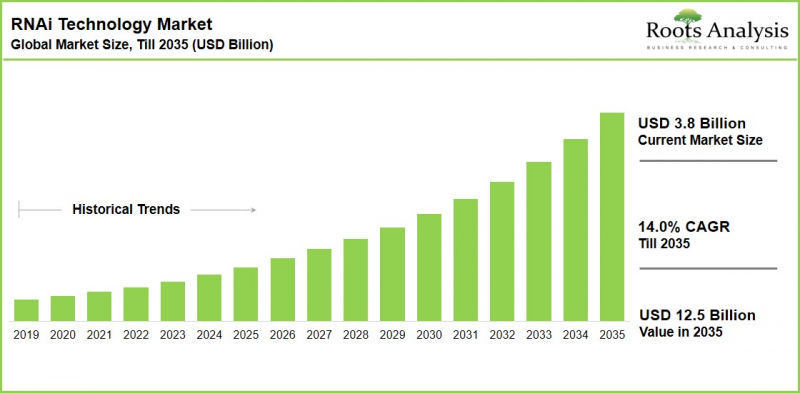
RNAi技術市場:成長與趨勢
RNA干擾(RNAi)已從分子生物學的一項基礎發現發展成為一項經臨床檢驗的治療和研究技術。這項進展得益於基於siRNA的藥物,例如ONPATTRO、GIVLAARI、OXLUMO、AMVUTTRA和LEQVIO等,相繼獲得監管部門批准。此外,這些臨床和商業性的成功降低了生物製藥公司使用RNAi平台的相關風險。因此,市場對RNAi試劑、試劑盒、合成服務、遞送技術和功能基因組學工具的需求日益成長,以支持藥物發現和轉化研究。
為了抓住這一不斷擴大的機遇,中小試劑和平台供應商正在擴大其產品線,並與主要的生命科學公司建立戰略合作夥伴關係,使他們能夠提供更全面的端到端 RNAi 技術解決方案。
多種因素正積極重塑競爭格局。特別是遞送化學領域的進步,例如 GalNAc 綴合物和脂質奈米顆粒 (LNP) 平台,正在拓展 RNAi 的應用範圍,使其從肝臟標靶治療擴展到神經系統疾病、眼科、呼吸系統疾病和腫瘤等領域。此外,地緣政治和貿易趨勢,包括進口試劑和特殊原料的關稅風險,也正在重塑 RNAi 的生產策略。為此,多家 RNAi 技術供應商和契約製造製造商正在擴大其國內 GMP 級寡核苷酸的生產能力,以減少對跨境供應鏈的依賴。
隨著以平台為中心的授權模式在生物製藥公司和 RNAi 創新者之間的合作中逐漸成為主流,以及對研究和臨床應用中試劑和服務的需求不斷成長,RNAi 技術市場預計將經歷持續的長期成長。
成長驅動力:支持市場擴張的因素
RNAi技術市場的發展主要受遺傳性疾病、腫瘤性疾病和心血管代謝疾病日益普遍的推動。此外,基因靜默機制臨床療效的不斷提高,以及人們對精準標特異性療法的偏好日益增強(而非傳統的小分子藥物),也是RNAi技術需求不斷成長的主要原因。隨著需求的成長,技術供應商正向生物技術和製藥公司提供其專有化學技術、新一代遞送平台和人工智慧定序工具的直接使用權,因此無需贊助公司自行建構這些能力。
此外,平台授權模式正日益受到大型製藥企業的關注。這些協議使RNAi創新者能夠自主管理早期藥物研發流程,同時檢驗平台在多個治療項目中的有效性,並降低贊助公司的資本投入。這種資本效率的提升將增強RNAi技術生態系統的長期策略價值,並在預測期內推動整體市場成長。
市場規模和機會分析根據以下參數進行分類:
依分子類型
- miRNA
- shRNA
- siRNA
- 其他RNAi分子
透過輸送技術
- 脂質奈米顆粒(LNPs)
- 聚合物和共軛體系
- 新興奈米粒子
- 病毒載體
用途別
- 農業
- 診斷
- 藥物發現與篩檢
- 治療
- 其他研究用途
最終用戶
- 製藥和生物技術公司
- 學術和研究機構
- CDMO
- 診斷檢測實驗室
- 其他
按地區
- 北美洲
- 歐洲
- 亞太地區
- 中東和北非
- 拉丁美洲
本報告對全球 RNAi 技術市場進行了分析,提供了概述、背景、市場影響因素分析、市場規模趨勢和預測、按各個細分市場進行的詳細分析、競爭格局以及主要公司的概況。
目錄
第1章:序言
第2章:調查方法
第3章 市場動態
第4章 宏觀經濟指標
第5章摘要整理
第6章:引言
第7章 市場概覽
第8章:技術競爭力分析
第9章:企業競爭力分析
第10章:公司簡介
- 章節概要
- Alnylam Pharmaceuticals
- Arrowhead Pharmaceuticals
- Dicerna Pharmaceuticals
- Merck
- Revvity
- Silence Therapeutics
- Sirnaomics
- Thermo Fisher Scientific
第11章 專利分析
第12章夥伴關係與合作
第13章:資金籌措與投資分析
第14章:全球RNAi技術市場
第15章 RNAi技術市場:依分子類型分類
第16章 RNAi技術市場:依遞送技術分類
第17章 RNAi技術市場:依應用分類
第18章 RNAi技術市場:依最終用戶分類
第19章 RNAi技術市場:依地區分類
第20章 SWOT分析
第21章 管理洞察
第22章 結論
第23章附錄1:表格形式數據
第24章 附錄2:公司與組織列表
RNAI TECHNOLOGY MARKET: OVERVIEW
As per Roots Analysis, the global RNAi technology market is estimated to grow from USD 3.8 billion in the current year to USD 12.5 billion by 2035, reflecting a CAGR of approximately 14.0% during the forecast period.
RNAi Technology Market: Growth and Trends
RNA interference (RNAi) has evolved from a foundational discovery in molecular biology into a validated therapeutic and research modality. This progress is driven by successive regulatory approvals of siRNA-based drugs, including ONPATTRO, GIVLAARI, OXLUMO, AMVUTTRA and LEQVIO. Further, these clinical and commercial successes have de-risked the RNAi platform for biopharmaceutical companies. As a result, demand has increased for RNAi reagents, kits, synthesis services, delivery technologies, and functional genomics tools supporting drug discovery and translational research.
To capture this expanding opportunity, small and mid-sized reagent and platform suppliers are broadening their catalogues and entering strategic partnerships with larger life science companies, enabling them to deliver more comprehensive, end-to-end RNAi technology offerings.
Several forces are actively reshaping the competitive landscape. Advances in delivery chemistry, particularly GalNAc-conjugate and lipid nanoparticle (LNP) platforms, are extending RNAi's reach beyond liver-targeted indications into neurology, ophthalmology, pulmonology, and oncology. Additionally, geopolitical and trade dynamics, including tariff exposure on imported reagents and specialty raw materials, are reshaping RNAi manufacturing strategies. In response, several RNAi technology providers and contract manufacturers are expanding GMP-grade oligonucleotide manufacturing capacity in the US to reduce reliance on cross-border supply chains.
As platform-centric licensing becomes the preferred mode of biopharma engagement with RNAi innovators, and as reagent and service demand broadens across research and clinical-stage applications, the RNAi technology market is positioned for sustained, long-term growth.
Growth Drivers: Factors Fueling Market Expansion
The RNAi technology market is being propelled by the growing prevalence of genetic, oncological and cardiometabolic disorders. In addition, the expanding clinical validation of gene-silencing mechanisms, and the rising preference for precision, target-specific therapeutics over conventional small molecules are the key reason for the growing demand for RNAi technology. Owing to the increasing demand, technology providers give biotech and pharmaceutical companies direct access to proprietary chemistries, next-generation delivery platforms, and AI-enabled sequence design tools, without requiring sponsors to build such capabilities in-house.
Additionally, platform access licensing models are gaining traction among large pharmaceutical companies. These agreements enable RNAi innovators to validate their platforms across multiple therapeutic programs while retaining early discovery control and reducing capital intensity for sponsors. This capital efficiency reinforces the long-term strategic value of the RNAi technology ecosystem, strengthening the growth trajectory of the broader market during the forecast period.
Market Challenges: Critical Barriers Hindering Progress
Despite favourable growth prospects, the market faces several challenges that could impede growth. GMP-grade oligonucleotide synthesis remains significantly more expensive than small-molecule production due to solvent-intensive processes and the limited availability of high-purity reagents. Further, efficient RNAi delivery beyond the liver, particularly to the CNS, lungs, and solid tumors, continues to be a major technical challenge.
Additionally, evolving regulatory expectations around genome-wide off-target screening add analytical cost and lengthen development timelines. Escalating trade tensions and tariff exposure on imported reagents and raw materials are compelling several manufacturers to re-evaluate their geographic footprint, creating near-term uncertainty around capacity planning and cost structures. Addressing these technical, regulatory, and geopolitical challenges will be critical for stakeholders seeking to capture the full commercial opportunity within this space.
RNAi Technology Market: Key Insights
The report delves into the current state of the RNAi technology market and identifies potential growth opportunities within the industry, particularly from a distributor and channel-partner perspective. Some key findings include:
- RNAi technology providers predominantly engage with pharmaceutical and biotechnology companies through direct platform-licensing and technology-access agreements. This engagement model limits the visibility that traditional distributors have into this segment, despite distributors' established reach into specialty reagent supply and cold-chain oligonucleotide handling.
- Specialty life science distributors and reagent supply partners are emerging as critical enablers of RNAi research and development pipelines, given the temperature-sensitive, high-purity nature of siRNA, miRNA and ASO reagents that dominate technology provider catalogues.
- Distributors and logistics partners seeking entry into this space must demonstrate validated GMP-aligned oligonucleotide managing protocols, reflecting the stringent quality requirements attached to RNAi drug substances and research-grade reagents alike.
- Rising onshoring activity in the US, driven in part by tariff exposure on imported reagents and specialty raw materials, is prompting technology providers to reassess supplier and distribution networks closer to end markets, favouring partners with domestic infrastructure.
- Consolidation among large RNAi platform companies through licensing deals, option agreements and acquisitions is raising barriers to entry for smaller regional players, while creating openings for niche distributors and logistics providers with modality-specific or geography-specific expertise.
- SanegeneBio entered a global RNAi licensing collaboration with Genentech (a member of the Roche Group), granting Genentech exclusive worldwide rights to develop and commercialize a program built on SanegeneBio's proprietary RNAi chemistry and delivery platform, in exchange for an upfront payment and development / commercialization milestones.
- The growing pipeline of RNAi therapeutics targeting tissues beyond the liver, including CNS, ophthalmic and pulmonary indications, is expected to sustain elevated demand for specialized delivery technologies and distribution infrastructure. Recently, Arrowhead Pharmaceuticals licensed its preclinical alpha-synuclein-targeting siRNA program to Novartis for the treatment of Parkinson's disease, in a deal with total potential value of up to USD 2.2 billion.
RNAi Technology Market Segments
Roots Analysis segments the global RNAi Technology market opportunity across the following parameters:
By Type of Molecule
- miRNA
- shRNA
- siRNA
- Other RNAi Molecules
By Delivery Technology
- Lipid Nanoparticles (LNPs)
- Polymer and Conjugate Systems
- Emerging Nanoparticles
- Viral Vectors
By Application
- Agriculture
- Diagnostics
- Drug Discovery and Screening
- Therapeutics
- Other Research Applications
By End User
- Pharmaceutical and Biotechnology Companies
- Academic and Research Institutes
- Contract Development and Manufacturing Organizations
- Diagnostic Laboratories
- Other End Users
By Geographical Regions
- North America
- Europe
- Asia-Pacific
- Middle East and North Africa
- Latin Americas
RNAi Technology Market: Key Segments Insight
siRNA Continues to Dominate the Type of Molecule Segment
Based on Roots Analysis market assessment, the siRNA segment currently secures highest market share. This leadership is primarily attributed to the extensive clinical validation and commercial success of siRNA-based therapeutics, making them the most mature class of RNA interference molecules. The widespread adoption of advanced chemical modification strategies, such as enhanced nucleotide stabilization and reduced off-target effects, has significantly improved the efficacy, safety, and durability of siRNA therapeutics. Furthermore, continuous innovation in RNAi platform technologies is reinforcing the segment's market position. For instance, researchers at the University of North Carolina at Chapel Hill introduced a novel platform designed to improve the potency of RNA interference therapeutics, highlighting ongoing advancements aimed at enhancing siRNA performance.
On the other hand, the shRNA segment is anticipated to register the highest CAGR over the forecast period. This growth is driven by the ability of shRNA molecules to provide long-term gene silencing through vector-mediated intracellular expression, reducing the need for repeated therapeutic administration. Unlike transient RNAi approaches, shRNA enables continuous production of silencing RNA within target cells, making it particularly attractive for chronic disorders, inherited genetic diseases, and oncology applications that require sustained suppression of disease-causing genes. Moreover, increasing research collaborations focused on integrating RNAi with gene therapy platforms, coupled with growing investments in next-generation vector technologies, are further accelerating the development of shRNA candidates.
Lipid Nanoparticles Dominate the Delivery Technology Segment
Based on the Roots Analysis market assessment, lipid nanoparticle-based delivery holds largest market share, owing to its clinically validated ability to achieve efficient hepatic gene silencing. Their ability to efficiently encapsulate, protect, and transport RNA molecules while facilitating intracellular delivery has significantly improved the therapeutic efficacy of RNAi-based products. Additionally, LNPs benefit from well-established manufacturing processes, scalable production capabilities, and increasing regulatory confidence owing to their successful application in multiple approved RNA therapeutics. Continuous improvements in lipid chemistry, formulation technologies, and targeted delivery strategies have further enhanced their stability, payload capacity, and safety profile.
Meanwhile, the nanomaterial sub-segment is anticipated to witness the highest CAGR during the forecast period. This growth is primarily driven by increasing efforts to address the limitations of conventional lipid nanoparticle systems, particularly their restricted extrahepatic delivery, limited cell-type specificity, and challenges associated with repeated dosing. Researchers and technology developers are actively designing next-generation nanocarriers, including polymeric nanoparticles, inorganic nanomaterials, biomimetic nanoparticles, peptide-based carriers, and extracellular vesicle-inspired delivery systems, to improve tissue penetration and target a broader range of organs beyond the liver.
Drug Discovery and Development Leads the Application Segment
Drug discovery and development is estimated to account for the largest RNAi technology market share. This highest share reflects the widespread integration of RNAi-based target validation and gene-silencing screens into pharmaceutical R&D pipelines. Functional genomics and target validation applications in academic and government research settings continue to provide a steady, complementary base of demand.
Pharmaceutical and Biotechnology Companies Hold the Highest Market Share
Presently, pharmaceutical and biotechnology companies account for the largest share overall market revenue. This dominance reflects their central role as both consumers of RNAi reagents / kits and licensees of proprietary RNAi delivery and chemistry platforms. On the other hand, CROs and CDMOs are expected to expand at a comparatively higher CAGR, as pipeline-stage biotech companies increasingly outsource RNAi-focused synthesis, screening, and manufacturing operations.
North America Dominates the Market; Asia-Pacific Registers the Higher CAGR
North America currently holds largest global market revenue share. This dominance is supported by the concentration of leading RNAi innovators, well-established reagent supply infrastructure, and the highest density of regulatory approvals to date.
Meanwhile, Asia-Pacific, led by China and South Korea, is projected to register the highest CAGR during the forecast period. This higher CAGR is driven by an expanding base of domestic RNAi platform companies, government-backed biotechnology initiatives, and lower-cost reagent and manufacturing infrastructure.
Example Players in RNAi Technology Market
- Alnylam Pharmaceuticals
- Arrowhead Pharmaceuticals
- Dicerna Pharmaceuticals
- Merck
- Revvity
- Silence Therapeutics
- Sirnaomics
- Thermo Fisher Scientific
Expert Interview and Industry Insights
The opinions and insights presented in this study were influenced by discussions conducted with multiple stakeholders. The research report features detailed transcripts of interviews held with the following industry stakeholders:
- Founder and Chief Executive Officer, Mid-sized Company, US
- President and Chief Executive Officer, Mid-sized Company, UK
- President and Chief Executive Officer, Small Company, US
- Chief Executive Officer and Co-Founder, Small Company, US
- Chief Executive Officer, Large Company, US
- Senior Vice President, Head of International Region, Large Company, US
- Executive Vice President, Chief Commercial Officer, Large Company, US
- Chief Technology Officer and Head of US Operations, Mid-sized Company, US
- Former Chief Medical Officer, Large Company, US
- Head of Advanced Drug Delivery, Very Large Company, UK
RNAi TECHNOLOGY MARKET: RESEARCH COVERAGE
- Market Sizing and Opportunity Analysis: An in-depth analysis of the market focusing on key segments, including type of molecule, delivery technology, application area, end user, and geographical regions.
- RNAi Technology Provider Landscape: A detailed assessment of active RNAi technology providers, featuring information on year of establishment, company size, location of headquarters, and range of products / services offered.
- Company Profiles: In-depth profiles of prominent players engaged in the RNAi technology market, covering year of establishment, headquarters location, company size, product / service portfolio, and key recent initiatives.
- Patent Analysis: A comprehensive analysis of patents related to RNAi technologies, based on several relevant parameters, including publication year, patent type, Cooperative Patent Classification (CPC) code, type of applicant, geographical distribution, emerging innovation areas, leading patent holders, patent benchmarking, and patent valuation, highlighting the evolving intellectual property landscape and competitive positioning within the RNAi therapeutics market.
- Partnerships and Collaborations: An analysis of partnerships and collaborations inked by RNAi technology providers, based on several relevant parameters, such as year of partnership, type of partnership, type of molecule, and most active players.
- Funding and Investments Analysis: A detailed analysis of the funding and investments made in this domain, based on several relevant parameters, such as year of funding, type of funding, amount invested, purpose of funding, geography, most active players, and leading investors.
- Mergers and Acquisitions: A comprehensive analysis of the mergers and acquisitions completed by RNAi technology providers, highlighting key value drivers, ownership change trends, and most active acquirers.
- Recent Expansions Analysis: A comprehensive assessment of recent expansion initiatives undertaken by RNAi technology providers. The chapter analyzes expansion trends by type, quarter, investment, and facility location, while identifying the most active companies.
- SWOT Analysis: A strategic assessment of the RNAi technology market, evaluating its key strengths, weaknesses, opportunities, and threats. The chapter compares the relative impact of each SWOT factor and provides actionable insights into the market's competitive position, growth potential, and strategic challenges.
Key Questions Answered in this Report
- Which are the leading companies in the RNAi technology market?
- Which region dominates the market, and which is growing the fastest?
- What are the key trends observed in this market?
- What factors are likely to influence the evolution of this market?
- What are the primary challenges faced by RNAi technology providers?
- What is the current and future market size?
- What is the CAGR of this market through 2035?
- How is current and future market opportunity distributed across key segments?
- What opportunities exist for distributors and logistics partners entering this space?
Reasons to Buy this Report
This report has been specifically developed to support distributors, channel partners, and business development teams evaluating entry into the RNAi Technology market.
- Top-Down and Bottom-Up Triangulated Forecasting: Market estimates are built using a hybrid methodology that cross-validates top-down macro assessments against bottom-up, company-level revenue and pipeline data, minimizing forecast bias.
- Extensive Chapter Coverage: Comprehensive coverage spanning market sizing, competitive benchmarking, patent landscape, clinical pipeline activity, funding and M&A analysis, and regional mapping across numerous countries.
- Primary Research-Backed Insights: Findings are validated through direct interviews with CEOs, CSOs, and commercial leaders across small, mid-sized, and large RNAi technology providers, ensuring insights reflect real operating conditions rather than desk research alone.
- Actionable Segmentation: Six-parameter segmentation (type of molecule, product & service, delivery technology, application, end user, geography) enables precise opportunity sizing for any go-to-market or investment thesis.
Additional Benefits
- Complementary Insights Pack
- Complementary PPT Insights Pack
- Complementary Excel Data Packs for all Analytical Modules in the Report
- 15% Free Content Customization
- Detailed Report Walkthrough Session with Research Team
- Free Updated report if the report is 6-12 months old or older
TABLE OF CONTENTS
1. PREFACE
- 1.1. Scope of the Report
- 1.2. Research Methodology
- 1.3. Market Segmentations
- 1.4. Key Questions Answered
- 1.5. Chapter Outlines
2. RESEARCH METHODOLOGY
- 2.1. Chapter Overview
- 2.2. Research Assumptions
- 2.2.1. Market Landscape and Market Trends
- 2.2.2. Market Forecast and Opportunity Analysis
- 2.2.3. Comparative Analysis
- 2.3. Database Building
- 2.3.1. Data Collection
- 2.3.2. Data Validation
- 2.3.3. Data Analysis
- 2.4. Project Methodology
- 2.4.1. Secondary Research
- 2.4.1.1. Annual Reports
- 2.4.1.2. Academic Research Papers
- 2.4.1.3. Company Websites
- 2.4.1.4. Investor Presentations
- 2.4.1.5. Regulatory Filings
- 2.4.1.6. White Papers
- 2.4.1.7. Industry Publications
- 2.4.1.8. Conferences and Seminars
- 2.4.1.9. Government Portals
- 2.4.1.10. Media and Press Releases
- 2.4.1.11. Newsletters
- 2.4.1.12. Industry Databases
- 2.4.1.13. Roots Proprietary Databases
- 2.4.1.14. Paid Databases and Sources
- 2.4.1.15. Social Media Portals
- 2.4.1.16. Other Secondary Sources
- 2.4.2. Primary Research
- 2.4.2.1. Types of Primary Research
- 2.4.2.1.1. Qualitative Research
- 2.4.2.1.2. Quantitative Research
- 2.4.2.1.3. Hybrid Approach
- 2.4.2.2. Advantages of Primary Research
- 2.4.2.3. Techniques for Primary Research
- 2.4.2.3.1. Interviews
- 2.4.2.3.2. Surveys
- 2.4.2.3.3. Focus Groups
- 2.4.2.3.4. Observational Research
- 2.4.2.3.5. Social Media Interactions
- 2.4.2.4. Key Opinion Leaders Considered in Primary Research
- 2.4.2.4.1. Company Executives (CXOs)
- 2.4.2.4.2. Board of Directors
- 2.4.2.4.3. Company Presidents and Vice Presidents
- 2.4.2.4.4. Research and Development Heads
- 2.4.2.4.5. Technical Experts
- 2.4.2.4.6. Subject Matter Experts
- 2.4.2.4.7. Scientists
- 2.4.2.4.8. Doctors and Other Healthcare Providers
- 2.4.2.5. Ethics and Integrity
- 2.4.2.5.1. Research Ethics
- 2.4.2.5.2. Data Integrity
- 2.4.2.1. Types of Primary Research
- 2.4.3. Analytical Tools and Databases
- 2.4.1. Secondary Research
- 2.5. Robust Quality Control
3. MARKET DYNAMICS
- 3.1. Chapter Overview
- 3.2. Forecast Methodology
- 3.2.1. Top-down Approach
- 3.2.2. Bottom-up Approach
- 3.2.3. Hybrid Approach
- 3.3. Market Assessment Framework
- 3.3.1. Total Addressable Market (TAM)
- 3.3.2. Serviceable Addressable Market (SAM)
- 3.3.3. Serviceable Obtainable Market (SOM)
- 3.3.4. Currently Acquired Market (CAM)
- 3.4. Forecasting Tools and Techniques
- 3.4.1. Qualitative Forecasting
- 3.4.2. Correlation
- 3.4.3. Regression
- 3.4.4. Extrapolation
- 3.4.5. Convergence
- 3.4.6. Sensitivity Analysis
- 3.4.7. Scenario Planning
- 3.4.8. Data Visualization
- 3.4.9. Time Series Analysis
- 3.4.10. Forecast Error Analysis
- 3.5. Key Considerations
- 3.5.1. Demographics
- 3.5.2. Government Regulations
- 3.5.3. Reimbursement Scenarios
- 3.5.4. Market Access
- 3.5.5. Supply Chain
- 3.5.6. Industry Consolidation
- 3.5.7. Pandemic / Unforeseen Disruptions Impact
- 3.6. Limitations
4. MACRO-ECONOMIC INDICATORS
- 4.1. Chapter Overview
- 4.2. Market Dynamics
- 4.2.1. Time Period
- 4.2.1.1. Historical Trends
- 4.2.1.2. Current and Forecasted Estimates
- 4.2.2. Currency Coverage
- 4.2.2.1. Major Currencies Affecting the Market
- 4.2.2.2. Factors Affecting Currency Fluctuations on the Industry
- 4.2.2.3. Impact of Currency Fluctuations on the Industry
- 4.2.3. Foreign Currency Exchange Rate
- 4.2.3.1. Impact of Foreign Exchange Rate Volatility on the Market
- 4.2.3.2. Strategies for Mitigating Foreign Exchange Risk
- 4.2.4. Recession
- 4.2.4.1. Assessment of Current Economic Conditions and Potential Impact on the Market
- 4.2.4.2. Historical Analysis of Past Recessions and Lessons Learnt
- 4.2.5. Inflation
- 4.2.5.1. Measurement and Analysis of Inflationary Pressures in the Economy
- 4.2.5.2. Potential Impact of Inflation on the Market Evolution
- 4.2.6. Interest Rates
- 4.2.6.1. Interest Rates and Their Impact on the Market
- 4.2.6.2. Strategies for Managing Interest Rate Risk
- 4.2.7. Commodity Flow Analysis
- 4.2.7.1. Type of Commodity
- 4.2.7.2. Origins and Destinations
- 4.2.7.3. Values and Weights
- 4.2.7.4. Modes of Transportation
- 4.2.8. Global Trade Dynamics
- 4.2.8.1. Import Scenario
- 4.2.8.2. Export Scenario
- 4.2.8.3. Trade Policies
- 4.2.8.4. Strategies for Mitigating the Risks Associated with Trade Barriers
- 4.2.8.5. Impact of Trade Barriers on the Market
- 4.2.9. War Impact Analysis
- 4.2.9.1. Russian-Ukraine War
- 4.2.9.2. Israel-Hamas War
- 4.2.10. COVID Impact / Related Factors
- 4.2.10.1. Global Economic Impact
- 4.2.10.2. Industry-specific Impact
- 4.2.10.3. Government Response and Stimulus Measures
- 4.2.10.4. Future Outlook and Adaptation Strategies
- 4.2.11. Other Indicators
- 4.2.11.1. Fiscal Policy
- 4.2.11.2. Consumer Spending
- 4.2.11.3. Gross Domestic Product
- 4.2.11.4. Employment
- 4.2.11.5. Taxes
- 4.2.11.6. Stock Market Performance
- 4.2.11.7. Cross Border Dynamics
- 4.2.1. Time Period
- 4.3. Conclusion
5. EXECUTIVE SUMMARY
6. INTRODUCTION
- 6.1. Chapter Overview
- 6.2. Key Milestones and Historical Trends
- 6.2.1. Discovery of RNAi
- 6.2.2. RNAi Therapy Development Efforts
- 6.3. Mechanism of RNAi
- 6.3.1. Components of RNAi
- 6.3.2. Cellular Mechanism
- 6.4. Types of RNAi Molecules
- 6.4.1. siRNA
- 6.4.2. miRNA
- 6.4.3. shRNA
- 6.5. Applications of RNAi
- 6.5.1. Functional Genomics
- 6.5.2. Therapeutics
- 6.5.3. Biotechnology
- 6.5.4. Genome-scale Screening
- 6.6. Advantages and Disadvantages of RNAi
- 6.6.1. Advantages of RNAi
- 6.6.2. Disadvantages of RNAi
- 6.6.3. Case Study: Concerns Discussed During Regulatory Submissions in Clinic
- 6.7. Future Perspectives
7. MARKET OVERVIEW
- 7.1. Chapter Overview
- 7.2. RNAi Technology Platforms and Delivery Systems
- 7.2.1. Analysis by Purpose of Technology
- 7.2.2. Analysis by Type of Molecule Delivered
- 7.2.3. Analysis by Type of Cell / Tissue Targeted
- 7.2.4. Analysis by Target Gene
- 7.3. RNAi Technology Developers
- 7.3.1. Analysis by Year of Establishment
- 7.3.2. Analysis by Company Size
- 7.3.3. Analysis by Location of Headquarters (Region-wise)
- 7.3.4. Analysis by Location of Headquarters (Country-wise)
8. TECHNOLOGY COMPETITIVENESS ANALYSIS
- 8.1. Chapter Overview
- 8.2. Assumptions / Key Parameters
- 8.3. Methodology
- 8.4. Technology Competitiveness Analysis: RNAi Therapeutics Technologies
- 8.4.1. Technology Competitiveness Analysis: Drug Delivery Technologies
- 8.4.2. Technology Competitiveness Analysis: Drug Discovery / Development Technologies
9. COMPANY COMPETITIVENESS ANALYSIS
- 9.1. Chapter Overview
- 9.2. Assumptions / Key Parameters
- 9.3. Methodology
- 9.4. Company Competitiveness Analysis: RNAi Therapeutics Developers
- 9.5. Developers based in North America
- 9.6. Developers based in Europe
- 9.7. Developers based in Asia-Pacific
10. COMPANY PROFILES
- 10.1. Chapter Overview
- 10.2. Alnylam Pharmaceuticals*
- 10.2.1. Company Overview
- 10.2.2. RNAi Technology Portfolio
- 10.2.3. Management Team
- 10.2.4. Key Initiatives
- Similar details are presented for other RNAi technology developers mentioned below (based on information in the public domain)
- 10.3. Arrowhead Pharmaceuticals
- 10.4. Dicerna Pharmaceuticals
- 10.5. Merck
- 10.6. Revvity
- 10.7. Silence Therapeutics
- 10.8. Sirnaomics
- 10.9. Thermo Fisher Scientific
11. PATENT ANALYSIS
- 11.1. Chapter Overview
- 11.2. Scope and Methodology
- 11.3. RNAi Technology: Patent Analysis
- 11.3.1. Analysis by Publication Year
- 11.3.2. Analysis by Patent Type and Publication Year
- 11.3.3. Analysis by CPC Code
- 11.3.4. Analysis by Type of Applicant
- 11.3.5. Analysis by Geography
- 11.3.6. Emerging Focus Areas
- 11.3.7. Leading Players: Analysis by Number of Patents
- 11.3.8. Patent Benchmarking Analysis
- 11.3.9. Patent Valuation Analysis
12. PARTNERSHIPS AND COLLABORATIONS
- 12.1. Chapter Overview
- 12.2. Partnership Models
- 12.3. RNAi Technology: Recent Partnerships and Collaborations
- 12.3.1. Analysis by Year of Partnership
- 12.3.2. Analysis by Type of Partnership
- 12.3.3. Analysis by Type of RNAi Molecule
- 12.3.4. Analysis by Scale of Partnership
- 12.3.5. Analysis by Therapeutic Area
- 12.3.6. Most Active Players: Analysis by Number of Partnerships
- 12.3.7. Regional Analysis
- 12.3.7.1. Country-wise Distribution
- 12.3.7.2. Intercontinental and Intracontinental Deals
13. FUNDING AND INVESTMENT ANALYSIS
- 13.1. Chapter Overview
- 13.2. Types of Funding
- 13.3. RNAi Technology: Funding and Investment Analysis
- 13.3.1. Analysis by Cumulative Funding Instances
- 13.3.2. Analysis by Amount Invested
- 13.3.3. Analysis by Type of Funding
- 13.3.4. Analysis by Year and Type of Funding
- 13.3.5. Analysis of Amount Invested Across Different Types of RNAi Molecules
- 13.3.6. Regional Analysis by Amount Invested
- 13.3.7. Most Active Players
- 13.3.8. Key Investors
- 13.4. Concluding Remarks
14. GLOBAL RNAi TECHNOLOGY MARKET
- 14.1. Chapter Overview
- 14.2. Assumptions and Methodology
- 14.3. Global RNAi Technology Market, Forecasted Estimates (till 2035)
- 14.4. Roots Analysis Perspective on Market Growth
- 14.5. Scenario Analysis
- 14.5.1. Conservative Scenario
- 14.5.2. Optimistic Scenario
- 14.6. Key Market Segmentations
15. RNAi TECHNOLOGY MARKET, BY TYPE OF MOLECULE
- 15.1. Chapter Overview
- 15.2. Key Assumptions and Methodology
- 15.3. RNAi Technology Market: Distribution by Type of Molecule
- 15.3.1. RNAi Technology Market for miRNA, Forecasted Estimates (till 2035)
- 15.3.2. RNAi Technology Market for shRNA, Forecasted Estimates (till 2035)
- 15.3.3. RNAi Technology Market for siRNA, Forecasted Estimates (till 2035)
- 15.3.4. RNAi Technology Market for Other RNA Molecules, Forecasted Estimates (till 2035)
- 15.4. Data Triangulation and Validation
16. RNAi TECHNOLOGY MARKET, BY DELIVERY TECHNOLOGY
- 16.1. Chapter Overview
- 16.2. Key Assumptions and Methodology
- 16.3. RNAi Technology Market: Distribution by Delivery Technology
- 16.3.1. RNAi Technology Market for Lipid Nanoparticles, Forecasted Estimates (till 2035)
- 16.3.2. RNAi Technology Market for Polymer and Conjugate Systems, Forecasted Estimates (till 2035)
- 16.3.3. RNAi Technology Market for Emerging Nanomaterials, Forecasted Estimates (till 2035)
- 16.3.4. RNAi Technology Market for Viral Vectors, Forecasted Estimates (till 2035)
- 16.4. Data Triangulation and Validation
17. RNAi TECHNOLOGY MARKET, BY APPLICATION AREA
- 17.1. Chapter Overview
- 17.2. Key Assumptions and Methodology
- 17.3. RNAi Technology Market: Distribution by Application Area
- 17.3.1. RNAi Technology Market for Agriculture, Forecasted Estimates (till 2035)
- 17.3.2. RNAi Technology Market for Diagnostics, Forecasted Estimates (till 2035)
- 17.3.3. RNAi Technology Market for Drug Discovery and Screening, Forecasted Estimates (till 2035)
- 17.3.4. RNAi Technology Market for Therapeutics, Forecasted Estimates (till 2035)
- 17.3.5. RNAi Technology Market for Other Application Areas, Forecasted Estimates (till 2035)
- 17.4. Data Triangulation and Validation
18. RNAi TECHNOLOGY MARKET, BY END USER
- 18.1. Chapter Overview
- 18.2. Key Assumptions and Methodology
- 18.3. RNAi Technology Market: Distribution by End User
- 18.3.1. RNAi Technology Market for Pharmaceutical and Biotechnology Companies, Forecasted Estimates (till 2035)
- 18.3.2. RNAi Technology Market for Academic and Research Institutes, Forecasted Estimates (till 2035)
- 18.3.3. RNAi Technology Market for Contract Development and Manufacturing Organizations, Forecasted Estimates (till 2035)
- 18.3.4. RNAi Technology Market for Diagnostic Laboratories, Forecasted Estimates (till 2035)
- 18.3.5. RNAi Technology Market for Other End Users, Forecasted Estimates (till 2035)
- 18.4. Data Triangulation and Validation
19. RNAi TECHNOLOGY MARKET, BY GEOGRAPHICAL REGIONS
- 19.1. Chapter Overview
- 19.2. Key Assumptions and Methodology
- 19.3. RNAi Technology Market: Distribution by Geographical Regions
- 19.3.1. RNAi Technology Market in North America: Forecasted Estimates (till 2035)
- 19.3.2. RNAi Technology Market in Europe: Forecasted Estimates (till 2035)
- 19.3.3. RNAi Technology Market in Asia-Pacific: Forecasted Estimates (till 2035)
- 19.3.4. RNAi Technology Market in Middle East and North Africa: Forecasted Estimates (till 2035)
- 19.3.5. RNAi Technology Market in Latin America: Forecasted Estimates (till 2035)
- 19.4. Market Dynamics Assessment
- 19.4.1. Penetration-Growth (P-G) Matrix
- 19.5. Data Triangulation and Validation
20. SWOT ANALYSIS
- 20.1. Chapter Overview
- 20.2. Strengths
- 20.3. Weaknesses
- 20.4. Opportunities
- 20.5. Threats
- 20.6. Comparison of SWOT Factors
- 20.6.1. Concluding Remarks
21. EXECUTIVE INSIGHTS
22. CONCLUSION
23. APPENDIX 1: TABULATED DATA
24. APPENDIX 2: LIST OF COMPANIES AND ORGANIZATIONS

 RNAi技術市場規模、佔有率和趨勢分析報告:按產品/服務、應用、最終用途、地區和細分市場預測(2026-2033年)
 RNAi治療藥物市場(第三版):按RNAi分子類型、治療領域、給藥途徑、主要地區和主要公司分類的趨勢和銷售預測(至2035年)
 RNA干擾療法市場:商業機會、成長要素、產業趨勢分析及2026-2035年預測。siRNA化學品、連接劑和試劑市場:市場規模、佔有率和趨勢分析(按類型、應用、最終用途和地區分類),細分市場預測(2026-2033年)
 RNAi技術市場規模、佔有率和成長分析:按分子類型、遞送技術、應用領域、終端用戶產業和地區分類-2026-2033年產業預測
 RNAI技術市場:按應用、最終用戶和地區分類
 RNAi療法市場分析及預測(至2035年):依類型、產品類型、技術、應用、最終使用者、製程、實施類型及功能分類
 RNAi技術市場-全球產業規模、佔有率、趨勢、機會、預測:按類型、應用、最終用戶、地區和競爭格局分類,2021-2031年