


 |
市場調查報告書
商品編碼
2112601
輸液幫浦市場:按設備類型、用途、技術、治療領域、最終用戶和地區分類的趨勢和銷售預測(至2035年)Infusion Pumps Market by Device Type, Type of Usage, Type of Technology, Therapeutic Area, End User and Geographical Regions and Sales Forecast - Trends and Forecast Till 2035 |
||||||

輸液幫浦市場概覽
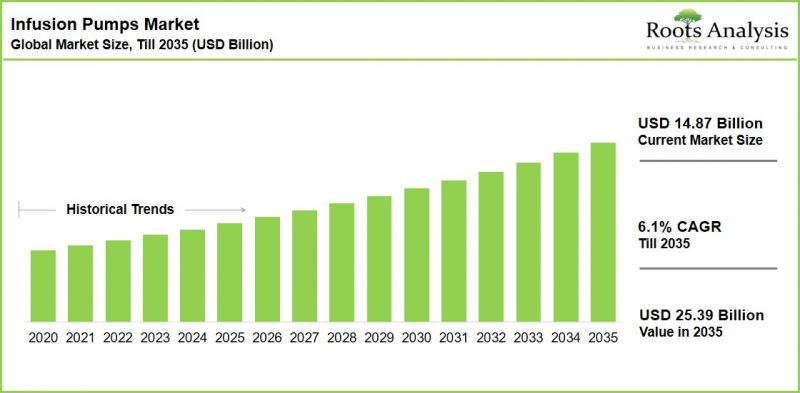
根據 Roots Analysis 的研究,預計到 2035 年,全球輸液幫浦市場將以 6.1% 的顯著複合年成長率成長,從今年的 148.7 億美元成長到 2035 年的 253.9 億美元。
輸液幫浦市場:成長與趨勢
輸液幫浦是一種精密藥物傳遞裝置,旨在以精確控制的劑量和指定的時間間隔將體液、藥物和營養物質輸送到患者體內。透過以自動化和可程式設計的輸液方式取代人工輸液,這些系統減少了輸液錯誤,並有助於在醫院、門診和居家照護環境中管理長期治療方案。
輸液幫浦的廣泛應用持續受到全球慢性疾病和需要長期治療的病症(例如癌症、糖尿病、心血管疾病和腎臟病)患者數量不斷增加的推動。隨著需要這些療法的患者群體不斷擴大,所有醫療機構對液體給藥的依賴程度也不斷提高。
輸液幫浦本身也經歷了顯著的發展。除了傳統的容積式輸液幫浦和注射式幫浦外,製造商還在開發攜帶式、穿戴式式和植入式系統,以便不僅可以在醫院床邊進行輸液治療,還可以在患者家中進行。同時,安全機制也得到了極大的改進。現代輸液幫浦通常配備軟體以減少劑量誤差,並設有警報裝置以檢測管路堵塞和空氣,以及低藥濃度警報。這些功能確保了治療的連續性並減少了不利事件。
推動該行業下一階段成長的關鍵趨勢之一是液體療法與數位醫療的融合。將人工智慧、物聯網連接和無線資料交換整合到靜脈輸液平台中,可實現即時靜脈輸液監測、遠端輸液幫浦管理以及與電子健康記錄 (EHR) 系統的無縫互通性,從而提高給藥安全性並增強臨床決策能力。
成長要素:推動全球輸液幫浦市場擴張的因素
輸液幫浦市場成長的主要促進因素是全球慢性病盛行率的上升。癌症、糖尿病和心血管疾病等疾病通常需要精準且持續的藥物輸注,隨著這些疾病發生率的顯著增加,輸液幫浦已成為長期患者管理必備的設備。
人口老化是推動市場成長的第二大主要因素。隨著老齡化,慢性疾病的風險增加,從而對靜脈輸液治療及其相關的長期照護基礎設施產生了持續的需求。此外,整個醫療保健系統向居家醫療和門診護理的轉變也推動了這一趨勢,加速了攜帶式、穿戴式式和易於使用的靜脈輸液技術的普及,這些技術可以在傳統醫療機構之外使用。
持續的產品創新正在進一步加速這一發展勢頭。配備智慧連接、整合藥物庫和安全增強軟體的輸液幫浦不斷湧現,正在取代老舊的傳統輸液系統。此外,醫療設備製造商與數位醫療公司之間日益密切的合作,也正在拓展輸液技術在各個治療領域的應用。
市場規模和機會分析根據以下參數進行分類:
依設備類型
- 容量型輸液泵
- 注射式幫浦
- 植入式輸液泵
- 彈性體輸液泵
- 攜帶式輸液泵
- 胰島素幫浦
- 穿戴式輸液泵
- 其他
依用途類型
- 固定式
- 攜帶式的
透過技術
- 傳統輸液幫浦
- 智慧型輸液幫浦
按治療區域
- 糖尿病
- 瘤
- 血液疾病
- 疼痛管理
- 其他
最終用戶
- 醫院
- 居家醫療
按地區
- 北美洲
- 美國
- 加拿大
- 墨西哥
- 歐洲
- 德國
- 法國
- 義大利
- 西班牙
- 英國
- 其他歐洲國家
- 亞太地區
- 中國
- 印度
- 日本
- 韓國
- 其他亞太地區
- 其他地區
本報告對全球輸液幫浦市場進行了分析,提供了概述、背景、市場影響因素分析、市場規模趨勢和預測、按各個細分市場進行的詳細分析、競爭格局以及主要公司的概況。
目錄
第一部分:報告概述
第1章:序言
第2章:調查方法
第3章 市場動態
第4章 宏觀經濟指標
第二部分:定性考量
第5章摘要整理
第6章:引言
第7章 監管情景
第三部分:市場概覽
第8章:主要公司綜合資料庫
第9章 競爭情勢
第10章:波特五力分析
第11章 產品競爭力分析
第12章:輸液幫浦市場的創業生態系統
第四部分:公司簡介
第13章:公司簡介
- 章節概要
- Avanos Medical(美國)
- B. Braun(德國)
- 百特(美國)
- BD(美國)
- CANE醫療技術(義大利)
- 芝加哥商品交易所集團(美國)
- DMWAH(韓國)
- 費森尤斯卡比(德國)
- Halyard We(美國)
- ICU醫療照護(美國)
- 美敦力(愛爾蘭)
- Micrel醫療器材(希臘)
- 邁瑞(中國)
- 深圳鷹光電儀器(中國)
- 泰爾茂(日本)
- Zyno Medical(美國)
第五部分:市場趨勢
第14章 近期趨勢
第六部分:市場機會分析
第15章:全球輸液幫浦市場
第16章 基於設備類型的市場機會
第17章 基於使用情況的市場機會
第18章:基於科技的市場機遇
第19章 基於治療領域的市場機遇
第20章 基於終端用戶的市場機遇
第21章 北美輸液幫浦市場機遇
第22章 歐洲輸液幫浦市場機遇
第23章 亞太地區輸液幫浦的市場機會
第24章 其他地區輸液幫浦的市場機會
第25章:鄰近市場分析
第七部分:戰略工具
第26章:制勝的關鍵策略
第27章 價值鏈分析
第28章:案例研究
第29章:ROOTS的策略建議
第八部分:其他獨特見解
第30章 來自初步調查的見解
第31章:報告結論
第9章:附錄
第32章:表格形式數據
第33章 公司與組織列表
第34章 客製化的機會
第35章:ROOTS訂閱服務
第36章 作者信息
INFUSION PUMPS MARKET: OVERVIEW
As per Roots Analysis, the global infusion pumps market is estimated to grow from USD 14.87 billion in the current year to USD 25.39 billion by 2035, at an impressive CAGR of 6.1%, during the forecast period, till 2035.
Infusion Pumps Market: Growth and Trends
Infusion pumps are precision drug-delivery devices engineered to administer fluids, medications and nutrients into a patient's body in carefully controlled volumes and at defined intervals. By replacing manual administration with automated, programmable delivery, these systems reduce the margin for dosing error and support the management of long-duration therapeutic regimens across hospital, ambulatory and home-care settings.
Adoption of infusion pumps continues to be driven by the rising global burden of chronic and long-term conditions, including cancer, diabetes, cardiovascular disorders and renal disease, all of which frequently require sustained or repeat-dose medication delivery. As the pool of patients requiring such regimens expands, so too does the reliance on infusion-based drug administration across care settings.
The device landscape itself has evolved considerably. Beyond conventional volumetric and syringe pumps, manufacturers are increasingly engineering ambulatory, wearable and implantable systems that extend infusion therapy beyond the hospital bedside and into the patient's home. In parallel, safety architecture has advanced meaningfully: modern pumps are now commonly equipped with dose-error-reduction software, occlusion and air-in-line alarms, and low-reservoir alerts, all of which work to safeguard therapy continuity and minimise adverse events.
A defining trend shaping the industry's next phase of growth is the convergence of infusion therapy with digital health. The integration of artificial intelligence, Internet-of-Things connectivity and wireless data exchange into infusion platforms is enabling real-time infusion monitoring, remote pump management and seamless interoperability with electronic health record systems, collectively strengthening medication safety and clinical decision-making.
Growth Drivers: Factors Fueling Expansion of the Global Infusion Pumps Market
Growth in the infusion pumps market is being propelled by the escalating global incidence of chronic disease. Conditions such as cancer, diabetes and cardiovascular disorders, which often demand precise and continuous medication administration, are becoming markedly more common, cementing infusion pumps as an indispensable component of long-term patient management.
The expanding geriatric population represents a second key driver of the market growth. As age advances, susceptibility to chronic illness rises correspondingly, generating sustained demand for infusion-based therapies and long-term care infrastructure capable of supporting them. This demographic shift is further reinforced by a broader healthcare system pivot toward home-based and ambulatory care models, which is accelerating uptake of portable, wearable and easy-to-operate infusion technologies designed for use outside traditional clinical settings.
Continuous product innovation is compounding this momentum. The steady introduction of pumps equipped with smart connectivity, integrated drug libraries and enhanced safety software is encouraging replacement of legacy, traditional infusion systems, while active collaboration between device manufacturers and digital health companies is widening the addressable applications for infusion technology across therapeutic areas.
Market Challenges: Critical Barriers Hindering Progress
Despite the positive growth outlook, the infusion pumps market faces several constraints. The elevated upfront cost associated with smart, feature-rich infusion systems can restrict adoption, particularly across price-sensitive and resource-constrained healthcare markets, thereby further complicates the adoption of these devices.
Additionally, regulatory rigor represents an additional hurdle for the market players. Infusion pumps are safety-critical devices, and manufacturers must satisfy stringent approval and post-market surveillance requirements set by authorities such as the USFDA, extending development timelines and increasing compliance costs. Beyond regulation, the operational complexity of smart infusion systems necessitates structured training for clinical staff and, in home-care contexts, for patients themselves. The inadequate familiarity with device operation can act as a meaningful barrier to adoption and safe use.
Infusion Pumps Market: Key Insights
The report delves into the current state of the infusion pumps market and identifies potential growth opportunities within the industry. Some key findings from the report include:
- The competitive landscape remains moderately fragmented, with established players including BD, Baxter, B. Braun and Fresenius Kabi engaging in continuous product innovation and strategic collaboration to defend and expand their market positions.
- Recent regulatory and product milestones including USFDA clearances secured by Baxter for its Novum IQ large-volume infusion platform and by ICU Medical for its Plum Solo precision IV pump underscore the pace of innovation shaping the competitive environment.
- Strategic partnerships centered on data-driven medication safety, such as the collaboration between Bainbridge Health and B. Braun Medical under the National Infusion Collaborative, are expected to be an increasingly important growth lever for industry stakeholders.
- Rather than focusing solely on standalone infusion pumps, leading manufacturers are investing in integrated medication management platforms that combine infusion devices with electronic medical records (EMRs), dose error reduction software (DERS), cloud connectivity, and clinical analytics.
- Baxter has continued expanding its connected care portfolio through investments in its Novum IQ and Spectrum IQ platforms, while presenting real-world evidence from over 1.3 million IV infusions demonstrating improved medication safety and nursing efficiency through EMR integration.
- Given the sustained rise in chronic disease prevalence and continued innovation in smart, connected and wearable infusion technologies, the global infusion pumps market is well positioned for steady growth through 2035.
Infusion Pumps Market
The market sizing and opportunity analysis has been segmented across the following parameters:
By Type of Device
- Volumetric
- Syringe
- Implantable
- Elastomeric
- Ambulatory
- Insulin Pumps
- Wearable Infusion Pumps
- Others
By Type of Usage
- Stationary
- Ambulatory
By Type of Technology
- Traditional Infusion Pumps
- Smart Infusion Pumps
By Therapeutic Area
- Diabetes
- Oncology
- Hematology
- Pain Management
- Others
By End User
- Hospitals
- Home Care
By Geographical Regions
- North America
- US
- Canada
- Mexico
- Europe
- Germany
- France
- Italy
- Spain
- UK
- Rest of Europe
- Asia-Pacific
- China
- India
- Japan
- South Korea
- Rest of Asia-Pacific
- Rest of the World
Infusion Pumps Market: Key Segments
Volumetric Pumps Continue to Lead the Infusion Pumps Market
Based on our market assessment, volumetric infusion pumps currently represent the largest device-type segment and are expected to retain this leadership through the forecast period. This position is supported by their high dosing precision, established safety profile and broad applicability across blood infusion, surgical fluid management, nutrient delivery and general drug administration in hospital settings.
Looking ahead, wearable infusion pumps are projected to register the highest CAGR among device types during the forecast period. This lucrative growth is due to the rising demand for continuous ambulatory drug administration in chronic disease management and the broader shift toward home-based care, which is likely to accelerate the adoption of digitally connected infusion technologies.
Stationary Segment Captures the Largest Market Share
Currently, the stationary segment accounts for the largest share of the overall market. This leadership is primarily attributed to the widespread adoption of stationary infusion pumps across hospitals, intensive care units (ICUs), ambulatory surgical centres, and specialty clinics, where continuous and highly accurate drug delivery is essential for the management of critically ill patients.
Stationary infusion pumps are extensively used for administering chemotherapy, intravenous (IV) fluids, parenteral nutrition, antibiotics, blood products, and other high-risk medications that require precise flow-rate control and continuous monitoring. Their ability to deliver large fluid volumes with high accuracy, support multiple infusion modes, and integrate with hospital information systems has further strengthened their adoption in acute care settings.
Smart Infusion Pumps Dominate the Market
At present, smart infusion pumps represent the largest share of the global market. This highest share is due to the increasing emphasis on medication safety, workflow automation, and digital healthcare integration. Smart infusion pumps incorporate advanced software capabilities, dose error reduction systems (DERS), programmable drug libraries, wireless connectivity, and real-time monitoring features that significantly minimise medication administration errors while improving clinical efficiency.
Consequently, this segment is anticipated to witness the fastest growth during the forecast period. This potential growth is due to the integration of electronic health records (EHRs), interoperability with hospital information systems, and advancements in artificial intelligence (AI)-enabled infusion management are expected to further accelerate the adoption of smart infusion pumps.
Diabetes Segment Holds the Largest Revenue Share
Currently, the diabetes segment accounts for the largest share of the market. This dominance is driven by the increasing global prevalence of diabetes, growing dependence on continuous subcutaneous insulin infusion (CSII) therapy, and rising adoption of wearable insulin pumps among patients with type 1 and insulin-dependent type 2 diabetes.
The growing preference for personalised diabetes management, combined with continuous glucose monitoring (CGM)-integrated insulin delivery systems and automated insulin dosing technologies, has further strengthened the market position of this segment. However, the oncology segment is expected to witness the highest CAGR during the forecast period. The increasing global burden of cancer, expanding use of infusion pumps for chemotherapy, targeted therapies, immunotherapies, and supportive care treatments, coupled with the growing demand for accurate administration of high-risk oncology drugs, is anticipated to drive significant growth within this segment.
North America Maintains Market Leadership
North America is expected to remain the largest regional market for infusion pumps through 2035. This position reflects the region's well-developed healthcare infrastructure, established reimbursement pathways, high rate of adoption of advanced medical technologies and growing preference for smart, connected infusion platforms to manage chronic disease.
Asia-Pacific Emerges as the Fastest-Growing Regional Market
The Asia-Pacific infusion pumps market is anticipated to post the highest regional CAGR over the forecast period. This growth is driven by expanding healthcare infrastructure investment, rising prevalence of chronic conditions such as diabetes, and improving affordability and access to advanced drug-delivery technologies across emerging economies in the region.
Hospitals Account for the Largest End-User Share
Hospitals currently represent the leading end-user segment for infusion pumps. This highest share reflects the concentration of complex, high-acuity infusion procedures, dedicated clinical infrastructure and trained personnel required to administer advanced therapies such as chemotherapy and critical-care fluid management. On the other hand, home-care segment is expected to grow at a considerably faster pace as remote patient monitoring and decentralized treatment models gain wider traction.
Example Players in Infusion Pumps Market
- Avanos Medical
- B. Braun
- Baxter
- BD
- CANE Medical Technology
- CME Corp
- Daiwha Fresenius Kabi
- Halyard Health
- ICU Medical
- Medtronic
- Micrel Medical Devices
- Mindray
- Shenzhen Hawk Optical Electronic Instrument
- Terumo
- Zyno Medical
INFUSION PUMPS MARKET: RESEARCH COVERAGE
- Market Opportunity Analysis: In-depth market sizing and opportunity analysis, segmented by [A] type of device, [B] type of usage, [C] type of technology, [D] therapeutic area, [E] end user and [F] geographical regions.
- Introduction and Regulatory Overview: A review of infusion pump fundamentals, key characteristics, applications and associated challenges, together with an overview of the prevailing regulatory scenario.
- Comprehensive Database of Leading Players: A structured database profiling companies active across the infusion pumps value chain.
- Competitive Landscape: An assessment of the overall market landscape, based on parameters such as year of establishment, company size, location of headquarters, device type, usage type, technology type, therapeutic area and end user.
- Porter's Five Forces Analysis: A qualitative evaluation of the five competitive forces shaping the industry, namely threat of new entrants, bargaining power of buyers, bargaining power of suppliers, threat of substitutes and rivalry among existing competitors.
- Product Competitiveness Analysis: A comparative benchmarking of infusion pump products against key performance and safety parameters.
- Startup Ecosystem in the Infusion Pumps Market: An analysis of emerging players, based on year of establishment, company size, location of headquarters and ownership structure, along with key findings.
- Company Profiles: In-depth profiles of prominent infusion pump manufacturers, featuring company overview, mission, footprint, management team, financial performance, business segments, product portfolio, MOAT analysis, and recent developments and future outlook.
- Recent Developments: A review of recent funding activity, partnerships and collaborations, and other strategic initiatives across the industry.
- Adjacent Market Analysis: A review of related and adjacent markets that offer supplementary growth opportunities for infusion pump stakeholders.
- Key Winning Strategies: An assessment of the strategic approaches adopted by leading and emerging players to strengthen their market position.
- Value Chain Analysis: A detailed mapping of the end-to-end infusion pumps value chain, highlighting the role of key stakeholders.
- Case Studies: A detailed case studies on infusion pump accessories and ambulatory infusion pumps, covering commonly used accessories, applications and product competitiveness.
- Roots Strategic Recommendations and Primary Research Insights: An actionable recommendations and qualitative insights drawn from structured engagement with industry stakeholders.
Key Questions Answered in this Report
- Which are the leading companies in the infusion pumps market?
- Which region dominates the infusion pumps market, and which region is growing the fastest?
- What are the key trends observed in the infusion pumps market?
- What factors are likely to influence the evolution of this market?
- What are the primary challenges faced by infusion pump manufacturers?
- What is the current and future size of the infusion pumps market?
- What is the CAGR of this market through 2035?
- How is the current and future market opportunity likely to be distributed across key market segments?
- Which emerging / startup players are shaping the competitive landscape?
Reasons to Buy this Report
- The report provides a comprehensive market analysis, offering detailed revenue projections of the overall market and its specific sub-segments, this information is valuable to both established market leaders and emerging entrants.
- The report offers stakeholders a comprehensive overview of the market, including key drivers, barriers, opportunities and challenges, empowering them to stay abreast of market trends and make data-driven decisions to capitalize on growth prospects.
- The report can aid businesses in identifying future opportunities across the infusion pumps value chain, and in assessing whether those opportunities are worth pursuing.
- The report helps in identifying customer demand by understanding the needs, preferences and behavior of the target audience, enabling stakeholders to tailor products or services effectively.
- The report equips new entrants with requisite information regarding the infusion pumps market to help them build successful market-entry strategies.
- The report allows for more effective communication with investors, partners and internal stakeholders, and supports the building of stronger business relationships.
Additional Benefits
- Complementary Excel Data Packs for all Analytical Modules in the Report
- 15% Free Content Customization
- Detailed Report Walkthrough Session with Research Team
- Free Updated report if the report is 6-12 months old or older
TABLE OF CONTENTS
SECTION I: REPORT OVERVIEW
1. PREFACE
- 1.1. Introduction
- 1.2. Market Share Insights
- 1.3. Key Market Insights
- 1.4. Report Coverage
- 1.5. Key Questions Answered
- 1.6. Chapter Outlines
2. RESEARCH METHODOLOGY
- 2.1. Chapter Overview
- 2.2. Research Assumptions
- 2.3. Database Building
- 2.3.1. Data Collection
- 2.3.2. Data Validation
- 2.3.3. Data Analysis
- 2.4. Project Methodology
- 2.4.1. Secondary Research
- 2.4.1.1. Annual Reports
- 2.4.1.2. Academic Research Papers
- 2.4.1.3. Company Websites
- 2.4.1.4. Investor Presentations
- 2.4.1.5. Regulatory Filings
- 2.4.1.6. White Papers
- 2.4.1.7. Industry Publications
- 2.4.1.8. Conferences and Seminars
- 2.4.1.9. Government Portals
- 2.4.1.10. Media and Press Releases
- 2.4.1.11. Newsletters
- 2.4.1.12. Industry Databases
- 2.4.1.13. Roots Proprietary Databases
- 2.4.1.14. Paid Databases and Sources
- 2.4.1.15. Social Media Portals
- 2.4.1.16. Other Secondary Sources
- 2.4.2. Primary Research
- 2.4.2.1. Introduction
- 2.4.2.2. Types
- 2.4.2.2.1. Qualitative
- 2.4.2.2.2. Quantitative
- 2.4.2.3. Advantages
- 2.4.2.4. Techniques
- 2.4.2.4.1. Interviews
- 2.4.2.4.2. Surveys
- 2.4.2.4.3. Focus Groups
- 2.4.2.4.4. Observational Research
- 2.4.2.4.5. Social Media Interactions
- 2.4.2.5. Stakeholders
- 2.4.2.5.1. Company Executives (CXOs)
- 2.4.2.5.2. Board of Directors
- 2.4.2.5.3. Company Presidents and Vice Presidents
- 2.4.2.5.4. Key Opinion Leaders
- 2.4.2.5.5. Research and Development Heads
- 2.4.2.5.6. Technical Experts
- 2.4.2.5.7. Subject Matter Experts
- 2.4.2.5.8. Scientists
- 2.4.2.5.9. Doctors and Other Healthcare Providers
- 2.4.2.6. Ethics and Integrity
- 2.4.2.6.1. Research Ethics
- 2.4.2.6.2. Data Integrity
- 2.4.3. Analytical Tools and Databases
- 2.4.1. Secondary Research
3. MARKET DYNAMICS
- 3.1. Forecast Methodology
- 3.1.1. Top-Down Approach
- 3.1.2. Bottom-Up Approach
- 3.1.3. Hybrid Approach
- 3.2. Market Assessment Framework
- 3.2.1. Total Addressable Market (TAM)
- 3.2.2. Serviceable Addressable Market (SAM)
- 3.2.3. Serviceable Obtainable Market (SOM)
- 3.2.4. Currently Acquired Market (CAM)
- 3.3. Forecasting Tools and Techniques
- 3.3.1. Qualitative Forecasting
- 3.3.2. Correlation
- 3.3.3. Regression
- 3.3.4. Time Series Analysis
- 3.3.5. Extrapolation
- 3.3.6. Convergence
- 3.3.7. Forecast Error Analysis
- 3.3.8. Data Visualization
- 3.3.9. Scenario Planning
- 3.3.10. Sensitivity Analysis
- 3.4. Key Considerations
- 3.4.1. Demographics
- 3.4.2. Market Access
- 3.4.3. Reimbursement Scenarios
- 3.4.4. Industry Consolidation
- 3.5. Robust Quality Control
- 3.6. Key Market Segmentations
- 3.7. Limitations
4. MACRO-ECONOMIC INDICATORS
- 4.1. Chapter Overview
- 4.2. Market Dynamics
- 4.2.1. Time Period
- 4.2.1.1. Historical Trends
- 4.2.1.2. Current and Forecasted Estimates
- 4.2.2. Currency Coverage
- 4.2.2.1. Overview of Major Currencies Affecting the Market
- 4.2.2.2. Impact of Currency Fluctuations on the Industry
- 4.2.3. Foreign Exchange Impact
- 4.2.3.1. Evaluation of Foreign Exchange Rates and Their Impact on Market
- 4.2.3.2. Strategies for Mitigating Foreign Exchange Risk
- 4.2.4. Recession
- 4.2.4.1. Historical Analysis of Past Recessions and Lessons Learnt
- 4.2.4.2. Assessment of Current Economic Conditions and Potential Impact on the Market
- 4.2.5. Inflation
- 4.2.5.1. Measurement and Analysis of Inflationary Pressures in the Economy
- 4.2.5.2. Potential Impact of Inflation on the Market Evolution
- 4.2.6. Interest Rates
- 4.2.6.1. Overview of Interest Rates and Their Impact on the Market
- 4.2.6.2. Strategies for Managing Interest Rate Risk
- 4.2.7. Commodity Flow Analysis
- 4.2.7.1. Type of Commodity
- 4.2.7.2. Origins and Destinations
- 4.2.7.3. Values and Weights
- 4.2.7.4. Modes of Transportation
- 4.2.8. Global Trade Dynamics
- 4.2.8.1. Import Scenario
- 4.2.8.2. Export Scenario
- 4.2.9. War Impact Analysis
- 4.2.9.1. Russian-Ukraine War
- 4.2.9.2. Israel-Hamas War
- 4.2.10. COVID Impact / Related Factors
- 4.2.10.1. Global Economic Impact
- 4.2.10.2. Industry-specific Impact
- 4.2.10.3. Government Response and Stimulus Measures
- 4.2.10.4. Future Outlook and Adaptation Strategies
- 4.2.11. Other Indicators
- 4.2.11.1. Fiscal Policy
- 4.2.11.2. Consumer Spending
- 4.2.11.3. Gross Domestic Product (GDP)
- 4.2.11.4. Employment
- 4.2.11.5. Taxes
- 4.2.11.6. R&D Innovation
- 4.2.11.7. Stock Market Performance
- 4.2.11.8. Supply Chain
- 4.2.11.9. Cross-Border Dynamics
- 4.2.1. Time Period
SECTION II: QUALITATIVE INSIGHTS
5. EXECUTIVE SUMMARY
6. INTRODUCTION
- 6.1. Chapter Overview
- 6.2. Overview of Infusion Pumps
- 6.2.1. Key Characteristics of Infusion Pumps
- 6.2.2. Key Applications of the Infusion Pumps
- 6.2.3. Challenges Associated with Infusion Pumps
- 6.3. Future Perspective
7. REGULATORY SCENARIO
8. COMPREHENSIVE DATABASE OF LEADING PLAYERS
9. COMPETITIVE LANDSCAPE
- 9.1. Chapter Overview
- 9.2. Infusion Pumps: Overall Market Landscape
- 9.2.1. Analysis by Year of Establishment
- 9.2.2. Analysis by Company Size
- 9.2.3. Analysis by Location of Headquarters
- 9.2.4. Infusion Pumps Market: Overall Market Landscape
- 9.2.4.1. Analysis by Device Type
- 9.2.4.2. Analysis by Usage Type
- 9.2.4.3. Analysis by Technology Type
- 9.2.4.4. Analysis by Therapeutic Area
- 9.2.4.5. Analysis by End User
10. PORTER'S FIVE FORECES ANALYSIS
11. PRODUCT COMPETITIVENESS ANALYSIS
12. STARTUP ECOSYSTEM IN THE INFUSION PUMPS MARKET
- 12.1. Infusion Pumps: Market Landscape of Startups
- 12.1.1. Analysis by Year of Establishment
- 12.1.2. Analysis by Company Size
- 12.1.3. Analysis by Company Size and Year of Establishment
- 12.1.4. Analysis by Location of Headquarters
- 12.1.5. Analysis by Company Size and Location of Headquarters
- 12.1.6. Analysis by Ownership Structure
- 12.2. Key Findings
SECTION IV: COMPANY PROFILES
13. COMPANY PROFILES
- 13.1. Chapter Overview
- 13.2. Avanos Medical (US)
- 13.2.1. Company Overview
- 13.2.2. Company Mission
- 13.2.3. Company Footprint
- 13.2.4. Management Team
- 13.2.5. Contact Details
- 13.2.6. Financial Performance
- 13.2.7. Operating Business Segments
- 13.2.8. Service / Product Portfolio (project specific)
- 13.2.9. MOAT Analysis
- 13.2.10. Recent Developments and Future Outlook
- Similar detail is presented for other below mentioned companies based on information in the public domain
- 13.3. B. Braun (Germany)
- 13.4. Baxter (US)
- 13.5. BD (US)
- 13.6. CANE Medical Technology (Italy)
- 13.7. CME Corp (US)
- 13.8. Daiwah (South Korea)
- 13.9. Fresenius Kabi (Germany)
- 13.10. Halyard Health (US)
- 13.11. ICU Medical (US)
- 13.12. Medtronic (Ireland)
- 13.13. Micrel Medical Devices (Greece)
- 13.14. Mindray (China)
- 13.15. Shenzhen Hawk Optical Electronic Instrument (China)
- 13.16. Terumo (Japan)
- 13.17. Zyno Medical (US)
SECTION V: MARKET TRENDS
14. RECENT DEVELOPMENTS
- 14.1. Chapter Overview
- 14.2. Recent Funding
- 14.3. Recent Partnerships
- 14.4. Other Recent Initiatives
SECTION VI: MARKET OPPORTUNITY ANALYSIS
15. GLOBAL INFUSION PUMPS MARKET
- 15.1. Chapter Overview
- 15.2. Key Assumptions and Methodology
- 15.3. Trends Disruption Impacting Market
- 15.4. Demand Side Trends
- 15.5. Supply Side Trends
- 15.6. Global Infusion Pumps Market, Historical Trends (Since 2020) and Forecasted Estimates (Till 2035)
- 15.7. Multivariate Scenario Analysis
- 15.7.1. Conservative Scenario
- 15.7.2. Optimistic Scenario
- 15.8. Investment Feasibility Index
- 15.9. Key Market Segmentations
16. MARKET OPPORTUNITIES BASED ON TYPE OF DEVICE
- 16.1. Chapter Overview
- 16.2. Key Assumptions and Methodology
- 16.3. Revenue Shift Analysis
- 16.4. Market Movement Analysis
- 16.5. Penetration-Growth (P-G) Matrix
- 16.6. Infusion Pumps Market for Volumetric: Historical Trends (Since 2020) and Forecasted Estimates (Till 2035)
- 16.7. Infusion Pumps Market for Syringe: Historical Trends (Since 2020) and Forecasted Estimates (Till 2035)
- 16.8. Infusion Pumps Market for Implantable: Historical Trends (Since 2020) and Forecasted Estimates (Till 2035)
- 16.9. Infusion Pumps Market for Elastomeric: Historical Trends (Since 2020) and Forecasted Estimates (Till 2035)
- 16.10. Infusion Pumps Market for Ambulatory: Historical Trends (Since 2020) and Forecasted Estimates (Till 2035)
- 16.11. Infusion Pumps Market for Insulin Pumps: Historical Trends (Since 2020) and Forecasted Estimates (Till 2035)
- 16.12. Infusion Pumps Market for Wearable Infusion Pumps: Historical Trends (Since 2020) and Forecasted Estimates (Till 2035)
- 16.13. Infusion Pumps Market for Others: Historical Trends (Since 2020) and Forecasted Estimates (Till 2035)
- 16.14. Data Triangulation and Validation
- 16.14.1. Secondary Sources
- 16.14.2. Primary Sources
- 16.14.3. Statistical Modeling
17. MARKET OPPORTUNITIES BASED ON TYPE OF USAGE
- 17.1. Chapter Overview
- 17.2. Key Assumptions and Methodology
- 17.3. Revenue Shift Analysis
- 17.4. Market Movement Analysis
- 17.5. Penetration-Growth (P-G) Matrix
- 17.6. Infusion Pumps Market for Stationary: Historical Trends (Since 2020) and Forecasted Estimates (Till 2035)
- 17.7. Infusion Pumps Market for Ambulatory: Historical Trends (Since 2020) and Forecasted Estimates (Till 2035)
- 17.8. Data Triangulation and Validation
- 17.8.1. Secondary Sources
- 17.8.2. Primary Sources
- 17.8.3. Statistical Modeling
18. MARKET OPPORTUNITIES BASED ON TYPE OF TECHNOLOGY
- 18.1. Chapter Overview
- 18.2. Key Assumptions and Methodology
- 18.3. Revenue Shift Analysis
- 18.4. Market Movement Analysis
- 18.5. Penetration-Growth (P-G) Matrix
- 18.6. Infusion Pumps Market for Traditional Infusion Pumps: Historical Trends (Since 2020) and Forecasted Estimates (Till 2035)
- 18.7. Infusion Pumps Market for Smart Infusion Pumps: Historical Trends (Since 2020) and Forecasted Estimates (Till 2035)
- 18.8. Data Triangulation and Validation
- 18.8.1. Secondary Sources
- 18.8.2. Primary Sources
- 18.8.3. Statistical Modeling
19. MARKET OPPORTUNITIES BASED ON THERAPEUTIC AREA
- 19.1. Chapter Overview
- 19.2. Key Assumptions and Methodology
- 19.3. Revenue Shift Analysis
- 19.4. Market Movement Analysis
- 19.5. Penetration-Growth (P-G) Matrix
- 19.6. Infusion Pumps Market for Diabetes: Historical Trends (Since 2020) and Forecasted Estimates (Till 2035)
- 19.7. Infusion Pumps Market for Oncology: Historical Trends (Since 2020) and Forecasted Estimates (Till 2035)
- 19.8. Infusion Pumps Market for Hematology: Historical Trends (Since 2020) and Forecasted Estimates (Till 2035)
- 19.9. Infusion Pumps Market for Pain Management: Historical Trends (Since 2020) and Forecasted Estimates (Till 2035)
- 19.10. Infusion Pumps Market for Others: Historical Trends (Since 2020) and Forecasted Estimates (Till 2035)
- 19.11. Data Triangulation and Validation
- 19.11.1. Secondary Sources
- 19.11.2. Primary Sources
- 19.11.3. Statistical Modeling
20. MARKET OPPORTUNITIES BASED ON END USER
- 20.1. Chapter Overview
- 20.2. Key Assumptions and Methodology
- 20.3. Revenue Shift Analysis
- 20.4. Market Movement Analysis
- 20.5. Penetration-Growth (P-G) Matrix
- 20.6. Infusion Pumps Market for Hospitals: Historical Trends (Since 2020) and Forecasted Estimates (Till 2035)
- 20.7. Infusion Pumps Market for Home Care: Historical Trends (Since 2020) and Forecasted Estimates (Till 2035)
- 20.8. Data Triangulation and Validation
- 20.8.1. Secondary Sources
- 20.8.2. Primary Sources
- 20.8.3. Statistical Modeling
21. MARKET OPPORTUNITIES FOR INFUSION PUMPS IN NORTH AMERICA
- 21.1. Chapter Overview
- 21.2. Key Assumptions and Methodology
- 21.3. Revenue Shift Analysis
- 21.4. Market Movement Analysis
- 21.5. Penetration-Growth (P-G) Matrix
- 21.6. Infusion Pumps Market in North America: Historical Trends (Since 2020) and Forecasted Estimates (Till 2035)
- 21.6.1. Infusion Pumps Market in the US: Historical Trends (Since 2020) and Forecasted Estimates (Till 2035)
- 21.6.2. Infusion Pumps Market in Canada: Historical Trends (Since 2020) and Forecasted Estimates (Till 2035)
- 21.6.3. Infusion Pumps Market in Mexico: Historical Trends (Since 2020) and Forecasted Estimates (Till 2035)
- 21.7. Data Triangulation and Validation
22. MARKET OPPORTUNITIES FOR INFUSION PUMPS IN EUROPE
- 22.1. Chapter Overview
- 22.2. Key Assumptions and Methodology
- 22.3. Revenue Shift Analysis
- 22.4. Market Movement Analysis
- 22.5. Penetration-Growth (P-G) Matrix
- 22.6. Infusion Pumps Market in Europe: Historical Trends (Since 2020) and Forecasted Estimates (Till 2035)
- 22.6.1. Infusion Pumps Market in Germany: Historical Trends (Since 2020) and Forecasted Estimates (Till 2035)
- 22.6.2. Infusion Pumps Market in France: Historical Trends (Since 2020) and Forecasted Estimates (Till 2035)
- 22.6.3. Infusion Pumps Market in Italy: Historical Trends (Since 2020) and Forecasted Estimates (Till 2035)
- 22.6.4. Infusion Pumps Market in Spain: Historical Trends (Since 2020) and Forecasted Estimates (Till 2035)
- 22.6.5. Infusion Pumps Market in the UK: Historical Trends (Since 2020) and Forecasted Estimates (Till 2035)
- 22.6.6. Infusion Pumps Market in Rest of Europe: Historical Trends (Since 2020) and Forecasted Estimates (Till 2035)
- 22.7. Data Triangulation and Validation
23. MARKET OPPORTUNITIES FOR INFUSION PUMPS IN ASIA-PACIFIC
- 23.1. Chapter Overview
- 23.2. Key Assumptions and Methodology
- 23.3. Revenue Shift Analysis
- 23.4. Market Movement Analysis
- 23.5. Penetration-Growth (P-G) Matrix
- 23.6. Infusion Pumps Market in Asia-Pacific: Historical Trends (Since 2020) and Forecasted Estimates (Till 2035)
- 23.6.1. Infusion Pumps Market in China: Historical Trends (Since 2020) and Forecasted Estimates (Till 2035)
- 23.6.2. Infusion Pumps Market in India: Historical Trends (Since 2020) and Forecasted Estimates (Till 2035)
- 23.6.3. Infusion Pumps Market in Japan: Historical Trends (Since 2020) and Forecasted Estimates (Till 2035)
- 23.6.4. Infusion Pumps Market in South Korea: Historical Trends (Since 2020) and Forecasted Estimates (Till 2035)
- 23.6.5. Infusion Pumps Market in Rest of the Asia-Pacific: Historical Trends (Since 2020) and Forecasted Estimates (Till 2035)
- 23.7. Data Triangulation and Validation
24. MARKET OPPORTUNITIES FOR INFUSION PUMPS IN REST OF THE WORLD
- 24.1. Chapter Overview
- 24.2. Key Assumptions and Methodology
- 24.3. Revenue Shift Analysis
- 24.4. Market Movement Analysis
- 24.5. Penetration-Growth (P-G) Matrix
- 24.6. Infusion Pumps Market in Rest of the World: Historical Trends (Since 2020) and Forecasted Estimates (Till 2035)
- 24.7. Data Triangulation and Validation
25. ADJACENT MARKET ANALYSIS
SECTION VII: STRATEGIC TOOLS
26. KEY WINNING STRATEGIES
27. VALUE CHAIN ANALYSIS
28. CASE STUDIES
- 28.1. Case Study: Infusion Pump Accessories
- 28.1.1. Commonly Used Accessories
- 28.1.2. Companies Manufacturing Accessories
- 28.2. Case Study: Ambulatory Infusion Pumps
- 28.2.1. Introduction
- 28.2.2. Applications
- 28.2.3. Product Competitiveness Analysis
29. ROOTS STRATEGIC RECOMMENDATIONS
SECTION VIII: OTHER EXCLUSIVE INSIGHTS
30. INSIGHTS FROM PRIMARY RESEARCH
31. REPORT CONCLUSION
SECTION IX: APPENDIX
32. TABULATED DATA
33. LIST OF COMPANIES AND ORGANIZATIONS
34. CUSTOMIZATION OPPORTUNITIES
35. ROOTS SUBSCRIPTION SERVICES
36. AUTHOR DETAILS

 MRI相容型靜脈輸液幫浦市場規模、佔有率和成長分析:按產品類型、磁場強度、配置類型、最終用戶和地區分類-2026-2033年產業預測
 輸液幫浦市場:2026-2032年全球市場預測(按產品類型、給藥方法、類別、應用、最終用戶和分銷管道分類)
 注射式幫浦市場 - 全球產業規模、佔有率、趨勢、機會及預測:按類型、應用、最終用戶、地區和競爭對手分類,2021-2031年
 輸液幫浦市場規模、佔有率和成長分析:按產品類型、應用、最終用戶和地區分類-2026-2033年產業預測
 輸液幫浦市場:按產品、技術、用途、應用、最終用戶和地區分類
 輸液幫浦市場規模、佔有率和成長率;全球產業分析;按類型、應用和地區分析;以及未來預測(2026-2034 年)。輸液幫浦及配件市場:按產品、操作方式、應用和最終用戶分類 - 2026-2032年全球預測
 美國壓力噴射器市場規模、佔有率和趨勢分析報告:按產品、產能、應用、最終用途、地區和細分市場分類(2026-2033 年)
 輸液幫浦及相關設備:各種技術及全球市場數位注射幫浦市場:按泵浦類型、動力源、材料、應用、最終用戶、分銷管道分類,全球預測(2026-2032年)