


 |
市場調查報告書
商品編碼
2106272
mRNA治療藥物市場:目標適應症(非小細胞肺癌、惡性黑色素瘤、子宮肌層浸潤性尿道上皮癌、丙酸血症、囊腫纖維化)、區域趨勢和預測(至2035年)mRNA Therapeutics Market by Target Indication (Non-Small Cell Lung Cancer, Melanoma, Muscle-Invasive Urothelial Carcinoma, Propionic Acidemia, and Cystic Fibrosis) and Geographical Regions - Trends and Forecast, Till 2035 |
||||||

mRNA治療藥物市場概覽
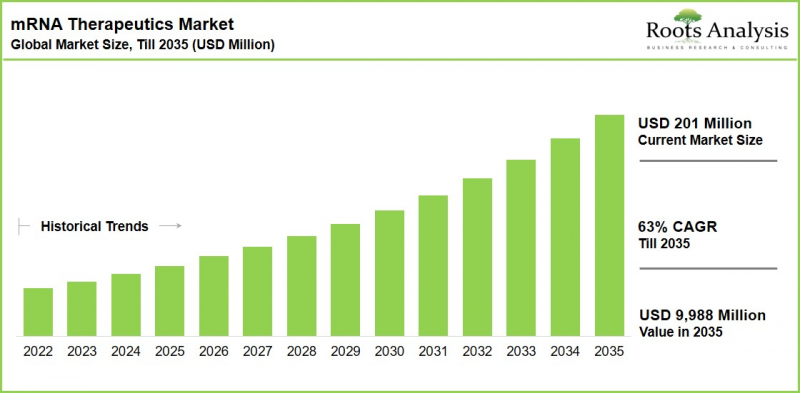
根據 Roots Analysis 的研究,全球 mRNA 療法市場(不包括 COVID 相關應用)預計將從目前的 2.01 億美元成長到 2035 年的 99.88 億美元,預測期內的複合年成長率約為 63%。
mRNA療法市場:成長與趨勢
在過去的十年中,傳訊RNA (mRNA)療法已成為生物製藥開發領域最重要的技術平台之一。與依賴外部合成的蛋白質、單株抗體和小分子化合物不同,基於mRNA的療法將合成的遺傳訊息直接遞送至患者自身的細胞,從而實現標靶治療性蛋白質的臨時性和按需生產。這種模組化平台只需使用相同的生產過程和脂質奈米顆粒(LNP)遞送系統改變編碼訊息,即可針對多種疾病進行治療,從而縮短研發週期。
尤其是在預防性療法取得臨床和商業性成功之後,mRNA療法在腫瘤學、罕見疾病、心血管疾病和再生醫學等領域正蓬勃發展。在腫瘤學領域,研究人員正在設計編碼腫瘤相關抗原、免疫刺激細胞激素和患者特異性抗原的mRNA構建體,旨在誘導持續且靶向的抗腫瘤免疫反應。這種方法作為查核點抑制劑療法的補充,正日益受到關注。蛋白質替代療法旨在透過重複治療來恢復缺失或功能異常的蛋白質。這種方法能夠在延緩疾病進展的同時,避免DNA基因療法帶來的永久性基因改變。
此外,該產業正朝著垂直整合的方向發展。市場參與者透過將RNA構建體最佳化和脂質奈米顆粒遞送整合到企業內部,縮短了研發週期,提高了企業發展的靈活性。這種整合趨勢,加上持續的資本流入以及平台開發商與大型製藥公司之間戰略合作夥伴關係的拓展,正在鞏固mRNA療法在整個生物製藥行業中穩步成長的市場地位。
成長驅動力:支持市場擴張的因素
市場成長的驅動力在於全球癌症、罕見遺傳疾病和自體免疫疾病負擔的日益加重,促使對高度精準、標靶性和生物差異化治療方案的需求不斷成長。向精準醫療的轉變也加速了基於mRNA療法的研發。基因組學、生物標記研究和分子診斷的進步,正推動著更具標靶性、更有效、更安全的療法的開發。
此外,政府、創業投資人和製藥公司之間的策略合作正在擴大資金和投資活動。公共資助機構正在支援平台無關的RNA生產基礎設施,而私人投資則流入下一代遞送技術,包括非LNP遞送載體和組織選擇性靶向技術。
新興生物技術創新者與成熟製藥公司之間的戰略夥伴關係進一步降低了臨床開發風險,匯集了技術專長,並在新地區擴大了商業性影響力,所有這些都在預測期內推動了市場的成長軌跡。
mRNA治療藥物市場
市場規模和機會分析根據以下參數進行分類:
根據指示
- 非小細胞肺癌
- 惡性黑色素瘤
- 肌層浸潤性尿道上皮癌
- 丙酸血症
- 囊腫纖維化
按地區
- 北美洲
- 美國
- 加拿大
- 歐洲
- 德國
- 英國
- 法國
- 義大利
- 西班牙
- 其他歐洲國家
- 亞太地區
- 中國
- 日本
- 韓國
- 澳洲
mRNA療法市場:主要細分市場
非小細胞肺癌是此療法的主要適應症。
根據 Roots Analysis 的市場估值和詳細的臨床研發管線分析,預計到 2035 年,非小細胞肺癌 (NSCLC) 將成為目標適應症中佔比最大的疾病。這一主導地位源於 NSCLC 的全球高發病率、晚期患者巨大的未滿足醫療需求以及顯著的腫瘤異質性。這些未滿足的醫療需求使得 NSCLC 在免疫療法和基於患者特異性新抗原的個人化 mRNA 疫苗方面展現出巨大的潛力。此外,次世代定序(NGS) 技術的普及和人工智慧驅動的生物標記發現技術的進步也推動了 mRNA 療法在該適應症中的精準標靶化治療。
北美保持市場領先地位
預計到2035年,北美將繼續引領mRNA療法的區域市場。這一成長得益於其成熟的技術生態系統,以及眾多擁有臨床檢驗平台的創新研發公司。在mRNA療法大規模應用期間建立的符合GMP標準的生產基礎設施,目前正被重新利用,以支持該地區在腫瘤學和罕見疾病應用領域不斷擴展的研發管線。
亞太地區正在崛起成為成長最快的區域市場。
儘管北美仍保持主導地位,但預計亞太地區在預測期內將實現最高的複合年成長率。這一加速成長主要得益於中國、印度、韓國和日本生物技術投資的增加。在這些國家,政府主導的舉措正積極支持mRNA研究、國內生產能力建構和技術轉移合作。這些措施共同推動了該地區生物製藥基礎設施的擴展,進一步促進了亞太地區mRNA療法市場的成長。
本報告對全球 mRNA 療法市場進行了分析,提供了概述、背景、市場影響因素分析、市場規模趨勢和預測、按各個細分市場和地區/主要國家進行的詳細分析、競爭格局以及主要公司的概況。
目錄
第1章:序言
第2章:調查方法
第3章 市場動態
第4章 宏觀經濟指標
第5章摘要整理
第6章:引言
- 章節概要
- mRNA治療藥物
- mRNA遞送途徑
- mRNA遞送策略
- mRNA療法面臨的主要挑戰
- 前景
第7章 市場狀況
- 章節概要
- mRNA療法:市場現狀
- mRNA療法:研發進展
第8章:產品競爭力分析
- 章節概要
- 前提條件和關鍵參數
- 調查方法
- mRNA療法:產品競爭力分析
第9章 公司簡介:總部位於北美的mRNA治療藥物研發公司
- 章節概要
- 一家總部位於北美的mRNA藥物開發公司
- Arcturus Therapeutics
- Immorna
- Moderna
- Providence Therapeutics
- Innovac Therapeutics
- Kernal Biologics
- Recode Therapeutics
- Rejuvenation Technologies
- RNAimmune
- Turn Biotechnologies
- Strand Therapeutics
第10章 公司簡介:總部位於歐洲的mRNA治療藥物研發公司
- 章節概要
- 一家總部位於歐洲的mRNA藥物開發公司
- BioNTech
- CureVac
- Ethris
第11章 公司簡介:亞太地區mRNA治療藥物研發公司
- 章節概要
- 總部位於亞太地區的mRNA療法研發公司。
- Suzhou Abogen Biosciences
- Gennova Biopharmaceuticals
- RNACure
- Walvax
第12章:主要製藥公司的舉措
- 章節概要
- 研究範圍和調查方法
- mRNA治療藥物市場:主要公司的舉措
- 基準分析:大型製藥企業
- 結論
第13章:新創企業健康指標
- 章節概要
- 專注於mRNA療法的新創公司。
- 新創公司基準分析
- 新創公司健康指數
第14章 臨床試驗分析
- 章節概要
- 研究範圍和調查方法
- mRNA療法:臨床試驗分析
第15章 夥伴關係與合作
- 章節概要
- 合作模式
- mRNA治療市場:合作與夥伴關係
第16章資金籌措與投資
- 章節概要
- 資金籌措模式
- mRNA治療藥物市場:資金籌措與投資分析
- 資金籌措和投資概況
第17章 專利分析
- 章節概要
- 研究範圍和調查方法
- mRNA療法:專利分析
- 專利基準分析
- 專利評估
- 被引用次數最多的專利
第18章:FDA核准策略
- 章節概要
- 調查方法
- 關鍵參數
- 導致以mRNA療法為基礎的臨床試驗失敗的常見原因
- 基準分析:mRNA療法關鍵策略的分佈
第19章 外包:可行/不可行框架
- 章節概要
- 外包:Go/NoGo 框架
- mRNA治療藥物外包:Go/NoGo框架
第20章 市場影響分析
- 章節概要
- 市場促進因素
- 市場限制因素
- 市場機遇
- 市場挑戰
- 結論
第21章:全球mRNA治療市場
- 章節概要
- 先決條件和調查方法
- 全球mRNA治療藥物市場預測
- 主要市場區隔
第22章 mRNA治療藥物市場:以標靶適應症分類
- 章節概要
- 關鍵假設和調查方法
- mRNA治療藥物市場:依適應症分類
- 非小細胞肺癌
- 惡性黑色素瘤
- 肌層浸潤性尿道上皮癌
- 丙酸血症
- 囊腫纖維化
- 數據三角測量與檢驗
第23章 mRNA治療藥物市場:依地區分類
- 章節概要
- 關鍵假設和調查方法
- mRNA治療藥物市場:區域分佈
- 北美洲
- 歐洲
- 亞太地區
- 市場動態評估:按地區分類
- 數據三角測量與檢驗
第24章 市場機會分析:北美
- mRNA治療藥物市場:依適應症分類
- 非小細胞肺癌
- 黑色素瘤治療藥物
- 肌層浸潤性尿道上皮癌
- 丙酸血症
- 囊腫纖維化
第25章 市場機會分析:歐洲
- mRNA治療藥物市場:依適應症分類
- 非小細胞肺癌
- 黑色素瘤治療藥物
- 肌層浸潤性尿道上皮癌
- 丙酸血症
- 囊腫纖維化
第26章 市場機會分析:亞太地區
- mRNA治療藥物市場:依適應症分類
- 非小細胞肺癌
- 黑色素瘤治療藥物
- 肌層浸潤性尿道上皮癌
- 丙酸血症
- 囊腫纖維化
第27章 結論
第28章 高階主管洞察
第29章附錄1:表格形式數據
第30章 附錄2:公司與組織列表
mRNA THERAPEUTICS MARKET: OVERVIEW
As per Roots Analysis, the global mRNA therapeutics market (growth opportunities beyond COVID applications) is estimated to grow from USD 201 million in the current year to USD 9,988 million by 2035, reflecting a compound annual growth rate (CAGR) of approximately 63% during the forecast period.
mRNA Therapeutics Market: Growth and Trends
Messenger RNA (mRNA) therapeutics represent one of the most consequential technology platforms to have entered mainstream biopharmaceutical development in the past decade. Rather than relying on externally manufactured proteins, monoclonal antibodies, or small molecules, mRNA-based interventions deliver synthetic genetic instructions directly into a patient's own cells, prompting transient, on-demand production of a therapeutic protein of interest. This modular platform enables the same manufacturing process and LNP delivery system to target multiple diseases by changing the encoded reducing development timelines.
Notably, following the clinical and commercial success of prophylactic therapeutics, the mRNA therapeutics field is advancing across oncology, rare diseases, cardiovascular disorders, and regenerative medicine. Within oncology, mRNA constructs are being engineered to encode tumor-associated antigens, immune-stimulatory cytokines, and patient-specific , with the objective of provoking a durable, targeted anti-tumor immune response. It is an approach that is increasingly viewed as complementary to checkpoint inhibition. For rare genetic disorders, protein replacement therapies aim to restore missing or faulty proteins through repeated treatment. This approach can slow disease progression while avoiding the permanent genetic changes associated with DNA-based gene therapy.
Industry is also shifting toward vertical integration, as market players seek to internalize both RNA construct optimization and lipid nanoparticle delivery in order to shorten iteration cycles and strengthen freedom-to-operate. This consolidation trend, combined with sustained capital inflows and an expanding base of strategic partnerships between platform originators and large pharmaceutical companies, is positioning mRNA therapeutics as a steadily growing market within the broader biopharmaceutical industry.
Growth Drivers: Factors Fueling Expansion
Growth of the market is underpinned by the rising global burden of oncological, rare genetic, and autoimmune conditions, which is intensifying demand for precisely targeted, biologically differentiated treatment options. The shift toward precision medicine is accelerating the development of mRNA-based therapies. Advances in genomics, biomarker research, and molecular diagnostics are enabling more targeted treatments with improved efficacy and safety.
Further, the growing funding and investment activities from governments, venture investors, and strategic pharmaceutical partnerships. Public funding agencies are backing platform-agnostic RNA manufacturing infrastructure, while private investment is flowing into next-generation delivery science, including non-LNP delivery vehicles and tissue-selective targeting chemistries.
Strategic collaborations between emerging biotechnology innovators and established pharmaceutical companies are further de-risking clinical development, pooling technical expertise, and extending commercial reach into new geographies which collectively reinforce the market's growth trajectory the forecast period.
Market Challenges: Critical Barriers Hindering Progress
Despite considerable scientific and commercial momentum, the mRNA therapeutics market continues to witness several barriers. Some of the significant challenges include achieving efficiency, tissue-selective, and repeat-dose-tolerant delivery beyond the liver and intramuscular compartments. This challenge continues to constrain the addressable set of indications for many programs. Further, the requirement of cold-chain logistics for storage and transportation of these therapeutics along with advanced manufacturing technologies may increase per-dose costs compared with those of small-molecule or many biologic alternatives, which can complicate reimbursement discussions in cost-sensitive markets.
Regulatory pathways for chronic and repeat-dosing mRNA therapeutics are still being established in most jurisdictions, creating approval-timeline uncertainty. Additionally, intense competition and intellectual property (IP) activity across lipid nanoparticle (LNP) and RNA construct technologies are increasing freedom-to-operate challenges, particularly for smaller developers. Furthermore, heightened public scrutiny of mRNA-based medicines in some markets following the COVID-19 pandemic underscores the need for transparent and proactive communication by industry stakeholders.
mRNA Therapeutics Market: Key Insights
The report delves into the current state of the mRNA therapeutics market and identifies potential growth opportunities within the industry. Some key findings include:
- Driven by the platform's inherent flexibility and the pressing need for differentiated treatment options, an expanding base of biotechnology innovators and large pharmaceutical companies is prioritizing mRNA-based drug development across oncology and rare disease indications.
- Several mRNA therapeutics are currently under active investigation across multiple stages of development; notably, approximately 70% of pipeline activity is concentrated among two developers, namely Moderna and BioNTech.
- Deal flow between platform owners and indication specialists continues to accelerate. In January 2026, Moderna partnered with Recordati to advance mRNA-3927, its investigational candidate for propionic acidemia, toward development and eventual commercialization.
- Capital inflows into mRNA-focused developers have risen steadily, giving companies more room to expand pipelines and candidates toward later-stage trials. Reprogram Biosciences illustrates this trend at the early stage, having raised USD 6 million in seed funding in May 2026 to advance an mRNA-based in situ cell reprogramming approach designed to convert tumors into antigen-presenting sites.
- More than 10% of the global mRNA therapeutics pipeline has reached Phase III, a relatively high late-stage share for an emerging modality and a signal of growing clinical maturity. Moderna and BioNTech together account for approximately 70% of active development activity, underscoring how concentrated pipeline leadership remains at this stage of the market.
- Patent filings tied to mRNA constructs, delivery systems and manufacturing processes have risen sharply over the past five years. This reflects both the pace of innovation and a defensive push by developers to protect platform technology that can be redeployed across many disease areas.
- Large pharmaceutical companies are increasingly partnering with or acquiring smaller mRNA-focused developers rather than building platforms internally. Pfizer has been the most active participant in this pattern, followed by Sanofi, which expanded its RNA capabilities through the acquisition of Translate Bio. Bayer has also entered this space through targeted collaborations.
mRNA Therapeutics Market
The market sizing and opportunity analysis has been segmented across the following parameters:
By Target Indication
- Non-Small Cell Lung Cancer
- Melanoma
- Muscle-Invasive Urothelial Carcinoma
- Propionic Acidemia
- Cystic Fibrosis
By Geographical Regions
- North America
- US
- Canada
- Europe
- Germany
- UK
- France
- Italy
- Spain
- Rest of Europe
- Asia-Pacific
- China
- Japan
- South Korea
- Australia
mRNA Therapeutics Market: Key Segments
Non-Small Cell Lung Cancer Leads the Target Indication Landscape
Based on Roots Analysis market assessment and detailed clinical pipeline analysis, non-small cell lung cancer (NSCLC) is projected to hold the highest share among target indications by 2035. This dominance is driven by the global prevalence of NSCLC, the substantial unmet need among patients diagnosed at advanced stages, and the pronounced tumor heterogeneity. These unmet needs make the indication particularly well suited to immunotherapy-driven and personalized neoantigen-based mRNA vaccine approaches. Further, rising adoption of next-generation sequencing and AI-enabled biomarker discovery is further strengthening the precision-targeting rationale for mRNA-based interventions in this indication.
North America Maintains Market Leadership
North America is expected to lead the regional market for mRNA therapeutics through 2035. This growth is supported by a well-established technology ecosystem featuring pioneering developers with clinically validated platforms. GMP-compliant manufacturing infrastructure built during the large-scale rollout of mRNA-based therapeutics are now being redeployed to support an expanding pipeline across oncology and rare disease applications in this region.
Asia-Pacific Emerges as the Fastest-Growing Regional Market
While North America continues to lead , Asia-Pacific is projected to register the highest CAGR during the forecast period. This accelerated growth is being driven by rising biotechnology investment across China, India, South Korea, and Japan, where government-backed initiatives are actively supporting mRNA research, domestic manufacturing capacity, and technology-transfer partnerships. These initiatives are collectively expanding the region's biopharmaceutical infrastructure, which further supports the mRNA therapeutics market growth in Asia-Pacific.
Example Players in mRNA Therapeutics Market
- Arcturus Therapeutics
- BioNTech
- CureVac
- Moderna
- Providence Therapeutics
- RNAimmune (subsidiary of Sirnaomics)
- Recode Therapeutics
- Suzhou Abogen Biosciences
- Turn Biotechnologies
- Walvax
Expert Interview and Industry Insights
The opinions and insights presented in this study were influenced by discussions conducted with multiple stakeholders across the mRNA therapeutics. The research features detailed transcripts of interviews held with the following industry stakeholders:
- Business Development Manager, Mid-sized Organization, Australia
- Senior Director Business Development, Large Organization, Belgium
- Team Leader, Large Organization, South Korea
In addition, the market report includes transcripts of the following other third-party discussions:
- Director of Advanced Drug Delivery, Mid-sized Organization, UK
- Deputy Director, Mid-sized Organization, US
- Co-founder and Chief Executive Officer, Mid-sized Organization, Germany
- Co-founder, Large Organization, Germany
- Chief Executive Officer, Large Organization, US
- Chief Executive Officer, Mid-sized Organization, US
- Chief Executive Officer, Large Organization, US
- Chief Executive Officer, Large Organization, Italy
- President, Mid-sized Organization, Switzerland
- Medical Professional, Large Organization, Germany
mRNA THERAPEUTICS MARKET: RESEARCH COVERAGE
- Market Sizing and Opportunity Analysis: An in-depth analysis of the mRNA therapeutics market, focusing on key segments, including target indication, geographical regions, and sales forecast of therapeutics.
- mRNA Therapeutics Landscape: A detailed assessment of the current development landscape, featuring information on stage of development, target indication, route of administration, delivery technology, and type of sponsor. Additionally, developer-level analysis based on year of establishment, company size, and location of headquarters.
- Company Profiles: In-depth profiles of prominent players engaged in mRNA therapeutics development, featuring their year of establishment, location of headquarters, company size, management team, portfolio, and key initiatives.
- Clinical Trial Analysis: An analysis of completed and ongoing clinical trials, based on trial registration year, enrolled patient population, trial phase, trial status, type of sponsor / collaborator, study design, and geography.
- Patent Analysis: An analysis of patents filed / granted related to mRNA constructs and delivery technologies since 2022, based on patent type, application and publication year, jurisdiction, CPC symbols, and type of applicant.
- Partnerships and Collaborations: An analysis of partnerships established in the past few years, based on the type of partnership, year of agreement, and geography of partnering companies.
- Funding and Investment Analysis: An analysis of investments made in this domain, including seed financing, venture capital rounds, and grants, highlighting the growing investor interest in mRNA-based platforms.
- Recent Developments: A detailed analysis of recent developments in this industry, including partnerships, funding activity, and other strategic initiatives undertaken by key stakeholders.
- Porter's Five Forces Analysis: A qualitative analysis of five competitive forces in this domain, namely, threat of new entrants, bargaining power of buyers, bargaining power of suppliers, threat of substitutes, and competitive rivalry.
- Market Impact Analysis: The report analyzes the various drivers, restraints, opportunities, and challenges affecting the growth of the mRNA therapeutics market.
Key Questions Answered in this Report
- Which are the leading companies in the mRNA therapeutics market?
- Which region dominates the mRNA therapeutics market?
- What are the key trends observed in the mRNA therapeutics market?
- What factors are likely to influence the evolution of this market?
- What are the primary challenges faced by mRNA therapeutics developers?
- What is the current and future market size?
- What is the CAGR of this market?
- How is the current and future market opportunity likely to be distributed across key market segments?
Reasons to Buy this Report
This study has been designed to serve as an investor and business-development-ready resource, differentiated from generic market sizing decks in the following:
- Forward-LookingNon-COVID Opportunity Sizing: Market estimates isolate the durable, non-pandemic-dependent opportunity for mRNA therapeutics, giving investors a clean view of the platform's long-term commercial potential across oncology and rare disease.
- Triangulated, Bottom-Up and Top-Down Forecasting: Revenue projections combine top-down category sizing with bottom-up, pipeline-level clinical and commercial assumptions, validated through primary interviews with active industry stakeholders.
- Multivariate Scenario Modelling: Conservative and optimistic scenario forecasts are provided alongside the base case, allowing investors and corporate strategy teams to stress-test assumptions under varying clinical and regulatory outcomes.
- Granular Segment-Level Transparency: Five-year and ten-year forecasts are available at the level of individual target indications and countries, supporting precise capital allocation and licensing / partnering decisions.
- Decision-Ready Company Intelligence: Profiles combine portfolio, pipeline, financial, and initiative-level data on both large pharmaceutical companies and emerging platform innovators, streamlining due diligence and competitive benchmarking.
- Deal and Funding Signal Tracking: Dedicated partnership, licensing, and funding analyses surface real-time strategic signals, critical inputs for M&A screening, co-investment, and licensing-out strategies.
Additional Benefits
- Complementary Excel Data Packs for all Analytical Modules in the Report
- 15% Free Content Customization
- Detailed Report Walkthrough Session with Research Team
- Free Updated report if the report is 6-12 months old or older
TABLE OF CONTENTS
1. PREFACE
- 1.1. Introduction
- 1.2. Market Share Insights
- 1.3. Key Market Insights
- 1.4. Report Coverage
- 1.5. Key Questions Answered
- 1.6. Chapter Outlines
2. RESEARCH METHODOLOGY
- 2.1. Chapter Overview
- 2.2. Research Assumptions
- 2.2.1. Market Landscape and Market Trends
- 2.2.2. Market Forecast and Opportunity Analysis
- 2.2.3. Comparative Analysis
- 2.3. Database Building
- 2.3.1. Data Collection
- 2.3.2. Data Validation
- 2.3.3. Data Analysis
- 2.4. Project Methodology
- 2.4.1. Secondary Research
- 2.4.1.1. Annual Reports
- 2.4.1.2. Academic Research Papers
- 2.4.1.3. Company Websites
- 2.4.1.4. Investor Presentations
- 2.4.1.5. Regulatory Filings
- 2.4.1.6. White Papers
- 2.4.1.7. Industry Publications
- 2.4.1.8. Conferences and Seminars
- 2.4.1.9. Government Portals
- 2.4.1.10. Media and Press Releases
- 2.4.1.11. Newsletters
- 2.4.1.12. Industry Databases
- 2.4.1.13. Roots Proprietary Databases
- 2.4.1.14. Paid Databases and Sources
- 2.4.1.15. Social Media Portals
- 2.4.1.16. Other Secondary Sources
- 2.4.2. Primary Research
- 2.4.2.1. Types of Primary Research
- 2.4.2.1.1. Qualitative Research
- 2.4.2.1.2. Quantitative Research
- 2.4.2.1.3. Hybrid Approach
- 2.4.2.2. Advantages of Primary Research
- 2.4.2.3. Techniques for Primary Research
- 2.4.2.3.1. Interviews
- 2.4.2.3.2. Surveys
- 2.4.2.3.3. Focus Groups
- 2.4.2.3.4. Observational Research
- 2.4.2.3.5. Social Media Interactions
- 2.4.2.4. Key Opinion Leaders Considered in Primary Research
- 2.4.2.4.1. Company Executives (CXOs)
- 2.4.2.4.2. Board of Directors
- 2.4.2.4.3. Company Presidents and Vice Presidents
- 2.4.2.4.4. Research and Development Heads
- 2.4.2.4.5. Technical Experts
- 2.4.2.4.6. Subject Matter Experts
- 2.4.2.4.7. Scientists
- 2.4.2.4.8. Doctors and Other Healthcare Providers
- 2.4.2.5. Ethics and Integrity
- 2.4.2.5.1. Research Ethics
- 2.4.2.5.2. Data Integrity
- 2.4.2.1. Types of Primary Research
- 2.4.3. Analytical Tools and Databases
- 2.4.1. Secondary Research
- 2.5. Robust Quality Control
3. MARKET DYNAMICS
- 3.1. Chapter Overview
- 3.2. Forecast Methodology
- 3.2.1. Top-down Approach
- 3.2.2. Bottom-up Approach
- 3.2.3. Hybrid Approach
- 3.3. Market Assessment Framework
- 3.3.1. Total Addressable Market (TAM)
- 3.3.2. Serviceable Addressable Market (SAM)
- 3.3.3. Serviceable Obtainable Market (SOM)
- 3.3.4. Currently Acquired Market (CAM)
- 3.4. Forecasting Tools and Techniques
- 3.4.1. Qualitative Forecasting
- 3.4.2. Correlation
- 3.4.3. Regression
- 3.4.4. Extrapolation
- 3.4.5. Convergence
- 3.4.6. Sensitivity Analysis
- 3.4.7. Scenario Planning
- 3.4.8. Data Visualization
- 3.4.9. Time Series Analysis
- 3.4.10. Forecast Error Analysis
- 3.5. Key Considerations
- 3.5.1. Demographics
- 3.5.2. Government Regulations
- 3.5.3. Reimbursement Scenarios
- 3.5.4. Market Access
- 3.5.5. Supply Chain
- 3.5.6. Industry Consolidation
- 3.5.7. Pandemic / Unforeseen Disruptions Impact
- 3.6. Limitations
4. MACRO-ECONOMIC INDICATORS
- 4.1. Chapter Overview
- 4.2. Market Dynamics
- 4.2.1. Time Period
- 4.2.1.1. Historical Trends
- 4.2.1.2. Current and Forecasted Estimates
- 4.2.2. Currency Coverage
- 4.2.2.1. Major Currencies Affecting the Market
- 4.2.2.2. Factors Affecting Currency Fluctuations in the Industry
- 4.2.2.3. Impact of Currency Fluctuations on the Industry
- 4.2.3. Foreign Currency Exchange Rate
- 4.2.3.1. Impact of Foreign Exchange Rate Volatility on the Market
- 4.2.3.2. Strategies for Mitigating Foreign Exchange Risk
- 4.2.4. Recession
- 4.2.4.1. Assessment of Current Economic Conditions and Potential Impact on the Market
- 4.2.4.2. Historical Analysis of Past Recessions and Lessons Learnt
- 4.2.5. Inflation
- 4.2.5.1. Measurement and Analysis of Inflationary Pressures in the Economy
- 4.2.5.2. Potential Impact of Inflation on the Market Evolution
- 4.2.6. Interest Rates
- 4.2.6.1. Interest Rates and Their Impact on the Market
- 4.2.6.2. Strategies for Managing Interest Rate Risk
- 4.2.7. Commodity Flow Analysis
- 4.2.7.1. Type of Commodity
- 4.2.7.2. Origins and Destinations
- 4.2.7.3. Values and Weights
- 4.2.7.4. Modes of Transportation
- 4.2.8. Global Trade Dynamics
- 4.2.8.1. Import Scenario
- 4.2.8.2. Export Scenario
- 4.2.8.3. Trade Policies
- 4.2.8.4. Strategies for Mitigating the Risks Associated with Trade Barriers
- 4.2.8.5. Impact of Trade Barriers on the Market
- 4.2.9. War Impact Analysis
- 4.2.9.1. Russia-Ukraine War
- 4.2.9.2. Israel-Hamas War
- 4.2.10. COVID Impact / Related Factors
- 4.2.10.1. Global Economic Impact
- 4.2.10.2. Industry-specific Impact
- 4.2.10.3. Government Response and Stimulus Measures
- 4.2.10.4. Future Outlook and Adaptation Strategies
- 4.2.11. Other Indicators
- 4.2.11.1. Fiscal Policy
- 4.2.11.2. Consumer Spending
- 4.2.11.3. Gross Domestic Product
- 4.2.11.4. Employment
- 4.2.11.5. Taxes
- 4.2.11.6. Stock Market Performance
- 4.2.11.7. Cross Border Dynamics
- 4.2.1. Time Period
- 4.3. Conclusion
5. EXECUTIVE SUMMARY
6. INTRODUCTION
- 6.1. Chapter Overview
- 6.2. mRNA Therapeutics
- 6.2.1. Advantages of mRNA Therapeutics
- 6.2.2. Key Applications of mRNA Therapeutics
- 6.3. mRNA Therapeutics
- 6.3.1. Advantages of mRNA Therapeutics
- 6.3.2. Key Applications of mRNA Therapeutics
- 6.4. mRNA Delivery Routes
- 6.5. mRNA Delivery Strategies
- 6.6. Key Challenges Associated with mRNA Therapeutics
- 6.7. Future Perspectives
7. MARKET LANDSCAPE
- 7.1. Chapter Overview
- 7.2. mRNA Therapeutics: Overall Market Landscape
- 7.2.1. Analysis by Status of Development
- 7.2.2. Analysis by Type of Drug Candidate
- 7.2.3. Analysis by Type of Program
- 7.2.4. Analysis by Type of Delivery System
- 7.2.5. Analysis by Type of Molecule Encoded
- 7.2.6. Analysis by Route of Administration
- 7.2.7. Analysis by Therapeutic Area
- 7.3. mRNA Therapeutics: Developer Landscape
- 7.3.1. Analysis by Year of Establishment
- 7.3.2. Analysis by Company Size
- 7.3.3. Analysis by Location of Headquarters
- 7.3.4. Most Active Developers: Analysis by Number of Drugs Developed
8. PRODUCT COMPETITIVENESS ANALYSIS
- 8.1. Chapter Overview
- 8.2. Assumptions and Key Parameters
- 8.3. Methodology
- 8.4. mRNA Therapeutics: Product Competitiveness Analysis
- 8.4.1. mRNA Therapeutics Developed by Players based in North America
- 8.4.2. mRNA Therapeutics Developed by Players based in Europe
- 8.4.3. mRNA Therapeutics Developed by Players based in Asia-Pacific and Rest of the World
9. COMPANY PROFILES: mRNA THERAPEUTICS DEVELOPERS BASED IN NORTH AMERICA
- 9.1. Chapter Overview
- 9.2. Leading Developers in mRNA Therapeutics Market based in North America
- 9.2.1. Arcturus Therapeutics
- 9.2.1.1. Company Overview
- 9.2.1.2. Financial Information
- 9.2.1.3. mRNA Therapeutics Portfolio
- 9.2.1.4. Recent Developments and Future Outlook
- 9.2.2. Immorna
- 9.2.2.1. Company Overview
- 9.2.2.2. mRNA Therapeutics Portfolio
- 9.2.2.3. Recent Developments and Future Outlook
- 9.2.3. Moderna
- 9.2.3.1. Company Overview
- 9.2.3.2. Financial Information
- 9.2.3.3. mRNA Therapeutics Portfolio
- 9.2.3.4. Recent Developments and Future Outlook
- 9.2.4. Providence Therapeutics
- 9.2.4.1. Company Overview
- 9.2.4.2. Financial Information
- 9.2.4.3. mRNA Therapeutics Portfolio
- 9.2.4.4. Recent Developments and Future Outlook
- 9.2.5. Innovac Therapeutics
- 9.2.5.1. Company Overview
- 9.2.5.2. mRNA Therapeutics Portfolio
- 9.2.5.3. Recent Developments and Future Outlook
- 9.2.6. Kernal Biologics
- 9.2.6.1. Company Overview
- 9.2.6.2. Financial Information
- 9.2.6.3. mRNA Therapeutics Portfolio
- 9.2.6.4. Recent Developments and Future Outlook
- 9.2.7. Recode Therapeutics
- 9.2.7.1. Company Overview
- 9.2.7.2. Financial Information
- 9.2.7.3. mRNA Therapeutics Portfolio
- 9.2.7.4. Recent Developments and Future Outlook
- 9.2.8. Rejuvenation Technologies
- 9.2.8.1. Company Overview
- 9.2.8.2. Financial Information
- 9.2.8.3. mRNA Therapeutics Portfolio
- 9.2.8.4. Recent Developments and Future Outlook
- 9.2.9. RNAimmune
- 9.2.9.1. Company Overview
- 9.2.9.2. Financial Information
- 9.2.9.3. mRNA Therapeutics Portfolio
- 9.2.9.4. Recent Developments and Future Outlook
- 9.2.10. Turn Biotechnologies
- 9.2.10.1. Company Overview
- 9.2.10.2. Financial Information
- 9.2.10.3. mRNA Therapeutics Portfolio
- 9.2.10.4. Recent Developments and Future Outlook
- 9.2.11. Strand Therapeutics
- 9.2.11.1. Company Overview
- 9.2.11.2. Financial Information
- 9.2.11.3. mRNA Therapeutics Portfolio
- 9.2.11.4. Recent Developments and Future Outlook
- 9.2.1. Arcturus Therapeutics
10. COMPANY PROFILES: mRNA THERAPEUTICS DEVELOPERS BASED IN EUROPE
- 10.1. Chapter Overview
- 10.2. Leading Developers in mRNA Therapeutics Market based in North America
- 10.2.1. BioNTech
- 10.2.1.1. Company Overview
- 10.2.1.2. Financial Information
- 10.2.1.3. mRNA Therapeutics Portfolio
- 10.2.1.4. Recent Developments and Future Outlook
- 10.2.2. CureVac
- 10.2.2.1. Company Overview
- 10.2.2.2. Financial Information
- 10.2.2.3. mRNA Therapeutics Portfolio
- 10.2.2.4. Recent Developments and Future Outlook
- 10.2.3. Ethris
- 10.2.3.1. Company Overview
- 10.2.3.2. mRNA Therapeutics Portfolio
- 10.2.3.3. Recent Developments and Future Outlook
- 10.2.1. BioNTech
11. COMPANY PROFILES: mRNA THERAPEUTICS DEVELOPERS BASED IN ASIA-PACIFIC
- 11.1. Chapter Overview
- 11.2. Leading Developers in mRNA Therapeutics Market based in North America
- 11.2.1. Suzhou Abogen Biosciences
- 11.2.1.1. Company Overview
- 11.2.1.2. mRNA Therapeutics Portfolio
- 11.2.1.3. Recent Developments and Future Outlook
- 11.2.2. Gennova Biopharmaceuticals
- 11.2.2.1. Company Overview
- 11.2.2.2. Financial Information
- 11.2.2.3. mRNA Therapeutics Portfolio
- 11.2.2.4. Recent Developments and Future Outlook
- 11.2.3. RNACure
- 11.2.3.1. Company Overview
- 11.2.3.2. mRNA Therapeutics Portfolio
- 11.2.3.3. Recent Developments and Future Outlook
- 11.2.4. Walvax
- 11.2.4.1. Company Overview
- 11.2.4.2. Financial Information
- 11.2.4.3. mRNA Therapeutics Portfolio
- 11.2.4.4. Recent Developments and Future Outlook
- 11.2.1. Suzhou Abogen Biosciences
12. BIG PHARMA INITIATIVES
- 12.1. Chapter Overview
- 12.2. Scope and Methodology
- 12.3. mRNA Therapeutics Market: Big Player Initiatives
- 12.3.1. Analysis by Year of Initiative
- 12.3.2. Analysis by Type of Initiative
- 12.3.3. Analysis by Year and Type of Initiative
- 12.3.4. Analysis by Type of Partnership
- 12.3.5. Analysis by Type of Expansion
- 12.3.6. Analysis by Year of Initiative and Company
- 12.3.7. Big Pharma Players: Analysis by Number of Initiatives
- 12.4. Benchmarking Analysis: Big Pharma Players
- 12.4.1. Spider Web Analysis: Bayer
- 12.4.2. Spider Web Analysis: Pfizer
- 12.4.3. Spider Web Analysis: Sanofi
- 12.5. Concluding Remarks
13. START-UP HEALTH INDEXING
- 13.1. Chapter Overview
- 13.2. Start-ups focused on mRNA Therapeutics
- 13.3. Benchmarking of Start-ups
- 13.4. Startup-Health Indexing
- 13.4.1. Analysis by Location of Headquarters
- 13.4.2. Analysis by Company Strength
- 13.4.3. Analysis by Pipeline Maturity
- 13.4.4. Analysis by Pipeline Strength
- 13.4.5. Analysis by Financial Support
- 13.4.6. Analysis by Investor Strength
- 13.4.7. Analysis by Partnership Activity
- 13.4.8. Start-ups Health Indexing: Roots Analysis Perspective
14. CLINICAL TRIAL ANALYSIS
- 14.1. Chapter Overview
- 14.2. Scope and Methodology
- 14.3. mRNA Therapeutics: Clinical Trial Analysis
- 14.3.1. Analysis by Trial Registration Year
- 14.3.2. Analysis of Number of Patients Enrolled by Trial Registration Year
- 14.3.3. Analysis by Trial Phase
- 14.3.4. Analysis of Number of Patients Enrolled by Trial Phase
- 14.3.5. Analysis by Trial Status
- 14.3.6. Analysis by Trial Registration Year and Trial Status
- 14.3.7. Analysis by Patient Gender
- 14.3.8. Analysis by Study Design
- 14.3.8.1. Analysis by Type of Allocation
- 14.3.8.2. Analysis by Type of Intervention Model
- 14.3.8.3. Analysis by Type of Masking
- 14.3.8.4. Analysis by Trial Purpose
- 14.3.9. Analysis by Type of Sponsor / Collaborator
- 14.3.10. Analysis by Geography
- 14.3.10.1. Analysis of Clinical Trials by Geography
- 14.3.10.2. Analysis of Clinical Trials by Geography and Trial Status
- 14.3.10.3. Analysis of Patients Enrolled by Geography and Trial Status
15. PARTNERSHIPS AND COLLABORATIONS
- 15.1. Chapter Overview
- 15.2. Partnership Models
- 15.3. mRNA Therapeutics Market: Partnerships and Collaborations
- 15.3.1. Analysis by Year of Partnership
- 15.3.2. Analysis by Type of Partnership
- 15.3.3. Analysis by Year and Type of Partnership
- 15.3.4. Analysis by Therapeutic Area
- 15.3.5. Most Active Players: Analysis by Number of Partnerships
- 15.3.6. Analysis by Geography
- 15.3.6.1. Intercontinental and Intracontinental Agreements
- 15.3.6.2. Local and International Agreements
16. FUNDING AND INVESTMENTS
- 16.1. Chapter Overview
- 16.2. Funding Models
- 16.3. mRNA Therapeutics Market: Funding and Investment Analysis
- 16.3.1. Analysis by Year of Funding
- 16.3.1.1. Cumulative Year-wise Trend of Funding Instances
- 16.3.1.2. Cumulative Year-wise Trend of Amount Invested
- 16.3.2. Analysis by Type of Funding
- 16.3.2.1. Analysis of Funding Instances
- 16.3.2.2. Analysis of Amount Invested
- 16.3.3. Analysis by Year and Type of Funding
- 16.3.4. Analysis by Amount Raised by Year and Type of Funding
- 16.3.5. Analysis by Therapeutic Area
- 16.3.6. Most Active Players: Analysis by Number of Funding Instances
- 16.3.7. Most Active Players: Analysis by Amount Raised
- 16.3.8. Analysis by Geography
- 16.3.9. Most Active Players: Analysis by Number of Funding Instances
- 16.3.10. Most Active Players: Analysis by Amount Invested
- 16.3.1. Analysis by Year of Funding
- 16.4. Summary of Funding and Investments
17. PATENT ANALYSIS
- 17.1. Chapter Overview
- 17.2. Scope and Methodology
- 17.3. mRNA Therapeutics: Patent Analysis
- 17.3.1. Analysis by Type of Patent
- 17.3.2. Analysis by Patent Publication Year
- 17.3.3. Analysis by Type of Patent and Publication Year
- 17.3.4. Analysis by Patent Application Year
- 17.3.5. Analysis by Patent Jurisdiction
- 17.3.6. Analysis by CPC Symbols
- 17.3.7. Analysis by Type of Applicant
- 17.3.8. Leading Industry Players: Analysis by Number of Patents
- 17.3.9. Leading Non-Industry Players: Analysis by Number of Patents
- 17.3.10. Leading Inventors: Analysis by Number of Patents
- 17.4. Patent Benchmarking Analysis
- 17.4.1. Analysis of Patent Characteristics
- 17.5. Patent Valuation
- 17.6. Leading Patents by Number of Citations
18. FDA APPROVAL STRATEGIES
- 18.1. Chapter Overview
- 18.2. Methodology
- 18.3. Key Parameters
- 18.4. General Reasons for Failure of Trials Focused on mRNA Therapeutics
- 18.5. Benchmarking Analysis: Distribution of Key Strategies by mRNA Therapeutics
19. OUTSOURCING: GO / NO-GO FRAMEWORK
- 19.1. Chapter Overview
- 19.2. Outsourcing: Go / No-Go Framework
- 19.3. mRNA Therapeutics Outsourcing: Go / No-Go Framework
- 19.3.1. Key Parameters and Assumptions
- 19.3.2. Methodology
- 19.3.3. Results and Interpretations
- 19.3.3.1. Outsourcing: Go / No-Go Framework for Small Companies
- 19.3.3.2. Outsourcing: Go / No-Go Framework for Mid-Sized Companies
- 19.3.3.3. Outsourcing: Go / No-Go Framework for Large Companies
20. MARKET IMPACT ANALYSIS
- 20.1. Chapter Overview
- 20.2. Market Drivers
- 20.3. Market Restraints
- 20.4. Market Opportunities
- 20.5. Market Challenges
- 20.6. Conclusion
21. GLOBAL mRNA THERAPEUTICS MARKET
- 21.1. Chapter Overview
- 21.2. Assumptions and Methodology
- 21.3. Global mRNA Therapeutics Market, Forecasted Estimates (Till 2035)
- 21.3.1. Scenario Analysis
- 21.3.1.1. Conservative Scenario
- 21.3.1.2. Optimistic Scenario
- 21.3.1. Scenario Analysis
- 21.4. Key Market Segmentations
22. mRNA THERAPEUTICS MARKET, BY TARGET INDICATION
- 22.1. Chapter Overview
- 22.2. Key Assumptions and Methodology
- 22.3. mRNA Therapeutics Market: Distribution by Target Indication
- 22.3.1. mRNA Therapeutics Market for Non-Small Cell Lung Cancer, Forecasted Estimates (Till 2035)
- 22.3.2. mRNA Therapeutics Market for Melanoma, Forecasted Estimates (Till 2035)
- 22.3.3. mRNA Therapeutics Market for Muscle-Invasive Urothelial Carcinoma, Forecasted Estimates (Till 2035)
- 22.3.4. mRNA Therapeutics Market for Propionic Acidemia, Forecasted Estimates (Till 2035)
- 22.3.5. mRNA Therapeutics Market for Cystic Fibrosis, Forecasted Estimates (Till 2035)
- 22.4. Data Triangulation and Validation
23. mRNA THERAPEUTICS MARKET, BY GEOGRAPHICAL REGIONS
- 23.1. Chapter Overview
- 23.2. Key Assumptions and Methodology
- 23.3. mRNA Therapeutics Market: Distribution by Geographical Regions
- 23.3.1. mRNA Therapeutics Market in North America, Forecasted Estimates (Till 2035)
- 23.3.1.1. mRNA Therapeutics Market in the US, Forecasted Estimates (Till 2035)
- 23.3.1.2. mRNA Therapeutics Market in Canada, Forecasted Estimates (Till 2035)
- 23.3.2. mRNA Therapeutics Market in Europe, Forecasted Estimates (Till 2035)
- 23.3.2.1. mRNA Therapeutics Market in Germany, Forecasted Estimates (Till 2035)
- 23.3.2.2. mRNA Therapeutics Market in France, Forecasted Estimates (Till 2035)
- 23.3.2.3. mRNA Therapeutics Market in Italy, Forecasted Estimates (Till 2035)
- 23.3.2.4. mRNA Therapeutics Market in UK, Forecasted Estimates (Till 2035)
- 23.3.2.5. mRNA Therapeutics Market in Spain, Forecasted Estimates (Till 2035)
- 23.3.2.6. mRNA Therapeutics Market in Rest of Europe, Forecasted Estimates (Till 2035)
- 23.3.3. mRNA Therapeutics Market in Asia-Pacific, Forecasted Estimates (Till 2035)
- 23.3.3.1. mRNA Therapeutics Market in China, Forecasted Estimates (Till 2035)
- 23.3.3.2. mRNA Therapeutics Market in Japan, Forecasted Estimates (Till 2035)
- 23.3.3.3. mRNA Therapeutics Market in Australia, Forecasted Estimates (Till 2035)
- 23.3.3.4. mRNA Therapeutics Market in South Korea, Forecasted Estimates (Till 2035)
- 23.3.1. mRNA Therapeutics Market in North America, Forecasted Estimates (Till 2035)
- 23.4. mRNA Therapeutics Market, By Geographical Regions: Market Dynamics Assessment
- 23.4.1. Penetration Growth (P-G) Matrix
- 23.4.2. Market Movement Analysis
- 23.5. Data Triangulation and Validation
24. MARKET OPPORTUNITY ANALYSIS: NORTH AMERICA
- 24.1. mRNA Therapeutics Market in North America: Distribution by Target Disease Indication
- 24.1.1. mRNA Therapeutics Market in North America for Non-Small Cell Lung Cancer, Forecasted Estimates (Till 2035)
- 24.1.2. mRNA Therapeutics Market in North America for Melanoma, Forecasted Estimates (Till 2035)
- 24.1.3. mRNA Therapeutics Market in North America for Muscle-Invasive Urothelial Carcinoma, Forecasted Estimates (Till 2035)
- 24.1.4. mRNA Therapeutics Market in North America for Propionic Acidemia, Forecasted Estimates (Till 2035)
- 24.1.5. mRNA Therapeutics Market in North America for Cystic Fibrosis, Forecasted Estimates (Till 2035)
25. MARKET OPPORTUNITY ANALYSIS: EUROPE
- 25.1. mRNA Therapeutics Market in Europe: Distribution by Target Disease Indication
- 25.1.1. mRNA Therapeutics Market in Europe for Non-Small Cell Lung Cancer, Forecasted Estimates (Till 2035)
- 25.1.2. mRNA Therapeutics Market in Europe for Melanoma, Forecasted Estimates (Till 2035)
- 25.1.3. mRNA Therapeutics Market in Europe for Muscle-Invasive Urothelial Carcinoma, Forecasted Estimates (Till 2035)
- 25.1.4. mRNA Therapeutics Market in Europe for Propionic Acidemia, Forecasted Estimates (Till 2035)
- 25.1.5. mRNA Therapeutics Market in Europe for Cystic Fibrosis, Forecasted Estimates (Till 2035)
26. MARKET OPPORTUNITY ANALYSIS: ASIA-PACIFIC
- 26.1. mRNA Therapeutics Market in Asia-Pacific: Distribution by Target Disease Indication
- 26.1.1. mRNA Therapeutics Market in Asia-Pacific for Non-Small Cell Lung Cancer, Forecasted Estimates (Till 2035)
- 26.1.2. mRNA Therapeutics Market in Asia-Pacific for Melanoma, Forecasted Estimates (Till 2035)
- 26.1.3. mRNA Therapeutics Market in Asia-Pacific for Muscle-Invasive Urothelial Carcinoma, Forecasted Estimates (Till 2035)
- 26.1.4. mRNA Therapeutics Market in Asia-Pacific for Propionic Acidemia, Forecasted Estimates (Till 2035)
- 26.1.5. mRNA Therapeutics Market in Asia-Pacific for Cystic Fibrosis, Forecasted Estimates (Till 2035)
27. CONCLUDING REMARKS
28. EXECUTIVE INSIGHTS
- 28.1. Chapter Overview
- 28.2. Company A
- 28.2.1. Company Snapshot
- 28.2.2. Interview Transcript: Business Development Manager
- 28.3. Company B
- 28.3.1. Company Snapshot
- 28.3.2. Interview Transcript: Senior Director, Business Development
- 28.4. Company C
- 28.4.1. Company Snapshot
- 28.4.2. Interview Transcript: Team Leader
- 28.5. Company D
- 28.5.1. Company Snapshot
- 28.5.2. Interview Transcript: Director of Advanced Drug Delivery
- 28.6. Company E
- 28.6.1. Company Snapshot
- 28.6.2. Interview Transcript: Deputy Director
- 28.7. Company F
- 28.7.1. Company Snapshot
- 28.7.2. Interview Transcript: Co-founder and Chief Executive Officer
- 28.8. Company G
- 28.8.1. Company Snapshot
- 28.8.2. Interview Transcript: Co-founder
- 28.9. Company H
- 28.9.1. Company Snapshot
- 28.9.2. Interview Transcript: Chief Executive Officer
- 28.10. Company I
- 28.10.1. Company Snapshot
- 28.10.2. Interview Transcript: Chief Executive Officer
- 28.11. Company J
- 28.11.1. Company Snapshot
- 28.11.2. Interview Transcript: Chief Executive Officer
- 28.12. Company K
- 28.12.1. Company Snapshot
- 28.12.2. Interview Transcript: Chief Executive Officer
- 28.13. Company L
- 28.13.1. Company Snapshot
- 28.13.2. Interview Transcript: President
- 28.14. Company M
- 28.14.1. Company Snapshot
- 28.14.2. Interview Transcript: Medical Professional
29. APPENDIX 1: TABULATED DATA
30. APPENDIX 2: LIST OF COMPANIES AND ORGANIZATIONS
List of Tables
List of Figures

 2026-2034年mRNA治療藥物合約開發與生產組織(CDMO)全球市場規模、佔有率、趨勢和成長分析報告
 mRNA治療藥物市場-2026-2032年全球市場預測mRNA平台市場-2026-2032年全球市場預測
 mRNA治療市場預測——全球按治療方法、mRNA構建體、遞送系統、應用、最終用戶、分銷管道和地區分類的分析——2034年
 下一代RNA療法市場(第二版):按治療方法、分子類型、標靶疾病、給藥途徑、地區和主要參與者分類-至2035年的趨勢與預測至2035年mRNA療法市場規模、佔有率、成長及全球產業分析:按類型、應用和地區分類的洞察,2026-2034年預測全球mRNA治療市場規模、佔有率、趨勢和成長分析報告(2026-2034年)
 mRNA平台市場 - 全球產業規模、佔有率、趨勢、機會及預測(按適應症、易用性、mRNA類型、最終用戶、地區和競爭格局分類,2021-2031年)mRNA治療藥物合約開發和生產市場-全球產業規模、佔有率、趨勢、機會及預測(按應用、適應症、最終用戶、地區和競爭格局分類,2021-2031年)甲基假尿苷三磷酸溶液市場按技術、等級、應用、最終用戶和分銷管道分類-2026-2032年全球預測