


 |
市場調查報告書
商品編碼
2029024
航太複合材料市場:按纖維類型、樹脂類型、製造流程、飛機類型、基體類型、應用、地區和主要企業分類:產業趨勢和全球市場預測(至2040年)Aerospace Composites Market, Till 2040: Distribution by Fiber Type, Resin Type, Manufacturing Process, Aircraft Type, Matrix Type, Application, Geographical Regions, and Key Players: Industry Trends and Global Forecasts |
||||||

航太複合材料市場展望
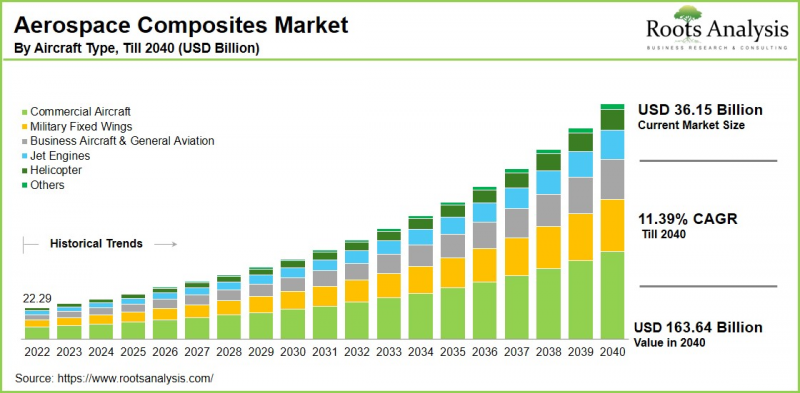
根據 Roots Analysis 的研究,預計到 2040 年,全球航太複合材料市場將以 11.39% 的複合年成長率成長,從今年的 361.5 億美元成長到 2040 年的 1636.4 億美元。
航太複合材料是一種先進的工程材料,它將碳纖維、玻璃纖維或醯胺纖維與聚合物、金屬或陶瓷基質結合,從而展現出卓越的性能。與傳統的單一金屬材料相比,這些材料具有更高的比強度、比剛度和抗疲勞性能。這種異質材料結構能夠精確客製化異向性性能,以滿足航太領域的嚴苛要求:纖維承受主要載荷,而基體則提供環境防護和有效的應力分佈。
在飛機製造領域,複合材料被廣泛應用於關鍵的機身部件,其中碳纖維增強聚合物與鋁合金相比,可將結構重量減輕高達25%。其他應用包括整流罩、引擎短艙和座艙內飾,在這些應用中,減振和隔熱等性能至關重要。在引擎系統中,採用熱塑性樹脂的混合複合材料可提高風扇葉片和機匣等零件的抗衝擊性。在下一代無人機(UAV)和高超音速平台等新興應用中,陶瓷基質材料因其卓越的耐熱性而廣泛應用。
輕質複合材料在其整個生命週期中有助於降低燃料消耗和碳排放,隨著航空業向淨零排放,推動市場成長。這些創新正在促進複合材料在下一代永續飛機(包括氫動力平台)中的更廣泛應用。
航太複合材料市場成長的關鍵市場促進因素
未來幾十年,航太複合材料市場將在幾個關鍵因素的驅動下迎來快速發展。其中一個主要促進因素是複合材料在飛機結構中的廣泛應用,以提高燃油效率並滿足日益嚴格的排放法規。這使得原始設備製造商 (OEM) 和航空公司能夠在降低營運成本的同時,推動永續性目標。同時,民用和國防航空的成長正在加速飛機(包括單通道噴射機和無人機 (UAV))的生產,從而促進複合材料的應用。此外,諸如電動垂直起降飛行器 (eVTOL)、無人機和空中計程車等先進飛機設計以及城市空中運輸(UAM) 解決方案的出現,也顯著提升了市場需求。這些平台之所以依賴複合材料,是因為其具有卓越的強度重量比、優異的空氣動力性能和高度的設計柔軟性。
航太複合材料市場:產業內各公司的競爭格局
航太複合材料市場的競爭格局十分激烈,產業主要企業如赫克塞爾(Hexcel)、東麗(Toray)和斯皮里特航空系統公司(Spirit AeroSystems)之間的競爭尤為突出。這些公司憑藉碳纖維增強材料的持續創新、高度自動化的製造流程以及關鍵機身結構零件的一體化供應鏈,保持強大的市場地位。赫克塞爾以其在高性能聚合物複合材料領域的專業技術而聞名,其產品包括用於民航機的樹脂和預浸料;而東麗則在碳纖維領域處於領先地位,其材料為機翼和機身應用提供了卓越的抗張強度。
同時,Spirit AeroSystems 利用其與原始設備製造商 (OEM) 的戰略夥伴關係關係,支持大規模複合材料重型組裝,例如機身和尾翼。這些公司共同佔據了相當大的市場佔有率,並在推動輕量化複合材料解決方案的普及方面發揮著至關重要的作用。
航太複合材料市場的新趨勢
航太複合材料市場正經歷多項變革性趨勢,這些趨勢既提升了性能,也提高了製造效率。複合材料在飛機關鍵結構(例如機身和機翼)的應用日益廣泛,使得先進飛機平台的重量減輕了約20%至50%。同時,由於生產週期更短、可回收性更強等優勢,航空航太產業正加速向熱塑性碳纖維增強塑膠(CFRP)轉型,尤其是在大規模生產環境中。
此外,複合材料在電動垂直起降飛行器(eVTOL)、無人機(UAV)和高超音速飛行器等新興應用領域備受關注,其優異的空氣動力性能和耐熱性使其脫穎而出。同時,碳纖維增強複合材料(CFRP)與金屬混合結構的研發,提高了損傷容限和可修復性,滿足了不斷變化的永續性要求。與這些進步相輔相成的是,自動化製造技術(例如自動纖維鋪放(AFP)和自動膠帶層壓(ATL))的引入也在不斷推進,提高了生產擴充性,以滿足日益成長的飛機交付需求。
北美在航太複合材料市場佔據主導地位。
今年,北美在全球航太複合材料市場佔據最大佔有率。這一主導地位主要得益於波音和洛克希德·馬丁等主要原始設備製造商(OEM)組成的成熟生態系統。該地區在國防現代化和下一代民航機研發方面的大量投資也進一步推動了其成長。此外,航空交通量的成長帶動了對節能型飛機需求的不斷增加,持續加速先進複合材料的應用。政府主導的太空探勘和無人機(UAV)計畫也鞏固了這一主導地位。
航太複合材料市場:主要市場細分
按纖維類型分類的市場佔有率
- 醯胺纖維
- 碳纖維
- 玻璃纖維
- 熱塑性複合材料
按樹脂類型分類的市場佔有率
- 環氧樹脂
- 酚醛樹脂
- 聚酯樹脂
- 聚醚醚酮(PEEK)
- 聚醚醯亞胺(PEI)
- 聚醯亞胺
- 聚碸(PSU)
- 熱固性複合材料
按製造程序分類的市場佔有率
- 自動膠帶層壓
- 纏繞成型
- 手工積層
- 樹脂轉注成形
按飛機類型分類的市場佔有率
- 公務機及通用航空
- 商用飛機
- 直升機
- 噴射引擎
- 軍用固定翼飛機
- 其他
按矩陣類型分類的市場佔有率
- 陶瓷基質
- 金屬基質
- 聚合物基質
按應用分類的市場佔有率
- 貨艙
- 引擎和推進系統
- 外部部件
- 內部零件
- 其他
按地區分類的市場佔有率
- 北美洲
- 美國
- 加拿大
- 墨西哥
- 北美及其他地區
- 歐洲
- 奧地利
- 比利時
- 丹麥
- 法國
- 德國
- 愛爾蘭
- 義大利
- 荷蘭
- 挪威
- 俄羅斯
- 西班牙
- 瑞典
- 瑞士
- 英國
- 歐洲及其他地區
- 亞太地區
- 澳洲
- 中國
- 印度
- 日本
- 紐西蘭
- 新加坡
- 韓國
- 亞太地區及其他地區
- 拉丁美洲
- 巴西
- 智利
- 哥倫比亞
- 委內瑞拉
- 拉丁美洲和其他地區
- 中東和非洲
- 埃及
- 伊朗
- 伊拉克
- 以色列
- 科威特
- 沙烏地阿拉伯
- 阿拉伯聯合大公國
- 中東、非洲等地區
本報告考察了全球航太複合材料市場,提供了概述、背景、市場影響因素分析、市場規模趨勢和預測、按各個細分市場進行的詳細分析、競爭格局以及主要企業的概況。
目錄
第1章:專案概述
第2章:調查方法
第3章 市場動態
第4章 宏觀經濟指標
第5章執行摘要
第6章:引言
第7章 監管情景
第8章:主要企業綜合資料庫
第9章 競爭情勢
第10章:閒置頻段分析
第11章:企業競爭力分析
第12章:Start-Ups生態系統
第13章:公司簡介
- 章節概要
- Absolute Composites
- Aernnova Aerospace
- Avior Integrated Products
- Bally Ribbon Mills
- Barrday
- Collins Aerospace
- Composite Recycling
- EireComposites
- FDC Composites
- Gaffco Ballistics
- General Dynamics
- Hexcel
- Honeywell
- ITT
- JPS Composite Materials
- Lee Aerospace
- LMI Aerospace
- Materion
- Mitsubishi Chemical
- Morgan Advanced Materials
- Owens Corning
- Royal Ten Cate
- SGL Carbon
- Solvay
- Spirit AeroSystems
- Teijin
- Toray Industries
- Unitech Aerospace
- VX Aerospace
第14章 大趨勢分析
第15章:未滿足需求的分析
第16章 專利分析
第17章 近期趨勢
第18章:全球航太複合材料市場
第19章 按纖維類型分類的市場機會
第20章 按樹脂類型分類的市場機會
第21章 按製造流程分類的市場機會
第22章 按飛機類型分類的市場機會
第23章 依矩陣類型分類的市場機會
第24章 按應用分類的市場機會
第25章 北美航太複合材料的市場機遇
第26章 歐洲航太複合材料的市場機遇
第27章 亞太地區航太複合材料的市場機遇
第28章 拉丁美洲航太複合材料的市場機遇
第29章 中東和非洲航太複合材料的市場機遇
第30章 市場集中度分析:主要企業的分佈
第31章:鄰近市場分析
第32章:制勝的關鍵策略
第33章:波特五力分析
第34章 SWOT分析
第35章 價值鏈分析
第36章:ROOTS的策略建議
第37章 來自初步調查的見解
第38章:報告結論
第39章:表格形式數據
第40章 公司與組織列表
Aerospace Composites Market Outlook
As per Roots Analysis, the global aerospace composites market size is estimated to grow from USD 36.15 billion in current year to USD 163.64 billion by 2040, at a CAGR of 11.39%, during the forecast period, till 2040.
Aerospace composites are advanced engineered materials that combine carbon, glass, or aramid fibers with polymer, metal, or ceramic matrices to deliver superior performance characteristics. These materials offer high specific strength, stiffness, and fatigue resistance, exceeding those of conventional monolithic metals. Their heterogeneous structure enables fibers to carry primary loads while the matrix provides environmental protection and effective stress distribution. This allows for precise customization of anisotropic properties to meet demanding aerospace requirements.
In aircraft manufacturing, composites are extensively utilized in primary airframe components, where carbon fiber-reinforced polymers can reduce structural weight by up to 25% compared to aluminum alloys. Additional applications include fairings, nacelles, and cabin interiors, where properties such as vibration damping and thermal insulation are critical. In engine systems, hybrid composites incorporating thermoplastics enhance impact resistance in components such as fan blades and casings. Emerging applications in next-generation unmanned aerial vehicles (UAVs) and hypersonic platforms are leveraging ceramic matrix composites for their exceptional high-temperature resilience.
Market growth is being driven by the aviation industry's transition toward net-zero emissions, as lightweight composites contribute to reduced fuel consumption and lower lifecycle carbon emissions These innovations are supporting broader adoption of composites in next-generation sustainable aircraft, including hydrogen-powered platforms.
Strategic Insights for Senior Leaders
Key Drivers Propelling Growth of Aerospace Composites Market
The aerospace composites market is poised for rapid evolution over the coming decades, driven by several key factors. One of the primary factors is that composites are widely adopted in aircraft structures to enhance fuel efficiency and meet stringent emission regulations, enabling OEMs and airlines to reduce operational costs while advancing sustainability objectives. Simultaneously, the growth in both commercial and defense aviation is accelerating the production of aircraft, including single-aisle jets, and unmanned aerial vehicles (UAVs), thereby boosting the adoption of composite materials. Furthermore, the emergence of advanced aircraft designs and urban air mobility solutions, such as eVTOL vehicles, drones, and air taxis, is significantly strengthening market demand. These platforms rely on composite materials for their superior strength-to-weight ratios, enhanced aerodynamic performance, and greater design flexibility.
Aerospace Composites Market: Competitive Landscape of Companies in this Industry
The competitive landscape of the aerospace composites market is characterized by intense competition among established industry leaders such as Hexcel, Toray, and Spirit AeroSystems. These companies maintain strong market positions through continuous innovation in carbon fiber reinforcements, advanced automated manufacturing processes, and well-integrated supply chains for primary airframe structures. Hexcel is recognized for its expertise in high-performance polymer composites, including resins and prepregs used in commercial aircraft, while Toray leads the carbon fiber segment with materials offering superior tensile strength for applications in wings and fuselages.
Meanwhile, Spirit AeroSystems capitalizes on strategic OEM partnerships to support large-scale assembly of composite-intensive structures such as fuselages and empennages. Collectively, these companies account for a significant share of the market and play a pivotal role in driving the adoption of lightweight composite solutions.
Emerging Trends in the Aerospace Composites Market
The aerospace composites market is witnessing several transformative trends that are enhancing both performance and manufacturing efficiency. There is a growing adoption of composite materials in primary aircraft structures, such as fuselages and wings, enabling weight reductions of approximately 20-50% in advanced aircraft platforms. At the same time, industry is increasingly shifting towards thermoplastic carbon fiber-reinforced polymers (CFRP), driven by their advantages in faster production cycles and improved recyclability, particularly in high-rate manufacturing environments.
Composites are also gaining traction in emerging applications, including eVTOL aircraft, unmanned aerial vehicles (UAVs), and hypersonic platforms, where they support superior aerodynamic performance and thermal resistance. Additionally, the development of hybrid CFRP-metal structures is improving damage tolerance and repairability, aligning with evolving sustainability requirements. Complementing these advancements, the adoption of automated manufacturing technologies such as automated fiber placement (AFP) and automated tape laying (ATL) is enhancing production scalability to meet the growing demand for aircraft deliveries.
North America Dominates the Aerospace Composites Market
According to our analysis, in the current year, North America captures the highest share of the global aerospace composites market. This dominance is primarily driven by a well-established ecosystem of leading OEMs such as Boeing and Lockheed Martin. The region's growth is further supported by substantial investments in research and development focused on defense modernization and next-generation commercial aircraft. Additionally, increasing demand for fuel-efficient aircraft amid rising air traffic continues to accelerate the adoption of advanced composite materials. This leadership is also reinforced by government-backed initiatives in space exploration and unmanned aerial vehicles (UAVs).
Key Challenges in the Aerospace Composites Market
The aerospace composites market faces several critical challenges that may impact its long-term growth and scalability. Achieving high-rate, automated composite manufacturing for next-generation aerospace platforms requires significant advancements in automation technologies and enhanced process precision. It also necessitates more streamlined supply chains, particularly for the production of large and complex airframe structures. Further, life-cycle environmental concerns remain a key issue, as thermoset composites present considerable recycling difficulties. This is due to limited infrastructure for recovering fibers and resins from decommissioned aircraft, thereby complicating sustainability efforts. Additionally, the industry is experiencing a shortage of skilled talent across composites engineering, and certification domains, underscoring the need for targeted workforce development and training initiatives to support future demand.
Aerospace Composites Market: Key Market Segmentation
Market Share by Fiber Type
- Aramid
- Carbon Fiber
- Glass Fiber
- Thermoplastic Composites
Market Share by Resin Type
- Epoxy
- Phenolic
- Polyester
- Polyether Ether Ketone (PEEK)
- Polyetherimide (PEI)
- Polyimides
- Polysulfone (PSU)
- Thermoset Composites
Market Share by Manufacturing Process
- Automated Tape Laying
- Filament Winding
- Hand Layup
- Resin Transfer Molding
Market Share by Aircraft Type
- Business Aircraft & General Aviation
- Commercial Aircraft
- Helicopter
- Jet Engines
- Military Fixed Wings
- Others
Market Share by Matrix Type
- Ceramic Matrix
- Metal Matrix
- Polymer Matrix
Market Share by Application
- Cargo Compartment
- Engine & Propulsion Systems
- Exterior Components
- Interior Components
- Others
Market Share by Geographical Regions
- North America
- US
- Canada
- Mexico
- Rest of North America
- Europe
- Austria
- Belgium
- Denmark
- France
- Germany
- Ireland
- Italy
- Netherlands
- Norway
- Russia
- Spain
- Sweden
- Switzerland
- UK
- Rest of Europe
- Asia-Pacific
- Australia
- China
- India
- Japan
- New-Zealand
- Singapore
- South Korea
- Rest of Asia-Pacific
- Latin America
- Brazil
- Chile
- Colombia
- Venezuela
- Rest of Latin America
- Middle East and Africa (MEA)
- Egypt
- Iran
- Iraq
- Israel
- Kuwait
- Saudi Arabia
- UAE
- Rest of MEA
Example Players in Aerospace Composites Market
- Absolute Composites
- Aernnova Aerospace
- Avior Integrated Products
- Bally Ribbon Mills
- Barrday
- Collins Aerospace
- Composite Recycling
- EireComposites
- FDC Composites
- Gaffco Ballistics
- General Dynamics
- Hexcel
- Honeywell
- ITT
- JPS Composite Materials
- Lee Aerospace
- LMI Aerospace
- Materion
- Mitsubishi Chemical
- Morgan Advanced Materials
- Owens Corning
- Royal Ten Cate
- SGL Carbon
- Solvay
- Spirit AeroSystems
- Teijin
- Toray Industries
- Unitech Aerospace
- VX Aerospace
Aerospace Composites Market: Report Coverage
The report on the aerospace composites market features insights on various sections, including:
- Market Sizing and Opportunity Analysis: An in-depth analysis of the aerospace composites market, focusing on key market segments, including [A] fiber type, [B] resin type, [C] manufacturing process, [D] aircraft type, [E] matrix type, [F] application, [G] geographical regions, and [H] key players.
- Competitive Landscape: A comprehensive analysis of the companies engaged in the aerospace composites market, based on several relevant parameters, such as [A] year of establishment, [B] company size, [C] location of headquarters and [D] ownership structure.
- Company Profiles: Elaborate profiles of prominent players engaged in the aerospace composites market, providing details on [A] location of headquarters, [B] company size, [C] company mission, [D] company footprint, [E] management team, [F] contact details, [G] financial information, [H] operating business segments, [I] product / technology portfolio, [J] recent developments, and an informed future outlook.
- Megatrends: An evaluation of ongoing megatrends in the aerospace composites industry.
- Patent Analysis: An insightful analysis of patents filed / granted in the aerospace composites domain, based on relevant parameters, including [A] type of patent, [B] patent publication year, [C] patent age and [D] leading players.
- Recent Developments: An overview of the recent developments made in the aerospace composites market, along with analysis based on relevant parameters, including [A] year of initiative, [B] type of initiative, [C] geographical distribution and [D] most active players.
- Porter's Five Forces Analysis: An analysis of five competitive forces prevailing in the aerospace composites market, including threats of new entrants, bargaining power of buyers, bargaining power of suppliers, threats of substitute products and rivalry among existing competitors.
- SWOT Analysis: An insightful SWOT framework, highlighting the strengths, weaknesses, opportunities and threats in the domain. Additionally, it provides Harvey ball analysis, highlighting the relative impact of each SWOT parameter.
Key Questions Answered in this Report
- What is the current and future market size?
- Who are the leading companies in this market?
- What are the growth drivers that are likely to influence the evolution of this market?
- What are the key partnership and funding trends shaping this industry?
- Which region is likely to grow at higher CAGR till 2040?
- How is the current and future market opportunity likely to be distributed across key market segments?
Reasons to Buy this Report
- Detailed Market Analysis: The report provides a comprehensive market analysis, offering detailed revenue projections of the overall market and its specific sub-segments. This information is valuable to both established market leaders and emerging entrants.
- In-depth Analysis of Trends: Stakeholders can leverage the report to gain a deeper understanding of the competitive dynamics within the market. Each report maps ecosystem activity across partnerships, funding, and patent landscapes to reveal growth hotspots and white spaces in the industry.
- Opinion of Industry Experts: The report features extensive interviews and surveys with key opinion leaders and industry experts to validate market trends mentioned in the report.
- Decision-ready Deliverables: The report offers stakeholders with strategic frameworks (Porter's Five Forces, value chain, SWOT), and complimentary Excel / slide packs with customization support.
Additional Benefits
- Complimentary Dynamic Excel Dashboards for Analytical Modules
- Exclusive 15% Free Content Customization
- Personalized Interactive Report Walkthrough with Our Expert Research Team
- Free Report Updates for Versions Older than 6-12 Months
TABLE OF CONTENTS
1. PROJECT OVERVIEW
- 1.1. Context
- 1.2. Project Objectives
2. RESEARCH METHODOLOGY
- 2.1. Chapter Overview
- 2.2. Research Assumptions
- 2.3. Database Building
- 2.3.1. Data Collection
- 2.3.2. Data Validation
- 2.3.3. Data Analysis
- 2.4. Project Methodology
- 2.4.1. Secondary Research
- 2.4.1.1. Annual Reports
- 2.4.1.2. Academic Research Papers
- 2.4.1.3. Company Websites
- 2.4.1.4. Investor Presentations
- 2.4.1.5. Regulatory Filings
- 2.4.1.6. White Papers
- 2.4.1.7. Industry Publications
- 2.4.1.8. Conferences and Seminars
- 2.4.1.9. Government Portals
- 2.4.1.10. Media and Press Releases
- 2.4.1.11. Newsletters
- 2.4.1.12. Industry Databases
- 2.4.1.13. Roots Proprietary Databases
- 2.4.1.14. Paid Databases and Sources
- 2.4.1.15. Social Media Portals
- 2.4.1.16. Other Secondary Sources
- 2.4.2. Primary Research
- 2.4.2.1. Introduction
- 2.4.2.2. Types
- 2.4.2.2.1. Qualitative
- 2.4.2.2.2. Quantitative
- 2.4.2.3. Advantages
- 2.4.2.4. Techniques
- 2.4.2.4.1. Interviews
- 2.4.2.4.2. Surveys
- 2.4.2.4.3. Focus Groups
- 2.4.2.4.4. Observational Research
- 2.4.2.4.5. Social Media Interactions
- 2.4.2.5. Stakeholders
- 2.4.2.5.1. Company Executives (CXOs)
- 2.4.2.5.2. Board of Directors
- 2.4.2.5.3. Company Presidents and Vice Presidents
- 2.4.2.5.4. Key Opinion Leaders
- 2.4.2.5.5. Research and Development Heads
- 2.4.2.5.6. Technical Experts
- 2.4.2.5.7. Subject Matter Experts
- 2.4.2.5.8. Scientists
- 2.4.2.5.9. Doctors and Other Healthcare Providers
- 2.4.2.6. Ethics and Integrity
- 2.4.2.6.1. Research Ethics
- 2.4.2.6.2. Data Integrity
- 2.4.3. Analytical Tools and Databases
- 2.4.1. Secondary Research
3. MARKET DYNAMICS
- 3.1. Forecast Methodology
- 3.1.1. Top-Down Approach
- 3.1.2. Bottom-Up Approach
- 3.1.3. Hybrid Approach
- 3.2. Market Assessment Framework
- 3.2.1. Total Addressable Market (TAM)
- 3.2.2. Serviceable Addressable Market (SAM)
- 3.2.3. Serviceable Obtainable Market (SOM)
- 3.2.4. Currently Acquired Market (CAM)
- 3.3. Forecasting Tools and Techniques
- 3.3.1. Qualitative Forecasting
- 3.3.2. Correlation
- 3.3.3. Regression
- 3.3.4. Time Series Analysis
- 3.3.5. Extrapolation
- 3.3.6. Convergence
- 3.3.7. Forecast Error Analysis
- 3.3.8. Data Visualization
- 3.3.9. Scenario Planning
- 3.3.10. Sensitivity Analysis
- 3.4. Key Considerations
- 3.4.1. Demographics
- 3.4.2. Market Access
- 3.4.3. Reimbursement Scenarios
- 3.4.4. Industry Consolidation
- 3.5. Robust Quality Control
- 3.6. Key Market Segmentations
- 3.7. Limitations
4. MACRO-ECONOMIC INDICATORS
- 4.1. Chapter Overview
- 4.2. Market Dynamics
- 4.2.1. Time Period
- 4.2.1.1. Historical Trends
- 4.2.1.2. Current and Forecasted Estimates
- 4.2.2. Currency Coverage
- 4.2.2.1. Overview of Major Currencies Affecting the Market
- 4.2.2.2. Impact of Currency Fluctuations on the Industry
- 4.2.3. Foreign Exchange Impact
- 4.2.3.1. Evaluation of Foreign Exchange Rates and Their Impact on Market
- 4.2.3.2. Strategies for Mitigating Foreign Exchange Risk
- 4.2.4. Recession
- 4.2.4.1. Historical Analysis of Past Recessions and Lessons Learnt
- 4.2.4.2. Assessment of Current Economic Conditions and Potential Impact on the Market
- 4.2.5. Inflation
- 4.2.5.1. Measurement and Analysis of Inflationary Pressures in the Economy
- 4.2.5.2. Potential Impact of Inflation on the Market Evolution
- 4.2.6. Interest Rates
- 4.2.6.1. Overview of Interest Rates and Their Impact on the Market
- 4.2.6.2. Strategies for Managing Interest Rate Risk
- 4.2.7. Commodity Flow Analysis
- 4.2.7.1. Type of Commodity
- 4.2.7.2. Origins and Destinations
- 4.2.7.3. Values and Weights
- 4.2.7.4. Modes of Transportation
- 4.2.8. Global Trade Dynamics
- 4.2.8.1. Import Scenario
- 4.2.8.2. Export Scenario
- 4.2.9. War Impact Analysis
- 4.2.9.1. Russian-Ukraine War
- 4.2.9.2. Israel-Hamas War
- 4.2.10. COVID Impact / Related Factors
- 4.2.10.1. Global Economic Impact
- 4.2.10.2. Industry-specific Impact
- 4.2.10.3. Government Response and Stimulus Measures
- 4.2.10.4. Future Outlook and Adaptation Strategies
- 4.2.11. Other Indicators
- 4.2.11.1. Fiscal Policy
- 4.2.11.2. Consumer Spending
- 4.2.11.3. Gross Domestic Product (GDP)
- 4.2.11.4. Employment
- 4.2.11.5. Taxes
- 4.2.11.6. R&D Innovation
- 4.2.11.7. Stock Market Performance
- 4.2.11.8. Supply Chain
- 4.2.11.9. Cross-Border Dynamics
- 4.2.1. Time Period
- 4.3. Concluding Remarks
5. EXECUTIVE SUMMARY
6. INTRODUCTION
- 6.1. Overview of Aerospace Composites
- 6.2. Technology of Aerospace Composites
- 6.3. Advantages of Aerospace Composites
- 6.4. Challenges Associated with Aerospace Composites
- 6.5. Future Perspective
7. REGULATORY SCENARIO
8. COMPREHENSIVE DATABASE OF LEADING PLAYERS
9. COMPETITIVE LANDSCAPE
- 9.1. Chapter Overview
- 9.2. Aerospace composites market: Overall Landscape
- 9.2.1. Analysis by Year of Establishment
- 9.2.2. Analysis by Company Size
- 9.2.3. Analysis by Location of Headquarters
- 9.2.4. Analysis by Type of Company
- 9.2.5. Analysis by Type of Interface
- 9.2.6. Analysis by Technology Stack
- 9.3. Key Findings
10. WHITE SPACE ANALYSIS
11. COMPANY COMPETITIVENESS ANALYSIS
12. STARTUP ECOSYSTEM ANALYSIS
- 12.1. Aerospace composites market: Startup Ecosystem Analysis
- 12.1.1. Analysis by Year of Establishment
- 12.1.2. Analysis by Company Size
- 12.1.3. Analysis by Location of Headquarters
- 12.1.4. Analysis by Ownership Type
- 12.1.5. Analysis by Type of Interface
- 12.1.6. Analysis by Technology Stack
- 12.2. Key Findings
13. COMPANY PROFILES
- 13.1. Chapter Overview
- 13.2. Absolute Composites *
- 13.2.1. Company Overview
- 13.2.2. Company Mission
- 13.2.3. Company Footprint
- 13.2.4. Management Team
- 13.2.5. Contact Details
- 13.2.6. Financial Performance
- 13.2.7. Operating Business Segments
- 13.2.8. Service / Product Portfolio (project specific)
- 13.2.9. MOAT Analysis
- 13.2.10. Recent Developments and Future Outlook
- Similar details are presented for other companies (listed below), based on information in the public domain
- 13.3. Aernnova Aerospace
- 13.4. Avior Integrated Products
- 13.5. Bally Ribbon Mills
- 13.6. Barrday
- 13.7. Collins Aerospace
- 13.8. Composite Recycling
- 13.9. EireComposites
- 13.10. FDC Composites
- 13.11. Gaffco Ballistics
- 13.12. General Dynamics
- 13.13. Hexcel
- 13.14. Honeywell
- 13.15. ITT
- 13.16. JPS Composite Materials
- 13.17. Lee Aerospace
- 13.18. LMI Aerospace
- 13.19. Materion
- 13.20. Mitsubishi Chemical
- 13.21. Morgan Advanced Materials
- 13.22. Owens Corning
- 13.23. Royal Ten Cate
- 13.24. SGL Carbon
- 13.25. Solvay
- 13.26. Spirit AeroSystems
- 13.27. Teijin
- 13.28. Toray Industries
- 13.29. Unitech Aerospace
- 13.30. VX Aerospace
14. MEGA TRENDS ANALYSIS
15. UNMET NEED ANALYSIS
16. PATENT ANALYSIS
17. RECENT DEVELOPMENTS
- 17.1. Chapter Overview
- 17.2. Recent Funding
- 17.3. Recent Partnerships
- 17.4. Other Recent Initiatives
18. GLOBAL AEROSPACE COMPOSITES MARKET
- 18.1. Chapter Overview
- 18.2. Key Assumptions and Methodology
- 18.3. Trends Disruption Impacting Market
- 18.4. Demand Side Trends
- 18.5. Supply Side Trends
- 18.6. Global Aerospace Composites Market: Historical Trends (Since 2022) and Forecasted Estimates (Till 2040)
- 18.7. Multivariate Scenario Analysis
- 18.7.1. Conservative Scenario
- 18.7.2. Optimistic Scenario
- 18.8. Investment Feasibility Index
- 18.9. Key Market Segmentations
19. MARKET OPPORTUNITIES BASED ON FIBER TYPE
- 19.1. Chapter Overview
- 19.2. Key Assumptions and Methodology
- 19.3. Revenue Shift Analysis
- 19.4. Market Movement Analysis
- 19.5. Penetration-Growth (P-G) Matrix
- 19.6. Aerospace Composites Market for Aramid: Historical Trends (Since 2022) and Forecasted Estimates (Till 2040)
- 19.7. Aerospace Composites Market for Carbon Fiber: Historical Trends (Since 2022) and Forecasted Estimates (Till 2040)
- 19.8. Aerospace Composites Market for Glass Fiber: Historical Trends (Since 2022) and Forecasted Estimates (Till 2040)
- 19.9. Aerospace Composites Market for Thermoplastic Composites: Historical Trends (Since 2022) and Forecasted Estimates (Till 2040)
- 19.10. Data Triangulation and Validation
- 19.10.1. Secondary Sources
- 19.10.2. Primary Sources
- 19.10.3. Statistical Modeling
20. MARKET OPPORTUNITIES BASED ON RESIN TYPE
- 20.1. Chapter Overview
- 20.2. Key Assumptions and Methodology
- 20.3. Revenue Shift Analysis
- 20.4. Market Movement Analysis
- 20.5. Penetration-Growth (P-G) Matrix
- 20.6. Aerospace Composites Market for Epoxy: Historical Trends (Since 2022) and Forecasted Estimates (Till 2040)
- 20.7. Aerospace Composites Market for Phenolic: Historical Trends (Since 2022) and Forecasted Estimates (Till 2040)
- 20.8. Aerospace Composites Market for Polyester: Historical Trends (Since 2022) and Forecasted Estimates (Till 2040)
- 20.9. Aerospace Composites Market for Polyether Ether Ketone (PEEK): Historical Trends (Since 2022) and Forecasted Estimates (Till 2040)
- 20.10. Aerospace Composites Market for Polyetherimide (PEI): Historical Trends (Since 2022) and Forecasted Estimates (Till 2040)
- 20.11. Aerospace Composites Market for Polyimides: Historical Trends (Since 2022) and Forecasted Estimates (Till 2040)
- 20.12. Aerospace Composites Market for Polysulfone (PSU): Historical Trends (Since 2022) and Forecasted Estimates (Till 2040)
- 20.13. Aerospace Composites Market for Thermoset Composites: Historical Trends (Since 2022) and Forecasted Estimates (Till 2040)
- 20.14. Data Triangulation and Validation
- 20.14.1. Secondary Sources
- 20.14.2. Primary Sources
- 20.14.3. Statistical Modeling
21. MARKET OPPORTUNITIES BASED ON MANUFACTURING PROCESS
- 21.1. Chapter Overview
- 21.2. Key Assumptions and Methodology
- 21.3. Revenue Shift Analysis
- 21.4. Market Movement Analysis
- 21.5. Penetration-Growth (P-G) Matrix
- 21.6. Aerospace Composites Market for Automated Tape Laying: Historical Trends (Since 2022) and Forecasted Estimates (Till 2040)
- 21.7. Aerospace Composites Market for Filament Winding: Historical Trends (Since 2022) and Forecasted Estimates (Till 2040)
- 21.8. Aerospace Composites Market for Hand Layup: Historical Trends (Since 2022) and Forecasted Estimates (Till 2040)
- 21.9. Aerospace Composites Market for Resin Transfer Molding: Historical Trends (Since 2022) and Forecasted Estimates (Till 2040)
- 21.10. Data Triangulation and Validation
- 21.10.1. Secondary Sources
- 21.10.2. Primary Sources
- 21.10.3. Statistical Modeling
22. MARKET OPPORTUNITIES BASED ON AIRCRAFT TYPE
- 22.1. Chapter Overview
- 22.2. Key Assumptions and Methodology
- 22.3. Revenue Shift Analysis
- 22.4. Market Movement Analysis
- 22.5. Penetration-Growth (P-G) Matrix
- 22.6. Aerospace Composites Market for Business Aircraft & General Aviation: Historical Trends (Since 2022) and Forecasted Estimates (Till 2040)
- 22.7. Aerospace Composites Market for Commercial Aircraft: Historical Trends (Since 2022) and Forecasted Estimates (Till 2040)
- 22.8. Aerospace Composites Market for Helicopter: Historical Trends (Since 2022) and Forecasted Estimates (Till 2040)
- 22.9. Aerospace Composites Market for Jet Engines: Historical Trends (Since 2022) and Forecasted Estimates (Till 2040)
- 22.10. Aerospace Composites Market for Military Fixed Wings: Historical Trends (Since 2022) and Forecasted Estimates (Till 2040)
- 22.11. Aerospace Composites Market for Others: Historical Trends (Since 2022) and Forecasted Estimates (Till 2040)
- 22.12. Data Triangulation and Validation
- 22.12.1. Secondary Sources
- 22.12.2. Primary Sources
- 22.12.3. Statistical Modeling
23. MARKET OPPORTUNITIES BASED ON MATRIX TYPE
- 23.1. Chapter Overview
- 23.2. Key Assumptions and Methodology
- 23.3. Revenue Shift Analysis
- 23.4. Market Movement Analysis
- 23.5. Penetration-Growth (P-G) Matrix
- 23.6. Aerospace Composites Market for Ceramic Matrix: Historical Trends (Since 2022) and Forecasted Estimates (Till 2040)
- 23.7. Aerospace Composites Market for Metal Matrix: Historical Trends (Since 2022) and Forecasted Estimates (Till 2040)
- 23.8. Aerospace Composites Market for Polymer Matrix: Historical Trends (Since 2022) and Forecasted Estimates (Till 2040)
- 23.9. Data Triangulation and Validation
- 23.9.1. Secondary Sources
- 23.9.2. Primary Sources
- 23.9.3. Statistical Modeling
24. MARKET OPPORTUNITIES BASED ON APPLICATION
- 24.1. Chapter Overview
- 24.2. Key Assumptions and Methodology
- 24.3. Revenue Shift Analysis
- 24.4. Market Movement Analysis
- 24.5. Penetration-Growth (P-G) Matrix
- 24.6. Aerospace Composites Market for Cargo Compartment: Historical Trends (Since 2022) and Forecasted Estimates (Till 2040)
- 24.7. Aerospace Composites Market for Engine & Propulsion Systems: Historical Trends (Since 2022) and Forecasted Estimates (Till 2040)
- 24.8. Aerospace Composites Market for Exterior Components: Historical Trends (Since 2022) and Forecasted Estimates (Till 2040)
- 24.9. Aerospace Composites Market for Interior Components: Historical Trends (Since 2022) and Forecasted Estimates (Till 2040)
- 24.10. Aerospace Composites Market for Others: Historical Trends (Since 2022) and Forecasted Estimates (Till 2040)
- 24.11. Data Triangulation and Validation
- 24.11.1. Secondary Sources
- 24.11.2. Primary Sources
- 24.11.3. Statistical Modeling
25. MARKET OPPORTUNITIES FOR AEROSPACE COMPOSITES IN NORTH AMERICA
- 25.1. Chapter Overview
- 25.2. Key Assumptions and Methodology
- 25.3. Revenue Shift Analysis
- 25.4. Market Movement Analysis
- 25.5. Penetration-Growth (P-G) Matrix
- 25.6. Aerospace Composites Market in North America: Historical Trends (Since 2022) and Forecasted Estimates (Till 2040)
- 25.6.1. Aerospace Composites Market in the US: Historical Trends (Since 2022) and Forecasted Estimates (Till 2040)
- 25.6.2. Aerospace Composites Market in Canada: Historical Trends (Since 2022) and Forecasted Estimates (Till 2040)
- 25.6.3. Aerospace Composites Market in Mexico: Historical Trends (Since 2022) and Forecasted Estimates (Till 2040)
- 25.6.4. Aerospace Composites Market in Rest of North America: Historical Trends (Since 2022) and Forecasted Estimates (Till 2040)
- 25.7. Data Triangulation and Validation
26. MARKET OPPORTUNITIES FOR AEROSPACE COMPOSITES IN EUROPE
- 26.1. Chapter Overview
- 26.2. Key Assumptions and Methodology
- 26.3. Revenue Shift Analysis
- 26.4. Market Movement Analysis
- 26.5. Penetration-Growth (P-G) Matrix
- 26.6. Aerospace Composites Market in Europe: Historical Trends (Since 2022) and Forecasted Estimates (Till 2040)
- 26.6.1. Aerospace Composites Market in Austria: Historical Trends (Since 2022) and Forecasted Estimates (Till 2040)
- 26.6.2. Aerospace Composites Market in Belgium: Historical Trends (Since 2022) and Forecasted Estimates (Till 2040)
- 26.6.3. Aerospace Composites Market in Denmark: Historical Trends (Since 2022) and Forecasted Estimates (Till 2040)
- 26.6.4. Aerospace Composites Market in France: Historical Trends (Since 2022) and Forecasted Estimates (Till 2040)
- 26.6.5. Aerospace Composites Market in Germany: Historical Trends (Since 2022) and Forecasted Estimates (Till 2040)
- 26.6.6. Aerospace Composites Market in Ireland: Historical Trends (Since 2022) and Forecasted Estimates (Till 2040)
- 26.6.7. Aerospace Composites Market in Italy: Historical Trends (Since 2022) and Forecasted Estimates (Till 2040)
- 26.6.8. Aerospace Composites Market in the Netherlands: Historical Trends (Since 2022) and Forecasted Estimates (Till 2040)
- 26.6.9. Aerospace Composites Market in Norway: Historical Trends (Since 2022) and Forecasted Estimates (Till 2040)
- 26.6.10. Aerospace Composites Market in Russia: Historical Trends (Since 2022) and Forecasted Estimates (Till 2040)
- 26.6.11. Aerospace Composites Market in Spain: Historical Trends (Since 2022) and Forecasted Estimates (Till 2040)
- 26.6.12. Aerospace Composites Market in Sweden: Historical Trends (Since 2022) and Forecasted Estimates (Till 2040)
- 26.6.13. Aerospace Composites Market in Switzerland: Historical Trends (Since 2022) and Forecasted Estimates (Till 2040)
- 26.6.14. Aerospace Composites Market in the UK: Historical Trends (Since 2022) and Forecasted Estimates (Till 2040)
- 26.6.15. Aerospace Composites Market in Rest of Europe: Historical Trends (Since 2022) and Forecasted Estimates (Till 2040)
- 26.7. Data Triangulation and Validation
27. MARKET OPPORTUNITIES FOR AEROSPACE COMPOSITES IN ASIA-PACIFIC
- 27.1. Chapter Overview
- 27.2. Key Assumptions and Methodology
- 27.3. Revenue Shift Analysis
- 27.4. Market Movement Analysis
- 27.5. Penetration-Growth (P-G) Matrix
- 27.6. Aerospace Composites Market in Asia-Pacific: Historical Trends (Since 2022) and Forecasted Estimates (Till 2040)
- 27.6.1. Aerospace Composites Market in China: Historical Trends (Since 2022) and Forecasted Estimates (Till 2040)
- 27.6.2. Aerospace Composites Market in India: Historical Trends (Since 2022) and Forecasted Estimates (Till 2040)
- 27.6.3. Aerospace Composites Market in Japan: Historical Trends (Since 2022) and Forecasted Estimates (Till 2040)
- 27.6.4. Aerospace Composites Market in Singapore: Historical Trends (Since 2022) and Forecasted Estimates (Till 2040)
- 27.6.5. Aerospace Composites Market in South Korea: Historical Trends (Since 2022) and Forecasted Estimates (Till 2040)
- 27.6.6. Aerospace Composites Market in Rest of Asia-Pacific: Historical Trends (Since 2022) and Forecasted Estimates (Till 2040)
- 27.7. Data Triangulation and Validation
28. MARKET OPPORTUNITIES FOR AEROSPACE COMPOSITES IN LATIN AMERICA
- 28.1. Chapter Overview
- 28.2. Key Assumptions and Methodology
- 28.3. Revenue Shift Analysis
- 28.4. Market Movement Analysis
- 28.5. Penetration-Growth (P-G) Matrix
- 28.6. Aerospace Composites Market in Latin America: Historical Trends (Since 2022) and Forecasted Estimates (Till 2040)
- 28.6.1. Aerospace Composites Market in Argentina: Historical Trends (Since 2022) and Forecasted Estimates (Till 2040)
- 28.6.2. Aerospace Composites Market in Brazil: Historical Trends (Since 2022) and Forecasted Estimates (Till 2040)
- 28.6.3. Aerospace Composites Market in Chile: Historical Trends (Since 2022) and Forecasted Estimates (Till 2040)
- 28.6.4. Aerospace Composites Market in Colombia Historical Trends (Since 2022) and Forecasted Estimates (Till 2040)
- 28.6.5. Aerospace Composites Market in Venezuela: Historical Trends (Since 2022) and Forecasted Estimates (Till 2040)
- 28.6.6. Aerospace Composites Market in Rest of Latin America: Historical Trends (Since 2022) and Forecasted Estimates (Till 2040)
- 28.7. Data Triangulation and Validation
29. MARKET OPPORTUNITIES FOR AEROSPACE COMPOSITES IN MIDDLE EAST AND AFRICA (MEA)
- 29.1. Chapter Overview
- 29.2. Key Assumptions and Methodology
- 29.3. Revenue Shift Analysis
- 29.4. Market Movement Analysis
- 29.5. Penetration-Growth (P-G) Matrix
- 29.6. Aerospace Composites Market in Middle East and Africa (MEA): Historical Trends (Since 2022) and Forecasted Estimates (Till 2040)
- 29.6.1. Aerospace Composites Market in Egypt: Forecasted Estimates (Till 205)
- 29.6.2. Aerospace Composites Market in Iran: Historical Trends (Since 2022) and Forecasted Estimates (Till 2040)
- 29.6.3. Aerospace Composites Market in Iraq: Historical Trends (Since 2022) and Forecasted Estimates (Till 2040)
- 29.6.4. Aerospace Composites Market in Israel: Historical Trends (Since 2022) and Forecasted Estimates (Till 2040)
- 29.6.5. Aerospace Composites Market in Kuwait: Historical Trends (Since 2022) and Forecasted Estimates (Till 2040)
- 29.6.6. Aerospace Composites Market in Saudi Arabia: Historical Trends (Since 2022) and Forecasted Estimates (Till 2040)
- 29.6.7. Aerospace Composites Market in United Arab Emirates (UAE): Historical Trends (Since 2022) and Forecasted Estimates (Till 2040)
- 29.6.8. Aerospace Composites Market in Rest of MEA: Historical Trends (Since 2022) and Forecasted Estimates (Till 2040)
- 29.7. Data Triangulation and Validation
30. MARKET CONCENTRATION ANALYSIS: DISTRIBUTION BY LEADING PLAYERS
31. ADJACENT MARKET ANALYSIS
32. KEY WINNING STRATEGIES
33. PORTER'S FIVE FORCES ANALYSIS
34. SWOT ANALYSIS
35. VALUE CHAIN ANALYSIS
36. ROOTS STRATEGIC RECOMMENDATIONS
- 36.1. Chapter Overview
- 36.2. Key Business-related Strategies
- 36.2.1. Research & Development
- 36.2.2. Product Manufacturing
- 36.2.3. Commercialization / Go-to-Market
- 36.2.4. Sales and Marketing
- 36.3. Key Operations-related Strategies
- 36.3.1. Risk Management
- 36.3.2. Workforce
- 36.3.3. Finance
- 36.3.4. Others
37. INSIGHTS FROM PRIMARY RESEARCH
38. REPORT CONCLUSION
39. TABULATED DATA
40. LIST OF COMPANIES AND ORGANIZATIONS

 航太複合材料市場:2026-2032年全球市場預測(依樹脂類型、產品形式、材料類型、複合材料類型、製造流程、應用和銷售管道)
 全球航太複合材料市場規模、佔有率、趨勢和成長分析報告(2026-2034)
 2026年全球航太複合材料和鋁合金市場報告2026年全球航太複合材料市場報告高速飛機和飛彈複合材料市場:按材料、製造流程、樹脂類型、平台類型、應用和最終用戶分類-2026-2032年全球市場預測飛機引擎複合材料市場規模、佔有率、成長及全球產業分析:按類型、應用和地區分類,並預測至2026-2034年
 航太複合材料市場規模、佔有率和趨勢分析報告:按產品、應用、地區和細分市場預測(2026-2033 年)
 航太複合材料市場-全球產業規模、佔有率、趨勢、機會與預測:按纖維類型、樹脂類型、製造流程、飛機類型、應用、地區和競爭格局分類,2021-2031年
 低空經濟區空間通訊需求趨勢航太複合材料市場按零件類型、樹脂類型、纖維類型、製造流程和最終用途分類-2026-2032年全球預測