


 |
市場調查報告書
商品編碼
2005198
印度細胞檢測市場:按產品、檢測類型、技術、應用和最終用戶分類-產業趨勢和預測(至2035年)India Cell Based Assay Market - Distribution by Products, Type of Assay, Technology, Application and End-user: Industry Trends and Global Forecasts, till 2035 |
||||||

印度細胞檢測市場概覽
根據 Roots Analysis 的研究,預計到 2035 年,印度基於細胞的檢測市場規模將以 9.0% 的複合年成長率成長,從目前的 5.4 億美元成長到 2035 年的 11.72 億美元。
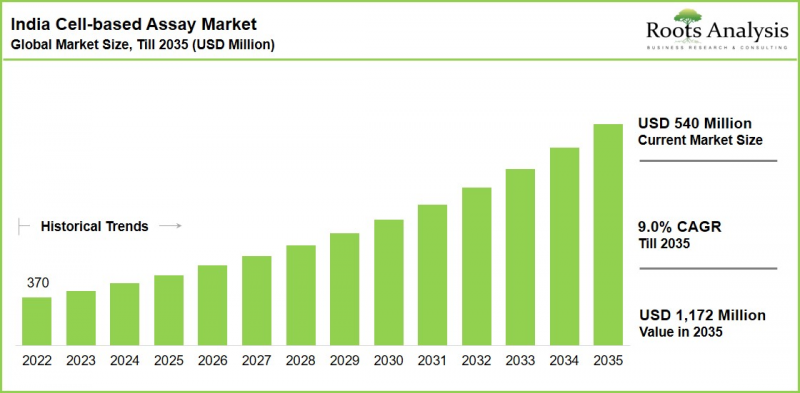
印度細胞檢測市場:成長與趨勢
基於細胞的檢測技術是一種體外技術,它利用活細胞來評估藥物的療效、毒性、ADME(吸收、分佈、代謝和排泄)特性以及生物機制。這些技術為傳統的生化和動物實驗提供了更符合生理實際的替代方案。這些檢測技術對於臨床前試驗的安全性評估至關重要,並且還可以證明細胞產品的生物活性和效力。印度的基於細胞的檢測市場是生命科學和生物製藥行業中一個快速成長的領域。藥物研發活動的增加、高通量篩檢的自動化以及外包給合約研究組織(CRO)的做法正在加速市場成長。此外,政府和私人對生命科學基礎設施的投資也進一步促進了學術界和工業界對此技術的應用。
印度細胞檢測市場的新趨勢包括採用3D細胞培養模型、類器官、高內涵成像、無標定技術以及與人工智慧/機器學習相結合的資料分析技術。此外,幹細胞研究、腫瘤篩檢、再生醫學和生物相似藥開發等領域也湧現新的機會。印度龐大的病患群體和成本優勢也是吸引全球臨床/臨床前外包的重要因素。
成長促進因素:市場擴張的策略推動者
印度細胞檢測市場的主要驅動力來自政府的大力扶持以及對生命科學和生物製藥領域研發的大量投入。在生物技術部 (DBT) 和生物技術產業研究援助委員會 (BIRAC) 的主導下,印度政府透過一系列計畫提供專款和津貼,並建立專門的生物技術園區。這些措施簡化了資金流向,減少了行政障礙,並積極推廣動物試驗的替代方案。這些措施正在建構一個支持生物製藥創新、促進官民合作關係並加速將細胞檢測技術整合到藥物發現、毒性評估和個人化醫療等臨床前工作流程的生態系統。因此,國內外企業正擴大利用這些檢測技術來支持生物相似藥的開發和慢性病研究。尤其是在腫瘤學領域,印度龐大的患者群體為進行生理相關性檢測提供了獨特的機會。
印度細胞檢測市場:主要細分市場
產品類型
- 消耗品
- 裝置
- 軟體
檢測類型
- 細胞活力
- 細胞增殖
- 細胞毒性
- 細胞死亡
- 其他
透過技術
- 高通量篩檢
- 高內涵篩檢
- 流式細胞技術
- 無標定檢測
目的
- 藥物發現
- 研究
- ADME/毒理學測試
- 其他
最終用戶
- 製藥和生物技術公司
- CRO
- 學術和研究機構
- 政府機構
本報告考察了印度基於細胞的檢測市場,提供了概述、背景、市場影響因素分析、市場規模趨勢和預測、按各個細分市場進行的詳細分析、競爭格局以及主要企業的概況。
目錄
第1章:序言
第2章:調查方法
第3章 市場動態
第4章 宏觀經濟指標
第5章執行摘要
第6章:引言
第7章 市場狀況
第8章 公司概況:印度細胞檢測市場
- 章節概要
- Agilent Technologies
- Becton, Dickinson and Company(BD)
- Bio-Rad Laboratories
- Charles River Laboratories
- Corning
- Danaher
- Lonza
- Merck KGaA
- PerkinElmer
- Promega
- Revvity
- Roche
- Thermo Fisher Scientific
第9章 專利分析
第10章:津貼分析
第11章 市場影響分析
第12章:印度細胞檢測市場
第13章:印度細胞檢測市場:依產品類型分類
第14章:印度細胞檢測市場:依檢測類型分類
第15章:印度細胞檢測市場:依技術分類
第16章:印度細胞檢測市場:依應用分類
第17章:印度細胞檢測市場:依最終用戶分類
第18章 結論
第19章附錄一:表格形式數據
第20章 附錄二:公司和組織列表
India Cell based Assay Market: Overview
As per Roots Analysis, the India cell-based assay market is estimated to grow from USD 540 million in the current year to USD 1,172 million by 2035 at a CAGR of 9.0% during the forecast period, till 2035.
India Cell based Assay Market: Growth and Trends
Cell-based assays are in-vitro techniques that use living cells to evaluate drug efficacy, toxicity, ADME (absorption, distribution, metabolism, excretion) properties, and biological mechanisms. These techniques serve as a more physiologically relevant alternative to traditional biochemical or animal-based testing. These assays are essential for assessing safety in preclinical studies and can additionally indicate the biological activity or potency of the cellular product. The India cell-based assay market is a rapidly expanding segment of the life sciences and biopharmaceutical industry. The rise in drug discovery activities, automation in high-throughput screening, and outsourcing operations to CROs have accelerated the expansion of the market. Further, government and private investments in life sciences infrastructure further boost adoption in academic and commercial settings.
Emerging trends in the India cell based assay market include adoption of 3D cell culture models, organoids, high-content imaging, label-free technologies, and integration with AI / ML for data analysis. Further, opportunities lie in stem cell research, oncology screening, regenerative medicine, and expanding biosimilar development. It is worth highlighting that India's large patient population and cost advantages make it attractive for global clinical / preclinical outsourcing.
Growth Drivers: Strategic Enablers of Market Expansion
The India cell-based assay market is primarily driven by robust government initiatives and substantial investments in research and development within the life sciences and biopharmaceutical sectors. Through programs led by the Department of Biotechnology (DBT) and the Biotechnology Industry Research Assistance Council (BIRAC), the country offers targeted subsidies, grants, and the establishment of dedicated biotech parks that streamline funding flows, reduce administrative hurdles, and actively promote alternatives to animal testing. These measures have created a supportive ecosystem for biopharma innovation, encouraging public-private partnerships and accelerating the integration of cell-based assays into preclinical workflows for drug discovery, toxicity evaluation, and personalized medicine applications. As a result, domestic and multinational players are increasingly leveraging these assays to support biosimilar development and chronic disease research, particularly in oncology, where India's large patient population provides unique opportunities for physiologically relevant testing.
Market Challenges: Critical Barriers Impeding Progress
Despite strong growth potential, the India cell-based assay market encounters notable challenges that can hinder broader adoption and scalability. A primary restraint is the elevated cost of advanced instruments, reagents, and end-user licensing agreements, which often make high-throughput screening technologies prohibitively expensive for smaller academic labs and resource-limited organizations. These financial barriers are compounded by the technical complexities involved in assay design, optimizing culture conditions, and measuring precise endpoints which require meticulous standardization to replicate real cellular environments accurately. Variability in outcomes can lengthen operating timeframes and hinder validation processes in the absence of consistent protocols, especially in a market where infrastructure is still developing. Additionally, a shortage of highly skilled professionals trained in advanced cell-based techniques poses a significant hurdle, as the rapid evolution of technologies demands continuous workforce upskilling amid India's competitive talent landscape.
Consumables: Leading Market Segment
In terms of types of products, the market is divided into consumables, instruments and software. At present, consumables capture the majority of the market share. This can be attributed to the fact that laboratories must continuously repurchase reagents, assay kits, microplates, cell lines, probes, labels, and media for every experiment, unlike one-time instrument purchases. This creates a steady demand cycle driven by widespread use in drug discovery, toxicity testing, and high-throughput screening across India's growing pharmaceutical, biotechnology, and CRO sectors.
Cell Viability: Dominating Market Segment
In terms of type of assay, the market is segmented into cell viability, cell proliferation, cytotoxicity, cell death and others. Our projection indicates that cell viability currently holds the largest share of the India cell-based assay market. This dominance stems from its widespread use in drug discovery, toxicity testing, and basic research which are core to India's expanding pharma / biotech and CRO activities.
India Cell based Assay Market: Key Segments
Type of Product
- Consumables
- Instruments
- Software
By Type of Assay
- Cell Viability
- Cell Proliferation
- Cytotoxicity
- Cell Death
- Others
By Technology
- High-Throughput Screening
- High-Content Screening
- Flow Cytometry
- Label-Free Detection
Application
- Drug Discovery
- Research
- ADME / Toxicity Studies
- Others
End-User
- Pharmaceutical & Biotechnology Companies
- Contract Research Organizations
- Academic / Research Institutions
- Government Organizations
Example Players in India Cell Based Assay Market
- Agilent Technologies
- Becton, Dickinson and Company (BD)
- Bio-Rad Laboratories
- Charles River Laboratories International
- Corning
- Danaher Corporation (including subsidiaries like Beckman Coulter)
- Lonza
- Merck
- PerkinElmer
- Promega
- Revvity
- Roche
- Thermo Fisher Scientific
Key Questions Answered in this Report
- How many India cell-based assay developers are currently engaged in this market?
- Which are the leading companies in this market?
- Which country dominates the India cell-based assay market?
- What are the key trends observed in the India cell-based assay market?
- What factors are likely to influence the evolution of this market?
- What are the primary challenges faced by India cell-based assay developers?
- What is the current and future India cell-based assay market size?
- What is the CAGR of India cell-based assay market?
- How is the current and future market opportunity likely to be distributed across key market segments?
Reasons to Buy this Report
- The report provides a comprehensive market analysis, offering detailed revenue projections of the overall market and its specific sub-segments. This information is valuable to both established market leaders and emerging entrants.
- The report offers stakeholders a comprehensive overview of the market, including key drivers, barriers, opportunities, and challenges. This information empowers stakeholders to stay abreast of market trends and make data-driven decisions to capitalize on growth prospects.
- The report can aid businesses in identifying future opportunities in any sector. It also helps in understanding if those opportunities are worth pursuing.
- The report helps in identifying customer demand by understanding the needs, preferences, and behavior of the target audience in order to tailor products or services effectively.
- The report equips new entrants with requisite information regarding a particular market to help them build successful business strategies.
- The report allows for more effective communication with the audience and in building strong business relations.
Complementary Benefits
- Complimentary PPT Insights Packs
- Complimentary Excel Data Packs for all Analytical Modules in the Report
- 15% Free Content Customization
- Detailed Report Walkthrough Session with Research Team
- Free Updated report if the report is 6-12 months old or older
TABLE OF CONTENTS
1. PREFACE
- 1.1. Introduction
- 1.2. Market Share Insights
- 1.3. Key Market Insights
- 1.4. Report Coverage
- 1.5. Key Questions Answered
- 1.6. Chapter Outlines
2. RESEARCH METHODOLOGY
- 2.1. Chapter Overview
- 2.2. Research Assumptions
- 2.2.1. Market Landscape and Market Trends
- 2.2.2. Market Forecast and Opportunity Analysis
- 2.2.3. Comparative Analysis
- 2.3. Database Building
- 2.3.1. Data Collection
- 2.3.2. Data Validation
- 2.3.3. Data Analysis
- 2.4. Project Methodology
- 2.4.1. Secondary Research
- 2.4.1.1. Annual Reports
- 2.4.1.2. Academic Research Papers
- 2.4.1.3. Company Websites
- 2.4.1.4. Investor Presentations
- 2.4.1.5. Regulatory Filings
- 2.4.1.6. White Papers
- 2.4.1.7. Industry Publications
- 2.4.1.8. Conferences and Seminars
- 2.4.1.9. Government Portals
- 2.4.1.10. Media and Press Releases
- 2.4.1.11. Newsletters
- 2.4.1.12. Industry Databases
- 2.4.1.13. Roots Proprietary Databases
- 2.4.1.14. Paid Databases and Sources
- 2.4.1.15. Social Media Portals
- 2.4.1.16. Other Secondary Sources
- 2.4.2. Primary Research
- 2.4.2.1. Types of Primary Research
- 2.4.2.1.1. Qualitative Research
- 2.4.2.1.2. Quantitative Research
- 2.4.2.1.3. Hybrid Approach
- 2.4.2.2. Advantages of Primary Research
- 2.4.2.3. Techniques for Primary Research
- 2.4.2.3.1. Interviews
- 2.4.2.3.2. Surveys
- 2.4.2.3.3. Focus Groups
- 2.4.2.3.4. Observational Research
- 2.4.2.3.5. Social Media Interactions
- 2.4.2.4. Key Opinion Leaders Considered in Primary Research
- 2.4.2.4.1. Company Executives (CXOs)
- 2.4.2.4.2. Board of Directors
- 2.4.2.4.3. Company Presidents and Vice Presidents
- 2.4.2.4.4. Research and Development Heads
- 2.4.2.4.5. Technical Experts
- 2.4.2.4.6. Subject Matter Experts
- 2.4.2.4.7. Scientists
- 2.4.2.4.8. Doctors and Other Healthcare Providers
- 2.4.2.5. Ethics and Integrity
- 2.4.2.5.1. Research Ethics
- 2.4.2.5.2. Data Integrity
- 2.4.2.1. Types of Primary Research
- 2.4.3. Analytical Tools and Databases
- 2.4.1. Secondary Research
- 2.5. Robust Quality Control
3. MARKET DYNAMICS
- 3.1. Chapter Overview
- 3.2. Forecast Methodology
- 3.2.1. Top-down Approach
- 3.2.2. Bottom-up Approach
- 3.2.3. Hybrid Approach
- 3.3. Market Assessment Framework
- 3.3.1. Total Addressable Market (TAM)
- 3.3.2. Serviceable Addressable Market (SAM)
- 3.3.3. Serviceable Obtainable Market (SOM)
- 3.3.4. Currently Acquired Market (CAM)
- 3.4. Forecasting Tools and Techniques
- 3.4.1. Qualitative Forecasting
- 3.4.2. Correlation
- 3.4.3. Regression
- 3.4.4. Extrapolation
- 3.4.5. Convergence
- 3.4.6. Sensitivity Analysis
- 3.4.7. Scenario Planning
- 3.4.8. Data Visualization
- 3.4.9. Time Series Analysis
- 3.4.10. Forecast Error Analysis
- 3.5. Key Considerations
- 3.5.1. Demographics
- 3.5.2. Government Regulations
- 3.5.3. Reimbursement Scenarios
- 3.5.4. Market Access
- 3.5.5. Supply Chain
- 3.5.6. Industry Consolidation
- 3.5.7. Pandemic / Unforeseen Disruptions Impact
- 3.6. Limitations
4. MACRO-ECONOMIC INDICATORS
- 4.1. Chapter Overview
- 4.2. Market Dynamics
- 4.2.1. Time Period
- 4.2.1.1. Historical Trends
- 4.2.1.2. Current and Forecasted Estimates
- 4.2.2. Currency Coverage
- 4.2.2.1. Major Currencies Affecting the Market
- 4.2.2.2. Factors Affecting Currency Fluctuations on the Industry
- 4.2.2.3. Impact of Currency Fluctuations on the Industry
- 4.2.3. Foreign Currency Exchange Rate
- 4.2.3.1. Impact of Foreign Exchange Rate Volatility on the Market
- 4.2.3.2. Strategies for Mitigating Foreign Exchange Risk
- 4.2.4. Recession
- 4.2.4.1. Assessment of Current Economic Conditions and Potential Impact on the Market
- 4.2.4.2. Historical Analysis of Past Recessions and Lessons Learnt
- 4.2.5. Inflation
- 4.2.5.1. Measurement and Analysis of Inflationary Pressures in the Economy
- 4.2.5.2. Potential Impact of Inflation on the Market Evolution
- 4.2.6. Interest Rates
- 4.2.6.1. Interest Rates and Their Impact on the Market
- 4.2.6.2. Strategies for Managing Interest Rate Risk
- 4.2.7. Commodity Flow Analysis
- 4.2.7.1. Type of Commodity
- 4.2.7.2. Origins and Destinations
- 4.2.7.3. Value and Weights
- 4.2.7.4. Modes of Transportation
- 4.2.8. Global Trade Dynamics
- 4.2.8.1. Import Scenario
- 4.2.8.2. Export Scenario
- 4.2.8.3. Trade Policies
- 4.2.8.4. Strategies for Mitigating the Risks Associated with Trade Barriers
- 4.2.8.5. Impact of Trade Barriers on the Market
- 4.2.9. War Impact Analysis
- 4.2.9.1. Russian-Ukraine War
- 4.2.9.2. Israel-Hamas War
- 4.2.10. COVID Impact / Related Factors
- 4.2.10.1. Global Economic Impact
- 4.2.10.2. Industry-specific Impact
- 4.2.10.3. Government Response and Stimulus Measures
- 4.2.10.4. Future Outlook and Adaptation Strategies
- 4.2.11. Other Indicators
- 4.2.11.1. Fiscal Policy
- 4.2.11.2. Consumer Spending
- 4.2.11.3. Gross Domestic Product (GDP)
- 4.2.11.4. Employment
- 4.2.11.5. Taxes
- 4.2.11.6. Stock Market Performance
- 4.2.11.7. Cross-Border Dynamics
- 4.2.1. Time Period
- 4.3. Conclusion
5. EXECUTIVE SUMMARY
6. INTRODUCTION
- 6.1. Chapter Overview
- 6.2. Overview of Cell based Assay
- 6.2.1. Key Characteristics of Cell based Assay
- 6.2.2. Benefits of Cell based Assay
- 6.2.3. Disadvantages of Cell based Assay
- 6.3. Future Perspective
7. MARKET LANDSCAPE
- 7.1. Chapter Overview
- 7.2. Cell based Assay: Overall Developers Landscape
- 7.2.1. Analysis by Year of Establishment
- 7.2.2. Analysis by Company Size
- 7.2.3. Analysis by Location of Headquarters
- 7.2.4. Cell based Assay: Overall Market Landscape
- 7.2.4.1. Analysis by Products
- 7.2.4.2. Analysis by Type of Assay
- 7.2.4.3. Analysis by Technology
- 7.2.4.3. Analysis by Application
8. COMPANY PROFILES: INDIA CELL-BASED ASSAY MARKET
- 8.1. Chapter Overview
- 8.2. Agilent Technologies
- 8.2.1. Company Overview
- 8.2.2. Product Portfolio
- 8.2.3. Financial Information
- 8.2.4. Recent Developments and Future Outlook
- 8.3. Becton, Dickinson and Company (BD)
- 8.4. Bio-Rad Laboratories
- 8.5. Charles River Laboratories
- 8.6. Corning
- 8.7. Danaher
- 8.8. Lonza
- 8.9. Merck KGaA
- 8.10. PerkinElmer
- 8.11. Promega
- 8.12. Revvity
- 8.13. Roche
- 8.14. Thermo Fisher Scientific
9. PATENT ANALYSIS
- 9.1. Chapter Overview
- 9.2. Scope and Methodology
- 9.3. Cell-based Assay: Patent Analysis
- 9.3.1. Analysis by Patent Publication Year
- 9.3.2. Analysis by Type of Patent and Patent Publication Year
- 9.3.3. Analysis by Patent Application Year
- 9.3.4. Analysis by Patent Jurisdiction
- 9.3.5. Analysis by CPC Symbols
- 9.3.6. Analysis by Type of Applicant
- 9.3.7. Leading Industry Players: Analysis by Number of Patents
- 9.3.8. Leading Individual Assignees: Analysis by Number of Patents
10. GRANTS ANALYSIS
- 10.1. Analysis Methodology and Key Parameters
- 10.2. Cell-based Assay: Grant Analysis
- 10.2.1. Analysis by Year of Grant Award
- 10.2.2. Analysis by Amount Awarded
- 10.2.3. Analysis by Support Period
- 10.2.4. Analysis by Type of Funding Institute Center and Support Period
- 10.2.5. Analysis by Grant Application
- 10.2.6. Analysis by Purpose of Grant Award
- 10.2.7. Analysis by Type of Funding Institute Center
- 10.2.8. Most Popular NIH Departments
11. MARKET IMPACT ANALYSIS
- 11.1. Chapter Overview
- 11.2. Market Drivers
- 11.3. Market Restraints
- 11.4. Market Opportunities
- 11.5. Market Challenges
- 11.6. Conclusion
12. INDIA CELL-BASED ASSAY MARKET
- 12.1. Chapter Overview
- 12.2. Key Assumptions and Methodology
- 12.3. India Cell-based Assay Market, Historical Trends (Since 2022) and Forecasted Estimates (Till 2035)
- 12.4. Roots Analysis Perspective on Market Growth
- 12.5 Scenario Analysis
- 12.5.1. Conservative Scenario
- 12.5.2. Optimistic Scenario
- 12.6. Key Market Segmentations
13. INDIA CELL-BASED ASSAY MARKET, BY TYPE OF PRODUCT
- 13.1. Chapter Overview
- 13.2. Key Assumptions and Methodology
- 13.3. India Cell-based Assay Market: Distribution by Type of ProductSi
- 13.3.1. India Cell-based Assay Market for Consumables: Historical Trends (Since 2022) and Forecasted Estimates (Till 2035)
- 13.3.2. India Cell-based Assay Market for Instruments: Historical Trends (Since 2022) and Forecasted Estimates (Till 2035)
- 13.3.3. India Cell-based Assay Market for Software: Historical Trends (Since 2022) and Forecasted Estimates (Till 2035)
- 13.4. Data Triangulation and Validation
14. INDIA CELL-BASED ASSAY MARKET, BY TYPE OF ASSAY
- 14.1. Chapter Overview
- 14.2. Key Assumptions and Methodology
- 14.3. India Cell-based Assay Market: Distribution by Type of Assay
- 14.3.1. India Cell-based Assay Market for Cell Viability: Historical Trends (Since 2022) and Forecasted Estimates (Till 2035)
- 14.3.2. India Cell-based Assay Market for Cell Proliferation: Historical Trends (Since 2022) and Forecasted Estimates (Till 2035)
- 14.3.3. India Cell-based Assay Market for Cytotoxicity: Historical Trends (Since 2022) and Forecasted Estimates (Till 2035)
- 14.3.4. India Cell-based Assay Market for Cell Death: Historical Trends (Since 2022) and Forecasted Estimates (Till 2035)
- 14.3.5. India Cell-based Assay Market for Others: Historical Trends (Since 2022) and Forecasted Estimates (Till 2035)
- 14.4. Data Triangulation and Validation
15. INDIA CELL-BASED ASSAY MARKET, BY TECHNOLOGY
- 15.1. Chapter Overview
- 15.2. Key Assumptions and Methodology
- 15.3. India Cell-based Assay Market: Distribution by Technology
- 15.3.1. India Cell-based Assay Market for High-Throughput Screening: Historical Trends (Since 2022) and Forecasted Estimates (Till 2035)
- 15.3.2. India Cell-based Assay Market for High-Content Screening: Historical Trends (Since 2022) and Forecasted Estimates (Till 2035)
- 15.3.3. India Cell-based Assay Market for Flow Cytometry: Historical Trends (Since 2022) and Forecasted Estimates (Till 2035)
- 15.3.4. India Cell-based Assay Market for Label-Free Detection: Historical Trends (Since 2022) and Forecasted Estimates (Till 2035)
- 15.4. Data Triangulation and Validation
16. INDIA CELL-BASED ASSAY MARKET, BY APPLICATION
- 16.1. Chapter Overview
- 16.2. Key Assumptions and Methodology
- 16.3. India Cell-based Assay Market: Distribution by Application
- 16.3.1. India Cell-based Assay Market for Drug Discovery: Historical Trends (Since 2022) and Forecasted Estimates (Till 2035)
- 16.3.2. India Cell-based Assay Market for Research: Historical Trends (Since 2022) and Forecasted Estimates (Till 2035)
- 16.3.3. India Cell-based Assay Market for ADME / Toxicity Studies: Historical Trends (Since 2022) and Forecasted Estimates (Till 2035)
- 16.3.4. India Cell-based Assay Market for Others: Historical Trends (Since 2022) and Forecasted Estimates (Till 2035)
- 16.4. Data Triangulation and Validation
17. INDIA CELL-BASED ASSAY MARKET, BY END-USER
- 17.1. Chapter Overview
- 17.2. Key Assumptions and Methodology
- 17.3. India Cell-based Assay Market: Distribution by End-user
- 17.3.1. India Cell-based Assay Market for Pharmaceutical & Biotechnology Companies: Historical Trends (Since 2022) and Forecasted Estimates (Till 2035)
- 17.3.2. India Cell-based Assay Market for Contract Research Organizations: Historical Trends (Since 2022) and Forecasted Estimates (Till 2035)
- 17.3.3. India Cell-based Assay Market for Academic / Research Institutions: Historical Trends (Since 2022) and Forecasted Estimates (Till 2035)
- 17.3.4. India Cell-based Assay Market for Government Organizations: Historical Trends (Since 2022) and Forecasted Estimates (Till 2035)
- 17.4. Data Triangulation and Validation
18. CONCLUDING REMARKS
19. APPENDIX I: TABULATED DATA
20. APPENDIX II: LIST OF COMPANIES AND ORGANIZATIONS

 細胞化驗分析市場:全球市場按產品、技術、檢測類型、應用和最終用戶分類的預測,2026-2032年
 細胞檢測市場-全球產業規模、佔有率、趨勢、機會和預測:按產品/服務、應用、最終用戶、地區和競爭對手分類,2021-2031年
 細胞化驗分析市場:按檢測類型、應用、最終用戶和地區分類。
 細胞化驗分析和高內涵篩檢市場:按使用者和產品分類的預測 - 高階主管和顧問的指南(2026-2030 年)
 細胞檢測市場報告:按產品/服務、技術、應用、最終用戶和地區分類(2026-2034 年)
 細胞檢測市場分析及預測(至2035年):依類型、產品類型、服務、技術、組件、應用、最終使用者、流程、模式及階段分類
 全球細胞檢測市場規模、佔有率、趨勢和成長分析報告(2026-2034)
 細胞檢測市場規模、佔有率和成長分析(按產品類型、技術、應用、最終用戶和地區分類)-2026-2033年產業預測細胞培養乳市場-全球產業規模、佔有率、趨勢、機會和預測,按類型、細胞來源、形態、地區和競爭格局分類,2020-2030年預測
 血管生成檢測:全球市場佔有率和排名、總收入和需求預測(2025-2031 年)