


 |
市場調查報告書
商品編碼
1958432
全球心理健康人工智慧市場(至 2040 年):依應用類型、技術類型、疾病類型、最終用戶類型和主要地區劃分:行業趨勢和預測AI in Mental Health Market, till 2040: Distribution by Type of Offering, Type of Technology, Type of Disorder, Type of End-User, and Key Geographical Regions: Industry Trends and Global Forecasts |
||||||

心理健康人工智慧市場展望
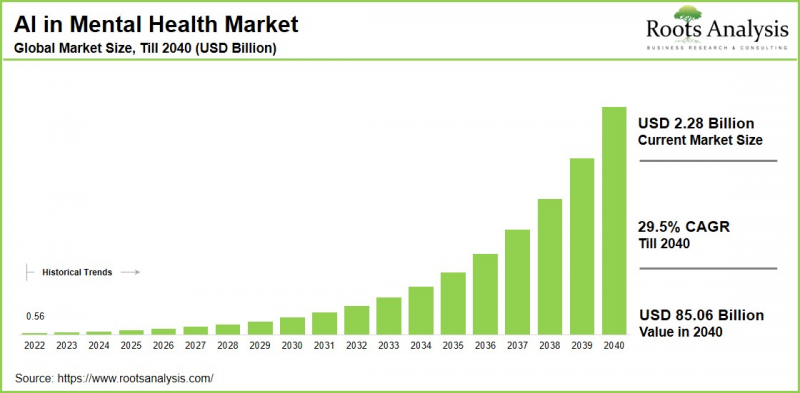
預計到 2040 年,全球心理健康人工智慧市場規模將從目前的 22.8 億美元增長至 850.6 億美元,預測期內複合年增長率 (CAGR) 為 29.5%。
人工智慧正在透過先進的分析、機器學習和自然語言處理技術,改善診斷、個人化治療並增強患者參與度,從而徹底改變心理健康醫療。聊天機器人和虛擬治療師(例如 Wysa)等人工智慧工具可提供可擴展的認知行為療法 (CBT)、症狀監測和危機幹預,從而緩解全球心理健康專業人員短缺的問題。
預測演算法分析電子健康記錄、穿戴式裝置數據和社群媒體中的模式,從而實現對憂鬱症、焦慮症和精神分裂症等疾病的早期檢測。 在精準精神病學領域,人工智慧整合了基因、神經影像和行為數據,用於定製藥物治療並優化雙相情感障礙等疾病的臨床研究結果。預計這些進步將在預測期內推動全球心理健康人工智慧市場顯著成長。
推動心理健康人工智慧市場成長的關鍵因素
心理健康人工智慧市場的成長受多種因素驅動,包括全球對便利且可擴展的行為健康解決方案日益增長的需求。憂鬱症和焦慮症等精神疾病的盛行率不斷上升,給傳統醫療保健系統帶來了巨大壓力。這推動了人工智慧工具(例如聊天機器人、預測分析和虛擬治療師)在早期檢測和介入方面的應用。
自然語言處理 (NLP)、機器學習演算法和穿戴式感測器等技術進步,使得精準的症狀監測、個人化治療建議和即時危機預測成為可能。此外,FDA 對數位療法的批准等支持性監管框架,以及對心理健康技術新創公司的大量投資,正在加速該領域的創新。另外,疫情後向遠距醫療的轉變以及消費者對數位化干預措施日益增長的接受度,正在推動預測期內人工智慧在心理健康領域的市場整體成長。
人工智慧在心理健康領域的應用面臨的倫理挑戰
將人工智慧應用於心理健康領域引發了重大的倫理問題,尤其是在資料隱私、演算法偏見以及人際互動不可取代的價值方面。敏感的患者資訊需要嚴格保護以確保其保密性。 然而,基於不具代表性的資料集訓練的人工智慧模型可能會加劇不同人群在醫療保健方面的不平等,從而導致偏見的延續。雖然人工智慧可以透過可擴展的診斷和乾預措施來增強服務,但它無法複製人類臨床醫生所建立的同理心和治療關係。過度依賴人工智慧可能會削弱對患者獲得最佳療效至關重要的人際關係。透過健全的監管框架和偏見緩解策略來應對這些挑戰仍然至關重要。
區域分析:北美佔最大市場佔有率
據我們估計,北美目前佔心理健康人工智慧市場的大部分佔有率。這主要歸功於其先進的醫療保健基礎設施、數位健康技術的廣泛應用以及對人工智慧創新的巨額投資。該地區慢性病患病率高,且聯邦醫療保險和私人保險公司提供有利的報銷政策,這些因素都為其帶來了好處。此外,包括美國和加拿大在內的主要科技公司和醫療保健提供者正在透過合作以及研發活動加速人工智慧的整合。
本報告分析了全球人工智慧在心理健康領域的應用市場,並提供了市場規模估算、機會分析、競爭格局和公司概況等資訊。
目錄
第一部分:報告概述
第一章:引言
第二章:研究方法
第三章:市場動態
第四章:宏觀經濟指標
第二部分:質性研究結果
第五章:摘要整理
第六章:引言
第七章:監理環境
第三部分:市場概覽
第八章:關鍵指標綜合資料庫
公司第九章:競爭格局
第十章:競爭分析
第十一章:心理健康人工智慧新創企業生態系統
第四部分:公司簡介
第十二章:公司簡介
- 章節概述
- Aiberry
- Calm Health
- Ellipsis Health
- Headspace Health
- Kintsugi
- Limbic
- Lyra Health
- meQ
- Quartet
- SilverCloud Health
- Spring Health
- Syra健康
- Woebot 健康
- Wysa
第五部分 市場趨勢
第十三章:大趨勢分析
第十四章:專利分析
第十五章:近期發展
第六部分:市場機會分析
第十六章:全球心理健康人工智慧市場
第十七章:依產品類型劃分的市場機會
第十八章:依技術類型劃分的市場機會
第十九章:依疾病類型劃分的市場機會
第二十章:市場依最終使用者類型劃分的市場機會
第21章:北美心理健康人工智慧市場機會
第22章:歐洲心理健康人工智慧市場機會
第23章:亞洲心理健康人工智慧市場機會
第24章:中東和北非(MENA)心理健康人工智慧市場機會
第25章:拉丁美洲心理健康人工智慧市場機會
第26章:其他地區心理健康人工智慧市場機會
第27章:主要參與者的市場集中度分析
第28章:鄰近市場
分析第七部分:策略工具
第二十九章:關鍵成功策略
第三十章:波特五力分析
第三十一章:SWOT分析
第三十二章:Roots戰略建議
第八部分:其他獨家發現
第三十三章:主要研究發現
第三十四章:報告結論
第九部分:附錄
AI in Mental Health Market Outlook
As per Roots Analysis, the global AI in mental health market size is estimated to grow from USD 2.28 billion in current year to USD 85.06 billion by 2040, at a CAGR of 29.5% during the forecast period, till 2040.
Artificial Intelligence (AI) is revolutionizing mental health care by enhancing diagnostics, treatment personalization, and patient engagement through advanced analytics, machine learning, and natural language processing. AI-driven tools, such as chatbots and virtual therapists like Wysa, provide scalable cognitive behavioral therapy (CBT), symptom monitoring, and crisis intervention, addressing global shortages in mental health professionals.
Predictive algorithms analyze electronic health records, wearable data, and social media patterns to enable early detection of conditions like depression, anxiety, and schizophrenia. Within precision psychiatry, AI customizes pharmacotherapy by integrating genetic, neuroimaging, and behavioral data, thereby refining results in clinical studies for conditions like bipolar disorder. Driven by these advancements, global AI in mental health market is expected to grow significantly during the forecast period.
Strategic Insights for Senior Leaders
Role of AI in Psychiatry and Psychology
Artificial Intelligence (AI) plays a transformative role in psychiatry and psychology by augmenting diagnostic precision, personalizing therapeutic interventions, and optimizing clinical workflows through machine learning, natural language processing, and predictive analytics. In psychiatry, AI algorithms analyze multimodal data from electronic health records, neuroimaging, wearables, and speech patterns. This enables early detection of disorders such as depression, schizophrenia, and bipolar affective disorders. Additionally, AI predicts treatment responses to antidepressants, antipsychotics, or electroconvulsive therapy with accuracies often exceeding traditional methods.
In psychology, AI supports scalable interventions via chatbots and virtual agents delivering cognitive behavioral therapy, emotional regulation training, and suicide risk assessment. These technologies address clinician shortages and enhance accessibility in educational and therapeutic settings. Furthermore, AI streamlines administrative tasks such as documentation summarization, literature synthesis, and resource allocation forecasting. These advancements promote personalized medicine and address biases through robust ethical frameworks.
Key Technological Breakthroughs in AI in Mental Health Applications
Recent technological advancements in AI for mental health applications have significantly enhanced personalized care, predictive analytics, and therapeutic interventions. Innovations such as AI-driven chatbots and large language models, including apps like Wysa, deliver cognitive behavioral therapy through conversational agents. These tools improve accessibility and engagement while reducing waiting time for patients.
Integration of machine learning with wearables and virtual reality enables real-time symptom monitoring, early detection of disorders like depression, and tailored treatment plans. These developments leverage natural language processing and multimodal data analysis to predict outcomes and support clinicians, though ethical challenges persist.
Key Drivers Propelling Growth of AI in mental health Market
The AI in mental health market is propelled by several key drivers including escalating global demand for accessible, scalable behavioral health solutions. The rising prevalence of mental disorders, such as depression and anxiety, strains traditional care systems. This fuels adoption of AI-powered tools like chatbots, predictive analytics, and virtual therapists for early detection and intervention.
Technological advancements, including natural language processing (NLP), machine learning algorithms, and wearable sensors, enable precise symptom monitoring, personalized treatment recommendations, and real-time crisis prediction. Further, supportive regulatory frameworks, such as FDA approvals for digital therapeutics, along with substantial investments for mental health technology startups are accelerating innovation in this domain. Moreover, post-pandemic shifts toward telehealth, coupled with growing consumer acceptance of digital interventions are propelling the growth of the overall AI in mental health market during the forecast period.
Ethical Challenges of AI in Mental Health Applications
The integration of AI in mental health care raises significant ethical concerns, particularly around data privacy, algorithmic bias, and the irreplaceable value of human interaction. Sensitive patient information demands stringent protection to uphold confidentiality. However, AI models trained on non-representative datasets risk perpetuating biases that exacerbate care disparities across demographics. Although AI augments services through scalable diagnostics and interventions, it cannot replicate the empathetic therapeutic bond fostered by human clinicians. Overreliance on AI may diminish interpersonal connections essential for optimal patient outcomes. Addressing these challenges through robust regulatory frameworks and bias-mitigation strategies remains critical.
Regional Analysis: North America to Hold the Largest Share in the Market
According to our estimates North America currently captures a significant share of the AI in mental health market. This can be attributed to its advanced healthcare infrastructure, high adoption of digital health technologies, and substantial investments in AI innovation. The region benefits from a high prevalence of chronic diseases, along with favorable reimbursement policies from Medicare and private insurers. Moreover, leading tech giants and healthcare providers, including those in the US and Canada, are also accelerating AI integration through partnerships and research and development initiatives.
AI in Mental Health Market: Key Market Segmentation
Type of Offering
- Software
- Services
Type of Technology
- Natural language processing
- Deep learning and machine learning
- Context-aware computing
- Computer Vision
- Others
Type of Disorder
- Depression
- Anxiety
- Schizophrenia
- Post-Traumatic Stress Disorder (PTSD)
- Insomnia
- Others
Type of End User
- Hospitals and Clinics
- Mental Health Centers
- Research Institutions
- Others
Geographical Regions
- North America
- US
- Canada
- Mexico
- Other North American countries
- Europe
- Austria
- Belgium
- Denmark
- France
- Germany
- Ireland
- Italy
- Netherlands
- Norway
- Russia
- Spain
- Sweden
- Switzerland
- UK
- Other European countries
- Asia
- China
- India
- Japan
- Singapore
- South Korea
- Other Asian countries
- Latin America
- Brazil
- Chile
- Colombia
- Venezuela
- Other Latin American countries
- Middle East and North Africa
- Egypt
- Iran
- Iraq
- Israel
- Kuwait
- Saudi Arabia
- UAE
- Other MENA countries
- Rest of the World
Example Players in AI in Mental Health Market
- Aiberry
- Calm Health
- Ellipsis Health
- Headspace Health
- Kintsugi
- Limbic
- Lyra Health
- meQ
- Quartet
- SilverCloud Health
- Spring Health
- Syra Health
- Woebot Health
- Wysa
AI in Mental Health Market: Report Coverage
The report on the AI in mental health market features insights on various sections, including:
- Market Sizing and Opportunity Analysis: An in-depth analysis of the AI in mental health market, focusing on key market segments, including [A] type of offering, [B] type of technology, [C] type of disorder, [D] type of end-user, and [E] key geographical regions.
- Competitive Landscape: A comprehensive analysis of the companies engaged in the AI in mental health market, based on several relevant parameters, such as [A] year of establishment, [B] company size, [C] location of headquarters and [D] ownership structure.
- Company Profiles: Elaborate profiles of prominent players engaged in the AI in mental health market, providing details on [A] location of headquarters, [B] company size, [C] company mission, [D] company footprint, [E] management team, [F] contact details, [G] financial information, [H] operating business segments, [I] product / technology portfolio, [J] recent developments, and an informed future outlook.
- Megatrends: An evaluation of ongoing megatrends in the AI in mental health industry.
- Recent Developments: An overview of the recent developments made in the AI in mental health market, along with analysis based on relevant parameters, including [A] year of initiative, [B] type of initiative, [C] geographical distribution and [D] most active players.
- SWOT Analysis: An insightful SWOT framework, highlighting the strengths, weaknesses, opportunities and threats in the domain. Additionally, it provides Harvey ball analysis, highlighting the relative impact of each SWOT parameter.
Key Questions Answered in this Report
- What is the current and future market size?
- Who are the leading companies in this market?
- What are the growth drivers that are likely to influence the evolution of this market?
- What are the key partnership and funding trends shaping this industry?
- Which region is likely to grow at higher CAGR till 2040?
- How is the current and future market opportunity likely to be distributed across key market segments?
Reasons to Buy this Report
- Detailed Market Analysis: The report provides a comprehensive market analysis, offering detailed revenue projections of the overall market and its specific sub-segments. This information is valuable to both established market leaders and emerging entrants.
- In-depth Analysis of Trends: Stakeholders can leverage the report to gain a deeper understanding of the competitive dynamics within the market. Each report maps ecosystem activity across partnerships, funding, and patent landscapes to reveal growth hotspots and white spaces in the industry.
- Opinion of Industry Experts: The report features extensive interviews and surveys with key opinion leaders and industry experts to validate market trends mentioned in the report.
- Decision-ready Deliverables: The report offers stakeholders with strategic frameworks (Porter's Five Forces, value chain, SWOT), and complimentary Excel / slide packs with customization support.
Additional Benefits
- Complimentary Dynamic Excel Dashboards for Analytical Modules
- Exclusive 15% Free Content Customization
- Personalized Interactive Report Walkthrough with Our Expert Research Team
- Free Report Updates for Versions Older than 6-12 Months
TABLE OF CONTENTS
SECTION I: REPORT OVERVIEW
1. PREFACE
- 1.1. Introduction
- 1.2. Market Share Insights
- 1.3. Key Market Insights
- 1.4. Report Coverage
- 1.5. Key Questions Answered
- 1.6. Chapter Outlines
2. RESEARCH METHODOLOGY
- 2.1. Chapter Overview
- 2.2. Research Assumptions
- 2.3. Database Building
- 2.3.1. Data Collection
- 2.3.2. Data Validation
- 2.3.3. Data Analysis
- 2.4. Project Methodology
- 2.4.1. Secondary Research
- 2.4.1.1. Annual Reports
- 2.4.1.2. Academic Research Papers
- 2.4.1.3. Company Websites
- 2.4.1.4. Investor Presentations
- 2.4.1.5. Regulatory Filings
- 2.4.1.6. White Papers
- 2.4.1.7. Industry Publications
- 2.4.1.8. Conferences and Seminars
- 2.4.1.9. Government Portals
- 2.4.1.10. Media and Press Releases
- 2.4.1.11. Newsletters
- 2.4.1.12. Industry Databases
- 2.4.1.13. Roots Proprietary Databases
- 2.4.1.14. Paid Databases and Sources
- 2.4.1.15. Social Media Portals
- 2.4.1.16. Other Secondary Sources
- 2.4.2. Primary Research
- 2.4.2.1. Introduction
- 2.4.2.2. Types
- 2.4.2.2.1. Qualitative
- 2.4.2.2.2. Quantitative
- 2.4.2.3. Advantages
- 2.4.2.4. Techniques
- 2.4.2.4.1. Interviews
- 2.4.2.4.2. Surveys
- 2.4.2.4.3. Focus Groups
- 2.4.2.4.4. Observational Research
- 2.4.2.4.5. Social Media Interactions
- 2.4.2.5. Stakeholders
- 2.4.2.5.1. Company Executives (CXOs)
- 2.4.2.5.2. Board of Directors
- 2.4.2.5.3. Company Presidents and Vice Presidents
- 2.4.2.5.4. Key Opinion Leaders
- 2.4.2.5.5. Research and Development Heads
- 2.4.2.5.6. Technical Experts
- 2.4.2.5.7. Subject Matter Experts
- 2.4.2.5.8. Scientists
- 2.4.2.5.9. Doctors and Other Healthcare Providers
- 2.4.2.6. Ethics and Integrity
- 2.4.2.6.1. Research Ethics
- 2.4.2.6.2. Data Integrity
- 2.4.3. Analytical Tools and Databases
- 2.4.1. Secondary Research
3. MARKET DYNAMICS
- 3.1. Forecast Methodology
- 3.1.1. Top-Down Approach
- 3.1.2. Bottom-Up Approach
- 3.1.3. Hybrid Approach
- 3.2. Market Assessment Framework
- 3.2.1. Total Addressable Market (TAM)
- 3.2.2. Serviceable Addressable Market (SAM)
- 3.2.3. Serviceable Obtainable Market (SOM)
- 3.2.4. Currently Acquired Market (CAM)
- 3.3. Forecasting Tools and Techniques
- 3.3.1. Qualitative Forecasting
- 3.3.2. Correlation
- 3.3.3. Regression
- 3.3.4. Time Series Analysis
- 3.3.5. Extrapolation
- 3.3.6. Convergence
- 3.3.7. Forecast Error Analysis
- 3.3.8. Data Visualization
- 3.3.9. Scenario Planning
- 3.3.10. Sensitivity Analysis
- 3.4. Key Considerations
- 3.4.1. Demographics
- 3.4.2. Market Access
- 3.4.3. Reimbursement Scenarios
- 3.4.4. Industry Consolidation
- 3.5. Robust Quality Control
- 3.6. Key Market Segmentations
- 3.7. Limitations
4. MACRO-ECONOMIC INDICATORS
- 4.1. Chapter Overview
- 4.2. Market Dynamics
- 4.2.1. Time Period
- 4.2.1.1. Historical Trends
- 4.2.1.2. Current and Forecasted Estimates
- 4.2.2. Currency Coverage
- 4.2.2.1. Overview of Major Currencies Affecting the Market
- 4.2.2.2. Impact of Currency Fluctuations on the Industry
- 4.2.3. Foreign Exchange Impact
- 4.2.3.1. Evaluation of Foreign Exchange Rates and Their Impact on Market
- 4.2.3.2. Strategies for Mitigating Foreign Exchange Risk
- 4.2.4. Recession
- 4.2.4.1. Historical Analysis of Past Recessions and Lessons Learnt
- 4.2.4.2. Assessment of Current Economic Conditions and Potential Impact on the Market
- 4.2.5. Inflation
- 4.2.5.1. Measurement and Analysis of Inflationary Pressures in the Economy
- 4.2.5.2. Potential Impact of Inflation on the Market Evolution
- 4.2.6. Interest Rates
- 4.2.6.1. Overview of Interest Rates and Their Impact on the Market
- 4.2.6.2. Strategies for Managing Interest Rate Risk
- 4.2.7. Commodity Flow Analysis
- 4.2.7.1. Type of Commodity
- 4.2.7.2. Origins and Destinations
- 4.2.7.3. Values and Weights
- 4.2.7.4. Modes of Transportation
- 4.2.8. Global Trade Dynamics
- 4.2.8.1. Import Scenario
- 4.2.8.2. Export Scenario
- 4.2.9. War Impact Analysis
- 4.2.9.1. Russian-Ukraine War
- 4.2.9.2. Israel-Hamas War
- 4.2.10. COVID Impact / Related Factors
- 4.2.10.1. Global Economic Impact
- 4.2.10.2. Industry-specific Impact
- 4.2.10.3. Government Response and Stimulus Measures
- 4.2.10.4. Future Outlook and Adaptation Strategies
- 4.2.11. Other Indicators
- 4.2.11.1. Fiscal Policy
- 4.2.11.2. Consumer Spending
- 4.2.11.3. Gross Domestic Product (GDP)
- 4.2.11.4. Employment
- 4.2.11.5. Taxes
- 4.2.11.6. R&D Innovation
- 4.2.11.7. Stock Market Performance
- 4.2.11.8. Supply Chain
- 4.2.11.9. Cross-Border Dynamics
- 4.2.1. Time Period
SECTION II: QUALITATIVE INSIGHTS
5. EXECUTIVE SUMMARY
6. INTRODUCTION
- 6.1. Chapter Overview
- 6.2. Overview of AI in Mental Health Market
- 6.2.1. Historical Evolution
- 6.2.2. Key Applications
- 6.2.3. Impact on Healthcare
- 6.3. Future Perspective
7. REGULATORY SCENARIO
SECTION III: MARKET OVERVIEW
8. COMPREHENSIVE DATABASE OF LEADING PLAYERS
9. COMPETITIVE LANDSCAPE
- 9.1. Chapter Overview
- 9.2. AI in Mental Health Market: Overall Market Landscape
- 9.2.1. Analysis by Year of Establishment
- 9.2.2. Analysis by Company Size
- 9.2.3. Analysis by Location of Headquarters
- 9.2.4. Analysis by Ownership Structure
10. COMPANY COMPETITIVENESS ANALYSIS
11. STARTUP ECOSYSTEM IN THE AI IN MENTAL HEALTH MARKET
- 11.1. AI in Mental Health Market: Market Landscape of Startups
- 11.1.1. Analysis by Year of Establishment
- 11.1.2. Analysis by Company Size
- 11.1.3. Analysis by Company Size and Year of Establishment
- 11.1.4. Analysis by Location of Headquarters
- 11.1.5. Analysis by Company Size and Location of Headquarters
- 11.1.6. Analysis by Ownership Structure
- 11.2. Key Findings
SECTION IV: COMPANY PROFILES
12. COMPANY PROFILES
- 12.1. Chapter Overview
- 12.2. Aiberry*
- 12.2.1. Company Overview
- 12.2.2. Company Mission
- 12.2.3. Company Footprint
- 12.2.4. Management Team
- 12.2.5. Contact Details
- 12.2.6. Financial Performance
- 12.2.7. Operating Business Segments
- 12.2.8. Service / Product Portfolio (project specific)
- 12.2.9. MOAT Analysis
- 12.2.10. Recent Developments and Future Outlook
- 12.3. Calm Health
- 12.4. Ellipsis Health
- 12.5. Headspace Health
- 12.6. Kintsugi
- 12.7. Limbic
- 12.8. Lyra Health
- 12.9. meQ
- 12.10. Quartet
- 12.11. SilverCloud Health
- 12.12. Spring Health
- 12.12. Syra Health
- 12.14. Woebot Health
- 12.15. Wysa
SECTION V: MARKET TRENDS
13. MEGA TRENDS ANALYSIS
14. PATENT ANALYSIS
15. RECENT DEVELOPMENTS
- 15.1. Chapter Overview
- 15.2. Recent Funding
- 15.3. Recent Partnerships
- 15.4. Other Recent Initiatives
SECTION VI: MARKET OPPORTUNITY ANALYSIS
16. GLOBAL AI IN MENTAL HEALTH MARKET
- 16.1. Chapter Overview
- 16.2. Key Assumptions and Methodology
- 16.3. Trends Disruption Impacting Market
- 16.4. Demand Side Trends
- 16.5. Supply Side Trends
- 16.6. Global AI in Mental Health Market, Historical Trends (Since 2022) and Forecasted Estimates (Till 2040)
- 16.7. Multivariate Scenario Analysis
- 16.7.1. Conservative Scenario
- 16.7.2. Optimistic Scenario
- 16.8. Investment Feasibility Index
- 16.9. Key Market Segmentations
17. MARKET OPPORTUNITIES BASED ON TYPE OF OFFERING
- 17.1. Chapter Overview
- 17.2. Key Assumptions and Methodology
- 17.3. Revenue Shift Analysis
- 17.4. Market Movement Analysis
- 17.5. Penetration-Growth (P-G) Matrix
- 17.6. AI in Mental Health Market for Software: Historical Trends (Since 2022) and Forecasted Estimates (Till 2040)
- 17.7. AI in Mental Health Market for Services: Historical Trends (Since 2022) and Forecasted Estimates (Till 2040)
- 17.8. Data Triangulation and Validation
- 17.8.1. Secondary Sources
- 17.8.2. Primary Sources
- 17.8.3. Statistical Modeling
18. MARKET OPPORTUNITIES BASED ON TYPE OF TECHNOLOGY
- 18.1. Chapter Overview
- 18.2. Key Assumptions and Methodology
- 18.3. Revenue Shift Analysis
- 18.4. Market Movement Analysis
- 18.5. Penetration-Growth (P-G) Matrix
- 18.6. AI in Mental Health Market for Natural Language Processing: Historical Trends (Since 2022) and Forecasted Estimates (Till 2040)
- 18.7. AI in Mental Health Market for Deep Learning and Machine Learning: Historical Trends (Since 2022) and Forecasted Estimates (Till 2040)
- 18.8. AI in Mental Health Market for Context-aware Computing: Historical Trends (Since 2022) and Forecasted Estimates (Till 2040)
- 18.9. AI in Mental Health Market for Computer Vision: Historical Trends (Since 2022) and Forecasted Estimates (Till 2040)
- 18.10. AI in Mental Health Market for Others: Historical Trends (Since 2022) and Forecasted Estimates (Till 2040)
- 18.11. Data Triangulation and Validation
- 18.11.1. Secondary Sources
- 18.11.2. Primary Sources
- 18.11.3. Statistical Modeling
19. MARKET OPPORTUNITIES BASED ON TYPE OF DISORDER
- 19.1. Chapter Overview
- 19.2. Key Assumptions and Methodology
- 19.3. Revenue Shift Analysis
- 19.4. Market Movement Analysis
- 19.5. Penetration-Growth (P-G) Matrix
- 19.6. AI in Mental Health Market for Depression: Historical Trends (Since 2022) and Forecasted Estimates (Till 2040)
- 19.7. AI in Mental Health Market for Anxiety: Historical Trends (Since 2022) and Forecasted Estimates (Till 2040)
- 19.8. AI in Mental Health Market for Schizophrenia: Historical Trends (Since 2022) and Forecasted Estimates (Till 2040)
- 19.9. AI in Mental Health Market for Post-Traumatic Stress Disorder (PTSD): Historical Trends (Since 2022) and Forecasted Estimates (Till 2040)
- 19.10. AI in Mental Health Market for Insomnia: Historical Trends (Since 2022) and Forecasted Estimates (Till 2040)
- 19.11. AI in Mental Health Market for Others: Historical Trends (Since 2022) and Forecasted Estimates (Till 2040)
- 19.12. Data Triangulation and Validation
- 19.12.1. Secondary Sources
- 19.12.2. Primary Sources
- 19.12.3. Statistical Modeling
20. MARKET OPPORTUNITIES BASED ON TYPE OF END USER
- 20.1. Chapter Overview
- 20.2. Key Assumptions and Methodology
- 20.3. Revenue Shift Analysis
- 20.4. Market Movement Analysis
- 20.5. Penetration-Growth (P-G) Matrix
- 20.6. AI in Mental Health Market for Hospitals and Clinics: Historical Trends (Since 2022) and Forecasted Estimates (Till 2040)
- 20.7. AI in Mental Health Market for Mental Health Centers: Historical Trends (Since 2022) and Forecasted Estimates (Till 2040)
- 20.8. AI in Mental Health Market for Research Institutions: Historical Trends (Since 2022) and Forecasted Estimates (Till 2040)
- 20.9. AI in Mental Health Market for Others: Historical Trends (Since 2022) and Forecasted Estimates (Till 2040)
- 20.10. Data Triangulation and Validation
- 20.10.1. Secondary Sources
- 20.10.2. Primary Sources
- 20.10.3. Statistical Modeling
21. MARKET OPPORTUNITIES FOR AI IN MENTAL HEALTH IN NORTH AMERICA
- 21.1. Chapter Overview
- 21.2. Key Assumptions and Methodology
- 21.3. Revenue Shift Analysis
- 21.4. Market Movement Analysis
- 21.5. Penetration-Growth (P-G) Matrix
- 21.6. AI in Mental Health Market in North America: Historical Trends (Since 2022) and Forecasted Estimates (Till 2040)
- 21.6.1. AI in Mental Health Market in the US: Historical Trends (Since 2022) and Forecasted Estimates (Till 2040)
- 21.6.2. AI in Mental Health Market in Canada: Historical Trends (Since 2022) and Forecasted Estimates (Till 2040)
- 21.6.3. AI in Mental Health Market in Mexico: Historical Trends (Since 2022) and Forecasted Estimates (Till 2040)
- 21.6.4. AI in Mental Health Market in Other North American Countries: Historical Trends (Since 2022) and Forecasted Estimates (Till 2040)
- 21.7. Data Triangulation and Validation
22. MARKET OPPORTUNITIES FOR AI IN MENTAL HEALTH IN EUROPE
- 22.1. Chapter Overview
- 22.2. Key Assumptions and Methodology
- 22.3. Revenue Shift Analysis
- 22.4. Market Movement Analysis
- 22.5. Penetration-Growth (P-G) Matrix
- 22.6. AI in Mental Health Market in Europe: Historical Trends (Since 2022) and Forecasted Estimates (Till 2040)
- 22.6.1. AI in Mental Health Market in Austria: Historical Trends (Since 2022) and Forecasted Estimates (Till 2040)
- 22.6.2. AI in Mental Health Market in Belgium: Historical Trends (Since 2022) and Forecasted Estimates (Till 2040)
- 22.6.3. AI in Mental Health Market in Denmark: Historical Trends (Since 2022) and Forecasted Estimates (Till 2040)
- 22.6.4. AI in Mental Health Market in France: Historical Trends (Since 2022) and Forecasted Estimates (Till 2040)
- 22.6.5. AI in Mental Health Market in Germany: Historical Trends (Since 2022) and Forecasted Estimates (Till 2040)
- 22.6.6. AI in Mental Health Market in Ireland: Historical Trends (Since 2022) and Forecasted Estimates (Till 2040)
- 22.6.7. AI in Mental Health Market in Italy: Historical Trends (Since 2022) and Forecasted Estimates (Till 2040)
- 22.6.8. AI in Mental Health Market in Netherlands: Historical Trends (Since 2022) and Forecasted Estimates (Till 2040)
- 22.6.9. AI in Mental Health Market in Norway: Historical Trends (Since 2022) and Forecasted Estimates (Till 2040)
- 22.6.10. AI in Mental Health Market in Russia: Historical Trends (Since 2022) and Forecasted Estimates (Till 2040)
- 22.6.11. AI in Mental Health Market in Spain: Historical Trends (Since 2022) and Forecasted Estimates (Till 2040)
- 22.6.12. AI in Mental Health Market in Sweden: Historical Trends (Since 2022) and Forecasted Estimates (Till 2040)
- 22.6.13. AI in Mental Health Market in Switzerland: Historical Trends (Since 2022) and Forecasted Estimates (Till 2040)
- 22.6.14. AI in Mental Health Market in the UK: Historical Trends (Since 2022) and Forecasted Estimates (Till 2040)
- 22.6.15. AI in Mental Health Market in Other European Countries: Historical Trends (Since 2022) and Forecasted Estimates (Till 2040)
- 22.7. Data Triangulation and Validation
23. MARKET OPPORTUNITIES FOR AI IN MENTAL HEALTH IN ASIA
- 23.1. Chapter Overview
- 23.2. Key Assumptions and Methodology
- 23.3. Revenue Shift Analysis
- 23.4. Market Movement Analysis
- 23.5. Penetration-Growth (P-G) Matrix
- 23.6. AI in Mental Health Market in Asia: Historical Trends (Since 2022) and Forecasted Estimates (Till 2040)
- 23.6.1. AI in Mental Health Market in China: Historical Trends (Since 2022) and Forecasted Estimates (Till 2040)
- 23.6.2. AI in Mental Health Market in India: Historical Trends (Since 2022) and Forecasted Estimates (Till 2040)
- 23.6.3. AI in Mental Health Market in Japan: Historical Trends (Since 2022) and Forecasted Estimates (Till 2040)
- 23.6.4. AI in Mental Health Market in Singapore: Historical Trends (Since 2022) and Forecasted Estimates (Till 2040)
- 23.6.5. AI in Mental Health Market in South Korea: Historical Trends (Since 2022) and Forecasted Estimates (Till 2040)
- 23.6.6. AI in Mental Health Market in Other Asian Countries: Historical Trends (Since 2022) and Forecasted Estimates (Till 2040)
- 23.7. Data Triangulation and Validation
24. MARKET OPPORTUNITIES FOR AI IN MENTAL HEALTH IN MIDDLE EAST AND NORTH AFRICA (MENA)
- 24.1. Chapter Overview
- 24.2. Key Assumptions and Methodology
- 24.3. Revenue Shift Analysis
- 24.4. Market Movement Analysis
- 24.5. Penetration-Growth (P-G) Matrix
- 24.6. AI in Mental Health Market in Middle East and North Africa (MENA): Historical Trends (Since 2022) and Forecasted Estimates (Till 2040)
- 24.6.1. AI in Mental Health Market in Egypt: Historical Trends (Since 2022) and Forecasted Estimates (Till 205)
- 24.6.2. AI in Mental Health Market in Iran: Historical Trends (Since 2022) and Forecasted Estimates (Till 2040)
- 24.6.3. AI in Mental Health Market in Iraq: Historical Trends (Since 2022) and Forecasted Estimates (Till 2040)
- 24.6.4. AI in Mental Health Market in Israel: Historical Trends (Since 2022) and Forecasted Estimates (Till 2040)
- 24.6.5. AI in Mental Health Market in Kuwait: Historical Trends (Since 2022) and Forecasted Estimates (Till 2040)
- 24.6.6. AI in Mental Health Market in Saudi Arabia: Historical Trends (Since 2022) and Forecasted Estimates (Till 2040)
- 24.6.7. AI in Mental Health Market in United Arab Emirates (UAE): Historical Trends (Since 2022) and Forecasted Estimates (Till 2040)
- 24.6.8. AI in Mental Health Market in Other MENA Countries: Historical Trends (Since 2022) and Forecasted Estimates (Till 2040)
- 24.7. Data Triangulation and Validation
25. MARKET OPPORTUNITIES FOR AI IN MENTAL HEALTH IN LATIN AMERICA
- 25.1. Chapter Overview
- 25.2. Key Assumptions and Methodology
- 25.3. Revenue Shift Analysis
- 25.4. Market Movement Analysis
- 25.5. Penetration-Growth (P-G) Matrix
- 25.6. AI in Mental Health Market in Latin America: Historical Trends (Since 2022) and Forecasted Estimates (Till 2040)
- 25.6.1. AI in Mental Health Market in Argentina: Historical Trends (Since 2022) and Forecasted Estimates (Till 2040)
- 25.6.2. AI in Mental Health Market in Brazil: Historical Trends (Since 2022) and Forecasted Estimates (Till 2040)
- 25.6.3. AI in Mental Health Market in Chile: Historical Trends (Since 2022) and Forecasted Estimates (Till 2040)
- 25.6.4. AI in Mental Health Market in Colombia Historical Trends (Since 2022) and Forecasted Estimates (Till 2040)
- 25.6.5. AI in Mental Health Market in Venezuela: Historical Trends (Since 2022) and Forecasted Estimates (Till 2040)
- 25.6.6. AI in Mental Health Market in Other Latin American Countries: Historical Trends (Since 2022) and Forecasted Estimates (Till 2040)
- 25.7. Data Triangulation and Validation
26. MARKET OPPORTUNITIES FOR AI IN MENTAL HEALTH IN REST OF THE WORLD
- 26.1. Chapter Overview
- 26.2. Key Assumptions and Methodology
- 26.3. Revenue Shift Analysis
- 26.4. Market Movement Analysis
- 26.5. Penetration-Growth (P-G) Matrix
- 26.6. AI in Mental Health Market in Rest of the World: Historical Trends (Since 2022) and Forecasted Estimates (Till 2040)
- 26.6.1. AI in Mental Health Market in Australia: Historical Trends (Since 2022) and Forecasted Estimates (Till 2040)
- 26.6.2. AI in Mental Health Market in New Zealand: Historical Trends (Since 2022) and Forecasted Estimates (Till 2040)
- 26.6.3. AI in Mental Health Market in Other Countries
- 26.7. Data Triangulation and Validation
27. MARKET CONCENTRATION ANALYSIS: DISTRIBUTION BY LEADING PLAYERS
28. ADJACENT MARKET ANALYSIS
SECTION VII: STRATEGIC TOOLS
29. KEY WINNING STRATEGIES
30. PORTER'S FIVE FORCES ANALYSIS
31. SWOT ANALYSIS
32. ROOTS STRATEGIC RECOMMENDATIONS
- 32.1. Chapter Overview
- 32.2. Key Business-related Strategies
- 32.2.1. Research & Development
- 32.2.2. Product Manufacturing
- 32.2.3. Commercialization / Go-to-Market
- 32.2.4. Sales and Marketing
- 32.3. Key Operations-related Strategies
- 32.3.1. Risk Management
- 32.3.2. Workforce
- 32.3.3. Finance
- 32.3.4. Others
SECTION VIII: OTHER EXCLUSIVE INSIGHTS
33. INSIGHTS FROM PRIMARY RESEARCH
34. REPORT CONCLUSION
SECTION IX: APPENDIX
35. TABULATED DATA
36. LIST OF COMPANIES AND ORGANIZATIONS
37. ROOTS SUBSCRIPTION SERVICES
38. AUTHOR DETAILS

 人工智慧驅動的心理表現平台市場預測至2034年:全球認知功能、人工智慧能力、交付方式、使用者群體、最終用戶和區域分析
 2026-2034年全球心理健康領域人工智慧(AI)市場規模、佔有率、趨勢和成長分析報告
 人工智慧市場規模、佔有率及成長分析在心理健康領域的應用:按交付方式、應用、部署方式、最終用戶、人工智慧技術、分發平台和地區分類——2026-2033年產業預測人工智慧驅動的心理健康支援解決方案市場預測至2034年:全球組件、平台、部署模式、技術、應用、最終用戶和區域分析
 2035年心理健康領域人工智慧市場分析與預測:按類型、產品、服務、技術、組件、應用、部署、最終用戶和功能分類
 全球心理健康人工智慧市場:產業分析、市場規模、佔有率及預測(按產品、技術、應用、疾病、國家和地區分類)(2025-2032 年)
 人工智慧在心理健康領域的市場規模、佔有率和趨勢:按產品、技術、疾病、地區和細分市場分類的預測(2026-2033 年)2032 年心理健康市場人工智慧預測:按組件、疾病、技術、應用、最終用戶和地區進行全球分析人工智慧 (AI) 在心理健康領域的應用:預測(2025-2030 年)