


 |
市場調查報告書
商品編碼
1919787
人工智慧在臨床試驗中的應用市場-產業趨勢及全球預測(至2040年)-依試驗階段、治療領域、最終使用者及主要地區劃分AI in Clinical Trials Market, till 2040: Distribution by Trial Phase, Target Therapeutic Area, End User and Key Geographical Regions: Industry Trends and Global Forecasts |
||||||

人工智慧(AI)在臨床試驗中的市場展望
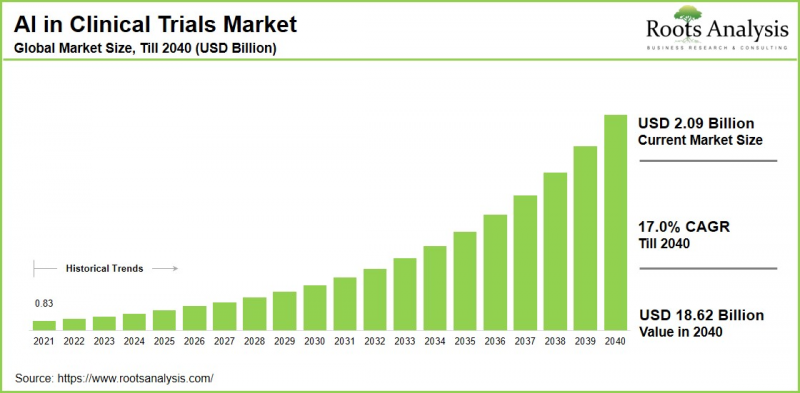
全球人工智慧在臨床試驗中的應用市場預計將從目前的20.9億美元增長到2040年的186.2億美元,在預測期內(至2040年)的複合年增長率(CAGR)為17.0%。
開發新療法需要大量的時間和資金,通常需要10到15年。臨床試驗對於評估藥物在人體的療效和安全性至關重要,約佔這些時間和預算的50%到70%。然而,許多試驗由於設計缺陷、招募問題、分層錯誤和高脫落率而失敗。為了應對這些挑戰,製藥業的利害關係人正在加速採用人工智慧,利用其處理大量資料集和優化試驗的能力。
人工智慧正在變革臨床試驗。它透過精準匹配加速患者招募,利用數位孿生技術優化試驗設計,並從包括電子健康記錄 (EHR) 和診斷影像在內的多個資料來源中提取安全性和有效性訊號。它還能自動執行報告和監測等日常任務。鑑於這些因素,預計全球臨床試驗人工智慧市場在預測期內將顯著成長。
高階主管的策略洞察
人工智慧在臨床試驗中的關鍵角色與應用
人工智慧在整個臨床試驗過程中發揮著至關重要的作用,從患者招募和研究中心選擇到研究設計、數據管理和結果預測。關鍵應用包括透過分析電子健康記錄 (EHR) 和真實世界數據,利用機器學習進行精準的患者配對。人工智慧也被用於減少篩檢失敗率並加快患者招募。此外,人工智慧還能自動清理資料、偵測異常值、預測不良事件,並透過持續分析各種資料集來加強監測。這提高了效率、降低了成本並提高了試驗成功率,從而支持個人化醫療方法。
推動臨床試驗市場人工智慧成長的關鍵市場驅動因素
由於幾個關鍵的市場驅動因素,臨床試驗中的人工智慧市場正在快速擴張,其中包括透過分析電子健康記錄和基因數據來簡化患者招募流程。這種方法可以加快識別合適的候選者,並縮短試驗時間和降低成本。預測分析和機器學習可以透過預測結果來優化試驗設計,而真實世界數據的整合則可以深入了解患者行為。此外,對個人化醫療日益增長的需求、精準醫療的發展以及管理大量臨床數據集的需求都在推動這些技術的應用。
人工智慧在臨床試驗中的應用:競爭格局
人工智慧在臨床試驗中的應用市場競爭激烈,大型企業和小型企業並存。 IQVIA、Medidata(達梭系統)、IBM Watson Health、Oracle Health Sciences 和 Phesi 等主要參與者憑藉其用於數據分析、患者匹配和試驗優化的綜合平台引領行業,並經常與輝瑞和諾華等製藥公司合作。
AiCure、Deep 6 AI、Mendel.ai、Saama Technologies、Unlearn.ai、ConcertAI 和 Tempus AI 等新興公司憑藉實時監測和預測建模等細分解決方案嶄露頭角,在對更高效藥物研發的需求不斷增長的背景下,加劇了市場競爭。
人工智慧在臨床試驗中的演進:新興產業趨勢
該領域的新興趨勢包括流程自動化、高階患者配對和預測分析,這些技術可以顯著降低成本並縮短時間。基於代理的人工智慧能夠自主管理試驗工作流程,從患者招募到即時風險監測以及自適應試驗中的方案調整。與生成式人工智慧不同,它能夠獨立執行決策,從而減少人工操作並加快患者招募。生成式人工智慧可以自動起草方案,產生用於模型訓練的合成資料集以及面向患者的內容,例如電子知情同意書。利用歷史資料模擬場景可以優化試驗設計,從而將開發時間縮短高達 50%,成本降低 25%。此外,數位孿生技術利用人工智慧和歷史數據來模擬個別患者的反應,從而能夠進行規模更小但統計效力更高的試驗。
主要市場挑戰
人工智慧在臨床試驗領域的市場面臨諸多挑戰,包括由於GDPR和HIPAA等嚴格的數據隱私法規而難以處理敏感的患者信息,以及與需要大量定制和互操作性標準的舊系統集成所面臨的挑戰。其他障礙還包括資料品質問題,例如真實世界資料集中的不完整性和偏差,以及在人工智慧專家短缺的情況下,基礎設施開發前期成本高昂。這些因素要求製藥公司、技術提供者和監管機構之間開展合作,以釋放人工智慧在簡化患者招募、監測和適應性設計方面的潛力。
臨床試驗中的人工智慧市場:主要市場區隔
試驗階段
- I期
- II期
- III期
目標治療領域
- 心血管疾病
- 中樞神經系統疾病
- 傳染病
- 代謝性疾病
- 腫瘤疾病
- 其他疾病
最終使用者
- 製藥和生技公司
- 其他
地區
- 北美
- 美國美國
- 加拿大
- 墨西哥
- 其他北美國家
- 歐洲
- 奧地利
- 比利時
- 丹麥
- 法國
- 德國
- 愛爾蘭
- 義大利
- 荷蘭
- 挪威
- 俄羅斯
- 西班牙
- 瑞典
- 瑞士
- 英國
- 歐洲其他國家
- 亞洲
- 中國
- 印度
- 日本
- 新加坡
- 韓國
- 亞洲其他國家
- 拉丁美洲
- 巴西
- 智利
- 哥倫比亞
- 委內瑞拉
- 拉丁美洲其他國家
- 中東和北非非洲
- 埃及
- 伊朗
- 伊拉克
- 以色列
- 科威特
- 沙烏地阿拉伯
- 阿拉伯聯合大公國
- 中東和北非其他地區
- 世界其他地區
- 澳大利亞
- 紐西蘭
- 世界其他地區
人工智慧在臨床試驗市場中的應用:關鍵市場份額洞察
依治療領域劃分的市佔率
依治療領域劃分,全球市場可細分為心血管疾病、中樞神經系統疾病、傳染病、代謝性疾病、腫瘤和其他疾病。據我們估計,腫瘤目前佔據了大部分市場份額。這主要是由於癌症臨床試驗規模龐大且複雜。這些試驗會從基因組分析、影像診斷和電子健康記錄中產生大量且多樣化的數據集,而人工智慧可以有效分析這些數據,從而提高患者招募的準確性。
依地區劃分的市佔率
據我們估計,亞太地區目前在人工智慧臨床試驗市場中佔據較大份額。這主要得益於該地區龐大且多元化的患者群體,使得在癌症和糖尿病等慢性疾病負擔日益加重的情況下,能夠快速招募患者參與臨床試驗。此外,該地區成本效益高的營運結構、不斷完善的監管框架、政府激勵措施以及不斷擴展的生物技術基礎設施,都在推動市場成長。
臨床試驗人工智慧市場代表性企業
- AiCure
- Antidote Technologies
- Deep 6 AI
- Innoplexus
- IQVIA
- Median Technologies
- Medidata
- Mendel.ai
- Phesi
- Saama Technologies
- Signant Health
- Trials.ai
臨床試驗人工智慧市場:報告內容
本報告涵蓋以下關於臨床試驗人工智慧市場的章節:
- 市場規模與機會分析:對臨床試驗人工智慧市場進行詳細分析,重點在於以下關鍵市場細分:[A] 試驗階段,[B] 目標治療領域,[C] 最終用戶,以及 [D] 主要地區。
- 競爭格局:基於多個相關參數,對參與人工智慧在臨床試驗市場中的公司進行全面分析,包括[A]成立年份、[B]公司規模、[C]總部所在地、[D]所有權結構。
- 公司簡介:提供參與人工智慧在臨床試驗市場中的主要公司的詳細簡介,包括[A]總部所在地、[B]公司規模、[C]公司使命、[D]營運區域、[E]管理團隊、[F]聯絡資訊、[G]財務資訊、[H]業務板塊、[I]產品組合以及[J]近期發展和未來展望。
- 宏觀趨勢:評估人工智慧在臨床試驗產業當前的宏觀趨勢。
- 專利分析:基於相關參數,對人工智慧在臨床試驗領域已提交和授權的專利進行深入分析,這些參數包括:[A] 專利類型,[B] 專利公開年份,[C] 專利年齡,以及 [D] 主要參與者。
- 近期發展:概述人工智慧在臨床試驗市場近期的發展動態,並基於相關參數進行分析,這些參數包括:[A] 啟動年份,[B] 啟動類型,[C] 地理分佈,以及 [D] 最活躍的參與者。
- 波特五力分析:分析人工智慧在臨床試驗市場的五種競爭力量(新進入者的威脅、買方的議價能力、供應商的議價能力、替代品的威脅、以及現有競爭對手之間的競爭)。
- SWOT 分析:深入的 SWOT 分析框架,突顯該領域的優勢、劣勢、機會和威脅。此外,哈維鮑爾分析突顯了每個 SWOT 參數的相對影響。
- 價值鏈分析:提供全面的價值鏈分析,介紹人工智慧在臨床試驗市場中涉及的各個階段和利害關係人的資訊。
本報告解答的關鍵問題
- 當前市場規模與未來展望市場規模有多大?
- 該市場的主要參與者有哪些?
- 哪些成長因素可能影響該市場的發展?
- 哪些關鍵的合作和融資趨勢正在塑造該產業?
- 預計到 2040 年,哪些地區的複合年增長率會較高?
- 當前和未來的市場機會預計將如何在主要細分市場中分佈?
目錄
第一章:引言
第二章:執行摘要
第三章:導論
- 章節概述
- 人工智慧的演進
- 人工智慧子領域
- 人工智慧在醫療保健領域的應用
- 人工智慧在臨床試驗的應用
- 人工智慧實施面臨的挑戰
- 未來展望
第四章:競爭格局
- 章節概述
- 人工智慧在臨床試驗中的應用:人工智慧軟體和服務提供者的現狀
第五章:公司簡介
- 章節概述
- AiCure
- Antidote Technologies
- Deep 6 AI
- Innoplexus
- IQVIA
- Median Technologies
- Medidata
- Mendel.ai
- Phesi
- Saama Technologies
- Signant Health
- Trials.ai
第六章 臨床試驗分析
- 章節概述
- 研究範圍與方法
- 人工智慧在臨床試驗的應用
第七章:合作與夥伴關係
- 章節概述
- 合作模式
- 人工智慧在臨床試驗中的應用:合作與夥伴關係合作
第八章:資金與投資
- 章節概述
- 資金類型
- 人工智慧在臨床試驗中的應用:資金與投資
- 結論
第九章:主要藥學項目
- 章節概述
- 範圍與研究方法
- 依專案年份分析
- 依項目類型分析
- 按人工智慧應用領域分析
- 依治療領域分析
- 基準分析:主要藥廠公司
第十章 人工智慧在臨床試驗中的應用:用例
- 章節概述
- 用例 1:羅氏與 AiCure 的合作
- 用例 2:武田與AiCure 合作案例
- 用例 3:梯瓦製藥與英特爾合作案例
- 用例 4:私人製藥公司與 Antidote 合作案例
- 用例 5:私人製藥公司與 Cognizant 合作案例
- 用例 6:西達賽奈醫療中心與 Deep 6 AI 合作案例
- 用例 7:葛蘭素史克 (GSK) 與 PathAI 合作案例
- 用例 8:百時美施貴寶 (BMS) 與 Concert AI 合作案例
第 11 章:價值創造架構:解決臨床試驗中未滿足需求的策略指引
第 12 章:成本降低分析
第 13 章:市場預測與機會分析
- 章節概述
- 關鍵假設與預測研究方法
- 全球人工智慧在臨床試驗中的應用市場
- 按試驗階段劃分的人工智慧在臨床試驗中的應用市場
- 按治療領域劃分的人工智慧在臨床試驗中的應用市場
- 按最終用戶劃分的人工智慧在臨床試驗中的應用市場
- 按主要地區劃分的人工智慧在臨床試驗中的應用市場
第14章:結論
第15章:高階主管洞察
第16章:附錄一:表格資料
第17章:附錄二:公司與組織清單
AI In Clinical Trials Market Outlook
As per Roots Analysis, the global artificial intelligence in clinical trials market size is estimated to grow from USD 2.09 billion in the current year to USD 18.62 billion by 2040, at a CAGR of 17.0% during the forecast period, till 2040.
Developing novel therapeutic interventions demands substantial time and financial resources, typically spanning about 10-15 years. Clinical trials, essential for evaluating efficacy and safety in humans, consume roughly 50-70% of this timeline and budget, yet many fail due to design flaws, recruitment issues, stratification errors, and high dropout rates. Therefore, pharma stakeholders are increasingly adopting AI to mitigate these hurdles, leveraging its capacity to process vast datasets for smarter trial optimization.
It is worth mentioning that artificial intelligence transforms clinical trials by accelerating patient recruitment through precise matching, refining trial designs via digital twins, and extracting safety and efficacy signals from multifaceted data sources like EHRs and imaging. Further, it automates the routine tasks such as reporting and monitoring. Overall, considering the above mentioned factors, the global AI in clinical trials market is expected to grow significantly during the forecast period.
Strategic Insights for Senior Leaders
Key Roles and Applications of AI in Clinical Trials
AI plays pivotal roles across clinical trials, from patient recruitment and site selection to trial design, data management, and outcome prediction. Key applications include using machine learning to analyze electronic health records and real-world data for precise patient matching. Further, it is used for reducing screen failures and accelerating enrollment. AI also automates data cleaning, detects anomalies, forecasts adverse events, and enhances monitoring through continuous analysis of diverse datasets. This enables improvement in efficiency, cutting costs, and boosting trial success rates while supporting personalized medicine approaches.
Prominent Drivers Propelling Growth of AI in Clinical Trials Market
The AI in clinical trials market is expanding rapidly due to several critical drivers, including enhanced patient recruitment through analysis of electronic health records and genetic data. This approach accelerates identification of suitable candidates and reduces trial timelines and costs. Predictive analytics and machine learning enable optimized trial designs by forecasting outcomes, while integration of real-world data provides deeper insights into patient behaviors. Further, rising demand for personalized medicine, growth in precision therapies, and the need to manage vast clinical datasets fuel adoption of such technologies.
AI in Clinical Trials Market: Competitive Landscape of Companies in this Industry
The competitive landscape of AI in clinical trials market is characterized by intense competition, featuring a combination of large and smaller firms. Key players such as IQVIA, Medidata (Dassault Systemes), IBM Watson Health, Oracle Health Sciences, and Phesi dominate through comprehensive platforms for data analytics, patient matching, and trial optimization, often collaborating with pharmaceutical firms like Pfizer and Novartis.
Emerging companies including AiCure, Deep 6 AI, Mendel.ai, Saama Technologies, Unlearn.ai, ConcertAI, and Tempus AI are gaining traction with niche solutions like real-time monitoring, and predictive modeling, intensifying competition amid rising demand for efficiency in drug development.
AI in Clinical Trials Evolution: Emerging Trends in the Industry
Emerging trends in this domain include automating processes, enhancing patient matching, and enabling predictive analytics to cut costs and timelines significantly. Agentic AI autonomously manages trial workflows, from patient recruitment to real-time risk monitoring and protocol adjustments in adaptive trials. Unlike generative AI, it executes decisions independently, reducing manual tasks and accelerating enrollment. Generative AI draft protocols, creates synthetic datasets for training models, and automates patient-facing content like eConsent. It optimizes trial design by simulating scenarios from historical data, potentially cutting development time by 50% and costs by 25%. Additionally, digital twins simulate individual patient responses using AI and historical data, enabling smaller trials with higher statistical power.
Key Market Challenges
The market for AI in clinical trials faces significant challenges, including stringent data privacy regulations like GDPR and HIPAA that complicate handling sensitive patient information, integration hurdles with legacy systems requiring substantial customization and interoperability standards. Additional barriers encompass data quality issues such as incompleteness and bias in real-world datasets, high upfront costs for infrastructure amid a shortage of AI-savvy clinicians. These factors necessitate collaborative efforts between pharma firms, tech providers, and regulators to unlock AI's potential in streamlining recruitment, monitoring, and adaptive designs.
AI In Clinical Trials Market: Key Market Segmentation
Trial Phase
- Phase I
- Phase II
- Phase III
Target Therapeutic Area
- Cardiovascular Disorders
- CNS Disorders
- Infectious Diseases
- Metabolic Disorders
- Oncological Disorders
- Other Disorders
End-user
- Pharmaceutical and Biotechnology Companies
- Other End-users
Geographical Regions
- North America
- US
- Canada
- Mexico
- Other North American countries
- Europe
- Austria
- Belgium
- Denmark
- France
- Germany
- Ireland
- Italy
- Netherlands
- Norway
- Russia
- Spain
- Sweden
- Switzerland
- UK
- Other European countries
- Asia
- China
- India
- Japan
- Singapore
- South Korea
- Other Asian countries
- Latin America
- Brazil
- Chile
- Colombia
- Venezuela
- Other Latin American countries
- Middle East and North Africa
- Egypt
- Iran
- Iraq
- Israel
- Kuwait
- Saudi Arabia
- UAE
- Other MENA countries
- Rest of the World
- Australia
- New Zealand
- Other countries
AI in clinical trials Market: Key Market Share Insights
Market Share by Therapeutic Area
Based on the therapeutic area, the global market is segmented into cardiovascular disorders, CNS disorders, infectious diseases, metabolic disorders, oncological disorders and other disorders. According to our estimates, currently, oncological disorders capture majority share of the market. This is due to the high volume and complexity of cancer trials; these trials generate vast, heterogeneous datasets from genomics, imaging, and electronic health records, which AI efficiently analyzes for precise patient recruitment.
Market Share by Geography
According to our estimates Asia-Pacific currently captures a significant share of the AI in clinical trials market. This is due to the massive, diverse patient population, offering rapid recruitment for trials amid rising chronic disease burdens like cancer and diabetes. Further, the region has cost-effective operations along with improving regulatory frameworks, government incentives, and expanding biotech infrastructure which fuels the growth.
Example Players in AI in Clinical Trials Market
- AiCure
- Antidote Technologies
- Deep 6 AI
- Innoplexus
- IQVIA
- Median Technologies
- Medidata
- Mendel.ai
- Phesi
- Saama Technologies
- Signant Health
- Trials.ai
AI in Clinical Trials Market: Report Coverage
The report on the AI in clinical trials market features insights on various sections, including:
- Market Sizing and Opportunity Analysis: An in-depth analysis of the AI in clinical trials market, focusing on key market segments, including [A] trial phase, [B] target therapeutic area, [C] end user, and [D] key geographical regions.
- Competitive Landscape: A comprehensive analysis of the companies engaged in the AI in clinical trials market, based on several relevant parameters, such as [A] year of establishment, [B] company size, [C] location of headquarters and [D] ownership structure.
- Company Profiles: Elaborate profiles of prominent players engaged in the AI in clinical trials market, providing details on [A] location of headquarters, [B] company size, [C] company mission, [D] company footprint, [E] management team, [F] contact details, [G] financial information, [H] operating business segments, [I] portfolio, [J] recent developments, and an informed future outlook.
- Megatrends: An evaluation of ongoing megatrends in the AI in clinical trials industry.
- Patent Analysis: An insightful analysis of patents filed / granted in the AI in clinical trials domain, based on relevant parameters, including [A] type of patent, [B] patent publication year, [C] patent age and [D] leading players.
- Recent Developments: An overview of the recent developments made in the AI in clinical trials market, along with analysis based on relevant parameters, including [A] year of initiative, [B] type of initiative, [C] geographical distribution and [D] most active players.
- Porter's Five Forces Analysis: An analysis of five competitive forces prevailing in the AI in clinical trials market, including threats of new entrants, bargaining power of buyers, bargaining power of suppliers, threats of substitute products and rivalry among existing competitors.
- SWOT Analysis: An insightful SWOT framework, highlighting the strengths, weaknesses, opportunities and threats in the domain. Additionally, it provides Harvey ball analysis, highlighting the relative impact of each SWOT parameter.
- Value Chain Analysis: A comprehensive analysis of the value chain, providing information on the different phases and stakeholders involved in the AI in clinical trials market.
Key Questions Answered in this Report
- What is the current and future market size?
- Who are the leading companies in this market?
- What are the growth drivers that are likely to influence the evolution of this market?
- What are the key partnership and funding trends shaping this industry?
- Which region is likely to grow at higher CAGR till 2040?
- How is the current and future market opportunity likely to be distributed across key market segments?
Reasons to Buy this Report
- Detailed Market Analysis: The report provides a comprehensive market analysis, offering detailed revenue projections of the overall market and its specific sub-segments. This information is valuable to both established market leaders and emerging entrants.
- In-depth Analysis of Trends: Stakeholders can leverage the report to gain a deeper understanding of the competitive dynamics within the market. Each report maps ecosystem activity across partnerships, funding, and patent landscapes to reveal growth hotspots and white spaces in the industry.
- Opinion of Industry Experts: The report features extensive interviews and surveys with key opinion leaders and industry experts to validate market trends mentioned in the report.
- Decision-ready Deliverables: The report offers stakeholders with strategic frameworks (Porter's Five Forces, value chain, SWOT), and complimentary Excel / slide packs with customization support.
Additional Benefits
- Complimentary Dynamic Excel Dashboards for Analytical Modules
- Exclusive 15% Free Content Customization
- Personalized Interactive Report Walkthrough with Our Expert Research Team
- Free Report Updates for Versions Older than 6-12 Months
TABLE OF CONTENTS
1. PREFACE
- 1.1. Scope of the Report
- 1.2. Research Methodology
- 1.3. Key Questions Answered
- 1.4. Chapter Outlines
2. EXECUTIVE SUMMARY
3. INTRODUCTION
- 3.1. Chapter Overview
- 3.2. Evolution of AI
- 3.3. Subfields of AI
- 3.4. Applications of AI in Healthcare
- 3.4.1. Drug Discovery
- 3.4.2. Drug Manufacturing
- 3.4.3. Marketing
- 3.4.4. Diagnosis and Treatment
- 3.4.5. Clinical Trials
- 3.5. Applications of AI in Clinical Trials
- 3.6. Challenges Associated with the Adoption of AI
- 3.7. Future Perspective
4. COMPETITIVE LANDSCAPE
- 4.1. Chapter Overview
- 4.2. AI in Clinical Trials: AI Software and Service Providers Landscape
- 4.2.1. Analysis by Year of Establishment
- 4.2.2. Analysis by Company Size
- 4.2.3. Analysis by Location of Headquarters
- 4.2.4. Analysis by Company Size and Location of Headquarters (Region-wise)
- 4.2.5. Analysis by Key Offering
- 4.2.6. Analysis by Business Model
- 4.2.7. Analysis by Deployment Option
- 4.2.8. Analysis by Type of AI Technology
- 4.2.9. Analysis by Application Area
- 4.2.10. Analysis by Potential End-user
5. COMPANY PROFILES
- 5.1. Chapter Overview
- 5.2. AiCure
- 5.2.1. Company Overview
- 5.2.2. AI-based Clinical Trial Offerings
- 5.2.3. Recent Developments and Future Outlook
- 5.3. Antidote Technologies
- 5.3.1. Company Overview
- 5.3.2. AI-based Clinical Trial Offerings
- 5.3.3. Recent Developments and Future Outlook
- 5.4. Deep 6 AI
- 5.4.1. Company Overview
- 5.4.2. AI-based Clinical Trial Offerings
- 5.4.3. Recent Developments and Future Outlook
- 5.5. Innoplexus
- 5.5.1. Company Overview
- 5.5.2. AI-based Clinical Trial Offerings
- 5.5.3. Recent Developments and Future Outlook
- 5.6. IQVIA
- 5.6.1. Company Overview
- 5.6.2. Financial Information
- 5.6.3. AI-based Clinical Trial Offerings
- 5.6.4. Recent Developments and Future Outlook
- 5.7. Median Technologies
- 5.7.1. Company Overview
- 5.7.2. Financial Information
- 5.7.3. AI-based Clinical Trial Offerings
- 5.7.4. Recent Developments and Future Outlook
- 5.8. Medidata
- 5.8.1. Company Overview
- 5.8.2. Financial Information
- 5.8.3. AI-based Clinical Trial Offerings
- 5.8.4. Recent Developments and Future Outlook
- 5.9. Mendel.ai
- 5.9.1. Company Overview
- 5.9.2. AI-based Clinical Trial Offerings
- 5.9.3. Recent Developments and Future Outlook
- 5.10. Phesi
- 5.10.1. Company Overview
- 5.10.2. AI-based Clinical Trial Offerings
- 5.10.3. Recent Developments and Future Outlook
- 5.11. Saama Technologies
- 5.11.1. Company Overview
- 5.11.2. AI-based Clinical Trial Offerings
- 5.11.3. Recent Developments and Future Outlook
- 5.12. Signant Health
- 5.12.1. Company Overview
- 5.12.2. AI-based Clinical Trial Offerings
- 5.12.3. Recent Developments and Future Outlook
- 5.13. Trials.ai
- 5.13.1. Company Overview
- 5.13.2. AI-based Clinical Trial Offerings
- 5.13.3. Recent Developments and Future Outlook
6. CLINICAL TRIAL ANALYSIS
- 6.1. Chapter Overview
- 6.2. Scope and Methodology
- 6.3. AI in Clinical Trials
- 6.3.1. Analysis by Trial Registration Year
- 6.3.2. Analysis by Number of Patients Enrolled
- 6.3.3. Analysis by Trial Phase
- 6.3.4. Analysis by Trial Status
- 6.3.5. Analysis by Trial Registration Year and Status
- 6.3.6. Analysis by Type of Sponsor
- 6.3.7. Analysis by Patient Gender
- 6.3.8. Analysis by Patient Age
- 6.3.9. Word Cloud Analysis: Emerging Focus Areas
- 6.3.10. Analysis by Target Therapeutic Area
- 6.3.11. Analysis by Study Design
- 6.3.11.1. Analysis by Type of Patient Allocation Model Used
- 6.3.11.2. Analysis by Type of Trial Masking Adopted
- 6.3.11.3. Analysis by Type of Intervention
- 6.3.11.4. Analysis by Trial Purpose
- 6.3.12. Most Active Players: Analysis by Number of Clinical Trials
- 6.3.13. Analysis of Clinical Trials by Geography
- 6.3.14. Analysis of Clinical Trials by Geography and Trial Status
- 6.3.15. Analysis of Patients Enrolled by Geography and Trial Registration Year
- 6.3.16. Analysis of Patients Enrolled by Geography and Trial Status
7. PARTNERSHIPS AND COLLABORATIONS
- 7.1. Chapter Overview
- 7.2. Partnership Models
- 7.3. AI in Clinical Trials: Partnerships and Collaborations
- 7.3.1. Analysis by Year of Partnership
- 7.3.2. Analysis by Type of Partnership
- 7.3.3. Analysis by Year and Type of Partnership
- 7.3.4. Analysis by Application Area
- 7.3.5. Analysis by Target Therapeutic Area
- 7.3.6. Analysis by Type of Partner
- 7.3.7. Most Active Players: Analysis by Number of Partnerships
- 7.3.8. Analysis by Geography
- 7.3.8.1. Local and International Agreements
- 7.3.8.2. Intercontinental and Intracontinental Agreements
8. FUNDING AND INVESTMENTS
- 8.1. Chapter Overview
- 8.2. Types of Funding
- 8.3. AI in Clinical Trials: Funding and Investments
- 8.3.1. Analysis by Year of Funding
- 8.3.2. Analysis by Amount Invested
- 8.3.3. Analysis by Type of Funding
- 8.3.4. Analysis by Year and Type of Funding
- 8.3.5. Analysis by Type of Funding and Amount Invested
- 8.3.6. Analysis by Application Area
- 8.3.7. Analysis by Geography
- 8.3.8. Most Active Players: Analysis by Number of Funding Instances and Amount Raised
- 8.3.9. Leading Investors: Analysis by Number of Funding Instances
- 8.4. Concluding Remarks
9. BIG PHARMA INITIATIVES
- 9.1. Chapter Overview
- 9.2. Scope and Methodology
- 9.3. Analysis by Year of Initiative
- 9.4. Analysis by Type of Initiative
- 9.5. Analysis by Application Area of AI
- 9.6. Analysis by Target Therapeutic Area
- 9.7. Benchmarking Analysis: Big Pharma Players
10. AI IN CLINICAL TRIALS: USE CASES
- 10.1. Chapter Overview
- 10.2. Use Case 1: Collaboration between Roche and AiCure
- 10.2.1. Roche
- 10.2.2. AiCure
- 10.2.3. Business Needs
- 10.2.4. Objectives Achieved and Solutions Provided
- 10.3. Use Case 2: Collaboration between Takeda and AiCure
- 10.3.1. Takeda
- 10.3.2. AiCure
- 10.3.3. Business Needs
- 10.3.4. Objectives Achieved and Solutions Provided
- 10.4. Use Case 3: Collaboration between Teva Pharmaceuticals and Intel
- 10.4.1. Teva Pharmaceuticals
- 10.4.2. Intel
- 10.4.3. Business Needs
- 10.4.4. Objectives Achieved and Solutions Provided
- 10.5. Use Case 4: Collaboration between Undisclosed Pharmaceutical Company and Antidote
- 10.5.1. Antidote
- 10.5.2. Business Needs
- 10.5.3. Objectives Achieved and Solutions Provided
- 10.6. Use Case 5: Collaboration between Undisclosed Pharmaceutical Company and Cognizant
- 10.6.1. Cognizant
- 10.6.2. Business Needs
- 10.6.3. Objectives Achieved and Solutions Offered
- 10.7. Use Case 6: Collaboration between Cedars-Sinai Medical Center and Deep 6 AI
- 10.7.1. Cedars-Sinai Medical Center
- 10.7.2. Deep 6 AI
- 10.7.3. Business Needs
- 10.7.4. Objectives Achieved and Solutions Offered
- 10.8. Use Case 7: Collaboration between GlaxoSmithKline (GSK) and PathAI
- 10.8.1. PathAI
- 10.8.2. GlaxoSmithKline (GSK)
- 10.8.3. Business Needs
- 10.8.4. Objectives Achieved and Solutions Provided
- 10.9. Use Case 8: Collaboration between Bristol Myers Squibb (BMS) and Concert AI
- 10.9.1. Concert AI
- 10.9.2. Bristol Myers Squibb (BMS)
- 10.9.3. Business Needs
- 10.9.4. Objectives Achieved and Solutions Provided
11. VALUE CREATION FRAMEWORK: A STRATEGIC GUIDE TO ADDRESS UNMET NEEDS IN CLINICAL TRIALS
12. COST SAVING ANALYSIS
13. MARKET FORECAST AND OPPORTUNITY ANALYSIS
- 13.1. Chapter Overview
- 13.2. Key Assumptions and Forecast Methodology
- 13.3. Global AI in Clinical Trials Market
- 13.3.1. AI in Clinical Trials Market: Distribution by Trial Phase
- 13.3.1.1. AI in Clinical Trials Market for Phase I
- 13.3.1.2. AI in Clinical Trials Market for Phase II
- 13.3.1.3. AI in Clinical Trials Market for Phase III
- 13.3.2. AI in Clinical Trials Market: Distribution by Target Therapeutic Area
- 13.3.2.1. AI in Clinical Trials Market for Cardiovascular Disorders
- 13.3.2.2. AI in Clinical Trials Market for CNS Disorders
- 13.3.2.3. AI in Clinical Trials Market for Infectious Diseases
- 13.3.2.4. AI in Clinical Trials Market for Metabolic Disorders
- 13.3.2.5. AI in Clinical Trials Market for Oncological Disorders
- 13.3.2.6. AI in Clinical Trials Market for Other Disorders
- 13.3.3. AI in Clinical Trials Market: Distribution by End-user
- 13.3.3.1. AI in Clinical Trials Market for Pharmaceutical and Biotechnology Companies
- 13.3.3.2. AI in Clinical Trials Market for Other End-users
- 13.3.4. AI in Clinical Trials Market: Distribution by Key Geographical Regions
- 13.3.4.1. AI in Clinical Trials Market in North America
- 13.3.4.2. AI in Clinical Trials Market in Europe
- 13.3.4.3. AI in Clinical Trials Market in Asia-Pacific
- 13.3.4.4. AI in Clinical Trials Market in Middle East and North Africa
- 13.3.4.5. AI in Clinical Trials Market in Latin America
- 13.3.1. AI in Clinical Trials Market: Distribution by Trial Phase
14. CONCLUSION
15.. EXECUTIVE INSIGHTS
- 15.1. Chapter Overview
- 15.2. Company A
- 15.2.1. Company Snapshot
- 15.2.2. Interview Transcript: Danielle Ralic, Co-Founder, Chief Executive Officer and Chief Technology Officer
- 15.3. Company B
- 15.3.1. Company Snapshot
- 15.3.2. Interview Transcript: Wout Brusselaers, Founder and Chief Executive Officer
- 15.4. Company C
- 15.4.1. Company Snapshot
- 15.4.2. Interview Transcript: Dimitrios Skaltsas, Co-Founder and Executive Director
- 15.5. Company D
- 15.5.1. Company Snapshot
- 15.5.2. Interview Transcript: R. A. Bavasso, Founder and Chief Executive Officer
- 15.6. Company E
- 15.6.1. Company Snapshot
- 15.6.2. Interview Transcript: Troy Bryenton (Chief Technology Officer), Michael Shipton (Chief Commercial Officer), Darcy Forman (Chief Delivery Officer), Grazia Mohren (Head of Marketing)
16. APPENDIX I: TABULATED DATA
17. APPENDIX II: LIST OF COMPANIES AND ORGANIZATIONS

 人工智慧驅動的臨床試驗市場:2026-2032年全球市場預測
 人工智慧驅動的臨床試驗解決方案(患者匹配)市場規模、佔有率和成長分析:按組件、部署模式、技術、臨床試驗階段、最終用戶和地區分類-2026-2033年產業預測
 臨床試驗中人工智慧市場規模、佔有率和成長分析:按交付方式、人工智慧技術類型、臨床試驗階段、治療領域、應用、最終用戶和地區分類——2026-2033年產業預測
 醫療人工智慧市場(至2040年):依組件、技術、應用、最終用戶和主要地區劃分-產業趨勢和全球預測
 人工智慧市場分析及2035年臨床試驗預測:按類型、產品、服務、技術、組件、應用、最終用戶及階段分類
 Frost Radar:人工智慧驅動的臨床試驗,2026 年臨床試驗人工智慧市場規模、佔有率、成長、全球產業分析:依類型、應用、區域洞察和預測(2026-2034 年)
 臨床智慧市場規模、佔有率和成長分析(按類型、組件、應用、最終用戶和地區分類)-2026-2033年產業預測臨床實踐中的人工智慧:預測(2025-2030)
 臨床試驗中人工智慧的全球市場:按產品、按功能、按階段、按部署模式、按適應症、按技術、按應用、按最終用戶、按地區 - 到 2030 年的預測