


 |
市場調查報告書
商品編碼
1895187
全球診斷人工智慧市場(至 2040 年):按組件類型、診斷類型、最終用戶類型、主要地區、行業趨勢和預測Artificial Intelligence in Diagnostics Market, till 2040: Distribution by Type of Component, Type of Diagnosis, Type of End User, and Key Geographical Regions: Industry Trends and Global Forecasts |
||||||

診斷人工智慧市場展望
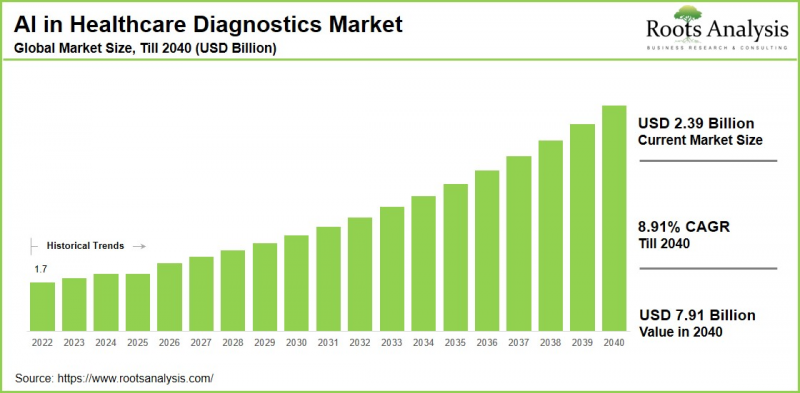
預計到 2040 年,全球診斷人工智慧市場規模將達到 79.1 億美元,較目前的 23.9 億美元年複合成長率 (CAGR) 為 8.91%。
診斷人工智慧利用機器學習分析大量患者資訊(影像、記錄、檢測結果等),從而更快、更準確地識別疾病、識別模式並預測風險。它並非取代醫療專業人員,而是透過提高效率、準確性和實現個人化護理,成為強大的決策支援工具。其應用在醫學影像領域尤為顯著,例如 X 光和 MRI,它可以識別細微的生物標誌物,並幫助及早預測潛在的健康狀況。
由於多種因素,全球人工智慧診斷市場呈現強勁成長勢頭,其中包括需要早期檢測的慢性病(如癌症和心血管疾病)的增加、全球醫療專業人員短缺以及電子健康記錄 (EHR) 和影像系統產生的醫療數據呈指數級增長。此外,深度學習和資料分析技術的不斷進步也使得更快、更準確的診斷解決方案成為可能。政府和私營部門為提高醫療保健效率和成本效益而不斷增加的投資,進一步推動了這一成長勢頭。
高階主管的策略洞察
人工智慧在醫療診斷中的作用
人工智慧正在透過提高診斷測試的準確性和效率,徹底改變醫療診斷的模式。人工智慧演算法能夠比傳統技術更快、更準確地分析龐大且複雜的資料集,包括醫學影像、電子健康記錄 (EHR) 和基因組資訊。這種方法減少了人為錯誤,並能夠更早發現疾病。
透過利用機器學習和深度學習技術,人工智慧系統可以檢測到臨床醫生經常忽略的醫療數據中的細微趨勢,從而提高診斷準確性並支援及時幹預。 人工智慧還能簡化診斷流程,使醫療專業人員能夠更專注於患者護理,並透過實證建議和預測分析提供臨床決策支援。此外,人工智慧透過根據患者的個人特徵客製化治療策略來促進個人化醫療,並將其整合到遠距醫療平台中,擴大了高品質診斷的覆蓋範圍,尤其是在資源匱乏的地區。
哪些因素推動了人工智慧醫療診斷的快速成長?
人工智慧醫療診斷市場的成長受到多種相互關聯的因素的驅動。其中包括癌症、糖尿病和心血管疾病等慢性病盛行率的上升,這推動了對更快、更準確的診斷解決方案的需求。深度學習、機器學習和自然語言處理的進步使得能夠精確解讀來自醫學影像、電子健康記錄 (EHR)、基因組分析和穿戴式技術的複雜資料集。 此外,研發投入的增加、政府推動數位醫療和精準醫療的舉措,以及英偉達、西門子醫療、Aidoc 和谷歌等行業領導企業之間的戰略聯盟,都在加速創新和市場擴張。
該產業的企業競爭格局
醫療影像人工智慧市場的競爭格局特徵是,大型企業和小型公司之間都存在著激烈的競爭。微軟、英偉達、IBM 和英特爾等大型科技公司與醫院和軟體公司合作,提供雲端、GPU 和模型開發基礎設施,以支援眾多下游診斷解決方案。該領域還涵蓋了各種專注於特定領域的利基新創公司和本地公司,例如罕見疾病檢測、數位病理自動化以及亞洲、中東和拉丁美洲的低資源放射科網路。此外,持續不斷的併購、策略聯盟和大量的風險投資加劇了競爭,並促使了供應商的整合。
本報告分析了全球診斷人工智慧市場,並提供了市場規模估算、機會分析、競爭格局和公司概況。
目錄
第一部分:報告概述
第一章:引言
第二章:研究方法
第三章:市場動態
第四章:宏觀經濟指標
第二部分:質性研究結果
第五章:摘要整理
第六章:引言
第七章:監理環境
第三部分:市場概覽
第八章:關鍵指標綜合資料庫
第 9 章:競爭格局
第 10 章:空白分析
第 11 章:競爭分析
第 12 章:診斷人工智慧市場的新創生態系統
第 4 部分:公司簡介
第 13 章:公司簡介
- 章節概述
- 艾多克
- AliveCor
- 數位診斷
- 通用電氣醫療保健
- 心流
- Imagen 技術
- 默拉提
- NovaSignal
- 路徑AI
- 河雨技術
- 羅氏
- 西門子醫療
- Vuno
- 斑馬醫療視覺
第五部分:市場趨勢
第十四章:大趨勢分析
第十五章:專利分析
第十六章:最新進展
第六部分:市場機會分析
第十七章:全球診斷人工智慧市場
第十八章:依組件類型劃分的市場機會
第十九章:依診斷類型劃分的市場機會
第二十章:市場依最終使用者類型劃分的市場機會
第21章:北美診斷人工智慧市場機會
第22章:歐洲診斷人工智慧市場機會
第23章:亞洲診斷人工智慧市場機會
第24章:中東和北非(MENA)診斷人工智慧市場機會
第25章:拉丁美洲診斷人工智慧市場機會
第26章:其他地區診斷人工智慧市場機會
第27章:主要參與者的市場集中度分析
第28章:鄰近市場分析
第七部分:策略工具
第二十九章:關鍵成功策略
第三十章:波特五力分析
第三十一章:SWOT分析
第三十二章:價值鏈分析
第三十三章:Roots戰略建議
第八部分:其他獨家發現
第三十四章:主要研究發現
第三十五章:報告結論
第九部分:附錄
Artificial Intelligence In Diagnostics Market Outlook
As per Roots Analysis, the global artificial intelligence in diagnostics market size is estimated to grow from USD 2.39 billion in the current year to USD 7.91 billion by 2040, at a CAGR of 8.91% during the forecast period, till 2040. The new study provides market size, growth scenarios, industry trend and future forecast.
AI in diagnostics leverages machine learning to analyze extensive patient information (such as images, records, and lab results) to facilitate quicker and more precise disease identification, recognize patterns, and foresee risks. This serves as a robust decision-support resource for healthcare providers rather than a substitute, by improving efficiency, accuracy, and tailored care. Its applications are particularly notable in medical imaging, such as X-rays and MRIs, where it assists in identifying subtle biomarkers and forecasting potential health conditions well in advance.
The global market for AI in diagnostics is witnessing robust growth, driven by a combination of factors including the rising incidence of chronic diseases such as cancer and cardiovascular disorders that demand early detection, shortage of healthcare professionals (at global level), and the exponential increase in healthcare data from electronic health records and imaging systems. Furthermore, continuous advancements in deep learning and data analytics technologies are enabling faster and more precise diagnostic solutions. This momentum is reinforced by growing government and private sector investments aimed at improving healthcare efficiency and cost-effectiveness.
Strategic Insights for Senior Leaders
Role of AI in Medical Diagnostics
Artificial intelligence (AI) is significantly changing the landscape of medical diagnostics by improving the accuracy and efficiency of diagnostic tests. AI algorithms have the capability to swiftly and precisely analyze extensive and intricate datasets, such as medical images, electronic health records, and genomic information, more effectively than conventional techniques. This approach diminishes human error and allows for the earlier identification of diseases.
By utilizing machine learning and deep learning techniques, AI systems can detect subtle trends in medical data that clinicians might overlook, enhancing diagnostic precision and aiding timely interventions. AI also simplifies diagnostic procedures, allowing healthcare professionals to concentrate more on patient care, while concurrently providing clinical decision support through evidence-based suggestions and predictive analytics. In addition, AI promotes personalized medicine by customizing treatment strategies to match individual patient characteristics, and its incorporation into telemedicine platforms broadens access to quality diagnostics, especially in areas with limited medical resources.
What's Powering the Surge in AI Medical Diagnostics?
The growth of the AI in medical diagnostics market is driven by several interrelated factors, including the rising prevalence of chronic diseases such as cancer, diabetes, and cardiovascular disorders, which amplify the demand for faster and more accurate diagnostic solutions. Advancements in deep learning, machine learning, and natural language processing enable precise interpretation of complex datasets from medical imaging, electronic health records, genomics, and wearable technologies. Moreover, increasing R&D investments, government initiatives promoting digital health and precision medicine, and strategic collaborations among industry leaders, such as NVIDIA, Siemens Healthineers, Aidoc, and Google, are accelerating innovation and market expansion.
Competitive Landscape of Companies in this Industry
The competitive landscape of AI in medical imaging market is characterized by intense competition, featuring a combination of large and smaller firms. Prominent technology firms such as Microsoft, NVIDIA, IBM, and Intel supply essential cloud, GPU, and model-development infrastructure that supports numerous downstream diagnostic solutions, by collaborating with hospitals and software companies. This domain also includes a variety of niche startups and local players focusing on specific areas like rare disease detection, digital pathology automation, and low-resource radiology networks in regions such as Asia, the Middle East, and Latin America. Further, the competitive environment is intensified by ongoing mergers and acquisitions, strategic partnerships, and substantial rounds of venture capital funding, resulting in consolidation among vendors.
Emerging Trends in the Artificial Intelligence in Diagnostics Industry
Emerging trends in this domain include federated learning, which enables model training across different institutions while preserving privacy, the development of explainable AI to enhance clinician trust. Further, the stakeholders are focused on the integration of AI in wearable devices that allow for real-time remote monitoring, facilitating proactive interventions through the analysis of various data types, such as ECGs, genomics, and electronic health records. Additionally, in the fields of pathology and genomics, AI improves workflows by automating tissue assessments and detecting rare genetic mutations, while point-of-care devices equipped with AI offer quick bedside diagnostics, helping to alleviate workforce shortages and increase accessibility in underserved regions.
Key Market Challenges
The field of artificial intelligence in diagnostics encounters numerous challenges, such as concerns over data privacy, ethical and regulatory issues, algorithmic biases, a lack of explainability, and obstacles to integration within clinical workflows. Researchers highlight uncertainties regarding legal liability for decisions made by AI, and the necessity for strong data protection in fragmented healthcare systems. Technical challenges include the lack of high-quality, standardized datasets, limitations in hardware like processing capabilities and interoperability. These factors undermine clinician trust despite their potential for high accuracy. Additionally, workflow obstacles, such as resistance to change, insufficient incentives for adoption, further complicates the adoption. To tackle these issues, interdisciplinary cooperation, governance structures, and standardization are essential to strike a balance between innovation and safety.
Artificial Intelligence In Diagnostics Market: Key Market Segmentation
Type of Component
- Software
- Hardware
- Services
Type of Diagnosis
- Neurology
- Radiology
- Oncology
- Cardiology
- Pathology
- Others
Type of End User
- Hospitals
- Diagnostic Laboratories
- Others
Geographical Regions
- North America
- US
- Canada
- Mexico
- Other North American countries
- Europe
- Austria
- Belgium
- Denmark
- France
- Germany
- Ireland
- Italy
- Netherlands
- Norway
- Russia
- Spain
- Sweden
- Switzerland
- UK
- Other European countries
- Asia
- China
- India
- Japan
- Singapore
- South Korea
- Other Asian countries
- Latin America
- Brazil
- Chile
- Colombia
- Venezuela
- Other Latin American countries
- Middle East and North Africa
- Egypt
- Iran
- Iraq
- Israel
- Kuwait
- Saudi Arabia
- UAE
- Other MENA countries
- Rest of the World
- Australia
- New Zealand
- Other countries
Example Players in Artificial Intelligence in Diagnostics Market
- Aidoc
- AliveCor
- Digital Diagnostics
- GE Healthcare
- HeartFlow
- Imagen Technologies
- Koninklijke Philips
- Merative
- NovaSignal
- PathAI
- Riverain Technologies
- Roche
- Siemens Healthineers
- Vuno
- Zebra Medical Vision
Artificial Intelligence In Diagnostics Market: Report Coverage
The report on the artificial intelligence in diagnostics market features insights on various sections, including:
- Market Sizing and Opportunity Analysis: An in-depth analysis of the artificial intelligence in diagnostics market, focusing on key market segments, including [A] type of component, [B] type of diagnosis, [C] type of end user, [D] and key geographical regions
- Competitive Landscape: A comprehensive analysis of the companies engaged in the artificial intelligence in diagnostics market, based on several relevant parameters, such as [A] year of establishment, [B] company size, [C] location of headquarters and [D] ownership structure.
- Company Profiles: Elaborate profiles of prominent players engaged in the Artificial intelligence in diagnostics market, providing details on [A] location of headquarters, [B] company size, [C] company mission, [D] company footprint, [E] management team, [F] contact details, [G] financial information, [H] operating business segments, [I] portfolio, [J] recent developments, and an informed future outlook.
- Megatrends: An evaluation of ongoing megatrends in the artificial intelligence in diagnostics industry.
- Patent Analysis: An insightful analysis of patents filed / granted in the artificial intelligence in diagnostics domain, based on relevant parameters, including [A] type of patent, [B] patent publication year, [C] patent age and [D] leading players.
- Recent Developments: An overview of the recent developments made in the Artificial intelligence in diagnostics market, along with analysis based on relevant parameters, including [A] year of initiative, [B] type of initiative, [C] geographical distribution and [D] most active players.
- Porter's Five Forces Analysis: An analysis of five competitive forces prevailing in the Artificial intelligence in diagnostics market, including threats of new entrants, bargaining power of buyers, bargaining power of suppliers, threats of substitute products and rivalry among existing competitors.
- SWOT Analysis: An insightful SWOT framework, highlighting the strengths, weaknesses, opportunities and threats in the domain. Additionally, it provides Harvey ball analysis, highlighting the relative impact of each SWOT parameter.
- Value Chain Analysis: A comprehensive analysis of the value chain, providing information on the different phases and stakeholders involved in the artificial intelligence in diagnostics market.
Key Questions Answered in this Report
- What is the current and future market size?
- Who are the leading companies in this market?
- What are the growth drivers that are likely to influence the evolution of this market?
- What are the key partnership and funding trends shaping this industry?
- Which region is likely to grow at higher CAGR till 2040?
- How is the current and future market opportunity likely to be distributed across key market segments?
Reasons to Buy this Report
- Detailed Market Analysis: The report provides a comprehensive market analysis, offering detailed revenue projections of the overall market and its specific sub-segments. This information is valuable to both established market leaders and emerging entrants.
- In-depth Analysis of Trends: Stakeholders can leverage the report to gain a deeper understanding of the competitive dynamics within the market. Each report maps ecosystem activity across partnerships, funding, and patent landscapes to reveal growth hotspots and white spaces in the industry.
- Opinion of Industry Experts: The report features extensive interviews and surveys with key opinion leaders and industry experts to validate market trends mentioned in the report.
- Decision-ready Deliverables: The report offers stakeholders with strategic frameworks (Porter's Five Forces, value chain, SWOT), and complimentary Excel / slide packs with customization support.
Additional Benefits
- Complimentary Dynamic Excel Dashboards for Analytical Modules
- Exclusive 15% Free Content Customization
- Personalized Interactive Report Walkthrough with Our Expert Research Team
- Free Report Updates for Versions Older than 6-12 Months
TABLE OF CONTENTS
SECTION I: REPORT OVERVIEW
1. PREFACE
- 1.1. Introduction
- 1.2. Market Share Insights
- 1.3. Key Market Insights
- 1.4. Report Coverage
- 1.5. Key Questions Answered
- 1.6. Chapter Outlines
2. RESEARCH METHODOLOGY
- 2.1. Chapter Overview
- 2.2. Research Assumptions
- 2.3. Database Building
- 2.3.1. Data Collection
- 2.3.2. Data Validation
- 2.3.3. Data Analysis
- 2.4. Project Methodology
- 2.4.1. Secondary Research
- 2.4.1.1. Annual Reports
- 2.4.1.2. Academic Research Papers
- 2.4.1.3. Company Websites
- 2.4.1.4. Investor Presentations
- 2.4.1.5. Regulatory Filings
- 2.4.1.6. White Papers
- 2.4.1.7. Industry Publications
- 2.4.1.8. Conferences and Seminars
- 2.4.1.9. Government Portals
- 2.4.1.10. Media and Press Releases
- 2.4.1.11. Newsletters
- 2.4.1.12. Industry Databases
- 2.4.1.13. Roots Proprietary Databases
- 2.4.1.14. Paid Databases and Sources
- 2.4.1.15. Social Media Portals
- 2.4.1.16. Other Secondary Sources
- 2.4.2. Primary Research
- 2.4.2.1. Introduction
- 2.4.2.2. Types
- 2.4.2.2.1. Qualitative
- 2.4.2.2.2. Quantitative
- 2.4.2.3. Advantages
- 2.4.2.4. Techniques
- 2.4.2.4.1. Interviews
- 2.4.2.4.2. Surveys
- 2.4.2.4.3. Focus Groups
- 2.4.2.4.4. Observational Research
- 2.4.2.4.5. Social Media Interactions
- 2.4.2.5. Stakeholders
- 2.4.2.5.1. Company Executives (CXOs)
- 2.4.2.5.2. Board of Directors
- 2.4.2.5.3. Company Presidents and Vice Presidents
- 2.4.2.5.4. Key Opinion Leaders
- 2.4.2.5.5. Research and Development Heads
- 2.4.2.5.6. Technical Experts
- 2.4.2.5.7. Subject Matter Experts
- 2.4.2.5.8. Scientists
- 2.4.2.5.9. Doctors and Other Healthcare Providers
- 2.4.2.6. Ethics and Integrity
- 2.4.2.6.1. Research Ethics
- 2.4.2.6.2. Data Integrity
- 2.4.3. Analytical Tools and Databases
- 2.4.1. Secondary Research
3. MARKET DYNAMICS
- 3.1. Forecast Methodology
- 3.1.1. Top-Down Approach
- 3.1.2. Bottom-Up Approach
- 3.1.3. Hybrid Approach
- 3.2. Market Assessment Framework
- 3.2.1. Total Addressable Market (TAM)
- 3.2.2. Serviceable Addressable Market (SAM)
- 3.2.3. Serviceable Obtainable Market (SOM)
- 3.2.4. Currently Acquired Market (CAM)
- 3.3. Forecasting Tools and Techniques
- 3.3.1. Qualitative Forecasting
- 3.3.2. Correlation
- 3.3.3. Regression
- 3.3.4. Time Series Analysis
- 3.3.5. Extrapolation
- 3.3.6. Convergence
- 3.3.7. Forecast Error Analysis
- 3.3.8. Data Visualization
- 3.3.9. Scenario Planning
- 3.3.10. Sensitivity Analysis
- 3.4. Key Considerations
- 3.4.1. Demographics
- 3.4.2. Market Access
- 3.4.3. Reimbursement Scenarios
- 3.4.4. Industry Consolidation
- 3.5. Robust Quality Control
- 3.6. Key Market Segmentations
- 3.7. Limitations
4. MACRO-ECONOMIC INDICATORS
- 4.1. Chapter Overview
- 4.2. Market Dynamics
- 4.2.1. Time Period
- 4.2.1.1. Historical Trends
- 4.2.1.2. Current and Forecasted Estimates
- 4.2.2. Currency Coverage
- 4.2.2.1. Overview of Major Currencies Affecting the Market
- 4.2.2.2. Impact of Currency Fluctuations on the Industry
- 4.2.3. Foreign Exchange Impact
- 4.2.3.1. Evaluation of Foreign Exchange Rates and Their Impact on Market
- 4.2.3.2. Strategies for Mitigating Foreign Exchange Risk
- 4.2.4. Recession
- 4.2.4.1. Historical Analysis of Past Recessions and Lessons Learnt
- 4.2.4.2. Assessment of Current Economic Conditions and Potential Impact on the Market
- 4.2.5. Inflation
- 4.2.5.1. Measurement and Analysis of Inflationary Pressures in the Economy
- 4.2.5.2. Potential Impact of Inflation on the Market Evolution
- 4.2.6. Interest Rates
- 4.2.6.1. Overview of Interest Rates and Their Impact on the Market
- 4.2.6.2. Strategies for Managing Interest Rate Risk
- 4.2.7. Commodity Flow Analysis
- 4.2.7.1. Type of Commodity
- 4.2.7.2. Origins and Destinations
- 4.2.7.3. Values and Weights
- 4.2.7.4. Modes of Transportation
- 4.2.8. Global Trade Dynamics
- 4.2.8.1. Import Scenario
- 4.2.8.2. Export Scenario
- 4.2.9. War Impact Analysis
- 4.2.9.1. Russian-Ukraine War
- 4.2.9.2. Israel-Hamas War
- 4.2.10. COVID Impact / Related Factors
- 4.2.10.1. Global Economic Impact
- 4.2.10.2. Industry-specific Impact
- 4.2.10.3. Government Response and Stimulus Measures
- 4.2.10.4. Future Outlook and Adaptation Strategies
- 4.2.11. Other Indicators
- 4.2.11.1. Fiscal Policy
- 4.2.11.2. Consumer Spending
- 4.2.11.3. Gross Domestic Product (GDP)
- 4.2.11.4. Employment
- 4.2.11.5. Taxes
- 4.2.11.6. R&D Innovation
- 4.2.11.7. Stock Market Performance
- 4.2.11.8. Supply Chain
- 4.2.11.9. Cross-Border Dynamics
- 4.2.1. Time Period
SECTION II: QUALITATIVE INSIGHTS
5. EXECUTIVE SUMMARY
6. INTRODUCTION
- 6.1. Chapter Overview
- 6.2. Overview of Artificial Intelligence in Diagnostics Market
- 6.2.1. Historical Evolution
- 6.2.2. Core AI Technologies
- 6.2.3. Application Areas
- 6.3. Future Perspective
7. REGULATORY SCENARIO
SECTION III: MARKET OVERVIEW
8. COMPREHENSIVE DATABASE OF LEADING PLAYERS
9. COMPETITIVE LANDSCAPE
- 9.1. Chapter Overview
- 9.2. Artificial Intelligence in Diagnostics Market: Overall Market Landscape
- 9.2.1. Analysis by Year of Establishment
- 9.2.2. Analysis by Company Size
- 9.2.3. Analysis by Location of Headquarters
- 9.2.4. Analysis by Ownership Structure
10. WHITE SPACE ANALYSIS
11. COMPANY COMPETITIVENESS ANALYSIS
12. STARTUP ECOSYSTEM IN THE ARTIFICIAL INTELLIGENCE IN DIAGNOSTICS MARKET
- 12.1. Artificial Intelligence in Diagnostics Market: Market Landscape of Startups
- 12.1.1. Analysis by Year of Establishment
- 12.1.2. Analysis by Company Size
- 12.1.3. Analysis by Company Size and Year of Establishment
- 12.1.4. Analysis by Location of Headquarters
- 12.1.5. Analysis by Company Size and Location of Headquarters
- 12.1.6. Analysis by Ownership Structure
- 12.2. Key Findings
SECTION IV: COMPANY PROFILES
13. COMPANY PROFILES
- 13.1. Chapter Overview
- 13.2. Aidoc*
- 13.2.1. Company Overview
- 13.2.2. Company Mission
- 13.2.3. Company Footprint
- 13.2.4. Management Team
- 13.2.5. Contact Details
- 13.2.6. Financial Performance
- 13.2.7. Operating Business Segments
- 13.2.8. Service / Product Portfolio (project specific)
- 13.2.9. MOAT Analysis
- 13.2.10. Recent Developments and Future Outlook
- 13.3. AliveCor
- 13.4. Digital Diagnostics
- 13.5. GE Healthcare
- 13.6. HeartFlow
- 13.7. Imagen Technologies
- 13.8. Merative
- 13.9. NovaSignal
- 13.10. PathAI
- 13.11. Riverain Technologies
- 13.12. Roche
- 13.13. Siemens Healthineers
- 13.14. Vuno
- 13.15. Zebra Medical Vision
SECTION V: MARKET TRENDS
14. MEGA TRENDS ANALYSIS
15. PATENT ANALYSIS
16. RECENT DEVELOPMENTS
- 16.1. Chapter Overview
- 16.2. Recent Funding
- 16.3. Recent Partnerships
- 16.4. Other Recent Initiatives
SECTION VI: MARKET OPPORTUNITY ANALYSIS
17. GLOBAL ARTIFICIAL INTELLIGENCE IN DIAGNOSTICS MARKET
- 17.1. Chapter Overview
- 17.2. Key Assumptions and Methodology
- 17.3. Trends Disruption Impacting Market
- 17.4. Demand Side Trends
- 17.5. Supply Side Trends
- 17.6. Global Artificial Intelligence in Diagnostics Market, Historical Trends (Since 2020) and Forecasted Estimates (Till 2040)
- 17.7. Multivariate Scenario Analysis
- 17.7.1. Conservative Scenario
- 17.7.2. Optimistic Scenario
- 17.8. Investment Feasibility Index
- 17.9. Key Market Segmentations
18. MARKET OPPORTUNITIES BASED ON TYPE OF COMPONENT
- 18.1. Chapter Overview
- 18.2. Key Assumptions and Methodology
- 18.3. Revenue Shift Analysis
- 18.4. Market Movement Analysis
- 18.5. Penetration-Growth (P-G) Matrix
- 18.6. Artificial Intelligence in Diagnostics Market for Software: Historical Trends (Since 2020) and Forecasted Estimates (Till 2040)
- 18.7. Artificial Intelligence in Diagnostics Market for Hardware: Historical Trends (Since 2020) and Forecasted Estimates (Till 2040)
- 18.8. Artificial Intelligence in Diagnostics Market for Services: Historical Trends (Since 2020) and Forecasted Estimates (Till 2040)
- 18.9. Data Triangulation and Validation
- 18.9.1. Secondary Sources
- 18.9.2. Primary Sources
- 18.9.3. Statistical Modeling
19. MARKET OPPORTUNITIES BASED ON TYPE OF DIAGNOSIS
- 19.1. Chapter Overview
- 19.2. Key Assumptions and Methodology
- 19.3. Revenue Shift Analysis
- 19.4. Market Movement Analysis
- 19.5. Penetration-Growth (P-G) Matrix
- 19.6. Artificial Intelligence in Diagnostics Market for Neurology: Historical Trends (Since 2020) and Forecasted Estimates (Till 2040)
- 19.7. Artificial Intelligence in Diagnostics Market for Radiology: Historical Trends (Since 2020) and Forecasted Estimates (Till 2040)
- 19.8. Artificial Intelligence in Diagnostics Market for Oncology: Historical Trends (Since 2020) and Forecasted Estimates (Till 2040)
- 19.9. Artificial Intelligence in Diagnostics Market for Cardiology: Historical Trends (Since 2020) and Forecasted Estimates (Till 2040)
- 19.10. Artificial Intelligence in Diagnostics Market for Pathology: Historical Trends (Since 2020) and Forecasted Estimates (Till 2040)
- 19.11. Artificial Intelligence in Diagnostics Market for Others: Historical Trends (Since 2020) and Forecasted Estimates (Till 2040)
- 19.12. Data Triangulation and Validation
- 19.12.1. Secondary Sources
- 19.12.2. Primary Sources
- 19.12.3. Statistical Modeling
20. MARKET OPPORTUNITIES BASED ON TYPE OF END USER
- 20.1. Chapter Overview
- 20.2. Key Assumptions and Methodology
- 20.3. Revenue Shift Analysis
- 20.4. Market Movement Analysis
- 20.5. Penetration-Growth (P-G) Matrix
- 20.6. Artificial Intelligence in Diagnostics Market for Hospitals: Historical Trends (Since 2020) and Forecasted Estimates (Till 2040)
- 20.7. Artificial Intelligence in Diagnostics Market for Diagnostic Laboratories: Historical Trends (Since 2020) and Forecasted Estimates (Till 2040)
- 20.8. Artificial Intelligence in Diagnostics Market for Others: Historical Trends (Since 2020) and Forecasted Estimates (Till 2040)
- 20.9. Data Triangulation and Validation
- 20.9.1. Secondary Sources
- 20.9.2. Primary Sources
- 20.9.3. Statistical Modeling
21. MARKET OPPORTUNITIES FOR ARTIFICIAL INTELLIGENCE IN DIAGNOSTICS MARKET IN NORTH AMERICA
- 21.1. Chapter Overview
- 21.2. Key Assumptions and Methodology
- 21.3. Revenue Shift Analysis
- 21.4. Market Movement Analysis
- 21.5. Penetration-Growth (P-G) Matrix
- 21.6. Artificial Intelligence in Diagnostics Market in North America: Historical Trends (Since 2020) and Forecasted Estimates (Till 2040)
- 21.6.1. Artificial Intelligence in Diagnostics Market in the US: Historical Trends (Since 2020) and Forecasted Estimates (Till 2040)
- 21.6.2. Artificial Intelligence in Diagnostics Market in Canada: Historical Trends (Since 2020) and Forecasted Estimates (Till 2040)
- 21.6.3. Artificial Intelligence in Diagnostics Market in Mexico: Historical Trends (Since 2020) and Forecasted Estimates (Till 2040)
- 21.6.4. Artificial Intelligence in Diagnostics Market in Other North American Countries: Historical Trends (Since 2020) and Forecasted Estimates (Till 2040)
- 21.7. Data Triangulation and Validation
22. MARKET OPPORTUNITIES FOR ARTIFICIAL INTELLIGENCE IN DIAGNOSTICS MARKET IN EUROPE
- 22.1. Chapter Overview
- 22.2. Key Assumptions and Methodology
- 22.3. Revenue Shift Analysis
- 22.4. Market Movement Analysis
- 22.5. Penetration-Growth (P-G) Matrix
- 22.6. Artificial Intelligence in Diagnostics Market in Europe: Historical Trends (Since 2020) and Forecasted Estimates (Till 2040)
- 22.6.1. Artificial Intelligence in Diagnostics Market in Austria: Historical Trends (Since 2020) and Forecasted Estimates (Till 2040)
- 22.6.2. Artificial Intelligence in Diagnostics Market in Belgium: Historical Trends (Since 2020) and Forecasted Estimates (Till 2040)
- 22.6.3. Artificial Intelligence in Diagnostics Market in Denmark: Historical Trends (Since 2020) and Forecasted Estimates (Till 2040)
- 22.6.4. Artificial Intelligence in Diagnostics Market in France: Historical Trends (Since 2020) and Forecasted Estimates (Till 2040)
- 22.6.5. Artificial Intelligence in Diagnostics Market in Germany: Historical Trends (Since 2020) and Forecasted Estimates (Till 2040)
- 22.6.6. Artificial Intelligence in Diagnostics Market in Ireland: Historical Trends (Since 2020) and Forecasted Estimates (Till 2040)
- 22.6.7. Artificial Intelligence in Diagnostics Market in Italy: Historical Trends (Since 2020) and Forecasted Estimates (Till 2040)
- 22.6.8. Artificial Intelligence in Diagnostics Market in Netherlands: Historical Trends (Since 2020) and Forecasted Estimates (Till 2040)
- 22.6.9. Artificial Intelligence in Diagnostics Market in Norway: Historical Trends (Since 2020) and Forecasted Estimates (Till 2040)
- 22.6.10. Artificial Intelligence in Diagnostics Market in Russia: Historical Trends (Since 2020) and Forecasted Estimates (Till 2040)
- 22.6.11. Artificial Intelligence in Diagnostics Market in Spain: Historical Trends (Since 2020) and Forecasted Estimates (Till 2040)
- 22.6.12. Artificial Intelligence in Diagnostics Market in Sweden: Historical Trends (Since 2020) and Forecasted Estimates (Till 2040)
- 22.6.13. Artificial Intelligence in Diagnostics Market in Switzerland: Historical Trends (Since 2020) and Forecasted Estimates (Till 2040)
- 22.6.14. Artificial Intelligence in Diagnostics Market in the UK: Historical Trends (Since 2020) and Forecasted Estimates (Till 2040)
- 22.6.15. Artificial Intelligence in Diagnostics Market in Other European Countries: Historical Trends (Since 2020) and Forecasted Estimates (Till 2040)
- 22.7. Data Triangulation and Validation
23. MARKET OPPORTUNITIES FOR ARTIFICIAL INTELLIGENCE IN DIAGNOSTICS MARKET IN ASIA
- 23.1. Chapter Overview
- 23.2. Key Assumptions and Methodology
- 23.3. Revenue Shift Analysis
- 23.4. Market Movement Analysis
- 23.5. Penetration-Growth (P-G) Matrix
- 23.6. Artificial Intelligence in Diagnostics Market in Asia: Historical Trends (Since 2020) and Forecasted Estimates (Till 2040)
- 23.6.1. Artificial Intelligence in Diagnostics Market in China: Historical Trends (Since 2020) and Forecasted Estimates (Till 2040)
- 23.6.2. Artificial Intelligence in Diagnostics Market in India: Historical Trends (Since 2020) and Forecasted Estimates (Till 2040)
- 23.6.3. Artificial Intelligence in Diagnostics Market in Japan: Historical Trends (Since 2020) and Forecasted Estimates (Till 2040)
- 23.6.4. Artificial Intelligence in Diagnostics Market in Singapore: Historical Trends (Since 2020) and Forecasted Estimates (Till 2040)
- 23.6.5. Artificial Intelligence in Diagnostics Market in South Korea: Historical Trends (Since 2020) and Forecasted Estimates (Till 2040)
- 23.6.6. Artificial Intelligence in Diagnostics Market in Other Asian Countries: Historical Trends (Since 2020) and Forecasted Estimates (Till 2040)
- 23.7. Data Triangulation and Validation
24. MARKET OPPORTUNITIES FOR ARTIFICIAL INTELLIGENCE IN DIAGNOSTICS MARKET IN MIDDLE EAST AND NORTH AFRICA (MENA)
- 24.1. Chapter Overview
- 24.2. Key Assumptions and Methodology
- 24.3. Revenue Shift Analysis
- 24.4. Market Movement Analysis
- 24.5. Penetration-Growth (P-G) Matrix
- 24.6. Artificial Intelligence in Diagnostics Market in Middle East and North Africa (MENA): Historical Trends (Since 2020) and Forecasted Estimates (Till 2040)
- 24.6.1. Artificial Intelligence in Diagnostics Market in Egypt: Historical Trends (Since 2020) and Forecasted Estimates (Till 205)
- 24.6.2. Artificial Intelligence in Diagnostics Market in Iran: Historical Trends (Since 2020) and Forecasted Estimates (Till 2040)
- 24.6.3. Artificial Intelligence in Diagnostics Market in Iraq: Historical Trends (Since 2020) and Forecasted Estimates (Till 2040)
- 24.6.4. Artificial Intelligence in Diagnostics Market in Israel: Historical Trends (Since 2020) and Forecasted Estimates (Till 2040)
- 24.6.5. Artificial Intelligence in Diagnostics Market in Kuwait: Historical Trends (Since 2020) and Forecasted Estimates (Till 2040)
- 24.6.6. Artificial Intelligence in Diagnostics Market in Saudi Arabia: Historical Trends (Since 2020) and Forecasted Estimates (Till 2040)
- 24.6.7. Artificial Intelligence in Diagnostics Market in United Arab Emirates (UAE): Historical Trends (Since 2020) and Forecasted Estimates (Till 2040)
- 24.6.8. Artificial Intelligence in Diagnostics Market in Other MENA Countries: Historical Trends (Since 2020) and Forecasted Estimates (Till 2040)
- 24.7. Data Triangulation and Validation
25. MARKET OPPORTUNITIES FOR ARTIFICIAL INTELLIGENCE IN DIAGNOSTICS MARKET IN LATIN AMERICA
- 25.1. Chapter Overview
- 25.2. Key Assumptions and Methodology
- 25.3. Revenue Shift Analysis
- 25.4. Market Movement Analysis
- 25.5. Penetration-Growth (P-G) Matrix
- 25.6. Artificial Intelligence in Diagnostics Market in Latin America: Historical Trends (Since 2020) and Forecasted Estimates (Till 2040)
- 25.6.1. Artificial Intelligence in Diagnostics Market in Argentina: Historical Trends (Since 2020) and Forecasted Estimates (Till 2040)
- 25.6.2. Artificial Intelligence in Diagnostics Market in Brazil: Historical Trends (Since 2020) and Forecasted Estimates (Till 2040)
- 25.6.3. Artificial Intelligence in Diagnostics Market in Chile: Historical Trends (Since 2020) and Forecasted Estimates (Till 2040)
- 25.6.4. Artificial Intelligence in Diagnostics Market in Colombia Historical Trends (Since 2020) and Forecasted Estimates (Till 2040)
- 25.6.5. Artificial Intelligence in Diagnostics Market in Venezuela: Historical Trends (Since 2020) and Forecasted Estimates (Till 2040)
- 25.6.6. Artificial Intelligence in Diagnostics Market in Other Latin American Countries: Historical Trends (Since 2020) and Forecasted Estimates (Till 2040)
- 25.7. Data Triangulation and Validation
26. MARKET OPPORTUNITIES FOR ARTIFICIAL INTELLIGENCE IN DIAGNOSTICS MARKET IN REST OF THE WORLD
- 26.1. Chapter Overview
- 26.2. Key Assumptions and Methodology
- 26.3. Revenue Shift Analysis
- 26.4. Market Movement Analysis
- 26.5. Penetration-Growth (P-G) Matrix
- 26.6. Artificial Intelligence in Diagnostics Market in Rest of the World: Historical Trends (Since 2020) and Forecasted Estimates (Till 2040)
- 26.6.1. Artificial Intelligence in Diagnostics Market in Australia: Historical Trends (Since 2020) and Forecasted Estimates (Till 2040)
- 26.6.2. Artificial Intelligence in Diagnostics Market in New Zealand: Historical Trends (Since 2020) and Forecasted Estimates (Till 2040)
- 26.6.3. Artificial Intelligence in Diagnostics Market in Other Countries
- 26.7. Data Triangulation and Validation
27. MARKET CONCENTRATION ANALYSIS: DISTRIBUTION BY LEADING PLAYERS
- 27.1. Leading Player 1
- 27.2. Leading Player 2
- 27.3. Leading Player 3
- 27.4. Leading Player 4
- 27.5. Leading Player 5
- 27.6. Leading Player 6
- 27.7. Leading Player 7
- 27.8. Leading Player 8
28. ADJACENT MARKET ANALYSIS
SECTION VII: STRATEGIC TOOLS
29. KEY WINNING STRATEGIES
30. PORTER'S FIVE FORCES ANALYSIS
31. SWOT ANALYSIS
32. VALUE CHAIN ANALYSIS
33. ROOTS STRATEGIC RECOMMENDATIONS
- 33.1. Chapter Overview
- 33.2. Key Business-related Strategies
- 33.2.1. Research & Development
- 33.2.2. Product Manufacturing
- 33.2.3. Commercialization / Go-to-Market
- 33.2.4. Sales and Marketing
- 33.3. Key Operations-related Strategies
- 33.3.1. Risk Management
- 33.3.2. Workforce
- 33.3.3. Finance
- 33.3.4. Others
SECTION VIII: OTHER EXCLUSIVE INSIGHTS
34. INSIGHTS FROM PRIMARY RESEARCH
35. REPORT CONCLUSION
SECTION IX: APPENDIX
36. TABULATED DATA
37. LIST OF COMPANIES AND ORGANIZATIONS
38. ROOTS SUBSCRIPTION SERVICES
39. AUTHOR DETAILS

 人工智慧醫療診斷應用市場(至2040年):依部署類型、應用、最終用戶和主要地區劃分 - 行業趨勢和全球預測
 2026年人工智慧(AI)增強型手術影像分析全球市場報告2026年人工智慧(AI)耳鏡影像分流平台全球市場報告2026年全球人工智慧顯微鏡市場報告2026年全球人工智慧(AI)遠端皮膚診斷設備市場報告
 全球人工智慧(AI)診斷市場規模、佔有率、趨勢和成長分析報告(2026-2034)
 人工智慧診斷市場規模、佔有率和趨勢分析報告:按組件、診斷類型、地區和細分市場分類,預測期為 2026 年至 2033 年
 醫療診斷人工智慧工具市場:按組件、技術、部署類型、應用和最終用戶分類 - 全球預測(2026-2032 年)全球機器人輔助手術人工智慧(AI)市場:市場規模、佔有率、成長率、產業分析、依類型、應用和地區劃分的分析以及未來預測(2026-2034)全球診斷人工智慧(AI)市場:市場規模、佔有率、成長率、產業分析、依類型、應用和地區劃分的考量因素以及未來預測(2026-2034)