


 |
市場調查報告書
商品編碼
1895180
全球農業天然害蟲防治市場(至 2035 年):按應用、天然害蟲防治服務類型、農藥類型、公司類型、主要地區、行業趨勢和預測Agri Natural Enemy Pest Control Market Till 2035: Distribution by Area of Application, Type of Natural Enemy Service, Type of Control Agent, Type of Enterprise, and Key Geographical Regions: Industry Trends and Global Forecasts |
||||||

農業天然害蟲防治市場概述
全球農業天然害蟲防治市場預計將從目前的 199.6 億美元成長到 2035 年的 401.6 億美元,預測期內複合年增長率 (CAGR) 為 7.24%。
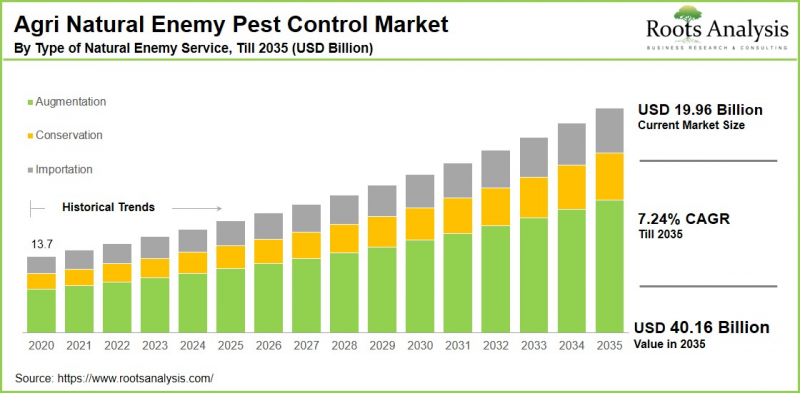
農業天敵害蟲防治市場:成長與趨勢
農業天敵防治是一種利用有益生物防治害蟲的耕作方法。此方法利用瓢蟲、草蛉等天敵,小型寄生蜂等寄生性天敵,以及細菌、病毒、真菌等病原體對抗有害生物。它是綜合蟲害管理 (IPM) 的重要組成部分,致力於以環境友善的方式保護作物。透過利用這些天然方法,農民可以顯著減少對合成化學農藥的依賴,而合成化學農藥已知會對環境造成負面影響。
這種生態防治方法不僅環境友好,還能有效防止害蟲產生抗藥性。它能有效防治多種害蟲,包括薊馬、粉蠔和白粉蝨,並且對從大田作物到溫室作物和觀賞植物等多種植物都有益。
此方法被廣泛採用的主要原因是農民和消費者對合成農藥相關健康風險的認識不斷提高。在將化學農藥的使用與癌症和神經系統疾病等健康問題聯繫起來的研究表明,全球範圍內的監管力度有所加強。各國政府和國際組織正在透過補貼、稅收減免和教育計畫等激勵措施來推廣生物防治方法的使用。此外,人們對有機農業的興趣日益濃厚,以及消費者對無化學添加農產品的需求不斷增長,也大大推動了對天敵害蟲防治方法的需求。考慮到這些因素,預計農業天敵防治市場在預測期內將以較高的複合年增長率成長。
本報告分析了全球農業天敵防治市場,並提供了市場規模估算、機會分析、競爭格局和公司概況等資訊。
目錄
第一部分:報告概述
第一章:引言
第二章:研究方法
第三章:市場動態
第四章:宏觀經濟指標
第二部分:質性研究結果
第五章:摘要整理
第六章:引言
第七章:監理環境
第三部分:市場概覽
第八章:關鍵指標綜合資料庫公司
第九章:競爭格局
第十章:市場空白分析
第十一章:競爭分析
第十二章:農業天然害蟲防治市場的新創企業生態系
第四部分:公司簡介
第十三章:公司簡介
- 章節概述
- 先進綜合蟲害管理
- AlphaBio
- Andermatt Biocontrol
- Anatis Bioprotection
- 阿斯特捷利康
- 巴斯夫農業專業
- 拜耳
- Biobest
- BioBee 生物系統
- Biorend
- 瑟蒂斯
- 作物衛士
- 陶氏化學
- 藝康
- 綠色方法
- 害蟲綜合管理害蟲防治
- 諾華
- Rincon Vitova 昆蟲館
- SGS SA
- 先正達
第 5 部分:市場趨勢
第 14 章:大趨勢分析
第 15 章:未滿足的需求分析
章節第十六章:專利分析
第十七章:最新進展
第六節:市場機會分析
第十八章:全球農業天敵防治市場
第十九章:依應用領域劃分的市場機會
第二十章:以天敵防治服務類型劃分的市場機會
第二十一章:依農藥類型劃分的市場機會
第二十二章:依公司類型劃分的市場機會
第二十三章:北美農業天敵防治市場機會
第二十四章:歐洲其他地區農業天敵防治市場機會
第25章:亞洲農業天敵防治市場機會
第26章:中東及北非(MENA)農業天敵防治市場機會
第27章:拉丁美洲農業天敵防治市場機會
第28章:其他地區農業害蟲防治市場機會
第29章:主要公司市場集中度分析
第30章:鄰近市場分析
第7節:策略工具
第31章:關鍵制勝策略
第32章:波特五力模型分析
第33章:SWOT分析
第34章:價值鏈分析
第35章:Roots的策略建議
第8節:其他獨家發現
第36章:一手調查結果
第37章:報告結論
第9節:附錄
Agri Natural Enemy Pest Control Market Overview
As per Roots Analysis, the global agri natural enemy pest control market size is estimated to grow from USD 19.96 billion in the current year USD 40.16 billion by 2035, at a CAGR of 7.24% during the forecast period, till 2035.
The opportunity for agri natural enemy pest control market has been distributed across the following segments:
Areas of Application
- Ant Control
- Beetle Control
- Bird Control
- Insects Control
- Mosquitoes & Flies Control
- Rat & Rodent Control
Type of Natural Enemy Service
- Augmentation
- Conservation
- Importation
Type of Control Agent
- Bacteria
- Fungi
- Oomycota
- Parasitoids
- Pathogens
- Predators
Type of Enterprise
- Large Enterprises
- Small and Medium Enterprises
Geographical Regions
- North America
- US
- Canada
- Mexico
- Other North American countries
- Europe
- Austria
- Belgium
- Denmark
- France
- Germany
- Ireland
- Italy
- Netherlands
- Norway
- Russia
- Spain
- Sweden
- Switzerland
- UK
- Other European countries
- Asia
- China
- India
- Japan
- Singapore
- South Korea
- Other Asian countries
- Latin America
- Brazil
- Chile
- Colombia
- Venezuela
- Other Latin American countries
- Middle East and North Africa
- Egypt
- Iran
- Iraq
- Israel
- Kuwait
- Saudi Arabia
- UAE
- Other MENA countries
- Rest of the World
- Australia
- New Zealand
- Other countries
Agri Natural Enemy Pest Control Market: Growth and Trends
Agri natural enemy pest management is a farming technique that employs beneficial organisms to control pests. This method involves introducing natural predators such as ladybugs and lacewings, parasitoids like small wasps, and pathogens including bacteria, viruses, and fungi to combat harmful species. As an essential component of integrated pest management (IPM), it focuses on protecting crops in an eco-friendly way. By utilizing these natural approaches, farmers can greatly decrease their dependence on synthetic chemical pesticides, which are known to harm the environment.
This ecological pest management approach is not only more environmentally friendly but also aids in preventing pests from developing resistance to treatments. It is effectively applied against a range of pests, such as thrips, mealybugs, and whiteflies, making it advantageous for both field crops and greenhouse or ornamental plants.
A key reason behind the increasing adoption of this method is the growing awareness among farmers and consumers regarding the negative health effects linked to synthetic pesticides. Studies revealing the connection between chemical pesticide usage and health issues, including cancer and neurological disorders, have resulted in stricter regulations globally. Governments and international bodies are promoting biological pest control methods through incentives such as subsidies, tax benefits, and educational programs. Additionally, the rising interest in organic farming practices and consumer demand for chemical-free produce have significantly boosted the need for natural enemy pest control methods. Overall, considering the above mentioned factors, the agri natural enemy pest control market is expected to grow at a higher CAGR during the forecast period.
Agri Natural Enemy Pest Control Market: Key Segments
Market Share by Areas of Application
Based on areas of application, the global agri natural enemy pest control market is segmented into ant control, beetle control, bird control, insects control, mosquitoes & flies control, rat & rodent control. According to our estimates, currently, the ant control segment captures the majority of the market share. This is due to the extensive effects of insect pests on crops and the effectiveness of natural enemies in controlling these pests. Insects like thrips, mealybugs, and whiteflies are frequent targets for natural enemy pest control approaches, which involve predators such as ladybugs and lacewings, along with parasitoids like small wasps.
Market Share by Types of Natural Enemy Service
Based on types of natural enemy service, the global agri natural enemy pest control market is segmented into augmentation, conservation, and importation. According to our estimates, currently, the augmentation segment captures the majority of the market share. This method is often employed when the natural enemy populations are not enough to achieve effective pest management independently. Augmentation is preferred because of its quick effects on pest numbers and its adaptability to specific pest management requirements.
On the other hand, the conservation sub-segment is projected to experience the highest compound annual growth rate (CAGR) throughout the forecast period. This growth can be linked to the conservation services aligning with broader trends toward sustainable farming practices and environmental preservation
Market Share by Type of Control Agent
Based on type of control agent, the global agri natural enemy pest control market is segmented into bacteria, fungi, oomycota, parasitoids, pathogens, and predators. According to our estimates, currently, predators sub-segment capture the majority of the market share. Predators, like ladybugs and lacewings, are commonly utilized because of their effectiveness in managing pest populations. They play essential roles in integrated pest management (IPM) approaches and are preferred for their capacity to target specific pests while safeguarding beneficial organisms
Conversely, the fungi segment is expected to grow at a higher CAGR during the forecast period, due to their specificity and effectiveness in pest control. Progress in biotechnology and genetic engineering is improving the adaptability and pest-specific action of fungal pathogens, making them increasingly appealing for farmers aiming for sustainable pest management practices.
Market Share by Type of Enterprise
Based on type of enterprise, the global agri natural enemy pest control market is segmented into, large and small and medium enterprises. According to our estimates, currently, electrical and electronics sub-segment captures the majority of the market share. This growth can be attributed to the increasing demand for natural pest control solutions in agriculture. Conversely, the small and medium enterprises are expected to grow at a higher CAGR during the forecast period. This can be attributed to their flexibility, innovative approaches, emphasis on specialized markets, and capacity to adjust to evolving customer needs and market dynamics.
Market Share by Geographical Regions
Based on geographical regions, the agri natural enemy pest control market is segmented into North America, Europe, Asia, Latin America, Middle East and North Africa, and the rest of the world. According to our estimates, currently North America captures the majority share of the market. The early implementation of biological pest control techniques has established a robust foundation for North America in this field. Additionally, the region's focus on organic farming, especially in the United States, has further increased the demand for natural enemy pest control products.
Example Players in Agri Natural Enemy Pest Control Market
- Advanced Integrated Pest Management
- AlphaBio
- Andermatt Biocontrol
- Anatis Bioprotection
- Anticimex
- Applied Bio-nomics
- AstraZeneca
- BASF Agricultural Specialities
- Bayer
- Biobest
- BioBee Biological Systems
- Bioline AgroSciences
- BioPlanet
- Biorend
- Biota Biosciences
- Certis
- Cook's Agri Natural Enemy Pest Control
- Corteva Agriscience
- Crop Defenders
- Dow
- Ecolab
- Fargro
- FMC
- GreenMethods
- Integrated Pest Management Pest Control
- Isagro
- Koppert Biological Systems
- Marrone Bio Innovations
- MB Integrated Pest Control
- Natural Enemies Pest Management
- Natural Insect Control
- Novartis
- Novozymes
- Rincon Vitova Insectaries
- SGS SA
- Syngenta
- Wageningen University & Research
Agri Natural Enemy Pest Control Market: Research Coverage
The report on the agri natural enemy pest control market features insights on various sections, including:
- Market Sizing and Opportunity Analysis: An in-depth analysis of the agri natural enemy pest control market, focusing on key market segments, including [A] area of application, [B] type of natural enemy service, [C] type of control agent, [D] type of enterprise, and [E] key geographical regions.
- Competitive Landscape: A comprehensive analysis of the companies engaged in the agri natural enemy pest control market, based on several relevant parameters, such as [A] year of establishment, [B] company size, [C] location of headquarters and [D] ownership structure.
- Company Profiles: Elaborate profiles of prominent players engaged in the agri natural enemy pest control market, providing details on [A] location of headquarters, [B] company size, [C] company mission, [D] company footprint, [E] management team, [F] contact details, [G] financial information, [H] operating business segments, [I] portfolio, [J] moat analysis, [K] recent developments, and an informed future outlook.
- Megatrends: An evaluation of ongoing megatrends in the agri natural enemy pest control industry.
- Patent Analysis: An insightful analysis of patents filed / granted in the agri natural enemy pest control domain, based on relevant parameters, including [A] type of patent, [B] patent publication year, [C] patent age and [D] leading players.
- Recent Developments: An overview of the recent developments made in the agri natural enemy pest control market, along with analysis based on relevant parameters, including [A] year of initiative, [B] type of initiative, [C] geographical distribution and [D] most active players.
- Porter's Five Forces Analysis: An analysis of five competitive forces prevailing in the agri natural enemy pest control market, including threats of new entrants, bargaining power of buyers, bargaining power of suppliers, threats of substitute products and rivalry among existing competitors.
- SWOT Analysis: An insightful SWOT framework, highlighting the strengths, weaknesses, opportunities and threats in the domain. Additionally, it provides Harvey ball analysis, highlighting the relative impact of each SWOT parameter.
- Value Chain Analysis: A comprehensive analysis of the value chain, providing information on the different phases and stakeholders involved in the agri natural enemy pest control market.
Key Questions Answered in this Report
- How many companies are currently engaged in agri natural enemy pest control market?
- Which are the leading companies in this market?
- What factors are likely to influence the evolution of this market?
- What is the current and future market size?
- What is the CAGR of this market?
- How is the current and future market opportunity likely to be distributed across key market segments?
Reasons to Buy this Report
- The report provides a comprehensive market analysis, offering detailed revenue projections of the overall market and its specific sub-segments. This information is valuable to both established market leaders and emerging entrants.
- Stakeholders can leverage the report to gain a deeper understanding of the competitive dynamics within the market. By analyzing the competitive landscape, businesses can make informed decisions to optimize their market positioning and develop effective go-to-market strategies.
- The report offers stakeholders a comprehensive overview of the market, including key drivers, barriers, opportunities, and challenges. This information empowers stakeholders to stay abreast of market trends and make data-driven decisions to capitalize on growth prospects.
Additional Benefits
- Complimentary Excel Data Packs for all Analytical Modules in the Report
- 15% Free Content Customization
- Detailed Report Walkthrough Session with Research Team
- Free Updated report if the report is 6-12 months old or older
TABLE OF CONTENTS
SECTION I: REPORT OVERVIEW
1. PREFACE
- 1.1. Introduction
- 1.2. Market Share Insights
- 1.3. Key Market Insights
- 1.4. Report Coverage
- 1.5. Key Questions Answered
- 1.6. Chapter Outlines
2. RESEARCH METHODOLOGY
- 2.1. Chapter Overview
- 2.2. Research Assumptions
- 2.3. Database Building
- 2.3.1. Data Collection
- 2.3.2. Data Validation
- 2.3.3. Data Analysis
- 2.4. Project Methodology
- 2.4.1. Secondary Research
- 2.4.1.1. Annual Reports
- 2.4.1.2. Academic Research Papers
- 2.4.1.3. Company Websites
- 2.4.1.4. Investor Presentations
- 2.4.1.5. Regulatory Filings
- 2.4.1.6. White Papers
- 2.4.1.7. Industry Publications
- 2.4.1.8. Conferences and Seminars
- 2.4.1.9. Government Portals
- 2.4.1.10. Media and Press Releases
- 2.4.1.11. Newsletters
- 2.4.1.12. Industry Databases
- 2.4.1.13. Roots Proprietary Databases
- 2.4.1.14. Paid Databases and Sources
- 2.4.1.15. Social Media Portals
- 2.4.1.16. Other Secondary Sources
- 2.4.2. Primary Research
- 2.4.2.1. Introduction
- 2.4.2.2. Types
- 2.4.2.2.1. Qualitative
- 2.4.2.2.2. Quantitative
- 2.4.2.3. Advantages
- 2.4.2.4. Techniques
- 2.4.2.4.1. Interviews
- 2.4.2.4.2. Surveys
- 2.4.2.4.3. Focus Groups
- 2.4.2.4.4. Observational Research
- 2.4.2.4.5. Social Media Interactions
- 2.4.2.5. Stakeholders
- 2.4.2.5.1. Company Executives (CXOs)
- 2.4.2.5.2. Board of Directors
- 2.4.2.5.3. Company Presidents and Vice Presidents
- 2.4.2.5.4. Key Opinion Leaders
- 2.4.2.5.5. Research and Development Heads
- 2.4.2.5.6. Technical Experts
- 2.4.2.5.7. Subject Matter Experts
- 2.4.2.5.8. Scientists
- 2.4.2.5.9. Doctors and Other Healthcare Providers
- 2.4.2.6. Ethics and Integrity
- 2.4.2.6.1. Research Ethics
- 2.4.2.6.2. Data Integrity
- 2.4.3. Analytical Tools and Databases
- 2.4.1. Secondary Research
3. MARKET DYNAMICS
- 3.1. Forecast Methodology
- 3.1.1. Top-Down Approach
- 3.1.2. Bottom-Up Approach
- 3.1.3. Hybrid Approach
- 3.2. Market Assessment Framework
- 3.2.1. Total Addressable Market (TAM)
- 3.2.2. Serviceable Addressable Market (SAM)
- 3.2.3. Serviceable Obtainable Market (SOM)
- 3.2.4. Currently Acquired Market (CAM)
- 3.3. Forecasting Tools and Techniques
- 3.3.1. Qualitative Forecasting
- 3.3.2. Correlation
- 3.3.3. Regression
- 3.3.4. Time Series Analysis
- 3.3.5. Extrapolation
- 3.3.6. Convergence
- 3.3.7. Forecast Error Analysis
- 3.3.8. Data Visualization
- 3.3.9. Scenario Planning
- 3.3.10. Sensitivity Analysis
- 3.4. Key Considerations
- 3.4.1. Demographics
- 3.4.2. Market Access
- 3.4.3. Reimbursement Scenarios
- 3.4.4. Industry Consolidation
- 3.5. Robust Quality Control
- 3.6. Key Market Segmentations
- 3.7. Limitations
4. MACRO-ECONOMIC INDICATORS
- 4.1. Chapter Overview
- 4.2. Market Dynamics
- 4.2.1. Time Period
- 4.2.1.1. Historical Trends
- 4.2.1.2. Current and Forecasted Estimates
- 4.2.2. Currency Coverage
- 4.2.2.1. Overview of Major Currencies Affecting the Market
- 4.2.2.2. Impact of Currency Fluctuations on the Industry
- 4.2.3. Foreign Exchange Impact
- 4.2.3.1. Evaluation of Foreign Exchange Rates and Their Impact on Market
- 4.2.3.2. Strategies for Mitigating Foreign Exchange Risk
- 4.2.4. Recession
- 4.2.4.1. Historical Analysis of Past Recessions and Lessons Learnt
- 4.2.4.2. Assessment of Current Economic Conditions and Potential Impact on the Market
- 4.2.5. Inflation
- 4.2.5.1. Measurement and Analysis of Inflationary Pressures in the Economy
- 4.2.5.2. Potential Impact of Inflation on the Market Evolution
- 4.2.6. Interest Rates
- 4.2.6.1. Overview of Interest Rates and Their Impact on the Market
- 4.2.6.2. Strategies for Managing Interest Rate Risk
- 4.2.7. Commodity Flow Analysis
- 4.2.7.1. Type of Commodity
- 4.2.7.2. Origins and Destinations
- 4.2.7.3. Values and Weights
- 4.2.7.4. Modes of Transportation
- 4.2.8. Global Trade Dynamics
- 4.2.8.1. Import Scenario
- 4.2.8.2. Export Scenario
- 4.2.9. War Impact Analysis
- 4.2.9.1. Russian-Ukraine War
- 4.2.9.2. Israel-Hamas War
- 4.2.10. COVID Impact / Related Factors
- 4.2.10.1. Global Economic Impact
- 4.2.10.2. Industry-specific Impact
- 4.2.10.3. Government Response and Stimulus Measures
- 4.2.10.4. Future Outlook and Adaptation Strategies
- 4.2.11. Other Indicators
- 4.2.11.1. Fiscal Policy
- 4.2.11.2. Consumer Spending
- 4.2.11.3. Gross Domestic Product (GDP)
- 4.2.11.4. Employment
- 4.2.11.5. Taxes
- 4.2.11.6. R&D Innovation
- 4.2.11.7. Stock Market Performance
- 4.2.11.8. Supply Chain
- 4.2.11.9. Cross-Border Dynamics
- 4.2.1. Time Period
SECTION II: QUALITATIVE INSIGHTS
5. EXECUTIVE SUMMARY
6. INTRODUCTION
- 6.1. Chapter Overview
- 6.2. Overview of Agri Natural Enemy Pest Control Market
- 6.2.1. Areas of Application
- 6.2.2. Type of Natural Enemy Service
- 6.2.3. Type of Control Agent
- 6.2.4. Type of Enterprises
- 6.3. Future Perspective
7. REGULATORY SCENARIO
SECTION III: MARKET OVERVIEW
8. COMPREHENSIVE DATABASE OF LEADING PLAYERS
9. COMPETITIVE LANDSCAPE
- 9.1. Chapter Overview
- 9.2. Agri Natural Enemy Pest Control Market: Overall Market Landscape
- 9.2.1. Analysis by Year of Establishment
- 9.2.2. Analysis by Company Size
- 9.2.3. Analysis by Location of Headquarters
- 9.2.4. Analysis by Ownership Structure
10. WHITE SPACE ANALYSIS
11. COMPANY COMPETITIVENESS ANALYSIS
12. STARTUP ECOSYSTEM IN THE AGRI NATURAL ENEMY PEST CONTROL MARKET
- 12.1. Agri Natural Enemy Pest Control Market: Market Landscape of Startups
- 12.1.1. Analysis by Year of Establishment
- 12.1.2. Analysis by Company Size
- 12.1.3. Analysis by Company Size and Year of Establishment
- 12.1.4. Analysis by Location of Headquarters
- 12.1.5. Analysis by Company Size and Location of Headquarters
- 12.1.6. Analysis by Ownership Structure
- 12.2. Key Findings
SECTION IV: COMPANY PROFILES
13. COMPANY PROFILES
- 13.1. Chapter Overview
- 13.2. Advanced Integrated Pest Management*
- 13.2.1. Company Overview
- 13.2.2. Company Mission
- 13.2.3. Company Footprint
- 13.2.4. Management Team
- 13.2.5. Contact Details
- 13.2.6. Financial Performance
- 13.2.7. Operating Business Segments
- 13.2.8. Service / Product Portfolio (project specific)
- 13.2.9. MOAT Analysis
- 13.2.10. Recent Developments and Future Outlook
- 13.3. AlphaBio
- 13.4. Andermatt Biocontrol
- 13.5. Anatis Bioprotection
- 13.6. AstraZeneca
- 13.7. BASF Agriculture Specialities
- 13.8. Bayer
- 13.9. Biobest
- 13.10. BioBee Biological Systems
- 13.11. Biorend
- 13.12. Certis
- 13.13. Crop Defenders
- 13.14. Dow
- 13.15. Ecolab
- 13.16. GreenMethods
- 13.17. Integrated Pest Management Pest Control
- 13.18. Novartis
- 13.19. Rincon Vitova Insectaries
- 13.20. SGS SA
- 13.21. Syngenta
SECTION V: MARKET TRENDS
14. MEGA TRENDS ANALYSIS
15. UNMET NEED ANALYSIS
16. PATENT ANALYSIS
17. RECENT DEVELOPMENTS
- 17.1. Chapter Overview
- 17.2. Recent Funding
- 17.3. Recent Partnerships
- 17.4. Other Recent Initiatives
SECTION VI: MARKET OPPORTUNITY ANALYSIS
18. GLOBAL AGRI NATURAL ENEMY PEST CONTROL MARKET
- 18.1. Chapter Overview
- 18.2. Key Assumptions and Methodology
- 18.3. Trends Disruption Impacting Market
- 18.4. Demand Side Trends
- 18.5. Supply Side Trends
- 18.6. Global Agri Natural Enemy Pest Control Market, Historical Trends (Since 2020) and Forecasted Estimates (Till 2035)
- 18.7. Multivariate Scenario Analysis
- 18.7.1. Conservative Scenario
- 18.7.2. Optimistic Scenario
- 18.8. Investment Feasibility Index
- 18.9. Key Market Segmentations
19. MARKET OPPORTUNITIES BASED ON AREAS OF APPLICATION
- 19.1. Chapter Overview
- 19.2. Key Assumptions and Methodology
- 19.3. Revenue Shift Analysis
- 19.4. Market Movement Analysis
- 19.5. Penetration-Growth (P-G) Matrix
- 19.6. Agri Natural Enemy Pest Control Market for Ant Control: Historical Trends (Since 2020) and Forecasted Estimates (Till 2035)
- 19.7. Agri Natural Enemy Pest Control Market for Beetle Control: Historical Trends (Since 2020) and Forecasted Estimates (Till 2035)
- 19.8. Agri Natural Enemy Pest Control Market for Bird Control: Historical Trends (Since 2020) and Forecasted Estimates (Till 2035)
- 19.9. Agri Natural Enemy Pest Control Market for Insects Control: Historical Trends (Since 2020) and Forecasted Estimates (Till 2035)
- 19.10. Agri Natural Enemy Pest Control Market for Mosquitoes & Flies Control: Historical Trends (Since 2020) and Forecasted Estimates (Till 2035)
- 19.11. Agri Natural Enemy Pest Control Market for Rat & Rodent Control: Historical Trends (Since 2020) and Forecasted Estimates (Till 2035)
- 19.12. Data Triangulation and Validation
- 19.12.1. Secondary Sources
- 19.12.2. Primary Sources
- 19.12.3. Statistical Modeling
20. MARKET OPPORTUNITIES BASED ON TYPE OF NATURAL ENEMY SERVICE
- 20.1. Chapter Overview
- 20.2. Key Assumptions and Methodology
- 20.3. Revenue Shift Analysis
- 20.4. Market Movement Analysis
- 20.5. Penetration-Growth (P-G) Matrix
- 20.6. Agri Natural Enemy Pest Control Market for Augmentation: Historical Trends (Since 2020) and Forecasted Estimates (Till 2035)
- 20.7. Agri Natural Enemy Pest Control Market for Conservation: Historical Trends (Since 2020) and Forecasted Estimates (Till 2035)
- 20.8. Agri Natural Enemy Pest Control Market for Importation: Historical Trends (Since 2020) and Forecasted Estimates (Till 2035)
- 20.9. Data Triangulation and Validation
- 20.9.1. Secondary Sources
- 20.9.2. Primary Sources
- 20.9.3. Statistical Modeling
21. MARKET OPPORTUNITIES BASED ON TYPE OF CONTROL AGENT
- 21.1. Chapter Overview
- 21.2. Key Assumptions and Methodology
- 21.3. Revenue Shift Analysis
- 21.4. Market Movement Analysis
- 21.5. Penetration-Growth (P-G) Matrix
- 21.6. Agri Natural Enemy Pest Control Market for Bacteria: Historical Trends (Since 2020) and Forecasted Estimates (Till 2035)
- 21.7. Agri Natural Enemy Pest Control Market for Fungi: Historical Trends (Since 2020) and Forecasted Estimates (Till 2035)
- 21.8. Agri Natural Enemy Pest Control Market for Oomycota: Historical Trends (Since 2020) and Forecasted Estimates (Till 2035)
- 21.9. Agri Natural Enemy Pest Control Market for Parasitoids: Historical Trends (Since 2020) and Forecasted Estimates (Till 2035)
- 21.10. Agri Natural Enemy Pest Control Market for Pathogens: Historical Trends (Since 2020) and Forecasted Estimates (Till 2035)
- 21.11. Agri Natural Enemy Pest Control Market for Predators: Historical Trends (Since 2020) and Forecasted Estimates (Till 2035)
- 21.12. Data Triangulation and Validation
- 21.12.1. Secondary Sources
- 21.12.2. Primary Sources
- 21.12.3. Statistical Modeling
22. MARKET OPPORTUNITIES BASED ON TYPE OF ENTERPRISE
- 22.1. Chapter Overview
- 22.2. Key Assumptions and Methodology
- 22.3. Revenue Shift Analysis
- 22.4. Market Movement Analysis
- 22.5. Penetration-Growth (P-G) Matrix
- 22.6. Agri Natural Enemy Pest Control Market for Large Enterprises: Historical Trends (Since 2020) and Forecasted Estimates (Till 2035)
- 22.7. Agri Natural Enemy Pest Control Market for Small and Medium Enterprises: Historical Trends (Since 2020) and Forecasted Estimates (Till 2035)
- 22.8. Data Triangulation and Validation
- 22.8.1. Secondary Sources
- 22.8.2. Primary Sources
- 22.8.3. Statistical Modeling
23. MARKET OPPORTUNITIES FOR AGRI NATURAL ENEMY PEST CONTROL IN NORTH AMERICA
- 23.1. Chapter Overview
- 23.2. Key Assumptions and Methodology
- 23.3. Revenue Shift Analysis
- 23.4. Market Movement Analysis
- 23.5. Penetration-Growth (P-G) Matrix
- 23.6. Agri Natural Enemy Pest Control Market in North America: Historical Trends (Since 2020) and Forecasted Estimates (Till 2035)
- 23.6.1. Agri Natural Enemy Pest Control Market in the US: Historical Trends (Since 2020) and Forecasted Estimates (Till 2035)
- 23.6.2. Agri Natural Enemy Pest Control Market in Canada: Historical Trends (Since 2020) and Forecasted Estimates (Till 2035)
- 23.6.3. Agri Natural Enemy Pest Control Market in Mexico: Historical Trends (Since 2020) and Forecasted Estimates (Till 2035)
- 23.6.4. Agri Natural Enemy Pest Control Market in Other North American Countries: Historical Trends (Since 2020) and Forecasted Estimates (Till 2035)
- 23.7. Data Triangulation and Validation
24. MARKET OPPORTUNITIES FOR AGRI NATURAL ENEMY PEST CONTROL IN EUROPE
- 24.1. Chapter Overview
- 24.2. Key Assumptions and Methodology
- 24.3. Revenue Shift Analysis
- 24.4. Market Movement Analysis
- 24.5. Penetration-Growth (P-G) Matrix
- 24.6. Agri Natural Enemy Pest Control Market in Europe: Historical Trends (Since 2020) and Forecasted Estimates (Till 2035)
- 24.6.1. Agri Natural Enemy Pest Control Market in Austria: Historical Trends (Since 2020) and Forecasted Estimates (Till 2035)
- 24.6.2. Agri Natural Enemy Pest Control Market in Belgium: Historical Trends (Since 2020) and Forecasted Estimates (Till 2035)
- 24.6.3. Agri Natural Enemy Pest Control Market in Denmark: Historical Trends (Since 2020) and Forecasted Estimates (Till 2035)
- 24.6.4. Agri Natural Enemy Pest Control Market in France: Historical Trends (Since 2020) and Forecasted Estimates (Till 2035)
- 24.6.5. Agri Natural Enemy Pest Control Market in Germany: Historical Trends (Since 2020) and Forecasted Estimates (Till 2035)
- 24.6.6. Agri Natural Enemy Pest Control Market in Ireland: Historical Trends (Since 2020) and Forecasted Estimates (Till 2035)
- 24.6.7. Agri Natural Enemy Pest Control Market in Italy: Historical Trends (Since 2020) and Forecasted Estimates (Till 2035)
- 24.6.8. Agri Natural Enemy Pest Control Market in Netherlands: Historical Trends (Since 2020) and Forecasted Estimates (Till 2035)
- 24.6.9. Agri Natural Enemy Pest Control Market in Norway: Historical Trends (Since 2020) and Forecasted Estimates (Till 2035)
- 24.6.10. Agri Natural Enemy Pest Control Market in Russia: Historical Trends (Since 2020) and Forecasted Estimates (Till 2035)
- 24.6.11. Agri Natural Enemy Pest Control Market in Spain: Historical Trends (Since 2020) and Forecasted Estimates (Till 2035)
- 24.6.12. Agri Natural Enemy Pest Control Market in Sweden: Historical Trends (Since 2020) and Forecasted Estimates (Till 2035)
- 24.6.13. Agri Natural Enemy Pest Control Market in Switzerland: Historical Trends (Since 2020) and Forecasted Estimates (Till 2035)
- 24.6.14. Agri Natural Enemy Pest Control Market in the UK: Historical Trends (Since 2020) and Forecasted Estimates (Till 2035)
- 24.6.15. Agri Natural Enemy Pest Control Market in Other European Countries: Historical Trends (Since 2020) and Forecasted Estimates (Till 2035)
- 24.7. Data Triangulation and Validation
25. MARKET OPPORTUNITIES FOR AGRI NATURAL ENEMY PEST CONTROL IN ASIA
- 25.1. Chapter Overview
- 25.2. Key Assumptions and Methodology
- 25.3. Revenue Shift Analysis
- 25.4. Market Movement Analysis
- 25.5. Penetration-Growth (P-G) Matrix
- 25.6. Agri Natural Enemy Pest Control Market in Asia: Historical Trends (Since 2020) and Forecasted Estimates (Till 2035)
- 25.6.1. Agri Natural Enemy Pest Control Market in China: Historical Trends (Since 2020) and Forecasted Estimates (Till 2035)
- 25.6.2. Agri Natural Enemy Pest Control Market in India: Historical Trends (Since 2020) and Forecasted Estimates (Till 2035)
- 25.6.3. Agri Natural Enemy Pest Control Market in Japan: Historical Trends (Since 2020) and Forecasted Estimates (Till 2035)
- 25.6.4. Agri Natural Enemy Pest Control Market in Singapore: Historical Trends (Since 2020) and Forecasted Estimates (Till 2035)
- 25.6.5. Agri Natural Enemy Pest Control Market in South Korea: Historical Trends (Since 2020) and Forecasted Estimates (Till 2035)
- 25.6.6. Agri Natural Enemy Pest Control Market in Other Asian Countries: Historical Trends (Since 2020) and Forecasted Estimates (Till 2035)
- 25.7. Data Triangulation and Validation
26. MARKET OPPORTUNITIES FOR AGRI NATURAL ENEMY PEST CONTROL IN MIDDLE EAST AND NORTH AFRICA (MENA)
- 26.1. Chapter Overview
- 26.2. Key Assumptions and Methodology
- 26.3. Revenue Shift Analysis
- 26.4. Market Movement Analysis
- 26.5. Penetration-Growth (P-G) Matrix
- 26.6. Agri Natural Enemy Pest Control Market in Middle East and North Africa (MENA): Historical Trends (Since 2020) and Forecasted Estimates (Till 2035)
- 26.6.1. Agri Natural Enemy Pest Control Market in Egypt: Historical Trends (Since 2020) and Forecasted Estimates (Till 205)
- 26.6.2. Agri Natural Enemy Pest Control Market in Iran: Historical Trends (Since 2020) and Forecasted Estimates (Till 2035)
- 26.6.3. Agri Natural Enemy Pest Control Market in Iraq: Historical Trends (Since 2020) and Forecasted Estimates (Till 2035)
- 26.6.4. Agri Natural Enemy Pest Control Market in Israel: Historical Trends (Since 2020) and Forecasted Estimates (Till 2035)
- 26.6.5. Agri Natural Enemy Pest Control Market in Kuwait: Historical Trends (Since 2020) and Forecasted Estimates (Till 2035)
- 26.6.6. Agri Natural Enemy Pest Control Market in Saudi Arabia: Historical Trends (Since 2020) and Forecasted Estimates (Till 2035)
- 26.6.7. Agri Natural Enemy Pest Control Market in United Arab Emirates (UAE): Historical Trends (Since 2020) and Forecasted Estimates (Till 2035)
- 26.6.8. Agri Natural Enemy Pest Control Market in Other MENA Countries: Historical Trends (Since 2020) and Forecasted Estimates (Till 2035)
- 26.7. Data Triangulation and Validation
27. MARKET OPPORTUNITIES FOR AGRI NATURAL ENEMY PEST CONTROL IN LATIN AMERICA
- 27.1. Chapter Overview
- 27.2. Key Assumptions and Methodology
- 27.3. Revenue Shift Analysis
- 27.4. Market Movement Analysis
- 27.5. Penetration-Growth (P-G) Matrix
- 27.6. Agri Natural Enemy Pest Control Market in Latin America: Historical Trends (Since 2020) and Forecasted Estimates (Till 2035)
- 27.6.1. Agri Natural Enemy Pest Control Market in Argentina: Historical Trends (Since 2020) and Forecasted Estimates (Till 2035)
- 27.6.2. Agri Natural Enemy Pest Control Market in Brazil: Historical Trends (Since 2020) and Forecasted Estimates (Till 2035)
- 27.6.3. Agri Natural Enemy Pest Control Market in Chile: Historical Trends (Since 2020) and Forecasted Estimates (Till 2035)
- 27.6.4. Agri Natural Enemy Pest Control Market in Colombia Historical Trends (Since 2020) and Forecasted Estimates (Till 2035)
- 27.6.5. Agri Natural Enemy Pest Control Market in Venezuela: Historical Trends (Since 2020) and Forecasted Estimates (Till 2035)
- 27.6.6. Agri Natural Enemy Pest Control Market in Other Latin American Countries: Historical Trends (Since 2020) and Forecasted Estimates (Till 2035)
- 27.7. Data Triangulation and Validation
28. MARKET OPPORTUNITIES FOR AGRI NATURAL ENEMY PEST CONTROL IN REST OF THE WORLD
- 28.1. Chapter Overview
- 28.2. Key Assumptions and Methodology
- 28.3. Revenue Shift Analysis
- 28.4. Market Movement Analysis
- 28.5. Penetration-Growth (P-G) Matrix
- 28.6. Agri Natural Enemy Pest Control Market in Rest of the World: Historical Trends (Since 2020) and Forecasted Estimates (Till 2035)
- 28.6.1. Agri Natural Enemy Pest Control Market in Australia: Historical Trends (Since 2020) and Forecasted Estimates (Till 2035)
- 28.6.2. Agri Natural Enemy Pest Control Market in New Zealand: Historical Trends (Since 2020) and Forecasted Estimates (Till 2035)
- 28.6.3. Agri Natural Enemy Pest Control Market in Other Countries
- 28.7. Data Triangulation and Validation
29. MARKET CONCENTRATION ANALYSIS: DISTRIBUTION BY LEADING PLAYERS
- 29.1. Leading Player 1
- 29.2. Leading Player 2
- 29.3. Leading Player 3
- 29.4. Leading Player 4
- 29.5. Leading Player 5
- 29.6. Leading Player 6
- 29.7. Leading Player 7
- 29.8. Leading Player 8
30. ADJACENT MARKET ANALYSIS
SECTION VII: STRATEGIC TOOLS
31. KEY WINNING STRATEGIES
32. PORTER'S FIVE FORCES ANALYSIS
33. SWOT ANALYSIS
34. VALUE CHAIN ANALYSIS
35. ROOTS STRATEGIC RECOMMENDATIONS
- 35.1. Chapter Overview
- 35.2. Key Business-related Strategies
- 35.2.1. Research & Development
- 35.2.2. Product Manufacturing
- 35.2.3. Commercialization / Go-to-Market
- 35.2.4. Sales and Marketing
- 35.3. Key Operations-related Strategies
- 35.3.1. Risk Management
- 35.3.2. Workforce
- 35.3.3. Finance
- 35.3.4. Others


