


 |
市場調查報告書
商品編碼
2163639
企業領導力培訓:市場佔有率分析、產業趨勢與統計、成長預測(2026-2031)Corporate Leadership Training - Market Share Analysis, Industry Trends & Statistics, Growth Forecasts (2026 - 2031) |
||||||

※ 本網頁內容可能與最新版本有所差異。詳細情況請與我們聯繫。
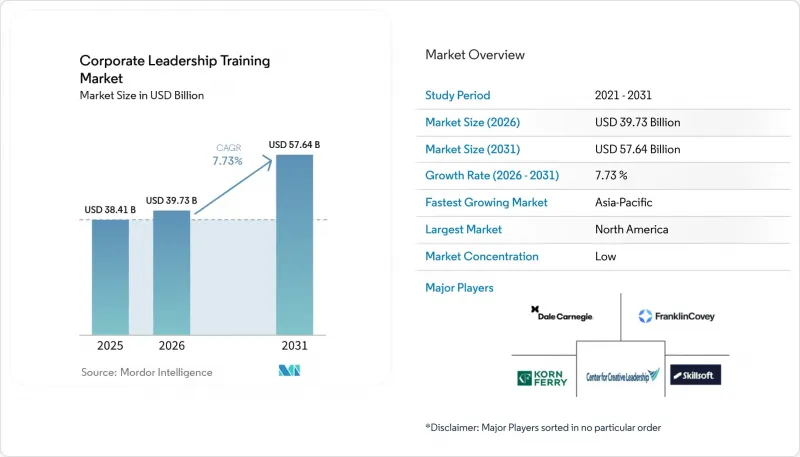
根據 Mordor Intelligence 預測,全球企業領導力培訓市場規模將從 2025 年的 384.1 億美元成長到 2026 年的 397.3 億美元,然後在 2031 年達到 576.4 億美元,2026 年至 2031 年的複合年成長率為 7.73%。
全球企業領導力培訓市場趨勢與洞察
混合型和分散式團隊中的領導力差距
混合辦公模式的興起暴露了企業領導力培訓市場,尤其是第一線和中階管理人員培訓的巨大缺口。只有25%的管理者接受過團隊領導的培訓,顯示他們對新的工作方式適應緩慢。一項2025年的調查強調,管理者需要將技術知識、軟性技能和管理專長結合,並指出市場對現代化領導課程的需求日益成長,而非僅限於虛擬團隊模組。 Z世代員工正在擁抱科技驅動型領導力,並且越來越傾向於離開那些領導文化與混合辦公模式預期不符的公司。蓋洛普的一項調查顯示,企業缺乏更廣泛的培訓,只有10%的管理者接受過必要的混合辦公領導培訓。這表明,企業領導力培訓市場存在著巨大的針對性培訓機會。
重組整個管理階層的繼任計畫流程
由於企業面臨高離職率且無法依賴非正式晉升途徑,繼任風險已成為企業領導力培訓市場的主要促進因素。 56% 的公司缺乏系統性的繼任策略,這暴露出關鍵職位儲備方面存在顯著差距。僅有 20% 的首席人力資源長 (CHRO) 擁有能夠勝任關鍵業務職位的領導者,凸顯了企業人才儲備的不足。繼任計畫已成為大多數人力資源經理的首要任務,反映出其日益成長的策略重要性。因此,培訓預算越來越與可衡量的繼任者準備成果掛鉤,而非僅僅關注一般的領導力發展。能夠加速總監和副總裁繼任者領導力培養的培訓機構,在企業領導力培訓市場中佔據優勢,有望獲得長期合約並拓展業務範圍。
對軟性技能培訓專案的投資報酬率進行歸因分析仍然具有挑戰性。
將領導者行為的改變與財務績效掛鉤,仍是企業領導培訓市場面臨的關鍵挑戰。人工智慧驅動的成本壓力和預算限制,使得人力資源部門在證明學習投資的合理性方面面臨越來越大的審查。雖然62%的組織使用員工調查來衡量領導力效能,但這些調查結果遠不足以提供財務部門所需的營運或商業證據。許多公司並未追蹤與學習舉措相關的財務關鍵績效指標(KPI),導致衡量系統與內容創新之間存在差距。儘管分析技術的進步有望逐步解決這個問題,但企業買家在該市場仍面臨預算擴張的限制。
細分市場分析
至2025年,講師主導型培訓(ILT)將佔企業領導力培訓市場42.63%的佔有率。這反映出高階主管和執行階層對基於信任、以小組為中心的培訓體驗的需求依然旺盛,他們更重視回饋和課責,而非便利性。只有26%的領導者認為其公司的發展項目“品質高”,這也解釋了為什麼企業仍然傾向於投資由促進者主導的體驗式項目,而不是全面採用低成本的數位化模組。由於講師主導型培訓在促進更深層的行為改變和加強同儕互動方面仍然有效,因此,現場培訓仍然是企業領導力培訓市場,特別是針對高級決策者和有潛力的接班人的培訓項目,重點關注的領域。
預計到2031年,線上培訓將以7.94%的複合年成長率成長,這主要得益於擴充性和柔軟性的重要性日益凸顯。 Skillsoft報告稱,其CAISY模擬器在2026會計年度的使用量較去年同期成長了341%。該工具支援40多種語言,充分展現了人工智慧驅動的線上培訓模式的有效性和在地化能力。越來越多的機構開始採用混合式教學模式,將課堂學習、虛擬講師指導課程、商業支援工具和輔導相結合,這進一步強化了混合式學習的作用,而非完全取代數位化。受監管行業的負責人更加關注可審計的設計和服務質量,這推動了結構化線上課程的擴展,但並未取代面授課程。儘管面授培訓(ILT)仍佔有一席之地,但線上和混合式培訓模式在基層管理人員和新一代領導者中持續成長。
到2025年,中階管理人員培訓將佔企業領導力培訓市場的44.81%,成為最大的細分市場。中階管理人員是策略與執行之間的橋樑,他們負責將計畫轉化為日常運營,同時也要應對來自高階領導和第一線團隊的變革。儘管73%的組織意識到需要重新定義管理者的角色,但只有少數組織取得了顯著進展,這表明市場仍存在巨大的未滿足需求。專注於輔導、賦能和執行的中階管理人員培訓計畫持續創造可觀的收入,而高階主管領導力培訓計畫雖然參與人數較少,但由於其較高的單次培訓費用,也貢獻了可觀的收入。
「新興領導者」細分市場是成長最快的細分市場,預計到2031年將以8.06%的複合年成長率成長。這反映出領導力發展在各員工層級的廣泛擴展。這項轉變的驅動力在於,企業越來越重視領導力發展管道和結構化的發展路徑,尤其是在員工職涯早期,晉升到管理職之前。這也符合人才留任策略,因為年輕員工往往更重視清晰的職涯發展機會。然而,只有35%的第一線領導者表示他們的工作有意義,這表明僅靠技能發展可能不足以留住人才。提供將技能發展與「目標感培養」和「職涯規劃」結合的綜合服務的機構,在這個企業領導力培訓市場區隔領域擁有強大的市佔率成長潛力。
區域分析
2025年,北美在收入方面持續保持領先地位,佔據企業領導力培訓市場佔有率的36.87%。美國憑藉其完善的企業培訓體系、成熟的外部供應商生態系統以及強大的內部學習能力,鞏固了這個市場主導地位。 2025年,美國企業在培訓方面的支出將達到1,028億美元,其中外部產品和服務支出成長29%,達到160億美元。這反映出企業對第三方供應商的依賴程度日益提高。 2025年,約25%的企業增加了人力資源開發人員,培訓方式的多元化也得到了推廣。加拿大和墨西哥也透過跨國公司專案和本地繼任計畫投資的連鎖效應做出了貢獻,但如何評估投資報酬率(ROI)仍然是一項關鍵挑戰。
亞太地區是企業領導力培訓市場成長最快的地區,預計到2031年將以9.83%的複合年成長率成長。這一成長主要得益於新興領導人才群體的壯大、企業數位轉型以及印度、中國、日本和東南亞地區對管理培訓投入的增加。在2025會計年度,來自30多個國家90多家客戶公司的5,000多名學員使用了人才發展服務,一項新的英語領導力培訓計畫也於2026年啟動。此外,2026年5月與印度工業聯合會(CII)簽署的合作備忘錄旨在促進印度的AI管治和數位化領導力培訓,並加強專案交付的基礎設施建設。這些趨勢表明,亞太地區的成長速度將超過西方市場。
歐洲企業領導力培訓市場受到監管壓力和合規驅動型學習需求的雙重影響。歐盟人工智慧法提高了對人工智慧素養和負責任使用培訓的需求,也增加了企業預算中的合規成本。德國和英國是最大的市場,但德國的共同決策機制傾向於那些擁有完善合規文件的供應商,同時減緩了人工智慧診斷工具的普及。 NIIT Learning Systems於2025年7月以2,237萬歐元(約2,410萬美元)收購了總部位於德國的MST集團,展現了其對德語區(德國、奧地利和瑞士)市場的信心。中東和非洲雖然收入規模較小,但由於各國的人才發展計畫和政府主導的舉措,其重要性日益凸顯。
其他好處:
- Excel格式的市場預測(ME)表
- 3個月的分析師支持
目錄
第1章:引言
- 研究假設和市場定義
- 調查範圍
第2章:調查方法
第3章執行摘要
第4章 市場狀況
- 市場概覽
- 市場促進因素
- 混合型和分散式團隊領導力面臨的挑戰
- 各管理層繼任者發展體系的重組
- 提高領導者的技能,從而更好地指導人才,對於人工智慧驅動的轉型至關重要。
- 過渡到個人化、可衡量的學習過程。
- 在薄型化的組織架構中,管理者的統籌範圍會擴大。
- 關於重返辦公室政策的摩擦導致管理者必須做出決定。
- 市場限制因素
- 對軟性技能培訓專案的投資報酬率進行歸因分析仍然具有挑戰性。
- 該項目費用高昂,而且需要長時間離開工作崗位。
- 人工智慧診斷引發的隱私問題以及勞資委員會的衝突
- 如果內容需要按照自己的步調推進,那麼一旦感到無聊,就很難將這種無聊轉化為行動。
- 價值供應鏈分析
- 監理情勢
- 技術展望
- 波特五力模型
第5章 市場規模與成長預測
- 透過串流媒體模式
- 線上培訓
- 講師指導式培訓
- 混合式培訓
- 按領導層級
- 新興領導力
- 中階領導
- 高階管理人員
- 按組織規模
- 大公司
- 小型企業
- 按行業分類
- 資訊科技/通訊
- BFSI
- 醫療保健和生命科學
- 製造業
- 零售與電子商務
- 專業服務
- 能源公用事業
- 公共部門和政府附屬公司
- 按地區
- 北美洲
- 美國
- 加拿大
- 墨西哥
- 南美洲
- 巴西
- 秘魯
- 智利
- 阿根廷
- 其他南美國家
- 歐洲
- 英國
- 德國
- 法國
- 西班牙
- 義大利
- 比荷盧經濟聯盟(比利時、荷蘭、盧森堡)
- 北歐國家(丹麥、芬蘭、冰島、挪威、瑞典)
- 其他歐洲國家
- 亞太地區
- 印度
- 中國
- 日本
- 澳洲
- 韓國
- 東南亞(新加坡、馬來西亞、泰國、印尼、越南、菲律賓)
- 其他亞太國家
- 中東和非洲
- 阿拉伯聯合大公國
- 沙烏地阿拉伯
- 南非
- 奈及利亞
- 其他中東和非洲國家
- 北美洲
第6章 競爭情勢
- 市場集中度
- 策略趨勢
- 市佔率分析
- 公司簡介
- Dale Carnegie & Associates
- FranklinCovey
- Korn Ferry
- Center for Creative Leadership
- Skillsoft
- Blanchard
- BTS Group
- Wilson Learning Worldwide
- Cegos Group
- Development Dimensions International(DDI)
- Harvard Business Impact
- American Management Association
- BetterUp
- CoachHub
- GP Strategies
- NIIT Learning Solutions
- IMD
- Crucial Learning
- MindGym
- LinkedIn Learning
第7章 市場機會與未來展望
According to Mordor Intelligence, the global corporate leadership training market is expected to grow from USD 38.41 billion in 2025 to USD 39.73 billion in 2026 and is forecast to reach USD 57.64 billion by 2031 at 7.73% CAGR over 2026-2031.
Global Corporate Leadership Training Market Trends and Insights
Hybrid and distributed team leadership gaps
Hybrid work has exposed a significant training gap for frontline and mid-level managers in the corporate leadership training market. Only 25% of managers have received training in leading teams, reflecting slow adaptation to new work patterns. A 2025 study highlighted the need for managers to combine technological knowledge, soft skills, and management expertise, emphasizing the demand for updated leadership curricula over narrow virtual team modules. Gen Z employees advocate technology-enabled leadership and are more likely to leave employers whose leadership culture does not align with hybrid work expectations. Gallup identified a broader training shortfall, with only 10% of managers receiving mandatory hybrid leadership training. This reveals a substantial opportunity for targeted programs in the corporate leadership training market.
Succession-pipeline rebuilding across manager layers
Succession risk is a key driver in the corporate leadership training market as organizations face high turnover and cannot rely on informal promotion pipelines. 56% of companies lacked a structured succession strategy, exposing a significant readiness gap for critical roles. Only 20% of CHROs had leaders prepared to fill essential business positions, highlighting weak bench strength across organizations. Succession planning has emerged as a top concern for most HR leaders, reflecting its growing strategic importance. As a result, training budgets are increasingly tied to measurable readiness outcomes rather than general leadership development. Providers that can accelerate leadership readiness for director and vice president successors are well positioned to secure longer-term contracts and expanded mandates in the corporate leadership training market.
ROI attribution remains difficult for soft-skill programs
Linking leadership behavior changes to financial outcomes remains a key challenge in the corporate leadership training market. AI-driven cost pressures and tighter budgets have increased scrutiny on HR teams to justify learning investments. While 62% of organizations use employee surveys to measure leadership effectiveness, these fail to meet finance teams' need for operational or commercial evidence. Many companies do not track financial KPIs for learning initiatives, exposing gaps in measurement infrastructure compared to content innovation. Although advancements in analytics are expected to gradually address this issue, budget growth for enterprise buyers continues to face restrictions in this market.
Other drivers and restraints analyzed in the detailed report include:
- AI transformation requires people-leader upskilling
- Shift toward personalized and measurable learning journeys
- High program cost and time-away-from-work burden
For complete list of drivers and restraints, kindly check the Table Of Contents.
Segment Analysis
Instructor-Led Training (ILT) held a 42.63% share of the corporate leadership training market in 2025. This reflects the ongoing demand for trust-based, cohort-focused experiences at senior and executive levels, where feedback and accountability outweigh convenience. Only 26% of leaders rated their development programs as high quality, explaining why organizations continue to invest in facilitated experiences instead of fully adopting lower-cost digital modules. The corporate leadership training market continues to value live facilitation for programs targeting senior decision-makers or high-potential successors, as ILT remains effective in enabling deeper behavioral change and stronger peer interaction.
Online Training is projected to grow at a 7.94% CAGR through 2031, driven by the increasing importance of scalability and flexibility. Skillsoft reported a 341% year-over-year increase in engagement with its CAISY simulator in fiscal 2026, with the tool available in over 40 languages, demonstrating the effectiveness and localization capabilities of AI-enabled online formats. Organizations are increasingly adopting blended delivery models that combine classroom learning, virtual instructor-led sessions, job aids, and coaching, reinforcing the continued role of hybrid learning over full digital substitution. Buyers in regulated sectors are focusing on auditable designs and service quality, enabling structured online programs to expand without replacing live formats. ILT retains its position, while online and blended formats continue to grow among first-line managers and emerging leaders.
Mid-Level Leadership held 44.81% of the corporate leadership training market share in 2025, making it the largest segment. This group bridges strategy and execution, translating plans into daily operations while managing changes from senior leaders and frontline teams. 73% of organizations recognize the need to redefine the manager's role, but only a small share have made significant progress, highlighting strong unmet demand. Programs for mid-level managers focused on coaching, delegation, and execution continue to generate substantial revenue, while executive leadership programs, though smaller in participant numbers, contribute significantly due to higher per-participant pricing.
Emerging Leadership is the fastest-growing segment, with an 8.06% CAGR projected through 2031, reflecting a broader expansion of leadership development across all employee levels. This shift is driven by increasing emphasis on early-career leadership pipelines and structured development pathways before employees' step into management roles. It also aligns with retention strategies, as younger employees prioritize clarity in growth opportunities. However, only 35% of frontline leaders report finding their roles purposeful, indicating that skill development alone may not be sufficient to retain talent. Providers that integrate skills development with purpose-building and career clarity are better positioned to gain share in this segment of the corporate leadership training market.
Complete Report Scope:
- By Delivery Mode
- Online Training
- Instructor-Led Training
- Blended Training
- By Leadership Level
- Emerging Leadership
- Mid-Level Leadership
- Executive Leadership
- By Organization Size
- Large Enterprises
- Small and Medium Enterprises
- By Industry Vertical
- Information Technology and Telecom
- BFSI
- Healthcare and Life Sciences
- Manufacturing
- Retail and E-commerce
- Professional Services
- Energy and Utilities
- Public Sector and Government-Linked Enterprises
- By Geography
- North America
- United States
- Canada
- Mexico
- South America
- Brazil
- Peru
- Chile
- Argentina
- Rest of South America
- Europe
- United Kingdom
- Germany
- France
- Spain
- Italy
- BENELUX (Belgium, Netherlands, and Luxembourg)
- NORDICS (Denmark, Finland, Iceland, Norway, and Sweden)
- Rest of Europe
- Asia-Pacific
- India
- China
- Japan
- Australia
- South Korea
- South East Asia (Singapore, Malaysia, Thailand, Indonesia, Vietnam, and Philippines)
- Rest of Asia-Pacific
- Middle East and Africa
- United Arab Emirates
- Saudi Arabia
- South Africa
- Nigeria
- Rest of Middle East and Africa
- North America
Geography Analysis
North America accounted for 36.87% of the corporate leadership training market share in 2025, maintaining its leading revenue position. The United States drove this dominance with its extensive corporate training base, mature external provider ecosystem, and established enterprise learning functions. The United States organizations spent USD 102.8 billion on training in 2025, with spending on external products and services rising 29% to USD 16 billion, reflecting increased reliance on third-party providers. Nearly 25% of organizations expanded their talent development staff in 2025, alongside broader adoption of diverse delivery methods. Canada and Mexico contributed through multinational program spillovers and local succession planning investments, though ROI scrutiny remains a key challenge.
Asia-Pacific is the fastest-growing region in the corporate leadership training market, with a projected CAGR of 9.83% through 2031. Growth is driven by large emerging leader populations, enterprise digitization, and increased investment in management training across India, China, Japan, and Southeast Asia. Over 5,000 participants from 90+ client companies across 30+ countries engaged with HR development services in FY2025, alongside the launch of new English-language leadership programs in 2026. Additionally, an MOU signed with the Confederation of Indian Industry in May 2026 aims to advance AI governance and digital leadership training in India, strengthening program delivery infrastructure. These developments position Asia-Pacific for faster growth compared to Western markets.
Europe's corporate leadership training market is shaped by regulatory pressures and compliance-driven learning demand. The European Union AI Act has increased the need for AI literacy and responsible use training, adding a compliance layer to budgets. Germany and the United Kingodm are the largest markets, though Germany's co-determination framework slows AI-based diagnostics adoption while favoring providers with strong compliance documentation. NIIT Learning Systems acquired Germany-based MST Group in July 2025 for EUR 22.37 million (USD 24.1 million), signaling confidence in the DACH region. The Middle East and Africa, though smaller in revenue, are gaining importance due to national talent development agendas and sovereign-backed initiatives.
- Dale Carnegie & Associates
- FranklinCovey
- Korn Ferry
- Center for Creative Leadership
- Skillsoft
- Blanchard
- BTS Group
- Wilson Learning Worldwide
- Cegos Group
- Development Dimensions International (DDI)
- Harvard Business Impact
- American Management Association
- BetterUp
- CoachHub
- GP Strategies
- NIIT Learning Solutions
- IMD
- Crucial Learning
- MindGym
- LinkedIn Learning
Additional Benefits:
- The market estimate (ME) sheet in Excel format
- 3 months of analyst support
TABLE OF CONTENTS
1 Introduction
- 1.1 Study Assumptions & Market Definition
- 1.2 Scope of the Study
2 Research Methodology
3 Executive Summary
4 Market Landscape
- 4.1 Market Overview
- 4.2 Market Drivers
- 4.2.1 Hybrid and distributed team leadership gaps
- 4.2.2 Succession-pipeline rebuilding across manager layers
- 4.2.3 AI transformation requires people-leader upskilling
- 4.2.4 Shift toward personalized and measurable learning journeys
- 4.2.5 Leaner organizations widen manager span of control
- 4.2.6 Return-to-office policy friction raises manager judgment needs
- 4.3 Market Restraints
- 4.3.1 ROI attribution remains difficult for soft-skill programs
- 4.3.2 High program cost and time-away-from-work burden
- 4.3.3 Privacy and works-council friction around AI-led diagnostics
- 4.3.4 Self-paced content fatigue weakens behavior transfer
- 4.4 Value / Supply-Chain Analysis
- 4.5 Regulatory Landscape
- 4.6 Technological Outlook
- 4.7 Porter's Five Forces
- 4.7.1 Threat of New Entrants
- 4.7.2 Bargaining Power of Buyers
- 4.7.3 Bargaining Power of Suppliers
- 4.7.4 Threat of Substitutes
- 4.7.5 Intensity of Competitive Rivalry
5 Market Size & Growth Forecasts (Value)
- 5.1 By Delivery Mode
- 5.1.1 Online Training
- 5.1.2 Instructor-Led Training
- 5.1.3 Blended Training
- 5.2 By Leadership Level
- 5.2.1 Emerging Leadership
- 5.2.2 Mid-Level Leadership
- 5.2.3 Executive Leadership
- 5.3 By Organization Size
- 5.3.1 Large Enterprises
- 5.3.2 Small and Medium Enterprises
- 5.4 By Industry Vertical
- 5.4.1 Information Technology and Telecom
- 5.4.2 BFSI
- 5.4.3 Healthcare and Life Sciences
- 5.4.4 Manufacturing
- 5.4.5 Retail and E-commerce
- 5.4.6 Professional Services
- 5.4.7 Energy and Utilities
- 5.4.8 Public Sector and Government-Linked Enterprises
- 5.5 By Geography
- 5.5.1 North America
- 5.5.1.1 United States
- 5.5.1.2 Canada
- 5.5.1.3 Mexico
- 5.5.2 South America
- 5.5.2.1 Brazil
- 5.5.2.2 Peru
- 5.5.2.3 Chile
- 5.5.2.4 Argentina
- 5.5.2.5 Rest of South America
- 5.5.3 Europe
- 5.5.3.1 United Kingdom
- 5.5.3.2 Germany
- 5.5.3.3 France
- 5.5.3.4 Spain
- 5.5.3.5 Italy
- 5.5.3.6 BENELUX (Belgium, Netherlands, and Luxembourg)
- 5.5.3.7 NORDICS (Denmark, Finland, Iceland, Norway, and Sweden)
- 5.5.3.8 Rest of Europe
- 5.5.4 Asia-Pacific
- 5.5.4.1 India
- 5.5.4.2 China
- 5.5.4.3 Japan
- 5.5.4.4 Australia
- 5.5.4.5 South Korea
- 5.5.4.6 South East Asia (Singapore, Malaysia, Thailand, Indonesia, Vietnam, and Philippines)
- 5.5.4.7 Rest of Asia-Pacific
- 5.5.5 Middle East and Africa
- 5.5.5.1 United Arab Emirates
- 5.5.5.2 Saudi Arabia
- 5.5.5.3 South Africa
- 5.5.5.4 Nigeria
- 5.5.5.5 Rest of Middle East and Africa
- 5.5.1 North America
6 Competitive Landscape
- 6.1 Market Concentration
- 6.2 Strategic Moves
- 6.3 Market Share Analysis
- 6.4 Company Profiles (includes Global level Overview, Market level overview, Core Segments, Financials as available, Strategic Information, Market Rank/Share for key companies, Products & Services, and Recent Developments)
- 6.4.1 Dale Carnegie & Associates
- 6.4.2 FranklinCovey
- 6.4.3 Korn Ferry
- 6.4.4 Center for Creative Leadership
- 6.4.5 Skillsoft
- 6.4.6 Blanchard
- 6.4.7 BTS Group
- 6.4.8 Wilson Learning Worldwide
- 6.4.9 Cegos Group
- 6.4.10 Development Dimensions International (DDI)
- 6.4.11 Harvard Business Impact
- 6.4.12 American Management Association
- 6.4.13 BetterUp
- 6.4.14 CoachHub
- 6.4.15 GP Strategies
- 6.4.16 NIIT Learning Solutions
- 6.4.17 IMD
- 6.4.18 Crucial Learning
- 6.4.19 MindGym
- 6.4.20 LinkedIn Learning
7 Market Opportunities & Future Outlook
- 7.1 White-space & unmet-need assessment
- 7.2 Market Opportunities
- 7.2.1 AI-native coaching copilots for first-line managers
- 7.2.2 Sector-specific leadership academies for regulated and high-turnover workforces

 2026年全球領導力發展服務市場報告2026年全球企業領導力培訓市場報告
 線上領導力發展專案市場規模、佔有率和成長分析:按專案類型、交付形式、學習方法、公司規模、最終用戶、定價模式和地區分類-2026-2033年產業預測
 線上企業領導力培訓市場規模、佔有率和成長分析(按培訓類型、交付方式、公司規模、最終用戶和地區分類):產業預測(2026-2033 年)
 數位社交技能療法市場預測至2034年:按療法類型、交付方式、技術、年齡層、最終用戶和地區分類的全球分析領導力發展市場預測至2034年-按培訓類型、交付方式、學習方式、部署方式、應用程式、最終用戶和地區分類的全球分析
 2026-2030年全球軟性技能培訓市場社交技能發展平台市場預測至2034年-全球分析(按組件、平台類型、技能類型、部署模式、應用、最終用戶和地區分類)2026年全球軟性技能管理市場報告
 企業領導力培訓市場規模、佔有率、成長及全球產業分析:按類型、應用和地區分類的洞察,2026-2034 年預測