


 |
市場調查報告書
商品編碼
2163599
水電解:市場佔有率分析、產業趨勢與統計、成長預測(2026-2031)Water Electrolysis - Market Share Analysis, Industry Trends & Statistics, Growth Forecasts (2026 - 2031) |
||||||

※ 本網頁內容可能與最新版本有所差異。詳細情況請與我們聯繫。
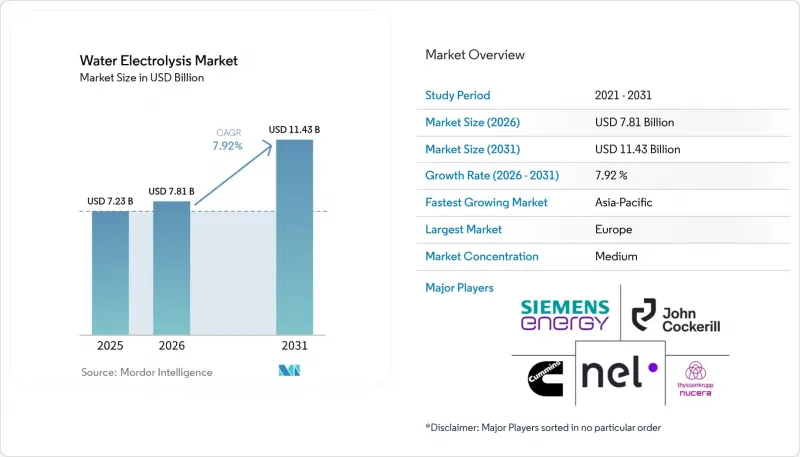
根據 Mordor Intelligence 預測,水電電解市場規模將從 2025 年的 72.3 億美元和 2026 年的 78.1 億美元成長到 2031 年的 114.3 億美元,2026 年至 2031 年的複合年成長率為 7.92%。
全球水電電解市場趨勢及洞察
除了化學工業之外,工業脫碳也在推動對電解槽。
工業脫碳是水電電解市場的主要驅動力。氫氣是許多製程的必需原料,而這些使用者對氫氣的品質要求、處理方法和操作風險已有相當的了解。 2024年,石油煉製和氨生產分別消耗了3,700萬噸和3,300萬噸氫氣。雖然傳統上大部分需求是透過石化燃料生產路線來滿足的,但這也為整合再生能源、水資源供應和企劃案融資創造了明確的替代方案。根據美國《通膨控制法》第45V條的稅額扣抵,某些地區可可再生氫氣用於鋼鐵和氨生產的經濟效益得以提升。因此,水電電解市場可以透過進入現有工業區來拓展業務,這些工業區已經具備完善的氫氣處理系統、需求模式、技術規格和營運人員。
隨著再生能源的併網,電解槽正轉變為電網資產。
再生能源的併網正在改變電解槽在水電電解市場中的角色。在風能和太陽能發電量通常有限的情況下,電解槽可以作為靈活的負荷,為專案開發商提供氫氣銷售以外的新價值來源。在可再生能源部署超過電網容量或電力系統需要靈活需求以適應不斷變化的發電條件的地區,這項功能尤其重要。儘管德國2026年的電解運作中容量為193兆瓦,但高昂的輸電成本意味著許多計畫仍需要公共資金支持。將電解供應與專用可再生能源資產和電力供應合約掛鉤的開發商,可以向貸款方、客戶和公共資金提供者提交更具吸引力的專案方案。
在大多數市場,電力成本限制了綠氫能的競爭力。
電力成本仍然是水電電解市場的主要阻礙因素,因為它會影響氫氣生產成本、設備運作和工業用戶最終支付的價格。國際能源總署(IEA)指出,2025年後天然氣價格的下降將擴大多個市場中可再生能源氫氣和石化燃料氫氣生產之間的成本差距。這可能會延遲最終的投資決策,尤其是在開發商無法將增加的氫氣成本轉嫁給客戶,或無法獲得津貼或合約保障的低成本電力的情況下。因此,專案開發正集中在可再生能源資源豐富、銷售條件便利、基礎設施完善且政策環境能夠降低專案早期風險的地區。伊比利半島、印度南部、中東和中國北部的風電產區具備支援低成本供應的條件。
細分市場分析
截至2025年,鹼性電解槽佔據了水電電解市場54.8%的佔有率,而質子交換膜(PEM)電解槽預計到2031年將以9.4%的複合年成長率成長。鹼性電解技術因其成熟的工業應用歷史、不依賴銥、使用鎳基催化劑以及在氯鹼生產等工業應用中數十年的經驗而廣泛應用。其較低的資本投入也使其在大規模工業項目中佔優勢。當買家優先考慮成熟設備、成本控制、標準化和快速供應,而非新技術的操作柔軟性時,鹼性電解技術的優勢尤其明顯。 PEM系統能夠快速響應再生能源的波動,並提供高純度氫氣。這在氫氣生產必須根據風能和太陽能的波動進行調整,同時又不影響專業終端用戶所需的品質時至關重要。這些特性正推動其在燃料電池應用和半導體製造領域的應用。在這些領域,緊湊的設備、動態的操作和嚴格的純度要求可能比與鹼性技術相關的低初始成本更重要。
2025年發表的一項研究表明,一種隧道結構的IrOx催化劑能夠降低PEM陽極中的銥負載量。這項成果解決了阻礙PEM廣泛應用的材料限制問題,因為全球銥供應有限,銥主要作為鉑礦開採的副產品而非主要原料生產。 2025年12月,Nel ASA批准了一項投資決定,將在挪威赫羅亞(Heroja)建造一個加壓鹼性電解池平台並實現工業化。固體氧化物電解池(SOEC)技術效率很高,尤其是在鋼鐵和氨製造等工業廢熱資源豐富的環境中,但與成熟的鹼性電解池系統相比,它仍處於商業化初期,在研發、製造和客戶應用方面面臨更高的風險。陰離子交換膜(AEM)系統也正從示範階段走向工業應用,不像PEM系統那樣依賴銥。這為那些注重靈活操作和降低材料依賴性的開發商提供了另一種技術選擇。
區域分析
到2025年,歐洲將佔全球水電電解市場的31.5%。在工業需求、政策支持和公共資金的推動下,到2025年中期,該地區的水電電解能將達到571兆瓦。平均專案規模從2023-2024年的2.9兆瓦擴大到2024-2025年的18兆瓦,顯示專案規模正從小規模示範專案轉向大規模工業設施。
截至2026年中期,德國的氫氣運作裝置容量為193兆瓦,另有993兆瓦在建。由於電力成本高昂,公共資金和低成本的供應路線是該國計畫儲備的關鍵要素。德國於2025年10月批准的《氫能加速法案》涵蓋了生產、終端、儲存和管道等各個環節的授權。規劃中的9,700公里「核子網路」(Kernnetz)預計2032年將北部生產區與工業需求中心連接起來。同時,西班牙正透過Moeve公司位於韋爾瓦的工廠擴大在氫能領域的佔有率。
亞太地區是水電電解市場成長最快的地區,預計到2031年將以9.2%的複合年成長率成長。 2025年,中國新增電解槽量佔全球近四分之三。中國鹼性電解槽製造規模龐大,既支持成本驅動型模式,也加劇了市場競爭。印度正在開發出口導向氫能項目,例如AM Green計劃在卡基納達部署1.3吉瓦的電解槽。北美市場受惠於美國第45V條稅額扣抵。同時,加拿大計畫可以利用低碳電網,而佩塞姆和蘇阿佩等南美港口樞紐正在尋求出口機會。在中東和非洲,低成本的太陽能資源和氨出口計畫與大規模鹼性電解計畫提案結合。
其他好處:
- Excel格式的市場預測(ME)表
- 3個月的分析師支持
目錄
第1章:引言
- 研究假設和市場定義
- 調查範圍
第2章:調查方法
第3章執行摘要
第4章 市場狀況
- 市場概覽
- 市場促進因素
- 工業脫碳及對綠氫的需求
- 可再生能源併網及長期儲能
- 與氫能相關的強制性措施、獎勵和碳減排政策
- 對氨、甲醇、煉油、鋼鐵和電子燃料的需求成長。
- 工業和港口集群中的氫氣聯產
- 數位堆疊監控和預測性維護
- 市場限制因素
- 高昂的電力成本和低成本的可再生能源供應
- 初始投資額大及專案融資風險
- 乾旱地區的水資源、冷卻和鹽水管理面臨的限制因素
- 銥、鉑族金屬以及與薄膜耐久性相關的瓶頸
- 供應鏈分析
- 波特五力分析
- 科技趨勢
- 監理情勢
- 投資分析
第5章 市場規模與成長預測
- 透過技術
- 鹼性電解裝置
- PEM電解槽
- 固體氧化物電解池(SOEC)
- 陰離子交換膜(AEM)電解槽
- 按產能分類的氫氣生產能力
- 低於500公升/小時
- 500~2,000 L/hr
- 2000公升/小時或以上
- 按最終用途
- 化學品
- 石油、天然氣和煉油
- 電力/公共產業
- 運輸
- 工業製造
- 電子和半導體
- 儲能
- 其他最終用戶
- 按地區
- 北美洲
- 美國
- 加拿大
- 墨西哥
- 歐洲
- 德國
- 法國
- 義大利
- 西班牙
- 英國
- 波蘭
- 俄羅斯
- 其他歐洲國家
- 亞太地區
- 中國
- 印度
- 日本
- 韓國
- 澳洲
- 印尼
- 越南
- 泰國
- 其他亞太國家
- 南美洲
- 巴西
- 阿根廷
- 智利
- 其他南美國家
- 中東和非洲
- 沙烏地阿拉伯
- 阿拉伯聯合大公國
- 埃及
- 南非
- 摩洛哥
- 其他中東和非洲國家
- 北美洲
第6章 競爭情勢
- 市場集中度
- 策略趨勢
- 市佔率分析
- 公司簡介
- Air Liquide SA
- Air Products and Chemicals, Inc.
- Asahi Kasei Corporation
- Bloom Energy Corporation
- Cummins Inc.
- Enapter AG
- HydrogenPro ASA
- ITM Power PLC
- John Cockerill
- Linde plc
- LONGi Green Energy Technology Co., Ltd.
- McPhy Energy SA
- Nel ASA
- Ohmium International, Inc.
- Plug Power Inc.
- Siemens Energy AG
- Sunfire GmbH
- Sungrow Power Supply Co., Ltd.
- thyssenkrupp nucera AG and Co. KGaA
- Topsoe A/S
- Toshiba Energy Systems and Solutions Corporation
第7章 市場機會與未來展望
According to Mordor Intelligence, the water electrolysis market size is projected to expand from USD 7.23 billion in 2025 and USD 7.81 billion in 2026 to USD 11.43 billion by 2031, at a CAGR of 7.92% between 2026 and 2031.
Global Water Electrolysis Market Trends and Insights
Industrial Decarbonization Driving Electrolyzer Demand Beyond the Chemicals Sector
Industrial decarbonization supports the water electrolysis market because many processes need hydrogen as a feedstock, and these users already understand hydrogen quality requirements, handling practices, and operating risks. Oil refining used 37 million tons of hydrogen in 2024, while ammonia production used 33 million tons. Most of this demand has historically been supplied through fossil-based production routes, creating a defined replacement opportunity where renewable electricity, water supply, and project finance can be brought together. The U.S. Inflation Reduction Act Section 45V credit can improve the economics of renewable hydrogen for steel and ammonia production in selected locations. The water electrolysis market, therefore, has a route into established industrial sites where hydrogen handling systems, demand patterns, technical specifications, and operating staff are already present.
Renewable-Power Integration Turning Electrolyzers Into Grid Assets
Renewable power integration is changing the role of electrolyzers within the water electrolysis market. Electrolyzers can act as flexible loads when wind and solar output would otherwise be curtailed, which can give project developers another source of value beyond hydrogen sales alone. This capability is particularly relevant where renewable additions have outpaced grid capacity and where power systems need flexible demand that can respond to changing generation conditions. Germany had 193 MW of operational electrolysis capacity in 2026, but high grid-power costs meant many projects still required public support. Developers that link electrolyzer supply with dedicated renewable assets and power agreements can present a more complete project case to lenders, customers, and public funding bodies.
Electricity Costs Limiting Green Hydrogen Competitiveness Across Most Markets
Electricity costs remain a central restraint on the water electrolysis market because they shape the cost of hydrogen production, the hours that equipment can operate, and the price that industrial customers must pay. The IEA reported that lower natural gas prices since 2025 had widened the cost difference between renewable and fossil hydrogen in several markets. This can delay final investment decisions where grants or contracted low-cost power are unavailable, particularly where developers cannot pass higher hydrogen costs through to their customers. Project development is consequently concentrated in regions with favorable renewable resources, workable offtake conditions, suitable infrastructure, and a policy environment that can reduce early project risks. The Iberian Peninsula, southern India, the Middle East, and northern Chinese wind regions have characteristics that can support lower-cost supply.
Other drivers and restraints analyzed in the detailed report include:
- Hydrogen Mandates and Carbon-Reduction Policies Anchoring Long-Term Demand
- E-Fuels, Ammonia, and Steel Creating Industrial-Scale Electrolyzer Pull
- High Capital Requirements and Project-Finance Risk Deferring Investment Decisions
For complete list of drivers and restraints, kindly check the Table Of Contents.
Segment Analysis
Alkaline electrolyzers held 54.8% of the water electrolysis market size in 2025, while PEM is expected to record a 9.4% CAGR through 2031. Alkaline technology remains widely used because it has an established industrial record, does not rely on iridium, works with nickel-based catalysts, and has been used for decades in industrial applications such as chlor-alkali production. Its lower capital requirements also support its position in large industrial projects, especially where buyers prioritize proven equipment, cost discipline, standardization, and rapid availability over the operating flexibility of newer technologies. PEM systems respond rapidly to variable renewable electricity and can deliver high-purity hydrogen, which is important when hydrogen production must follow changing wind and solar generation without compromising the quality required by specialized end users. These attributes support use in fuel-cell applications and semiconductor-related production, where compact equipment, dynamic operation, and stringent purity specifications can matter more than the lower initial cost associated with alkaline technology.
Research published in 2025 demonstrated a tunnel-structured IrOx catalyst that reduced iridium loading in PEM anodes. The result addresses a material constraint that affects wider PEM deployment because global iridium supply is limited and iridium is largely produced as a by-product of platinum mining rather than as a primary material. Nel ASA approved an investment decision in December 2025 to industrialize a pressurized alkaline platform at Heroya, Norway. SOEC technology retains an efficiency case where industrial waste heat is available, particularly in steel and ammonia settings, but it is earlier in commercialization and carries greater development, manufacturing, and customer adoption risk than established alkaline systems. AEM systems are also moving from demonstrations toward industrial applications without the same iridium exposure as PEM systems, giving developers another possible technology route where flexible operation and lower material dependency are central procurement considerations.
Complete Report Scope:
- By Technology
- Alkaline Electrolyzer
- PEM Electrolyzer
- Solid Oxide Electrolyzer Cell (SOEC)
- Anion Exchange Membrane (AEM) Electrolyzer
- By Hydrogen Production Capacity
- Below 500 L/hr
- 500-2,000 L/hr
- Above 2,000 L/hr
- By End Use
- Chemicals
- Oil & Gas and Refining
- Power & Utilities
- Transportation
- Industrial Manufacturing
- Electronics & Semiconductors
- Energy Storage
- Other End Users
- By Geography
- North America
- United States
- Canada
- Mexico
- Europe
- Germany
- France
- Italy
- Spain
- United Kingdom
- Poland
- Russia
- Rest of Europe
- Asia-Pacific
- China
- India
- Japan
- South Korea
- Australia
- Indonesia
- Vietnam
- Thailand
- Rest of Asia-Pacific
- South America
- Brazil
- Argentina
- Chile
- Rest of South America
- Middle East and Africa
- Saudi Arabia
- United Arab Emirates
- Egypt
- South Africa
- Morocco
- Rest of Middle East and Africa
- North America
Geography Analysis
Europe held 31.5% of the water electrolysis market share in 2025. The region combines industrial demand, policy support, and public funding, and European installed electrolysis capacity reached 571 MWel by mid-2025. Average project size increased from 2.9 MWel in 2023-2024 to 18 MWel in 2024-2025. This indicates a move beyond small demonstrations toward larger industrial facilities.
Germany had 193 MW of operational capacity and 993 MW under construction in mid-2026. High electricity costs make public funding and lower-cost supply routes important to the country's project pipeline. Germany's Hydrogen Acceleration Act, approved in October 2025, covered permitting across production, terminals, storage, and pipelines. The planned 9,700 km Kernnetz network is expected to connect northern production areas with industrial demand centers by 2032, while Spain is gaining relevance through Moeve's Huelva facility.
Asia-Pacific is the fastest-growing regional water electrolysis market at a 9.2% CAGR through 2031. China accounted for nearly three-quarters of new global electrolyzer installations in 2025. Its alkaline manufacturing scale supports a cost-led model but also increases competitive pressure. India is developing export-oriented hydrogen projects, including AM Green's planned 1.3 GW electrolyzer deployment in Kakinada. North America is shaped by the U.S. Section 45V credit, while Canadian projects can draw on lower-carbon electricity grids and South American port locations such as Pecem and Suape are pursuing export opportunities. The Middle East and Africa combine low-cost solar resources with ammonia export programs and large alkaline project proposals.
- Air Liquide S.A.
- Air Products and Chemicals, Inc.
- Asahi Kasei Corporation
- Bloom Energy Corporation
- Cummins Inc.
- Enapter AG
- HydrogenPro ASA
- ITM Power PLC
- John Cockerill
- Linde plc
- LONGi Green Energy Technology Co., Ltd.
- McPhy Energy S.A.
- Nel ASA
- Ohmium International, Inc.
- Plug Power Inc.
- Siemens Energy AG
- Sunfire GmbH
- Sungrow Power Supply Co., Ltd.
- thyssenkrupp nucera AG and Co. KGaA
- Topsoe A/S
- Toshiba Energy Systems and Solutions Corporation
Additional Benefits:
- The market estimate (ME) sheet in Excel format
- 3 months of analyst support
TABLE OF CONTENTS
1 INTRODUCTION
- 1.1 Study Assumptions and Market Definition
- 1.2 Scope of the Study
2 RESEARCH METHODOLOGY
3 EXECUTIVE SUMMARY
4 MARKET LANDSCAPE
- 4.1 Market Overview
- 4.2 Market Drivers
- 4.2.1 Industrial Decarbonization and Green-Hydrogen Demand
- 4.2.2 Renewable-Power Integration and Long-Duration Energy Storage
- 4.2.3 Hydrogen Mandates, Incentives and Carbon-Reduction Policies
- 4.2.4 Demand Growth from Ammonia, Methanol, Refining, Steel and E-Fuels
- 4.2.5 Co-Located Hydrogen Production in Industrial and Port Clusters
- 4.2.6 Digital Stack Monitoring and Predictive Maintenance
- 4.3 Market Restraints
- 4.3.1 High Electricity Cost and Low-Cost Renewable Availability
- 4.3.2 High Upfront Capital and Project-Finance Risk
- 4.3.3 Water, Cooling and Brine-Management Constraints in Arid Locations
- 4.3.4 Iridium, Platinum-Group Metals and Membrane Durability Bottlenecks
- 4.4 Supply-Chain Analysis
- 4.5 Porter's Five Forces Analysis
- 4.5.1 Bargaining Power of Suppliers
- 4.5.2 Bargaining Power of Buyers
- 4.5.3 Threat of New Entrants
- 4.5.4 Threat of Substitutes
- 4.5.5 Competitive Rivalry
- 4.6 Technology Outlook
- 4.7 Regulatory Landscape
- 4.8 Investment Analysis
5 MARKET SIZE AND GROWTH FORECASTS
- 5.1 By Technology
- 5.1.1 Alkaline Electrolyzer
- 5.1.2 PEM Electrolyzer
- 5.1.3 Solid Oxide Electrolyzer Cell (SOEC)
- 5.1.4 Anion Exchange Membrane (AEM) Electrolyzer
- 5.2 By Hydrogen Production Capacity
- 5.2.1 Below 500 L/hr
- 5.2.2 500-2,000 L/hr
- 5.2.3 Above 2,000 L/hr
- 5.3 By End Use
- 5.3.1 Chemicals
- 5.3.2 Oil & Gas and Refining
- 5.3.3 Power & Utilities
- 5.3.4 Transportation
- 5.3.5 Industrial Manufacturing
- 5.3.6 Electronics & Semiconductors
- 5.3.7 Energy Storage
- 5.3.8 Other End Users
- 5.4 By Geography
- 5.4.1 North America
- 5.4.1.1 United States
- 5.4.1.2 Canada
- 5.4.1.3 Mexico
- 5.4.2 Europe
- 5.4.2.1 Germany
- 5.4.2.2 France
- 5.4.2.3 Italy
- 5.4.2.4 Spain
- 5.4.2.5 United Kingdom
- 5.4.2.6 Poland
- 5.4.2.7 Russia
- 5.4.2.8 Rest of Europe
- 5.4.3 Asia-Pacific
- 5.4.3.1 China
- 5.4.3.2 India
- 5.4.3.3 Japan
- 5.4.3.4 South Korea
- 5.4.3.5 Australia
- 5.4.3.6 Indonesia
- 5.4.3.7 Vietnam
- 5.4.3.8 Thailand
- 5.4.3.9 Rest of Asia-Pacific
- 5.4.4 South America
- 5.4.4.1 Brazil
- 5.4.4.2 Argentina
- 5.4.4.3 Chile
- 5.4.4.4 Rest of South America
- 5.4.5 Middle East and Africa
- 5.4.5.1 Saudi Arabia
- 5.4.5.2 United Arab Emirates
- 5.4.5.3 Egypt
- 5.4.5.4 South Africa
- 5.4.5.5 Morocco
- 5.4.5.6 Rest of Middle East and Africa
- 5.4.1 North America
6 COMPETITIVE LANDSCAPE
- 6.1 Market Concentration
- 6.2 Strategic Moves
- 6.3 Market Share Analysis
- 6.4 Company Profiles (includes Global Level Overview, Market Level Overview, Core Segments, Financials as available, Strategic Information, Market Rank/Share, Products and Services, Recent Developments)
- 6.4.1 Air Liquide S.A.
- 6.4.2 Air Products and Chemicals, Inc.
- 6.4.3 Asahi Kasei Corporation
- 6.4.4 Bloom Energy Corporation
- 6.4.5 Cummins Inc.
- 6.4.6 Enapter AG
- 6.4.7 HydrogenPro ASA
- 6.4.8 ITM Power PLC
- 6.4.9 John Cockerill
- 6.4.10 Linde plc
- 6.4.11 LONGi Green Energy Technology Co., Ltd.
- 6.4.12 McPhy Energy S.A.
- 6.4.13 Nel ASA
- 6.4.14 Ohmium International, Inc.
- 6.4.15 Plug Power Inc.
- 6.4.16 Siemens Energy AG
- 6.4.17 Sunfire GmbH
- 6.4.18 Sungrow Power Supply Co., Ltd.
- 6.4.19 thyssenkrupp nucera AG and Co. KGaA
- 6.4.20 Topsoe A/S
- 6.4.21 Toshiba Energy Systems and Solutions Corporation
7 MARKET OPPORTUNITIES AND FUTURE OUTLOOK
- 7.1 White-Space and Unmet-Need Assessment

 基於水電電解的氫氣生產測試平台市場-全球預測(2026-2032年)鎂強化礦泉水過濾器市場:全球市場預測(2026-2032年)
 Brown-Lee電解設備市場規模、佔有率和成長分析:按設備類型、電極類型、應用、最終用戶和地區分類-2026-2033年產業預測
 2026年全球氯鹼電解市場研究報告
 綠色氫氣生產技術市場分析及預測(至2035年):類型、技術、組件、應用、製程、最終用戶、安裝類型、設備、解決方案、階段
 固體氧化物電解槽市場預測至2034年-按動作溫度、組件、系統配置、應用、最終用戶和地區分類的全球分析水電電解市場預測至2034年-按技術、處理能力、電源、應用、最終用戶和地區分類的全球分析
 鹽酸電解:市場佔有率分析、產業趨勢與統計、成長預測(2026-2031)可再生氫電解市場預測至2034年-全球原料、系統類型、產能、技術、應用、最終用戶及區域分析
 2026年全球水電解市場報告