


 |
市場調查報告書
商品編碼
2163593
偏振機械視覺系統:市場佔有率分析、產業趨勢與統計、成長預測(2026-2031)Polarimetric Machine Vision Systems - Market Share Analysis, Industry Trends & Statistics, Growth Forecasts (2026 - 2031) |
||||||

※ 本網頁內容可能與最新版本有所差異。詳細情況請與我們聯繫。
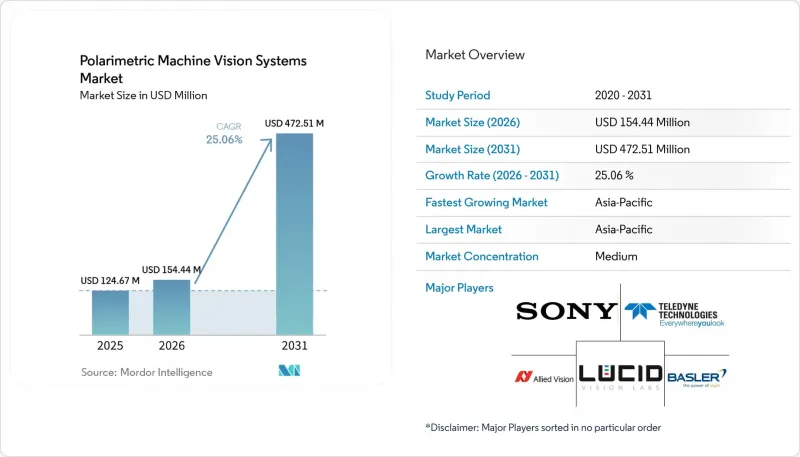
根據 Mordor Intelligence 預測,偏振機器視覺系統的市場規模預計將從 2025 年的 1.2467 億美元成長到 2026 年的 1.5444 億美元,到 2031 年達到 4.7251 億美元,2026 年至 2031 年的年複合成長率(CAGR)為 25.06%。
全球偏振機器視覺系統市場趨勢與洞察
對反射和透明部件的檢測中「零缺陷」的要求越來越高。
「零缺陷」生產目標正推動市場對用於檢測難以檢測的光學表面的偏振機器視覺系統產生濃厚興趣。標準相機在玻璃蓋板、拋光金屬和透明聚合物薄膜上會損失對比。這些材料廣泛應用於電動車電池組、OLED 面板和藥品泡殼包裝。偏振成像技術能夠分離反射光和透射光,從而檢測出分層、密封缺陷和殘餘應力區域。保時捷萊比錫工廠已部署人工智慧驅動的機器人油漆檢測系統,這表明人們正擴大轉向使用光學方法來減少光面檢測誤差。汽車和家用電子電器的偵測失敗可能導致損失超過偏振測量系統的初始投資。
使用片上偏振片可以降低系統複雜性。
在偏振機器視覺系統市場,片上偏振片的應用降低了系統複雜性。傳統的旋轉偏振系統需要電動組裝和同步曝光。SONY的 IMX250、IMX253 和 IMX264 感測器透過 2x2 像素排列,在單次曝光中即可捕捉 0°、45°、90° 和 135° 的偏振態。這種設計支援超過 70 幀/秒的即時成像,使其成為高吞吐量生產環境的理想選擇。 2026 年 5 月,CCS 推出了一款用於晶圓和玻璃偵測的分瞳偏振片單元。本單元利用單次成像即可可視化表面翹曲、傾斜和粗糙度。感測器可用性的提高有望推動亞太地區 OEM 廠商和嵌入式視覺供應商進一步採用該技術。
偏振測量系統實施過程中缺乏校準與演算法技術
偏振測量專業知識的匱乏阻礙了偏振測量機器視覺系統的廣泛應用。有效實施偏振度測量(DoFP)需要掌握斯托克斯參數、穆勒矩陣校準和去馬賽克等技術。這些技能在接受標準自動化光學檢測或色彩視覺訓練的團隊中並不常見。因此,許多專案都由少數專業整合商負責。這會導致交付週期延長和成本增加,可能抵消低成本感測器的優勢。雖然供應商培訓和現成的軟體庫有所幫助,但培養必要的人才需要時間。
細分市場分析
到2025年,臉部掃描偏振相機將佔據偏振機器視覺系統市場38.46%的佔有率。其領先地位得益於在晶圓處理、汽車車體面板和藥品包裝等應用領域的廣泛使用。 Allied Vision、LUCID Vision Labs、Basler、JAI和IDS等公司皆提供採用SONYIMX250或IMX264感光元件系列的DoFP(偏振光成像)相機。這些相機無需對現有GigE視覺系統進行完整的硬體重新設計,即可為其添加偏振功能。線掃描相機則適用於需要連續掃描範圍的捲對捲介質和高速輸送機。
預計到2031年,偏振相機模組和感光元件核心的市場將以26.12%的複合年成長率成長。 2026年3月,維也納技術大學(TU Wien)使用Allied Vision公司的EXO250ZU3偏振相機檢驗了一種線上成像橢偏儀,成功測量了移動箔片的光學厚度。整合偏振系統結合了校準光學元件、軟體和應用支持,可用於複雜的檢測。由於整合工作量減少,這些整合系統可以實現更高的售價。相機模組和感測器核心發揮戰略性作用,因為亞太地區的原始設備製造商(OEM)已將Polarsens感測器直接整合到其嵌入式平台中。萊布尼茨複合材料研究所檢驗了Baumer公司的VCXU-50MP相機,可用於即時監測碳纖維增強複合材料(CFRP)纖維的取向。
區域分析
預計到2025年,亞太地區將佔據偏振機器視覺系統市場43.27%的佔有率,並在2031年之前以26.13%的複合年成長率持續成長。中國、韓國、日本和印度擁有半導體製造、電子組裝和汽車製造的綜合產能。該地區預計也將成為成長最快的地區。三星、SK海力士、台積電和日本半導體製造商正在推動晶圓應力監測的需求。 JAI在日本生產「GO-5100MP-PGE」DoFP面陣相機,為半導體客戶提供在地採購解決方案,該方案具備四向偏振濾波和千兆乙太網路連接功能。
東芝和東芝資訊系統公司宣布將於2026年合作開發半導體表面缺陷單點奈米級3D光學檢測的技術。北美和歐洲是偏振機器視覺系統市場第二大集中需求地區。在北美,英特爾、格羅方德、Wolfspeed和連貫等公司正在投資半導體產能。在歐洲,航太複合材料、汽車車身面板、食品包裝和藥品檢測等領域的需求十分活躍。德國、法國和英國佔據了歐洲這些應用領域的大部分需求。
維也納科技大學 (TU Wien) 2026 年的一項關於線上橢偏儀的研究表明,歐洲在卷對卷 (R2R) 塗層檢測領域持續發展。南美洲、中東和非洲雖然規模較小,但在全球需求中卻成長迅速。巴西的電子組裝企業對自動化光學檢測的需求正逐漸成長。沙烏地阿拉伯對半導體封裝的熱情促使雙方就偵測技術展開了初步探討。低成本的 DoFP 感測器未來有望縮小與北美和歐洲在技術獲取方面的差距。
其他好處:
- Excel格式的市場預測(ME)表
- 3個月的分析師支持
目錄
第1章:引言
- 研究假設和市場定義
- 調查範圍
第2章:調查方法
第3章執行摘要
第4章 市場狀況
- 市場概覽
- 市場促進因素
- 對反射和透明部件的檢測中「零缺陷」的要求越來越高。
- 使用片上偏振片可以降低系統複雜性。
- 先進節點和化合物材料的半導體晶圓應力監測
- 偏振功能可提高眩光下人工智慧缺陷分類的準確性。
- 對易損產品進行非接觸式包裝密封檢測
- 複合材料製造中纖維的線性傾向與屈光映射
- 市場限制因素
- 偏振測量系統實施過程中缺乏校準與演算法技術
- 微電網取樣中解析度和信噪比之間的權衡
- 攝影機、照明和偵測軟體之間的介面分散。
- 關於特殊材料和缺陷的生產線檢驗數據有限。
- 宏觀經濟因素對市場的影響
- 產業供應鏈分析
- 科技趨勢
- 監理情勢
- 波特五力分析
第5章 市場規模與成長預測
- 依產品類型
- 臉部掃描偏振相機
- 線掃描偏振相機
- 偏振相機模組和感測器核心(嵌入式/OEM)
- 偏振檢測系統(整合式,軟體+光學元件)
- 極化方法
- 焦平面分割(DoFP)
- 時分式和旋轉式偏振器
- 開局
- 幅度分割
- 按最終用戶行業分類
- 製造業(通用/離散型)
- 汽車和運輸業
- 半導體和電子學
- 食品/飲料
- 製藥
- 航太/國防
- 安全和公共安全
- 研究和科學機構
- 其他終端用戶產業
- 按地區
- 北美洲
- 美國
- 加拿大
- 墨西哥
- 南美洲
- 巴西
- 阿根廷
- 其他南美國家
- 歐洲
- 德國
- 英國
- 法國
- 義大利
- 西班牙
- 其他歐洲國家
- 亞太地區
- 中國
- 日本
- 印度
- 韓國
- 其他亞太國家
- 中東和非洲
- 中東
- 沙烏地阿拉伯
- 阿拉伯聯合大公國
- 土耳其
- 其他中東國家
- 非洲
- 南非
- 奈及利亞
- 其他非洲國家
- 中東
- 北美洲
第6章 競爭情勢
- 市場集中度
- 策略趨勢
- 市佔率分析
- 公司簡介
- Sony Corporation
- Teledyne Technologies Incorporated
- Cognex Corporation
- Basler AG
- Keyence Corporation
- Omron Corporation
- Allied Vision Technologies GmbH
- LUCID Vision Labs Inc.
- JAI A/S
- Hamamatsu Photonics KK
- IDS Imaging Development Systems GmbH
- Photonfocus AG
- Thorlabs, Inc.
- FLIR Systems, Inc.
- TKH Group NV
- Photron Limited
- Baumer Holding AG
- Stemmer Imaging AG
- The Imaging Source Europe GmbH
- Imperx, Inc.
- Alkeria Srl
- PVA TePla AG
第7章 市場機會與未來展望
According to Mordor Intelligence, the polarimetric machine vision systems market size is projected to expand from USD 124.67 million in 2025 to USD 154.44 million in 2026, and to USD 472.51 million by 2031, registering a CAGR of 25.06% between 2026 and 2031.
Global Polarimetric Machine Vision Systems Market Trends and Insights
Rising Zero-Defect Requirements in Reflective and Transparent Component Inspection
Zero-defect production targets are increasing interest in the Polarimetric Machine Vision Systems Market for difficult optical surfaces. Standard cameras can lose contrast on glass covers, polished metals, and transparent polymer films. Those materials are widely used in EV battery packs, OLED covers, and pharmaceutical blister packaging. Polarization imaging separates reflected and transmitted light, which can reveal delamination, weak seals, and residual-stress areas. Porsche's Leipzig facility has adopted AI-enabled robotic paint inspection, illustrating the broader shift toward optical methods to reduce errors on glossy surfaces. Inspection failures in automotive and consumer electronics can create costs that exceed the expense of a polarimetric retrofit.
On-Chip Polarizer Adoption Reducing System Complexity
On-chip polarizers are lowering system complexity in the Polarimetric Machine Vision Systems Market. Earlier rotating-polarizer systems needed motorized assemblies and synchronized exposures. Sony's IMX250, IMX253, and IMX264 sensors capture 0°, 45°, 90°, and 135° polarization states in one exposure through a 2X2 pixel arrangement. This design supports real-time imaging at more than 70 frames per second and is well-suited to high-throughput production settings. CCS launched a pupil-division polarization unit in May 2026 for wafer and glass inspection, using single-shot imaging to visualize surface warp, tilt, and roughness. Greater sensor availability may strengthen adoption by Asia-Pacific OEMs and embedded-vision suppliers.
Calibration and Algorithm Skills Shortage for Polarimetric Deployments
A shortage of polarimetric expertise limits the broader adoption of Polarimetric Machine Vision Systems. Effective DoFP deployment requires knowledge of Stokes parameters, Mueller-matrix calibration, and demosaicking. These skills are uncommon among teams trained in standard automated optical inspection or color vision. As a result, a small group of specialized integrators handles many projects. This can extend delivery times and add costs, the benefit of lower-priced sensors. Vendor training and ready-to-use software libraries can help, but broad workforce development will take time.
Other drivers and restraints analyzed in the detailed report include:
- Semiconductor Wafer Stress Monitoring for Advanced Nodes and Compound Materials
- Polarization Features Improving AI Defect Classification Under Glare
- Resolution and Signal-to-Noise Trade-Offs From Microgrid Sampling
For complete list of drivers and restraints, kindly check the Table Of Contents.
Segment Analysis
Area-scan polarization cameras accounted for 38.46% of the Polarimetric Machine Vision Systems Market size in 2025. Their broad use across wafer handling, vehicle body panels, and pharmaceutical packaging supports this leading position. Allied Vision, LUCID Vision Labs, Basler, JAI, and IDS offer DoFP models using Sony IMX250 or IMX264 sensor families. These cameras allow established GigE Vision installations to add polarization capability without a full hardware redesign. Line-scan cameras address roll-to-roll webs and high-speed conveyors that require continuous coverage.
Polarization camera modules and sensor cores are projected to expand at a 26.12% CAGR through 2031. TU Wien validated an inline imaging ellipsometer in March 2026 using Allied Vision's EXO250ZU3 polarized camera for optical-thickness measurement on moving foils. Integrated polarization systems combine calibrated optics, software, and application support for complex inspections. These packages can command higher selling prices because they reduce integration work. Camera modules and sensor cores have a strategic role as Asia-Pacific OEMs integrate Polarsens sensors directly into embedded platforms. The Leibniz Institute for Composite Materials validated a Baumer VCXU-50MP camera for real-time CFRP fiber-orientation monitoring.
Complete Report Scope:
- By Product Type
- Area-Scan Polarization Cameras
- Line-Scan Polarization Cameras
- Polarization Camera Modules and Sensor Cores (embedded/OEM)
- Polarization Inspection Systems (integrated, software + optics)
- By Polarization Technique
- Division of Focal Plane (DoFP)
- Division of Time and Rotating Polarizer
- Division of Aperture
- Division of Amplitude
- By End-User Industry
- Manufacturing (General/Discrete)
- Automotive and Transportation
- Semiconductors and Electronics
- Food and Beverage
- Pharmaceuticals
- Aerospace and Defense
- Security and Public Safety
- Research and Scientific Institutions
- Other End-User Industries
- By Geography
- North America
- United States
- Canada
- Mexico
- South America
- Brazil
- Argentina
- Rest of South America
- Europe
- Germany
- United Kingdom
- France
- Italy
- Spain
- Rest of Europe
- Asia-Pacific
- China
- Japan
- India
- South Korea
- Rest of Asia-Pacific
- Middle East and Africa
- Middle East
- Saudi Arabia
- United Arab Emirates
- Turkey
- Rest of the Middle East
- Africa
- South Africa
- Nigeria
- Rest of Africa
- Middle East
- North America
Geography Analysis
Asia-Pacific held 43.27% of the Polarimetric Machine Vision Systems Market share in 2025 and is projected to expand at a 26.13% CAGR through 2031. China, South Korea, Japan, and India combine semiconductor fabrication, electronics assembly, and vehicle manufacturing capacity. The region is also expected to be the fastest-growing area. Samsung, SK hynix, TSMC, and Japanese integrated device manufacturers support demand for wafer stress monitoring. JAI produces its GO-5100MP-PGE DoFP area camera in Japan, giving semiconductor customers a locally sourced option with 4-directional polarization filtering and GigE connectivity.
Toshiba and Toshiba Information Systems announced a 2026 collaboration on single-shot nanoscale 3D optical inspection for semiconductor surface defects. North America and Europe account for the second-largest concentration of demand in the Polarimetric Machine Vision Systems Market. North America has semiconductor capacity investment at Intel, GlobalFoundries, Wolfspeed, and Coherent. Europe has strong activity in aerospace composites, automotive body panels, food packaging, and pharmaceutical inspection. Germany, France, and the United Kingdom account for much of the European demand for these applications.
TU Wien's 2026 inline ellipsometer work shows continued European development in roll-to-roll coating inspection. South America, the Middle East, and Africa represent a smaller but developing portion of global demand. Brazil's electronics assembly base provides incremental demand for automated optical inspection. Saudi Arabia's semiconductor packaging ambitions are creating early discussions around inspection technologies. Lower-cost DoFP sensors may reduce the access gap with North America and Europe over time.
- Sony Corporation
- Teledyne Technologies Incorporated
- Cognex Corporation
- Basler AG
- Keyence Corporation
- Omron Corporation
- Allied Vision Technologies GmbH
- LUCID Vision Labs Inc.
- JAI A/S
- Hamamatsu Photonics K.K.
- IDS Imaging Development Systems GmbH
- Photonfocus AG
- Thorlabs, Inc.
- FLIR Systems, Inc.
- TKH Group N.V.
- Photron Limited
- Baumer Holding AG
- Stemmer Imaging AG
- The Imaging Source Europe GmbH
- Imperx, Inc.
- Alkeria S.r.l.
- PVA TePla AG
Additional Benefits:
- The market estimate (ME) sheet in Excel format
- 3 months of analyst support
TABLE OF CONTENTS
1 INTRODUCTION
- 1.1 Study Assumptions and Market Definition
- 1.2 Scope of the Study
2 RESEARCH METHODOLOGY
3 EXECUTIVE SUMMARY
4 MARKET LANDSCAPE
- 4.1 Market Overview
- 4.2 Market Drivers
- 4.2.1 Rising Zero-Defect Requirements in Reflective and Transparent Component Inspection
- 4.2.2 On-Chip Polarizer Adoption Reducing System Complexity
- 4.2.3 Semiconductor Wafer Stress Monitoring for Advanced Nodes and Compound Materials
- 4.2.4 Polarization Features Improving AI Defect Classification Under Glare
- 4.2.5 Contactless Packaging Seal Inspection for Damage-Sensitive Products
- 4.2.6 In-Line Fiber Orientation and Birefringence Mapping in Composite Production
- 4.3 Market Restraints
- 4.3.1 Calibration and Algorithm Skills Shortage for Polarimetric Deployments
- 4.3.2 Resolution and Signal-to-Noise Trade-Offs from Microgrid Sampling
- 4.3.3 Fragmented Interfaces Across Camera, Lighting, and Inspection Software
- 4.3.4 Limited Production-Line Validation Data for Niche Materials and Defects
- 4.4 Impact of Macroeconomic Factors on the Market
- 4.5 Industry Supply-Chain Analysis
- 4.6 Technology Outlook
- 4.7 Regulatory Landscape
- 4.8 Porter's Five Forces Analysis
- 4.8.1 Threat of New Entrants
- 4.8.2 Bargaining Power of Suppliers
- 4.8.3 Bargaining Power of Buyers
- 4.8.4 Threat of Substitutes
- 4.8.5 Intensity of Competitive Rivalry
5 MARKET SIZE AND GROWTH FORECASTS (VALUE)
- 5.1 By Product Type
- 5.1.1 Area-Scan Polarization Cameras
- 5.1.2 Line-Scan Polarization Cameras
- 5.1.3 Polarization Camera Modules and Sensor Cores (embedded/OEM)
- 5.1.4 Polarization Inspection Systems (integrated, software + optics)
- 5.2 By Polarization Technique
- 5.2.1 Division of Focal Plane (DoFP)
- 5.2.2 Division of Time and Rotating Polarizer
- 5.2.3 Division of Aperture
- 5.2.4 Division of Amplitude
- 5.3 By End-User Industry
- 5.3.1 Manufacturing (General/Discrete)
- 5.3.2 Automotive and Transportation
- 5.3.3 Semiconductors and Electronics
- 5.3.4 Food and Beverage
- 5.3.5 Pharmaceuticals
- 5.3.6 Aerospace and Defense
- 5.3.7 Security and Public Safety
- 5.3.8 Research and Scientific Institutions
- 5.3.9 Other End-User Industries
- 5.4 By Geography
- 5.4.1 North America
- 5.4.1.1 United States
- 5.4.1.2 Canada
- 5.4.1.3 Mexico
- 5.4.2 South America
- 5.4.2.1 Brazil
- 5.4.2.2 Argentina
- 5.4.2.3 Rest of South America
- 5.4.3 Europe
- 5.4.3.1 Germany
- 5.4.3.2 United Kingdom
- 5.4.3.3 France
- 5.4.3.4 Italy
- 5.4.3.5 Spain
- 5.4.3.6 Rest of Europe
- 5.4.4 Asia-Pacific
- 5.4.4.1 China
- 5.4.4.2 Japan
- 5.4.4.3 India
- 5.4.4.4 South Korea
- 5.4.4.5 Rest of Asia-Pacific
- 5.4.5 Middle East and Africa
- 5.4.5.1 Middle East
- 5.4.5.1.1 Saudi Arabia
- 5.4.5.1.2 United Arab Emirates
- 5.4.5.1.3 Turkey
- 5.4.5.1.4 Rest of the Middle East
- 5.4.5.2 Africa
- 5.4.5.2.1 South Africa
- 5.4.5.2.2 Nigeria
- 5.4.5.2.3 Rest of Africa
- 5.4.5.1 Middle East
- 5.4.1 North America
6 COMPETITIVE LANDSCAPE
- 6.1 Market Concentration
- 6.2 Strategic Moves
- 6.3 Market Share Analysis
- 6.4 Company Profiles (includes Global Level Overview, Market Level Overview, Core Segments, Financials as available, Strategic Information, Market RankandShare, Products and Services, Recent Developments)
- 6.4.1 Sony Corporation
- 6.4.2 Teledyne Technologies Incorporated
- 6.4.3 Cognex Corporation
- 6.4.4 Basler AG
- 6.4.5 Keyence Corporation
- 6.4.6 Omron Corporation
- 6.4.7 Allied Vision Technologies GmbH
- 6.4.8 LUCID Vision Labs Inc.
- 6.4.9 JAI A/S
- 6.4.10 Hamamatsu Photonics K.K.
- 6.4.11 IDS Imaging Development Systems GmbH
- 6.4.12 Photonfocus AG
- 6.4.13 Thorlabs, Inc.
- 6.4.14 FLIR Systems, Inc.
- 6.4.15 TKH Group N.V.
- 6.4.16 Photron Limited
- 6.4.17 Baumer Holding AG
- 6.4.18 Stemmer Imaging AG
- 6.4.19 The Imaging Source Europe GmbH
- 6.4.20 Imperx, Inc.
- 6.4.21 Alkeria S.r.l.
- 6.4.22 PVA TePla AG
7 MARKET OPPORTUNITIES AND FUTURE OUTLOOK
- 7.1 White-Space and Unmet-Need Assessment

 X光陣列檢測器市場:全球市場預測,2026-2032年InGaAs相機感光元件市場:全球市場預測,2026-2032年X光面陣影像感測器市場:全球市場預測,2026-2032年影像感測器彩色濾光片陣列市場:全球市場預測,2026-2032年智慧型手機相機光學影像防手震器市場:全球市場預測,2026-2032年相機模組光學影像防手震器市場:全球市場預測,2026-2032年整合式鏡頭筒市場:全球市場預測,2026-2032年基於半導體的光子輻射檢測器市場:全球市場預測(2026-2032年)平板電腦影像感測器市場:全球市場預測,2026-2032年
 影像感測器市場規模、佔有率、成長率、全球產業分析、區域趨勢及2026-2034年預測。