


 |
市場調查報告書
商品編碼
2163441
石墨烯增強聚合物複合材料:市場佔有率分析、產業趨勢與統計、成長預測(2026-2031)Graphene Reinforced Polymer Composites - Market Share Analysis, Industry Trends & Statistics, Growth Forecasts (2026 - 2031) |
||||||

※ 本網頁內容可能與最新版本有所差異。詳細情況請與我們聯繫。
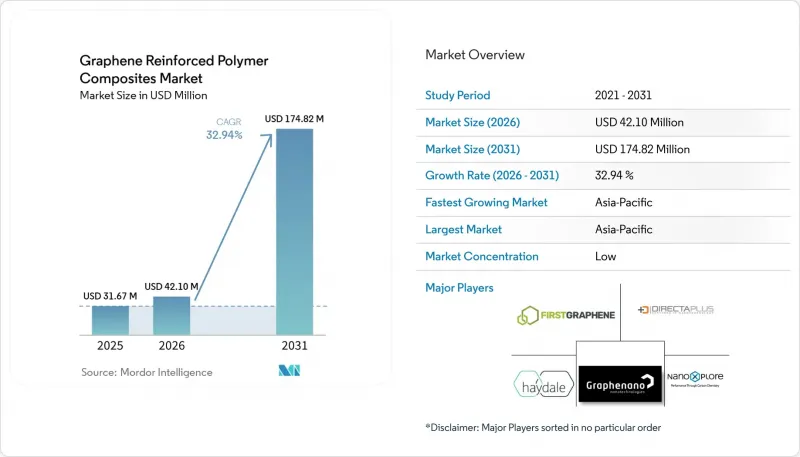
據 Mordor Intelligence 稱,2025 年石墨烯增強聚合物複合材料的市場規模為 3,167 萬美元,預計到 2031 年將達到 1.7482 億美元,而 2026 年為 4,210 萬美元,預測期(2026-2031 年)的複合成長率為 32.94%。
全球石墨烯增強聚合物複合材料市場趨勢及洞察
汽車和儲能領域的電氣化和溫度控管
抑制熱失控是電動車製造商面臨的關鍵材料挑戰。石墨烯增強聚合物複合材料有助於實現更輕的電池機殼、熱響應隔膜和導電塗層,從而幫助控制整個電池陣列的溫度。 2026 年的一項研究表明,一種石墨烯基阻燃材料在 140 度C左右的溫度下,其導熱係數在 20 秒內從 1.23 W m⁻¹K⁻¹ 降至 0.11 W m⁻¹K⁻¹ 的隔熱性能。這結果抑制了鎳錳鋰離子電池模組中的熱擴散,限制了熱失控的蔓延。 2026 年 5 月,NANOXPLORE 推出了用於儲能、導電複合材料和先進電子裝置的「xGnP D500-HP」產品,並在發布之初就獲得了亞洲客戶的商業展示。在固定式儲能系統中,日益嚴格的溫度限制和有限的維護條件,促使人們需要能夠在單一組件中執行多種功能的材料。
對輕量化設計和多功能性能的要求
輕量化是汽車、航太和攜帶式電子設備應用中的設計要求。在低填料含量下,石墨烯可以在不顯著增加密度的情況下提高強度、阻隔性能和加工性能。 2026年的一項綜述發現,用於汽車和航太零件的石墨烯增強碳纖維複合材料的拉伸強度和楊氏模數有顯著提高。該篇綜述也指出,閃速焦耳加熱是一種將廢棄複合材料轉化為紊層石墨烯的潛在方法。一項關於超高分子量聚乙烯奈米複合材料的研究證實,添加10 wt%的石墨烯奈米微片可使拉伸模量增加61%,儲能模量增加72%。因此,隨著最初檢驗次級結構的部件逐漸應用於對結構要求更為嚴格的領域,石墨烯增強聚合物複合材料市場有望從中受益。
功能化石墨烯原料高成本且品質不穩定
功能化石墨烯需經過表面改質以確保與特定聚合物系統的相容性,因此其價格比傳統的導電填料(例如炭黑)高出10到100倍。即使乾法剝離技術不斷擴展,這種價格差異依然存在。美國專利號12,454,459指出,現有的製造方法是多步驟工藝,可能需要使用有毒化學品,並且可能無法在商業性可行的濃度下獲得可重複的機械性能提升。氧化態、片層尺寸、層數和表面官能基的差異會導致使用不同批次產品時,經認證的複合材料的性能有所不同。原始設備製造商(OEM)要求每個批次的原料都必須提供符合國際標準化組織(ISO)規範的分析證明。因此,如果供應商無法證明其擁有可靠的品管,石墨烯增強聚合物複合材料市場將面臨核准延遲的問題。
細分市場分析
截至2025年,熱塑性塑膠佔聚合物基材的44.75%,這反映了其與標準生產設備的兼容性。預計到2031年,熱塑性塑膠的複合年成長率將達到34.34%。使用顆粒狀母料使得製造商無需大量資本投資和生產線改造,即可將石墨烯添加到現有生產線中。一項針對熱塑性聚氨酯奈米複合材料的細分市場研究(2026年開展)發現,添加0.5 wt%的氧化石墨烯可使拉伸強度達到30.4 MPa,斷裂伸長率達800%。
熱塑性樹脂廣泛應用於消費品包裝、汽車內裝、電纜護套和軟性電子產品基板等領域。其可回收性也滿足了採購部門對產品生命週期管理日益重視的要求。熱固性樹脂在航太結構、耐腐蝕工業塗料和電子封裝中繼續發揮至關重要的作用。這些材料固化週期長,即使在持續載荷和高溫下也能保持尺寸穩定性。石墨烯增強聚合物複合複合材料產業受益於這兩類材料,因為它們各自滿足不同的加工和性能要求。
區域分析
預計到2025年,亞太地區將佔全球石墨烯增強聚合物複合複合材料市場規模的32.56%,並將在2031年之前以35.16%的複合年成長率持續成長。在該地區,石墨烯生產、複合材料配方和最終產品製造已在緊密聯繫的產業群中整合。在中國,生產活動主要集中在Delta、Delta和川渝工業區。根據新華社2025年3月報道,石墨烯-銅複合材料已在電觸點、電動車充電槍、變壓器以及電線電纜系統等領域實現了工業級實用化。在韓國,有機發光二極體(OLED)組件、半導體封裝和電力電子領域的需求推動了市場成長;而在日本,石墨烯增強熱塑性塑膠正被評估用於機器人和分析儀器領域。
預計到2025年,北美將憑藉美國和加拿大航太、舉措和汽車行業的認證項目,佔據石墨烯增強聚合物複合材料市場的重要佔有率。 NANOXPLORE和VoltaXplore將於2026年9月在加拿大國防無人機計畫市場獲得石墨烯增強複合材料零件和21700鋰離子電池的認證。 NANOXPLORE的乾式剝離平台設計年產能為500至1000公噸,具體產能取決於等級。該平台鞏固了加拿大作為粉末和母料產品供應中心的地位。在墨西哥,由於汽車製造商採用了德國和日本目的地設備製造商(OEM)研究中心製定的規範,市場需求正在進一步成長。
在歐洲,輕量化和塗層領域的研究網路、受監管的終端應用領域以及產業項目正在為市場提供支援。歐盟委員會的GIANCE計畫正在開發11種基於石墨烯的多功能複合材料和塗層,用於汽車、航太、能源和水處理等領域。可回收性和生命週期永續性是其開發要求的重要組成部分。南美洲、中東和非洲仍處於起步階段,但巴西、阿根廷、沙烏地阿拉伯和南非正透過製造、研究和先進材料項目形成需求基礎。
其他好處:
- Excel格式的市場預測(ME)表
- 3個月的分析師支持
目錄
第1章:引言
- 研究假設和市場定義
- 調查範圍
第2章:調查方法
第3章執行摘要
第4章 市場狀況
- 市場概覽
- 市場促進因素
- 對輕量化設計和多功能性能的要求
- 汽車和儲能領域的電氣化和溫度控管
- 對導電、耐腐蝕及電磁干擾屏蔽塗層的需求
- 軟性電子產品、穿戴式裝置和印刷元件的擴展。
- 低濃度石墨烯分散液和母料的商業化
- 市場限制因素
- 功能化石墨烯原料高成本且品質不穩定
- 分散、界面耦合和規模化的複雜性。
- 缺乏認證週期和長期實地數據
- 價值鏈分析
- 波特五力分析
第5章 市場規模與成長預測
- 通過聚合物基質
- 熱塑性塑膠
- 熱固性
- 按類型分類的加固材料
- 氧化石墨烯
- 還原氧化石墨烯
- 原始石墨烯
- 其他增強材料
- 透過使用
- 電子元件
- 油漆和塗料
- 電池
- 太陽能板
- 其他用途
- 按地區
- 亞太地區
- 中國
- 印度
- 日本
- 韓國
- 東南亞國協
- 其他亞太國家
- 北美洲
- 美國
- 加拿大
- 墨西哥
- 歐洲
- 德國
- 英國
- 法國
- 義大利
- 北歐國家
- 其他歐洲國家
- 南美洲
- 巴西
- 阿根廷
- 其他南美國家
- 中東和非洲
- 沙烏地阿拉伯
- 南非
- 其他中東和非洲國家
- 亞太地區
第6章 競爭情勢
- 市場集中度
- 策略趨勢
- 市佔率和排名分析
- 公司簡介
- Asbury Advanced Materials
- Cabot Corporation
- Directa Plus SpA
- First Graphene
- G6 Materials Corp.
- Graphenea
- Graphmatech AB
- Grupo Graphenano
- HAYDALE PLC
- Levidian Nanosystems Limited
- NANOXPLORE
- The Sixth Element(Changzhou)Materials Technology Co., Ltd.
- Thomas Swan & Co. Ltd.
- Versarien
- Vorbeck Materials
第7章 市場機會與未來展望
According to Mordor Intelligence, the graphene reinforced polymer composites market size was valued at USD 31.67 million in 2025 and is estimated to grow from USD 42.10 million in 2026 to reach USD 174.82 million by 2031, at a CAGR of 32.94% during the forecast period (2026-2031).
Global Graphene Reinforced Polymer Composites Market Trends and Insights
Electrification and Thermal Management in Vehicles and Energy Storage
Thermal runaway mitigation has become an important materials issue for electric vehicle manufacturers. Graphene reinforced polymer composites can support lighter battery enclosures, thermally switchable separators, and conductive coatings that help manage temperature across cell arrays. A 2026 study reported a graphene-based flame-retardant material that changed from thermally conductive at 1.23 W m-1 K-1 to insulating at 0.11 W m-1 K-1 within 20 seconds near 140 °C. The result reduced heat diffusion and limited thermal runaway propagation in nickel-manganese lithium-ion battery modules. NANOXPLORE launched xGnP D500-HP in May 2026 for energy storage, conductive composites, and advanced electronics, with commercial validation from an Asian customer secured at launch. In stationary storage, tighter temperature limits and limited maintenance access strengthen the case for materials that deliver several functions in one component.
Lightweighting and Multifunctional Performance Requirements
Weight reduction is a design requirement in automotive, aerospace, and portable electronics applications. At low loading levels, graphene can improve strength, barrier performance, and processing behavior without a comparable increase in density. A 2026 review found measurable gains in tensile strength and Young's modulus in graphene reinforced carbon fiber composites used for automotive and aerospace components. The review also identified flash Joule heating as a potential route for converting waste composites into turbostratic graphene. Research on ultrahigh molecular weight polyethylene nanocomposites recorded a 61% rise in tensile modulus and a 72% rise in storage modulus at 10 wt% graphene nanoplatelet content. The graphene reinforced polymer composites market can therefore benefit as components first validated for secondary structures move into applications with more demanding structural requirements.
High Cost and Inconsistent Quality of Functionalized Graphene Inputs
Functionalized graphene is surface-modified for compatibility with specific polymer systems and carries a premium of 10x to 100x over conventional conductive fillers such as carbon black. This difference remains even as dry-exfoliation capacity expands. U.S. Patent 12,454,459 describes existing production methods as multistep processes that can require toxic chemicals and may not provide repeatable mechanical gains at commercially relevant concentrations. Differences in oxidation state, flake size, layer count, and surface functional groups can cause a qualified composite to behave differently when a later production lot is used. Original equipment manufacturers require certificates of analysis aligned with International Organization for Standardization specifications for each input lot. The graphene reinforced polymer composites market is consequently affected by approval delays when suppliers cannot demonstrate reliable quality controls.
Other drivers and restraints analyzed in the detailed report include:
- Demand for Conductive, Anti-Corrosion and EMI-Shielding Coatings
- Low-Loading Graphene Dispersion and Masterbatch Commercialization
- Dispersion, Interfacial Bonding and Scale-Up Complexity
For complete list of drivers and restraints, kindly check the Table Of Contents.
Segment Analysis
Thermoplastics held 44.75% of the polymer matrix segment in 2025, reflecting compatibility with standard manufacturing equipment. Thermoplastics are projected to advance at a 34.34% CAGR through 2031. Pelletized masterbatches allow manufacturers to add graphene to established production lines without capital-intensive retooling. A 2026 study of segmented thermoplastic polyurethane nanocomposites found that 0.5 wt% graphene oxide achieved tensile strength of 30.4 MPa and elongation at break of 800%.
Thermoplastics support applications in consumer packaging, automotive interiors, cable jacketing, and flexible electronics substrates. Their recyclability also supports procurement requirements that give greater weight to product lifecycle considerations. Thermosets retain a role in aerospace structures, corrosion-resistant industrial coatings, and electronics encapsulants. These materials provide dimensional stability under sustained load and elevated temperatures, although their cure cycles are longer. The graphene reinforced polymer composites industry benefits from both material classes because they serve different processing and performance requirements.
Complete Report Scope:
- By Polymer Matrix
- Thermoplastics
- Thermosets
- By Reinforcement Material
- Graphene Oxide
- Reduced Graphene Oxide
- Pristine Graphene
- Other Reinforcement Materials
- By Application
- Electronic Components
- Paints and Coatings
- Batteries
- Solar Panels
- Other Applications
- By Geography
- Asia-Pacific
- China
- India
- Japan
- South Korea
- ASEAN Countries
- Rest of Asia-Pacific
- North America
- United States
- Canada
- Mexico
- Europe
- Germany
- United Kingdom
- France
- Italy
- NORDIC Countries
- Rest of Europe
- South America
- Brazil
- Argentina
- Rest of South America
- Middle East and Africa
- Saudi Arabia
- South Africa
- Rest of Middle East and Africa
- Asia-Pacific
Geography Analysis
Asia-Pacific held 32.56% of the graphene reinforced polymer composites market size in 2025 and is projected to advance at a 35.16% CAGR through 2031. The region integrates graphene production, composite compounding, and end-product manufacturing in closely connected clusters. China has production activity in the Yangtze River Delta, Pearl River Delta, and Sichuan-Chongqing industrial zones. A March 2025 Xinhua report stated that graphene-copper composites reached industrial deployment in electrical contacts, electric vehicle charging guns, transformers, and wire and cable systems. South Korea supports demand from organic light-emitting diode components, semiconductor packaging, and power electronics, while Japan is evaluating graphene reinforced thermoplastics for robotics and analytical instruments.
North America held a significant share of the graphene reinforced polymer composites market in 2025 through aerospace, defense, and automotive qualification programs in the United States and Canada. NANOXPLORE and VoltaXplore qualified in September 2026 under Canada's Defence Drone Initiative Marketplace for graphene-enhanced composite components and lithium-ion 21700 battery cells. NANOXPLORE's dry-exfoliation platform was designed for an annual output of 500 to 1,000 metric tons, depending on grade. The platform supports Canada's role as a supply base for powder and masterbatch products. Mexico adds demand because automotive production uses specifications developed by original equipment manufacturer research centers in Germany and Japan.
Europe is supported by research networks, regulated end-use sectors, and industrial programs for lightweighting and coatings. The European Commission's GIANCE project is developing 11 graphene-based multifunctional composite and coating products for automotive, aerospace, energy, and water treatment applications. Recyclability and lifecycle sustainability are built into its development requirements. South America and Middle East and Africa remain at an early stage, with Brazil, Argentina, Saudi Arabia, and South Africa providing demand foundations through manufacturing, research, and advanced materials programs.
- Asbury Advanced Materials
- Cabot Corporation
- Directa Plus S.p.A.
- First Graphene
- G6 Materials Corp.
- Graphenea
- Graphmatech AB
- Grupo Graphenano
- HAYDALE PLC
- Levidian Nanosystems Limited
- NANOXPLORE
- The Sixth Element (Changzhou) Materials Technology Co., Ltd.
- Thomas Swan & Co. Ltd.
- Versarien
- Vorbeck Materials
Additional Benefits:
- The market estimate (ME) sheet in Excel format
- 3 months of analyst support
TABLE OF CONTENTS
1 Introduction
- 1.1 Study Assumptions and Market Definition
- 1.2 Scope of the Study
2 Research Methodology
3 Executive Summary
4 Market Landscape
- 4.1 Market Overview
- 4.2 Market Drivers
- 4.2.1 Lightweighting and Multifunctional Performance Requirements
- 4.2.2 Electrification and Thermal Management in Vehicles and Energy Storage
- 4.2.3 Demand for Conductive, Anti-Corrosion and EMI-Shielding Coatings
- 4.2.4 Expansion of Flexible Electronics, Wearables and Printed Components
- 4.2.5 Low-Loading Graphene Dispersion and Masterbatch Commercialization
- 4.3 Market Restraints
- 4.3.1 High Cost and Inconsistent Quality of Functionalized Graphene Inputs
- 4.3.2 Dispersion, Interfacial Bonding and Scale-Up Complexity
- 4.3.3 Qualification Cycles and Limited Long-Term Field Data
- 4.4 Value Chain Analysis
- 4.5 Porter's Five Forces Analysis
- 4.5.1 Threat of New Entrants
- 4.5.2 Bargaining Power of Suppliers
- 4.5.3 Bargaining Power of Buyers
- 4.5.4 Threat of Substitutes
- 4.5.5 Competitive Rivalry
5 Market Size and Growth Forecasts (Value)
- 5.1 By Polymer Matrix
- 5.1.1 Thermoplastics
- 5.1.2 Thermosets
- 5.2 By Reinforcement Material
- 5.2.1 Graphene Oxide
- 5.2.2 Reduced Graphene Oxide
- 5.2.3 Pristine Graphene
- 5.2.4 Other Reinforcement Materials
- 5.3 By Application
- 5.3.1 Electronic Components
- 5.3.2 Paints and Coatings
- 5.3.3 Batteries
- 5.3.4 Solar Panels
- 5.3.5 Other Applications
- 5.4 By Geography
- 5.4.1 Asia-Pacific
- 5.4.1.1 China
- 5.4.1.2 India
- 5.4.1.3 Japan
- 5.4.1.4 South Korea
- 5.4.1.5 ASEAN Countries
- 5.4.1.6 Rest of Asia-Pacific
- 5.4.2 North America
- 5.4.2.1 United States
- 5.4.2.2 Canada
- 5.4.2.3 Mexico
- 5.4.3 Europe
- 5.4.3.1 Germany
- 5.4.3.2 United Kingdom
- 5.4.3.3 France
- 5.4.3.4 Italy
- 5.4.3.5 NORDIC Countries
- 5.4.3.6 Rest of Europe
- 5.4.4 South America
- 5.4.4.1 Brazil
- 5.4.4.2 Argentina
- 5.4.4.3 Rest of South America
- 5.4.5 Middle East and Africa
- 5.4.5.1 Saudi Arabia
- 5.4.5.2 South Africa
- 5.4.5.3 Rest of Middle East and Africa
- 5.4.1 Asia-Pacific
6 Competitive Landscape
- 6.1 Market Concentration
- 6.2 Strategic Moves
- 6.3 Market Share (%)/Ranking Analysis
- 6.4 Company Profiles (includes Global Overview, Market Overview, Core Segments, Financials as available, Strategic Information, Products and Services, and Recent Developments)
- 6.4.1 Asbury Advanced Materials
- 6.4.2 Cabot Corporation
- 6.4.3 Directa Plus S.p.A.
- 6.4.4 First Graphene
- 6.4.5 G6 Materials Corp.
- 6.4.6 Graphenea
- 6.4.7 Graphmatech AB
- 6.4.8 Grupo Graphenano
- 6.4.9 HAYDALE PLC
- 6.4.10 Levidian Nanosystems Limited
- 6.4.11 NANOXPLORE
- 6.4.12 The Sixth Element (Changzhou) Materials Technology Co., Ltd.
- 6.4.13 Thomas Swan & Co. Ltd.
- 6.4.14 Versarien
- 6.4.15 Vorbeck Materials
7 Market Opportunities and Future Outlook
- 7.1 White-Space and Unmet-Need Assessment

 石墨烯-銅複合材料市場:全球市場預測,2026-2032年
 MXene 與新型2D過渡金屬碳化物市場預測至 2034 年-按材料類型、結構與成分、應用、最終使用者和地區分類的全球分析石墨烯增強複合材料市場:預測(至2034年)-全球分析(依複合材料基體類型、石墨烯材料類型、製造流程、性能增強、技術、應用、終端用戶產業和地區分類)石墨烯複合材料市場預測(2034 年)—全球分析(按複合材料類型、石墨烯類型、基體材料、製造流程、功能、應用、終端用戶產業、銷售管道和地區分類)
 石墨烯複合材料市場報告:按產品類型、應用和地區分類(2026-2034年)
 石墨烯增強塑膠市場規模、佔有率和趨勢分析報告:按聚合物、最終用途、地區和細分市場分類(2026-2033 年)石墨烯複合材料市場:依形態、製造流程、等級、應用和最終用途產業分類-2026-2032年全球預測石墨烯結構層壓板市場預測至2032年:按產品類型、製造流程、應用、最終用戶和地區分類的全球分析全球石墨烯增強材料市場:預測至2032年-按產品類型、形態、應用、最終用戶和地區分類的分析
 石墨烯增強聚合物複合材料的全球市場