


 |
市場調查報告書
商品編碼
2163440
電池用銅箔:市場佔有率分析、行業趨勢和統計數據、成長預測(2026-2031)Copper Foil For Battery - Market Share Analysis, Industry Trends & Statistics, Growth Forecasts (2026 - 2031) |
||||||

※ 本網頁內容可能與最新版本有所差異。詳細情況請與我們聯繫。
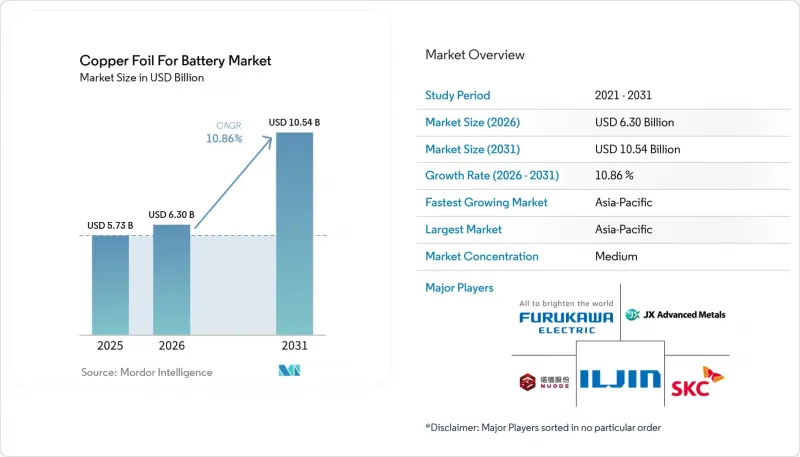
據 Mordor Intelligence 稱,電池用銅箔的市場規模預計在 2025 年為 57.3 億美元,從 2026 年的 63 億美元成長到 2031 年的 105.4 億美元,在預測期(2026-2031 年)內的複合年成長率為 10.86%。
全球電池銅箔市場趨勢與洞察
加快電動汽車電池的生產
電動汽車電池的生產仍然是電池用銅箔市場的主要驅動力。預計到2026年,全球鋰離子電池單體產量將達到3400吉瓦時(GWh),每吉瓦時需要1000至1400噸電池級銅箔。隨著電池產量的擴大,對穩定供應銅箔的需求也不斷成長,因為沒有合格的集集電器材料,負極製造就無法進行。大型圓柱形電池對尺寸公差和抗張強度的要求比許多現有產品更高,因此採購趨勢正從通用材料轉向先進的電解級材料。 LG能源解決方案公司計劃在2026年底,在北美五家工廠實現超過50吉瓦時的磷酸鋰鐵(LFP)電池產能,這表明對電池的投資如何能夠滿足當地的認證標準,並為銅箔供應商建立穩定的供應管道。
電網級和固定式儲能設施的擴展
固定式儲能系統 (FSS) 是電池市場對銅箔的重要需求來源。與可再生能源發電部署的電網級電池需要銅集流體,類似汽車電池。 2019 年至 2025 年間,美國電池型能源儲存系統的部署量增加了 25 倍。預計到 2026 年,全球能源儲存系統領域的銅消耗量將達到 54 萬噸,年增 80%。這些應用通常使用磷酸鐵鋰 (LFP) 電池和 8-10 微米厚的銅箔,部分電動車電池則使用 6 微米厚的銅箔,從而支撐了對主流銅箔的需求。這種需求趨勢可能會部分抵消電動車用銅箔訂單的下滑。
陰極銅價格波動
電解銅箔的陰極成本佔製造成本的60%至80%。這種成本結構使得電解銅箔生產商極易受到金屬價格波動的影響,除非合約條款能夠將成本上漲完全轉嫁給電池製造商。 2025年1月至2026年4月期間,銅價上漲了三分之一,創下歷史新高,而2026年的冶煉加工費則為每噸0美元。這種情況顯示上游精礦供應趨緊,這可能會提高陰極採購成本的下限。到2026年6月,標準6μm銅箔的加工費已降至每噸19,500元人民幣,使得生產商應對不斷上漲的原料成本的空間有限。這種壓力可能會影響整個電池用銅箔市場的盈利,尤其對專注於標準等級銅箔的製造商而言,情況更為嚴峻。
細分市場分析
到2025年,電解銅箔將佔電池用銅箔市場總需求的58.31%,預計到2031年將以11.45%的複合年成長率成長。電解是目前主流的製造方法,因為它能夠大規模生產薄壁材料。此製程透過控制電流密度和電解成分,可以生產厚度小於6微米的銅箔。這種能力對於負極集電器至關重要。銅箔厚度均勻,方便電池製造商順利進行塗覆和組裝。根據2025年的一項研究,電解生產的超薄銅箔兼具高強度和高延展性,推動了電解材料在更薄電池設計中的應用。
預計到2026年,中國電解銅箔產能將達到207萬噸,這清楚地表明了該製造方法在供應鏈中的核心地位。投資趨勢顯示,能夠開發超薄和HVLP(高電壓低電流)材料的製造商與供應通用6μm銅箔的製造商之間存在明顯的兩極化。軋製銅箔仍然十分重要,因為在需要反覆彎曲的應用中,它需要更高的抗彎曲疲勞性能。 JX Advanced Metals提供厚度從9μm到150μm的加工軋製銅箔,包括專為汽車和電信應用設計的等級。其他類型的銅箔,例如在聚合物薄膜上塗覆薄銅層的複合集電器,仍處於商業化的早期階段。這些材料正在固態電池和矽負極的設計中進行評估,其潛在優勢包括減輕重量和改善熱失控性能。
區域分析
預計到2025年,亞太地區將佔全球總需求的56.27%,並將在2031年之前以12.23%的複合年成長率成長。中國是該地區最大的生產基地,而韓國和日本在高階產品領域也佔有重要地位。中國4.5μm超薄電解箔的產量佔有率將從2025年的25%上升到2026年的50%。這表明,儘管標準等級電解箔的產能仍然很高,但中國製造商正在轉向生產更高規格的材料。由於電動車需求疲軟,韓國供應商正加大對儲能和高頻電路用電解箔的投入。日本在高容量低厚度(HVLP)電解箔和其他高階電解箔領域繼續保持重要地位,這些領域的製程控制和產品性能至關重要。
在電池銅箔市場,北美正崛起為新的生產和需求中心,這主要受在地採購需求的驅動。 《通貨膨脹控制法案》規定,到2029年,所有電池組件必須從北美採購,以獲得全額消費者稅額扣抵。日本電開公司(Nihon Denkai)獲得了1.5億美元的投資,將於2025年在其位於喬治喬治亞的工廠開始大規模生產,年產能為9500噸電動車電池銅箔。加拿大伏特能源解決方案公司(Volta Energy Solutions Canada)計畫於2026年下半年在魁北克省投產,年產能為2.5萬噸。墨西哥在電動車組裝日益重要的地位,也帶動了對符合區域標準的材料的需求。預計這些趨勢將在未來降低該地區的進口依賴度,同時也將為供應商創造新的認證機會。
在電池銅箔市場,歐洲的需求與德國、匈牙利和北歐國家超級工廠的發展密切相關。該地區的電池銅箔供應集中度高於需求集中度。 Solus Advanced Materials 在匈牙利營運電池銅箔製造廠。歐盟電池法規要求揭露碳足跡並進行供應鏈實質審查,凸顯了記錄生產條件的重要性。這些要求有利於能夠證明其生產過程低碳且可追溯的供應商。南美、中東和非洲的需求仍處於早期階段,生產主要與電動車計畫和儲能先導計畫相關。巴西的可再生能源整合計畫和沙烏地阿拉伯的「2030願景」在儲能相關需求方面具有長期潛力。
其他好處:
- Excel格式的市場預測(ME)表
- 3個月的分析師支持
目錄
第1章:引言
- 研究假設和市場定義
- 調查範圍
第2章:調查方法
第3章執行摘要
第4章 市場狀況
- 市場概覽
- 市場促進因素
- 加快電動汽車電池的生產
- 電網級和固定式儲能設施的擴展
- 對超薄箔材日益成長的需求可望提高電池的能量密度。
- 電池製造本地化和供應鏈多元化
- 固態電池的商業化
- 市場限制因素
- 陰極銅價格波動
- 可能出現供應過剩和運轉率。
- 鈦電鑄鼓和特殊化學品的供應受限
- 價值鏈分析
- 波特五力分析
第5章 市場規模與成長預測
- 按類型
- 卷銅箔
- 電解銅箔
- 其他類型的銅箔
- 透過使用
- 鋰離子電池
- 全固態電池
- 鎳氫電池
- 其他電池應用
- 按最終用戶行業分類
- 電動車
- 家用電子產品
- 能源儲存系統
- 工業應用
- 其他電池應用
- 按地區
- 亞太地區
- 中國
- 印度
- 日本
- 韓國
- 東南亞國協
- 其他亞太國家
- 北美洲
- 美國
- 加拿大
- 墨西哥
- 歐洲
- 德國
- 英國
- 法國
- 義大利
- 北歐國家
- 其他歐洲國家
- 南美洲
- 巴西
- 阿根廷
- 其他南美國家
- 中東和非洲
- 沙烏地阿拉伯
- 南非
- 其他中東和非洲國家
- 亞太地區
第6章 競爭情勢
- 市場集中度
- 策略趨勢
- 市佔率和排名分析
- 公司簡介
- Anhui Tongguan Copper Foil Co., Ltd.
- Chang Chun Group
- Doosan Corporation Electro-Materials
- FURUKAWA ELECTRIC CO., LTD.
- Guangdong Chaohua Technology Co., Ltd.
- Guangdong Jia Yuan Technology Co., Ltd.
- ILJIN co., ltd.
- Jiujiang Defu Technology
- JX Advanced Metals Corporation
- Londian Wason(Shenzhen)Holdings Group Co., Ltd.
- LOTTE ENERGY MATERIALS Corporation
- Nippon Denkai, Ltd.
- Nuode Investment Co., Ltd.
- SKC
- Solus Advanced Materials
第7章 市場機會與未來展望
According to Mordor Intelligence, the copper foil for battery market size was valued at USD 5.73 billion in 2025 and is estimated to grow from USD 6.30 billion in 2026 to USD 10.54 billion by 2031, at a CAGR of 10.86% during the forecast period (2026-2031).
Global Copper Foil For Battery Market Trends and Insights
Accelerating Electric Vehicle Battery Production
Electric vehicle battery production remains the primary driver for the copper foil for battery market. Global lithium-ion cell production is estimated at 3,400 GWh in 2026, and each GWh requires 1,000 to 1,400 tons of battery-grade foil. Growth in cell production increases the need for a reliable supply of foil, as anode production cannot proceed without a qualified current-collector material. Large-format cylindrical cells require tighter dimensional tolerances and higher tensile strength than many established products, shifting purchasing toward advanced electrolytic grades rather than commodity material. LG Energy Solution is targeting more than 50 GWh of Lithium Iron Phosphate (LFP) cell capacity across five North American facilities by the end of 2026, demonstrating how cell investments can establish local qualification and pipelines for foil suppliers.
Expansion of Grid-Scale and Stationary Energy Storage
Stationary storage is an independent source of demand for copper foil in the battery market. Grid-scale batteries are deployed alongside renewable generation and require the same copper current-collector function as vehicle batteries. Battery energy storage deployment in the United States increased 25-fold between 2019 and 2025. Global copper consumption in the energy storage system sector reached 540,000 metric tons in 2026, up 80% from the prior year. These applications commonly use LFP chemistry and 8-10 μm copper foil, supporting demand for mainstream grades, even as some electric vehicle cells use 6 μm foil. This demand stream can partially offset softness in electric-vehicle foil orders.
Copper Cathode Price Volatility
Copper cathode accounts for 60% to 80% of the cost of producing electrolytic foil. This cost structure makes foil producers sensitive to changes in metal prices when contract terms do not fully pass cost increases on to battery makers. Copper prices rose by one-third between January 2025 and April 2026, reaching record highs, while 2026 smelter treatment charges settled at USD 0 per ton. These conditions indicate tightness in upstream concentrate supply and can raise the cost floor for cathode purchases. Standard 6 μm foil processing fees had fallen to CNY 19,500 per ton by June 2026, limiting producers' ability to absorb increases in input costs. This pressure can constrain profitability across the copper foil for battery market, particularly for producers concentrated in standard grades.
Other drivers and restraints analyzed in the detailed report include:
- Demand for Ultra-Thin Foil to Increase Cell Energy Density
- Battery-Manufacturing Localization and Supply-Chain Diversification
- Potential Oversupply and Utilization Pressure
For complete list of drivers and restraints, kindly check the Table Of Contents.
Segment Analysis
Electrolytic foil held 58.31% of the total demand in the copper foil for battery market in 2025 and is expected to grow at an 11.45% CAGR through 2031. It is the dominant production method because electrodeposition can deliver thin material at a production scale. The process uses controlled current density and electrolyte chemistry to produce foil with a thickness below 6 μm. This capability is important for anode current collectors, where consistent foil thickness helps cell manufacturers manage coating and assembly. A 2025 study found that electrodeposited ultra-thin foil can combine high strength with ductility, supporting the use of electrolytic material in thinner battery designs.
China's 2.07 million tons of electrolytic capacity in 2026 underscores the method's central position in the supply chain. Investment patterns are separating producers that can develop ultra-thin and HVLP material from those supplying commodity 6 μm foil. Rolled foil remains important in applications where repeated bending requires greater flex-fatigue resistance. JX Advanced Metals offers treated rolled copper foil in thicknesses from 9 μm to 150 μm, including grades designed for automotive and communications applications. Other types, including composite current collectors that place thin copper on polymer films, remain at an early commercial stage. These materials are being evaluated for solid-state and silicon-anode designs, where their lower weight and improved thermal runaway behavior offer potential advantages.
Complete Report Scope:
- By Type
- Rolled Copper Foil
- Electrolytic Copper Foil
- Other Copper Foil Types
- By Application
- Lithium-Ion Batteries
- Solid-State Batteries
- Nickel-Metal Hydride Batteries
- Other Battery Applications
- By End-User Industry
- Electric Vehicles
- Consumer Electronics
- Energy Storage Systems
- Industrial Applications
- Other Battery End Uses
- By Geography
- Asia-Pacific
- China
- India
- Japan
- South Korea
- ASEAN Countries
- Rest of Asia-Pacific
- North America
- United States
- Canada
- Mexico
- Europe
- Germany
- United Kingdom
- France
- Italy
- NORDIC Countries
- Rest of Europe
- South America
- Brazil
- Argentina
- Rest of South America
- Middle East and Africa
- Saudi Arabia
- South Africa
- Rest of Middle East and Africa
- Asia-Pacific
Geography Analysis
Asia-Pacific held 56.27% of total demand in 2025 and is forecast to grow at a 12.23% CAGR through 2031. China provides the region's largest production base, while South Korea and Japan retain important positions in advanced products. China's share of 4.5 μm ultra-thin electrolytic foil output rose from 25% in 2025 to 50% in 2026, indicating that Chinese producers are moving toward higher-specification material even as standard-grade capacity remains high. South Korean suppliers are increasing their focus on energy storage and high-frequency circuit foil following weakness in electric vehicle demand. Japan remains important in High Volume Low Profile (HVLP) and other premium foil categories where process control and product performance are critical.
Within the copper foil for battery market, North America is emerging as a new production and demand center driven by local-content requirements. The Inflation Reduction Act requires 100% North American sourcing of battery components by 2029 to qualify for the full consumer tax credit. Nippon Denkai began mass production at its Augusta, Georgia, facility in 2025, with an annual electric-vehicle battery copper foil capacity of 9,500 metric tons, supported by a USD 150 million investment. Volta Energy Solutions Canada is set to begin production of 25,000 tons per year in Quebec during the second half of 2026. Mexico's growing role in electric vehicle assembly supports demand for regionally qualified materials. These developments are expected to reduce the region's dependence on imports over time while creating new qualification opportunities for suppliers.
Within the copper foil for battery market, demand in Europe is linked to gigafactory development in Germany, Hungary, and the Nordic countries. The region's battery-grade foil supply is more concentrated than its demand base. Solus Advanced Materials operates a battery-grade copper foil facility in Hungary. The EU Battery Regulation requires carbon footprint declarations and supply chain due diligence, underscoring the importance of documented manufacturing conditions. These obligations favor suppliers that can demonstrate lower-carbon and traceable production. South America, the Middle East, and Africa remain early-stage demand areas, with output connected to electric vehicle programs and pilot energy storage projects. Brazil's renewable energy integration plans and Saudi Arabia's Vision 2030 agenda offer longer-term potential for storage-related demand.
- Anhui Tongguan Copper Foil Co., Ltd.
- Chang Chun Group
- Doosan Corporation Electro-Materials
- FURUKAWA ELECTRIC CO., LTD.
- Guangdong Chaohua Technology Co., Ltd.
- Guangdong Jia Yuan Technology Co., Ltd.
- ILJIN co., ltd.
- Jiujiang Defu Technology
- JX Advanced Metals Corporation
- Londian Wason (Shenzhen) Holdings Group Co., Ltd.
- LOTTE ENERGY MATERIALS Corporation
- Nippon Denkai, Ltd.
- Nuode Investment Co., Ltd.
- SKC
- Solus Advanced Materials
Additional Benefits:
- The market estimate (ME) sheet in Excel format
- 3 months of analyst support
TABLE OF CONTENTS
1 Introduction
- 1.1 Study Assumptions and Market Definition
- 1.2 Scope of the Study
2 Research Methodology
3 Executive Summary
4 Market Landscape
- 4.1 Market Overview
- 4.2 Market Drivers
- 4.2.1 Accelerating Electric Vehicle Battery Production
- 4.2.2 Expansion of Grid-Scale and Stationary Energy Storage
- 4.2.3 Demand for Ultra-Thin Foil to Increase Cell Energy Density
- 4.2.4 Battery-Manufacturing Localization and Supply-Chain Diversification
- 4.2.5 Solid-State Battery Commercialization
- 4.3 Market Restraints
- 4.3.1 Copper Cathode Price Volatility
- 4.3.2 Potential Oversupply and Utilization Pressure
- 4.3.3 Titanium Electroforming-Drum and Specialty Chemical Bottlenecks
- 4.4 Value Chain Analysis
- 4.5 Porter's Five Forces Analysis
- 4.5.1 Bargaining Power of Suppliers
- 4.5.2 Bargaining Power of Buyers
- 4.5.3 Threat of New Entrants
- 4.5.4 Threat of Substitutes
- 4.5.5 Competitive Rivalry
5 Market Size and Growth Forecasts (Value)
- 5.1 By Type
- 5.1.1 Rolled Copper Foil
- 5.1.2 Electrolytic Copper Foil
- 5.1.3 Other Copper Foil Types
- 5.2 By Application
- 5.2.1 Lithium-Ion Batteries
- 5.2.2 Solid-State Batteries
- 5.2.3 Nickel-Metal Hydride Batteries
- 5.2.4 Other Battery Applications
- 5.3 By End-User Industry
- 5.3.1 Electric Vehicles
- 5.3.2 Consumer Electronics
- 5.3.3 Energy Storage Systems
- 5.3.4 Industrial Applications
- 5.3.5 Other Battery End Uses
- 5.4 By Geography
- 5.4.1 Asia-Pacific
- 5.4.1.1 China
- 5.4.1.2 India
- 5.4.1.3 Japan
- 5.4.1.4 South Korea
- 5.4.1.5 ASEAN Countries
- 5.4.1.6 Rest of Asia-Pacific
- 5.4.2 North America
- 5.4.2.1 United States
- 5.4.2.2 Canada
- 5.4.2.3 Mexico
- 5.4.3 Europe
- 5.4.3.1 Germany
- 5.4.3.2 United Kingdom
- 5.4.3.3 France
- 5.4.3.4 Italy
- 5.4.3.5 NORDIC Countries
- 5.4.3.6 Rest of Europe
- 5.4.4 South America
- 5.4.4.1 Brazil
- 5.4.4.2 Argentina
- 5.4.4.3 Rest of South America
- 5.4.5 Middle East and Africa
- 5.4.5.1 Saudi Arabia
- 5.4.5.2 South Africa
- 5.4.5.3 Rest of Middle East and Africa
- 5.4.1 Asia-Pacific
6 Competitive Landscape
- 6.1 Market Concentration
- 6.2 Strategic Moves
- 6.3 Market Share (%)/Ranking Analysis
- 6.4 Company Profiles (includes Global Overview, Market Overview, Core Segments, Financials as available, Strategic Information, Products and Services, and Recent Developments)
- 6.4.1 Anhui Tongguan Copper Foil Co., Ltd.
- 6.4.2 Chang Chun Group
- 6.4.3 Doosan Corporation Electro-Materials
- 6.4.4 FURUKAWA ELECTRIC CO., LTD.
- 6.4.5 Guangdong Chaohua Technology Co., Ltd.
- 6.4.6 Guangdong Jia Yuan Technology Co., Ltd.
- 6.4.7 ILJIN co., ltd.
- 6.4.8 Jiujiang Defu Technology
- 6.4.9 JX Advanced Metals Corporation
- 6.4.10 Londian Wason (Shenzhen) Holdings Group Co., Ltd.
- 6.4.11 LOTTE ENERGY MATERIALS Corporation
- 6.4.12 Nippon Denkai, Ltd.
- 6.4.13 Nuode Investment Co., Ltd.
- 6.4.14 SKC
- 6.4.15 Solus Advanced Materials
7 Market Opportunities and Future Outlook
- 7.1 White-Space and Unmet-Need Assessment

 壓制銅箔市場:全球市場預測,2026-2032年薄銅箔市場:全球市場預測,2026-2032年磷處理銅陽極市場:全球市場預測(2026-2032年)樹脂塗層銅箔市場:全球市場預測(2026-2032)
 工業低位落地秤市場規模、佔有率和成長分析:按秤類型、稱重能力、平台尺寸、應用、終端用戶產業和地區分類 - 2026-2033 年產業預測5G銅箔市場:全球市場預測,2026-2032年PCB用電解銅箔市場 - 全球市場預測(2026-2032年)VLP ED銅箔市場 - 全球市場預測(2026-2032年)人工智慧加速器用銅箔市場-2026-2032年全球市場預測高頻/高速電泳銅箔市場:全球市場預測(2026-2032年)