


 |
市場調查報告書
商品編碼
2163360
北美和歐洲農業機械:市場佔有率分析、行業趨勢和統計數據以及成長預測(2026-2031 年)North America and Europe Agricultural Machinery - Market Share Analysis, Industry Trends & Statistics, Growth Forecasts (2026 - 2031) |
||||||

※ 本網頁內容可能與最新版本有所差異。詳細情況請與我們聯繫。
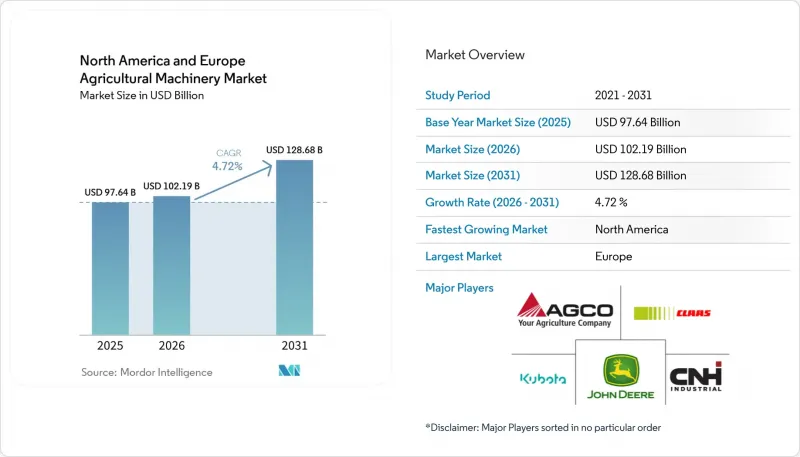
根據 Mordor Intelligence 預測,北美和歐洲農業機械市場規模預計將從 2025 年的 976.4 億美元成長到 2026 年的 1,021.9 億美元。
預計到 2031 年將達到 1,286.8 億美元,預計從 2026 年到 2031 年的複合年成長率為 4.72%。
北美和歐洲農業機械市場的趨勢和洞察
農業勞動力持續短缺
在美國,2024年農業就業約240萬個,但預計到2025年中期,農業就業人數將減少約15.5萬人。雖然許多大田作物的田間作業正在實現機械化,但特種作物的勞動密集型作業仍需要大量的人工。歐洲也面臨長期勞動力短缺和農業勞動力老化的問題。在歐盟,2024年農業勞動力總量下降了0.9%。這反映出全部區域農業勞動力投入的持續下降,從而推動了對省力機械和自動化設備的需求。由於及時的田間作業對於維持作物品質、產量和整體農場效率仍然至關重要,這些勞動力限制正在加速北美和歐洲農業機械市場對精準收割機、定向噴藥機、機械化插秧機和其他省力設備的需求。
精密農業與ISOBUS的整合
農業機械的互聯互通正從一項可選功能轉變為許多農場的必備功能。 ISOBUS 支援相容的曳引機、農具和數位系統之間的通訊,從而提升不同設備車隊之間的協同作業能力。歐盟委員會在通用農業政策 (CAP) 的未來發展方向中,更加重視數位化和精密農業。這一方向推動了對能夠更精準地記錄作業和施用投入的農業機械的更換。 2024 年,迪爾公司繼續加大對數位平台和連網設備能力的投入,透過約翰迪爾營運中心生態系統,實現了 77.5 萬台互聯設備和 4.55 億英畝的運作面積。 AGCO 公司也在 2024 年透過推出混合車隊的 PTx Trimble 平台,進一步強化了其精密農業策略。該平台旨在支援工廠安裝和後製加裝兩種方案。因此,營運商可以評估在其現有車隊中採用封閉式生態系統還是採用更廣泛的兼容性方案更為合適。由於農場主們都在尋求既能有效利用數位工具又不影響現有設備和服務合約的方案,因此,選擇該平台可能會影響北美和歐洲農業機械市場的經銷商關係、業務收益和升級決策。
高昂的初始設備成本和資金籌措成本
配備精準導航、遠端資訊處理和排放氣體合規系統等先進技術的最新型大馬力農機設備,初始投資成本顯著更高,這使得現金流有限的企業越來越難以獲得高階農機設備的資金籌措。農民還需要考慮舊機置換價值、多年貸款以及經銷商服務套餐的費用。這些因素會延長銷售流程,並增加經銷商的營運資金需求。由於借貸成本居高不下,小規模企業往往會延後購買,而大規模商業農場則可能在資金籌措截止日期前下單。因此,北美和歐洲的農機市場呈現出因農場規模而異的需求模式。資金籌措準備充分的商業企業更有能力購買能夠提高生產力、效率和合規性的設備,而小規模企業則傾向於透過延長現有資產的使用壽命來節省現金。
細分市場分析
2025年,曳引機在北美和歐洲農業機械市場中佔比47.3%,成為主要細分市場。這代表了北美和歐洲農業機械市場中,各類設備類別中最大的市場佔有率。曳引機的需求分為兩類:一類是面向旨在拓展業務的農場的高馬力曳引機,另一類是面向特殊用途的緊湊型多用途曳引機。隨著農場整合的推進,農民需要在有限的天氣條件下完成播種、耕作和收割,這推動了高功率曳引機的普及。果園、葡萄園和畜牧場對小型曳引機的需求仍然強勁。犁地設備(犁、耙、中耕機、旋耕機等)仍是標準的資本投資需求。 2025年,犁地設備是德國農業機械產業中少數表現優於整體農業機械產業的細分市場之一。儘管由於糧食利潤下降,部分地區的訂單減少,但糧食產區的收割機械需求保持穩定。由於北美和歐洲的耕作方式和種植制度存在顯著差異,這兩個地區的農業機械市場對各種機械的需求仍然存在。
2025年,乳牛和牛價格飆升,帶動了乾草和飼料設備的銷售成長,部分抵消了法國、英國和愛爾蘭牧區對曳引機和聯合收割機需求疲軟的影響。預計2026年至2031年,灌溉設備的複合年成長率將達到6.4%。美國西部、西南部和中部平原地區的水資源短缺為北美和歐洲的農業機械市場提供了成長機會。雖然精密中心支軸式噴灌和滴灌系統比傳統的漫灌成本更高,但它們能夠更有效地水資源管理。聯邦和州政府的計畫可以降低符合要求的節水系統的實施成本。播種設備受益於對變數施肥和大規模農田的需求。迪爾公司於2026年7月推出了C1450T氣力播種機,旨在提高補種間隔的播種效率。此外,隨著農民尋求減少勞動力投入並滿足精準噴灑的要求,他們對包括無人機噴灑系統在內的噴灑設備越來越感興趣。設備供應商可以透過整合機械和控制系統、農業支援以及實用的服務基礎設施來滿足這些需求。
其他好處:
- Excel格式的市場預測(ME)表
- 3個月的分析師支持
目錄
第1章:引言
- 研究假設和市場定義
- 調查範圍
第2章:調查方法
第3章執行摘要
第4章 市場狀況
- 市場概覽
- 市場促進因素
- 農業勞動力持續短缺
- 精密農業與ISOBUS的整合
- 獎勵使用具有氣候變遷意識的設備
- 更換老舊車輛和合併農場
- 為現有高價值車隊增加自動駕駛功能
- 小型和專用機械的電氣化
- 市場限制因素
- 高昂的初始設備成本和資金籌措成本
- 農業收入和利率波動
- 網路安全和資料所有權方面的不確定性
- 遵守第五階段和第四階段排放法規的成本不斷上升。
- 監理情勢
- 技術展望
- 波特五力分析
第5章 市場規模與成長預測
- 按類型
- 聯結機
- 按馬力
- 小於40馬力
- 40 HP~99 HP
- 100馬力或以上
- 曳引機類型
- 小型多用途曳引機
- 通用曳引機
- 田間曳引機
- 果園和葡萄園用曳引機
- 按馬力
- 土壤準備和農業機械
- 犁
- 光環
- 耕耘機和中耕機
- 種植/播種機械
- 播種機
- 播種機
- 撒佈器
- 種植機
- 收割機械
- 聯合收割機和脫粒機
- 飼料收割機
- 專用農作物收割機
- 噴灑和作物保護機械
- 自走式噴霧機
- 拖曳式和懸掛式噴霧器
- 空中噴灑和無人機噴灑系統
- 乾草和飼料機械
- 割草和修剪
- 打包機
- 耙子和耙子
- 灌溉機械
- 噴水灌溉
- 滴灌
- 機械樞軸系統
- 聯結機
- 按自動化級別
- 手動的
- 半自動
- 自動的
- 按地區
- 北美洲
- 美國
- 加拿大
- 墨西哥
- 其他北美國家
- 歐洲
- 德國
- 法國
- 英國
- 義大利
- 俄羅斯
- 其他歐洲國家
- 北美洲
第6章 競爭情勢
- 市場集中度
- 策略趨勢
- 市佔率分析
- 公司簡介
- Deere & Company
- CNH Industrial NV
- AGCO Corporation
- Kubota Corporation
- Claas KGaA mbH
- Mahindra & Mahindra Ltd.
- SDF Group
- Yanmar Holdings Co., Ltd.
- ISEKI & CO., LTD.
- Argo Tractors SpA
- Bucher Industries AG
- Valmont Industries, Inc.
- Lindsay Corporation
- Tractors and Farm Equipment Limited(TAFE)
- Orbia Advance Corporation, SAB de CV(Netafim Limited)
第7章 市場機會與未來展望
According to Mordor Intelligence, the North America and Europe agricultural machinery market size in 2026 is estimated at USD 102.19 billion, up from the 2025 value of USD 97.64 billion, with projections to USD 128.68 billion in 2031, growing at a CAGR of 4.72% over 2026-2031.
North America and Europe Agricultural Machinery Market Trends and Insights
Persistent Agricultural Labor Shortages
The United States reported approximately 2.4 million open agricultural jobs in 2024, while agricultural employment declined by about 155,000 positions during mid-2025. Row-crop farming has adopted mechanization for many field operations, yet labor-intensive activities in specialty crops still require substantial manual labor. Europe also faces persistent labor shortages and an aging farming workforce. In the European Union, agricultural labor volume declined by 0.9% in 2024, reflecting the continued contraction of agricultural labor input across the region and supporting demand for labor-saving machinery and automation. These labor constraints are accelerating demand for precision harvesters, targeted sprayers, mechanized transplanters, and other labor-saving equipment across the North America and Europe Agricultural Machinery Market, as timely field operations remain critical for maintaining crop quality, productivity, and overall farm efficiency.
Precision Agriculture and ISOBUS Integration
Equipment connectivity is moving from an optional feature to a practical requirement for many farms. ISOBUS supports communication among compatible tractors, implements, and digital systems, improving machine coordination across mixed fleets. The European Commission has placed greater emphasis on digitalization and precision approaches within the future direction of the Common Agricultural Policy. This direction supports replacement demand for equipment that can document operations and apply inputs more precisely. In 2024, Deere & Company continued investing in its digital platform and connected equipment capabilities, reporting 775,000 connected machines and 455 million engaged acres through its John Deere Operations Center ecosystem. AGCO Corporation also strengthened its precision agriculture strategy in 2024 by launching PTx Trimble, a mixed-fleet platform designed to support both factory-fit and retrofit applications. Operators can therefore evaluate whether a closed ecosystem or broader compatibility better fits their existing fleet. This platform choice can shape dealer relationships, service revenue, and upgrade decisions across the North America and Europe Agricultural Machinery Market because farms want useful digital tools without disrupting established equipment and service arrangements.
High Upfront Equipment and Financing Costs
Premium agricultural machinery has become increasingly difficult to finance for operators with limited cash flow, as modern high-horsepower equipment equipped with advanced technologies such as precision guidance, telematics, and emissions-compliant systems requires significantly higher upfront investment. Farmers also need to consider trade-in values, multi-year financing, and the cost of dealer service packages. These requirements can extend the sales process and increase dealer working capital needs. Smaller operators may postpone purchases when borrowing costs remain high, while larger commercial farms may place orders before funding deadlines. The North American and European agricultural machinery markets consequently show different demand patterns across farm-size groups, with finance-ready commercial operators better positioned to secure equipment that improves capacity, efficiency, and regulatory compliance, while smaller operations may preserve cash by extending the use of existing assets.
Other drivers and restraints analyzed in the detailed report include:
- Public Incentives for Climate-Smart Equipment
- Aging Fleet Replacement and Farm Consolidation
- Cybersecurity and Data Ownership Uncertainty
For complete list of drivers and restraints, kindly check the Table Of Contents.
Segment Analysis
Tractors accounted for 47.3% of the North American and Europe agricultural machinery market size in 2025, making them the leading segment. This represented the largest agricultural machinery market share in North America and Europe among the stated equipment categories. Demand within tractors is divided between high-horsepower models for expanding farms and compact utility machines for specialty use. Farm consolidation supports the adoption of higher-capacity tractors because operators need to complete planting, cultivation, and harvesting within limited weather windows. Compact tractors also retain relevance in orchard, vineyard, and livestock settings. Soil preparation and cultivation equipment remained a standard capital need, including plows, harrows, cultivators, and tillers. Tillage equipment was among the few German production segments to outperform the wider equipment sector in 2025. Harvesting machinery maintained stable demand in grain-producing areas, although lower cereal returns weakened orders in some locations. The North America and Europe agricultural machinery market continues to require a broad equipment range because farm tasks and crop systems vary widely across the two regions.
Hay and forage equipment benefited from strong dairy and beef cattle prices in 2025, which partly offset weaker tractor and combine demand in pastoral areas of France, the United Kingdom, and Ireland. Irrigation machinery is projected to advance at a 6.4% CAGR from 2026 to 2031. Water stress in the western, southwestern, and central plains regions of the United States supports this North America and Europe agricultural machinery market size growth opportunity. Precision center-pivot and drip systems cost more than traditional flood irrigation, but they can improve water management. Federal and state programs can lower the cost of qualifying water-efficient systems. Planting and seeding equipment benefits from variable-rate practices and large-acreage demand. Deere & Company launched the C1450T air cart in July 2026 to support seeding productivity between refills. Spraying equipment, including drone-enabled systems, is also attracting interest as growers seek to reduce labor needs and meet precision application requirements. Equipment suppliers can address these needs by combining machines with controls, agronomic support, and practical service coverage.
Complete Report Scope:
- By Type
- Tractors
- By Horsepower
- Less than 40 HP
- 40 HP to 99 HP
- 100 HP and Above
- By Tractor Type
- Compact Utility Tractors
- Utility Tractors
- Row Crop Tractors
- Orchard and Vineyard Tractors
- By Horsepower
- Soil Preparation and Cultivation Machinery
- Plows
- Harrows
- Cultivators and Tillers
- Planting and Seeding Machinery
- Seed Drills
- Planters
- Broadcast Spreaders
- Transplanters
- Harvesting Machinery
- Combine Harvesters and Threshers
- Forage Harvesters
- Specialty Crop Harvesters
- Spraying and Crop Protection Machinery
- Self-Propelled Sprayers
- Trailed and Mounted Sprayers
- Aerial and Drone-Enabled Spraying Systems
- Hay and Forage Machinery
- Mower-Conditioners
- Balers
- Rakes and Tedders
- Irrigation Machinery
- Sprinkler Irrigation
- Drip Irrigation
- Mechanized Pivot Systems
- Tractors
- By Automation Level
- Manual
- Semi-Automatic
- Automatic
- By Geography
- North America
- United States
- Canada
- Mexico
- Rest of North America
- Europe
- Germany
- France
- United Kingdom
- Italy
- Russia
- Rest of Europe
- North America
List of Companies Covered in this Report:
- Deere & Company
- CNH Industrial N.V.
- AGCO Corporation
- Kubota Corporation
- Claas KGaA mbH
- Mahindra & Mahindra Ltd.
- SDF Group
- Yanmar Holdings Co., Ltd.
- ISEKI & CO., LTD.
- Argo Tractors S.p.A.
- Bucher Industries AG
- Valmont Industries, Inc.
- Lindsay Corporation
- Tractors and Farm Equipment Limited (TAFE)
- Orbia Advance Corporation, S.A.B. de C.V. (Netafim Limited)
Additional Benefits:
- The market estimate (ME) sheet in Excel format
- 3 months of analyst support
TABLE OF CONTENTS
1 INTRODUCTION
- 1.1 Study Assumptions and Market Definition
- 1.2 Scope of the Study
2 RESEARCH METHODOLOGY
3 EXECUTIVE SUMMARY
4 MARKET LANDSCAPE
- 4.1 Market Overview
- 4.2 Market Drivers
- 4.2.1 Persistent Agricultural Labor Shortages
- 4.2.2 Precision Agriculture and ISOBUS Integration
- 4.2.3 Public Incentives for Climate-Smart Equipment
- 4.2.4 Aging Fleet Replacement and Farm Consolidation
- 4.2.5 Retrofit Autonomy for Existing High-Value Fleets
- 4.2.6 Electrification of Compact and Specialty Machinery
- 4.3 Market Restraints
- 4.3.1 High Upfront Equipment and Financing Costs
- 4.3.2 Volatile Farm Income and Interest Rates
- 4.3.3 Cybersecurity and Data Ownership Uncertainty
- 4.3.4 Stage V and Tier 4 Compliance Cost Escalation
- 4.4 Regulatory Landscape
- 4.5 Technological Outlook
- 4.6 Porter's Five Forces Analysis
- 4.6.1 Threat of New Entrants
- 4.6.2 Bargaining Power of Suppliers
- 4.6.3 Bargaining Power of Buyers
- 4.6.4 Threat of Substitutes
- 4.6.5 Intensity of Competitive Rivalry
5 MARKET SIZE AND GROWTH FORECASTS (VALUE)
- 5.1 By Type
- 5.1.1 Tractors
- 5.1.1.1 By Horsepower
- 5.1.1.1.1 Less than 40 HP
- 5.1.1.1.2 40 HP to 99 HP
- 5.1.1.1.3 100 HP and Above
- 5.1.1.2 By Tractor Type
- 5.1.1.2.1 Compact Utility Tractors
- 5.1.1.2.2 Utility Tractors
- 5.1.1.2.3 Row Crop Tractors
- 5.1.1.2.4 Orchard and Vineyard Tractors
- 5.1.1.1 By Horsepower
- 5.1.2 Soil Preparation and Cultivation Machinery
- 5.1.2.1 Plows
- 5.1.2.2 Harrows
- 5.1.2.3 Cultivators and Tillers
- 5.1.3 Planting and Seeding Machinery
- 5.1.3.1 Seed Drills
- 5.1.3.2 Planters
- 5.1.3.3 Broadcast Spreaders
- 5.1.3.4 Transplanters
- 5.1.4 Harvesting Machinery
- 5.1.4.1 Combine Harvesters and Threshers
- 5.1.4.2 Forage Harvesters
- 5.1.4.3 Specialty Crop Harvesters
- 5.1.5 Spraying and Crop Protection Machinery
- 5.1.5.1 Self-Propelled Sprayers
- 5.1.5.2 Trailed and Mounted Sprayers
- 5.1.5.3 Aerial and Drone-Enabled Spraying Systems
- 5.1.6 Hay and Forage Machinery
- 5.1.6.1 Mower-Conditioners
- 5.1.6.2 Balers
- 5.1.6.3 Rakes and Tedders
- 5.1.7 Irrigation Machinery
- 5.1.7.1 Sprinkler Irrigation
- 5.1.7.2 Drip Irrigation
- 5.1.7.3 Mechanized Pivot Systems
- 5.1.1 Tractors
- 5.2 By Automation Level
- 5.2.1 Manual
- 5.2.2 Semi-Automatic
- 5.2.3 Automatic
- 5.3 By Geography
- 5.3.1 North America
- 5.3.1.1 United States
- 5.3.1.2 Canada
- 5.3.1.3 Mexico
- 5.3.1.4 Rest of North America
- 5.3.2 Europe
- 5.3.2.1 Germany
- 5.3.2.2 France
- 5.3.2.3 United Kingdom
- 5.3.2.4 Italy
- 5.3.2.5 Russia
- 5.3.2.6 Rest of Europe
- 5.3.1 North America
6 COMPETITIVE LANDSCAPE
- 6.1 Market Concentration
- 6.2 Strategic Moves
- 6.3 Market Share Analysis
- 6.4 Company Profiles (Includes Global Level Overview, Market Level Overview, Core Segments, Financials as Available, Strategic Information, Market Rank/Share for Key Companies, Products and Services, and Recent Developments)
- 6.4.1 Deere & Company
- 6.4.2 CNH Industrial N.V.
- 6.4.3 AGCO Corporation
- 6.4.4 Kubota Corporation
- 6.4.5 Claas KGaA mbH
- 6.4.6 Mahindra & Mahindra Ltd.
- 6.4.7 SDF Group
- 6.4.8 Yanmar Holdings Co., Ltd.
- 6.4.9 ISEKI & CO., LTD.
- 6.4.10 Argo Tractors S.p.A.
- 6.4.11 Bucher Industries AG
- 6.4.12 Valmont Industries, Inc.
- 6.4.13 Lindsay Corporation
- 6.4.14 Tractors and Farm Equipment Limited (TAFE)
- 6.4.15 Orbia Advance Corporation, S.A.B. de C.V. (Netafim Limited)
7 MARKET OPPORTUNITIES AND FUTURE OUTLOOK

 農業除雪設備市場:全球市場預測,2026-2032年
 全球糧食螺旋輸送機市場(2026-2030 年)
 2034年農業機械市場預測-全球分析(按組件、機器類型、動力、驅動系統、應用、最終用戶產業和地區分類)農業機械自動駕駛市場:全球市場預測,2026-2032年農業機械市場:全球市場預測,2026-2032年曳引機橡膠履帶市場:全球市場預測,2026-2032年越野車駕駛室市場:全球市場預測(2026-2032年)
 牆槽機市場規模、佔有率和成長分析:按機器類型、動力源、應用、最終用戶、切割刀片類型和地區分類 - 產業預測,2026-2033年可攜式穀物螺旋輸送機市場:全球市場預測,2026-2032年新能源農業機械市場:全球市場預測(2026-2032年)