


 |
市場調查報告書
商品編碼
2163353
汽車選擇性催化還原:市場佔有率分析、產業趨勢與統計及成長預測(2026-2031)Automotive Selective Catalytic Reduction - Market Share Analysis, Industry Trends & Statistics, Growth Forecasts (2026 - 2031) |
||||||

※ 本網頁內容可能與最新版本有所差異。詳細情況請與我們聯繫。
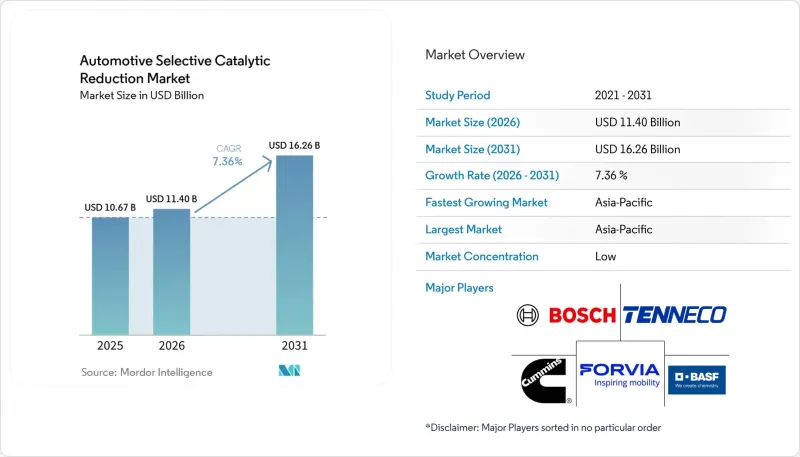
據 Mordor Intelligence 稱,2025 年汽車選擇性催化還原 (SCR) 市場價值為 106.7 億美元,預計到 2031 年將從 2026 年的 114 億美元成長至 162.6 億美元,預測期(2026-2031 年)的複合成長率為 7.36%。
全球汽車選擇性催化還原(SCR)市場趨勢與洞察
更嚴格的氮氧化物排放標準需要進行系統層面的重新設計。
2026年開始的新一輪排放法規對汽車選擇性催化還原(SCR)市場提出了比歐VI排放標準更為嚴格的要求。歐盟7排放標準將從2026年11月起適用於新款輕型車輛,重型車輛的型式認證則從2028年5月開始。美國2027年車型的排放法規將重型車輛引擎的氮氧化物(NOx)排放上限從每馬力200毫克降至35毫克。康明斯公司為此開發了一種雙模組SCR設計,該設計採用兩個5千瓦的電暖器和一個專用的48伏特交流發電機進行熱控制。這些新要求提高了單一排放氣體控制系統中催化劑、加熱器、噴油器和感測器之間的相互依賴性。在印度,預計2026會計年度頒布Bharat Stage VII排放標準,並於2030年實施,這將延長重型商用車製造地的車輛升級週期。
柴油商用車車隊的成長為柴油商用車的普及提供了支撐。
亞洲大型商用車生產支撐著汽車應用領域選擇性催化還原(SCR)技術的強勁市場,即便乘用車正朝著電氣化方向發展。預計到2025年,中國重型卡車產量將超過90萬輛,而向GB VI B階段的過渡也強制要求新型重型柴油車安裝SCR系統。印度的PM-Gati Shakti高速公路計畫縮短了主要走廊的貨運時間,增加了對符合排放氣體標準的長途卡車的需求。韓國和日本也透過基於以重量為準的課稅和加強監管合規性監測,持續推進各自的商用車更新換代。中國的車輛合規性驗證計畫也催生了售後市場需求,因為一些運作中的卡車未能達到實際排放標準。 2026 年對 24 輛重型卡車進行的一項研究表明,符合「國六」排放標準的車輛與「國五」排放標準的車輛相比,氮氧化物排放量減少了 59.6%,而不合規車輛的排放因子比「國五」基準值高出 85.6%。
高昂的系統、安裝和維護成本阻礙了新興市場的滲透。
汽車選擇性催化還原(SCR)市場面臨成本壓力,因為該系統需要催化劑、輸液設備、氮氧化物感測器、電控系統(ECU)、安裝以及持續維護。柴油引擎廢氣處理液(DEF)的使用以及催化劑的定期更換和再生進一步增加了整個生命週期的運作成本。在印度、東南亞和撒哈拉以南非洲等對價格敏感的卡車市場,車隊採購者通常會在選擇符合法規的車輛之前評估總擁有成本(TCO)。更先進的雙噴射和閉式耦合SCR佈局會增加系統複雜性並提高維護要求。 SAE在2025年發布的一份報告強調了將精確的柴油引擎廢氣處理液噴射、診斷和故障安全功能整合到經濟高效的控制單元中的難度。此外,印度二線和三線城市缺乏專業的維修服務基礎設施,這可能會導致中型卡車系統故障時停機時間延長。
細分市場分析
到2025年,尿素罐將佔汽車選擇性催化還原(SCR)市場29.45%的佔有率,成為最大的零件細分市場。這一地位反映了商用車對高密度聚苯乙烯和增強複合複合材料罐的需求,以及它們在所有車型中的應用。洛克林汽車公司(Lochling Automotive)為卡車和乘用車製造商提供帶有模製防晃結構的SCR尿素罐系統和加註系統。其30公升商用車尿素槽設計相比傳統設計可減輕0.8公斤的重量。噴油嘴和電控系統(ECU)構成下一層零件。噴油嘴的需求與新車產量有關,而隨著採用多感測器進行封閉回路型控制的系統日益普及,ECU的重要性也日益凸顯。
預計到2031年,尿素幫浦市場將以7.85%的複合年成長率成長,超過汽車選擇性催化還原(SCR)市場的整體成長率。雙噴射和閉式耦合設計要求在多個噴射點實現精確輸送。博世的DI-SCR雙噴射技術採用閉式耦合和底置式噴射,這提高了對泵浦和噴射射精度的要求。 2026年SAE的一項研究表明,軟體控制噴射能夠識別沉積物引起的故障,並在結晶對催化劑性能產生負面影響之前啟動再生過程。美國環保署(EPA)的車載診斷(OBD)要求以及印度擬議的遠端OBD資料上傳法規正在推動對高性能ECU和感測器的需求。
區域分析
到2025年,亞太地區將佔據汽車選擇性催化還原(SCR)市場38.31%的佔有率,預計到2031年將以8.22%的複合年成長率成長。中國是該地區的主要驅動力,因為根據國六B排放標準,新型重型柴油車必須安裝SCR系統。預計到2025年,中國將生產超過90萬輛重型卡車。在印度,由於符合國六B排放標準的實際排放氣體法規,以及擬議的新型商用車即時OBD-II(車載診斷系統II)資料上傳要求(將於2026年6月生效),市場正在擴張。日本和韓國透過生產專用催化劑和感測器做出貢獻,而泰國、越南和印尼正在努力達到歐5和歐盟6排放標準的要求。
北美是全球第二大汽車選擇性催化還原(SCR)技術區域市場,也是後處理SCR技術展示了滿足這項要求的不同途徑。墨西哥的PROAIRE計畫正逐步收緊美國-墨西哥-加拿大(MCA)生產走廊沿線商用車的標準。美國柴油引擎廢氣處理液(DEF)工廠2025年的維護計畫表明,庫存水準可能迅速變得緊張。隨著DEF生產的推進,雅苒位於斯盧斯克的工廠將從2026年開始每年捕捉並液化80萬噸二氧化碳。
歐洲擁有成熟的汽車選擇性催化還原(SCR)市場,與商用車成長形成鮮明對比的是,乘用車柴油需求正在下降。預計到2025年,柴油卡車將佔該地區卡車車隊的87%,而新註冊的柴油乘用車預計將佔新車銷量的不到10%。歐7排放法規正在推動封閉式耦合和雙劑量SCR催化劑的升級,以滿足實際駕駛條件。德國仍是關鍵市場,大眾集團、戴姆勒卡車、寶馬和曼恩卡車客車等公司都在此設有總部。巴西、中東和非洲提供了早期商業機會,因為符合PROCONVE P-8和歐標的分階段法規的引入正在推動供應鏈投資。雅苒位於庫巴陶的工廠利用可再生甲烷生產氨,用於製造工業尿素。
其他好處:
- Excel格式的市場預測(ME)表
- 3個月的分析師支持
目錄
第1章:引言
- 研究假設和市場定義
- 調查範圍
第2章:調查方法
第3章執行摘要
第4章 市場狀況
- 市場概覽
- 市場促進因素
- 更嚴格的氮氧化物排放標準
- 擴大柴油商用車車隊
- SCR在新興汽車市場的應用日益廣泛
- 低溫催化劑和溫度控管技術的進步
- 數位閉合迴路加藥和氮氧化物感測器整合
- 市場限制因素
- 高昂的系統、安裝和維護成本
- 柴油引擎廢氣(DEF)供應狀況和品質限制
- 小型汽車電氣化和柴油車普及率下降
- 價值鏈分析
- 波特五力分析
第5章 市場規模與成長預測
- 按組件
- 尿素罐
- 尿素泵
- 電控系統
- 注射器
- 其他規則
- 車輛類型
- 搭乘用車
- 輕型商用車
- 大型商用車輛
- 催化劑類型
- 銅沸石
- 鐵沸石
- 釩基催化劑
- 其他觸媒技術
- 按地區
- 亞太地區
- 中國
- 印度
- 日本
- 韓國
- 東南亞國協
- 其他亞太國家
- 北美洲
- 美國
- 加拿大
- 墨西哥
- 歐洲
- 德國
- 英國
- 法國
- 義大利
- 北歐國家
- 其他歐洲國家
- 南美洲
- 巴西
- 阿根廷
- 其他南美國家
- 中東和非洲
- 沙烏地阿拉伯
- 南非
- 其他中東和非洲國家
- 亞太地區
第6章 競爭情勢
- 市場集中度
- 策略趨勢
- 市佔率和排名分析
- 公司簡介
- BASF
- Continental AG
- Corning Incorporated
- Cummins Inc.
- DENSO CORPORATION
- Eberspacher Gruppe GmbH & Co. KG
- FORVIA
- Johnson Matthey
- Marelli Holdings Co., Ltd.
- OPmobility
- Robert Bosch GmbH
- Rochling SE & Co. KG
- Tenneco Inc.
- Textron Inc.
- Umicore
- Yara International ASA
第7章 市場機會與未來展望
According to Mordor Intelligence, the automotive selective catalytic reduction market size was valued at USD 10.67 billion in 2025 and is estimated to grow from USD 11.40 billion in 2026 to reach USD 16.26 billion by 2031, at a CAGR of 7.36% during the forecast period (2026-2031).
Global Automotive Selective Catalytic Reduction Market Trends and Insights
Tightening NOx Emission Standards Compel System-Level Redesigns
The regulatory cycle beginning in 2026 places more demanding requirements on the automotive selective catalytic reduction market than the Euro VI cycle. Euro 7 applies to new light-duty model types from November 2026, while heavy-duty vehicle type approvals begin in May 2028. The US model-year 2027 rule lowers the heavy-duty engine nitrogen oxide limit to 35 mg per horsepower-hour from 200 mg per horsepower-hour. Cummins has responded with a twin-module SCR design that uses two 5 kW electric heaters and a dedicated 48 V alternator for thermal control. These requirements make catalysts, heaters, dosing equipment, and sensors more interdependent within one emissions-control system. India is expected to notify Bharat Stage VII during fiscal year 2026 for rollout in 2030, extending this vehicle upgrade cycle to a large commercial vehicle manufacturing base.
Growth of Diesel Commercial Vehicle Fleets Sustains Installation Base
Heavy commercial vehicle production in Asia supports a durable installation base for the automotive selective catalytic reduction market despite passenger vehicle electrification. China produced more than 900,000 heavy-duty trucks in 2025, and the GB VI Phase B transition requires the installation of SCRs on new heavy-duty diesel vehicles. India's PM-Gati Shakti expressway program has reduced freight times along key corridors and boosted demand for compliant long-haul trucks. South Korea and Japan also continue their own commercial vehicle upgrade cycles through weight-based taxes and stronger compliance monitoring. China's in-service conformity program creates an aftermarket need because some operating trucks do not meet real-world targets. A 2026 study of 24 heavy-duty trucks found that compliant China VI vehicles reduced nitrogen oxide emissions by 59.6% against China V vehicles, while non-compliant vehicles had emission factors 85.6% higher than China V benchmarks.
High System, Installation, and Maintenance Costs Constrain Emerging-Market Penetration
The automotive selective catalytic reduction market faces cost pressure because systems require a catalyst, dosing unit, nitrogen oxide sensors, an electronic control unit (ECU), installation, and ongoing maintenance. The use of diesel exhaust fluid and periodic catalyst replacement or reconditioning add to lifetime operating costs. In price-sensitive truck markets, including India, Southeast Asia, and Sub-Saharan Africa, fleet buyers often assess total ownership cost before selecting a compliant vehicle. More advanced dual-dosing and close-coupled SCR layouts increase system complexity and can raise maintenance requirements. A 2025 Society of Automotive Engineers (SAE) paper identified the difficulty of combining accurate diesel exhaust fluid dosing, diagnostics, and fail-safe functions in a cost-effective control unit. Limited specialist service capacity in India's Tier-2 and Tier-3 cities can also increase downtime when medium-duty truck systems fail.
Other drivers and restraints analyzed in the detailed report include:
- Expansion of Selective Catalytic Reduction (SCR) in Emerging Automotive Markets Creates a Second Growth Curve
- Low-Temperature Catalyst and Thermal-Management Advances Redefine System Architecture
- DEF Availability and Quality Constraints Introduce Operational Risk
For complete list of drivers and restraints, kindly check the Table Of Contents.
Segment Analysis
Urea tanks accounted for 29.45% of the automotive selective catalytic reduction market share in 2025, making them the largest component segment. Their position reflects use across vehicle types and the material requirements of high-density polyethylene and reinforced-composite tanks in commercial vehicles. Rochling Automotive supplies SCR tank systems with molded anti-sloshing structures and filling systems for truck and passenger vehicle manufacturers. Its 30-liter commercial vehicle tank design reduced weight by 0.8 kg compared to earlier designs. Injectors and electronic control units form the next component tier. Injector demand tracks new-vehicle production, while ECUs are gaining importance as more systems use multiple sensors for closed-loop control.
Urea pumps are forecast to expand at a 7.85% CAGR through 2031, above the overall automotive selective catalytic reduction market growth rate. Dual-dosing and close-coupled designs require accurate delivery across multiple dosing points. Bosch's DI-SCR double-injection technology uses a close-coupled and an underfloor dosing position, which increases pump requirements and dosing precision. A 2026 Society of Automotive Engineers (SAE) study found that software-controlled dosing can identify deposit faults and begin regeneration before crystallization harms catalyst performance. EPA on-board diagnostic requirements and India's draft remote-OBD data-upload rule are supporting demand for more capable ECUs and sensors.
Complete Report Scope:
- By Component
- Urea Tank
- Urea Pump
- Electronic Control Unit
- Injectors
- Other Components
- By Vehicle Type
- Passenger Vehicles
- Light Commercial Vehicles
- Heavy Commercial Vehicles
- By Catalyst Technology
- Copper Zeolite
- Iron Zeolite
- Vanadium-Based Catalyst
- Other Catalyst Technologies
- By Geography
- Asia-Pacific
- China
- India
- Japan
- South Korea
- ASEAN Countries
- Rest of Asia-Pacific
- North America
- United States
- Canada
- Mexico
- Europe
- Germany
- United Kingdom
- France
- Italy
- NORDIC Countries
- Rest of Europe
- South America
- Brazil
- Argentina
- Rest of South America
- Middle East and Africa
- Saudi Arabia
- South Africa
- Rest of Middle East and Africa
- Asia-Pacific
Geography Analysis
Asia-Pacific held 38.31% of the automotive selective catalytic reduction market share in 2025 and is forecast to grow at an 8.22% CAGR through 2031. China is the regional anchor, as GB VI Phase B requires SCR on new heavy-duty diesel vehicles. More than 900,000 heavy-duty trucks were produced in China in 2025. India is expanding through BS VI Phase 2 real-driving-emissions compliance and a June 2026 draft requirement for real-time On-Board Diagnostics II (OBD-II) data uploads from new commercial vehicles. Japan and South Korea contribute specialized catalyst and sensor manufacturing, while Thailand, Vietnam, and Indonesia are moving toward Euro 5 and Euro 6-equivalent requirements.
North America is the second-largest regional market for automotive selective catalytic reduction and an important center for aftertreatment design. The U.S. EPA's model-year 2027 rule requires more than an 80% reduction in nitrogen oxide emissions from current heavy-duty levels. Cummins' twin-module X15 and Detroit's Gen 6 close-coupled pre-SCR approach represent different methods of meeting this requirement. Mexico's PROAIRE programs are progressively tightening commercial vehicle standards along the USMCA production corridor. Planned maintenance at U.S. Diesel Exhaust Fluid (DEF) plants during 2025 demonstrated how quickly inventory conditions can tighten. Yara's Sluiskil facility captures and liquefies 800,000 tons of carbon dioxide annually from DEF production beginning in 2026.
Europe is a mature automotive selective catalytic reduction market where commercial vehicle growth contrasts with declining passenger diesel demand. Diesel trucks represented 87% of the regional truck fleet in 2025, while diesel passenger registrations were below 10% of new-car sales. Euro 7 is driving an SCR catalyst upgrade cycle for close-coupled and dual-dosing systems to meet real-world conditions. Germany remains an important market as it is home to Volkswagen Group, Daimler Truck, BMW, and MAN Truck & Bus. Brazil, the Middle East, and Africa represent earlier-stage opportunities, as PROCONVE P-8 and progressive Euro-equivalent alignment encourage supply chain investment. Yara's Cubatao plant also produces ammonia using renewable biomethane to produce technical-grade urea.
- BASF
- Continental AG
- Corning Incorporated
- Cummins Inc.
- DENSO CORPORATION
- Eberspacher Gruppe GmbH & Co. KG
- FORVIA
- Johnson Matthey
- Marelli Holdings Co., Ltd.
- OPmobility
- Robert Bosch GmbH
- Rochling SE & Co. KG
- Tenneco Inc.
- Textron Inc.
- Umicore
- Yara International ASA
Additional Benefits:
- The market estimate (ME) sheet in Excel format
- 3 months of analyst support
TABLE OF CONTENTS
1 Introduction
- 1.1 Study Assumptions and Market Definition
- 1.2 Scope of the Study
2 Research Methodology
3 Executive Summary
4 Market Landscape
- 4.1 Market Overview
- 4.2 Market Drivers
- 4.2.1 Tightening NOx Emission Standards
- 4.2.2 Growth of Diesel Commercial Vehicle Fleets
- 4.2.3 Expansion of SCR in Emerging Automotive Markets
- 4.2.4 Low-Temperature Catalyst and Thermal-Management Advances
- 4.2.5 Digital Closed-Loop Dosing and NOx Sensor Integration
- 4.3 Market Restraints
- 4.3.1 High System, Installation, and Maintenance Costs
- 4.3.2 DEF Availability and Quality Constraints
- 4.3.3 Light-Duty Electrification and Declining Diesel Adoption
- 4.4 Value Chain Analysis
- 4.5 Porter's Five Forces Analysis
- 4.5.1 Bargaining Power of Suppliers
- 4.5.2 Bargaining Power of Buyers
- 4.5.3 Threat of New Entrants
- 4.5.4 Threat of Substitutes
- 4.5.5 Competitive Rivalry
5 Market Size and Growth Forecasts (Value)
- 5.1 By Component
- 5.1.1 Urea Tank
- 5.1.2 Urea Pump
- 5.1.3 Electronic Control Unit
- 5.1.4 Injectors
- 5.1.5 Other Components
- 5.2 By Vehicle Type
- 5.2.1 Passenger Vehicles
- 5.2.2 Light Commercial Vehicles
- 5.2.3 Heavy Commercial Vehicles
- 5.3 By Catalyst Technology
- 5.3.1 Copper Zeolite
- 5.3.2 Iron Zeolite
- 5.3.3 Vanadium-Based Catalyst
- 5.3.4 Other Catalyst Technologies
- 5.4 By Geography
- 5.4.1 Asia-Pacific
- 5.4.1.1 China
- 5.4.1.2 India
- 5.4.1.3 Japan
- 5.4.1.4 South Korea
- 5.4.1.5 ASEAN Countries
- 5.4.1.6 Rest of Asia-Pacific
- 5.4.2 North America
- 5.4.2.1 United States
- 5.4.2.2 Canada
- 5.4.2.3 Mexico
- 5.4.3 Europe
- 5.4.3.1 Germany
- 5.4.3.2 United Kingdom
- 5.4.3.3 France
- 5.4.3.4 Italy
- 5.4.3.5 NORDIC Countries
- 5.4.3.6 Rest of Europe
- 5.4.4 South America
- 5.4.4.1 Brazil
- 5.4.4.2 Argentina
- 5.4.4.3 Rest of South America
- 5.4.5 Middle East and Africa
- 5.4.5.1 Saudi Arabia
- 5.4.5.2 South Africa
- 5.4.5.3 Rest of Middle East and Africa
- 5.4.1 Asia-Pacific
6 Competitive Landscape
- 6.1 Market Concentration
- 6.2 Strategic Moves
- 6.3 Market Share (%)/Ranking Analysis
- 6.4 Company Profiles (includes Global Overview, Market Overview, Core Segments, Financials as available, Strategic Information, Products and Services, and Recent Developments)
- 6.4.1 BASF
- 6.4.2 Continental AG
- 6.4.3 Corning Incorporated
- 6.4.4 Cummins Inc.
- 6.4.5 DENSO CORPORATION
- 6.4.6 Eberspacher Gruppe GmbH & Co. KG
- 6.4.7 FORVIA
- 6.4.8 Johnson Matthey
- 6.4.9 Marelli Holdings Co., Ltd.
- 6.4.10 OPmobility
- 6.4.11 Robert Bosch GmbH
- 6.4.12 Rochling SE & Co. KG
- 6.4.13 Tenneco Inc.
- 6.4.14 Textron Inc.
- 6.4.15 Umicore
- 6.4.16 Yara International ASA
7 Market Opportunities and Future Outlook
- 7.1 White-Space and Unmet-Need Assessment


