


 |
市場調查報告書
商品編碼
2163349
矽橡膠:市場佔有率分析、產業趨勢與統計、成長預測(2026-2031)Silicone Rubber - Market Share Analysis, Industry Trends & Statistics, Growth Forecasts (2026 - 2031) |
||||||

※ 本網頁內容可能與最新版本有所差異。詳細情況請與我們聯繫。
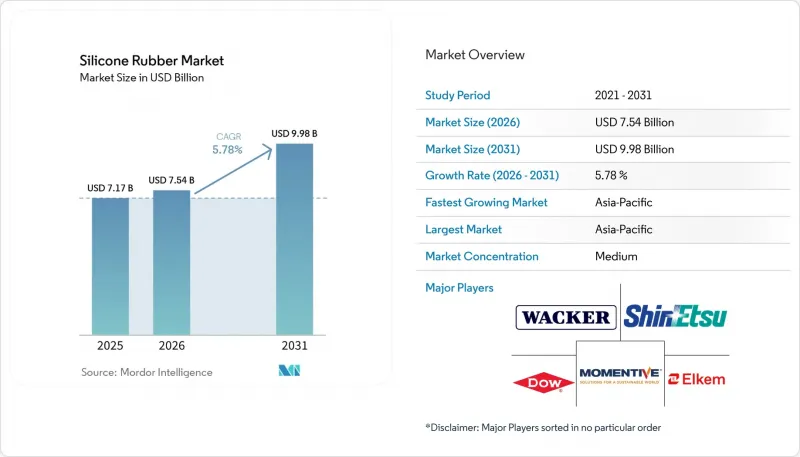
據 Mordor Intelligence 稱,2025 年全球矽橡膠市場價值為 71.7 億美元,預計在預測期(2026-2031 年)內將以 5.78% 的複合年成長率成長,從 2026 年的 75.4 億美元成長到 2031 億美元的 9.88 億美元。
全球矽橡膠市場趨勢與洞察
醫用和植入式矽膠組件的成長
醫用級矽橡膠受益於供應商難以滿足的嚴格認證要求,這些要求適用於醫療設備投入臨床或商業應用前的材料選擇。隨著美國食品藥物管理局 (FDA) 的品管系統法規於 2026 年 2 月 2 日生效,美國醫療設備製造要求現已與 ISO 13485:2016 標準保持一致。這些要求使得 II 類和 III 類醫療設備中認證材料的替換更加困難,因為變更可能需要醫療設備製造商重新實施文件編制、測試和核准程序。配方符合美國藥典 (USP) VI 類和 ISO 10993 標準的製造商保持認證優勢,而其他製造商需要兩到四年才能獲得相同的優勢。 2026 年 6 月,東莞市瑞祥矽膠有限公司推出了用於心臟輔助裝置和血液透析等與體液接觸的醫療器材的鉑金硫化醫用導管。即使產量成長緩慢,高附加價值植入材料的價格也可能高於工業級產品。這是因為供應商提供的材料適用於那些以可靠性、生物相容性和品質可追溯性為核心要求的應用。
電動車電池對密封件和高壓絕緣材料的需求
中國電池安全標準GB 38031-2025於2026年7月生效,該標準規定了電池系統在熱失控情況下保護乘員和緊急應變人員的要求。該標準提高了對電池外殼密封件及相關部件的技術關注度,尤其是那些即使在高溫、高壓和化學品等極端條件下也必須保持功能的部件。 WEVO-CHEMIE公司開發了用於模壓墊片密封的「WEVOSIL 23130」。本產品具有超過2 MPa的黏合強度,並且在氣體壓力快速升高的情況下仍能保持耐久性。瓦克公司的「ELASTOSIL LR 3822」專為電動車驅動電池的連接器密封件和冷卻迴路部件而設計,即使在125 度C的乙二醇-水混合物中浸泡1000小時後仍能保持其完整性。在電池應用中,密封、熱學、電氣和安全要求整合在一個車輛系統中,因此,針對特定應用的化合物比重新配製的通用材料更適合滿足這些要求。隨著產品開發轉向針對電池系統的特定應用材料,矽橡膠市場預計將從中受益。這一細分市場的發展受到電池安全性、材料耐久性和支持自動駕駛汽車生產的組件等因素的影響。
矽氧烷、金屬矽和能源成本波動
對於尚未整合上游工程的矽橡膠加工商而言,原料成本仍然是一項重大風險。這是因為原物料成本的變化速度可能超過現有供應合約下調整客戶價格的能力。由於中國供應過剩以及鋁和化工應用領域的需求下降,2025年美國金屬矽價格較2024年平均下降了21%。 2026年上半年,中國二甲基環矽氧烷(DMC)價格較去年同期回升13%,但截至2026年6月,國內產能仍維持在344萬噸。在德國,矽氧烷價格在2026年第二季上漲7.0%,從第一季的每噸5,700美元漲至每噸6,100美元。這一逆轉與2025年下半年全球價格走軟的趨勢相符,顯示即使成本負擔在一段時間內有所減輕,也可能無法為長期商業決策提供穩定的基礎。非垂直整合的複合生產商更容易受到這些價格波動的影響,因為它們缺乏垂直整合供應商所擁有的上游工程成本緩衝。
細分市場分析
到2025年,工業級矽橡膠將佔據47.13%的市場。它繼續廣泛應用於汽車、製造和建築行業的密封件、墊圈和O型圈,其耐熱性和耐環境性確保了零件的日常性能。在這些應用領域,採購決策主要取決於成本和效能的平衡。醫用級矽橡膠是成長最快的類型,預計到2031年將以6.14%的複合年成長率成長。材料合格要求對價格有重要影響,並縮小了II類和III類醫療設備中替代品的選擇空間。這是因為供應商必須證明其材料適用於與患者接觸的敏感應用或植入式應用。
Elchem於2025年10月推出了“SILBIONE液體矽橡膠(LSR)Select EC 70”,這是一款生物相容性導電液體矽橡膠(LSR)。該產品電阻率低於10歐姆·厘米,並通過了ISO 10993-5細胞毒性測試認證。該材料專為穿戴式裝置、義肢和軟性電路而設計,體現了醫療設計要求與具有電氣功能的矽材料之間的通用之處。食品接觸級產品廣泛應用於烘焙用品、乳製品管材和食品加工設備,由於亞洲新興經濟體有組織食品生產的擴張,該細分市場需求穩定成長。此細分市場的需求包括對食品接觸性能和可靠加工特性有要求的設備和管材應用。在矽橡膠市場,滿足嚴格的醫療和電氣要求的配方仍然備受青睞。這是因為這些配方應用於對技術和品質要求明確的領域。
預計到2025年,液態射出成型(LIM)將佔加工方式銷售額的64.67%,並將在2031年之前以6.43%的複合年成長率成長,增速高於其他加工方式。這反映了加工方式正持續從壓縮轉注成型成型轉向自動化系統,尤其是在零件品質可重複性和降低人事費用對客戶經濟效益至關重要的應用領域。在2026年Fakuma展會上,ENGEL展示了其無拉桿電動LIM成型機無需二次去毛邊即可生產大型密封件。這消除了先前限制LIM技術應用於較不複雜零件的返工成本。
Elmet 的「Smartshot i.」系統透過自動平衡型腔填充,可將 16 腔模具的推出時間縮短高達 95%。擠出成型在軟管、管材和電線護套等連續型材的生產中仍然發揮著至關重要的作用,因為這些產品需要連續的形狀,而不是射出成型生產的單一零件形狀。轉注成型和壓縮成型仍然用於航太和工業領域對精度要求極高且產量較小的零件。這些零件的生產週期通常較長,因此需要較高的模具投資。自動化雷射誘導成型 (LIM) 正在增強矽橡膠市場滿足需要重複性和最大限度減少人工精加工的生產項目的能力。對於加工商而言,自動化降低了與傳統方法相關的變異性和人工成本,從而提高了 LIM 的生產效益。在矽橡膠市場,當客戶的產量不足以支援大規模後處理時,LIM 也被用於提高效率。
區域分析
到2025年,亞太地區將佔據矽橡膠市場46.68%的佔有率,預計到2031年將以6.34%的複合年成長率成長。中國是電動車電池系統、家用電子電器和醫療設備的主要生產和需求中心。中國也向東南亞、印度和中東出口通用級矽橡膠產品。印度是該地區成長最快的市場,這得益於其醫療基礎設施、汽車製造業和完善的食品加工業。到2025年,日本將繼續保持其高規格市場的地位,這得益於《藥品和醫療設備法》(PMD法)對醫療應用的合規要求以及日本工業標準(JIS)對工業材料的框架。這些框架共同推動了對符合嚴格性能和品質要求的材料的需求,使矽橡膠成為那些基於既定標準和產品認證做出採購決策的客戶的關鍵材料。
韓國和東南亞國協透過家用電子電器和汽車零件為該產業做出貢獻。東協市場也受益於製造地從中國的轉移。北美是醫療設備、航太以及美國和墨西哥不斷擴張的電動車供應鏈的重要收入來源地,當地生產的認證材料和可靠的供應深受客戶重視。美國食品藥物管理局 (FDA) 的品管法規正在強化合規性環境,並推動認證矽膠材料在醫療應用中的使用。 2026 年 6 月,陶氏宣布對特種矽膠進行 1 億美元的重大投資,其中包括擴建其位於肯塔基州卡羅爾頓的液態矽橡膠 (LSR) 生產工廠。
在歐洲,電動車的需求和監管合規要求的雙重推動,催生了對能夠為汽車、醫療技術和工業客戶提供特定應用材料的供應商的需求。 2026年6月17日,瓦克在捷克共和國卡羅維發利開設了一家生產工廠,生產用於汽車、醫療技術和電動車客戶的室溫固化矽膠和高黏度橡膠。南美、中東和非洲的市場規模相對小規模,但巴西市場受益於管道密封、汽車零件和食品加工的需求。沙烏地阿拉伯和南非是該地區的主要需求中心,這得益於其產業多元化和汽車組裝。在這些地區,由於國內混煉能力有限,大多數特殊和醫用級產品都依賴從亞太地區和歐洲的供應商進口,當地用戶不得不依賴成熟的國際製造商來獲取技術先進的產品。
其他好處:
- Excel格式的市場預測(ME)表
- 3個月的分析師支持
目錄
第1章:引言
- 研究假設和市場定義
- 調查範圍
第2章:調查方法
第3章執行摘要
第4章 市場狀況
- 市場概覽
- 市場促進因素
- 醫用和植入式矽膠組件的成長
- 電動車電池對密封件和高壓絕緣材料的需求
- 電子設備小型化和溫度控管
- 自動化液體射出成型的擴展
- 抗菌導電矽膠配方
- 市場限制因素
- 矽氧烷、金屬矽和能源成本波動
- 與高性能熱可塑性橡膠的競爭
- 交聯矽橡膠回收利用面臨的挑戰
- 價值鏈分析
- 波特五力分析
第5章 市場規模與成長預測
- 按類型
- 工業級
- 醫用級
- 食品接觸級
- 透過聚合方法
- 液態射出成型
- 擠壓
- 轉注成型
- 壓縮成型
- 其他
- 透過使用
- 密封件、墊圈、O形圈
- 導管和醫用管
- 穿戴式和植入式藥物傳輸系統
- 其他
- 按最終用戶行業分類
- 醫療保健和醫療設備
- 汽車和運輸業
- 電氣和電子設備
- 消費品
- 其他
- 按地區
- 亞太地區
- 中國
- 印度
- 日本
- 韓國
- 東南亞國協
- 其他亞太國家
- 北美洲
- 美國
- 加拿大
- 墨西哥
- 歐洲
- 德國
- 英國
- 法國
- 義大利
- 北歐國家
- 其他歐洲國家
- 南美洲
- 巴西
- 阿根廷
- 其他南美國家
- 中東和非洲
- 沙烏地阿拉伯
- 南非
- 其他中東和非洲國家
- 亞太地區
第6章 競爭情勢
- 市場集中度
- 策略趨勢
- 市佔率和排名分析
- 公司簡介
- Avantor, Inc.
- Cabot Corporation
- China National Bluestar(Group)Co., Ltd.
- CHT Germany GmbH
- Dow
- DuPont
- Elkem ASA
- KCC Corporation
- Mesgo SpA
- Momentive
- Reiss Manufacturing Inc.
- Rogers Corporation
- Shin-Etsu Chemical Co., Ltd.
- Specialty Silicone Products, Inc.
- Wacker Chemie AG
第7章 市場機會與未來展望
According to Mordor Intelligence, the global silicone rubber market size was valued at USD 7.17 billion in 2025 and is estimated to grow from USD 7.54 billion in 2026 to USD 9.98 billion by 2031, at a CAGR of 5.78% during the forecast period (2026-2031).
Global Silicone Rubber Market Trends and Insights
Growth in Medical-Grade and Implantable Silicone Components
Medical-grade silicone rubber benefits from qualification requirements that are difficult for suppliers to meet and that apply to material selection before devices reach clinical or commercial use. The FDA Quality Management System Regulation took effect on February 2, 2026, aligning U.S. device manufacturing requirements with ISO 13485:2016. These requirements make it harder to replace qualified materials in Class II and Class III devices, because a change can require renewed documentation, testing, and approval activity by device manufacturers. Manufacturers with United States Pharmacopeia (USP) Class VI and ISO 10993 compliant formulations retain a qualification advantage that takes 2 to 4 years to reproduce. In June 2026, Dongguan Ruixiang Silicone released platinum-cured medical-grade tubing for fluid-contact cardiac assist and hemodialysis applications. Higher-value implantable materials also support a premium over industrial-grade products, even when output growth is moderate, as suppliers provide materials for uses where reliability, biocompatibility, and traceable quality are central requirements.
EV Battery Sealing and High-Voltage Insulation Demand
China's GB 38031-2025 battery safety standard took effect in July 2026 and requires battery systems to protect occupants and emergency personnel during thermal runaway. The standard increases the technical focus on battery-housing seals and related components, particularly where a component must continue to perform under severe heat, pressure, and chemical exposure. WEVO-CHEMIE developed WEVOSIL 23130 for formed-in-place gasket sealing, with adhesive strength above 2 MPa and durability during gas-pressure spikes. WACKER's ELASTOSIL LR 3822 is intended for connector seals and cooling-circuit elements in EV traction batteries, maintaining integrity after 1,000 hours in glycol-water mixtures at 125°C. These requirements favor purpose-built compounds rather than reformulated industrial materials, since battery applications combine sealing, thermal, electrical, and safety requirements into a single vehicle system. The silicone rubber market stands to benefit as product development shifts toward application-specific materials for battery systems, with this segment shaped by battery safety, material durability, and the need for components that support automated vehicle production.
Volatility in Siloxane, Silicon Metal, and Energy Costs
Raw material costs remain a major risk for silicone rubber processors without upstream integration, as material costs can change faster than customer pricing can be adjusted under established supply agreements. U.S. silicon metal prices averaged 21% lower in 2025 than in 2024 due to Chinese oversupply and weaker demand from aluminum and chemical applications. In the first half of 2026, silicone dimethylcyclosiloxane (DMC) prices in China recovered 13% year over year while domestic capacity remained at 3.44 million tons through June 2026. Siloxane prices in Germany rose 7.0% in the second quarter of 2026 to USD 6,100 per metric ton from USD 5,700 per metric ton in the first quarter. This reversal followed the softer global pricing seen in late 2025, indicating that cost relief available in one period may not provide a stable basis for longer-term operating decisions. Non-integrated compounders remain more exposed to these fluctuations, as they lack the upstream cost buffer available to vertically integrated suppliers.
Other drivers and restraints analyzed in the detailed report include:
- Electronics Miniaturization and Thermal Management
- Expansion of Automated Liquid Injection Molding
- Competition from High-Performance Thermoplastic Elastomers
For complete list of drivers and restraints, kindly check the Table Of Contents.
Segment Analysis
Industrial Grade accounted for 47.13% of the silicone rubber market share in 2025. It remained widely used in seals, gaskets, and O-rings for automotive, manufacturing, and construction applications, where resistance to heat and environmental exposure supports routine component performance. Purchasing decisions in these applications are driven by the balance between cost and performance. Medical Grade is the fastest-growing type and is forecast to grow at a 6.14% CAGR through 2031. Material qualification requirements support its pricing position and reduce the scope for substitution in Class II and Class III devices, as suppliers must demonstrate that materials are suitable for sensitive patient-contact and implantable applications.
Elkem introduced SILBIONE Liquid Silicone Rubber (LSR) Select EC 70 in October 2025 as a biocompatible and electrically conductive LSR. It has resistivity below 10 ohm-centimeters and ISO 10993-5 cytotoxicity certification. The material is intended for wearables, prosthetics, and flexible circuits, reflecting the overlap between healthcare-oriented design requirements and electrically functional silicone materials. Food-Contact Grade serves bakeware, dairy tubing, and food-processing equipment and is a stable segment whose demand follows the expansion of organized food manufacturing in emerging Asian economies. Demand in this segment includes equipment and tubing applications that require food-contact performance and reliable processing characteristics. The silicone rubber market continues to place greater value on formulations that meet demanding medical and electrical requirements, as these formulations are used in applications with defined technical and quality needs.
Liquid Injection Molding (LIM) held 64.67% of processing-method revenue in 2025 and is projected to grow at a 6.43% CAGR through 2031, faster than other processing methods. This position reflects continued movement away from compression and transfer methods toward automated systems, particularly for applications where repeatable part quality and lower labor content are important to customer economics. ENGEL demonstrated at Fakuma 2026 that a tie-bar-less electric LIM machine could produce large-format seals without secondary deburring, removing a rework cost that had previously limited LIM adoption for lower-complexity parts.
Elmet's Smartshot i system reduced startup time by up to 95% on 16-cavity molds by automatically balancing cavity fill. Extrusion remains important for continuous profiles such as hoses, tubing, and wire jacketing, as these products require continuous geometry rather than the discrete part shapes produced by injection molding. Transfer Molding and Compression Molding are still used for precision-critical, low-volume aerospace and industrial parts, which often have long product cycles that justify higher tooling investment. Automated LIM strengthens the silicone rubber market's ability to serve production programs that require repeatability and less manual finishing. For processors, automation reduces the variability and labor associated with traditional methods, improving the production case for LIM. The silicone rubber market is also applying LIM to improve efficiency where customer volumes do not support extensive downstream processing.
Complete Report Scope:
- By Type
- Industrial Grade
- Medical Grade
- Food-Contact Grade
- By Processing Method
- Liquid Injection Molding
- Extrusion
- Transfer Molding
- Compression Molding
- Others
- By Application
- Seals, Gaskets and O-Rings
- Catheters and Medical Tubing
- Wearable and Implantable Drug-Delivery Systems
- Others
- By End-User Industry
- Healthcare and Medical Devices
- Automotive and Transportation
- Electrical and Electronics
- Consumer Goods
- Others
- By Geography
- Asia-Pacific
- China
- India
- Japan
- South Korea
- ASEAN Countries
- Rest of Asia-Pacific
- North America
- United States
- Canada
- Mexico
- Europe
- Germany
- United Kingdom
- France
- Italy
- NORDIC Countries
- Rest of Europe
- South America
- Brazil
- Argentina
- Rest of South America
- Middle East and Africa
- Saudi Arabia
- South Africa
- Rest of Middle East and Africa
- Asia-Pacific
Geography Analysis
Asia-Pacific held 46.68% of the silicone rubber market share in 2025 and is forecast to grow at a 6.34% CAGR through 2031. China is both the main production center and a major demand center for electric vehicle (EV) battery systems, consumer electronics, and medical devices. It also exports general-purpose grades to Southeast Asia, India, and the Middle East. India is the fastest-growing country market in the region, supported by healthcare infrastructure, automotive manufacturing, and organized food processing. Japan remained a high-specification market in 2025, supported by compliance requirements under the Pharmaceutical and Medical Device Act (PMD Act) for healthcare applications and the Japanese Industrial Standards framework for industrial materials. Together, these frameworks drive demand for materials that meet closely defined performance and quality requirements, making silicone rubber relevant to customers who base their purchasing decisions on established standards and product qualification.
South Korea and ASEAN countries contribute to the sector through consumer electronics and automotive components. ASEAN markets also benefit from the relocation of manufacturing from China. North America is an important revenue base for medical devices, aerospace, and the expanding EV supply chain in the United States and Mexico, where locally produced, qualified materials and dependable supply are valued by customers. The FDA Quality Management System Regulation reinforces a compliance-focused environment that supports the use of qualified silicone materials in medical applications. In June 2026, Dow announced targeted investments in specialty silicones totaling USD 100 million, including expansions of liquid silicone rubber (LSR) manufacturing in Carrollton, Kentucky.
Europe combines demand from electromobility with regulatory compliance requirements, creating demand for suppliers that can serve automotive, medical technology, and industrial customers with materials designed for defined applications. On June 17, 2026, WACKER opened its Karlovy Vary production site in the Czech Republic to manufacture room-temperature-curing silicones and high-consistency rubber for automotive, medical technology, and electromobility customers. South America, the Middle East, and Africa are smaller markets, with Brazil supporting demand for pipeline sealing, automotive components, and food processing. Saudi Arabia and South Africa are key regional demand centers due to industrial diversification and vehicle assembly. These regions import most specialty and medical grades from Asia-Pacific and European suppliers due to limited domestic compounding capacity, leaving local users dependent on established international producers for technically demanding products.
- Avantor, Inc.
- Cabot Corporation
- China National Bluestar (Group) Co., Ltd.
- CHT Germany GmbH
- Dow
- DuPont
- Elkem ASA
- KCC Corporation
- Mesgo S.p.A.
- Momentive
- Reiss Manufacturing Inc.
- Rogers Corporation
- Shin-Etsu Chemical Co., Ltd.
- Specialty Silicone Products, Inc.
- Wacker Chemie AG
Additional Benefits:
- The market estimate (ME) sheet in Excel format
- 3 months of analyst support
TABLE OF CONTENTS
1 Introduction
- 1.1 Study Assumptions and Market Definition
- 1.2 Scope of the Study
2 Research Methodology
3 Executive Summary
4 Market Landscape
- 4.1 Market Overview
- 4.2 Market Drivers
- 4.2.1 Growth in Medical-Grade and Implantable Silicone Components
- 4.2.2 EV Battery Sealing and High-Voltage Insulation Demand
- 4.2.3 Electronics Miniaturization and Thermal Management
- 4.2.4 Expansion of Automated Liquid Injection Molding
- 4.2.5 Antimicrobial and Conductive Silicone Formulations
- 4.3 Market Restraints
- 4.3.1 Volatility in Siloxane, Silicon Metal, and Energy Costs
- 4.3.2 Competition from High-Performance Thermoplastic Elastomers
- 4.3.3 Recycling Challenges for Cross-Linked Silicone Rubber
- 4.4 Value Chain Analysis
- 4.5 Porter's Five Forces Analysis
- 4.5.1 Bargaining Power of Suppliers
- 4.5.2 Bargaining Power of Buyers
- 4.5.3 Threat of New Entrants
- 4.5.4 Threat of Substitutes
- 4.5.5 Competitive Rivalry
5 Market Size and Growth Forecasts (Value)
- 5.1 By Type
- 5.1.1 Industrial Grade
- 5.1.2 Medical Grade
- 5.1.3 Food-Contact Grade
- 5.2 By Processing Method
- 5.2.1 Liquid Injection Molding
- 5.2.2 Extrusion
- 5.2.3 Transfer Molding
- 5.2.4 Compression Molding
- 5.2.5 Others
- 5.3 By Application
- 5.3.1 Seals, Gaskets and O-Rings
- 5.3.2 Catheters and Medical Tubing
- 5.3.3 Wearable and Implantable Drug-Delivery Systems
- 5.3.4 Others
- 5.4 By End-User Industry
- 5.4.1 Healthcare and Medical Devices
- 5.4.2 Automotive and Transportation
- 5.4.3 Electrical and Electronics
- 5.4.4 Consumer Goods
- 5.4.5 Others
- 5.5 By Geography
- 5.5.1 Asia-Pacific
- 5.5.1.1 China
- 5.5.1.2 India
- 5.5.1.3 Japan
- 5.5.1.4 South Korea
- 5.5.1.5 ASEAN Countries
- 5.5.1.6 Rest of Asia-Pacific
- 5.5.2 North America
- 5.5.2.1 United States
- 5.5.2.2 Canada
- 5.5.2.3 Mexico
- 5.5.3 Europe
- 5.5.3.1 Germany
- 5.5.3.2 United Kingdom
- 5.5.3.3 France
- 5.5.3.4 Italy
- 5.5.3.5 NORDIC Countries
- 5.5.3.6 Rest of Europe
- 5.5.4 South America
- 5.5.4.1 Brazil
- 5.5.4.2 Argentina
- 5.5.4.3 Rest of South America
- 5.5.5 Middle East and Africa
- 5.5.5.1 Saudi Arabia
- 5.5.5.2 South Africa
- 5.5.5.3 Rest of Middle East and Africa
- 5.5.1 Asia-Pacific
6 Competitive Landscape
- 6.1 Market Concentration
- 6.2 Strategic Moves
- 6.3 Market Share (%)/Ranking Analysis
- 6.4 Company Profiles (includes Global Overview, Market Overview, Core Segments, Financials as available, Strategic Information, Products and Services, and Recent Developments)
- 6.4.1 Avantor, Inc.
- 6.4.2 Cabot Corporation
- 6.4.3 China National Bluestar (Group) Co., Ltd.
- 6.4.4 CHT Germany GmbH
- 6.4.5 Dow
- 6.4.6 DuPont
- 6.4.7 Elkem ASA
- 6.4.8 KCC Corporation
- 6.4.9 Mesgo S.p.A.
- 6.4.10 Momentive
- 6.4.11 Reiss Manufacturing Inc.
- 6.4.12 Rogers Corporation
- 6.4.13 Shin-Etsu Chemical Co., Ltd.
- 6.4.14 Specialty Silicone Products, Inc.
- 6.4.15 Wacker Chemie AG
7 Market Opportunities and Future Outlook
- 7.1 White-Space and Unmet-Need Assessment

 2026年全球醫用級矽橡膠市場報告
 醫用矽橡膠市場:全球市場預測,2026-2032年
 複合導電橡膠條市場規模、佔有率和成長分析:按產品類型、導電填料、應用、最終用戶和地區分類-2026-2033年產業預測矽膠樹脂市場-2026-2032年全球市場預測
 高黏度矽橡膠市場-全球產業規模、佔有率、趨勢、機會、預測:按工藝、最終用途、地區和競爭對手分類,2021-2031年
 醫用矽橡膠市場規模、佔有率和成長分析:按產品類型、固化類型、形狀、應用、最終用途和地區分類-2026-2033年產業預測陶瓷矽橡膠市場:依產品類型、成型技術、硬度、應用及銷售管道-2026-2032年全球預測2026年全球矽橡膠絕緣塗料市場報告2026年全球矽膠樹脂市場報告導電固體矽橡膠市場:按應用、終端用戶產業、填料類型、製造方法和分銷管道分類-2026-2032年全球預測