


 |
市場調查報告書
商品編碼
2163333
歐洲城市物流:市場佔有率分析、產業趨勢與統計及成長預測(2026-2031 年)Europe Urban Logistics - Market Share Analysis, Industry Trends & Statistics, Growth Forecasts (2026 - 2031) |
||||||

※ 本網頁內容可能與最新版本有所差異。詳細情況請與我們聯繫。
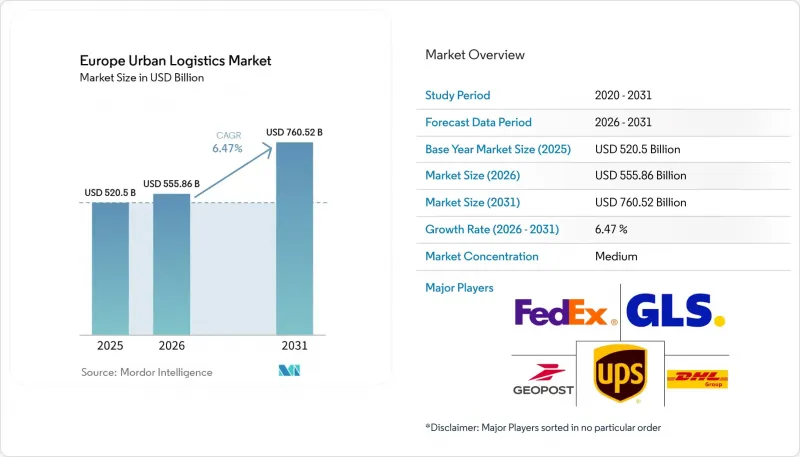
據 Mordor Intelligence 稱,2025 年歐洲城市物流市場價值為 5205 億美元,預計到 2031 年將達到 7605.2 億美元,而 2026 年為 5558.6 億美元,預測期內(2026-2031 年)的複合年成長率預計為 6.47%。
由於小包裹處理集中在人口稠密的城市,以及對更快配送的需求不斷成長,歐洲城市物流市場正在經歷重組。本報告按服務類型(運輸服務、履約服務等)、配送速度(即時達/即時達、隔日達等)、客戶類型(B2B、B2C、C2C)、終端用戶行業(電子商務/零售、食品飲料等)以及國家/地區(英國、德國等)進行細分。市場預測以美元計價。
歐洲城市物流市場的趨勢與洞察
電子商務履約密度
電子商務密度(履約密度)是歐洲城市物流市場的主要驅動力,因為它提高了每條城市路線可處理的配送數量。此外,隨著線上零售活動的活性化,消費者和經銷商能夠接受的配送時限也越來越短。因此,企業正將庫存地點轉向更靠近消費者的地方,而不是增加城市以外路線的運輸能力。 2026年3月,京東旗下的Joybuy平台在歐洲六個市場上線,為倫敦、巴黎和柏林超過1,500萬戶家庭提供當日送達服務。這種服務模式提高了現有承運商和托運人之間競爭的門檻。郊區樞紐在歐洲城市物流市場的重要性日益凸顯,因為在地化營運可以降低單次配送成本。
對當日送達和快速交易的需求
隨著消費者對更廣泛產品類別的快速配送需求日益成長,快速商務正在西歐城市地區迅速擴張。 Flink 於 2026 年 3 月融資 1 億美元,在德國和荷蘭經營 160 個履約中心,平均客單價超過 45 歐元(52.90 美元)。其精準的擴大策略表明,高密度營運和嚴格的樞紐選擇仍然是盈利的關鍵。因此,歐洲城市物流市場需要小規模的配送中心,以便將庫存更貼近需求,即使與傳統倉儲營運的經濟效益不符。當日送達的需求正從食品雜貨擴展到時尚、電子產品和醫療保健等領域。這為能夠透過單一區域網路處理各種小包裹類型的企業擴大了基本客群。
司機短缺和工資上漲
即使貨運需求疲軟,勞動力短缺仍是歐洲城市物流市場面臨的結構性限制。歐洲議會研究辦公室已將道路運輸工人的工作條件列為歐洲持續存在的政策和勞工問題。不斷上漲的工資壓力對依賴靈活本地勞動力的中小型運輸企業而言尤其具有挑戰性。這些企業也面臨著改用電動車和合規認證的成本。這些壓力可能會降低它們在城市地區合約競爭中的競爭力。由於勞動力供應仍然有限,擁有更豐富資源的大規模運輸網路可能會佔據更有利的地位。
細分市場分析
至2025年,依服務類型分類,運輸服務佔歐洲城市物流市場規模的38.71%。幹線運輸、末端貨車運輸和宅配網路仍然是都市區小包裹遞送的營運基礎。每日小包裹處理量支撐著跨城物流業務的成長。然而,由於人事費用、車輛監管合規要求以及提高路線密度的需求,利潤率面臨壓力。與從遠距離設施進行單段配送相比,從微型樞紐進行整合配送可以提高區域配送的經濟效益。隨著零售商和食品雜貨企業將揀貨和包裝轉移到面積小於4000平方米的城市設施,履約服務的重要性日益凸顯。
預計到2031年,逆向物流服務將以8.39%的複合年成長率成長,成為所有服務類別中成長最快的領域。生產者延伸責任制(EPR)架構和永續產品生態設計法規的實施,使得電子產品、紡織品和包裝材料整體有據可查的回收流程的需求日益成長。法國將於2025年強制實施紡織品回收,德國也將推出更嚴格的塑膠包裝回收目標,這些都促使都市區的回收、分類和再交易活動日益增加。歐洲城市物流產業可以透過區域樞紐的退貨處理來應對這些物流流動。多承運商的退貨處理能力既能滿足合規要求,又能透過再交易實現價值回收。
到2025年,標準配送將佔據歐洲城市物流市場的76.90%。由於其規模龐大,路線密度、配送成功率和每公里成本成為影響大批量配送獲利能力的關鍵營運指標。次日達對於B2B運輸和對時間要求嚴格的消費者訂單仍然至關重要。它允許收取服務溢價,而無需即時達那樣進行大規模的基礎設施投資。在訂閱零售和生鮮配送服務中,準時配送仍然非常重要,因為可靠性比速度更為重要。
預計到2031年,即時和當日送達服務將以7.56%的複合年成長率成長。平台間的競爭以及消費者對快速生鮮配送體驗的提升,是推動人口密集城市這項成長的主要動力。微型配送中心、路線規劃系統以及電動貨運自行車等技術正助力這一配送領域蓬勃發展,這些技術也可用於普通配送。倫敦城市微型配送中心聯盟正利用改造後的停車場和鐵路拱橋場地,力求2026年實現超過一百萬次的環保小包裹配送。在配送量集中於都市區,投資高速配送基礎設施能有效提升高階配送和普通配送的營運效率。
其他好處:
- Excel格式的市場預測(ME)表
- 3個月的分析師支持
目錄
第1章:引言
- 研究假設和市場定義
- 調查範圍
第2章:調查方法
第3章執行摘要
第4章 市場狀況
- 市場概況及城市物流的重要性
- 市場促進因素
- 電子商務履約密度
- 擴大自宅配櫃和PUDO網路
- 對當日送達和快速交易的需求
- 零排放區的車輛遷移
- 將閒置的店面和停車場改造成微型中心。
- 基於人工智慧的區域路線規劃和最佳化的停靠時間。
- 市場限制因素
- 促進要素短缺和工資上漲
- 進入都市區的限制以及合規成本
- 城市地區物流地產短缺
- 不同的路邊停車規定和零排放區規則
- 產業法規結構
- 價值鍊和分銷管道的結構分析
- 城市物流技術的大趨勢和結構性變化
- 波特五力分析
- 成本結構分析
- 城市基礎設施評估
- 永續性和綠色物流
- 地緣政治事件對供應鏈變化的影響
第5章 市場規模及成長預測(價值,2026-2031 年)
- 按服務類型
- 交通運輸服務
- 倉儲和城市儲存服務
- 履約服務
- 逆向物流服務
- 加值物流(VAL)服務
- 配送速度
- 即時出貨及當日送達
- 隔日送達
- 預定交付
- 標準配送
- 依客戶類型
- 企業對企業 (B2B) 交易
- B2C(Business-to-Consumer)
- 個人對個人(C2C)交易
- 按最終用途行業分類
- 電子商務與零售
- 食品/飲料
- 醫療和藥品
- 家用電子產品
- 時尚與服裝
- 汽車零件
- 工業和製造業
- 其他
- 國家
- 英國
- 德國
- 法國
- 西班牙
- 義大利
- 比利時
- 荷蘭
- 波蘭
- 北歐國家(丹麥、芬蘭、冰島、挪威、瑞典)
- 其他歐洲國家
第6章 競爭情勢
- 市場集中度
- 關鍵策略趨勢
- 市佔率分析
- 公司簡介
- DHL Group
- GeoPost SA
- GLS Group
- United Parcel Service, Inc.
- FedEx Corporation
- DSV A/S
- Kuehne+Nagel International AG
- GEODIS SA
- CEVA Logistics AG
- DACHSER SE
- Rhenus SE & Co. KG
- GXO Logistics, Inc.
- ID Logistics Group
- STEF SA
- InPost SA
- Poste Italiane SpA
- Koninklijke PostNL NV
- PostNord AB
- Posten Bring AS
- bpost SA/NV
- Correos Express Paqueteria Urgente, SA, SME
- Amazon Logistics
第7章 市場機會與未來展望
According to Mordor Intelligence, the Europe urban logistics market size was valued at USD 520.50 billion in 2025 and is estimated to grow from USD 555.86 billion in 2026 to reach USD 760.52 billion by 2031, at a CAGR of 6.47% during the forecast period (2026-2031).
The Europe urban logistics market is being reshaped as parcel volumes concentrate in dense cities and delivery expectations become shorter. This report is Segmented by Service Type (Transportation Services, Fulfillment Services, and More), by Delivery Speed (Instant and Same-Day Delivery, Next-Day Delivery, and More), by Customer Type (B2B, B2C, and C2C), by End-Use Industry (E-Commerce and Retail, Food and Beverage, and More), and by Country (United Kingdom, Germany, and More). The Market Forecasts are Provided in Terms of Value (USD).
Europe Urban Logistics Market Trends and Insights
E-Commerce Fulfillment Density
E-commerce density is a central driver of the European urban logistics market because it increases the number of deliveries that can be served from each urban route. Higher online retail activity also reduces the delivery window that shoppers and merchants consider acceptable. Operators are therefore moving inventory closer to consumers instead of adding capacity to routes from outer-city locations. The March 2026 launch of JD.com's Joybuy platform in 6 European markets offered same-day delivery to more than 15 million households in London, Paris, and Berlin. This service model raises the competitive standard for established carriers and their shipper relationships. Dense local operations can reduce the cost per drop, which makes city-adjacent sites more important for the Europe urban logistics market.
Same-Day and Quick-Commerce Demand
Quick commerce is expanding across Western European cities as consumers expect short delivery windows for more purchase categories. Flink operated 160 fulfillment hubs across Germany and the Netherlands, with an average basket value above EUR 45.0 (USD 52.9), when it raised USD 100.0 million in March 2026. The company's targeted expansion approach showed that dense operations and disciplined hub selection remained important to profitability. The European urban logistics market, therefore, needs smaller sites that can place inventory near demand, even when those sites do not fit traditional warehouse economics. Same-day expectations are extending from grocery to fashion, consumer electronics, and healthcare. This broadens the customer base for operators that can handle different parcel types through one local network.
Driver Shortages and Wage Inflation
A limited workforce remains a structural constraint for the European urban logistics market, even when freight demand weakens. The European Parliament Research Service identified road transport workforce conditions as a continuing policy and labor issue across Europe. Rising wage pressure can be especially difficult for smaller carriers that depend on flexible local labor. Smaller operators also face the costs of electric vehicle replacement and compliance certification at the same time. These pressures can reduce their ability to compete for city-center contracts. Scaled networks with deeper resources may gain a stronger position as labor availability remains limited.
Other drivers and restraints analyzed in the detailed report include:
- Zero-Emission-Zone Fleet Transition
- AI-Enabled Zonal Routing and Curb-Time Optimization
- Urban Access Restrictions and Compliance Costs
For complete list of drivers and restraints, kindly check the Table Of Contents.
Segment Analysis
Transportation services held 38.71% of the Europe urban logistics market size by service type in 2025. Linehaul, last-mile van operations, and courier networks remained the operational base of urban parcel delivery. The scale of routine parcel supported the segment's volume position flows across cities. Still, margins faced pressure from labor costs, vehicle compliance requirements, and the need for higher route density. Consolidated dispatch from micro-hubs can improve the economics of local delivery compared with single-leg operations from distant facilities. Fulfillment Services became more important as retailers and grocery operators shifted picking and packing into city-core sites below 4,000 m2.
Reverse logistics services is forecast to expand at an 8.39% CAGR through 2031, the fastest rate among service types. Extended producer responsibility frameworks and the Ecodesign for Sustainable Products Regulation are increasing the need for documented recovery processes across electronics, textiles, and packaging. Mandatory textile collection obligations in France during 2025 and tighter plastic packaging collection targets in Germany added collection, sorting, and re-commerce activities within cities. The Europe urban logistics industry can support these flows through returns processing at local hubs. Multi-carrier returns capability can serve both compliance needs and the value recovery from recommerce.
Standard delivery held 76.90% of the Europe urban logistics market share in 2025. Its scale made route density, drop rates, and cost per kilometer important operating measures that can affect earnings across large delivery volumes. Next-day delivery retained a strong role in B2B shipments and time-sensitive consumer orders. It can command a service premium without the full infrastructure demands of instant delivery. Scheduled delivery also remained relevant for subscription retail and grocery services, where reliability was more important than speed.
Instant and same-day delivery is forecast to expand at a 7.56% CAGR through 2031. Platform competition and consumer experience with rapid grocery delivery are supporting this growth in dense cities. This delivery tier benefits from micro-hubs, routing systems, and electric cargo bikes that can also support standard delivery. The Urban Microhub Alliance in London targeted more than 1 million green parcel deliveries in 2026 from repurposed parking and railway-arch sites. Investment in speed-tier infrastructure can improve both premium and standard delivery operations when volumes are concentrated in city areas.
Complete Report Scope:
- By Service Type
- Transportation Services
- Warehousing and Urban Storage Services
- Fulfillment Services
- Reverse Logistics Services
- Value-Added Logistics (VAL) Services
- By Delivery Speed
- Instant and Same-Day Delivery
- Next-Day Delivery
- Scheduled Delivery
- Standard Delivery
- By Customer Type
- Business-to-Business (B2B)
- Business-to-Consumer (B2C)
- Consumer-to-Consumer (C2C)
- By End-Use Industry
- E-commerce and Retail
- Food and Beverage
- Healthcare and Pharmaceuticals
- Consumer Electronics
- Fashion and Apparel
- Automotive Parts
- Industrial and Manufacturing
- Others
- By Country
- United Kingdom
- Germany
- France
- Spain
- Italy
- Belgium
- Netherlands
- Poland
- NORDICS (Denmark, Finland, Iceland, Norway, and Sweden)
- Rest of Europe
List of Companies Covered in this Report:
- DHL Group
- GeoPost SA
- GLS Group
- United Parcel Service, Inc.
- FedEx Corporation
- DSV A/S
- Kuehne + Nagel International AG
- GEODIS SA
- CEVA Logistics AG
- DACHSER SE
- Rhenus SE & Co. KG
- GXO Logistics, Inc.
- ID Logistics Group
- STEF SA
- InPost SA
- Poste Italiane S.p.A.
- Koninklijke PostNL NV
- PostNord AB
- Posten Bring AS
- bpost SA/NV
- Correos Express Paqueteria Urgente, SA, SME
- Amazon Logistics
Additional Benefits:
- The market estimate (ME) sheet in Excel format
- 3 months of analyst support
TABLE OF CONTENTS
1 Introduction
- 1.1 Study Assumptions and Market Definition
- 1.2 Scope of the Study
2 Research Methodology
3 Executive Summary
4 Market Landscape
- 4.1 Market Overview and Importance of Urban Logistics
- 4.2 Market Drivers
- 4.2.1 E-Commerce Fulfillment Density
- 4.2.2 Expansion of Parcel-Locker and PUDO Networks
- 4.2.3 Same-Day and Quick-Commerce Demand
- 4.2.4 Zero-Emission-Zone Fleet Transition
- 4.2.5 Reuse of Vacant Retail and Parking Assets as Micro-Hubs
- 4.2.6 AI-Enabled Zonal Routing and Curb-Time Optimization
- 4.3 Market Restraints
- 4.3.1 Driver Shortages and Wage Inflation
- 4.3.2 Urban Access Restrictions and Compliance Costs
- 4.3.3 Scarcity of Inner-City Logistics Real Estate
- 4.3.4 Fragmented Curbside and Zero-Emission-Zone Rules
- 4.4 Industry Regulatory Framework
- 4.5 Value Chain and Distribution Channel Architecture Analysis
- 4.6 Technology Megatrends and Structural Shifts in Urban Logistics
- 4.7 Porter's Five Forces Analysis
- 4.7.1 Threat of New Entrants
- 4.7.2 Bargaining Power of Suppliers
- 4.7.3 Bargaining Power of Buyers
- 4.7.4 Threat of Substitutes
- 4.7.5 Rivalry Among Competitors
- 4.8 Cost Structure Analysis
- 4.9 Urban Infrastructure Assessment
- 4.10 Sustainability and Green Logistics
- 4.11 Impact of Geo-Political Events on Supply Chain Shifts
5 Market Size and Growth Forecasts (Value, 2026-2031)
- 5.1 By Service Type
- 5.1.1 Transportation Services
- 5.1.2 Warehousing and Urban Storage Services
- 5.1.3 Fulfillment Services
- 5.1.4 Reverse Logistics Services
- 5.1.5 Value-Added Logistics (VAL) Services
- 5.2 By Delivery Speed
- 5.2.1 Instant and Same-Day Delivery
- 5.2.2 Next-Day Delivery
- 5.2.3 Scheduled Delivery
- 5.2.4 Standard Delivery
- 5.3 By Customer Type
- 5.3.1 Business-to-Business (B2B)
- 5.3.2 Business-to-Consumer (B2C)
- 5.3.3 Consumer-to-Consumer (C2C)
- 5.4 By End-Use Industry
- 5.4.1 E-commerce and Retail
- 5.4.2 Food and Beverage
- 5.4.3 Healthcare and Pharmaceuticals
- 5.4.4 Consumer Electronics
- 5.4.5 Fashion and Apparel
- 5.4.6 Automotive Parts
- 5.4.7 Industrial and Manufacturing
- 5.4.8 Others
- 5.5 By Country
- 5.5.1 United Kingdom
- 5.5.2 Germany
- 5.5.3 France
- 5.5.4 Spain
- 5.5.5 Italy
- 5.5.6 Belgium
- 5.5.7 Netherlands
- 5.5.8 Poland
- 5.5.9 NORDICS (Denmark, Finland, Iceland, Norway, and Sweden)
- 5.5.10 Rest of Europe
6 Competitive Landscape
- 6.1 Market Concentration
- 6.2 Key Strategic Moves
- 6.3 Market Share Analysis
- 6.4 Company Profiles (includes Global level Overview, Market level overview, Core Segments, Financials as available, Strategic Information, Geographic Presence, Products and Services, and Recent Developments)
- 6.4.1 DHL Group
- 6.4.2 GeoPost SA
- 6.4.3 GLS Group
- 6.4.4 United Parcel Service, Inc.
- 6.4.5 FedEx Corporation
- 6.4.6 DSV A/S
- 6.4.7 Kuehne + Nagel International AG
- 6.4.8 GEODIS SA
- 6.4.9 CEVA Logistics AG
- 6.4.10 DACHSER SE
- 6.4.11 Rhenus SE & Co. KG
- 6.4.12 GXO Logistics, Inc.
- 6.4.13 ID Logistics Group
- 6.4.14 STEF SA
- 6.4.15 InPost SA
- 6.4.16 Poste Italiane S.p.A.
- 6.4.17 Koninklijke PostNL NV
- 6.4.18 PostNord AB
- 6.4.19 Posten Bring AS
- 6.4.20 bpost SA/NV
- 6.4.21 Correos Express Paqueteria Urgente, SA, SME
- 6.4.22 Amazon Logistics
7 Market Opportunities and Future Outlook
- 7.1 White-space and Unmet-Need Assessment

 全球災害救援物流市場(2026-2030 年)
 寵物物流市場:全球市場預測,2026-2032年
 本地配送網路市場預測至2034年-按服務地點類型、網路模型、服務、技術、位置類型和區域分類的全球分析伸縮式整平機市場:全球市場預測,2026-2032年2026-2030年全球工業物流市場2026-2030年全球電子商務及物流市場城市物流市場預測至2034年-按服務類型、配送模式、車輛類型、技術、最終用戶和地區分類的全球分析智慧物流市場預測至2034年-按解決方案類型、技術、部署模式、組織規模、最終用戶和地區分類的全球分析
 JIT(即時)物流市場規模、佔有率和成長分析:按服務類型、運輸方式、最終用戶、公司規模、部署和地區分類 - 行業預測,2026-2033 年碼頭邊緣整平機市場:全球市場預測,2026-2032年