


 |
市場調查報告書
商品編碼
2163328
兒童水瓶:市場佔有率分析、行業趨勢和統計數據、成長預測(2026-2031)Kids' Water Bottle - Market Share Analysis, Industry Trends & Statistics, Growth Forecasts (2026 - 2031) |
||||||

※ 本網頁內容可能與最新版本有所差異。詳細情況請與我們聯繫。
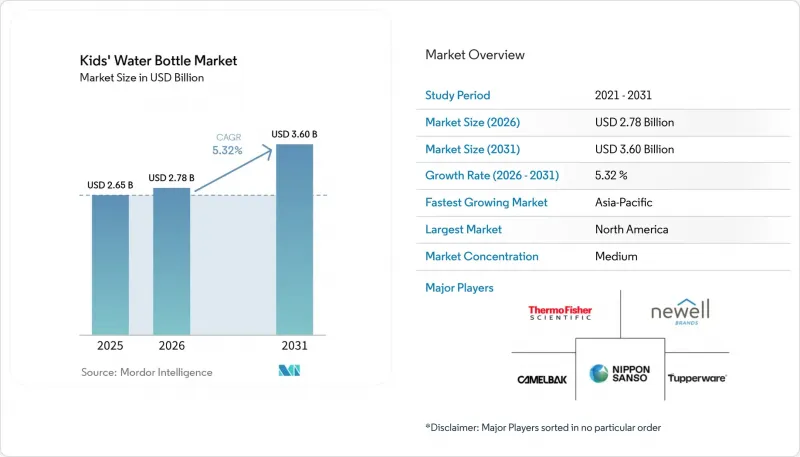
根據 Mordor Intelligence 預測,兒童水瓶市場規模將從 2025 年的 26.5 億美元和 2026 年的 27.8 億美元成長到 2031 年的 36 億美元,2026 年至 2031 年的複合年成長率為 5.32%。
全球兒童水瓶市場趨勢及洞察
人們越來越傾向於選擇可重複使用的水瓶
由於地方政府的塑膠法規和學校採購政策,可重複使用的水瓶正逐漸成為家庭的常見選擇。歐盟關於包裝和包裝廢棄物的法規2025/40於2025年2月11日生效,並將於2026年8月12日起實施。該法規鼓勵零售商和學校負責人優先考慮耐用飲料容器,因為其可再生要求。 2026年4月,印度國家綠色法院就學校強制使用塑膠水瓶而非金屬水瓶的規定啟動了一項例行聽證會。這次聽證會表明,人們越來越支持在學校採購中使用非塑膠替代品。來自學校、夏令營和日託中心的訂單受短期價格波動的影響較小,這可能比個人零售購買更能穩定地推動兒童水瓶市場的銷售。人們對塑膠污染的日益關注也促使家長們轉向使用可重複使用的替代品,這些替代品能夠經受住日常頻繁使用。不銹鋼和其他耐用材料因其使用壽命長且能減少對一次性塑膠的依賴而備受關注。防漏蓋、輕巧、易於清潔以及兒童友善設計等特性也進一步影響消費者的購買決策。隨著環保意識與日常家庭消費的連結日益緊密,這些趨勢預計將持續推動可重複使用兒童水瓶的需求。
參與運動和戶外活動的人數增加
有組織的體育運動和戶外活動正在推動兒童水壺的需求成長,尤其是那些具備適合運動使用功能的兒童水壺。根據「健康人群2030」計劃,到2024年,美國6至17歲兒童參與有組織的體育運動的比例將達到58%,朝著2030年63%的目標邁進。戶外產業協會報告稱,到2025年,青少年參與戶外活動的比例將增加5.6%。健行、露營和釣魚等活動越來越受到有孩子的家庭的歡迎。對於這些活動,容量在350至500毫升之間、帶有防漏翻蓋吸管的輕便保溫水壺更受歡迎。隨著這類產品在體育相關銷售管道的普及,兒童水壺市場的應用場景也從學校擴展到了學校以外的領域。家長們越來越重視輕盈、耐用、易於攜帶的設計,這些水壺能夠經受住頻繁的戶外活動和意外跌落的考驗。運動隊伍、夏令營和休閒活動也為品牌產品和大宗購買提供了更多機會。隨著家長尋求方便日常重複使用的產品,可放入洗碗機清洗的材質和易於清潔的部件的需求日益成長。為了順應這些趨勢,製造商們正在開發兼具便攜性、耐用性、保溫性和兒童友善性等特點的水瓶,以滿足運動和戶外活動的需求。
高檔水瓶和不鏽鋼水瓶價格昂貴
高昂的價格阻礙了需要為多個孩子購買水瓶的家庭的普及。不鏽鋼保溫水瓶的價格通常比標準的不含雙酚A的塑膠水瓶高出100%到250%,而智慧水瓶的價格則可能高出150%到300%。對於低收入家庭和需要頻繁更換的市場而言,這種價格差異難以接受。在印度和巴西,大眾市場擁有最廣泛的需求基礎,價格敏感度仍然是一個重要因素。因此,在兒童水瓶市場,高級產品的客戶群主要集中在高所得的都市區。對於需要購買多個水瓶的家庭來說,這種價格差異會造成更大的負擔,尤其是對於那些因丟失、損壞或孩子成長過程中需求變化而需要頻繁更換的產品而言。因此,對於那些希望將高級產品銷售管道拓展到富裕都市區消費者以外的製造商來說,價格負擔仍然是至關重要的考量。
細分市場分析
2025年,塑膠憑藉其低成本、輕巧和設計靈活等優勢,佔據了兒童水瓶市場37.84%的最大佔有率。不銹鋼成為第二大材料,這主要得益於消費者對耐用性、隔熱性和化學惰性的需求。鋁製水瓶輕巧且可回收,因此仍頗具吸引力,尤其受到永續性的消費者的青睞。 Tritan、矽膠和混合複合複合材料則滿足了諸如抗衝擊性和柔軟性等特定需求。不含雙酚A (BPA) 的Tritan和食品級聚丙烯作為受監管的聚碳酸酯產品的替代品,正變得越來越受歡迎。塑膠水瓶在大眾零售通路的廣泛普及以及其色彩鮮豔、卡通主題設計的適用性,進一步推動了塑膠水瓶的流行。
鋁預計將成為成長最快的材料,2026年至2031年間的複合年成長率將達到6.01%,主要得益於其可回收性和與循環經濟理念的契合。 SIGG公司正在推廣其「WMB ONE Kids」鋁製水瓶,重點強調其可回收性以及不含雙酚A(BPA)、鄰苯二甲酸酯和類雌激素物質。不銹鋼因其耐用性和隔熱性能,預計將繼續受益於市場需求,尤其是在高級產品和可重複使用產品領域。消費者對持久耐用、永續材料日益成長的興趣預計將在預測期內進一步推動對鋁和不銹鋼產品的需求。
區域分析
2025年,北美市場規模佔全球的40.37%。該地區受益於成熟的返校季消費、青少年體育設施以及學區和夏令營的採購。 「健康人群2030」計畫旨在2030年將青少年體育參與率提高到63%,高於2024年的58%。根據加拿大2025年的報告,56%的兒童和青少年在教練或指導員的指導下參與了體育或身體活動。 YETI、CamelBak、Hydro Flask、Contigo和Nalgene等品牌在該地區擁有顯著的市場佔有率。
預計到2031年,亞太地區的複合年成長率將達到6.28%,是所有地區中最高的。中國既是該地區的生產基地,也是主要的消費國,到2026年,電子商務將在兒童水瓶零售額中佔據很大比例。家長們正在利用數位市場和社群電商平台尋找正版授權的高階產品。印度國家綠色法院將於2026年4月舉行關於學校水瓶政策的聽證會,顯示人們對非塑膠飲水方式的支持正在不斷成長。在日本和韓國,便於放入書包的保溫水瓶的需求旺盛。印尼、越南和菲律賓學校所進行的飲水宣傳活動可能會促進學校對基本款可重複使用水瓶的訂單。
歐洲在安全性和永續性要求影響材料選擇方面佔有重要地位。 EN 14350 標準規定了兒童飲水用具的化學安全性、機械完整性和窒息風險。這些要求有利於能夠滿足詳細產品標準的供應商,並限制低成本、不合規的進口產品。 SIGG 在德國和瑞士的業務反映了該地區對鋁製品和安全認證塑膠製品的濃厚興趣。南美洲、中東和非洲仍是規模較小、以銷量為主導的地區,大眾市場塑膠製品較為普遍。在巴西和南非,隨著現代零售業的擴張和家長對材料安全性的日益重視,都市區對高級產品的需求正在迅速成長。
其他好處:
- Excel格式的市場預測(ME)表
- 3個月的分析師支持
目錄
第1章:引言
- 研究假設和市場定義
- 調查範圍
第2章:調查方法
第3章執行摘要
第4章 市場狀況
- 市場概覽
- 市場促進因素
- 對可重複使用水瓶的需求日益成長
- 參與運動和戶外活動的人數增加
- 對兒童安全材料的需求日益成長
- 對符合人體工學和兒童友善設計的需求日益成長。
- 智慧補水解決方案的廣泛應用
- 對保溫瓶和保溫瓶的需求日益成長。
- 市場限制因素
- 高檔瓶子和不銹鋼瓶價格昂貴
- 食品接觸材料和產品安全方面有嚴格的規定。
- 來自低價非專利藥的激烈競爭
- 人們越來越關注塑膠的安全性和環境影響
- 消費行為分析
- 監理情勢
- 技術展望
- 波特五力分析
第5章 市場規模與成長預測
- 材料
- 塑膠
- 不銹鋼
- 鋁
- 其他材料
- 按價格範圍
- 鱒魚
- 優質的
- 透過分銷管道
- 超級市場和大賣場
- 健康美容商店
- 線上零售商店
- 其他分銷管道
- 按地區
- 北美洲
- 美國
- 加拿大
- 墨西哥
- 其他北美國家
- 歐洲
- 德國
- 英國
- 義大利
- 法國
- 西班牙
- 荷蘭
- 波蘭
- 比利時
- 瑞典
- 其他歐洲國家
- 亞太地區
- 中國
- 印度
- 日本
- 澳洲
- 印尼
- 韓國
- 泰國
- 新加坡
- 其他亞太國家
- 南美洲
- 巴西
- 阿根廷
- 哥倫比亞
- 智利
- 秘魯
- 其他南美國家
- 中東和非洲
- 南非
- 沙烏地阿拉伯
- 阿拉伯聯合大公國
- 奈及利亞
- 埃及
- 摩洛哥
- 土耳其
- 其他中東和非洲國家
- 北美洲
第6章 競爭情勢
- 市場集中度
- 策略趨勢
- 市佔率分析
- 公司簡介
- CamelBak Products, LLC
- Nippon Sanso Holdings Corporation
- Newell Brands
- Thermo Fisher Scientific
- Tupperware Brands Corporation
- Zojirushi Corporation
- Helen of Troy Limited
- Think Better Group
- LocknLock Co., Ltd.
- SIGG Switzerland AG
- Hamilton Housewares Private Limited
- Borosil Limited
- Luv n'care, Ltd.
- Aydya Limited
- YETI Holdings, Inc.
- Trove Brands
- Takeya USA
- WHY Brands Inc.
- air up GmbH
- Miniland SA
第7章 市場機會與未來展望
According to Mordor Intelligence, the kids' water bottle market size is projected to expand from USD 2.65 billion in 2025 and USD 2.78 billion in 2026 to USD 3.60 billion by 2031, registering a CAGR of 5.32% between 2026 to 2031.
Global Kids' Water Bottle Market Trends and Insights
Increasing Preference for Reusable Water Bottles
Municipal plastic restrictions and school purchasing policies are making reusable bottles a more regular purchase for families. Regulation (EU) 2025/40 on packaging and packaging waste entered into force on February 11, 2025, and applies from August 12, 2026. Its recyclability requirements encourage retailers and school buyers to favor durable drinkware. India's National Green Tribunal began suo motu proceedings in April 2026 concerning schools that required plastic rather than metal bottles. The proceeding points to stronger support for non-plastic choices in school purchasing. School, summer-camp, and daycare orders can provide the kids water bottles market with steadier volumes than individual retail purchases because they are less sensitive to short-term price changes. Growing awareness of plastic pollution is also encouraging parents to shift toward reusable alternatives that can withstand frequent daily use. Stainless steel and other durable materials are gaining attention because they combine longevity with lower reliance on disposable plastics. Features such as leak-proof lids, lightweight construction, easy cleaning, and child-friendly designs are further influencing purchasing decisions. These trends are expected to support sustained demand for reusable kids' water bottles as environmental awareness becomes more closely linked with everyday family consumption.
Rising Participation in Sports and Outdoor Activities
Organized sports and outdoor use support demand for children's bottles with features suited to active use. The Healthy People 2030 program reported that 58% of United States children ages 6-17 participated in organized sports in 2024, against a 2030 target of 63%. The Outdoor Industry Association reported a 5.6% increase in youth outdoor participation during 2025. Hiking, camping, and fishing participation rose among families with children. These uses favor compact insulated bottles with spill-resistant flip straws and capacities of 350-500 ml. As these formats become more common in sports channels, the kids water bottles market gains use cases beyond the school day. Parents increasingly prioritize lightweight, durable, and easy-to-carry designs that can withstand frequent outdoor activity and accidental drops. Sports teams, camps, and recreational programs also provide additional opportunities for branded and bulk bottle purchases. Demand for dishwasher-safe materials and easy-clean components is increasing as parents seek convenient products for repeated daily use. These trends are encouraging manufacturers to develop bottles that combine portability, durability, insulation, and child-friendly functionality for both sports and outdoor activities.
High Prices of Premium and Stainless-Steel Bottles
Premium pricing limits adoption among families that need to buy bottles for more than one child. Stainless steel insulated models typically command a 100%-250% premium over standard BPA-free plastic bottles, while smart bottles can carry a 150%-300% premium. This cost difference is difficult to justify in lower-income households and in markets where replacement purchases are frequent. Price sensitivity remains important in India and Brazil, where the mass tier holds the broadest demand base. The kids water bottles market therefore has a smaller premium customer pool outside higher-income urban households. The higher price premium becomes more significant for families purchasing multiple bottles, particularly when products require frequent replacement due to loss, damage, or changing age requirements. As a result, affordability remains a key consideration for manufacturers seeking to expand premium products beyond affluent urban consumers.
Other drivers and restraints analyzed in the detailed report include:
- Growing Demand for Child-Safe Materials
- Increasing Demand for Insulated and Temperature-Retaining Bottles
- Growing Concerns Regarding Plastic Safety and Environmental Impact
For complete list of drivers and restraints, kindly check the Table Of Contents.
Segment Analysis
Plastic held the largest share of the kids water bottles market at 37.84% in 2025, supported by its low cost, lightweight properties, and design flexibility. Stainless steel was the second-largest material, driven by demand for durability, insulation, and chemical inertness. Aluminum remains an attractive alternative for lightweight and recyclable bottles, particularly among sustainability-focused buyers. Tritan, silicone, and hybrid composites serve niche needs such as shatter resistance and flexibility. BPA-free Tritan and food-grade polypropylene are gaining preference over restricted polycarbonate-type products. The broad availability of plastic bottles across mass-market retail channels and their suitability for colorful, character-based designs further reinforce their widespread adoption.
Aluminum is projected to be the fastest-growing material, with a 6.01% CAGR from 2026 to 2031, supported by recyclability and alignment with circular-economy initiatives. SIGG promotes its WMB ONE Kids aluminium bottle around recyclability and the absence of BPA, phthalates, and estrogen-mimicking substances. Stainless steel will continue benefiting from its durability and insulation performance, particularly in premium and reusable formats. Growing consumer interest in long-lasting, sustainable materials is expected to strengthen demand for aluminum and stainless steel products during the forecast period.
Complete Report Scope:
- By Material
- Plastic
- Stainless Steel
- Aluminium
- Other Materials
- By Price Range
- Mass
- Premium
- By Distribution Channel
- Supermarkets/Hypermarkets
- Health and Beauty Stores
- Online Retail Stores
- Other Distribution Channels
- By Geography
- North America
- United States
- Canada
- Mexico
- Rest of North America
- Europe
- Germany
- United Kingdom
- Italy
- France
- Spain
- Netherlands
- Poland
- Belgium
- Sweden
- Rest of Europe
- Asia-Pacific
- China
- India
- Japan
- Australia
- Indonesia
- South Korea
- Thailand
- Singapore
- Rest of Asia-Pacific
- South America
- Brazil
- Argentina
- Colombia
- Chile
- Peru
- Rest of South America
- Middle East and Africa
- South Africa
- Saudi Arabia
- United Arab Emirates
- Nigeria
- Egypt
- Morocco
- Turkey
- Rest of Middle East and Africa
- North America
Geography Analysis
North America accounted for 40.37% of global value in 2025. The region benefits from established back-to-school spending, youth sports facilities, and purchasing by school districts and summer camps. The Healthy People 2030 program has a 63% target for youth sports participation by 2030, compared with 58% reported in 2024. Canada reported that 56% of children and youth participated in sports or physical activity with a coach or instructor in its 2025. YETI, CamelBak, Hydro Flask, Contigo, and Nalgene are among the brands with a visible presence in the region.
Asia-Pacific is forecast to grow at a 6.28% CAGR through 2031, the highest rate among regions. China is both a production center and a major regional consumer, with e-commerce representing a significant proportion of its kid's bottle retail sales in 2026. Parents use digital marketplaces and social commerce to discover licensed and premium products. India's April 2026 National Green Tribunal proceedings related to school bottle policies point toward greater support for non-plastic hydration choices. Japan and South Korea show demand for insulated formats designed to fit school bags. Indonesia, Vietnam, and the Philippines have school hydration campaigns that can support institutional orders for basic reusable bottles.
Europe maintains an important position because safety and sustainability requirements influence material selection. The EN 14350 standard addresses chemical safety, mechanical integrity, and choking hazards for children's drinking equipment. These requirements favor suppliers that can meet detailed product standards and can limit low-cost noncompliant imports. SIGG's position in Germany and Switzerland reflects regional interest in aluminum and certified-safe plastic products. South America and the Middle East and Africa remain smaller and more volume-oriented areas, where mass-tier plastic is common. Brazil and South Africa show early premium demand in urban areas as modern retail expands and parents place more weight on material safety.
- CamelBak Products, LLC
- Nippon Sanso Holdings Corporation
- Newell Brands
- Thermo Fisher Scientific
- Tupperware Brands Corporation
- Zojirushi Corporation
- Helen of Troy Limited
- Think Better Group
- LocknLock Co., Ltd.
- SIGG Switzerland AG
- Hamilton Housewares Private Limited
- Borosil Limited
- Luv n' care, Ltd.
- Aydya Limited
- YETI Holdings, Inc.
- Trove Brands
- Takeya USA
- WHY Brands Inc.
- air up GmbH
- Miniland S.A.
Additional Benefits:
- The market estimate (ME) sheet in Excel format
- 3 months of analyst support
TABLE OF CONTENTS
1 INTRODUCTION
- 1.1 Study Assumptions and Market Definition
- 1.2 Scope of the Study
2 RESEARCH METHODOLOGY
3 EXECUTIVE SUMMARY
4 MARKET LANDSCAPE
- 4.1 Market Overview
- 4.2 Market Drivers
- 4.2.1 Increasing preference for reusable water bottles
- 4.2.2 Rising participation in sports and outdoor activities
- 4.2.3 Growing demand for child-safe materials
- 4.2.4 Increasing demand for ergonomic and child-friendly designs
- 4.2.5 Growing adoption of smart hydration solutions
- 4.2.6 Increasing demand for insulated and temperature-retaining bottles
- 4.3 Market Restraints
- 4.3.1 High prices of premium and stainless-steel bottles
- 4.3.2 Strict regulations for food-contact materials and product safety
- 4.3.3 Intense competition from low-priced generic bottles
- 4.3.4 Growing concerns regarding plastic safety and environmental impact
- 4.4 Consumer Behavior Analysis
- 4.5 Regulatory Landscape
- 4.6 Technological Outlook
- 4.7 Porter's Five Forces Analysis
- 4.7.1 Threat of New Entrants
- 4.7.2 Bargaining Power of Buyers/Consumers
- 4.7.3 Bargaining Power of Suppliers
- 4.7.4 Threat of Substitute Products
- 4.7.5 Intensity of Competitive Rivalry
5 MARKET SIZE AND GROWTH FORECASTS (VALUE)
- 5.1 By Material
- 5.1.1 Plastic
- 5.1.2 Stainless Steel
- 5.1.3 Aluminium
- 5.1.4 Other Materials
- 5.2 By Price Range
- 5.2.1 Mass
- 5.2.2 Premium
- 5.3 By Distribution Channel
- 5.3.1 Supermarkets/Hypermarkets
- 5.3.2 Health and Beauty Stores
- 5.3.3 Online Retail Stores
- 5.3.4 Other Distribution Channels
- 5.4 By Geography
- 5.4.1 North America
- 5.4.1.1 United States
- 5.4.1.2 Canada
- 5.4.1.3 Mexico
- 5.4.1.4 Rest of North America
- 5.4.2 Europe
- 5.4.2.1 Germany
- 5.4.2.2 United Kingdom
- 5.4.2.3 Italy
- 5.4.2.4 France
- 5.4.2.5 Spain
- 5.4.2.6 Netherlands
- 5.4.2.7 Poland
- 5.4.2.8 Belgium
- 5.4.2.9 Sweden
- 5.4.2.10 Rest of Europe
- 5.4.3 Asia-Pacific
- 5.4.3.1 China
- 5.4.3.2 India
- 5.4.3.3 Japan
- 5.4.3.4 Australia
- 5.4.3.5 Indonesia
- 5.4.3.6 South Korea
- 5.4.3.7 Thailand
- 5.4.3.8 Singapore
- 5.4.3.9 Rest of Asia-Pacific
- 5.4.4 South America
- 5.4.4.1 Brazil
- 5.4.4.2 Argentina
- 5.4.4.3 Colombia
- 5.4.4.4 Chile
- 5.4.4.5 Peru
- 5.4.4.6 Rest of South America
- 5.4.5 Middle East and Africa
- 5.4.5.1 South Africa
- 5.4.5.2 Saudi Arabia
- 5.4.5.3 United Arab Emirates
- 5.4.5.4 Nigeria
- 5.4.5.5 Egypt
- 5.4.5.6 Morocco
- 5.4.5.7 Turkey
- 5.4.5.8 Rest of Middle East and Africa
- 5.4.1 North America
6 COMPETITIVE LANDSCAPE
- 6.1 Market Concentration
- 6.2 Strategic Moves
- 6.3 Market Share Analysis
- 6.4 Company Profiles (includes Global level Overview, Market level overview, Core Segments, Financials as available, Strategic Information, Market Rank/Share for key companies, Products & Services, and Recent Developments)
- 6.4.1 CamelBak Products, LLC
- 6.4.2 Nippon Sanso Holdings Corporation
- 6.4.3 Newell Brands
- 6.4.4 Thermo Fisher Scientific
- 6.4.5 Tupperware Brands Corporation
- 6.4.6 Zojirushi Corporation
- 6.4.7 Helen of Troy Limited
- 6.4.8 Think Better Group
- 6.4.9 LocknLock Co., Ltd.
- 6.4.10 SIGG Switzerland AG
- 6.4.11 Hamilton Housewares Private Limited
- 6.4.12 Borosil Limited
- 6.4.13 Luv n' care, Ltd.
- 6.4.14 Aydya Limited
- 6.4.15 YETI Holdings, Inc.
- 6.4.16 Trove Brands
- 6.4.17 Takeya USA
- 6.4.18 WHY Brands Inc.
- 6.4.19 air up GmbH
- 6.4.20 Miniland S.A.
7 MARKET OPPORTUNITIES AND FUTURE OUTLOOK

 攜帶式水瓶市場:全球市場預測,2026-2032年
 水瓶市場機會、成長要素、產業趨勢分析及2026-2035年預測。
 保溫杯市場規模、佔有率和成長分析:按材質、容量、杯蓋類型、分銷管道、最終用戶、價格範圍和地區分類-產業預測,2026-2033年
 即飲瓶裝飲料市場規模、佔有率和成長分析:按材質、容量、飲料類型、瓶蓋類型、分銷管道和地區分類-2026-2033年產業預測
 背包式水質淨化器市場規模、佔有率和成長分析:按產品類型、過濾技術、應用、分銷管道和地區分類-2026-2033年產業預測
 環保水瓶市場:依材質、產品類型、銷售管道和地區分類水瓶市場:依產品類型、材料、容量、銷售管道和地區分類。
 纖維瓶市場規模、佔有率和成長分析:按製造技術、材料類型、應用和地區分類-2026-2033年產業預測熱水袋市場:依材質、容量、應用、銷售管道及地區分類
 2026-2030年全球過濾水瓶市場