


 |
市場調查報告書
商品編碼
2157086
視覺引導焊接機器人:市場佔有率分析、行業趨勢和統計數據以及成長預測(2026-2031 年)Vision-Guided Welding Robots - Market Share Analysis, Industry Trends & Statistics, Growth Forecasts (2026 - 2031) |
||||||

※ 本網頁內容可能與最新版本有所差異。詳細情況請與我們聯繫。
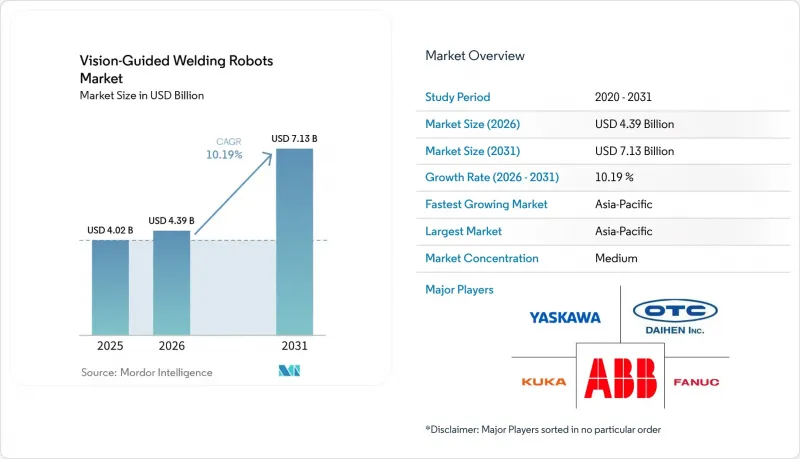
根據 Mordor Intelligence 預測,視覺引導焊接機器人市場將從 2025 年的 40.2 億美元成長到 2026 年的 43.9 億美元,到 2031 年達到 71.3 億美元,2026 年至 2031 年的年複合成長率(CAGR)為 10.19%。
全球視覺引導焊接機器人市場趨勢及洞察
熟練焊工短缺和生產壓力
熟練焊工的短缺使得自動化焊接不再只是提高效率的問題,而更關乎生產力。美國相當一部分焊工即將退休,而焊接行業需要大量新人才的加入才能維持產能。儘管基礎設施、汽車和製造業對焊接能力的需求持續旺盛,但美國的焊接勞動力卻在老化。透過利用視覺引導單元,製造商可以減少對人工示教的依賴,並確保不同班次工作的可重複性。因此,視覺引導焊接機器人市場將惠及那些需要可靠產量但又無法獲得足夠數量合格焊工的工廠。
電動汽車電池機殼和輕質材料的焊接
電動車電池機殼需要精確控制熱輸入、接頭位置和密封性能。雖然鋁製電池組件比同類鋼製組件輕50%,但鋁的熱特性決定了焊接必須格外謹慎。視覺導引雷射焊接和電阻焊接可以輔助焊接定位,即使不同車型電池設計和材料組合各異。在加工鋁製電池機殼時,與傳統的MIG焊接相比,光纖雷射系統可以降低熱輸入。此外,在「電芯到電池包」的電池設計中,由於不同車型的焊接路徑可能不同,固定夾具的價值也隨之降低。這些需求推動了視覺引導焊接機器人市場的發展,高精度連接、氣孔控制和機殼密封是生產中的重中之重。
高昂的電池投資和整合成本
實施視覺引導焊接單元可能需要在機器人、夾具、感測器、校準、工程設計、安全聯鎖裝置和培訓等方面進行投資。承包前期投入成本較高。對於低產量焊接作業而言,這些成本可能導致較長的投資回收期。此外,整合還要求機器人軟體、感測器介面、焊接電源和PLC安全系統之間相容。小規模製造商通常缺乏專門的自動化團隊來管理這些操作。在模組化單元和靈活的資金籌措方案克服這些障礙之前,預計視覺引導焊接機器人市場在大型工廠以外的地區普及速度將較為緩慢。
細分市場分析
到2025年,關節型機器人將佔據視覺引導焊接機器人市場48.11%的佔有率。其六軸運動能力、承重能力範圍以及在汽車車身本體和結構件製造領域長期累積的經驗,都支撐著這一地位。已經在使用關節型機器人的製造商通常可以在升級週期中沿用相同的佈局。這種成熟的經驗減少了為適應新型機器人而重新設計夾具、安全區域和物料輸送的需求。在許多應用領域,協作機器人是第二大傳統機器人類別。它們適用於那些零件系列之間重新定位比最大吞吐量更重要的場景。
預計到2031年,移動式自主焊接機器人將以17.32%的複合年成長率成長。這些機器人能夠移動到固定工作單元無法容納的大型、重型或複雜工件的位置進行焊接。這種方法在造船、能源基礎設施和大型結構製造領域非常有效。 2026年5月,發FANUC)推出了CRX-3iA,這是一款重11公斤的協作機器人,適用於結構和造船應用。操作員即可在輪胎邊緣之間移動工件。此外,如果機械臂在靠近人員的位置操作,則該移動系統必須符合ISO 10218-1標準的要求。
到2025年,2D視覺系統將佔據53.45%的市場。其成本效益高、操作簡便,且在可控光照條件下應用廣泛,這些優勢支撐了其持續發展。在大批量生產的汽車車身工廠中,由於面板形狀可預測且相機對比度可控,2D系統正被廣泛採用。這些系統非常適合電阻點焊和許多電弧焊接線。採用2D系統的視覺引導焊接機器人的市場規模仍取決於標準化的生產環境。另一方面,在接頭形狀、材料界面和表面反射率等因素導致2D對比度不可靠的情況下,3D系統的應用正在不斷增加。
預計到2031年,多模態視覺系統將以14.65%的複合年成長率成長。這些系統結合了多種感測方法,適用於單一攝影機或感測器無法充分控制的應用場景。其主要應用包括電池焊接、航太領域的鈦連接以及電子組裝。 2026年5月,康耐視推出了In-Sight 3900,這是一款用於高速邊緣偵測的高效能人工智慧視覺系統。該系統支援即時生產檢測所需的邊緣處理基礎設施。多模態系統的轉變反映了同時追蹤焊接形狀、熔池狀態和飛濺情況的需求。
區域分析
亞太地區佔據全球總銷量的最大佔有率,預計在預測期內將保持快速成長。中國擁有全球一半以上的工業機器人,且機器人部署量持續成長。在中國,推動機器人運作的主要動力來自電氣和電子產業,其次是汽車產業。日本憑藉其汽車和電子產品生產基地,滿足了對高規格系統的需求。韓國擁有全球最高的機器人密度,並在半導體和汽車供應鏈中應用了視覺整合點焊技術。
印度是全球工業機器人部署量領先的國家之一,在整個預測期內都蘊藏著巨大的區域機會。該國蓬勃發展的汽車、電子、金屬加工和一般製造業預計將進一步推動工業機器人的應用,包括視覺引導焊接系統。亞洲在全球機器人部署量中佔據主導地位,隨著製造商擴大自動化程度以應對勞動力短缺、提高生產一致性並支援大規模生產能力,該地區的機器人部署量正在不斷成長。中國、日本、韓國和印度憑藉其成熟的製造地和對先進自動化技術的持續投入,持續推動區域需求。
加拿大和墨西哥透過汽車供應鏈支撐著北美市場的需求。在墨西哥,工業機器人的安裝數量有所下降,反映出短期內的不確定性。在歐洲,德國、義大利和瑞典仍然是汽車車身本體焊接領域的主要參與者。儘管歐洲的工業機器人安裝數量下降,但德國對高規格焊接單元的需求仍然強勁。在南美洲,農業機械和石油天然氣產業的需求旺盛。在中東和非洲,沙烏地阿拉伯、阿拉伯聯合大公國和南非的需求旺盛,這些國家需要適用於能源、基礎設施、採礦機械和大規模的自主系統。
其他好處:
- Excel格式的市場預測(ME)表
- 3個月的分析師支持
目錄
第1章:引言
- 研究假設和市場定義
- 調查範圍
第2章:調查方法
第3章執行摘要
第4章 市場狀況
- 市場概覽
- 市場促進因素
- 熟練焊工短缺和生產壓力
- 電動汽車電池機殼和輕量材料的焊接
- 工業4.0中的可追溯性和封閉回路型品管
- 降低視覺感測器和邊緣運算的成本。
- 視覺引導自動化,適用於多品種、小批量生產。
- 大型不規則形狀工件的自主焊接
- 市場限制因素
- 高昂的電池投資和整合成本
- 缺乏機器人編程和焊接整合方面的技能
- 電弧眩光、濺鍍、煙霧和反射金屬引起的光學干擾。
- 自適應焊接模型中擬合不均勻和訓練資料有限
- 宏觀經濟因素對市場的影響
- 產業價值與價值鏈分析
- 監理情勢
- 技術展望
- 波特五力分析
第5章 市場規模與成長預測
- 按機器人類型
- 關節機器人
- 協作機器人
- 笛卡兒/龍門機器人
- SCARA機器人
- 移動式/自主式焊接機器人
- 其他類型的機器人
- 視覺科技
- 2D視覺系統
- 3D視覺系統
- 多模態視覺系統
- 透過焊接工藝
- 電弧焊接
- 電阻點焊
- 雷射焊接
- 氬弧焊和等離子焊接
- 其他焊接工藝
- 按有效載荷能力
- 10公斤或以下
- 10~20 kg
- 20~50 kg
- 50公斤或以上
- 透過使用
- 車輛車身及結構件焊接
- 零件和子組件的焊接
- 管道和管材焊接
- 鈑金焊接
- 重型工業焊接
- 精密/微焊接
- 其他用途
- 按最終用戶行業分類
- 汽車和運輸業
- 金屬和機械
- 電氣和電子設備
- 航太/國防
- 造船、能源、基礎設施
- 契約製造和加工車間
- 其他終端用戶產業
- 按地區
- 北美洲
- 美國
- 加拿大
- 墨西哥
- 南美洲
- 巴西
- 阿根廷
- 其他南美國家
- 歐洲
- 德國
- 英國
- 法國
- 義大利
- 西班牙
- 其他歐洲國家
- 亞太地區
- 中國
- 日本
- 印度
- 韓國
- ASEAN
- 其他亞太國家
- 中東和非洲
- 中東
- 沙烏地阿拉伯
- 阿拉伯聯合大公國
- 其他中東國家
- 非洲
- 南非
- 奈及利亞
- 其他非洲國家
- 中東
- 北美洲
第6章 競爭情勢
- 市場集中度
- 策略趨勢
- 市佔率分析
- 公司簡介
- ABB Ltd.
- FANUC Corporation
- Yaskawa Electric Corporation
- KUKA AG
- OTC DAIHEN Inc.
- Kawasaki Heavy Industries, Ltd.
- Panasonic Holdings Corporation
- Comau SpA
- Lincoln Electric Holdings, Inc.
- Trumpf GmbH and Co. KG
- Fronius International GmbH
- Cognex Corporation
- KEYENCE CORPORATION
- SICK AG
- Servo-Robot Inc.
- ESAB Corporation
- Novarc Technologies Inc.
- Inrotech A/S
- Universal Robots A/S
- Nachi-Fujikoshi Corporation
第7章 市場機會與未來展望
According to Mordor Intelligence, the vision-guided welding robots market size is projected to expand from USD 4.02 billion in 2025 to USD 4.39 billion in 2026, and to USD 7.13 billion by 2031, registering a CAGR of 10.19% between 2026 and 2031.
Global Vision-Guided Welding Robots Market Trends and Insights
Skilled Welder Shortages and Throughput Pressure
The shortage of skilled welders makes automated welding a capacity issue rather than solely an efficiency decision. A substantial portion of the US welding workforce is nearing retirement, while the industry requires a significant influx of new professionals to maintain capacity. The active US welder workforce is aging, even as infrastructure, vehicle, and fabrication activities continue to require welding capacity. Manufacturers can use vision-guided cells to reduce dependence on manual path teaching and maintain repeatable work across shifts. The vision-guided welding robots market therefore benefits when factories need reliable output but cannot recruit enough certified welders.
EV Battery Enclosure and Lightweight-Material Welding
Electric vehicle battery enclosures require accurate control of heat input, joint position, and sealing performance. Aluminum battery components can be up to 50% lighter than comparable steel components, but they require careful welding due to aluminum's thermal behavior. Vision-guided laser and resistance welding can support seam positioning where battery designs and material combinations change across vehicle programs. Fiber laser systems can reduce heat input compared with traditional MIG welding in aluminum battery enclosure work. Cell-to-pack battery designs also reduce the value of fixed tooling because seam paths can vary across model lines. These requirements support the Vision-guided welding robots market, where precision joining, porosity control, and enclosure sealing are production priorities.
High Cell Investment and Integration Costs
A vision-guided welding cell may require investment in the robot, fixturing, sensors, calibration, engineering, safety interlocks, and training. Turnkey articulated robot cells with integrated vision systems can involve substantial upfront costs. These costs can extend payback periods for lower-throughput welding operations. Integration also requires compatibility among robot software, sensor interfaces, welding power sources, and PLC safety systems. Smaller fabricators often lack dedicated automation teams to manage this work. The Vision-guided welding robots market faces slower adoption outside high-volume plants until modular cells and flexible financing reduce these barriers.
Other drivers and restraints analyzed in the detailed report include:
- Industry 4.0 Traceability and Closed-Loop Quality Control
- Falling Vision-Sensor and Edge-Compute Costs
- Shortage of Robot-Programming and Welding-Integration Skills
For complete list of drivers and restraints, kindly check the Table Of Contents.
Segment Analysis
Articulated robots held 48.11% of the Vision-guided welding robots market share in 2025. Their six-axis movement, payload range, and long use in automotive body-in-white and structural fabrication support this position. Manufacturers that already use articulated cells can often expand the same layout during replacement cycles. This installed base reduces the need to redesign fixtures, safety areas, and material handling around a new robot type. Collaborative robots are the next large conventional category in many applications. They are used where redeployment across part families is more valuable than maximum throughput.
Mobile and autonomous welding robots are projected to expand at a 17.32% CAGR through 2031. They move the robot to large, heavy, or complex workpieces that cannot enter a fixed cell. This approach is relevant in shipbuilding, energy infrastructure, and large structural fabrication. FANUC launched the CRX-3iA in May 2026 as an 11-kg collaborative robot for structural and shipbuilding applications. One operator can carry the product between weld seams. Mobile systems must also meet the requirements of ISO 10218-1 when robotic arms operate near people.
2D vision systems held 53.45% of the market in 2025. Their cost, simpler operation, and established role in controlled lighting conditions support continued use. High-volume automotive body shops use 2D systems in which panel geometry is predictable, and camera contrast can be managed. These systems are well-suited to resistance spot welding and many arc welding lines. The Vision-guided welding robots market size for 2D systems remains tied to standardized production environments. 3D systems are gaining use where joint geometry, material interfaces, and surface reflectivity make 2D contrast less reliable.
Multimodal vision systems are projected to expand at a 14.65% CAGR through 2031. These systems combine sensing methods for applications where a single camera or sensor cannot provide sufficient control. Battery welding, titanium aerospace joining, and electronics assembly are key uses. Cognex launched the In-Sight 3900 high-performance AI vision system in May 2026 for high-speed edge inspection. The system supports the edge-processing infrastructure needed for real-time production inspection. The shift toward multimodal systems reflects the need to track seam geometry, weld-pool conditions, and spatter simultaneously.
Complete Report Scope:
- By Robot Type
- Articulated Robots
- Collaborative Robots
- Cartesian / Gantry Robots
- SCARA Robots
- Mobile / Autonomous Welding Robots
- Other Robot Types
- By Vision Technology
- 2D Vision Systems
- 3D Vision Systems
- Multimodal Vision Systems
- By Welding Process
- Arc Welding
- Resistance Spot Welding
- Laser Welding
- TIG and Plasma Welding
- Other Welding Processes
- By Payload Capacity
- Up to 10 kg
- 10-20 kg
- 20-50 kg
- Above 50 kg
- By Application
- Body and Structural Welding
- Component and Subassembly Welding
- Pipe and Tube Welding
- Sheet Metal Welding
- Heavy Fabrication Welding
- Precision / Micro-Welding
- Other Applications
- By End-User Industry
- Automotive and Transportation
- Metals and Machinery
- Electrical and Electronics
- Aerospace and Defense
- Shipbuilding, Energy, and Infrastructure
- Contract Manufacturing and Job Shops
- Other End-User Industries
- By Geography
- North America
- United States
- Canada
- Mexico
- South America
- Brazil
- Argentina
- Rest of South America
- Europe
- Germany
- United Kingdom
- France
- Italy
- Spain
- Rest of Europe
- Asia-Pacific
- China
- Japan
- India
- South Korea
- ASEAN
- Rest of Asia-Pacific
- Middle East and Africa
- Middle East
- Saudi Arabia
- United Arab Emirates
- Rest of the Middle East
- Africa
- South Africa
- Nigeria
- Rest of Africa
- Middle East
- North America
Geography Analysis
Asia-Pacific accounted for the largest share of the regional total and is projected to grow rapidly through the forecast period. China accounted for more than half of the global operational industrial robot fleet and saw increased robot installations. Electrical and electronics-led robot installations in China, ahead of automotive. Japan supports demand for high-specification systems through its automotive and electronics production base. South Korea has the highest robot density globally and uses vision-integrated spot welding in semiconductor and automotive supply chains.
India recorded an increase in industrial robot installations and ranked among the leading countries globally, making it an important regional opportunity through the forecast period. The country's expanding automotive, electronics, metal fabrication, and general manufacturing industries are expected to support further adoption of industrial robots, including vision-guided welding systems. Asia accounted for the majority of global robot installations, with regional installations increasing as manufacturers expanded automation to address labor constraints, improve production consistency, and support high-volume manufacturing operations. China, Japan, South Korea, and India continue to drive regional demand through their established manufacturing bases and growing investments in advanced automation technologies.
Canada and Mexico support North American demand through automotive supply chains. Mexico recorded a decline in industrial robot installations, reflecting near-term uncertainty. Europe remains centered on Germany, Italy, and Sweden for automotive body-in-white welding. European industrial robot installations declined, although Germany retained demand for high-specification cells. South America has a demand for agricultural equipment and oil and gas applications. The Middle East and Africa have demand in Saudi Arabia, the United Arab Emirates, and South Africa, with autonomous systems suited to energy, infrastructure, mining equipment, and large structural work.
- ABB Ltd.
- FANUC Corporation
- Yaskawa Electric Corporation
- KUKA AG
- OTC DAIHEN Inc.
- Kawasaki Heavy Industries, Ltd.
- Panasonic Holdings Corporation
- Comau S.p.A.
- Lincoln Electric Holdings, Inc.
- Trumpf GmbH and Co. KG
- Fronius International GmbH
- Cognex Corporation
- KEYENCE CORPORATION
- SICK AG
- Servo-Robot Inc.
- ESAB Corporation
- Novarc Technologies Inc.
- Inrotech A/S
- Universal Robots A/S
- Nachi-Fujikoshi Corporation
Additional Benefits:
- The market estimate (ME) sheet in Excel format
- 3 months of analyst support
TABLE OF CONTENTS
1 INTRODUCTION
- 1.1 Study Assumptions and Market Definition
- 1.2 Scope of the Study
2 RESEARCH METHODOLOGY
3 EXECUTIVE SUMMARY
4 MARKET LANDSCAPE
- 4.1 Market Overview
- 4.2 Market Drivers
- 4.2.1 Skilled Welder Shortages and Throughput Pressure
- 4.2.2 EV Battery Enclosure and Lightweight-Material Welding
- 4.2.3 Industry 4.0 Traceability and Closed-Loop Quality Control
- 4.2.4 Falling Vision-Sensor and Edge-Compute Costs
- 4.2.5 Vision-Guided Automation for High-Mix, Low-Volume Fabrication
- 4.2.6 Autonomous Welding of Large and Unstructured Workpieces
- 4.3 Market Restraints
- 4.3.1 High Cell Investment and Integration Costs
- 4.3.2 Shortage of Robot-Programming and Welding-Integration Skills
- 4.3.3 Optical Interference from Arc Glare, Spatter, Smoke, and Reflective Metals
- 4.3.4 Inconsistent Fit-Up and Limited Training Data for Adaptive Welding Models
- 4.4 Impact of Macroeconomic Factors on the Market
- 4.5 Industry Value and Supply-Chain Analysis
- 4.6 Regulatory Landscape
- 4.7 Technological Outlook
- 4.8 Porter's Five Forces Analysis
- 4.8.1 Threat of New Entrants
- 4.8.2 Bargaining Power of Suppliers
- 4.8.3 Bargaining Power of Buyers
- 4.8.4 Threat of Substitutes
- 4.8.5 Intensity of Competitive Rivalry
5 MARKET SIZE AND GROWTH FORECASTS (VALUE)
- 5.1 By Robot Type
- 5.1.1 Articulated Robots
- 5.1.2 Collaborative Robots
- 5.1.3 Cartesian / Gantry Robots
- 5.1.4 SCARA Robots
- 5.1.5 Mobile / Autonomous Welding Robots
- 5.1.6 Other Robot Types
- 5.2 By Vision Technology
- 5.2.1 2D Vision Systems
- 5.2.2 3D Vision Systems
- 5.2.3 Multimodal Vision Systems
- 5.3 By Welding Process
- 5.3.1 Arc Welding
- 5.3.2 Resistance Spot Welding
- 5.3.3 Laser Welding
- 5.3.4 TIG and Plasma Welding
- 5.3.5 Other Welding Processes
- 5.4 By Payload Capacity
- 5.4.1 Up to 10 kg
- 5.4.2 10-20 kg
- 5.4.3 20-50 kg
- 5.4.4 Above 50 kg
- 5.5 By Application
- 5.5.1 Body and Structural Welding
- 5.5.2 Component and Subassembly Welding
- 5.5.3 Pipe and Tube Welding
- 5.5.4 Sheet Metal Welding
- 5.5.5 Heavy Fabrication Welding
- 5.5.6 Precision / Micro-Welding
- 5.5.7 Other Applications
- 5.6 By End-User Industry
- 5.6.1 Automotive and Transportation
- 5.6.2 Metals and Machinery
- 5.6.3 Electrical and Electronics
- 5.6.4 Aerospace and Defense
- 5.6.5 Shipbuilding, Energy, and Infrastructure
- 5.6.6 Contract Manufacturing and Job Shops
- 5.6.7 Other End-User Industries
- 5.7 By Geography
- 5.7.1 North America
- 5.7.1.1 United States
- 5.7.1.2 Canada
- 5.7.1.3 Mexico
- 5.7.2 South America
- 5.7.2.1 Brazil
- 5.7.2.2 Argentina
- 5.7.2.3 Rest of South America
- 5.7.3 Europe
- 5.7.3.1 Germany
- 5.7.3.2 United Kingdom
- 5.7.3.3 France
- 5.7.3.4 Italy
- 5.7.3.5 Spain
- 5.7.3.6 Rest of Europe
- 5.7.4 Asia-Pacific
- 5.7.4.1 China
- 5.7.4.2 Japan
- 5.7.4.3 India
- 5.7.4.4 South Korea
- 5.7.4.5 ASEAN
- 5.7.4.6 Rest of Asia-Pacific
- 5.7.5 Middle East and Africa
- 5.7.5.1 Middle East
- 5.7.5.1.1 Saudi Arabia
- 5.7.5.1.2 United Arab Emirates
- 5.7.5.1.3 Rest of the Middle East
- 5.7.5.2 Africa
- 5.7.5.2.1 South Africa
- 5.7.5.2.2 Nigeria
- 5.7.5.2.3 Rest of Africa
- 5.7.5.1 Middle East
- 5.7.1 North America
6 COMPETITIVE LANDSCAPE
- 6.1 Market Concentration
- 6.2 Strategic Moves
- 6.3 Market Share Analysis
- 6.4 Company Profiles (includes Global Level Overview, Market Level Overview, Core Segments, Financials as available, Strategic Information, Market Rank/Share, Products and Services, Recent Developments)
- 6.4.1 ABB Ltd.
- 6.4.2 FANUC Corporation
- 6.4.3 Yaskawa Electric Corporation
- 6.4.4 KUKA AG
- 6.4.5 OTC DAIHEN Inc.
- 6.4.6 Kawasaki Heavy Industries, Ltd.
- 6.4.7 Panasonic Holdings Corporation
- 6.4.8 Comau S.p.A.
- 6.4.9 Lincoln Electric Holdings, Inc.
- 6.4.10 Trumpf GmbH and Co. KG
- 6.4.11 Fronius International GmbH
- 6.4.12 Cognex Corporation
- 6.4.13 KEYENCE CORPORATION
- 6.4.14 SICK AG
- 6.4.15 Servo-Robot Inc.
- 6.4.16 ESAB Corporation
- 6.4.17 Novarc Technologies Inc.
- 6.4.18 Inrotech A/S
- 6.4.19 Universal Robots A/S
- 6.4.20 Nachi-Fujikoshi Corporation
7 MARKET OPPORTUNITIES AND FUTURE OUTLOOK
- 7.1 White-Space and Unmet-Need Assessment

 自動銀膠點膠機市場:全球市場預測,2026-2032年TWB雷射焊接系統市場:全球市場預測,2026-2032年自動穿刺機市場:全球市場預測,2026-2032年桌上型雷射焊接機市場:全球市場預測,2026-2032年
 人工智慧驅動的機器人廢棄物系統市場預測(2034 年)—全球分析(按組件、技術、機器人類型、廢棄物類型、應用和區域分類)自動化產品拆卸機器人市場預測至2034年-全球分析(按機器人類型、自動化技術、系統組件、產品類型、最終用戶和地區分類)汽車機器人示教器市場:全球市場預測,2026-2032年雷射對接輔助系統市場:全球市場預測,2026-2032年工業機器人馬達市場:全球市場預測,2026-2032年小型電動執行器市場:全球市場預測,2026-2032年