


 |
市場調查報告書
商品編碼
2157053
工業輪胎:市場佔有率分析、產業趨勢與統計、成長預測(2026-2031)Industrial Tires - Market Share Analysis, Industry Trends & Statistics, Growth Forecasts (2026 - 2031) |
||||||

※ 本網頁內容可能與最新版本有所差異。詳細情況請與我們聯繫。
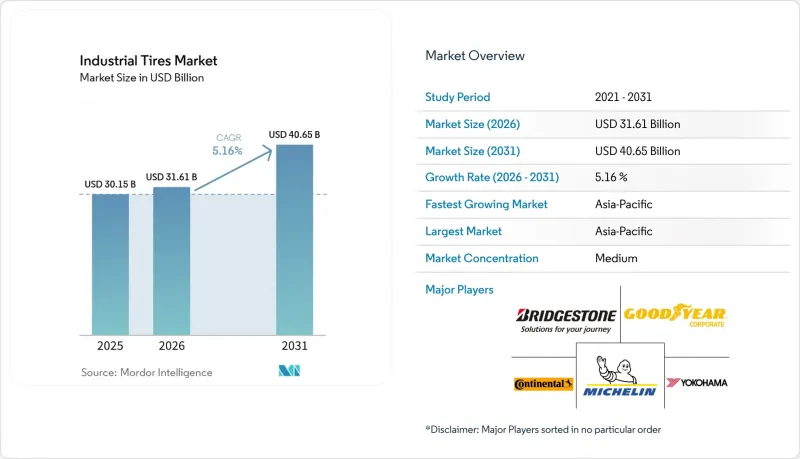
據 Mordor Intelligence 稱,2025 年工業輪胎市場價值為 301.5 億美元,預計到 2031 年將達到 406.5 億美元,而 2026 年為 316.1 億美元,預測期(2026-2031 年)的複合年成長率為 5.16%。
全球工業輪胎市場趨勢與洞察
對基礎設施和施工機械的投資
政府主導的基礎設施發展項目提高了建築、採石和道路建設等活動中重型機械的運轉率,從而推動了工業輪胎市場的消費成長。印度已為2026-2027會計年度向公路運輸和公路部撥款348億美元,上年度增8%。該部在2025-2026會計年度完成了5,313公里國家公路的建設,超額完成目標15%。大規模專案增強了承包商維護運作中重型機械車隊的信心,從而支撐了OEM和售後市場管道的需求。資料中心建設也推動了對土木工程機具和裝載機的需求,尤其是在北美和亞太地區偏遠地區的大型資料中心。這些項目在設施投入運作前需要進行挖掘、平整和骨材處理,延長了現場輪胎的運作。因此,即使住宅和商業建築受到資金籌措成本的限制,採石活動仍將繼續使用越野輪胎。
擴大開採重要礦產的船隊
對銅、鋰、鈷和鎳的需求正在推動礦用車輛和工業輪胎市場投資週期延長。國際能源總署(IEA)預測,在預設政策情境下,到2030年這些礦物的需求量可能會翻倍;在淨零排放情境下,到2050年可能會成長兩倍。在礦業開發中,在產量增加之前,必須投資於運輸卡車、裝載機和輔助設備。隨著地表礦床的逐漸枯竭,基岩硬化,鑽探深度增加,導致輪胎磨損加劇。這增加了每台機器每小時的輪胎消耗量,凸顯了在作業現場可靠供應替換輪胎的重要性。必和必拓維持其2026會計年度及2027會計年度110億美元的資本支出預測,其銅業務是其計畫的核心。 2025年4月,賽輪輪胎旗下的「Maxam」品牌與力拓簽署了一份為期五年的契約,為其在幾內亞西芒杜項目的230噸級礦用卡車提供輪胎解決方案。
天然橡膠和增強材質價格的波動
由於天然橡膠樹從種植到成熟所需的週期較長,其供應對需求的反應較為緩慢。根據天然橡膠生產國協會統計,全球超過40%的橡膠種植園的樹齡在30年以上。即使價格趨勢使得增產在經濟上具有吸引力,種植年限長的人工林也難以柔軟性應對供應需求。該協會預計,到2026年,天然橡膠產量將成長0.5%,低於1.3%的需求成長率,這將導致40萬噸的供不應求。此外,原油價格上漲可能導致合成橡膠成本增加,從而可能縮小材料替代的範圍。輪胎價格上漲可能落後於投入成本上漲6至12個月,這將進一步增加大規模較小、垂直整合程度較低的製造商的壓力。這些情況可能導致對價格敏感的車隊營運商推遲工業輪胎市場的車輛更換決策。
細分市場分析
預計到2025年,子午線輪胎將佔據工業輪胎市場58.13%的佔有率,並將以5.84%的複合年成長率持續成長至2031年。這反映了在採礦、建築和物料搬運等嚴苛工況下運作的車輛,其輪胎結構已從斜交胎轉向子午線胎。與斜交胎相比,子午線輪胎具有更低的油耗、更長的汽車胎體壽命和更優異的散熱性能。鑑於目前設備運作和燃油成本的高要求,這些因素至關重要。加上車隊的廣泛應用和採購趨勢的持續變化,子午線輪胎已成為規模最大、成長最快的輪胎類型。
斜交輪胎在一些低速行駛和承受強烈衝擊時,其性能比燃油效率更為重要,例如某些地下礦井和在崎嶇地形上運作的重型裝載機。實心輪胎在室內倉庫的應用日益廣泛。這是因為,對於在可預測的室內路面上行駛的車輛而言,消除穿刺風險的優勢有時超過了乘坐舒適性降低的代價。帶束層斜交輪胎在農業和建築應用中仍然發揮著有限的作用,因為在這些應用中,由於輪圈尺寸的限制,子午線輪胎難以安裝,而且操作人員需要更高的承載能力。電動非公路機械從靜止狀態瞬間產生扭矩,增加了輪胎邊緣和胎側的應力,這對輪胎供應商提出了獨特的設計要求。 2025年12月,貴州輪胎推出了「電青」系列電動非公路(OTR)輪胎,該系列輪胎採用強化汽車胎體結構和散熱胎面配方,適用於高扭力設備。
區域分析
到2025年,亞太地區將佔工業輪胎市場38.68%的佔有率,預計到2031年將以6.06%的複合年成長率成長。儘管中國仍然是施工機械的主要生產國和消費國,但印度和東南亞在擴大區域需求方面也發揮著日益重要的作用。印度2026-2027會計年度的道路運輸預算預計將達到348億美元,而正在進行的高速公路建設計畫正在支撐對工程和土方輪胎的需求。在印尼、越南和菲律賓,基礎設施投資和農業機械化的進步正在推動各種用途輪胎的需求。
北美工業輪胎市場高度依賴替換需求和成本績效的採購方式。公共基礎設施、資料中心開發和能源轉型專案的資金投入,推動了住宅建設活動以外的建築輪胎需求成長。美國關鍵礦產資源舉措可能會促進內華達州、亞利桑那州和阿拉斯加州鋰礦和稀土元素開採所需的車輛部署。歐洲的消費趨勢反映了工業脫碳以及與第五階段非道路排放氣體法規相關的設備升級。德國、法國和北歐國家對輪胎壓力監測系統和預測性維護服務的需求不斷成長,支撐了輪胎的溢價。
在中東和非洲,需求模式兼具建築業驅動和採礦業驅動的特性。在沙烏地阿拉伯和阿拉伯聯合大公國,城市發展計畫和「2030願景」計畫推動了對施工機械的需求。在南非、剛果民主共和國、尚比亞和加納,金屬採礦業支撐了對礦用輪胎的需求。 2026年9月,Asenso在南非舉行的非洲礦業展(Electra Mining Africa)上發布了其全鋼子午線工程機械輪胎系列。阿根廷鋰產區和智利銅帶的車隊需求不斷成長,而偏遠礦區則需要可靠的、區域性的輪胎供應方案。
其他好處:
- Excel格式的市場預測(ME)表
- 3個月的分析師支持
目錄
第1章:引言
- 研究假設和市場定義
- 調查範圍
第2章:調查方法
第3章執行摘要
第4章 市場狀況
- 市場概覽
- 市場促進因素
- 對基礎設施和施工機械的投資
- 加強開採重要礦產的車輛
- 倉庫自動化與高效率物料搬運
- 新興經濟體的農業機械化
- 電氣化驅動下的非公路設備輪胎重新設計
- 市場限制因素
- 天然橡膠和增強材質價格的波動
- 高檔輪胎更換成本高,使用壽命長
- 與低價輪胎和假輪胎的競爭
- 價值鏈分析
- 波特五力分析
第5章 市場規模與成長預測
- 按輪胎類型
- 子午線輪胎
- 斜交輪胎
- 斜交輪胎
- 實心輪胎
- 其他
- 透過使用
- 建造
- 礦業
- 物料輸送
- 農業
- 其他用途
- 車輛類型
- 土木工程施工機械
- 裝載機和推土機
- 聯結機
- 堆高機
- 其他車型
- 按地區
- 亞太地區
- 中國
- 印度
- 日本
- 韓國
- 東南亞國協
- 其他亞太國家
- 北美洲
- 美國
- 加拿大
- 墨西哥
- 歐洲
- 德國
- 英國
- 法國
- 義大利
- 北歐國家
- 其他歐洲國家
- 南美洲
- 巴西
- 阿根廷
- 其他南美國家
- 中東和非洲
- 沙烏地阿拉伯
- 南非
- 其他中東和非洲國家
- 亞太地區
第6章 競爭情勢
- 市場集中度
- 策略趨勢
- 市佔率和排名分析
- 公司簡介
- APOLLO TYRES LTD
- Balkrishna Industries Limited(BKT)
- Bridgestone Corporation
- CEAT Limited
- Continental AG
- Hankook Tire & Technology
- JK Tyre & Industries Ltd.
- Michelin
- MRF Tyres
- Nokian Tyres plc
- Pirelli & CSpA
- Sumitomo Rubber Industries, Ltd.
- The Goodyear Tire & Rubber Company
- THE YOKOHAMA RUBBER CO., LTD.
- Titan International, Inc.
- Trelleborg Group
第7章 市場機會與未來展望
According to Mordor Intelligence, the industrial tires market size was valued at USD 30.15 billion in 2025 and is estimated to grow from USD 31.61 billion in 2026 to reach USD 40.65 billion by 2031, at a CAGR of 5.16% during the forecast period (2026-2031).
Global Industrial Tires Market Trends and Insights
Infrastructure and Construction Equipment Investment
Government-backed infrastructure programs increase equipment utilization and support tire consumption in the industrial tires market across construction, quarrying, and road-building activities. India allocated USD 34.8 billion to the Ministry of Road Transport and Highways for fiscal year 2026-27, an 8% increase from the prior year. The ministry completed 5,313 km of national highways in fiscal year 2025-26, exceeding its target by 15%. Large programs give contractors greater confidence in maintaining active equipment fleets and support demand across original equipment and aftermarket channels. Data-center construction also increases demand for earthmovers and loaders, particularly at remote, land-intensive sites in North America and the Asia-Pacific. This work requires excavation, grading, and aggregate handling before a facility becomes operational, increasing the operating hours of tires used at the site. Quarry activity can therefore sustain off-the-road tire use even when residential and commercial construction remains constrained by financing costs.
Mining Fleet Expansion for Critical Minerals
Demand for copper, lithium, cobalt, and nickel supports a longer investment cycle for mining fleets and the industrial tires market. The International Energy Agency projects that demand for these minerals could double by 2030 under its Stated Policies Scenario and triple under its Net Zero Emissions by 2050 Scenario. Mine development requires investment in haul trucks, loaders, and support equipment before production output can rise. Harder rock and deeper excavation increase tire wear as accessible surface deposits are depleted over time. This raises tire consumption per machine-hour and increases the importance of a dependable supply of replacements at operating sites. BHP maintained capital expenditure guidance of USD 11 billion for each of fiscal years 2026 and 2027, with copper operations central to its program. In April 2025, Sailun's Maxam brand secured a 5-year agreement to supply tire solutions for Rio Tinto's 230-ton mining trucks at the Simandou project in Guinea.
Volatile Natural Rubber and Reinforcement Material Costs
Natural rubber supply responds slowly to demand because productive trees require long planting and maturation cycles. More than 40% of global rubber plantations consisted of trees older than 30 years, according to the Association of Natural Rubber Producing Countries. Older plantations limit supply responsiveness even when pricing makes additional production economically attractive. The association estimated natural rubber production growth of 0.5% in 2026, below demand growth of 1.3%, producing a 400,000-ton supply deficit. Higher oil prices can also increase synthetic rubber costs and reduce the scope for material substitution. Tire price increases can lag input-cost increases by 6 to 12 months, placing greater pressure on smaller and less integrated producers. These conditions can extend replacement decisions among price-sensitive fleet operators in the industrial tires market.
Other drivers and restraints analyzed in the detailed report include:
- Warehouse Automation and Material-Handling Intensification
- Agricultural Mechanization in Emerging Economies
- High Replacement Cost and Extended Premium-Tier Service Life
For complete list of drivers and restraints, kindly check the Table Of Contents.
Segment Analysis
Radial tires held 58.13% of the industrial tires market share in 2025 and are forecast to grow at a 5.84% CAGR through 2031. This reflects a long-running shift away from bias-ply construction across mining, construction, and material-handling fleets operating in demanding conditions. Radial designs offer lower fuel consumption, longer carcass life, and better heat dissipation than bias alternatives, which is significant as equipment operating hours and fuel costs remain elevated. The radial category is both the largest and fastest-growing tire type, combining established fleet use with a continuing shift in purchasing preferences.
Bias-ply tires remain relevant where rugged performance at low speeds and under high impact is more important than fuel efficiency, including in some underground mining settings and on heavy loaders operating on rough terrain. Solid tires are gaining use in enclosed warehouses, as eliminating puncture risk can outweigh the ride-comfort trade-off for vehicles operating on predictable indoor surfaces. Belted-bias tires retain a narrower role in agricultural and construction applications where rim sizes limit radial fitment, and operators require greater load-carrying capability. Electric off-highway machines deliver immediate torque from a standstill and increase bead and sidewall stresses, creating distinct design requirements for tire suppliers. In December 2025, Guizhou Tire Co., Ltd. launched its Dianqing electric-drive Off-The-Road (OTR) series, featuring reinforced carcass construction and heat-dissipating tread compounds for high-torque equipment.
Complete Report Scope:
- By Tire Type
- Radial Tires
- Bias Tires
- Belted-Bias Tires
- Solid Tires
- Others
- By Application
- Construction
- Mining
- Material Handling
- Agriculture
- Other Applications
- By Vehicle Type
- Earthmovers
- Loaders and Dozers
- Tractors
- Forklifts
- Other Vehicle Types
- By Geography
- Asia-Pacific
- China
- India
- Japan
- South Korea
- ASEAN Countries
- Rest of Asia-Pacific
- North America
- United States
- Canada
- Mexico
- Europe
- Germany
- United Kingdom
- France
- Italy
- NORDIC Countries
- Rest of Europe
- South America
- Brazil
- Argentina
- Rest of South America
- Middle East and Africa
- Saudi Arabia
- South Africa
- Rest of Middle East and Africa
- Asia-Pacific
Geography Analysis
Asia-Pacific accounted for 38.68% of the industrial tires market in 2025 and is forecast to grow at a 6.06% CAGR through 2031. China remains a major producer and consumer of construction equipment, while India and Southeast Asia are increasingly central to regional demand growth. India's USD 34.8 billion road transport budget for fiscal year 2026-27 and its active highway program support demand for construction and earthmover tires. Indonesia, Vietnam, and the Philippines combine infrastructure investment with rising agricultural mechanization, creating demand across several tire applications.
North America's industrial tires market is more heavily dependent on replacement demand and value-focused purchasing. Public infrastructure funding, data-center development, and energy-transition projects support construction tire demand beyond housing activity. The U.S. critical-minerals initiative supports possible fleet expansion for lithium and rare-earth extraction in Nevada, Arizona, and Alaska. Europe's consumption reflects equipment renewal linked to industrial decarbonization and Stage V non-road emissions standards. Germany, France, and the Nordic countries show demand for tire pressure monitoring and predictive maintenance services, supporting premium pricing.
The Middle East and Africa combine construction-led and mining-led demand patterns. Saudi Arabia and the United Arab Emirates drive equipment demand through urban projects and Vision 2030 programs. South Africa, the Democratic Republic of the Congo, Zambia, and Ghana support mining tire demand through metals extraction. In September 2026, Ascenso introduced an all-steel radial OTR range at Electra Mining Africa in South Africa. Argentina's lithium areas and Chile's copper belt add fleet demand, while remote mines require reliable regional tire delivery programs.
- APOLLO TYRES LTD
- Balkrishna Industries Limited (BKT)
- Bridgestone Corporation
- CEAT Limited
- Continental AG
- Hankook Tire & Technology
- JK Tyre & Industries Ltd.
- Michelin
- MRF Tyres
- Nokian Tyres plc
- Pirelli & C. S.p.A.
- Sumitomo Rubber Industries, Ltd.
- The Goodyear Tire & Rubber Company
- THE YOKOHAMA RUBBER CO., LTD.
- Titan International, Inc.
- Trelleborg Group
Additional Benefits:
- The market estimate (ME) sheet in Excel format
- 3 months of analyst support
TABLE OF CONTENTS
1 Introduction
- 1.1 Study Assumptions and Market Definition
- 1.2 Scope of the Study
2 Research Methodology
3 Executive Summary
4 Market Landscape
- 4.1 Market Overview
- 4.2 Market Drivers
- 4.2.1 Infrastructure and Construction Equipment Investment
- 4.2.2 Mining Fleet Expansion for Critical Minerals
- 4.2.3 Warehouse Automation and Material-Handling Intensification
- 4.2.4 Agricultural Mechanization in Emerging Economies
- 4.2.5 Electrification-Driven Tire Redesign for Off-Highway Equipment
- 4.3 Market Restraints
- 4.3.1 Volatile Natural Rubber and Reinforcement Material Costs
- 4.3.2 High Replacement Cost and Extended Premium-Tire Service Life
- 4.3.3 Low-Cost and Counterfeit Tire Competition
- 4.4 Value Chain Analysis
- 4.5 Porter's Five Forces Analysis
- 4.5.1 Bargaining Power of Suppliers
- 4.5.2 Bargaining Power of Buyers
- 4.5.3 Threat of New Entrants
- 4.5.4 Threat of Substitutes
- 4.5.5 Competitive Rivalry
5 Market Size And Growth Forecasts (Value)
- 5.1 By Tire Type
- 5.1.1 Radial Tires
- 5.1.2 Bias Tires
- 5.1.3 Belted-Bias Tires
- 5.1.4 Solid Tires
- 5.1.5 Others
- 5.2 By Application
- 5.2.1 Construction
- 5.2.2 Mining
- 5.2.3 Material Handling
- 5.2.4 Agriculture
- 5.2.5 Other Applications
- 5.3 By Vehicle Type
- 5.3.1 Earthmovers
- 5.3.2 Loaders and Dozers
- 5.3.3 Tractors
- 5.3.4 Forklifts
- 5.3.5 Other Vehicle Types
- 5.4 By Geography
- 5.4.1 Asia-Pacific
- 5.4.1.1 China
- 5.4.1.2 India
- 5.4.1.3 Japan
- 5.4.1.4 South Korea
- 5.4.1.5 ASEAN Countries
- 5.4.1.6 Rest of Asia-Pacific
- 5.4.2 North America
- 5.4.2.1 United States
- 5.4.2.2 Canada
- 5.4.2.3 Mexico
- 5.4.3 Europe
- 5.4.3.1 Germany
- 5.4.3.2 United Kingdom
- 5.4.3.3 France
- 5.4.3.4 Italy
- 5.4.3.5 NORDIC Countries
- 5.4.3.6 Rest of Europe
- 5.4.4 South America
- 5.4.4.1 Brazil
- 5.4.4.2 Argentina
- 5.4.4.3 Rest of South America
- 5.4.5 Middle East and Africa
- 5.4.5.1 Saudi Arabia
- 5.4.5.2 South Africa
- 5.4.5.3 Rest of Middle East and Africa
- 5.4.1 Asia-Pacific
6 Competitive Landscape
- 6.1 Market Concentration
- 6.2 Strategic Moves
- 6.3 Market Share (%)/Ranking Analysis
- 6.4 Company Profiles (includes Global Overview, Market Overview, Core Segments, Financials as available, Strategic Information, Products and Services, and Recent Developments)
- 6.4.1 APOLLO TYRES LTD
- 6.4.2 Balkrishna Industries Limited (BKT)
- 6.4.3 Bridgestone Corporation
- 6.4.4 CEAT Limited
- 6.4.5 Continental AG
- 6.4.6 Hankook Tire & Technology
- 6.4.7 JK Tyre & Industries Ltd.
- 6.4.8 Michelin
- 6.4.9 MRF Tyres
- 6.4.10 Nokian Tyres plc
- 6.4.11 Pirelli & C. S.p.A.
- 6.4.12 Sumitomo Rubber Industries, Ltd.
- 6.4.13 The Goodyear Tire & Rubber Company
- 6.4.14 THE YOKOHAMA RUBBER CO., LTD.
- 6.4.15 Titan International, Inc.
- 6.4.16 Trelleborg Group
7 Market Opportunities and Future Outlook
- 7.1 White-Space and Unmet-Need Assessment

 衝擊輪平衡塊市場:全球市場預測,2026-2032年鉤/夾式車輪平衡塊市場:全球市場預測,2026-2032年黏性車輪平衡塊市場:全球市場預測,2026-2032年
 2026-2030年全球汽車輪胎服務市場2026-2030年全球輪胎和車輪搬運設備市場車輪擋塊市場:全球市場預測,2026-2032年
 自動輪胎拆裝機市場規模、佔有率和成長分析:按機器類型、自動化程度、車輛類型、最終用戶、輪圈尺寸範圍和地區分類 - 行業預測,2026-2033 年零壓球囊市場:全球市場預測,2026-2032年乘用車替換輪胎市場:全球市場預測,2026-2032年乘用車輪胎售後市場:全球市場預測,2026-2032年