


 |
市場調查報告書
商品編碼
2157052
原子鐵粉:市場佔有率分析、產業趨勢與統計、成長預測(2026-2031)Atomized Iron Powder - Market Share Analysis, Industry Trends & Statistics, Growth Forecasts (2026 - 2031) |
||||||

※ 本網頁內容可能與最新版本有所差異。詳細情況請與我們聯繫。
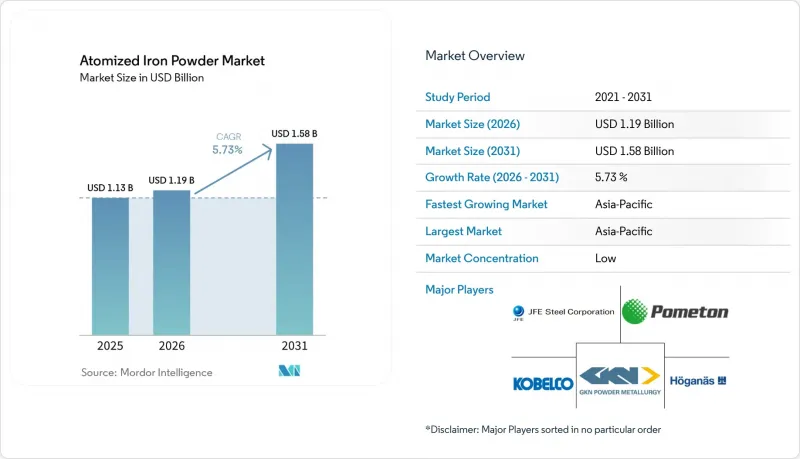
據 Mordor Intelligence 稱,2025 年噴霧乾燥鐵粉市值為 11.3 億美元,預計到 2031 年將從 2026 年的 11.9 億美元成長至 15.8 億美元,預測期(2026-2031 年)複合年成長率為 5.73%。
全球噴塗鐵粉市場趨勢及洞察
粉末冶金技術在汽車和工業零件領域的應用日益廣泛。
由於粉末冶金技術能夠成型複雜零件,同時減少製作流程、最大限度降低材料損耗,並在大規模生產中實現高度可重複的尺寸控制,因此它在霧化鐵粉市場中繼續發揮重要作用。到2025年,北美地區超過70%的鐵粉出貨量將用於汽車應用,這表明汽車項目仍然是該地區粉末供應商的主要需求來源。同年,該地區每輛乘用車平均將使用14.3公斤粉末冶金零件,反映出這些零件並非用於單一汽車零件,而是應用於多個功能系統。齒輪、結構支架、油泵轉子和摩擦零件繼續為霧化鐵粉市場提供廣泛的汽車應用基礎和一系列成熟的製造流程。隨著傳統動力傳動系統配置的改變和汽車製造商對零件的重新設計,需求正在轉向混合動力傳動系統零件、渦輪增壓零件和人形機器人執行器。在抗壓強度和成本仍然至關重要的領域,鐵基材料繼續佔據主導地位,並繼續在大規模生產需要高耐久性零件的應用中發揮作用。
電氣化導致對軟磁鐵粉元件的需求增加
在馬達應用領域,霧化鐵粉市場正透過軟磁複合材料(SMC)不斷擴張,這些材料利用絕緣粉末顆粒形成磁芯。這些材料能夠在特定的馬達設計中實現3D磁通路徑和近淨成形,為工程師提供超越傳統疊片結構的更多選擇。 2026年的一項科學研究報告稱,採用摩擦攪拌鍛造製程生產的Fe-3.5Si SMC零件的抗張強度超過650 MPa,矯頑力小於10 Oe。 JFE鋼鐵公司報告稱,其採用絕緣塗層純鐵粉的軸向氣隙電機原型,在保持相同效率的同時,比同類徑向氣隙電機薄48%,輕40%。 2026年6月,Hoganas AB公司推出了“Somaloy 7P”,這是一種水性塗層,旨在降低高頻應用中的鐵芯損耗。在高頻應用中,材料的選擇會影響效率和熱性能。此外,國際電工委員會(IEC)對磁芯性能的要求也確保了現有優質等級材料的價值。這是因為客戶必須先檢驗材料的性能,才能在其認證設計中使用這種新型粉末。
霧化過程涉及高昂的能源和設備成本。
能源和設備成本限制了霧化鐵粉市場產能的擴張。對於無法將固定成本分攤到大批量生產中的小規模生產商而言,這種影響尤其顯著。操作要求也更加複雜,因為水霧化需要高壓水和熱能,而氣霧化則需要惰性氣體和專用回收系統。氣霧化設備需要處理熔融物料、分級設備以及嚴格的粉末處理控制,以確保粉末品質並安全地處理細顆粒。即使終端用途快速成長,商業性機會也隨之增加,但這些要求仍導致以生產優質等級鐵粉為目標的專案投資回收期延長。能源價格波動加劇是一項重大挑戰,尤其對於歐洲和北美的生產商而言,因為他們無法總是迅速地將不斷上漲的成本轉嫁給認證客戶。使用廢鋼或氫氣作為燃料的一體化運作可以在一定程度上降低營運風險,但這些設施需要更高的初始投資和更長的規劃週期。
細分市場分析
到2025年,水噴法將佔據噴塗鐵粉市場68.43%的佔有率,這反映了其強大的設備產能和成熟的客戶認可。此方法生產的粉末形狀不規則,常用於壓制和燒結等應用。其典型的粒徑範圍為45–150 μm,在全球粉末冶金需求中仍佔有重要地位。此外,水噴法在大量生產上具有單位成本優勢。憑藉這些特性,水噴法在汽車和工業供應鏈的噴塗鐵粉產業中繼續佔據核心地位。
受使用者對用於雷射粉末層熔化、黏著劑噴塗成型和SMC芯材的球形粉末的需求驅動,預計到2031年,氣體霧化法將以6.56%的複合年成長率成長。 2024年發表於AIChE Journal的一篇綜述指出,與水霧化法70%至80%的產率相比,氣體霧化法製備粒徑小於30 μm的粉末的產率可能低於50%。這種產率差異限制了產量成長,同時也解釋了為何對規格要求嚴格的材料定價較高。 2026年,神戶製鋼在其「MAGMEL」系列產品中新增了一種用於磁退火的耐高溫絕緣塗層。這項進展滿足了對高可靠性磁性能應用中穩定基體粉末的需求。
區域分析
預計2025年,亞太地區將佔霧化鐵粉銷售額的60.65%,並將以6.77%的複合年成長率成長至2031年。中國從鋼鐵到粉末的一體化生產體系,憑藉其具有成本競爭力的供應、大規模的燒結零件市場以及電動車傳動系統和SMC電機鐵芯的生產,支撐了該地區的需求。在日本和韓國,家用電子電器和工業電機對先進材料的需求也隨之成長,其中JFE鋼鐵公司的絕緣純鐵粉因其在需要更薄更輕電機設計中的應用而備受關注。在印度,汽車製造和製藥生產的需求不斷成長,而東南亞國協正經歷工業產能從成本高昂的東北亞地區轉移的趨勢。這些因素共同造就了霧化鐵粉市場的廣泛基礎,不僅對標準等級產品有需求,對高階磁性材料應用也有需求。
2025年,北美鋼鐵粉末出貨量達268,880公噸。出貨量低於去年,部分原因是內燃機和混合動力汽車的需求,但也受到一些汽車工程延誤的影響。國防、航太、半導體製造設備和資料中心硬體的需求進一步推動了對高品質粉末的需求,尤其是在積層製造(AM)材料認證至關重要的領域。該地區一體化的供應鏈基礎有助於認證材料的價格穩定,但關稅的不確定性加劇了與汽車製造商就國內採購問題的討論。國際汽車工作小組(IATF)16949的要求以及2026年材料標準的更新將繼續影響黏著劑噴塗和指向性能量沉積技術的供應商認證和應用評估。
憑藉其技術供應基礎、成熟的零件製造商和低碳生產計劃,歐洲在霧化鐵粉市場中佔據了穩固地位。 Hoganas AB 與 FerraVolt 於 2026 年 4 月宣布夥伴關係,共同推動氫基煉鐵技術。此舉表明,歐洲生產商如何將不斷變化的原料與下游粉末應用相結合。隨著內燃機需求的下降以及混合動力汽車、渦輪增壓器和馬達零件應用的不斷擴展,歐洲汽車市場的需求正在改變。 Hoganas AB 在 2026 年 3 月舉行的印度粉末冶金協會 PM26 會議上闡述了其對永續粉末和成型過程的承諾。南美洲與巴西的燒結零件製造地緊密相連,而中東和非洲在沙烏地阿拉伯的工業化計畫的支持下,非汽車產業的需求也開始顯現。
其他好處:
- Excel格式的市場預測(ME)表
- 3個月的分析師支持
目錄
第1章:引言
- 研究假設和市場定義
- 調查範圍
第2章:調查方法
第3章執行摘要
第4章 市場狀況
- 市場概覽
- 市場促進因素
- 粉末冶金技術在汽車和工業零件領域的應用日益廣泛。
- 軟磁鐵粉零件電氣化的需求
- 積層製造及金屬射出成型技術簡介
- 利用廢料和減少廢棄物閉合迴路系統
- 透過數位化過程控制實現更窄的粒徑分佈
- 市場限制因素
- 霧化過程涉及高昂的能源和設備成本。
- 還原鐵粉與電解鐵粉之間的競爭
- 安全關鍵部件中粉末成分差異導致的合格風險。
- 價值鏈分析
- 波特五力分析
第5章 市場規模與成長預測
- 透過技術
- 水噴
- 氣體霧化法
- 透過使用
- 粉末冶金
- 化學合成
- 電子材料
- 製藥
- 其他用途
- 按地區
- 亞太地區
- 中國
- 印度
- 日本
- 韓國
- 東南亞國協
- 其他亞太國家
- 北美洲
- 美國
- 加拿大
- 墨西哥
- 歐洲
- 德國
- 英國
- 法國
- 義大利
- 北歐國家
- 其他歐洲國家
- 南美洲
- 巴西
- 阿根廷
- 其他南美國家
- 中東和非洲
- 沙烏地阿拉伯
- 南非
- 其他中東和非洲國家
- 亞太地區
第6章 競爭情勢
- 市場集中度
- 策略趨勢
- 市佔率和排名分析
- 公司簡介
- Anhui Xujing Crystal Powder NewMaterial Technology Co, LTD
- CNPC Powder North America Inc.
- FUKUDA METAL FOIL & POWDER CO., LTD.
- GKN Powder Metallurgy
- Hangzhou Yitong New Materials Co., Ltd.
- Hoganas AB
- JFE Steel Corporation
- Jiangxi Yuean Superfine Metal Co., Ltd.
- KOBE STEEL, LTD.
- Mitsui Kinzoku Co., Ltd.
- Pometon SpA
- Porwal Metallurgicals
- Sandvik AB
- Shandong Iron and Steel Group Co., Ltd.
- SLM Metal Private Limited
第7章 市場機會與未來展望
According to Mordor Intelligence, the atomized iron powder market size was valued at USD 1.13 billion in 2025 and is estimated to grow from USD 1.19 billion in 2026 to reach USD 1.58 billion by 2031, at a CAGR of 5.73% during the forecast period (2026-2031).
Global Atomized Iron Powder Market Trends and Insights
Rising Powder Metallurgy Adoption in Automotive and Industrial Components
Powder metallurgy remains important to the atomized iron powder market because it forms complex parts with less machining, less material waste, and repeatable dimensional control in high-volume production. More than 70% of North American iron-powder shipments went to automotive applications in 2025, indicating that vehicle programs remained the principal demand base for regional powder suppliers. Passenger vehicles in the region used an average of 14.3 kg of powder-metallurgy components during that year, which reflects use across several functional systems rather than a single vehicle part. Gears, structural brackets, oil-pump rotors, and friction parts continue to give the atomized iron powder market a broad automotive base and a set of established manufacturing routes. Demand is rotating toward hybrid-powertrain parts, turbocharger components, and humanoid-robot actuators as conventional drivetrain content changes and vehicle makers revise component designs. Ferrous materials retain an advantage where compressive strength and cost remain important, supporting their continued role in applications that require durable components at a production scale.
Electrification Demand for Soft Magnetic Iron-Powder Components
Electric-motor applications are broadening the atomized iron powder market through soft magnetic composites (SMCs) which use insulated powder particles to create magnetic cores. These materials enable three-dimensional magnetic flux paths and net-shape fabrication for selected motor designs, giving engineers options beyond conventional laminated structures. A 2026 scientific study reported Fe-3.5Si SMC components with tensile strength above 650 MPa and coercivity below 10 Oe after friction-stir forging. JFE Steel Corporation reported that its insulation-coated pure-iron powder supported an axial-gap motor prototype that was 48% thinner and 40% lighter than comparable radial-gap designs at equivalent efficiency. Hoganas AB introduced Somaloy 7P in June 2026 with a water-based coating intended to reduce core losses in high-frequency applications, where material selection influences both efficiency and thermal performance. International Electrotechnical Commission requirements for magnetic-core performance also preserve the value of established premium grades, since customers must verify material performance before using new powders in qualified designs.
High Energy and Equipment Costs for Atomization
Energy and equipment costs limit capacity expansion in the atomized iron powder market, particularly for smaller producers that cannot spread fixed costs over large output volumes. Water atomization needs high-pressure water and thermal energy, while gas atomization also needs inert gas and specialized recovery systems that add to operating requirements. Gas-atomization equipment requires melt handling, classification equipment, and strict control of powder handling to protect powder quality and manage fine particles safely. These requirements create long payback periods for projects that target premium grades, even when the commercial opportunity is supported by fast-growing end uses. Higher energy-price volatility has been particularly difficult for European and North American producers because cost increases cannot always be passed through quickly to qualified customers. Integrated operations with scrap or hydrogen-based feedstocks can reduce some operating exposure, although their facilities require higher initial investment and longer planning horizons.
Other drivers and restraints analyzed in the detailed report include:
- Additive Manufacturing and Metal Injection Molding Adoption
- Closed-Loop Scrap Feedstock and Lower Material Waste
- Price Competition from Reduced and Electrolytic Iron Powders
For complete list of drivers and restraints, kindly check the Table Of Contents.
Segment Analysis
Water atomization held 68.43% of the atomized iron powder market share in 2025, reflecting extensive installed capacity and established customer approvals. It produces irregular powders commonly used in press-and-sinter applications. Its typical 45-150 μm particle range remains relevant to much of global powder-metallurgy demand. Water atomization also provides a cost-per-kilogram advantage for high-volume production. These attributes keep it central to the atomized iron powder industry across automotive and industrial supply chains.
Gas atomization is projected to advance at a 6.56% CAGR through 2031 as users seek spherical powders for laser powder-bed fusion, binder jetting, and SMC cores. A 2024 AIChE Journal review noted that sub-30 μm powder yields can remain below 50% for gas atomization, compared with 70%-80% for water atomization. This yield difference limits output growth and supports premium prices for tightly specified material. KOBE STEEL, LTD. expanded its MAGMEL range in 2026 with high-heat-resistant insulated coatings for magnetic annealing. The development supports demand for consistent base powders in applications that need reliable magnetic behavior.
Complete Report Scope:
- By Technology
- Water Atomization
- Gas Atomization
- By Application
- Powder Metallurgy
- Chemical Synthesis
- Electronic Materials
- Pharmaceutical
- Other Applications
- By Geography
- Asia-Pacific
- China
- India
- Japan
- South Korea
- ASEAN Countries
- Rest of Asia-Pacific
- North America
- United States
- Canada
- Mexico
- Europe
- Germany
- United Kingdom
- France
- Italy
- NORDIC Countries
- Rest of Europe
- South America
- Brazil
- Argentina
- Rest of South America
- Middle East and Africa
- Saudi Arabia
- South Africa
- Rest of Middle East and Africa
- Asia-Pacific
Geography Analysis
Asia-Pacific held 60.65% of the atomized iron powder revenue share in 2025 and is projected to advance at a 6.77% CAGR through 2031. China's integrated steel-to-powder operations support cost-competitive supply, a large sintered-parts base, and regional demand from electric-vehicle drivetrain and SMC motor-core production. Japan and South Korea add advanced materials demand from consumer electronics and industrial motors, while JFE Steel Corporation's insulated pure-iron powder has drawn interest for designs requiring thinner and lighter motors. India is gaining demand from automotive manufacturing and pharmaceutical production, and ASEAN countries receive industrial capacity transfers from higher-cost Northeast Asian locations. This mix gives the atomized iron powder market a broad base of standard-grade demand alongside premium magnetic-material applications.
In North America, iron and steel powder shipments reached 268,880 metric tons in 2025. Shipment volumes were lower than the prior year because some vehicle programs faced delays, although internal-combustion and hybrid demand provided partial support. Defense, aerospace, semiconductor equipment, and data-center hardware provide additional demand paths for higher-grade powder, especially where additive-manufacturing material qualifications are important. The region's integrated supply base supports pricing stability for qualified material, while tariff uncertainty strengthens domestic-sourcing discussions with automotive customers. International Automotive Task Force (IATF) 16949 requirements and 2026 material-standard updates continue to shape supplier approvals and application evaluation for binder jetting and directed energy deposition.
Europe holds a position in the atomized iron powder market because of its technical supply base, established component manufacturers, and low-carbon production programs. Hoganas AB is pursuing hydrogen-based ironmaking with FerraVolt through a partnership announced in April 2026, while its work illustrates how European producers are linking feedstock changes with downstream powder applications. European automotive demand is changing as internal-combustion demand declines and hybrid, turbocharger, and motor-component uses grow, and Hoganas AB presented sustainable powder and compaction work at the Powder Metallurgy Association of India's PM26 conference in March 2026. South America is linked to Brazil's sintered-parts manufacturing base, while the Middle East and Africa have early non-automotive demand supported by Saudi Arabia's industrialization agenda.
- Anhui Xujing Crystal Powder NewMaterial Technology Co, LTD
- CNPC Powder North America Inc.
- FUKUDA METAL FOIL & POWDER CO., LTD.
- GKN Powder Metallurgy
- Hangzhou Yitong New Materials Co., Ltd.
- Hoganas AB
- JFE Steel Corporation
- Jiangxi Yuean Superfine Metal Co., Ltd.
- KOBE STEEL, LTD.
- Mitsui Kinzoku Co., Ltd.
- Pometon S.p.A.
- Porwal Metallurgicals
- Sandvik AB
- Shandong Iron and Steel Group Co., Ltd.
- SLM Metal Private Limited
Additional Benefits:
- The market estimate (ME) sheet in Excel format
- 3 months of analyst support
TABLE OF CONTENTS
1 Introduction
- 1.1 Study Assumptions and Market Definition
- 1.2 Scope of the Study
2 Research Methodology
3 Executive Summary
4 Market Landscape
- 4.1 Market Overview
- 4.2 Market Drivers
- 4.2.1 Rising Powder Metallurgy Adoption in Automotive and Industrial Components
- 4.2.2 Electrification Demand for Soft Magnetic Iron-Powder Components
- 4.2.3 Additive Manufacturing and Metal Injection Molding Adoption
- 4.2.4 Closed-Loop Scrap Feedstock and Lower Material Waste
- 4.2.5 Digital Process Control for Narrower Particle-Size Distributions
- 4.3 Market Restraints
- 4.3.1 High Energy and Equipment Costs for Atomization
- 4.3.2 Price Competition from Reduced and Electrolytic Iron Powders
- 4.3.3 Qualification Risk from Powder Variability in Safety-Critical Components
- 4.4 Value Chain Analysis
- 4.5 Porter's Five Forces Analysis
- 4.5.1 Threat of New Entrants
- 4.5.2 Bargaining Power of Suppliers
- 4.5.3 Bargaining Power of Buyers
- 4.5.4 Threat of Substitutes
- 4.5.5 Competitive Rivalry
5 Market Size and Growth Forecasts (Value)
- 5.1 By Technology
- 5.1.1 Water Atomization
- 5.1.2 Gas Atomization
- 5.2 By Application
- 5.2.1 Powder Metallurgy
- 5.2.2 Chemical Synthesis
- 5.2.3 Electronic Materials
- 5.2.4 Pharmaceutical
- 5.2.5 Other Applications
- 5.3 By Geography
- 5.3.1 Asia-Pacific
- 5.3.1.1 China
- 5.3.1.2 India
- 5.3.1.3 Japan
- 5.3.1.4 South Korea
- 5.3.1.5 ASEAN Countries
- 5.3.1.6 Rest of Asia-Pacific
- 5.3.2 North America
- 5.3.2.1 United States
- 5.3.2.2 Canada
- 5.3.2.3 Mexico
- 5.3.3 Europe
- 5.3.3.1 Germany
- 5.3.3.2 United Kingdom
- 5.3.3.3 France
- 5.3.3.4 Italy
- 5.3.3.5 NORDIC Countries
- 5.3.3.6 Rest of Europe
- 5.3.4 South America
- 5.3.4.1 Brazil
- 5.3.4.2 Argentina
- 5.3.4.3 Rest of South America
- 5.3.5 Middle East and Africa
- 5.3.5.1 Saudi Arabia
- 5.3.5.2 South Africa
- 5.3.5.3 Rest of Middle East and Africa
- 5.3.1 Asia-Pacific
6 Competitive Landscape
- 6.1 Market Concentration
- 6.2 Strategic Moves
- 6.3 Market Share (%)/Ranking Analysis
- 6.4 Company Profiles (includes Global Overview, Market Overview, Core Segments, Financials as available, Strategic Information, Products and Services, and Recent Developments)
- 6.4.1 Anhui Xujing Crystal Powder NewMaterial Technology Co, LTD
- 6.4.2 CNPC Powder North America Inc.
- 6.4.3 FUKUDA METAL FOIL & POWDER CO., LTD.
- 6.4.4 GKN Powder Metallurgy
- 6.4.5 Hangzhou Yitong New Materials Co., Ltd.
- 6.4.6 Hoganas AB
- 6.4.7 JFE Steel Corporation
- 6.4.8 Jiangxi Yuean Superfine Metal Co., Ltd.
- 6.4.9 KOBE STEEL, LTD.
- 6.4.10 Mitsui Kinzoku Co., Ltd.
- 6.4.11 Pometon S.p.A.
- 6.4.12 Porwal Metallurgicals
- 6.4.13 Sandvik AB
- 6.4.14 Shandong Iron and Steel Group Co., Ltd.
- 6.4.15 SLM Metal Private Limited
7 Market Opportunities and Future Outlook
- 7.1 White-Space and Unmet-Need Assessment

 被動元件用銀粉和銀膏市場:全球市場預測,2026-2032年微氧化鋁粉末市場:全球市場預測,2026-2032年微米級銀粉市場:全球市場預測,2026-2032年
 鋁粉市場規模、佔有率、趨勢和預測:按技術、應用、原料和地區分類(2026-2034 年)鋁粉市場:類型、粒度、純度等級、應用、最終用途-2026-2032年全球市場預測
 全球鋁粉市場規模、佔有率、趨勢和成長分析報告(2026-2034年)全球導熱球形氧化鋁粉末市場(依粒徑、純度等級、生產流程、銷售管道、應用領域及最終用途產業分類)預測(2026-2032年)高純度氧化鋁粉末市場:依純度等級、物理形態、等級、應用及銷售管道,全球預測(2026-2032年)全球鋁粉市場:市場規模、佔有率、成長率、產業分析、按類型、應用和地區劃分的考量及未來預測(2026-2034)全球霧化鐵粉市場:市場規模、佔有率、成長率、產業分析、類型、應用和地區因素及未來預測(2026-2034)