


 |
市場調查報告書
商品編碼
2157008
SaaS 資料保護:市場佔有率分析、產業趨勢與統計資料、成長預測(2026-2031 年)SaaS Data Protection - Market Share Analysis, Industry Trends & Statistics, Growth Forecasts (2026 - 2031) |
||||||

※ 本網頁內容可能與最新版本有所差異。詳細情況請與我們聯繫。
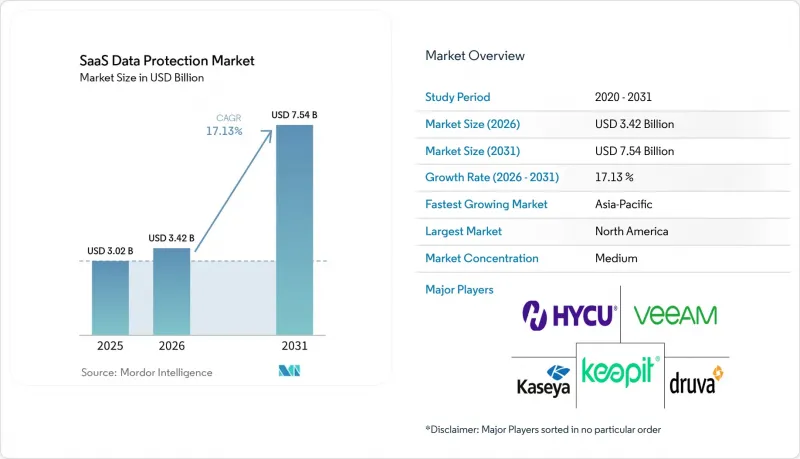
根據 Mordor Intelligence 預測,SaaS 資料保護市場規模將從 2025 年的 30.2 億美元成長到 2026 年的 34.2 億美元,到 2031 年將達到 75.4 億美元,2026 年至 2031 年的年複合成長率(CAGR)為 17.13%。
全球SaaS資料保護市場趨勢與洞察
勒索軟體和意外刪除帶來的風險
勒索軟體之所以催生了對備份的需求,是因為攻擊者通常會優先攻擊備份儲存庫,而不是生產系統。擁有乾淨且可恢復備份的組織不太可能需要支付贖金。根據 IBM 的記錄,到 2025 年,活躍的勒索軟體和敲詐勒索組織將達到 109 個,高於 2024 年的 73 個。在此背景下,隔離備份副本在 SaaS 資料保護市場的重要性日益凸顯,因為即使生產系統、使用者帳戶或關鍵管理環境在攻擊中遭到入侵,受保護的副本也必須保持可用狀態。 Spanning 的一份報告顯示,87% 的資訊科技和安全專業人員在過去 12 個月中經歷過 SaaS 資料遺失。該報告還指出,在超過 50% 的報告事件中存在惡意刪除行為,這凸顯了對自動化恢復服務的需求。
加速在業務關鍵型工作負載中採用 SaaS
業務關鍵型營運正以前所未有的速度遷移到雲端應用,許多組織在擴展其保護策略方面都未能跟上這一步伐。根據 Spanning 預測,到 2025 年,超過 50% 的運作在公共雲端環境中的工作負載和應用程式預計將遷移到雲端。因此,SaaS 資料保護市場需要更廣泛的連接器來支援生產力工具、CRM、身分管理和開發人員工具。 Keepit 表示,計劃在 2028 年支援數百個 SaaS 應用程式。 AvePoint 則計劃在 2026 年增加對 ServiceNow、AWS S3、Azure Kubernetes 和 Entra External Identity 的保護。 Salesforce、Jira Cloud 和 Confluence Cloud 的保護範圍相對較窄,這為供應商將其已建立的 Microsoft 365 合作關係擴展到其他應用程式留下了空間。供應商可以利用熟悉的策略控制和合作夥伴關係,來解決其客戶尚未納入正式備份計畫的工作負載問題。
對第三方雲端的資料管理和隱私問題的擔憂
保護高度敏感的SaaS資訊的組織仍然擔憂資料的儲存位置、儲存方式以及法律監管。如果備份提供者使用額外的資料處理者,GDPR對資料處理者的課責可能會加劇審查。這種擔憂可能會延長金融服務和醫療保健行業的採購週期,因為在這些行業中,決策者在授權將受保護的資料傳輸給第三方服務之前,可能需要安全、法律、合規、技術、採購和業務永續營運團隊的參與。此外,儲存設計、合約控制和清晰的恢復流程在SaaS資料保護市場的重要性日益凸顯。直接管理儲存架構的提供者可以解決買方的一些擔憂,尤其是在他們能夠解釋受保護副本的儲存位置、明確存取權限、限制其他處理方以及使服務條款與客戶的內部隱私要求保持一致的情況下。這個問題可能會阻礙謹慎的組織採用SaaS服務,但同時也會推動以資料主權為中心的服務的需求。
細分市場分析
到 2025 年,解決方案將佔據 SaaS 資料保護市場佔有率的 71.63%。這反映了 IT 團隊在內部管理軟體驅動部署的趨勢。在 SaaS 資料保護市場中,該細分市場包括用於配置備份、保留副本以及協調跨常用雲端應用程式的復原活動的平台。對於希望直接控制策略設計、日常營運、應用程式優先順序、保留規則、存取權限以及整個內部技術環境中恢復活動時間的大型組織而言,解決方案仍然是關鍵選擇。透過雲端交付的產品減輕了傳統備份環境相關的基礎設施負擔,因為團隊可以利用提供者管理的容量,同時保持與應用程式環境和已記錄的復原要求一致的策略。這些產品將繼續作為備份和復原產業中保護整個 SaaS 環境中應用程式的基礎。 DORA 和 SOC 2 Type II 的要求正在推動對已記錄的恢復程序的需求。這些要求也促使買家考慮解決方案如何支援可複現測試、清晰的證據收集、存取控制、資料保留管理以及用於審計和內部彈性評估的可驗證記錄。領先的供應商正在增加自動化功能並支援更廣泛的工作負載,以保持其市場地位。
預計2026年至2031年,服務市場將以23.58%的複合年成長率成長。這一成長反映了備份即服務 (BaaS)、託管備份和外部營運恢復功能的日益普及。當客戶本身團隊無法持續管理警報、策略、測試和復原工作流程時,這些服務可以為客戶提供清晰的營運模式。 2025年10月,Veeam發布了託管服務供應商的資料雲,旨在增強由合作夥伴提供服務的客戶的SaaS資料彈性。託管服務供應商正成為中小企業獲得SaaS資料保護的更廣泛途徑。 AvePoint報告稱,其2026年第二季營收年增22%至1.245億美元,主要得益於其合作夥伴和託管服務模式。服務可以幫助缺乏恢復專業知識的小規模買家以及需要持續檢驗的受監管組織。這是因為服務提供者可以在整個訂閱期內為客戶執行標準策略、監控受保護的環境、協助測試並記錄其活動。儘管解決方案預計仍將佔據收入的大部分,但服務的普及速度可能會超過解決方案。這種轉變反映出使用者對持續支援的需求,而非一次性的軟體部署。
到 2025 年,Microsoft 365 將佔受保護工作負載收入的 34.78%。這一主導地位反映了企業對電子郵件、協作和生產力應用程式的廣泛使用。根據 Spanning 估計,到 2025 年,70% 的 Microsoft 365 用戶將擁有備份策略。然而,惡意刪除仍然是 SaaS 資料遺失的主要原因之一。因此,Microsoft 365 保護已成為 SaaS 資料保護市場的一個成熟切入點。這是因為它涵蓋了企業在應用層級事件發生後必須能夠恢復的常用電子郵件、文件、協作記錄和使用者內容。 Google Workspace 是供應商尋求廣泛協作覆蓋範圍的另一個主要工作負載。其他 SaaS 應用程式包括身分識別平台、開發人員工具和人力資源系統,其中可能包含使用者憑證、來源資料、管理設定、專案記錄以及團隊維持正常業務運作所需的營運資訊。 Jira Cloud 和 Confluence Cloud 的備份覆蓋率較低,表示工作負載仍有擴充空間。供應商正透過利用各種連接器來獲取擁有多樣化應用組合的客戶,從而展開競爭。
Salesforce 預計在 2026 年至 2031 年間將以 24.63% 的複合年成長率成長。根據 Arcserve 的研究,Salesforce 的備份採用率為 20.5%,而 Microsoft 365 的備份採用率則高達 63.1%。這一差異意義重大,因為 Salesforce 包含銷售管道、客戶合約、服務記錄、帳戶資訊、銷售活動以及相關的配置數據,所有這些對於商業營運和客戶支援功能都至關重要。 2024 年底, 銷售團隊以 19 億美元完成了對 Own Company 的收購。此次交易為其平台增加了原生備份和復原功能。受監管的組織,尤其是那些由於內部策略需要獨立恢復副本,以及團隊需要在原始應用程式環境之外恢復資訊的組織,可能仍然需要獨立的安全保障。這些客戶可能需要跨元資料、配置和相關性進行復原。因此,SaaS 資料保護市場可以填補最成熟的生產力工作負載之外的覆蓋空白。已經提供 Microsoft 365 保護的供應商可以利用這一空白來擴展與客戶的關係。
區域分析
預計到2025年,北美將佔全球收入的36.43%。該地區擁有較高的SaaS滲透率、成熟的網路安全投資,以及許多受監管的金融、醫療保健和國防機構。這些機構的技術團隊通常已建立完善的彈性計劃,並具備評估多種備份方法所需的預算、技能和管治結構。 HIPAA、薩班斯-奧克斯利法案以及美國證券交易委員會(SEC)2024年網路安全揭露規則正在推動對資料保護的持續投資。該地區也是Druva、Rubrik、Commvault、Cohesity和AvePoint等公司的所在地。這種集中化使得供應商能夠獲取早期採用者客戶,並定期收到產品回饋。這促使供應商不斷改進工作負載連接器、復原流程、管理介面、合作夥伴服務和合規能力,以滿足複雜的營運需求。因此,北美 SaaS 資料保護市場既有成熟的需求,又有強大的供應商基礎,使得買家能夠在熟悉的法規環境下比較成熟的解決方案,這些解決方案能夠滿足生產力、CRM、雲端基礎設施、身分管理以及更廣泛的企業復原需求。
預計亞太地區2026年至2031年將以24.71%的複合年成長率成長。這一成長速度得益於數位基礎設施的投資、本地數據法規以及眾多大規模的存在。隨著企業採用雲端應用進行日常運營,並尋求無需建置大規模本地基礎設施即可購買、部署、管理和擴展的資料保護方案,這一成長勢頭尤為強勁。在中國,資訊傳輸、軟體和資訊技術服務產業在2026年第一季實現了10.6%的年成長。阿里雲和華為雲端正在各自的平台中新增企業級備份功能。印度的《數位個人資料保護法》也推動了將高度敏感工作負載的備份儲存優先部署在印度境內的趨勢。隨著備份即服務(BaaS)在亞太地區的日益普及,SaaS資料保護市場也從中受益。服務供應商和合作夥伴正透過訂閱模式提供資料保護解決方案,以滿足不同國家/地區客戶不同的雲端系統採用率和資料儲存需求。
歐洲是SaaS資料保護市場第二大區域,DORA將於2025年1月生效,擴大了金融機構的備份採購需求。 GDPR使得在金融和公共部門的競標中,注重資料主權的儲存和處理管理至關重要,買家會仔細審查資料儲存位置、資料處理者、存取管理方式以及備份安排是否符合合約和監管要求。德國、英國、法國、義大利和比荷盧經濟聯盟國家是這項需求的核心。南美洲也取得了進展,巴西的《通用資料保護法》(Lei Geral de Protecao de Dados)推動了合規性雲端備份的普及。中東和非洲地區也正透過海灣合作理事會(GCC)的數位政府計畫獲得發展動力。阿拉伯聯合大公國和沙烏地阿拉伯透過其「2030願景」和主權雲端計劃,優先考慮本地託管備份選項,將雲端現代化與基礎設施和服務結構的選擇聯繫起來,從而實現敏感資料的本地管理,支援業務永續營運計劃,並滿足公共部門的期望。
其他好處:
- Excel格式的市場預測(ME)表
- 三個月的分析師支持
目錄
第1章:引言
- 研究假設和市場定義
- 調查範圍
第2章:調查方法
第3章執行摘要
第4章 市場狀況
- 市場概覽
- 市場促進因素
- 勒索軟體和意外刪除帶來的風險
- 加速採用 SaaS 來處理業務關鍵型工作負載
- 監管和數據主權要求
- 對自動化恢復和業務永續營運的需求
- 應用程式介面 (API) 依賴關係映射
- AI工作負載恢復檢驗
- 市場限制因素
- 對第三方雲端的資料管理和隱私問題的擔憂
- 廠商鎖定和專有備份格式
- SaaS應用程式介面(API)的速率限制
- 配置、元資料和關係的恢復不完整。
- 宏觀經濟因素的影響
- 產業價值鏈分析
- 監理情勢
- 技術展望
- 波特五力分析
第5章 市場規模與成長預測
- 按組件
- 解決方案
- 服務
- 透過工作負載來保護
- Microsoft 365
- Google Workspace
- Salesforce
- 其他SaaS應用
- 按部署模式
- 公共雲端
- 私有雲端
- 混合雲端
- 按組織規模
- 大公司
- 小型企業
- 按行業分類
- 政府和公共行政
- 零售與電子商務
- 運輸/物流
- 資訊科技/通訊
- 媒體與娛樂
- 醫療保健和生命科學
- 銀行、金融服務和保險(BFSI)
- 其他工業部門
- 按地區
- 北美洲
- 美國
- 加拿大
- 墨西哥
- 南美洲
- 巴西
- 阿根廷
- 其他南美國家
- 歐洲
- 德國
- 英國
- 法國
- 義大利
- 比荷盧經濟聯盟
- 其他歐洲國家
- 亞太地區
- 中國
- 日本
- 印度
- 韓國
- 澳洲
- 其他亞太國家
- 中東和非洲
- 中東
- 阿拉伯聯合大公國
- 沙烏地阿拉伯
- 其他中東國家
- 非洲
- 南非
- 奈及利亞
- 埃及
- 其他非洲國家
- 中東
- 北美洲
第6章 競爭情勢
- 市場集中度
- 策略趨勢
- 市佔率分析
- 公司簡介
- Druva Inc.
- Veeam Software Group GmbH
- Keepit A/S
- HYCU, Inc.
- Kaseya US LLC, Spanning
- AvePoint, Inc.
- Commvault Systems, Inc.
- Rubrik, Inc.
- Cohesity, Inc.
- Acronis International GmbH
- Barracuda Networks, Inc.
- Asigra Inc.
- Own Company, Inc.
- Spin Technology, Inc.
- CloudAlly Ltd.
- SysCloud, Inc.
- Odaseva, Inc.
- Rewind Software Inc.
- Backupify, Inc.
- Datto, Inc.
- Veritas Technologies LLC
- Open Text Corporation
- N-able Technologies Ltd.
- CrashPlan Group LLC
- Zadara Storage, Inc.
第7章 市場機會與未來展望
According to Mordor Intelligence, the SaaS data protection market size is projected to expand from USD 3.02 billion in 2025 to USD 3.42 billion in 2026, and to USD 7.54 billion by 2031, registering a CAGR of 17.13% between 2026 and 2031.
Global SaaS Data Protection Market Trends and Insights
Ransomware and Accidental Deletion Exposure
Ransomware creates demand because attackers often target backup repositories before production systems. An organization with a clean recoverable copy has less reason to pay a ransom. IBM recorded 109 active ransomware and extortion groups in 2025, up from 73 in 2024. This setting makes isolated backup copies more important for the SaaS data protection market, because a protected copy must remain usable when production systems, user accounts, or the primary administrative environment have been compromised during an attack. Spanning reported that 87% of information technology and security professionals experienced SaaS data loss during the prior 12 months. Its report also identified malicious deletion in more than 50% of reported incidents, which supports the demand for automated recovery services.
Accelerating SaaS Adoption for Business-Critical Workloads
Business-critical work is moving into cloud applications faster than many organizations are expanding their protection policies. More than 50% of workloads and applications operated in public cloud environments in 2025, according to Spanning. The SaaS data protection market, therefore, needs broader connectors for productivity, CRM, identity, and developer tools. Keepit has stated that it plans to support hundreds of SaaS applications by 2028. AvePoint added protection sources for ServiceNow, AWS S3, Azure Kubernetes, and Entra External ID in 2026. Lower protection coverage for Salesforce, Jira Cloud, and Confluence Cloud leaves vendors room to extend established Microsoft 365 relationships into other applications, using familiar policy controls and partner relationships to address workloads that buyers may not yet have placed under a formal backup program.
Data Control and Privacy Concerns in Third-Party Clouds
Organizations protecting sensitive SaaS information remain concerned about data location, access, and legal jurisdiction. GDPR data-processor accountability can increase scrutiny when a backup provider uses additional processors. This concern can lengthen buying cycles in financial services and healthcare, where decision-makers may involve security, legal, compliance, technology, procurement, and business continuity teams before approving the transfer of protected data to a third-party service. It also increases the importance of storage design, contractual controls, and clear recovery processes in the SaaS data protection market. Providers that maintain direct control of their storage architecture can address some buyer concerns, especially when they can explain the location of protected copies, identify access roles, limit additional processing parties, and align their service terms with the customer's internal privacy requirements. The issue may reduce adoption by cautious organizations while directing demand toward sovereignty-focused offerings.
Other drivers and restraints analyzed in the detailed report include:
- Regulatory and Data-Sovereignty Requirements
- Demand for Automated Recovery and Business Continuity
- Vendor Lock-In and Proprietary Backup Formats
For complete list of drivers and restraints, kindly check the Table Of Contents.
Segment Analysis
Solutions accounted for 71.63% of the SaaS data protection market share in 2025. This position reflected software-led deployments managed internally by information technology teams. Within the SaaS data protection market, the segment includes platforms for configuring backups, retaining copies, and coordinating restoration activities across common cloud applications. Solutions remain relevant for large organizations that want direct control over policy design, day-to-day operations, application priorities, retention rules, access permissions, and the timing of recovery activities across their internal technology environments. Cloud-delivered products also reduce the infrastructure burden associated with older backup environments, as teams can use provider-managed capacity while retaining policies aligned with their application estate and documented recovery requirements. The SaaS backup and recovery industry continues to rely on these products as the base layer for protection across applications. DORA and SOC 2 Type II requirements increase the need for documented recovery procedures. Those requirements also encourage buyers to consider how solutions support repeatable testing, clear evidence collection, access control, retention management, and records that can be reviewed during an audit or an internal resilience assessment. The largest providers are adding automation and broader workload support to retain their positions.
Services are projected to record a 23.58% CAGR from 2026 to 2031. Growth reflects the wider adoption of Backup as a Service, managed backup, and externally operated recovery functions, which can provide customers with a defined operating model when their own teams cannot continuously manage alerts, policies, tests, and restoration workflows. Veeam launched Data Cloud for Managed Service Providers in October 2025 to extend SaaS data resilience to partner-served accounts. Managed service providers are also becoming a wider route to SaaS data protection for small and mid-market customers. AvePoint reported Q2 2026 revenue of USD 124.5 million, up 22% year over year, supported by its partner and managed service approach. Services can help smaller buyers that lack recovery expertise and regulated organizations that need ongoing validation, since providers can apply standard policies, monitor the protected environment, assist with tests, and document activities for customers over the subscription period. Solutions are expected to retain the majority of revenue, but service adoption is likely to outpace them. The shift reflects demand for recurring support rather than a one-time software installation.
Microsoft 365 held 34.78% of protected-workload revenue in 2025. Its lead reflected broad enterprise use of email, collaboration, and productivity applications. Spanning estimated that 70% of Microsoft 365 users had a backup strategy in place in 2025. Even so, malicious deletion remained a leading cause of SaaS data loss. Microsoft 365 protection is therefore an established entry point in the SaaS data protection market because it addresses widely used email, files, collaboration records, and user content that organizations must be able to restore after an application-level incident. Google Workspace represents another core workload for vendors seeking broad collaboration coverage. Other SaaS applications include identity platforms, developer tools, and human resources systems, which can hold user credentials, source materials, administrative settings, project records, and operational information that teams need to maintain normal business activity. Jira Cloud and Confluence Cloud had lower backup coverage, indicating continued scope for workload expansion. Vendors are using a breadth of connectors to compete for accounts with diverse application portfolios.
Salesforce is projected to grow at 24.63% CAGR from 2026 to 2031. An Arcserve survey reported 20.5% backup adoption for Salesforce, compared with 63.1% for Microsoft 365. The difference matters because Salesforce may contain revenue pipelines, customer contracts, service records, account information, sales activity, and related configuration data that are important to commercial operations and customer support functions. Salesforce completed its acquisition of Own Company in late 2024 for USD 1.9 billion. The transaction added native Backup and Recover capabilities to its platform. Independent protection may still be needed by regulated organizations operating multiple production environments, particularly where internal policy requires a separate recovery copy and teams need to restore information outside the original application environment. These buyers can require recovery across metadata, configuration, and relationships. The SaaS data protection market can therefore address a coverage gap that remains outside the most mature productivity workloads. Vendors that already protect Microsoft 365 can use this gap to extend their customer relationships.
Complete Report Scope:
- By Component
- Solutions
- Services
- By Protected Workload
- Microsoft 365
- Google Workspace
- Salesforce
- Other SaaS Applications
- By Deployment Model
- Public Cloud
- Private Cloud
- Hybrid Cloud
- By Organization Size
- Large Enterprises
- Small and Medium-sized Enterprises
- By Industry Vertical
- Government and Public Administration
- Retail and E-Commerce
- Transportation and Logistics
- IT and Telecommunication
- Media and Entertainment
- Healthcare and Life Sciences
- Banking, Financial Services, and Insurance (BFSI)
- Other Industry Verticals
- By Geography
- North America
- United States
- Canada
- Mexico
- South America
- Brazil
- Argentina
- Rest of South America
- Europe
- Germany
- United Kingdom
- France
- Italy
- BENELUX
- Rest of Europe
- Asia-Pacific
- China
- Japan
- India
- South Korea
- Australia
- Rest of Asia-Pacific
- Middle East and Africa
- Middle East
- United Arab Emirates
- Saudi Arabia
- Rest of Middle East
- Africa
- South Africa
- Nigeria
- Egypt
- Rest of Africa
- Middle East
- North America
Geography Analysis
North America accounted for 36.43% of revenue in 2025. The region benefits from deep SaaS use, mature cybersecurity spending, and regulated financial, healthcare, and defense organizations, where technology teams often have established resilience programs and the budget, skills, and governance structures needed to evaluate several backup approaches. HIPAA, the Sarbanes-Oxley Act, and the U.S. Securities and Exchange Commission's 2024 cybersecurity disclosure rules support ongoing data protection investments. The region also hosts Druva, Rubrik, Commvault, Cohesity, and AvePoint. This concentration provides vendors with early-adopter enterprise customers and regular product feedback, allowing suppliers to refine workload connectors, recovery processes, management interfaces, partner services, and compliance features in response to complex operational needs. The SaaS data protection market in North America is therefore supported by both demand maturity and a strong supplier base, with buyers able to compare established offerings that address common productivity, CRM, cloud infrastructure, identity, and broader enterprise recovery requirements within a familiar regulatory setting.
Asia-Pacific is projected to expand to a 24.71% CAGR from 2026 to 2031. Digital infrastructure investment, local data rules, and a large base of small and medium-sized businesses support this pace, as organizations adopt cloud applications for everyday operations and seek protection that can be purchased, deployed, managed, and expanded without extensive internal infrastructure. China reported 10.6% year-over-year growth in information transmission, software, and information technology services in the first quarter of 2026. Alibaba Cloud and Huawei Cloud are adding enterprise backup capabilities within their platforms. India's Digital Personal Data Protection Act also supports a preference for India-resident backup storage for sensitive workloads. The SaaS data protection market is benefiting from the wider adoption of Backup as a Service in the region, as providers and partners make protection available through subscription models that suit customers adopting cloud systems at different speeds and operating across countries with varying data-location expectations.
Europe is the second-largest geographic area in the SaaS data protection market, and DORA's January 2025 application date increased backup procurement by financial institutions. GDPR has made sovereignty-aware storage and processor controls important in financial and public-sector tenders, with buyers examining where data is held, who processes it, how access is controlled, and whether backup arrangements meet contractual and regulatory responsibilities. Germany, the United Kingdom, France, Italy, and the BENELUX countries are central to this demand. South America is advancing, as Brazil's Lei Geral de Protecao de Dados supports the adoption of compliance-aware cloud backup. The Middle East and Africa are gaining momentum through digital-government programs in the Gulf Cooperation Council. The UAE and Saudi Arabia are prioritizing locally hosted backup options through Vision 2030 and sovereign cloud programs, linking cloud modernization to a preference for infrastructure and service arrangements that offer local control over sensitive data, support continuity planning, and meet public-sector expectations.
- Druva Inc.
- Veeam Software Group GmbH
- Keepit A/S
- HYCU, Inc.
- Kaseya US LLC, Spanning
- AvePoint, Inc.
- Commvault Systems, Inc.
- Rubrik, Inc.
- Cohesity, Inc.
- Acronis International GmbH
- Barracuda Networks, Inc.
- Asigra Inc.
- Own Company, Inc.
- Spin Technology, Inc.
- CloudAlly Ltd.
- SysCloud, Inc.
- Odaseva, Inc.
- Rewind Software Inc.
- Backupify, Inc.
- Datto, Inc.
- Veritas Technologies LLC
- Open Text Corporation
- N-able Technologies Ltd.
- CrashPlan Group LLC
- Zadara Storage, Inc.
Additional Benefits:
- The market estimate (ME) sheet in Excel format
- 3 months of analyst support
TABLE OF CONTENTS
1 INTRODUCTION
- 1.1 Study Assumptions and Market Definition
- 1.2 Scope of the Study
2 RESEARCH METHODOLOGY
3 EXECUTIVE SUMMARY
4 MARKET LANDSCAPE
- 4.1 Market Overview
- 4.2 Market Drivers
- 4.2.1 Ransomware and Accidental Deletion Exposure
- 4.2.2 Accelerating SaaS Adoption for Business-Critical Workloads
- 4.2.3 Regulatory and Data-Sovereignty Requirements
- 4.2.4 Demand for Automated Recovery and Business Continuity
- 4.2.5 Application-Programming-Interface Dependency Mapping
- 4.2.6 Recovery Validation for Artificial Intelligence Workloads
- 4.3 Market Restraints
- 4.3.1 Data Control and Privacy Concerns in Third-Party Clouds
- 4.3.2 Vendor Lock-In and Proprietary Backup Formats
- 4.3.3 SaaS Application Programming Interface Rate Limits
- 4.3.4 Incomplete Recovery of Configuration, Metadata, and Relationships
- 4.4 Impact of Macroeconomic Factors
- 4.5 Industry Value-Chain Analysis
- 4.6 Regulatory Landscape
- 4.7 Technological Outlook
- 4.8 Porter's Five Forces Analysis
- 4.8.1 Bargaining Power of Suppliers
- 4.8.2 Bargaining Power of Buyers
- 4.8.3 Threat of New Entrants
- 4.8.4 Threat of Substitutes
- 4.8.5 Competitive Rivalry
5 MARKET SIZE AND GROWTH FORECASTS (VALUE)
- 5.1 By Component
- 5.1.1 Solutions
- 5.1.2 Services
- 5.2 By Protected Workload
- 5.2.1 Microsoft 365
- 5.2.2 Google Workspace
- 5.2.3 Salesforce
- 5.2.4 Other SaaS Applications
- 5.3 By Deployment Model
- 5.3.1 Public Cloud
- 5.3.2 Private Cloud
- 5.3.3 Hybrid Cloud
- 5.4 By Organization Size
- 5.4.1 Large Enterprises
- 5.4.2 Small and Medium-sized Enterprises
- 5.5 By Industry Vertical
- 5.5.1 Government and Public Administration
- 5.5.2 Retail and E-Commerce
- 5.5.3 Transportation and Logistics
- 5.5.4 IT and Telecommunication
- 5.5.5 Media and Entertainment
- 5.5.6 Healthcare and Life Sciences
- 5.5.7 Banking, Financial Services, and Insurance (BFSI)
- 5.5.8 Other Industry Verticals
- 5.6 By Geography
- 5.6.1 North America
- 5.6.1.1 United States
- 5.6.1.2 Canada
- 5.6.1.3 Mexico
- 5.6.2 South America
- 5.6.2.1 Brazil
- 5.6.2.2 Argentina
- 5.6.2.3 Rest of South America
- 5.6.3 Europe
- 5.6.3.1 Germany
- 5.6.3.2 United Kingdom
- 5.6.3.3 France
- 5.6.3.4 Italy
- 5.6.3.5 BENELUX
- 5.6.3.6 Rest of Europe
- 5.6.4 Asia-Pacific
- 5.6.4.1 China
- 5.6.4.2 Japan
- 5.6.4.3 India
- 5.6.4.4 South Korea
- 5.6.4.5 Australia
- 5.6.4.6 Rest of Asia-Pacific
- 5.6.5 Middle East and Africa
- 5.6.5.1 Middle East
- 5.6.5.1.1 United Arab Emirates
- 5.6.5.1.2 Saudi Arabia
- 5.6.5.1.3 Rest of Middle East
- 5.6.5.2 Africa
- 5.6.5.2.1 South Africa
- 5.6.5.2.2 Nigeria
- 5.6.5.2.3 Egypt
- 5.6.5.2.4 Rest of Africa
- 5.6.5.1 Middle East
- 5.6.1 North America
6 COMPETITIVE LANDSCAPE
- 6.1 Market Concentration
- 6.2 Strategic Moves
- 6.3 Market Share Analysis
- 6.4 Company Profiles (includes Global Level Overview, Market Level Overview, Core Segments, Financials as available, Strategic Information, Market Rank/Share, Products and Services, Recent Developments)
- 6.4.1 Druva Inc.
- 6.4.2 Veeam Software Group GmbH
- 6.4.3 Keepit A/S
- 6.4.4 HYCU, Inc.
- 6.4.5 Kaseya US LLC, Spanning
- 6.4.6 AvePoint, Inc.
- 6.4.7 Commvault Systems, Inc.
- 6.4.8 Rubrik, Inc.
- 6.4.9 Cohesity, Inc.
- 6.4.10 Acronis International GmbH
- 6.4.11 Barracuda Networks, Inc.
- 6.4.12 Asigra Inc.
- 6.4.13 Own Company, Inc.
- 6.4.14 Spin Technology, Inc.
- 6.4.15 CloudAlly Ltd.
- 6.4.16 SysCloud, Inc.
- 6.4.17 Odaseva, Inc.
- 6.4.18 Rewind Software Inc.
- 6.4.19 Backupify, Inc.
- 6.4.20 Datto, Inc.
- 6.4.21 Veritas Technologies LLC
- 6.4.22 Open Text Corporation
- 6.4.23 N-able Technologies Ltd.
- 6.4.24 CrashPlan Group LLC
- 6.4.25 Zadara Storage, Inc.
7 MARKET OPPORTUNITIES AND FUTURE OUTLOOK
- 7.1 White-space and Unmet-need Assessment

 雲端運算資料安全市場:全球市場預測(2026-2032年)
 資料主權解決方案市場預測至 2034 年—按解決方案類型、資料類型、部署模式、主權功能、最終使用者和地區分類的全球分析
 2026年全球雲端資料安全市場報告