


 |
市場調查報告書
商品編碼
2157005
勒索軟體復原服務:市場佔有率分析、產業趨勢與統計、成長預測(2026-2031 年)Ransomware Recovery Services - Market Share Analysis, Industry Trends & Statistics, Growth Forecasts (2026 - 2031) |
||||||

※ 本網頁內容可能與最新版本有所差異。詳細情況請與我們聯繫。
據 Mordor Intelligence 稱,2025 年勒索軟體恢復服務市值為 91.5 億美元,預計到 2031 年將從 2026 年的 102.7 億美元成長至 199.8 億美元,預測期(2026-2031 年)的複合年成長率為 14.24%。
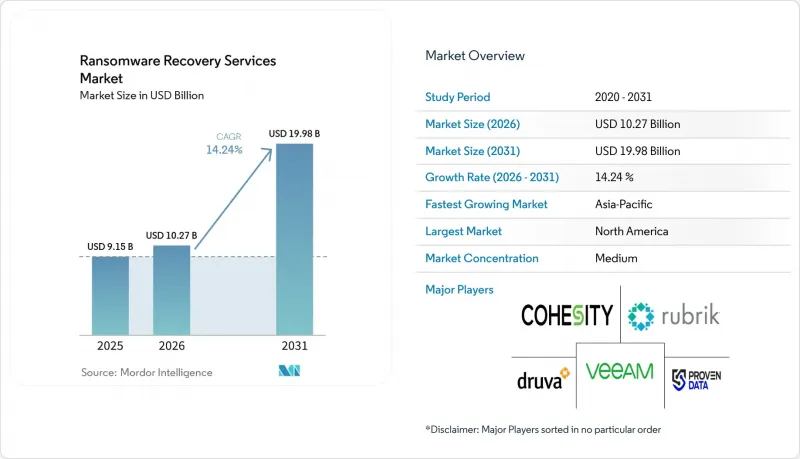
全球勒索軟體恢復服務市場趨勢及洞察
雙重甚至三重勒索攻擊愈演愈烈。
高級勒索軟體集團如今將加密和資料竊取、分散式阻斷服務 (DDoS) 攻擊以及與相關人員的直接聯繫整合到單一宣傳活動中。這種策略縮短了受害者的回應時間,其影響遠不止於系統可用性。 Chainalysis 預測,到 2025 年,鏈上勒索軟體支付的金額將降至 8.2 億美元,而洩漏網站上的索賠數量將同比成長 50%。 Sophos 的研究表明,到 2026 年,56% 的攻擊會加密數據,高於 2025 年的 50%。 Mandiant 觀察到一些加密前的準備步驟,例如刪除卷影副本、加密 ESXi 資料儲存以及劫持備份管理帳戶,這些都可能導致常規復原方法失效。隨著贖金支付比例下降至 28%,企業尋求替代支付方式,對技術恢復、取證調查和解密支援的需求也隨之增加。
擴展勒索軟體即服務 (RaaS) 和存取仲介生態系統
勒索軟體即服務 (RaaS) 和存取仲介模式已將攻擊事件擴散至更多營運商和關聯組織。在 LockBit 和 RansomHub 於 2025 年關閉後,Akira、Qilin, Inc.、Safepay 和 DragonForce 等組織擴大了其影響力。這表明,消滅一個組織並不能消除攻擊活動,而只是轉移了其行動基地。早期訪問仲介在 2025 年至少獲得了 1400 萬美元的鏈上結算,使勒索軟體收入增加了 58 倍。自動化、人工智慧輔助工具以及來自竊取資訊的惡意軟體的日誌流的增加降低了關聯組織的准入門檻,導致平均訪問價格從 2023 年第一季的 1427 美元降至 2026 年第一季的 439 美元。攻擊准入成本的降低可能導致目標組織數量的成長速度超過許多防禦計畫的改進速度。因此,勒索軟體恢復服務市場依賴廣泛的事件需求,而非特定營運商品牌的持續存在。這種市場狀況確保了即使犯罪集團更換名稱、工具或關聯網路,復原能力仍然至關重要。
回收工程師和法證專家短缺
經驗豐富的數位鑑識和事件回應 (DFIR) 專業人員短缺,限制了服務交付能力並推高了交付成本。 Magnet Forensics 對 368 位私人企業 DFIR負責人進行的一項調查顯示,近四分之三的受訪者表示在招聘和留住人才方面面臨挑戰,其中 39.4% 的受訪者認為該問題「嚴重」或「非常嚴重」。 SANS 的一份報告發現,60% 的組織將技能差距列為其面臨的主要人才挑戰,而只有 40% 的組織認為存在人員短缺。在 55% 的案例中,招募擁有 15 年以上經驗的專業需要超過六個月的時間。雖然擁有實力雄厚的取證團隊的成熟服務提供者能夠維持服務質量,但不斷上漲的人事費用可能會減緩預算敏感的中小型企業 (SME) 對服務的採用。這種限制使得可擴展的方法、結構化的長期合作協議和自動化恢復流程對於旨在服務更廣泛基本客群的服務提供者變得更加重要。勒索軟體復原服務市場將受益於稀缺專家能夠將時間集中在最複雜的復原決策上。
細分市場分析
到2025年,解密和專業資料恢復將佔銷售額的36.71%。這反映出,當加密系統無法透過自助方式恢復時,對專家介入的需求仍然存在。 Sophos報告稱,2026年56%的攻擊將涉及加密數據,這表明事件發生後,對專業服務的需求將持續存在。傳統上,許多組織只有在事件已經影響到生產資料和系統後才會購買恢復支援。這種趨勢有利於那些能夠將技術分析與業務團隊明確的恢復優先事項相結合的服務提供者。從確定洩漏範圍到最大限度地減少進一步損失,緊急評估、分類、遏制和根除通常是回應的第一步。當組織需要具有法律效力的事件過程記錄時,數位取證和證據保存有助於滿足調查要求。基礎設施、系統、應用程式和雲端恢復仍然是艱鉅的任務,因為恢復工作可能涉及混合系統,並且持續數週。
在勒索軟體復原服務市場中,與建立、測試和演練勒索軟體復原系統相關的領域預計將在2026年至2031年間以18.39%的複合年成長率成長。隨著保險公司、董事會和監管機構日益要求提供證據證明恢復流程在實際條件下有效運行,這項服務正受到越來越多的關注。勒索軟體恢復服務市場正在積極回應,提供演練服務,使不具備技術專長的決策者也能輕鬆評估其恢復系統的準備情況。由於停機時間、合約義務和資訊揭露要求可能會影響技術團隊以外的部門,恢復測試正成為一項管理挑戰。為了確保系統恢復運行,恢復後檢驗和安全恢復營運支援服務正日益普及。此外,身分、目錄和存取權限恢復也變得越來越重要,因為79%的攻擊都是利用身分攻擊技術發動的。另外,根據Sophos的一項調查,67%的受害者認為勒索軟體事件是他們遭遇的「最嚴重的身分攻擊」。 Rubrik 和 CrowdStrike 的整合於 2026 年 9 月實施,將身分基礎設施恢復時間從幾天縮短到幾小時,這表明技術提供者致力於提高恢復速度。
到2025年,遠端服務將佔總收入的58.64%。這為初步分類、終端取證、解密分析、威脅搜尋、身分調查和雲端工作負載復原提供了一種切實可行的模式。服務提供者無需等待工作人員前往受影響地區,即可快速部署專用工具。遠端團隊還可以同時處理多個案例,即使在事件激增期間也能維持服務能力。這種交付方式適用於可安全網路存取且復原工作無需收集實體證據的情況。由於其規模和速度優勢,預計到2031年,遠端服務仍將保持其市場佔有率的主導地位。勒索軟體復原服務市場繼續依賴遠端訪問,以便在客戶分散的各個地點快速部署專家。遠端回應也為客戶提供了一個切入點,讓他們在確定是否需要現場支援之前,可以利用專家的專業知識。
混合模式預計將在2026年至2031年間以19.27%的複合年成長率成長,在所有服務模式中成長率最高。複雜的復原工作可能需要現場作業,包括處理需要考慮網路附加儲存 (NAS)、RAID、SAN 陣列、硬體級取證和證據鏈的證據。 2025年,實際恢復中備份的使用率降至54%,為六年來的最低水準。這意味著,一旦發現備份鏈遭到破壞,可能需要更深入介入的事件數量可能會增加。混合服務結合了遠端調查的速度和根據基礎設施情況所需的實體支援。在資料主權法規限制透過公共網路傳輸證據的受監管環境中,現場回應仍然至關重要。在網路存取受限或不安全的營運技術 (OT) 環境中,現場回應也至關重要。能夠在單一工作流程中無縫地從遠端回應過渡到現場恢復的服務提供者可以使其服務脫穎而出。對於小規模專業公司而言,大規模建構這種服務範圍可能很困難,而大規模平台可以將其納入包月協議和分階段服務模式中。
區域分析
到2025年,北美將佔據勒索軟體恢復服務市場37.48%的佔有率。該地區擁有大量高價值企業目標、成熟的網路保險生態系統以及強大的事件回應能力。美國證券交易委員會(SEC)的資訊揭露規則和即將訂定的CIRCIA框架正在推動對專業文件化復原計畫的系統性投資。到2026年,加拿大中小企業(SMB)每次勒索軟體事件的總成本將在13.5萬加元(97,594.15美元)至25萬加元(180,729.90美元)之間。此成本範圍凸顯了企業級以下訂閱式恢復產品的需求。在勒索軟體恢復服務市場,利用週期性服務模式可以將準備和回應成本分攤到更長的周期內。
在歐洲,監管要求正促使受監管的買家更明確地證明其檢驗的復原能力。 DORA於2025年1月17日生效,強制要求歐盟金融機構提供檢驗的ICT業務永續營運和備份復原能力。監管審查力道將在2026年持續加強,針對集中型第三方ICT風險的專題審查計畫持續到2027年。由於德國、英國、法國和義大利金融和工業活動高度集中,預計這些國家的需求將顯著成長。在英國,2026年勒索贖金中位數將達到250萬美元,創下全球新高。
預計亞太地區2026年至2031年的複合年成長率將達到19.79%,成為成長最快的地區。 2026年上半年,印度記錄了77起勒索軟體攻擊事件,在亞太地區排名第二,僅次於記錄了82起的泰國。印度CERT-In要求在六小時內報告安全漏洞,這推動了對記錄在案的回應和恢復援助的需求。在日本,2026年有45.8%的企業報告遭受勒索軟體感染,恢復成功率為44.2%,低於2025年的46%。 2026年8月,中國發布警告,指出一種名為「Sorry」的勒索軟體變種正針對擁有大量Linux伺服器和資料的中小型企業。除了南美洲的金融、保險、證券(BFSI)和能源產業活動外,海灣國家的數位基礎設施發展計劃,以及奈及利亞和南非數位經濟的擴張,將隨著攻擊面在區域內擴大而支持未來的需求。
其他好處:
- Excel格式的市場預測(ME)表
- 3個月的分析師支持
目錄
第1章:引言
- 研究假設和市場定義
- 調查範圍
第2章:調查方法
第3章執行摘要
第4章 市場狀況
- 市場概覽
- 市場促進因素
- 雙重和三重勒索攻擊愈演愈烈
- 擴展 RaaS(勒索軟體即服務)和存取仲介生態系統
- 監管壓力對檢驗的網路恢復的影響
- 在雲端和多重雲端中擴展工作負載
- 針對備份的攻擊催生了對不可竄改復原的需求。
- 網路保險對可證明的復原能力的要求
- 市場限制因素
- 回收技術人員和法醫專家短缺
- 複雜的催收操作高成本且經濟效益不確定。
- 加密或破壞性載荷在技術上可能無法恢復。
- 資料主權、儲存鍊和跨境存取的限制
- 產業價值鏈分析
- 宏觀經濟因素的影響
- 監理情勢
- 技術展望
- 波特五力分析
第5章 市場規模與成長預測
- 按服務類型
- 緊急評估、分流、控制和根除
- 數位取證和證據保存
- 解密和專業資料恢復
- 基礎架構、系統、應用程式和雲端恢復
- ID、目錄和存取恢復
- 檢驗恢復情況及安全復工狀況
- 勒索軟體復原流程、測試和演練
- 按型號提供
- 偏僻的
- 現場
- 混合
- 按組織規模
- 大公司
- 小型企業
- 按行業分類
- 政府和公共行政
- 零售與電子商務
- 運輸/物流
- 資訊科技/通訊
- 媒體與娛樂
- 醫療保健和生命科學
- 銀行、金融服務和保險(BFSI)
- 其他工業部門
- 按地區
- 北美洲
- 美國
- 加拿大
- 墨西哥
- 南美洲
- 巴西
- 阿根廷
- 其他南美國家
- 歐洲
- 德國
- 英國
- 法國
- 義大利
- 比荷盧經濟聯盟
- 其他歐洲國家
- 亞太地區
- 中國
- 日本
- 印度
- 韓國
- 澳洲
- 其他亞太國家
- 中東和非洲
- 中東
- 阿拉伯聯合大公國
- 沙烏地阿拉伯
- 其他中東國家
- 非洲
- 南非
- 奈及利亞
- 埃及
- 其他非洲國家
- 中東
- 北美洲
第6章 競爭情勢
- 市場集中度
- 策略趨勢
- 市佔率分析
- 公司簡介
- Veeam Software Group GmbH
- Rubrik, Inc.
- Cohesity, Inc.
- Druva Inc.
- Proven Data Recovery, LLC
- Acronis International GmbH
- Alvaka Networks, Inc.
- Arete Advisors, Inc.
- Bitdefender SRL
- Commvault Systems, Inc.
- Coveware, Inc.
- CrowdStrike Holdings, Inc.
- DriveSavers, Inc.
- Gillware, Inc.
- Kroll, LLC
- NCC Group plc
- Palo Alto Networks, Inc.
- Secure Data Recovery Services, Inc.
- SentinelOne, Inc.
- Sophos Limited
- STORM Guidance, LLC
- Rossmann Repair Group Inc.
- Verizon Communications Inc.
- VMware, Inc.
- WithSecure Corporation
第7章 市場機會與未來展望
According to Mordor Intelligence, the ransomware recovery services market size was valued at USD 9.15 billion in 2025 and estimated to grow from USD 10.27 billion in 2026 to reach USD 19.98 billion by 2031, at a CAGR of 14.24% during the forecast period (2026-2031).
Global Ransomware Recovery Services Market Trends and Insights
Escalation of Double- and Triple-Extortion Attacks
Advanced ransomware groups now combine encryption with data exfiltration, distributed denial-of-service attacks, and direct outreach to stakeholders in a single campaign. This approach shortens the time available for a victim to respond and broadens the consequences beyond system availability. Chainalysis recorded a 50% year-over-year increase in leak-site-claimed victims during 2025, even as on-chain ransomware payments fell to USD 820 million. Sophos found that 56% of attacks encrypted data in 2026, compared with 50% in 2025. Mandiant documented deletion of volume shadow copies, encryption of ESXi data stores, and compromise of backup-administration accounts as pre-encryption steps, which can remove the option of routine restoration. The share of ransoms paid fell to 28%, increasing the need for technical recovery, forensic work, and decryption support as organizations seek payment alternatives.
Expansion of Ransomware-as-a-Service and Access-Broker Ecosystems
Ransomware-as-a-Service and access-broker models spread incident activity across a larger group of operators and affiliates. The closure of LockBit and RansomHub in 2025 was followed by gains for Akira, Qilin, Inc, Safepay, and DragonForce, showing that disruption of one group can shift activity rather than remove it. Initial Access Brokers received at least USD 14 million in on-chain payments during 2025 and enabled ransomware proceeds that were 58 times larger. Average access prices declined from USD 1,427 in Q1 2023 to USD 439 in Q1 2026 as automation, AI-assisted tools, and a greater supply of infostealer logs reduced barriers for affiliates. Lower attack-entry costs can expand the pool of targeted organizations faster than many defensive programs can improve. The ransomware recovery services market, therefore, depends on broad incident demand rather than the continued presence of any single operator brand. This ransomware recovery services market condition keeps recovery capacity relevant when criminal groups change names, tools, or affiliate networks.
Shortage of Recovery Engineers and Forensic Specialists
The shortage of experienced digital forensics and incident response professionals limits service capacity and increases delivery costs. Magnet Forensics found that nearly three-quarters of 368 private-sector DFIR respondents faced recruitment and retention challenges, with 39.4% describing the issue as large or extreme. SANS reported that 60% of organizations identified skills gaps as their main workforce challenge, compared with 40% that cited headcount shortages. Expert roles requiring 15 or more years of experience took 6 months or longer to fill in 55% of cases. Incumbent providers with established forensic teams can protect service quality, but higher staffing costs can delay purchases among budget-sensitive SMEs. This constraint also makes scalable methods, structured retainers, and recovery automation more important for providers seeking to serve a larger client base. The ransomware recovery services market benefits when scarce expert time is directed to the most complex recovery decisions.
Other drivers and restraints analyzed in the detailed report include:
- Regulatory Pressure for Tested Cyber Recovery
- Cloud and Multicloud Workload Expansion
- High Cost and Uncertain Economics of Complex Recovery Engagements
For complete list of drivers and restraints, kindly check the Table Of Contents.
Segment Analysis
Decryption and specialist data recovery held 36.71% of revenue in 2025. This position reflected continuing demand for expert intervention when encrypted systems could not be restored through self-service methods. Sophos reported that 56% of attacks encrypted data in 2026, sustaining the need for post-incident specialist work. Historically, many organizations purchased recovery support only after an incident had already affected production data and systems. This pattern favors providers that can combine technical analysis with clear recovery priorities for business teams. Emergency Assessment, Triage, Containment, and Eradication often start the engagement by identifying the scope of compromise and limiting further damage. Digital Forensics and Evidence Preservation supports investigation requirements where an organization needs a defensible record of events. Infrastructure, System, Application, and Cloud Restoration remains labor-intensive because restoration can span hybrid systems and continue for several weeks.
The ransomware recovery services market size for ransomware recovery readiness, Testing, and exercises is projected to grow at an 18.39% CAGR between 2026 and 2031. This service is gaining attention as insurers, boards, and regulators request evidence that recovery processes work under realistic conditions. The ransomware recovery services market is responding by offering exercises that make recovery readiness easier for nontechnical decision-makers to evaluate. Tested recovery is becoming a management issue because downtime, contractual commitments, and disclosure obligations can have consequences beyond technology teams. Recovery validation and secure return to operations are increasingly sold after restoration to confirm that systems can resume normal use. Identity, directory, and access recovery are also becoming more important because 79% of attacks began through identity-based approaches. Sophos also found that 67% of victims considered the ransomware incident their most significant identity attack. The September 2026 integration between Rubrik and CrowdStrike reduced identity infrastructure recovery times from days to hours, demonstrating how technology providers are working to improve recovery speed.
Remote held 58.64% of revenue in 2025. It provides a practical model for early triage, endpoint forensics, decryption analysis, threat hunting, identity investigations, and cloud workload restoration. Providers can deploy specialist tools quickly without waiting for staff to travel to the affected location. Remote teams can also manage several engagements at the same time, which supports service capacity during periods of high incident volume. This delivery method remains suitable where secure network access is available and the recovery task does not require physical evidence collection. Its scale and speed mean it is expected to retain a majority position through 2031. The ransomware recovery services market continues to rely on remote access for rapid specialist deployment across dispersed customer locations. Remote response also gives customers an entry point to specialist expertise before deciding whether on-site support is needed.
Hybrid is projected to grow at a 19.27% CAGR between 2026 and 2031, the fastest rate among delivery models. Complex rebuilds can require on-site work for network-attached storage, RAID, SAN arrays, hardware-level forensics, and chain-of-custody-sensitive evidence. Backup use for actual recovery fell to 54% in 2025, a 6-year low, which means more incidents may need deeper intervention after compromised backup chains are discovered. Hybrid delivery combines the speed of remote investigation with physical support when infrastructure conditions require it. On-Site delivery remains necessary in regulated settings where data sovereignty rules restrict transmission of evidence over public networks. It is also relevant to operational technology environments where network access is limited or unsafe. Providers that can move smoothly from remote action to site-based recovery within one workflow can differentiate their service. Smaller specialists may find it difficult to build this coverage at scale, while larger platforms can include it in retainer programs and tiered response models.
Complete Report Scope:
- By Service Type
- Emergency Assessment, Triage, Containment, and Eradication
- Digital Forensics and Evidence Preservation
- Decryption and Specialist Data Recovery
- Infrastructure, System, Application, and Cloud Restoration
- Identity, Directory, and Access Recovery
- Recovery Validation and Secure Return to Operations
- Ransomware Recovery Readiness, Testing, and Exercises
- By Delivery Model
- Remote
- On-Site
- Hybrid
- By Organization Size
- Large Enterprises
- Small and Medium-Sized Enterprises
- By Industry Vertical
- Government and Public Administration
- Retail and E-Commerce
- Transportation and Logistics
- IT and Telecommunication
- Media and Entertainment
- Healthcare and Life Sciences
- Banking, Financial Services, and Insurance (BFSI)
- Other Industry Verticals
- By Geography
- North America
- United States
- Canada
- Mexico
- South America
- Brazil
- Argentina
- Rest of South America
- Europe
- Germany
- United Kingdom
- France
- Italy
- BENELUX
- Rest of Europe
- Asia-Pacific
- China
- Japan
- India
- South Korea
- Australia
- Rest of Asia-Pacific
- Middle East and Africa
- Middle East
- United Arab Emirates
- Saudi Arabia
- Rest of Middle East
- Africa
- South Africa
- Nigeria
- Egypt
- Rest of Africa
- Middle East
- North America
Geography Analysis
North America held 37.48% of the ransomware recovery services market share in 2025. The region has a high concentration of valuable corporate targets, a mature cyber-insurance ecosystem, and substantial incident-response capacity. U.S. SEC disclosure rules and the forthcoming CIRCIA framework support systematic investment in professionally documented recovery programs. Canadian SMBs faced all-in ransomware incident costs of CAD 135,000 (USD 97,594.15) to CAD 250,000 (USD 180,729.90) per engagement during 2026. This cost range supports demand for subscription-based recovery products below the enterprise tier. The ransomware recovery services market can use recurring service models to spread preparedness and response costs across a longer period.
Europe is shaped by regulatory requirements that make tested restoration more visible to regulated buyers. DORA has been effective since January 17, 2025, and requires tested ICT continuity and backup restoration for EU financial entities. Supervisory review is intensifying through 2026, and thematic reviews of third-party ICT risk concentration are planned through 2027. Germany, the United Kingdom, France, and Italy provide significant demand through concentrated financial and industrial activity. The United Kingdom recorded the highest median ransom demand globally in 2026, at USD 2.5 million.
Asia-Pacific is projected to expand at a 19.79% CAGR between 2026 and 2031, making it the fastest-growing regional area. India recorded 77 confirmed ransomware incidents in H1 2026, second in APAC behind Thailand, which recorded 82 incidents. India's 6-hour CERT-In breach notification requirement strengthens demand for documented response and recovery support. Japan reported that 45.8% of companies experienced ransomware infection in 2026, and its recovery success rate was 44.2%, down from 46% in 2025. China issued an August 2026 warning regarding the Sorry ransomware variant, which targeted Linux servers and data-rich SMEs. South America's BFSI and energy activity, together with Gulf digital infrastructure programs and expanding digital economies in Nigeria and South Africa, support future demand as regional attack surfaces develop.
- Veeam Software Group GmbH
- Rubrik, Inc.
- Cohesity, Inc.
- Druva Inc.
- Proven Data Recovery, LLC
- Acronis International GmbH
- Alvaka Networks, Inc.
- Arete Advisors, Inc.
- Bitdefender SRL
- Commvault Systems, Inc.
- Coveware, Inc.
- CrowdStrike Holdings, Inc.
- DriveSavers, Inc.
- Gillware, Inc.
- Kroll, LLC
- NCC Group plc
- Palo Alto Networks, Inc.
- Secure Data Recovery Services, Inc.
- SentinelOne, Inc.
- Sophos Limited
- STORM Guidance, LLC
- Rossmann Repair Group Inc.
- Verizon Communications Inc.
- VMware, Inc.
- WithSecure Corporation
Additional Benefits:
- The market estimate (ME) sheet in Excel format
- 3 months of analyst support
TABLE OF CONTENTS
1 INTRODUCTION
- 1.1 Study Assumptions and Market Definition
- 1.2 Scope of the Study
2 RESEARCH METHODOLOGY
3 EXECUTIVE SUMMARY
4 MARKET LANDSCAPE
- 4.1 Market Overview
- 4.2 Market Drivers
- 4.2.1 Escalation of Double- and Triple-Extortion Attacks
- 4.2.2 Expansion of Ransomware-as-a-Service and Access-Broker Ecosystems
- 4.2.3 Regulatory Pressure for Tested Cyber Recovery
- 4.2.4 Cloud and Multicloud Workload Expansion
- 4.2.5 Backup Targeting Creates Demand for Immutable Recovery
- 4.2.6 Cyber-Insurance Requirements for Demonstrable Recovery Readiness
- 4.3 Market Restraints
- 4.3.1 Shortage of Recovery Engineers and Forensic Specialists
- 4.3.2 High Cost and Uncertain Economics of Complex Recovery Engagements
- 4.3.3 Encrypted or Destructive Payloads Can Make Recovery Technically Impossible
- 4.3.4 Data-Sovereignty, Chain-of-Custody, and Cross-Border Access Constraints
- 4.4 Industry Value-Chain Analysis
- 4.5 Impact of Macroeconomic Factors
- 4.6 Regulatory Landscape
- 4.7 Technological Outlook
- 4.8 Porter's Five Forces Analysis
- 4.8.1 Threat of Substitutes
- 4.8.2 Bargaining Power of Buyers
- 4.8.3 Bargaining Power of Suppliers
- 4.8.4 Threat of New Entrants
- 4.8.5 Competitive Rivalry
5 MARKET SIZE AND GROWTH FORECASTS (VALUE)
- 5.1 By Service Type
- 5.1.1 Emergency Assessment, Triage, Containment, and Eradication
- 5.1.2 Digital Forensics and Evidence Preservation
- 5.1.3 Decryption and Specialist Data Recovery
- 5.1.4 Infrastructure, System, Application, and Cloud Restoration
- 5.1.5 Identity, Directory, and Access Recovery
- 5.1.6 Recovery Validation and Secure Return to Operations
- 5.1.7 Ransomware Recovery Readiness, Testing, and Exercises
- 5.2 By Delivery Model
- 5.2.1 Remote
- 5.2.2 On-Site
- 5.2.3 Hybrid
- 5.3 By Organization Size
- 5.3.1 Large Enterprises
- 5.3.2 Small and Medium-Sized Enterprises
- 5.4 By Industry Vertical
- 5.4.1 Government and Public Administration
- 5.4.2 Retail and E-Commerce
- 5.4.3 Transportation and Logistics
- 5.4.4 IT and Telecommunication
- 5.4.5 Media and Entertainment
- 5.4.6 Healthcare and Life Sciences
- 5.4.7 Banking, Financial Services, and Insurance (BFSI)
- 5.4.8 Other Industry Verticals
- 5.5 By Geography
- 5.5.1 North America
- 5.5.1.1 United States
- 5.5.1.2 Canada
- 5.5.1.3 Mexico
- 5.5.2 South America
- 5.5.2.1 Brazil
- 5.5.2.2 Argentina
- 5.5.2.3 Rest of South America
- 5.5.3 Europe
- 5.5.3.1 Germany
- 5.5.3.2 United Kingdom
- 5.5.3.3 France
- 5.5.3.4 Italy
- 5.5.3.5 BENELUX
- 5.5.3.6 Rest of Europe
- 5.5.4 Asia-Pacific
- 5.5.4.1 China
- 5.5.4.2 Japan
- 5.5.4.3 India
- 5.5.4.4 South Korea
- 5.5.4.5 Australia
- 5.5.4.6 Rest of Asia-Pacific
- 5.5.5 Middle East and Africa
- 5.5.5.1 Middle East
- 5.5.5.1.1 United Arab Emirates
- 5.5.5.1.2 Saudi Arabia
- 5.5.5.1.3 Rest of Middle East
- 5.5.5.2 Africa
- 5.5.5.2.1 South Africa
- 5.5.5.2.2 Nigeria
- 5.5.5.2.3 Egypt
- 5.5.5.2.4 Rest of Africa
- 5.5.5.1 Middle East
- 5.5.1 North America
6 COMPETITIVE LANDSCAPE
- 6.1 Market Concentration
- 6.2 Strategic Moves
- 6.3 Market Share Analysis
- 6.4 Company Profiles (includes Global Level Overview, Market Level Overview, Core Segments, Financials as available, Strategic Information, Market Rank/Share, Products and Services, Recent Developments)
- 6.4.1 Veeam Software Group GmbH
- 6.4.2 Rubrik, Inc.
- 6.4.3 Cohesity, Inc.
- 6.4.4 Druva Inc.
- 6.4.5 Proven Data Recovery, LLC
- 6.4.6 Acronis International GmbH
- 6.4.7 Alvaka Networks, Inc.
- 6.4.8 Arete Advisors, Inc.
- 6.4.9 Bitdefender SRL
- 6.4.10 Commvault Systems, Inc.
- 6.4.11 Coveware, Inc.
- 6.4.12 CrowdStrike Holdings, Inc.
- 6.4.13 DriveSavers, Inc.
- 6.4.14 Gillware, Inc.
- 6.4.15 Kroll, LLC
- 6.4.16 NCC Group plc
- 6.4.17 Palo Alto Networks, Inc.
- 6.4.18 Secure Data Recovery Services, Inc.
- 6.4.19 SentinelOne, Inc.
- 6.4.20 Sophos Limited
- 6.4.21 STORM Guidance, LLC
- 6.4.22 Rossmann Repair Group Inc.
- 6.4.23 Verizon Communications Inc.
- 6.4.24 VMware, Inc.
- 6.4.25 WithSecure Corporation
7 MARKET OPPORTUNITIES AND FUTURE OUTLOOK
- 7.1 White-Space and Unmet-Need Assessment

 網路安全與資料保護解決方案市場:全球市場預測,2026-2032年
 2026年全球災害復原系統市場報告2026年全球資料保護與複製解決方案市場報告2026年全球資料保護與複製軟體市場報告2026年全球資料備份平台市場報告
 行動資料安全軟體市場規模、佔有率和成長分析:按軟體類型、作業系統、部署規模、最終用戶產業和地區分類 - 產業預測,2026-2033 年
 資料保護和復原解決方案市場規模、佔有率和趨勢分析報告:按解決方案、部署類型、企業規模、最終用途、地區和細分市場預測(2026-2033 年)
 全球行動資料保護解決方案和服務市場規模、佔有率、趨勢和成長分析報告(2026-2034年)2026年全球VIP票務市場報告2026年全球加密狗市場報告