


 |
市場調查報告書
商品編碼
2156971
混凝土:市場佔有率分析、產業趨勢與統計、成長預測(2026-2031)Concrete - Market Share Analysis, Industry Trends & Statistics, Growth Forecasts (2026 - 2031) |
||||||

※ 本網頁內容可能與最新版本有所差異。詳細情況請與我們聯繫。
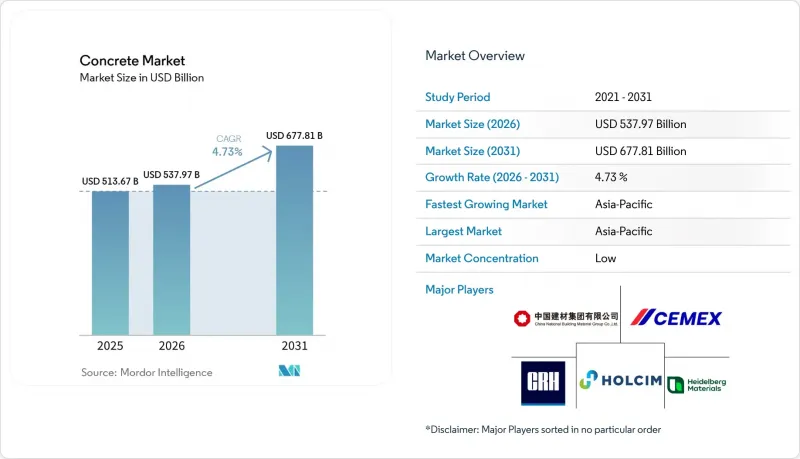
據 Mordor Intelligence 稱,2025 年混凝土市場價值為 5,136.7 億美元,預計到 2026 年將從 5,379.7 億美元成長到 2031 年的 6,778.1 億美元。
預測期(2026-2031 年)的複合年成長率預計為 4.73%。
全球混凝土市場趨勢及洞察
對全球基礎設施和交通運輸領域的投資
政府為基礎設施現代化所做的努力,正在為混凝土市場建立多年需求基礎。長期公共投資項目為交通運輸、公共產業和其他大量使用混凝土的資產提供支援。道路、鐵路、港口和發電廠在其整個生命週期(從建設到維護)中都需要混凝土。一條四車道高速公路每公里可能需要1萬至1.2萬立方公尺的混凝土,顯示混凝土在交通基礎設施工程的使用量極為巨大。貨運走廊、高速鐵路和港口開發仍然是各國基礎設施規劃中混凝土的主要消耗領域。巴西的基礎設施投資持續整體交通運輸和公共產業項目的建設活動。
都市區對住宅和商業建築的需求
城市發展正在推動亞洲、中東和撒哈拉以南非洲地區對住宅和商業建築的需求。混凝土供應商擴大透過混凝土攪拌站網路而非現場攪拌來滿足這一需求。在中小城市,經濟適用住宅的建設為預拌混凝土配送網路仍然有限的地區創造了新的機會。擁有密集攪拌站網路的供應商具有優勢,因為較長的配送距離會影響成本和服務可靠性。此外,資料中心需要滿足抗振、耐熱和耐化學腐蝕等高性能要求的混凝土,這推動了對技術先進的混凝土混合料的需求。
遵守水泥碳排放法規的成本
應對碳排放法規給嚴重依賴水泥熟料水泥的混凝土生產商帶來了巨大的成本壓力。根據歐盟實施條例2025/2621,波特蘭水泥的碳邊境調節機制(CBAM)官方基準值為每公噸0.83噸二氧化碳當量。 CBAM係數預計將從2026年的2.5%上升到2030年的48.5%,並在2034年全面實施。這一趨勢可能加劇向歐盟進口高排放水泥的成本劣勢。大型生產商可以將報告和檢驗成本分攤到更廣泛的業務活動中,而小規模供應商則可能面臨更大的固定成本負擔。因此,混凝土市場有獎勵使用低碳接合材料並改善排放測量。買家也可能優先考慮能夠提供與技術性能數據同等可靠性的經檢驗環境資訊的供應商。
細分市場分析
截至2025年,預拌混凝土將佔混凝土市場佔有率的55.13%。這一地位體現了集中式批量處理的價值,它能夠實現一致的匹配和精確的澆築時間。這種方法還可以減少現場施工,這對於空間有限的密集型都市區專案至關重要。建築公司使用預拌混凝土是為了避免現場攪拌帶來的品質波動。預拌混凝土的市場規模得益於其在住宅、商業和基礎設施建設中的廣泛應用。由於供應商需要靠近客戶的工廠,運輸限制仍然造成了區域競爭。整合骨材來源的企業可以提高可靠性並控制投入成本。
預計到2031年,預製混凝土產品將以5.24%的複合年成長率成長。它們廣泛應用於隧道襯砌、橋樑梁體、模組化樓板以及其他可透過工廠化控制縮短工期的項目。標準化的養護和尺寸精度使其能夠應用於對耐久性要求極高的專案。據美國國家預製混凝土協會稱,與普通商業建築相比,美國為公共和基礎設施項目提供的資金籌措條件更為穩定。工廠生產的產品在品質、前置作業時間、物流網路覆蓋以及滿足專案規範的能力方面都具有競爭優勢。隨著專案日益複雜,這些因素在整個混凝土市場中的重要性也與日俱增。
區域分析
預計到2025年,亞太地區將佔全球混凝土需求的40.38%,並在2031年之前以5.32%的複合年成長率持續成長。該地區規劃了眾多交通和電力項目,這些項目將需要大量的混凝土。在印度,貨運走廊、高速公路建設合約、地鐵工程和公共資本支出是推動混凝土需求的主要因素。中國的基礎建設需求依然強勁,但房地產投資仍低迷。在日本和韓國,對高強度和抗震混凝土的需求預計將保持強勁。
在北美和歐洲,需求更集中在維修和升級改造,而非大規模新建設。美國的基礎建設資金主要用於公路維修、橋樑更換和公共交通發展。預計到2026年,美國的建築開工量將達到2.2兆美元,其中公共和基礎設施項目的資金基礎比住宅更為雄厚。 Holcim於2025年收購加拿大蘭利混凝土集團(Langley Concrete Group),體現了其對該地區基礎設施建設週期的信心。在法國,海德堡材料股份公司(Heidelberg Materials AG)於2026年5月在艾爾沃伊(Airvoy)運作了一條年產能為125萬噸的窯爐生產線。與傳統生產方式相比,此生產線可減少30%的碳排放。歐洲製造商正在努力平衡維修和基礎設施的需求與日益成長的脫碳要求。歐洲混凝土市場越來越依賴規範的生產和維修標準。
南美洲、中東和非洲蘊藏著巨大的商機,但投資時機因國家而異。巴西的建築市場依然蓬勃發展,基礎建設投資支撐著市場需求。 2026年3月,豪瑞國際完成了秘魯帕卡斯馬約水泥公司(Cementos Pacasmayo)多數股權的收購。同月,豪瑞國際也同意從墨西哥水泥公司(CEMEX)收購其在哥倫比亞的建材和解決方案業務。沙烏地阿拉伯的「2030願景」計畫正在推動對高規格混凝土的需求,而阿拉伯聯合大公國則在商業和工業領域推動消費。企劃案融資和分散的採購結構可能會延遲向該地區其他地區的交付。在這些市場運營的供應商需要使其產能與當地的合約進度和運輸管道相匹配。因此,可靠的骨材供應和工廠位置與大型專案的支出同等重要。高規格建築可以提高產品的附加價值,但也需要一支技術精湛的團隊和對混凝土配合比設計的嚴格控制。
其他好處:
- Excel格式的市場預測(ME)表
- 3個月的分析師支持
目錄
第1章:引言
- 研究假設和市場定義
- 調查範圍
第2章:調查方法
第3章執行摘要
第4章 市場狀況
- 市場概覽
- 市場促進因素
- 全球基礎建設和交通投資
- 都市區對住宅和商業建築的需求
- 預製構件和預拌混凝土的生產效率優勢
- 低碳建築及配套水泥基材料
- 具有韌性的基礎設施和應對極端天氣事件的適應能力
- 市場限制因素
- 遵守水泥碳排放法規的成本
- 預拌混凝土的配送範圍及混凝土硬化的限制
- 能源、骨材和外加劑成本的波動
- 價值鏈分析
- 波特五力分析
第5章 市場規模與成長預測
- 混凝土的類型
- 預拌混凝土
- 預製產品
- 其他
- 透過使用
- 鋼筋混凝土
- 非鋼筋混凝土
- 其他
- 按最終用戶行業分類
- 住宅
- 商業的
- 產業
- 基礎設施
- 按地區
- 亞太地區
- 中國
- 印度
- 日本
- 韓國
- 東南亞國協
- 其他亞太國家
- 北美洲
- 美國
- 加拿大
- 墨西哥
- 歐洲
- 德國
- 英國
- 法國
- 義大利
- 北歐國家
- 俄羅斯
- 其他歐洲國家
- 南美洲
- 巴西
- 阿根廷
- 其他南美國家
- 中東和非洲
- 沙烏地阿拉伯
- 阿拉伯聯合大公國
- 南非
- 其他中東和非洲國家
- 亞太地區
第6章 競爭情勢
- 市場集中度
- 策略趨勢
- 市佔率和排名分析
- 公司簡介
- Buzzi SpA
- Cementir Holding NV
- CEMEX SAB de CV
- China National Building Material Group Co., Ltd.
- CRH
- Heidelberg Materials AG
- HOLCIM
- Martin Marietta
- Sika AG
- Taiheiyo Cement Corporation
- The QUIKRETE Companies
- TITAN
- UltraTech Cement Ltd
- Vicat
- Votorantim Cimentos
- Vulcan Materials
第7章 市場機會與未來展望
According to Mordor Intelligence, the concrete market size was valued at USD 513.67 billion in 2025 and is estimated to grow from USD 537.97 billion in 2026 to reach USD 677.81 billion by 2031, at a CAGR of 4.73% during the forecast period (2026-2031).
Global Concrete Market Trends and Insights
Global Infrastructure and Transport Investment
Government commitments to infrastructure modernization are establishing a multi-year base of demand for the concrete market. Long-term public investment programs are supporting transport, utilities, and other concrete-intensive assets. Roads, railways, ports, and power installations require concrete throughout construction and maintenance cycles. A 4-lane highway kilometer can require 10,000 to 12,000 cubic meters of concrete, which shows the material intensity of transport programs. Freight corridors, high-speed rail, and port development remain concrete-intensive parts of national infrastructure programs. Infrastructure investment in Brazil continues to support construction activity across transport and utility projects.
Urban Housing and Commercial Construction Demand
Urban growth is sustaining demand for residential and commercial construction across Asia, the Middle East, and sub-Saharan Africa. Concrete suppliers increasingly serve this demand through batching networks rather than site-mixed production. Affordable housing in smaller cities creates opportunities where ready-mix delivery networks are still limited. This favors suppliers with dense plant networks because long delivery distances can affect cost and service reliability. Data centers also require high-performance concrete that can meet vibration, thermal-load, and chemical-resistance requirements, which supports demand for technically advanced mixes.
Cement-Related Carbon Compliance Costs
Carbon compliance is a major cost pressure for concrete producers that rely on clinker-intensive cement. Portland cement has an official Carbon Border Adjustment Mechanism benchmark of 0.83 tCO2e per metric ton under EU Implementing Regulation 2025/2621. The Carbon Border Adjustment Mechanism factor is 2.5% in 2026 and is scheduled to rise to 48.5% by 2030 before full exposure in 2034. This trajectory can increase the cost disadvantage of high-emissions cement imports into the European Union. Large producers can spread reporting and verification costs across wider operations, while smaller suppliers may face a higher fixed-cost burden. The concrete market, therefore, has an incentive to use lower-carbon binders and improve emissions measurement. Buyers may also favor suppliers that can provide verified environmental information with the same reliability as technical performance data.
Other drivers and restraints analyzed in the detailed report include:
- Precast and Ready-Mix Productivity Benefits
- Low-Carbon Construction and Supplementary Cementitious Materials
- Volatility in Energy, Aggregates and Admixture Costs
For complete list of drivers and restraints, kindly check the Table Of Contents.
Segment Analysis
Ready-mix concrete held 55.13% of the concrete market share in 2025. Its position reflects the value of centralized batching for consistent mix design and accurate pour timing. The format also reduces on-site labor requirements, which matter in dense urban projects with limited working space. Contractors use ready-mix to avoid the quality variation associated with site-mixed materials. The concrete market size for ready-mix benefits from broad use in residential, commercial, and infrastructure work. Delivery constraints still create a local competitive structure because suppliers need plants close to customers. Operators with integrated aggregate sources can improve reliability and manage input costs.
Precast products are projected to advance at a 5.24% CAGR through 2031. They are used in tunnel linings, bridge girders, modular floor slabs, and other projects where factory control can shorten construction schedules. Standardized curing and dimensional accuracy support their use in projects with strict durability requirements. The National Precast Concrete Association reported that institutional and infrastructure work offers more durable funding conditions than standard commercial construction in the United States. Factory-produced formats will compete on quality, lead time, logistics coverage, and the ability to meet project specifications. These factors are becoming more material across the concrete market as projects become more complex.
Complete Report Scope:
- By Concrete Type
- Ready-Mix Concrete
- Precast Products
- Others
- By Application
- Reinforced Concrete
- Non-Reinforced Concrete
- Others
- By End-User Industry
- Residential
- Commercial
- Industrial
- Infrastructure
- By Geography
- Asia-Pacific
- China
- India
- Japan
- South Korea
- ASEAN Countries
- Rest of Asia-Pacific
- North America
- United States
- Canada
- Mexico
- Europe
- Germany
- United Kingdom
- France
- Italy
- NORDIC Countries
- Russia
- Rest of Europe
- South America
- Brazil
- Argentina
- Rest of South America
- Middle East and Africa
- Saudi Arabia
- United Arab Emirates
- South Africa
- Rest of Middle East and Africa
- Asia-Pacific
Geography Analysis
Asia-Pacific held 40.38% share of global concrete demand in 2025 and is projected to advance at a 5.32% CAGR through 2031. The region has a large pipeline of transport and power projects that need concrete-intensive construction. India is supported by freight corridors, highway awards, metro projects, and public capital expenditure. China has a stronger infrastructure demand, but its real estate investment remains weak. Japan and South Korea maintain a steady demand for high-strength and seismically rated concrete.
In North America and Europe, demand is focused on renewal and specification upgrades rather than broad greenfield construction. United States infrastructure funding supports highway rehabilitation, bridge replacement, and transit work. United States construction put in place is projected at USD 2.2 trillion in 2026, while institutional and infrastructure work has more durable funding than residential construction. HOLCIM acquired Langley Concrete Group in Canada during 2025, reflecting confidence in the region's infrastructure cycle. In France, Heidelberg Materials AG commissioned a 1.25 million metric tons annual kiln line at Airvault in May 2026 that has a 30% lower carbon footprint than prior production. European producers are balancing demand for renovation and infrastructure with rising decarbonization requirements. The concrete market in Europe depends increasingly on compliant production and renovation specifications.
South America and the Middle East and Africa have meaningful opportunities, although investment timing differs across countries. Brazil remains an active construction market, with infrastructure investment supporting demand. HOLCIM completed its acquisition of a majority stake in Cementos Pacasmayo in Peru during March 2026. It also agreed to acquire Colombian building materials and solutions operations from CEMEX during the same month. Saudi Arabia's Vision 2030 projects are creating demand for high-specification concrete, while the United Arab Emirates supports commercial and industrial consumption. Project financing and fragmented procurement can slow delivery across other parts of the region. Suppliers operating across these markets must match production capacity with local contract pipelines and transport access. This makes reliable aggregates supply and plant location as important as headline project spending. High-specification work can improve product value, but it also requires trained teams and careful control over mix performance.
- Buzzi S.p.A.
- Cementir Holding N.V.
- CEMEX S.A.B. de C.V.
- China National Building Material Group Co., Ltd.
- CRH
- Heidelberg Materials AG
- HOLCIM
- Martin Marietta
- Sika AG
- Taiheiyo Cement Corporation
- The QUIKRETE Companies
- TITAN
- UltraTech Cement Ltd
- Vicat
- Votorantim Cimentos
- Vulcan Materials
Additional Benefits:
- The market estimate (ME) sheet in Excel format
- 3 months of analyst support
TABLE OF CONTENTS
1 Introduction
- 1.1 Study Assumptions and Market Definition
- 1.2 Scope of the Study
2 Research Methodology
3 Executive Summary
4 Market Landscape
- 4.1 Market Overview
- 4.2 Market Drivers
- 4.2.1 Global Infrastructure and Transport Investment
- 4.2.2 Urban Housing and Commercial Construction Demand
- 4.2.3 Precast and Ready-Mix Productivity Benefits
- 4.2.4 Low-Carbon Construction and Supplementary Cementitious Materials
- 4.2.5 Resilient Infrastructure and Extreme-Weather Adaptation
- 4.3 Market Restraints
- 4.3.1 Cement-Related Carbon Compliance Costs
- 4.3.2 Ready-Mix Delivery Radius and Concrete Setting Constraints
- 4.3.3 Volatility in Energy, Aggregates and Admixture Costs
- 4.4 Value Chain Analysis
- 4.5 Porter's Five Forces Analysis
- 4.5.1 Threat of New Entrants
- 4.5.2 Bargaining Power of Suppliers
- 4.5.3 Bargaining Power of Buyers
- 4.5.4 Threat of Substitutes
- 4.5.5 Competitive Rivalry
5 Market Size and Growth Forecasts (Value)
- 5.1 By Concrete Type
- 5.1.1 Ready-Mix Concrete
- 5.1.2 Precast Products
- 5.1.3 Others
- 5.2 By Application
- 5.2.1 Reinforced Concrete
- 5.2.2 Non-Reinforced Concrete
- 5.2.3 Others
- 5.3 By End-User Industry
- 5.3.1 Residential
- 5.3.2 Commercial
- 5.3.3 Industrial
- 5.3.4 Infrastructure
- 5.4 By Geography
- 5.4.1 Asia-Pacific
- 5.4.1.1 China
- 5.4.1.2 India
- 5.4.1.3 Japan
- 5.4.1.4 South Korea
- 5.4.1.5 ASEAN Countries
- 5.4.1.6 Rest of Asia-Pacific
- 5.4.2 North America
- 5.4.2.1 United States
- 5.4.2.2 Canada
- 5.4.2.3 Mexico
- 5.4.3 Europe
- 5.4.3.1 Germany
- 5.4.3.2 United Kingdom
- 5.4.3.3 France
- 5.4.3.4 Italy
- 5.4.3.5 NORDIC Countries
- 5.4.3.6 Russia
- 5.4.3.7 Rest of Europe
- 5.4.4 South America
- 5.4.4.1 Brazil
- 5.4.4.2 Argentina
- 5.4.4.3 Rest of South America
- 5.4.5 Middle East and Africa
- 5.4.5.1 Saudi Arabia
- 5.4.5.2 United Arab Emirates
- 5.4.5.3 South Africa
- 5.4.5.4 Rest of Middle East and Africa
- 5.4.1 Asia-Pacific
6 Competitive Landscape
- 6.1 Market Concentration
- 6.2 Strategic Moves
- 6.3 Market Share (%)/Ranking Analysis
- 6.4 Company Profiles (includes Global Overview, Market Overview, Core Segments, Financials as available, Strategic Information, Products and Services, and Recent Developments)
- 6.4.1 Buzzi S.p.A.
- 6.4.2 Cementir Holding N.V.
- 6.4.3 CEMEX S.A.B. de C.V.
- 6.4.4 China National Building Material Group Co., Ltd.
- 6.4.5 CRH
- 6.4.6 Heidelberg Materials AG
- 6.4.7 HOLCIM
- 6.4.8 Martin Marietta
- 6.4.9 Sika AG
- 6.4.10 Taiheiyo Cement Corporation
- 6.4.11 The QUIKRETE Companies
- 6.4.12 TITAN
- 6.4.13 UltraTech Cement Ltd
- 6.4.14 Vicat
- 6.4.15 Votorantim Cimentos
- 6.4.16 Vulcan Materials
7 Market Opportunities and Future Outlook
- 7.1 White-Space and Unmet-Need Assessment

 預力混凝土牆板市場:全球市場預測,2026-2032年
 硫磺混凝土市場規模、佔有率和成長分析:按產品類型、應用、最終用戶、採礦業和地區分類-2026-2033年產業預測
 高壓釜加氣混凝土市場規模、佔有率和趨勢分析報告:按產品、應用、地區和細分市場分類(2026-2033 年)
 2035年前再生混凝土市場分析和預測 :按類型、產品、技術、應用、材料類型、工藝、最終用戶、功能和安裝類型分類。
 二氧化碳減排混凝土市場規模、佔有率和成長分析:按產品類型、技術、應用、最終用戶、強度等級和地區分類-2026-2033年產業預測
 2026-2030年全球混凝土市場
 混凝土市場-全球產業規模、佔有率、趨勢、機會和預測:按混凝土類型、應用、終端用戶產業、地區和競爭格局分類,2021-2031年
 2026年全球乾式混凝土市場報告2026年全球抗收縮混凝土市場報告2026年全球抗裂混凝土市場報告