


 |
市場調查報告書
商品編碼
2156964
潤滑油包裝:市場佔有率分析、產業趨勢與統計、成長預測(2026-2031)Lubricant Packaging - Market Share Analysis, Industry Trends & Statistics, Growth Forecasts (2026 - 2031) |
||||||

※ 本網頁內容可能與最新版本有所差異。詳細情況請與我們聯繫。
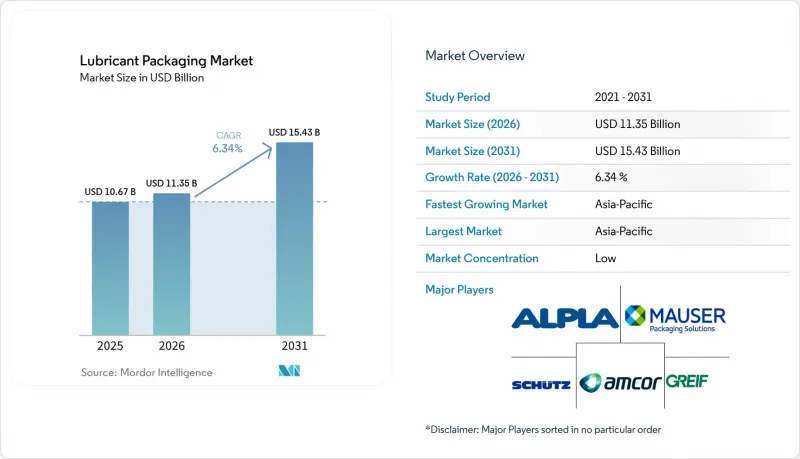
據 Mordor Intelligence 稱,2025 年潤滑油包裝市場價值為 106.7 億美元,預計到 2031 年將達到 154.3 億美元,而 2026 年為 113.5 億美元,預測期(2026-2031 年)複合年成長率為 6.34%。
全球潤滑油包裝市場趨勢與洞察
汽車保有量和汽車售後市場的成長
全球超過14億輛汽車的運作正推動潤滑油包裝市場的發展。每輛車都會持續產生對潤滑油以及用於維護和零售的包裝容器的需求。預計到2025年,印度的汽車註冊量將達到2,820萬輛,2025-2026會計年度的汽車產量將達到3,470萬輛。其中,二輪車產量將超過2,660萬輛,這將需要頻繁使用小包裝潤滑油。預計2025年印度汽車零售將成長7.71%,其中乘用車零售將成長9.70%。東南亞和中東的授權售後服務網路正在從無品牌包裝轉向使用貼有標籤且防篡改的包裝,從而提高了每單位潤滑油銷售所需的包裝容器數量。這項轉變將使潤滑油品牌能夠在銷售點更嚴格地管理產品展示、真偽驗證和產品資訊。隨著汽車擁有者數量的增加,以便利性為設計理念的套餐可以幫助確保在更廣泛的服務中心和經銷商網路中遵守保養週期和零售補貨。
製造業、建築業、採礦業和能源產業的工業化和擴張。
潤滑油包裝市場也服務於操作施工機械、採礦設備和能源資產的工業用戶。這些用戶需要能夠支援大容量填充、安全搬運和可控分配的油桶和IBC(中型散裝容器)。沙烏地阿拉伯的建設項目、印度的基礎設施投資以及印尼的採礦活動正在擴大對工業容器的需求。與200公升的油桶相比,1000公升的IBC可以減少搬運流程和分配成本。回收網路正在促進這些容器在大規模工業場所的再利用。能源領域的應用,包括離岸風力發電維護,也需要使用符合聯合國認證標準的合成油容器,這進一步推動了更專業化包裝形式的需求。工業客戶也重視能夠在儲存過程中保護液體並確保在工地安全穩定運輸的包裝。他們的規格要求往往傾向於堅固耐用的包裝形式,即使在頻繁移動、長期儲存和惡劣的運作條件下也能保持可靠性。
石油化學樹脂和金屬價格波動
石油化學樹脂價格的波動對潤滑油包裝市場的供應商構成直接的成本挑戰。由於高密度聚苯乙烯廣泛用於瓶、罐和桶的製造,加工商尤其容易受到原料供應變化的影響。受霍爾木茲海峽貿易航線中斷的影響,2026年第一季聚乙烯和聚丙烯的價格年增了25%至30%。金屬罐和桶也面臨類似的壓力,因為馬口鐵和鋁的價格與大宗商品市場趨勢密切相關。沒有長期樹脂供應合約或穩定原料來源的供應商面臨更高的邊際成本壓力風險。即使對潤滑油容器的需求依然強勁,這種不確定性也可能限制對產能的投資。此外,這也凸顯了合約定價、原料採購和庫存計畫對包裝供應商和潤滑油調配商的重要性。對於那些使用大量聚合物樹脂和金屬,且根據與客戶簽訂的固定合約供應的產品而言,這種影響尤其顯著。
細分市場分析
至2025年,瓶裝潤滑油將佔潤滑油包裝市場規模的29.46%。這一佔有率反映了零售通路在汽車售後市場的重要性,貨架可見度、包裝尺寸和易傾倒性至關重要。瓶身設計受套模貼標、再生材料的使用、符合人體工學的握持方式以及防篡改瓶蓋等因素的影響。這些特性有助於潤滑油品牌在DIY和維修店等場所實現產品差異化。小包裝也適用於機油和其他車輛液體的更換週期。瓶裝潤滑油市場與汽車零售網路的規模和結構密切相關。其持續的重要性取決於供應商如何有效地將價格優勢、安全操作和獨特的品牌形象融入緊湊的包裝形式中。製造商還需要確保提供給零售商、維修店和服務連鎖店的各種尺寸包裝的品質保持一致。
在潤滑油包裝市場,中型散貨箱(IBC)預計將在2026年至2031年間以6.84%的複合年成長率成長。與200公升的桶裝產品相比,工業用戶正在使用1000公升的可重複使用IBC來減少搬運流程並降低成本。 Schutz GmbH & Co. KGaA在2026年國際包裝展(interpack 2026)上推出了其「SC2」系列塑膠桶,該系列採用層級構造乙烯-乙烯醇阻隔結構,不含全氟烷基和多氟烷基物質。該系列還包括一個「綠色層」版本,其中含有高達30%的再生樹脂。罐裝產品仍廣泛應用於高階零售市場和小批量工業應用。雖然小袋和小袋在車間中的使用日益增多,但對於不需要IBC等級容量的工業用戶而言,桶裝產品仍然發揮著重要作用。桶及相關容器用於航空航太工業和中型散貨箱供應等特殊應用領域,在這些領域中,需要精確填充和可靠密封。
區域分析
預計到2025年,亞太地區將佔據潤滑油包裝市場36.20%的佔有率,並在2031年之前以7.06%的複合年成長率成長。在印度,2025-2026會計年度汽車產量為3,470萬輛,其中超過2,660萬輛為摩托車。這些車輛的使用需要頻繁使用小型潤滑油容器。在中國,汽車保有量的成長帶動了零售包裝機油更換需求的大規模。在泰國、越南和印度尼西亞,自動擋乘用車的普及推動了瓶裝和IBC(中型散貨箱)自動變速箱油的需求。在日本和韓國,採用先進真偽驗證技術和再生材料包裝的高級合成潤滑油越來越受歡迎。在這些市場,兼具技術保護和清晰產品識別的包裝形式越來越受到消費者的青睞。此外,有序的零售環境也使得品牌製造商更容易透過包裝向消費者傳達產品的可回收性和真偽訊息。
在北美,龐大的車輛運作中和對優質合成潤滑油的需求推動了市場需求。奧勒岡州於2025年7月根據其「生產者延伸責任制」(EPR)計畫首次就包裝問題開立了生產者發票;科羅拉多於2026年1月開始收費;加州的SB 54法規於2026年5月生效。在歐洲,汽車產業的老化以及售後市場對潤滑油的持續需求提供了支撐。歐盟的《包裝和包裝廢棄物法規》加大了對可回收包裝重新設計和材料資訊透明化報告的壓力。在此背景下,能夠妥善管理產品安全、再生材料含量和跨境合規性的供應商將更具優勢。此外,儘早投資於包裝容器重新設計和生命週期性能文件也具有更明確的商業意義。供應商在規劃面向多個國家和地區市場的產品線時,需要將這些要求納入考量。
在南美洲,巴西和阿根廷是商用車和農業機械的主要需求中心。 Greif公司在2024年對其巴西潤滑油包裝客戶進行的一項調查中,淨推薦值(NPS)高達+87。在中東和非洲地區,工業包裝的區域產能正在進一步擴大。 2025年1月,Schutz GmbH & Co. KGaA與沙烏地阿拉伯國家塑膠工廠公司簽署了授權合約,生產ECOBULK IBC噸桶。採礦、能源和基礎設施相關活動支撐著全部區域對桶裝和IBC噸桶的需求。此外,阿根廷、南非和阿拉伯聯合大公國零售業的正常化也促使潤滑油銷售轉向品牌化和標籤檢視包裝。
其他好處:
- Excel格式的市場預測(ME)表
- 3個月的分析師支持
目錄
第1章:引言
- 研究假設和市場定義
- 調查範圍
第2章:調查方法
第3章執行摘要
第4章 市場狀況
- 市場概覽
- 市場促進因素
- 汽車保有量的增加和汽車售後市場的成長
- 製造業、建設業、採礦業和能源產業的工業化和擴張
- 過渡到輕巧、可回收且便捷的包裝
- 特殊潤滑油和高性能配方產品的成長
- 包裝級可追溯性,用於預防仿冒品和應對召回。
- 市場限制因素
- 石化樹脂和金屬價格波動
- 生產者責任延伸制度(EPR)導致與處理和運輸危險產品相關的合規成本增加。
- 殘留潤滑油造成的污染正在削弱回收的經濟可行性。
- 價值鏈分析
- 波特五力分析
第5章 市場規模與成長預測
- 按包裝類型
- 瓶子
- 坎
- 小袋和小袋
- 桶和罐
- 中型散貨箱(IBC)
- 桶
- 其他
- 材料
- 塑膠
- 金屬
- 其他
- 按潤滑劑類型
- 機油
- 變速箱油和液壓油
- 其他
- 按地區
- 亞太地區
- 中國
- 印度
- 日本
- 韓國
- 東南亞國協
- 其他亞太國家
- 北美洲
- 美國
- 加拿大
- 墨西哥
- 歐洲
- 德國
- 英國
- 法國
- 義大利
- 北歐國家
- 其他歐洲國家
- 南美洲
- 巴西
- 阿根廷
- 其他南美國家
- 中東和非洲
- 沙烏地阿拉伯
- 南非
- 其他中東和非洲國家
- 亞太地區
第6章 競爭情勢
- 市場集中度
- 策略趨勢
- 市佔率和排名分析
- 公司簡介
- ALPLA
- Amcor plc
- CCL Industries
- Crown Holdings, Inc.
- Graham Packaging
- Greif
- Mauser Packaging Solutions
- Mold-Tek Packaging Ltd.
- Mondi
- Plastipak Holdings, Inc.
- Schutz GmbH & Co. KGaA
- Silgan Holdings Inc.
- Sonoco
- Time Technoplast Ltd.
第7章 市場機會與未來展望
According to Mordor Intelligence, the lubricant packaging market size was valued at USD 10.67 billion in 2025 and is estimated to grow from USD 11.35 billion in 2026 to reach USD 15.43 billion by 2031, at a CAGR of 6.34% during the forecast period (2026-2031).
Global Lubricant Packaging Market Trends and Insights
Growth in Vehicle Ownership and Automotive After-Sales
The lubricant packaging market benefits from a global in-use vehicle fleet that has exceeded 1.4 billion units. Each vehicle generates recurring demand for lubricants and the containers used for service and retail sales. India recorded 28.2 million vehicle registrations in 2025, while automotive production reached 34.7 million units in fiscal year 2025-26. Two-wheelers accounted for more than 26.6 million units of production in fiscal year 2025-26 and require frequent use of smaller lubricant packs. India's vehicle retail volume grew 7.71% in calendar year 2025, while passenger vehicle retail sales increased 9.70%. In formal after-sales networks in Southeast Asia and the Middle East, sales are moving from unbranded dispensing toward labeled and tamper-evident packs, increasing container use per unit of lubricant sold. The transition also gives lubricant brands more control over presentation, authentication, and product information at the point of sale. As vehicle ownership rises, packs designed for convenient use can support service intervals and retail replenishment across a broader network of workshops and distributors.
Industrialization and Expansion of Manufacturing, Construction, Mining, and Energy
The lubricant packaging market also serves industrial users who operate construction equipment, mining machinery, and energy assets. These users need drums and IBCs that support larger fills, safe handling, and controlled dispensing. Construction programs in Saudi Arabia, infrastructure spending in India, and mining activity in Indonesia are widening the demand base for industrial containers. IBCs with 1,000-liter capacity can reduce handling steps and dispensing costs compared with 200-liter drums. Reconditioning networks improve the reuse case for these units in large industrial centers. Energy applications, including offshore wind servicing, also require synthetic oils in United Nations-certified containers, which supports demand for more specialized formats. Industrial customers also value packages that protect fluids during storage and allow safe, consistent transfer at operating sites. Their specifications can favor robust formats that remain reliable during frequent movement, extended storage, and demanding operating conditions.
Volatility in Petrochemical Resin and Metal Prices
Petrochemical resin price volatility is a direct cost challenge for lubricant packaging market suppliers. High-density polyethylene is widely used in bottles, cans, and drums, leaving converters exposed to changes in feedstock availability. Polyethylene and polypropylene prices increased 25%-30% year over year in the first quarter of 2026 following the disruption to the Strait of Hormuz trade routes. Metal cans and drums face similar pressure because tin-plated steel and aluminum prices follow commodity markets. Suppliers without long-term resin agreements or secured feedstock face a greater risk of margin pressure. This uncertainty can limit capacity investment even when demand for lubricant containers remains strong. It also makes contract pricing, material sourcing, and inventory planning more important for both pack suppliers and lubricant blenders. The effect is especially material for formats that use large volumes of polymer resin or metal and are supplied under fixed customer agreements.
Other drivers and restraints analyzed in the detailed report include:
- Shift Toward Lightweight, Recyclable, and Convenient Packaging
- Growth in Specialty Lubricants and Performance-Specific Formulations
- Rising Compliance Costs for EPR, Hazardous-Product Handling, and Transport
For complete list of drivers and restraints, kindly check the Table Of Contents.
Segment Analysis
Bottles accounted for 29.46% of the lubricant packaging market size in 2025. Their position reflects the importance of retail automotive after-sales channels, where shelf visibility, pack size, and ease of pouring matter. Bottle design is shaped by in-mold labeling, recycled content, ergonomic handling, and tamper-evident closures. These features help lubricant brands differentiate products in do-it-yourself and workshop settings. Small formats also suit the replacement cycle for engine oils and other vehicle fluids. The bottle segment remains closely tied to the scale and formalization of automotive retail networks. Its continued relevance depends on how effectively suppliers combine affordability, safe handling, and distinctive brand presentation in compact formats. Manufacturers also need to maintain consistent container quality across the varied sizes supplied to retail stores, workshops, and service chains.
IBCs are projected to grow at a 6.84% CAGR from 2026 to 2031 within the lubricant packaging market. Industrial buyers use 1,000-liter reusable units to reduce handling steps and lower costs relative to 200-liter drums. Schutz GmbH & Co. KGaA introduced its SC2 jerrycan series at interpack 2026 with 6-layer, perfluoroalkyl and polyfluoroalkyl substances-free ethylene vinyl alcohol barrier structures. The range includes Green Layer variants with up to 30% regranulate content. Cans continue to serve premium retail and lower-volume industrial fills. Pouches and sachets are gaining use in workshops, while drums and barrels remain important for industrial users that do not require IBC capacity. Kegs and related formats serve specialized aviation and lubricant supply applications that need precise fills and secure closures.
Complete Report Scope:
- By Packaging Type
- Bottles
- Cans
- Pouches and Sachets
- Drums and Barrels
- Intermediate Bulk Containers (IBCs)
- Kegs
- Others
- By Material
- Plastic
- Metal
- Others
- By Lubricant Type
- Engine Oils
- Transmission and Hydraulic Fluids
- Others
- By Geography
- Asia-Pacific
- China
- India
- Japan
- South Korea
- ASEAN Countries
- Rest of Asia-Pacific
- North America
- United States
- Canada
- Mexico
- Europe
- Germany
- United Kingdom
- France
- Italy
- NORDIC Countries
- Rest of Europe
- South America
- Brazil
- Argentina
- Rest of South America
- Middle East and Africa
- Saudi Arabia
- South Africa
- Rest of Middle East and Africa
- Asia-Pacific
Geography Analysis
Asia-Pacific held 36.20% of the lubricant packaging market share in 2025 and is projected to grow at a 7.06% CAGR through 2031. India produced 34.7 million vehicles in fiscal year 2025-26, including more than 26.6 million two-wheelers. These vehicles support frequent use of smaller lubricant containers. China's expanding vehicle fleet is creating a large replacement demand for engine oils in retail packs. Thailand, Vietnam, and Indonesia are seeing a move toward passenger vehicles with automatic transmissions, which supports demand for automatic transmission fluid bottles and IBCs. Japan and South Korea also support premium synthetic lubricants in packs with advanced authentication and recycled-content features. These markets reinforce the value of formats that combine technical protection with clear consumer-facing product identification. Organized retail environments also make it easier for branded suppliers to communicate recycling and authentication features through the pack.
North America drives demand through a large in-service vehicle fleet and demand for premium synthetic lubricants. Oregon issued its first producer invoices under its packaging Extended Producer Responsibility program in July 2025, Colorado began charging in January 2026, and California's SB 54 regulations took effect in May 2026. Europe is supported by an aging car base and recurring aftermarket lubricant demand. The European Union Packaging and Packaging Waste Regulation adds pressure for recyclable format redesigns and transparent material reporting. These conditions reward suppliers that can manage product safety, recycled content, and cross-border compliance. They also create a clearer commercial case for early investment in redesigned containers and documented lifecycle performance. Suppliers must account for these requirements when they plan product ranges intended for multiple national and regional markets.
South America relies on Brazil and Argentina as important demand centers for commercial fleets and agricultural machinery. Greif reported a Net Promoter Score of +87 among its Brazilian lubricant packaging customers in 2024. The Middle East and Africa is developing more regional production capacity for industrial packs. Schutz GmbH & Co. KGaA signed a license agreement with National Plastic Factory Company in Saudi Arabia in January 2025 for ECOBULK IBC production. Mining, energy, and infrastructure activity support demand for drums and IBCs across the region. Retail formalization in Argentina, South Africa, and the United Arab Emirates also shifts lubricant sales into branded and labeled containers.
- ALPLA
- Amcor plc
- CCL Industries
- Crown Holdings, Inc.
- Graham Packaging
- Greif
- Mauser Packaging Solutions
- Mold-Tek Packaging Ltd.
- Mondi
- Plastipak Holdings, Inc.
- Schutz GmbH & Co. KGaA
- Silgan Holdings Inc.
- Sonoco
- Time Technoplast Ltd.
Additional Benefits:
- The market estimate (ME) sheet in Excel format
- 3 months of analyst support
TABLE OF CONTENTS
1 Introduction
- 1.1 Study Assumptions and Market Definition
- 1.2 Scope of the Study
2 Research Methodology
3 Executive Summary
4 Market Landscape
- 4.1 Market Overview
- 4.2 Market Drivers
- 4.2.1 Growth in Vehicle Ownership and Automotive After-Sales
- 4.2.2 Industrialization and Expansion of Manufacturing, Construction, Mining, and Energy
- 4.2.3 Shift Toward Lightweight, Recyclable, and Convenient Packaging
- 4.2.4 Growth in Specialty Lubricants and Performance-Specific Formulations
- 4.2.5 Packaging-Level Traceability for Counterfeit Control and Recall Readiness
- 4.3 Market Restraints
- 4.3.1 Volatility in Petrochemical Resin and Metal Prices
- 4.3.2 Rising Compliance Costs for EPR, Hazardous-Product Handling, and Transport
- 4.3.3 Residual-Lubricant Contamination Weakening Recycling Economics
- 4.4 Value Chain Analysis
- 4.5 Porter's Five Forces Analysis
- 4.5.1 Threat of New Entrants
- 4.5.2 Bargaining Power of Suppliers
- 4.5.3 Bargaining Power of Buyers
- 4.5.4 Threat of Substitutes
- 4.5.5 Competitive Rivalry
5 Market Size and Growth Forecasts (Value)
- 5.1 By Packaging Type
- 5.1.1 Bottles
- 5.1.2 Cans
- 5.1.3 Pouches and Sachets
- 5.1.4 Drums and Barrels
- 5.1.5 Intermediate Bulk Containers (IBCs)
- 5.1.6 Kegs
- 5.1.7 Others
- 5.2 By Material
- 5.2.1 Plastic
- 5.2.2 Metal
- 5.2.3 Others
- 5.3 By Lubricant Type
- 5.3.1 Engine Oils
- 5.3.2 Transmission and Hydraulic Fluids
- 5.3.3 Others
- 5.4 By Geography
- 5.4.1 Asia-Pacific
- 5.4.1.1 China
- 5.4.1.2 India
- 5.4.1.3 Japan
- 5.4.1.4 South Korea
- 5.4.1.5 ASEAN Countries
- 5.4.1.6 Rest of Asia-Pacific
- 5.4.2 North America
- 5.4.2.1 United States
- 5.4.2.2 Canada
- 5.4.2.3 Mexico
- 5.4.3 Europe
- 5.4.3.1 Germany
- 5.4.3.2 United Kingdom
- 5.4.3.3 France
- 5.4.3.4 Italy
- 5.4.3.5 NORDIC Countries
- 5.4.3.6 Rest of Europe
- 5.4.4 South America
- 5.4.4.1 Brazil
- 5.4.4.2 Argentina
- 5.4.4.3 Rest of South America
- 5.4.5 Middle East and Africa
- 5.4.5.1 Saudi Arabia
- 5.4.5.2 South Africa
- 5.4.5.3 Rest of Middle East and Africa
- 5.4.1 Asia-Pacific
6 Competitive Landscape
- 6.1 Market Concentration
- 6.2 Strategic Moves
- 6.3 Market Share (%)/Ranking Analysis
- 6.4 Company Profiles (includes Global Overview, Market Overview, Core Segments, Financials as available, Strategic Information, Products and Services, and Recent Developments)
- 6.4.1 ALPLA
- 6.4.2 Amcor plc
- 6.4.3 CCL Industries
- 6.4.4 Crown Holdings, Inc.
- 6.4.5 Graham Packaging
- 6.4.6 Greif
- 6.4.7 Mauser Packaging Solutions
- 6.4.8 Mold-Tek Packaging Ltd.
- 6.4.9 Mondi
- 6.4.10 Plastipak Holdings, Inc.
- 6.4.11 Schutz GmbH & Co. KGaA
- 6.4.12 Silgan Holdings Inc.
- 6.4.13 Sonoco
- 6.4.14 Time Technoplast Ltd.
7 Market Opportunities and Future Outlook
- 7.1 White-Space and Unmet-Need Assessment

