


 |
市場調查報告書
商品編碼
2156940
焊接設備:市場佔有率分析、產業趨勢與統計、成長預測(2026-2031)Soldering Equipment - Market Share Analysis, Industry Trends & Statistics, Growth Forecasts (2026 - 2031) |
||||||

※ 本網頁內容可能與最新版本有所差異。詳細情況請與我們聯繫。
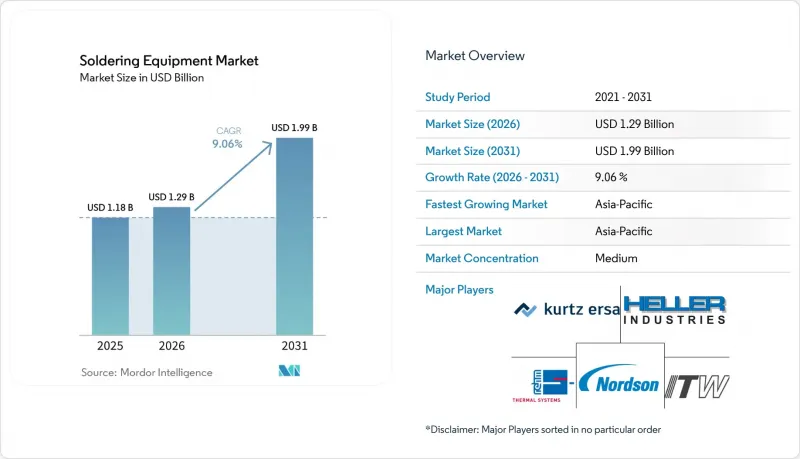
據 Mordor Intelligence 稱,2025 年焊接設備市場價值為 11.8 億美元,預計到 2031 年將從 2026 年的 12.9 億美元成長至 19.9 億美元,預測期(2026-2031 年)複合年成長率為 9.06%。
全球焊接設備市場趨勢及洞察
電子元件小型化和高密度PCB組裝加速
高密度互連 (HDI) 組件對複雜基板上的焊料量和溫度提出了更嚴格的公差要求。用於 01005 尺寸被動元件和 0.3 毫米間距球柵陣列 (BGA) 的系統必須在超過 40 層基板上保持 ±5 度C的溫差。為舊式元件規格設計的設備無法持續保證間距小於 100 微米的組件所需的良率。用於 5G、物聯網 (IoT) 和高級駕駛輔助系統 (ADAS) 的高密度互連基板正在更換需求。隨著電子製造服務供應商升級設備以滿足航太、醫療和汽車生產中高可靠性的要求,焊接設備市場正從中受益。對於尋求新生產合約的供應商而言,符合國際電工委員會 (IEC) 和 IPC 要求的文件變得至關重要。
擴大電動車、電池管理和電力電子產品的生產規模
電動車 (EV) 的馬達逆變器、車載充電器和電池管理系統等組件均以焊接方式組裝。向 800V 車輛架構的轉變增加了獨立電子元件的電應力,對空泡控制性能提出了更高的要求。 SEHO Systems GmbH 在 2025 年義大利電子生產設備展 (productronica 2025) 上發布了其 PowerSelective-HD 系統,該系統適用於電動車、電池管理和轉換器技術。博世公司與美國商務部達成 2.25 億美元的直接資助協議後,將於 2026 年在加州羅斯維爾的碳化矽半導體製造工廠開始原型生產。這些要求促使真空回流焊接和選擇性焊接系統應具備處理汽車級功率模組的能力。因此,隨著汽車平臺向更高電壓設計發展,焊接設備市場的設備更換週期正在延長。
自動化和選擇性焊接系統需要高額的資本投資。
用於先進封裝和汽車生產的選擇性焊接和雷射焊接平台,單價可能超過50萬美元。小規模電子製造服務供應商還需承擔氮氣供應、振動控制和溫度控管設施成本。這些成本可能使初始設備成本增加20%至40%。由於總成本較高,中型組裝通常仍繼續使用舊的波峰焊接生產線。租賃和按件付費模式可以緩解這些障礙,但在設備融資受限的市場,這些模式的應用仍然有限。儘管南美、中東和非洲地區的本地組裝能力不斷擴大,但這些地區仍然是資金籌措最嚴重的地區。
細分市場分析
2025年,回流焊接設備佔據了焊接設備市場38.65%的佔有率,主要得益於大規模生產的表面黏著技術(SMT)組裝。回流焊接廣泛應用於家用電子電器、網路電路基板和汽車電控系統(ECU)等領域。高密度互連基板需要多區域熱分佈來安裝小型元件和微球柵陣列(MBGA)。然而,高產能回流焊接線的能耗增加、氮氣用量增加以及維護週期縮短,都可能推高其營運成本。在2026年EFX展會上,Rehm Thermal Systems GmbH公司發表了其「VisionXP+」系列產品,並指出,電子整流馬達、智慧風扇控制和氮氣百葉窗可以將待機能耗降低高達60%。感應式和熱棒式回流焊接系統在需要局部熱源的應用中仍然發揮著至關重要的作用,例如穿戴式裝置和有機發光二極體顯示器的軟性電路焊接。
預計到2031年,雷射焊接將以9.75%的複合年成長率成長,成為焊接設備市場中成長最快的領域。這項技術為相機模組、微機電系統(MEMS)裝置、軟性印刷電路板連接器和汽車感測器組件提供非接觸式加熱。 2026年,漢氏雷射發布了一款專用於3C電子產品製造的雷射焊接系統,涵蓋相機模組、真無線立體聲耳機和軟性印刷電路板連接器。人工智慧(AI)加速器封裝也需要在精細的焊盤間距下進行精確的對準控制。雖然雷射系統的初始成本高於回流焊接系統,但考慮到先進封裝產品缺陷所帶來的成本,這項投資是值得的。機械焊接和鋁焊平台仍廣泛應用於工業、國防和電力基礎設施組裝領域,用於處理通孔和重型元件。
區域分析
預計到2025年,亞太地區將佔據全球焊接設備市場45.87%的佔有率,並在2031年之前以10.07%的複合年成長率持續成長。這一地位得益於中國的表面黏著技術(SMT)基地、日本的精密設備技術、韓國的半導體和顯示器產業叢集以及印度不斷擴大的電子製造服務能力。 2025-2026會計年度,印度電子產品產值達131.1億千升(約1,560億美元),較去年成長15.8%。印度與生產連結獎勵計畫計畫和半導體投資計畫也為該地區焊接設備市場規模的成長提供了支撐。 SEHO Systems GmbH於2026年8月宣布與NMTronics India Pvt. Ltd.建立合作夥伴關係,計劃在Heller Industries, Inc.位於印度的工廠本地生產波峰焊系統。
在北美,由於半導體生產回流和先進封裝技術的投資,對設備的需求正在成長。台積電計畫在亞利桑那州投資2,650億美元,用於支援回流焊接、覆晶鍵合和其他先進封裝製程。墨西哥也積極擁抱汽車電子製造領域的近岸外包趨勢。 2026年3月,諾信公司擴大了與Assembly Products的銷售合作關係,在美國和加拿大全面推廣MARCH等離子焊接系統和SELECT精選焊接產品。這項商業性措施符合擴大區域電子產品生產能力和發展本地服務網路的更廣泛趨勢。
歐洲焊接設備市場受汽車電子產品生產、精密製造以及無鉛法規合規要求的影響。歐盟於2025年11月發布的修正案縮小了焊料中鉛含量豁免範圍,要求製造商在截止日期前更新技術文件。 Rehm Thermal Systems GmbH在2026年IPC APEX EXPO展會上推出了其VisionXC Nitro回流焊接平台,該平台支援氮氣氣氛處理和能源管理。儘管南美洲和中東及非洲的需求仍然較小,但隨著電子製造服務產能的擴大,該市場正在持續成長。巴西和阿根廷透過生產家用電子電器和汽車零件來支撐南美洲的需求,而沙烏地阿拉伯和南非則提供了前景廣闊的長期分銷和服務機會。
其他好處:
- Excel格式的市場預測(ME)表
- 3個月的分析師支持
目錄
第1章:引言
- 研究假設和市場定義
- 調查範圍
第2章:調查方法
第3章執行摘要
第4章 市場狀況
- 市場概覽
- 市場促進因素
- 電子元件小型化和高密度PCB組裝加速
- 電動車產量增加、電池管理和電力電子產品。
- 半導體封裝和先進互連技術的擴展
- 電子製造業中的自動化、機器人技術和工業4.0的引入
- 電子製造和EMS生產能力的在地化
- 市場限制因素
- 自動化焊接系統和選擇性焊接系統需要高額的資金投入。
- 無鉛焊接的嚴格工藝窗口
- 熟練操作人員和工藝驗證專家短缺
- 價值鏈分析
- 波特五力分析
第5章 市場規模與成長預測
- 按類型
- 回流焊接
- 感應焊接
- 熱吧台回流焊接
- 雷射焊接
- 機械焊接
- 鋁焊接
- 透過使用
- 家用電子產品
- 網路與通訊
- 車
- 航太/國防
- 其他用途
- 按地區
- 亞太地區
- 中國
- 印度
- 日本
- 韓國
- 東南亞國協
- 其他亞太國家
- 北美洲
- 美國
- 加拿大
- 墨西哥
- 歐洲
- 德國
- 英國
- 法國
- 義大利
- 北歐國家
- 其他歐洲國家
- 南美洲
- 巴西
- 阿根廷
- 其他南美國家
- 中東和非洲
- 沙烏地阿拉伯
- 南非
- 其他中東和非洲國家
- 亞太地區
第6章 競爭情勢
- 市場集中度
- 策略趨勢
- 市佔率和排名分析
- 公司簡介
- Apollo Seiko Ltd.
- BTU-An Amtech Company
- HAKKO Corporation
- Heller Industries, Inc.
- Illinois Tool Works Inc.
- JAPAN UNIX CO., LTD.
- JBC Soldering SL
- JUKI Automation Systems GmbH
- Kurtz Ersa
- Metcal, an OK International Company
- Nordson Corporation
- Pillarhouse International Ltd
- Rehm Thermal Systems GmbH
- SEHO Systems GmbH
- Weller
第7章 市場機會與未來展望
According to Mordor Intelligence, the soldering equipment market size was valued at USD 1.18 billion in 2025 and is estimated to grow from USD 1.29 billion in 2026 to reach USD 1.99 billion by 2031, at a CAGR of 9.06% during the forecast period (2026-2031).
Global Soldering Equipment Market Trends and Insights
Accelerating Electronics Miniaturization and High-Density PCB Assembly
High-density interconnect assembly has tightened allowable variation in solder volume and temperature across complex boards. Systems used for 01005 passive components and 0.3 mm-pitch ball grid arrays must maintain a temperature difference within +-5 °C across boards with more than 40 layers. Equipment designed for older component formats cannot consistently deliver the yield needed for sub-100 µm pitch assemblies. High-density interconnect boards for 5G, Internet of Things, and advanced driver-assistance systems are supporting replacement demand for qualified soldering platforms. The soldering equipment market benefits when electronics manufacturing services providers renew equipment to meet high-reliability requirements in aerospace, medical, and automotive production. Documentation aligned with International Electrotechnical Commission and Association Connecting Electronics Industries (IPC) requirements is becoming necessary for suppliers seeking new production contracts.
Rising EV, Battery-Management and Power-Electronics Production
Electric vehicles require soldered assemblies in motor inverters, onboard chargers, and battery management systems. The move to 800 V vehicle architectures increases electrical stress on isolation electronics and requires tighter void-control performance. SEHO Systems GmbH introduced its PowerSelective-HD system for e-mobility, battery management, and converter technology applications at productronica 2025. Bosch began sample production at its silicon carbide semiconductor facility in Roseville, California, in 2026 after a USD 225 million direct funding agreement with the U.S. Department of Commerce. These requirements favor vacuum reflow and selective systems that can support automotive-grade power modules. The soldering equipment market, therefore, has a longer equipment upgrade cycle as vehicle platforms shift toward higher-voltage designs.
High Capital Requirements for Automated and Selective Soldering Systems
Selective and laser soldering platforms used for advanced packaging or automotive production can cost more than USD 500,000 per unit. Smaller electronics manufacturing services providers also face facility costs for nitrogen supply, vibration control, and thermal management. These changes can add 20% to 40% to the initial equipment cost. The resulting total cost often leads mid-sized assemblers to continue using older wave-soldering lines. Leasing and pay-per-yield models can reduce this barrier, but they remain limited in markets with restricted equipment financing. Capital constraints are most acute in South America and Middle East and Africa, even as local assembly capacity grows.
Other drivers and restraints analyzed in the detailed report include:
- Expansion of Semiconductor Packaging and Advanced Interconnects
- Automation, Robotics and Industry 4.0 Adoption in Electronics Manufacturing
- Tight Process Windows for Lead-Free Soldering
For complete list of drivers and restraints, kindly check the Table Of Contents.
Segment Analysis
Reflow soldering held 38.65% of the soldering equipment market share in 2025, supported by high-volume surface-mount technology assembly. It is widely used for consumer electronics, networking boards, and automotive electronic control units. High-density interconnect boards need multi-zone thermal profiles for small components and micro ball grid array placements. Energy consumption, nitrogen use, and shorter maintenance intervals can raise the operating cost of high-throughput reflow lines. Rehm Thermal Systems GmbH presented its VisionXP+ generation at EFX 2026 with reported idle-period energy savings of up to 60% through electronically commutated motors, intelligent fan control, and a nitrogen shutter. Induction and hot-bar reflow systems remain relevant where a localized heat source is preferable, including flexible circuit bonding for wearables and organic light-emitting diode displays.
Laser soldering is projected to advance at a 9.75% CAGR through 2031, the fastest type growth rate in the soldering equipment market size. It provides noncontact heating for camera modules, microelectromechanical systems devices, flexible printed-circuit connectors, and automotive sensor assemblies. Han's Laser introduced dedicated laser soldering systems for 3C electronics manufacturing in 2026, covering camera modules, true wireless stereo earbuds, and flexible printed-circuit connectors. Artificial intelligence accelerator packages also require alignment control at small pad pitches. Laser systems carry a higher acquisition cost than reflow systems, but the cost of a rejected advanced package can justify the investment. Mechanical and aluminum soldering platforms continue to serve through-hole and heavy-component work in industrial, defense, and power-infrastructure assembly.
Complete Report Scope:
- By Type
- Reflow Soldering
- Induction Soldering
- Hot-Bar Reflow
- Laser Soldering
- Mechanical Soldering
- Aluminum Soldering
- By Application
- Consumer Electronics
- Networking and Communication
- Automotive
- Aerospace and Defense
- Other Applications
- By Geography
- Asia-Pacific
- China
- India
- Japan
- South Korea
- ASEAN Countries
- Rest of Asia-Pacific
- North America
- United States
- Canada
- Mexico
- Europe
- Germany
- United Kingdom
- France
- Italy
- NORDIC Countries
- Rest of Europe
- South America
- Brazil
- Argentina
- Rest of South America
- Middle East and Africa
- Saudi Arabia
- South Africa
- Rest of Middle East and Africa
- Asia-Pacific
Geography Analysis
Asia-Pacific held 45.87% of the soldering equipment market share in 2025 and is projected to advance at a 10.07% CAGR through 2031. China's surface-mount technology base, Japan's precision-equipment capabilities, South Korea's semiconductor and display clusters, and India's growing electronics manufacturing services capacity support this position. India's electronics output rose 15.8% year over year to INR 13.11 lakh crore (approximately USD 156 billion) in fiscal year 2025-26. The soldering equipment market size in the region is also supported by India's production-linked incentive programs and semiconductor investment plans. SEHO Systems GmbH announced an August 2026 partnership with NMTronics India Pvt. Ltd. and plans to manufacture wave soldering systems locally at Heller Industries, Inc.'s Indian facility.
North America is gaining equipment demand through semiconductor reshoring and advanced packaging investment. TSMC's USD 265 billion Arizona commitment supports reflow, flip-chip bonding, and other advanced packaging workflows. Mexico is also absorbing nearshoring activity in automotive-related electronics manufacturing. Nordson Corporation expanded its distribution partnership with Assembly Products Inc. in March 2026 to include MARCH plasma systems and SELECT selective soldering products across the United States and Canada. This commercial move aligns with a broader shift toward regional electronics capacity and local service coverage.
Europe's soldering equipment market is shaped by automotive electronics production, precision manufacturing, and lead-free compliance requirements. European Union amendments published in November 2025 narrowed legacy lead-in-solder exemptions and required manufacturers to prepare updated technical files before applicable deadlines. Rehm Thermal Systems GmbH presented the VisionXC Nitro reflow platform at IPC APEX EXPO 2026 for nitrogen-atmosphere processing and energy management. South America and Middle East and Africa remain smaller demand areas that are expanding with electronics manufacturing services capacity. Brazil and Argentina support South American demand through consumer electronics and automotive component production, while Saudi Arabia and South Africa offer longer-term distribution and service opportunities.
- Apollo Seiko Ltd.
- BTU - An Amtech Company
- HAKKO Corporation
- Heller Industries, Inc.
- Illinois Tool Works Inc.
- JAPAN UNIX CO., LTD.
- JBC Soldering S.L.
- JUKI Automation Systems GmbH
- Kurtz Ersa
- Metcal, an OK International Company
- Nordson Corporation
- Pillarhouse International Ltd
- Rehm Thermal Systems GmbH
- SEHO Systems GmbH
- Weller
Additional Benefits:
- The market estimate (ME) sheet in Excel format
- 3 months of analyst support
TABLE OF CONTENTS
1 Introduction
- 1.1 Study Assumptions and Market Definition
- 1.2 Scope of the Study
2 Research Methodology
3 Executive Summary
4 Market Landscape
- 4.1 Market Overview
- 4.2 Market Drivers
- 4.2.1 Accelerating Electronics Miniaturization and High-Density PCB Assembly
- 4.2.2 Rising EV, Battery-Management and Power-Electronics Production
- 4.2.3 Expansion of Semiconductor Packaging and Advanced Interconnects
- 4.2.4 Automation, Robotics and Industry 4.0 Adoption in Electronics Manufacturing
- 4.2.5 Regionalization of Electronics Manufacturing and EMS Capacity
- 4.3 Market Restraints
- 4.3.1 High Capital Requirements for Automated and Selective Soldering Systems
- 4.3.2 Tight Process Windows for Lead-Free Soldering
- 4.3.3 Shortage of Skilled Operators and Process-Validation Specialists
- 4.4 Value Chain Analysis
- 4.5 Porter's Five Forces Analysis
- 4.5.1 Threat of New Entrants
- 4.5.2 Bargaining Power of Suppliers
- 4.5.3 Bargaining Power of Buyers
- 4.5.4 Threat of Substitutes
- 4.5.5 Competitive Rivalry
5 Market Size and Growth Forecasts (Value)
- 5.1 By Type
- 5.1.1 Reflow Soldering
- 5.1.2 Induction Soldering
- 5.1.3 Hot-Bar Reflow
- 5.1.4 Laser Soldering
- 5.1.5 Mechanical Soldering
- 5.1.6 Aluminum Soldering
- 5.2 By Application
- 5.2.1 Consumer Electronics
- 5.2.2 Networking and Communication
- 5.2.3 Automotive
- 5.2.4 Aerospace and Defense
- 5.2.5 Other Applications
- 5.3 By Geography
- 5.3.1 Asia-Pacific
- 5.3.1.1 China
- 5.3.1.2 India
- 5.3.1.3 Japan
- 5.3.1.4 South Korea
- 5.3.1.5 ASEAN Countries
- 5.3.1.6 Rest of Asia-Pacific
- 5.3.2 North America
- 5.3.2.1 United States
- 5.3.2.2 Canada
- 5.3.2.3 Mexico
- 5.3.3 Europe
- 5.3.3.1 Germany
- 5.3.3.2 United Kingdom
- 5.3.3.3 France
- 5.3.3.4 Italy
- 5.3.3.5 NORDIC Countries
- 5.3.3.6 Rest of Europe
- 5.3.4 South America
- 5.3.4.1 Brazil
- 5.3.4.2 Argentina
- 5.3.4.3 Rest of South America
- 5.3.5 Middle East and Africa
- 5.3.5.1 Saudi Arabia
- 5.3.5.2 South Africa
- 5.3.5.3 Rest of Middle East and Africa
- 5.3.1 Asia-Pacific
6 Competitive Landscape
- 6.1 Market Concentration
- 6.2 Strategic Moves
- 6.3 Market Share (%)/Ranking Analysis
- 6.4 Company Profiles (includes Global Overview, Market Overview, Core Segments, Financials as available, Strategic Information, Products and Services, and Recent Developments)
- 6.4.1 Apollo Seiko Ltd.
- 6.4.2 BTU - An Amtech Company
- 6.4.3 HAKKO Corporation
- 6.4.4 Heller Industries, Inc.
- 6.4.5 Illinois Tool Works Inc.
- 6.4.6 JAPAN UNIX CO., LTD.
- 6.4.7 JBC Soldering S.L.
- 6.4.8 JUKI Automation Systems GmbH
- 6.4.9 Kurtz Ersa
- 6.4.10 Metcal, an OK International Company
- 6.4.11 Nordson Corporation
- 6.4.12 Pillarhouse International Ltd
- 6.4.13 Rehm Thermal Systems GmbH
- 6.4.14 SEHO Systems GmbH
- 6.4.15 Weller
7 Market Opportunities and Future Outlook
- 7.1 White-Space and Unmet-Need Assessment


