


 |
市場調查報告書
商品編碼
2156939
電氣絕緣膠帶:市場佔有率分析、產業趨勢與統計、成長預測(2026-2031)Electrical Insulation Tape - Market Share Analysis, Industry Trends & Statistics, Growth Forecasts (2026 - 2031) |
||||||

※ 本網頁內容可能與最新版本有所差異。詳細情況請與我們聯繫。
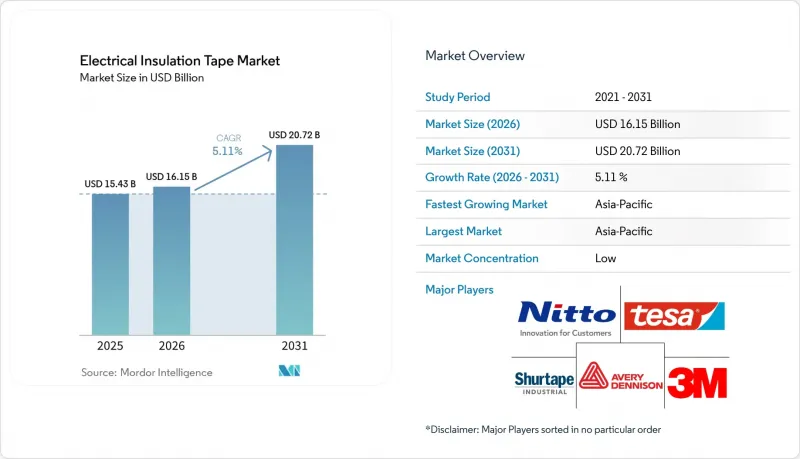
據 Mordor Intelligence 稱,2025 年電氣絕緣膠帶市場價值為 154.3 億美元,預計在預測期(2026-2031 年)內將以 5.11% 的複合年成長率成長,從 2026 年的 161.5 億美元成長到 20312 年的 207.2 億美元。
全球電氣絕緣膠帶市場趨勢及洞察
電網現代化和可再生能源基礎設施擴建
電網維護是電氣絕緣膠帶的持續需求來源。這是因為在升級、維修、電網擴建和可再生能源併網過程中都需要絕緣措施。各種等級的膠帶被用於電纜、接頭、終端、配電盤以及暴露於運行負荷和環境壓力的設備周圍。全球電網投資從2020年的3,000億美元增加至2025年的4,800億美元。國際能源總署(IEA)表示,為滿足2030年的電力需求,電網年度投資需要在4,000億美元的基準上增加50%。 2026年3月,美國美國能源局決定撥款19億美元用於導體更換和電網升級。同時,美國電力公司(American Electric Power)在2026-2030年計畫中,從780億美元的資本計畫中撥款330億美元用於電網建設。電網建造和可再生能源併網對膠帶系統的要求比許多配電項目更為嚴格,這反過來又推動了對具有更優異絕緣性、阻燃性和機械性能的膠帶的需求。此外,公共產業項目對初始安裝和維護材料的需求也擴大了市場機會。
車輛電氣化和高壓線束的擴展
汽車電氣化導致每輛車的絕緣膠帶用量增加,電工絕緣膠帶市場供應商面臨的需求也隨之改變。電池組、高壓電纜、線束和電子控制系統都需要可靠的電氣絕緣和物理保護。電池式電動車使用180至250公尺的絕緣膠帶,而傳統內燃機汽車僅需80至120公尺。新型800V平台對介電強度和熱穩定性的要求高於許多400V系統。電池式電動車的高壓線束長度預計為1至2公里,而內燃機汽車則為200至300公尺。國際標準化組織(ISO)標準19642和LV 215強調了新能源汽車對認證線束材料的需求。這些標準建議的產品需符合原始設備製造商(OEM)的認證要求,並在車輛的整個生命週期中保持性能穩定。
PVC、橡膠、聚酯薄膜和黏合劑等原料價格波動。
由於樹脂、橡膠、薄膜和黏合劑的成本直接影響膠帶的利潤率,原料成本的波動仍然是電氣絕緣膠帶市場面臨的緊迫問題。汽車、公共產業、電子和建築業的買家可能面臨價格快速調整受限的情況。 2026年6月,美國PVC樹脂價格達到每噸644美元,而亞洲乙烯基PVC價格在2026年前兩個月的波動幅度高達每噸300美元。 2026年5月,信越化學宣布,由於氯鹼產能緊張和海運成本上漲,將PVC樹脂的出廠價提高每公斤30日圓以上。下游製造商由於簽訂了供應受限的契約,可能無法在固定價格的OEM協議下將增加的投入成本完全轉嫁給客戶。大規模一體化製造商可以進行避險,從多個供應商採購,並保持大量庫存,這進一步增強了他們在價格高波動時期的成本優勢。
細分市場分析
預計到2025年,PVC膠帶將佔據電氣絕緣膠帶市場60.45%的佔有率。這反映了PVC膠帶在住宅佈線、低壓工業作業、現場維修、建築維護以及其他依賴易得且經濟實惠的膠帶產品的日常電氣工作中確立的穩固地位。在指定使用符合UL 510或CSA-C22.2標準的阻燃PVC膠帶時,其成本績效仍是關鍵因素。 PVC膠帶也受惠於經銷商長期穩定的供應鏈,尤其是在眾多市場的建築佈線應用領域。其高市佔率並非源自於其他材料發展不足,而是由於成熟的分銷網路和熟悉的規格。建設活動和常規電網維護持續支撐著該領域的基本需求。隨著買家對更高耐熱性和更低鹵素含量的需求不斷成長,PVC供應商必須滿足化合物變更的要求。 PVC電氣絕緣膠帶市場是一個重要的細分市場,其廣泛的替換需求和大規模的成功安裝案例為其提供了支撐,即使客戶在要求更高的應用中選擇更專業的材料。由於PVC樹脂是主要原料,因此該領域仍容易受到原料成本波動的影響。
預計到2031年,橡膠膠帶市場將以5.75%的複合年成長率成長,超過電氣絕緣膠帶市場的整體成長率。這主要歸功於自熔材料能夠滿足高壓應用的需求,在嚴苛條件下可靠地覆蓋不平整表面、電纜接頭和終端。自熔橡膠產品可在15 kV以上的電纜連接和終端處形成無氣泡絕緣層,有效應對標準PVC膠帶無法應付的條件。電網營運商擴大指定採用兼具初級絕緣和機械保護功能的膠帶系統,這推動了橡膠膠帶的普及。 UL 510和國際電工委員會(IEC)60454-3-1標準的要求進一步促進了其在高壓輸配電領域的應用。聚酯膠帶用於馬達繞組、變壓器絕緣和PCB遮蔽,其尺寸穩定性和耐化學性使其成為高階產品。 「其他」類別的產品,包括玻璃布、聚醯亞胺和特殊層壓材料,廣泛應用於航太和半導體領域,這些膠帶都是經過認證的製程材料。 3M 已投資開發符合 UL 510A、UL 840 和 IEC 60112 認證標準的聚酯膠帶和玻璃布膠帶產品線。這些產品差異化正在推動市場轉向滿足更高規格要求的材料。
區域分析
預計到2025年,亞太地區將佔據全球電氣絕緣膠帶市場57.84%的佔有率,並在2031年之前以5.83%的複合年成長率持續成長。這一成長主要得益於電子產品生產、消費性電子產品製造、汽車供應鏈、電網建設和電氣產品分銷等產業的共同推動。該地區集中了電子組裝、汽車線束生產和消費性電子產品製造,從而支撐了本地需求和短供應鏈。中國憑藉其電子製造地和電網投資計劃,正在引領該地區的生產和消費。在印度,基礎設施建設、智慧城市計畫、國內電動車生產以及印度標準局(BIS)日益嚴格的認證要求,都支撐著對電氣絕緣膠帶的需求。根據印度住宅和城市發展部統計,截至2025年6月,8,067個智慧城市計畫中已有94%竣工。日本和韓國則透過其汽車和電子產品供應鏈,推動了對高規格產品的需求。
北美電氣絕緣膠帶市場的需求主要受老化電網、資料中心電力需求以及電動車基礎設施投資的驅動,其中輸電項目、配電網升級、汽車生產和受監管的電氣工程構成了該地區的應用格局。 2026年5月,加州獨立系統營運商(CAISO)批准了一項2025-2026年輸電計劃,涵蓋38個項目,總投資額達67億美元。 Fast Energy公司投資9.5億美元的俄亥俄州-賓夕法尼亞州電網維修項目以及美國電力公司(American Electric Power)的資本計劃也加入了輸電項目儲備。墨西哥憑藉其在北美汽車供應鏈中的作用以及電動車線束的生產,支撐著市場需求。美國和加拿大的法規環境有利於現有供應商,因為計畫通常要求產品獲得美國保險商實驗室(UL)認證並符合加拿大標準協會(CSA)的相關規定。此外,不斷上漲的人事費用也促使人們對用於特定高可靠性應用的預絕緣連接器產生了濃厚的興趣。這些因素正在創造對認證產品的需求,同時也增加了替換標準磁帶格式的壓力。
在歐洲,汽車電氣化和可再生能源的併網正在為電工絕緣膠帶市場帶來獨特的需求趨勢。合規要求和工業供應鏈決定電力傳輸設備、車輛系統、電子產品和建築相關電氣應用所使用的材料。歐盟委員會的「電網行動計畫」正在為歐洲主要國家的電網升級提供授權和資金籌措支援。 REACH 和 IEC 60454-3-1 法規的要求正在推動含鹵聚氯乙烯 (PVC) 配方的改進,尤其是在有替代品的情況下。南美洲、中東和非洲地區的需求尚處於早期階段,在這些地區,電網擴建和都市化比大規模的規格升級更為重要。巴西在南美洲引領市場活動,而沙烏地阿拉伯和南非則透過基礎設施和能源供給能力的開發,創造了專案驅動的需求。
其他好處:
- Excel格式的市場預測(ME)表
- 3個月的分析師支持
目錄
第1章:引言
- 研究假設和市場定義
- 調查範圍
第2章:調查方法
第3章執行摘要
第4章 市場狀況
- 市場概覽
- 市場促進因素
- 電網現代化和可再生能源基礎設施擴建
- 車輛電氣化和高壓線束的擴展
- 電子產品和連網型設備的日益複雜化
- 對經認證的阻燃耐熱膠帶的需求
- 透過電化學遷移測試評估膠帶性能
- 市場限制因素
- PVC、橡膠、聚酯薄膜和黏合劑等原料價格波動。
- 使用熱縮管、連接器和模製絕緣體進行替換。
- 由於安裝不當、表面污染和黏合劑。
- 價值鏈分析
- 波特五力分析
第5章 市場規模與成長預測
- 依產品類型
- PVC膠帶
- 橡膠膠帶
- 聚酯膠帶
- 其他產品類型
- 按最終用戶行業分類
- 電氣和電子設備
- 車
- 航太
- 建造
- 電訊
- 其他
- 按地區
- 亞太地區
- 中國
- 印度
- 日本
- 韓國
- 東南亞國協
- 其他亞太國家
- 北美洲
- 美國
- 加拿大
- 墨西哥
- 歐洲
- 德國
- 英國
- 法國
- 義大利
- 北歐國家
- 其他歐洲國家
- 南美洲
- 巴西
- 阿根廷
- 其他南美國家
- 中東和非洲
- 沙烏地阿拉伯
- 南非
- 其他中東和非洲國家
- 亞太地區
第6章 競爭情勢
- 市場集中度
- 策略趨勢
- 市佔率和排名分析
- 公司簡介
- 3M
- ACHEM
- Advance Tapes International.
- Avery Dennison Corporation
- Coroplast Fritz Muller GmbH & Co. KG
- Denka Company Limited
- HellermannTyton
- IPG
- Nitto Denko Corporation
- Pidilite Industries Ltd.
- Saint-Gobain
- Scapa
- Shurtape Technologies, LLC
- Teraoka Seisakusho co.,Ltd.
- tesa SE
第7章 市場機會與未來展望
According to Mordor Intelligence, the electrical insulation tape market size was valued at USD 15.43 billion in 2025 and is estimated to grow from USD 16.15 billion in 2026 to USD 20.72 billion by 2031, at a CAGR of 5.11% during the forecast period (2026-2031).
Global Electrical Insulation Tape Market Trends and Insights
Expansion of Power-Grid Modernization and Renewable-Energy Infrastructure
Power grid work provides a durable source of demand for the electrical insulation tape market, as insulation is required during upgrades, repairs, transmission expansion, and renewable energy connections. Different tape grades are used around cables, splices, terminations, panels, and equipment that are exposed to operating and environmental stresses. Global grid spending rose from USD 300 billion in 2020 to USD 480 billion in 2025. The International Energy Agency stated that annual grid investment needs to increase 50% from the USD 400 billion baseline to meet electricity demand through 2030. The US Department of Energy committed USD 1.9 billion in March 2026 for reconductoring and transmission upgrades, while American Electric Power's 2026 to 2030 plan allocated USD 33 billion to transmission within its USD 78 billion capital plan. Transmission construction and renewable integration require more demanding tape systems than many distribution projects, supporting demand for grades with stronger dielectric, flame-retardant, and mechanical properties. Utility projects also require both initial installation materials and maintenance supplies, broadening the market opportunity.
Electrification of Vehicles and Growth of High-Voltage Harnesses
Vehicle electrification is increasing tape use per vehicle and changing the requirements faced by suppliers in the electrical insulation tape market. Battery packs, high-voltage cable runs, wire harnesses, and electronic control systems each require reliable electrical separation and physical protection. A battery-electric vehicle uses 180 to 250 meters of insulating tape, compared with 80 to 120 meters in a conventional internal-combustion vehicle. New 800V platforms require greater dielectric strength and thermal stability than many 400V systems. High-voltage cabling in a battery-electric vehicle is estimated at 1 to 2 km, compared with 200 to 300 m in an internal-combustion vehicle. International Organization for Standardization (ISO) 19642 and LV 215 frameworks reinforce the need for qualified wiring-harness materials in new-energy vehicles. These specifications favor products that meet OEM approval requirements and sustain performance across the vehicle life cycle.
Volatility in PVC, Rubber, Polyester Film, and Adhesive Inputs
Input cost movements remain an immediate concern for the electrical insulation tape market, as resin, rubber, film, and adhesive costs directly affect tape margins. Buyers in automotive, utilities, electronics, and construction may operate under conditions that limit rapid price adjustments. PVC resin prices in the United States reached USD 644 per metric ton in June 2026, while ethylene-based PVC prices in Asia moved by as much as USD 300 per metric ton over a two-month period earlier in 2026. Shin-Etsu Chemical announced an ex-factory price increase for PVC resin of more than JPY 30 per kg in May 2026, citing tighter chlor-alkali capacity and higher maritime freight rates. Downstream manufacturers with limited-supply contracts may not be able to fully pass through higher input costs under fixed-price OEM agreements. Larger integrated suppliers can hedge, source from multiple suppliers, and hold more inventory, which can widen their cost advantage during periods of price volatility.
Other drivers and restraints analyzed in the detailed report include:
- Rising Complexity of Electronics and Connected Devices
- Demand for Certified Flame-Retardant and High-Temperature Tapes
- Substitution by Heat-Shrink Tubing, Connectors, and Molded Insulation
For complete list of drivers and restraints, kindly check the Table Of Contents.
Segment Analysis
PVC tapes accounted for 60.45% of the electrical insulation tape market share in 2025, reflecting their established position in residential wiring, low-voltage industrial work, field repair, building maintenance, and everyday electrical tasks that rely on accessible, cost-effective tape products. Their cost-performance balance remains relevant where flame-retardant PVC tape meeting UL 510 or CSA-C22.2 requirements is specified. PVC also benefits from long-standing availability from distributors, particularly in building wire applications across many markets. Its large share reflects established distribution and familiar specifications rather than an absence of development in other materials. Construction activity and routine grid maintenance continue to support the segment's underlying demand. PVC suppliers must respond to reformulation requirements as buyers seek products with higher temperature performance and lower halogen content. The electrical insulation tape market size for PVC is supported by widespread replacement demand and a broad installed base, making it an important segment even as customers adopt more specialized materials for demanding applications. The segment remains exposed to raw material costs, as PVC resin is a major input.
Rubber tapes are forecast to grow at a 5.75% CAGR through 2031, outpacing the overall electrical insulation tape market growth rate, as self-amalgamating materials address high-voltage applications requiring reliable coverage of uneven surfaces, cable joints, and demanding terminations. Self-amalgamating rubber products can form void-free insulation at cable splices and terminations above 15 kV, addressing conditions that standard PVC tapes cannot effectively address. Grid operators increasingly specify tape systems that combine primary insulation and mechanical protection, which supports rubber tape adoption. UL 510 and International Electrotechnical Commission (IEC) 60454-3-1 requirements further support use in high-voltage transmission and distribution work. Polyester tape is used for motor winding, transformer insulation, and PCB masking, where its dimensional stability and chemical resistance support a premium position. Products in the other category, including glass cloth, polyimide, and specialty laminates, serve aerospace and semiconductor applications where tape is a certified process material. 3M has invested in polyester and glass-cloth tape lines with recognition under UL 510A, UL 840, and IEC 60112. These product differences shift value toward materials that meet higher specification requirements.
Complete Report Scope:
- By Product Type
- PVC Tapes
- Rubber Tapes
- Polyester Tapes
- Other Product Types
- By End-User Industry
- Electrical and Electronics
- Automotive
- Aerospace
- Construction
- Telecommunications
- Others
- By Geography
- Asia-Pacific
- China
- India
- Japan
- South Korea
- ASEAN Countries
- Rest of Asia-Pacific
- North America
- United States
- Canada
- Mexico
- Europe
- Germany
- United Kingdom
- France
- Italy
- NORDIC Countries
- Rest of Europe
- South America
- Brazil
- Argentina
- Rest of South America
- Middle East and Africa
- Saudi Arabia
- South Africa
- Rest of Middle East and Africa
- Asia-Pacific
Geography Analysis
Asia-Pacific held 57.84% of the electrical insulation tape market share in 2025 and is projected to expand at a 5.83% CAGR through 2031. The combined scale of electronics production, appliance manufacturing, automotive supply chains, grid construction, and electrical-product distribution supports this growth. Electronics assembly, automotive wire-harness production, and appliance manufacturing are concentrated in the region, supporting localized demand and short supply chains. China leads the region in production and consumption due to its electronics manufacturing base and grid investment program. India's demand for electrical insulation tape is supported by infrastructure development, Smart Cities initiatives, domestic electric vehicle (EV) production, and tighter Bureau of Indian Standards (BIS) certification requirements. The Ministry of Housing and Urban Affairs stated that 94% of 8,067 Smart Cities projects had been completed by June 2025. Japan and South Korea add demand for higher-specification products through automotive and electronics supply chains.
North American demand in the electrical insulation tape market is driven by an aging grid, data-center electricity demand, and EV infrastructure investment, with transmission projects, power-distribution upgrades, automotive production, and regulated electrical work shaping the region's application mix. The California Independent System Operator (CAISO) approved a 2025 to 2026 transmission plan covering USD 6.7 billion across 38 projects in May 2026. FirstEnergy's USD 950 million Ohio-Pennsylvania upgrade and American Electric Power's capital plan add to the transmission project pipeline. Mexico supports demand through its role in North American automotive supply chains and EV wire-harness production. The regulatory environment in the United States and Canada favors established suppliers, as projects often require Underwriters Laboratories (UL)-listed products and applicable Canadian Standards Association (CSA) compliance. High labor costs also increase interest in pre-insulated connectors for selected high-reliability applications. These factors create demand for certified products while increasing substitution pressure on standard tape formats.
Europe combines automotive electrification with renewable-energy integration, creating a distinct demand profile for the electrical insulation tape market. Compliance requirements and industrial supply chains shape the materials selected for transmission equipment, vehicle systems, electronics, and building-related electrical applications. The European Commission's Grid Action Plan supports permitting and financing for transmission upgrades across major European countries. REACH and IEC 60454-3-1 requirements are encouraging reformulation away from halogen-containing PVC where alternatives are available. South America, the Middle East, and Africa are earlier-stage demand regions where grid expansion and urbanization are more important than broad specification upgrades. Brazil anchors South American activity, while Saudi Arabia and South Africa contribute project-led demand through infrastructure and energy-capacity development.
- 3M
- ACHEM
- Advance Tapes International.
- Avery Dennison Corporation
- Coroplast Fritz Muller GmbH & Co. KG
- Denka Company Limited
- HellermannTyton
- IPG
- Nitto Denko Corporation
- Pidilite Industries Ltd.
- Saint-Gobain
- Scapa
- Shurtape Technologies, LLC
- Teraoka Seisakusho co.,Ltd.
- tesa SE
Additional Benefits:
- The market estimate (ME) sheet in Excel format
- 3 months of analyst support
TABLE OF CONTENTS
1 Introduction
- 1.1 Study Assumptions and Market Definition
- 1.2 Scope of the Study
2 Research Methodology
3 Executive Summary
4 Market Landscape
- 4.1 Market Overview
- 4.2 Market Drivers
- 4.2.1 Expansion of Power-Grid Modernization and Renewable-Energy Infrastructure
- 4.2.2 Electrification of Vehicles and Growth of High-Voltage Harnesses
- 4.2.3 Rising Complexity of Electronics and Connected Devices
- 4.2.4 Demand for Certified Flame-Retardant and High-Temperature Tapes
- 4.2.5 Qualification of Tape Performance Through Electrochemical-Migration Testing
- 4.3 Market Restraints
- 4.3.1 Volatility in PVC, Rubber, Polyester Film and Adhesive Inputs
- 4.3.2 Substitution by Heat-Shrink Tubing, Connectors and Molded Insulation
- 4.3.3 Failure Risk from Incorrect Installation, Surface Contamination and Incompatible Adhesives
- 4.4 Value Chain Analysis
- 4.5 Porter's Five Forces Analysis
- 4.5.1 Bargaining Power of Suppliers
- 4.5.2 Bargaining Power of Buyers
- 4.5.3 Threat of New Entrants
- 4.5.4 Threat of Substitutes
- 4.5.5 Competitive Rivalry
5 Market Size And Growth Forecasts (Value)
- 5.1 By Product Type
- 5.1.1 PVC Tapes
- 5.1.2 Rubber Tapes
- 5.1.3 Polyester Tapes
- 5.1.4 Other Product Types
- 5.2 By End-User Industry
- 5.2.1 Electrical and Electronics
- 5.2.2 Automotive
- 5.2.3 Aerospace
- 5.2.4 Construction
- 5.2.5 Telecommunications
- 5.2.6 Others
- 5.3 By Geography
- 5.3.1 Asia-Pacific
- 5.3.1.1 China
- 5.3.1.2 India
- 5.3.1.3 Japan
- 5.3.1.4 South Korea
- 5.3.1.5 ASEAN Countries
- 5.3.1.6 Rest of Asia-Pacific
- 5.3.2 North America
- 5.3.2.1 United States
- 5.3.2.2 Canada
- 5.3.2.3 Mexico
- 5.3.3 Europe
- 5.3.3.1 Germany
- 5.3.3.2 United Kingdom
- 5.3.3.3 France
- 5.3.3.4 Italy
- 5.3.3.5 NORDIC Countries
- 5.3.3.6 Rest of Europe
- 5.3.4 South America
- 5.3.4.1 Brazil
- 5.3.4.2 Argentina
- 5.3.4.3 Rest of South America
- 5.3.5 Middle East and Africa
- 5.3.5.1 Saudi Arabia
- 5.3.5.2 South Africa
- 5.3.5.3 Rest of Middle East and Africa
- 5.3.1 Asia-Pacific
6 Competitive Landscape
- 6.1 Market Concentration
- 6.2 Strategic Moves
- 6.3 Market Share (%)/Ranking Analysis
- 6.4 Company Profiles (includes Global Overview, Market Overview, Core Segments, Financials as available, Strategic Information, Products and Services, and Recent Developments)
- 6.4.1 3M
- 6.4.2 ACHEM
- 6.4.3 Advance Tapes International.
- 6.4.4 Avery Dennison Corporation
- 6.4.5 Coroplast Fritz Muller GmbH & Co. KG
- 6.4.6 Denka Company Limited
- 6.4.7 HellermannTyton
- 6.4.8 IPG
- 6.4.9 Nitto Denko Corporation
- 6.4.10 Pidilite Industries Ltd.
- 6.4.11 Saint-Gobain
- 6.4.12 Scapa
- 6.4.13 Shurtape Technologies, LLC
- 6.4.14 Teraoka Seisakusho co.,Ltd.
- 6.4.15 tesa SE
7 Market Opportunities and Future Outlook
- 7.1 White-Space and Unmet-Need Assessment

 電氣絕緣材料市場:預測(至2034年)-按材料類型、絕緣等級、形狀、電氣設備、最終用戶和地區分類的全球分析
 發電機絕緣層壓板市場:全球市場預測,2026-2032年
 全球電氣絕緣紙銷售市場報告、競爭分析及區域商機(2026-2032年)
 電氣絕緣膠帶市場規模、佔有率、成長及全球產業分析:按類型、應用和地區的洞察,2026-2034年的預測絕緣體上碳化矽(SOI)薄膜市場:依材料類型、晶圓尺寸、應用和產業分類-2026-2032年全球市場預測全球電氣絕緣材料市場規模、佔有率、趨勢和成長分析報告(2026-2034年)
 全球電氣線路和電纜絕緣材料市場-產業規模、佔有率、趨勢、機會、預測:按應用、材料、地區和競爭格局分類,2021-2031年電氣絕緣壓製板市場:材料類型、板材類型、厚度、電壓等級、製造流程、應用和最終用戶分類,全球預測,2026-2032年
 電氣絕緣材料市場規模、佔有率和成長分析(按材料類型、熱固性樹脂、應用和地區分類)—2026-2033年產業預測
 電氣絕緣膠帶市場規模、佔有率及成長分析(按材料、應用及地區分類)-2026-2033年產業預測