


 |
市場調查報告書
商品編碼
2156935
黑色母粒:市佔率分析、產業趨勢與統計、成長預測(2026-2031)Black Masterbatch - Market Share Analysis, Industry Trends & Statistics, Growth Forecasts (2026 - 2031) |
||||||

※ 本網頁內容可能與最新版本有所差異。詳細情況請與我們聯繫。
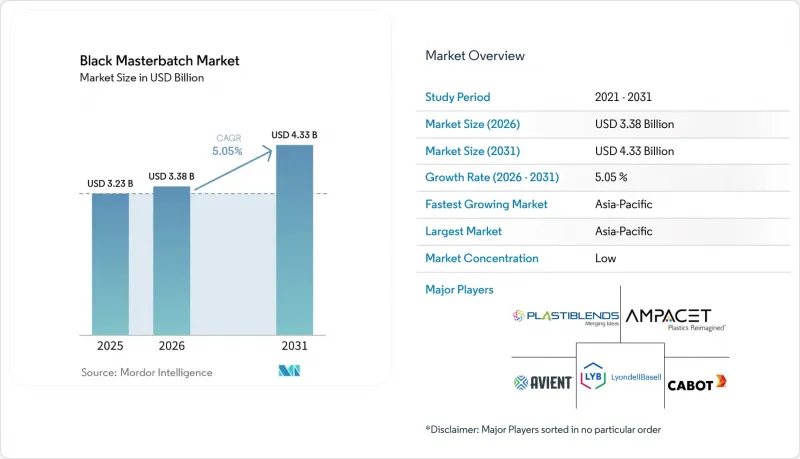
據 Mordor Intelligence 稱,2025 年黑色母粒市場價值為 32.3 億美元,預計在預測期(2026-2031 年)內將以 5.05% 的複合年成長率成長,從 2026 年的 33.8 億美元成長到 2031 年的 43.3 億美元。
全球黑色母粒市場趨勢與洞察
軟性及剛性塑膠包裝的擴張
軟包裝仍然是黑色母粒市場需求的主要驅動力。向單一材料聚乙烯和聚丙烯薄膜的轉變,增加了對聚丙烯 (PP) 和線性低密度聚乙烯 (LLDPE) 載體系統的需求。這些薄膜結構使加工商能夠控制黑色母粒的配方,而不會受到黏合層的影響。用於電子產品退貨和醫療用品的不透明郵寄信封需要在高通量薄膜生產線上保持穩定的紫外線防護和防潮性能。在巴西,包裝加工商正在擴大農業捆包膜和青貯膜的生產,這些產品在亞熱帶地區需要防紫外線輻射。 2025年3月,Amperset推出了包裝加工商的UVBLOCK 1496,該產品將著色、紫外線防護和法規合規性整合於單一濃縮液中。
汽車輕量化和電氣化
汽車電氣化正在改變黑色母粒市場對汽車塑膠化合物的性能要求。電池式電動車(BEV) 平台採用尺寸較大的熱塑性零件,例如電池外殼、底盤覆層和空氣動力學面板。這些部件需要良好的不透明度、紫外線穩定性和可控導電性,同時也需確保抗衝擊性。 2024 年 5 月,卡博特 (Cabot) 為汽車化合物製造商推出了 REPLASBLAK reUN5285 和 reUN5290。這兩款產品分別含有 45% 和 20% 的國際永續性與碳認證 (ISCC) PLUS物料平衡認證的再生材料。報廢車輛的相關要求也提升了黑色母粒在設計階段的重要性。能夠滿足認證再生載體配方要求的供應商,在滿足未來材料需求方面更具優勢。
炭黑和聚合物原料成本波動
炭黑和聚合物原料成本仍是黑色母粒市場面臨的阻礙因素。 2025年及2026年,受煤焦油價格上漲的影響,山東省炭黑價格在每噸6,250元至8,800元人民幣之間波動。無菸煤供不應求和輪胎行業的採購週期進一步加劇了生產商的壓力。 2026年初霍爾木茲海峽的航行中斷也推高了原物料成本,之後價格回落。包裝產業的顧客往往抵制現貨價格上漲,使得生產商難以回收成本。印度塑膠工業股份有限公司(Plastiblends India Ltd)報告稱,地緣政治因素和供應鏈中斷也對原物料價格產生了影響。
細分市場分析
到2025年,標準黑色母粒將佔據黑色母粒市場65.84%的佔有率。該產品仍廣泛應用於通用薄膜擠出、管道製造和射出成型領域。這些應用領域的買家優先考慮噸成本、炭黑含量、分散性以及與載體樹脂的相容性。高黑度黑色母粒適用於對顏色要求較高、顆粒更細、炭黑濃度更高的應用,例如汽車儀錶面板、電子設備機殼和高階包裝材料。抗紫外線黑色母粒則用於基礎設施和農業領域,這些領域的材料必須能夠經受風吹雨打。
預計到2031年,導電碳黑色母粒的複合年成長率將達到5.67%。對導電等級的需求主要受電動車(EV)中電控塑膠零件數量不斷增加以及電子設備對靜電放電(ESD)防護要求日益嚴格的推動。儘管再生聚合物基導電母粒仍是市場佔有率最小的細分市場,但它們有助於最大限度地減少消費後再生原料的顏色差異,並利用各種再生原料生產出可商業性化的產品。卡博特(Cabot)的「REPLASBLAK」產品組合包含再生載體含量高達45%的產品,並通過了國際永續性與碳認證(ISCC) PLUS物料平衡認證。 2026年1月,里昂巴塞爾(Lyoner Basel)宣布其循環母粒產品組合「Circulen」開始商業性化應用,顯示市場對再生載體產品的需求正在成長。
含有再生聚合物的產品能夠應付獨特的加工挑戰。由於回收物料來源混雜,再生材料的顏色和性能往往存在差異。黑色配方可以提供更均勻的表面外觀,從而提高這些材料的商業性可行性。這對於需要外觀一致的再生材料產品的客戶而言尤其重要。近紅外線 (NIR) 可偵測配方在需要分類的應用中具有進一步的回收優勢。因此,黑色母料市場已經開發出多種等級的產品,以應對再生原料的差異性和廢舊產品的回收要求。產品合格仍然至關重要,因為再生載體在加工過程中可能與原生樹脂表現出不同的特性。供應商必須證明其在整個樹脂體系中都能滿足性能要求。此外,當客戶要求提供檢驗的供應鏈文件時,循環材料的認證也至關重要。
區域分析
預計到2025年,亞太地區將佔據全球炭黑母粒市場47.81%的佔有率,並在2031年之前以5.83%的複合年成長率成長。中國憑藉汽車、電子和包裝產品的生產,正引領區域需求。印度正崛起為第二大成長中心,主要得益於塑膠加工和建築管道的需求。日本和韓國則滿足了汽車電子和光學元件等高附加價值需求。越南和泰國繼續吸引包裝和消費品製造業。該地區的炭黑供應基地支撐著標準和通用產品的生產,而日本和韓國的生產商則提供優質導電炭黑。
在歐洲和北美,法規和汽車產業要求對市場形成的影響遠大於產量成長本身。由於《包裝和包裝廢棄物法規》(PPWR) 以及差異化的生產者延伸責任制 (EPR) 費率的要求,歐洲黑色母粒市場正轉向近紅外線 (NIR) 可檢測配方和無炭黑配方。這些要求支撐了對高性能配方的需求,即便部分塑膠消費因包裝減量措施而受到限制。里昂巴塞爾已透過其子公司 Interpolymeri,自 2026 年第一季起,將母粒和客製化高性能顏料的分銷範圍擴展至德國和奧地利。在北美,市場對永續黑色配方和高階汽車應用的需求旺盛。可再生能源電纜的鋪設也推動了對符合抗紫外線和低菸/無鹵 (LSZH) 標準的黑色化合物的需求。
在南美洲、中東和非洲,需求與基礎設施和農業投資週期密切相關。在這些地區,食品飲料生產和電子商務的包裝需求支撐著這個市場。紫外線穩定型高密度聚乙烯 (HDPE) 和低密度聚乙烯 (LDPE) 複合材料被用於甘蔗、咖啡和柑橘種植的地膜和灌溉管道。墨西哥受益於汽車產業的近岸外包以及對裝飾條和外板複合材料需求的成長。在沙烏地阿拉伯和南非,基礎設施投資和供水系統維修推動了專案驅動的紫外線穩定型 HDPE 管道複合材料需求。這些地區的投資週期往往將需求與特定的建築、灌溉和農業採購計畫掛鉤,導致訂單模式比成熟的包裝市場波動更大。由於這些應用需要暴露在高溫和陽光下,紫外線防護尤為重要。供應商必須保持穩定的多元化,以滿足客戶對管道和薄膜預期使用壽命的要求。隨著這些項目擴大當地的加工能力,黑色母粒市場將出現新的商機。然而,要實現這些機遇,需要穩定的產品供應和對本地加工商的技術支援。
其他好處:
- Excel格式的市場預測(ME)表
- 3個月的分析師支持
目錄
第1章:引言
- 研究假設和市場定義
- 調查範圍
第2章:調查方法
第3章執行摘要
第4章 市場狀況
- 市場概覽
- 市場促進因素
- 軟性及剛性塑膠包裝的擴張
- 汽車輕量化和電氣化
- 基礎設施和農業領域對紫外線穩定性的要求日益提高。
- 電子和電動車領域導電塑膠的發展
- 可進行近紅外線分選的黑色化合物,其設計以可回收性為目標。
- 市場限制因素
- 炭黑和聚合物原料成本波動
- 炭黑引起的傳統近紅外線(NIR)分選系統故障
- 混合再生原料的批次間差異
- 價值鏈分析
- 波特五力分析
第5章 市場規模與成長預測
- 按類型
- 標準黑色母粒
- 高黑曜石母粒
- 抗紫外線黑色母粒
- 導電碳黑色母粒
- 可回收聚合物相容的黑色母料
- 通過載體樹脂
- 聚丙烯
- 線型低密度聚乙烯
- 低密度聚乙烯
- 高密度聚苯乙烯
- 聚對苯二甲酸乙二酯
- 聚氯乙烯
- 聚苯乙烯
- 聚醯胺
- 其他載體樹脂
- 按最終用戶行業分類
- 車
- 包裝
- 基礎設施
- 電氣和電子設備
- 其他終端用戶產業
- 按地區
- 亞太地區
- 中國
- 印度
- 日本
- 韓國
- 東南亞國協
- 其他亞太國家
- 北美洲
- 美國
- 加拿大
- 墨西哥
- 歐洲
- 德國
- 英國
- 法國
- 義大利
- 北歐國家
- 其他歐洲國家
- 南美洲
- 巴西
- 阿根廷
- 其他南美國家
- 中東和非洲
- 沙烏地阿拉伯
- 南非
- 其他中東和非洲國家
- 亞太地區
第6章 競爭情勢
- 市場集中度
- 策略趨勢
- 市佔率和排名分析
- 公司簡介
- Americhem
- Ampacet Corporation
- Avient Corporation
- Cabot Corporation
- Clariant AG
- Colloids
- Gabriel-Chemie
- Huber Engineered Materials
- Hubron International
- LyondellBasell Industries Holdings BV
- Penn Color, Inc.
- Plastiblends
- Plastika Kritis SA
- RTP Company
- Sukano
- Tosaf Compounds Ltd.
第7章 市場機會與未來展望
According to Mordor Intelligence, the black masterbatch market size was valued at USD 3.23 billion in 2025 and is estimated to grow from USD 3.38 billion in 2026 to USD 4.33 billion by 2031, at a CAGR of 5.05% during the forecast period (2026-2031).
Global Black Masterbatch Market Trends and Insights
Expansion of Flexible and Rigid Plastic Packaging
Flexible packaging remains the primary driver of demand in the black masterbatch market. The shift toward mono-material polyethylene and polypropylene films reinforces demand for polypropylene (PP) and linear low-density polyethylene (LLDPE) carrier systems. These film structures allow converters to control black masterbatch loading without interference from adhesive layers. Opaque mailers for electronics returns and medical supplies require consistent UV protection and moisture resistance on high-throughput film lines. In Brazil, packaging converters are expanding production of agricultural bale wrap and silage films that require protection from subtropical UV exposure. Ampacet launched UVBLOCK 1496 in March 2025 to combine pigmentation, UV protection, and regulatory support in a single concentrate for packaging converters.
Lightweighting and Electrification of Vehicles
Vehicle electrification is changing the performance requirements for automotive plastic compounds in the black masterbatch market. Battery electric vehicle platforms use larger thermoplastic parts, including battery housings, underbody cladding, and aerodynamic panels. These parts require opacity, UV stability, and controlled conductivity without compromising impact strength. Cabot launched REPLASBLAK reUN5285 and reUN5290 in May 2024, with 45% and 20% International Sustainability and Carbon Certification (ISCC) PLUS mass-balance-certified recycled content, respectively, for automotive compounders. End-of-life vehicle requirements also make black masterbatch more important at the design stage. Suppliers that qualify for certified recycled-carrier formulations are better positioned to meet future material requirements.
Volatility in Carbon Black and Polymer Feedstock Costs
Carbon black and polymer feedstock costs remain a restraint for the black masterbatch market. In 2025 and 2026, carbon black prices in Shandong ranged from CNY 6,250 to CNY 8,800 per ton amid rising coal tar costs. Limited availability of anthracite and tire-sector buying cycles added further pressure on producers. Disruption to traffic in the Strait of Hormuz in early 2026 also raised feedstock costs before prices retreated. Packaging customers often resist spot-price increases, making cost recovery difficult for producers. Plastiblends India Ltd reported that geopolitical factors and supply chain disruptions affected raw material prices.
Other drivers and restraints analyzed in the detailed report include:
- Rising UV-Stability Requirements in Infrastructure and Agriculture
- Growth of Conductive Plastics in Electronics and Electric Vehicles
- Carbon-Black-Induced Failure of Conventional NIR Sorting
For complete list of drivers and restraints, kindly check the Table Of Contents.
Segment Analysis
Standard Black Masterbatch held 65.84% of the black masterbatch market share in 2025. It remains widely used in commodity film extrusion, pipe production, and injection molding. Buyers in these applications prioritize cost per ton, carbon black loading, dispersion quality, and carrier-resin compatibility. High-Jetness Black Masterbatch is used in automotive instrument panels, electronic housings, and premium packaging, where deep color is required, and smaller particle sizes and higher carbon black concentrations may be necessary. UV-Resistant Black Masterbatch is used in infrastructure and agriculture, where materials must withstand weathering.
Conductive Black Masterbatch is expected to grow at a 5.67% CAGR through 2031. Demand for conductive grades is supported by a growing number of electrically managed plastic components in electric vehicles (EVs) and stricter electrostatic discharge (ESD) protection requirements in electronics. Recycled-polymer-compatible grades remain the smallest type segment, but they help mask color variation in post-consumer recycled feedstocks, supporting commercially usable output from variable recyclate streams. Cabot's REPLASBLAK portfolio includes options with up to 45% International Sustainability and Carbon Certification (ISCC) PLUS mass-balance certified recycled carrier content. LyondellBasell reported commercial uptake of its Circulen circular masterbatch portfolio in January 2026, indicating procurement interest in recycled-carrier products.
Recycled-polymer-compatible products address a distinct processing challenge. Recyclate often has varied colors and properties due to mixed collection streams. Black formulations can provide a more uniform finished appearance and improve the commercial viability of these materials. This is particularly relevant where customers require recycled-content products without inconsistent visual output. Near-infrared (NIR)-detectable formulations offer an additional recycling benefit in applications that require sortability. The black masterbatch market is therefore developing grades that address both variations in recycled feedstocks and end-of-life recovery requirements. Product qualification remains important because recycled carriers can behave differently from virgin resins during processing. Suppliers must demonstrate that performance claims can be maintained across the intended resin systems. Circular material certifications are also relevant when customers require verified supply chain documentation.
Complete Report Scope:
- By Type
- Standard Black Masterbatch
- High-Jetness Black Masterbatch
- UV-Resistant Black Masterbatch
- Conductive Black Masterbatch
- Recycled-Polymer Compatible Black Masterbatch
- By Carrier Resin
- Polypropylene
- Linear Low-Density Polyethylene
- Low-Density Polyethylene
- High-Density Polyethylene
- Polyethylene Terephthalate
- Polyvinyl Chloride
- Polystyrene
- Polyamide
- Other Carrier Resins
- By End-User Industry
- Automotive
- Packaging
- Infrastructure
- Electrical and Electronics
- Other End-Use Industries
- By Geography
- Asia-Pacific
- China
- India
- Japan
- South Korea
- ASEAN Countries
- Rest of Asia-Pacific
- North America
- United States
- Canada
- Mexico
- Europe
- Germany
- United Kingdom
- France
- Italy
- NORDIC Countries
- Rest of Europe
- South America
- Brazil
- Argentina
- Rest of South America
- Middle East and Africa
- Saudi Arabia
- South Africa
- Rest of Middle East and Africa
- Asia-Pacific
Geography Analysis
Asia-Pacific accounted for 47.81% of the black masterbatch market share in 2025 and is forecast to grow at a 5.83% CAGR through 2031. China supports regional demand through automotive, electronics, and packaging production. India is emerging as a second growth center, driven by plastics processing and construction-linked pipe demand. Japan and South Korea address higher-value demand for automotive electronics and optical components. Vietnam and Thailand continue to attract packaging and consumer goods manufacturing. The region's carbon black supply base supports standard and commodity production, while Japanese and Korean formulators serve premium conductive grades.
Europe and North America are shaped more by regulation and automotive requirements than by output growth alone. The black masterbatch market in Europe is moving toward Near-Infrared (NIR)-detectable and carbon-black-free formulations due to requirements under the Packaging and Packaging Waste Regulation (PPWR) and differentiated Extended Producer Responsibility (EPR) fees. These requirements support demand for performance formulations even as packaging-reduction measures limit some plastic consumption. LyondellBasell expanded masterbatch and custom performance color distribution into Germany and Austria through Interpolimeri, effective in Q1 2026. North America shows demand for sustainable black formulations and high-end automotive applications. Renewable energy cable installations also support demand for UV-resistant and low-smoke zero-halogen (LSZH)-compliant black compounds.
South America, the Middle East, and Africa follow infrastructure and agricultural investment cycles. Food and beverage output and e-commerce packaging support demand in these regions. Mulch films and irrigation pipes for sugarcane, coffee, and citrus cultivation use UV-stabilized HDPE and LDPE formulations. Mexico benefits from automotive near-shoring and higher demand for trim and exterior panel compounds. Saudi Arabia and South Africa support project-led demand for UV-stable HDPE pipe compounds through infrastructure investment and water-system rehabilitation. Investment cycles in these regions tend to link demand with specific construction, irrigation, and agricultural procurement programs, which can make order patterns less consistent than in mature packaging markets. UV protection is particularly important in these applications due to exposure to high outdoor temperatures and solar radiation. Suppliers must maintain stable dispersion to meet the service-life expectations of pipe and film customers. The black masterbatch market presents opportunities as local conversion capacity expands alongside these projects, though realizing them depends on consistent product supply and technical support for regional processors.
- Americhem
- Ampacet Corporation
- Avient Corporation
- Cabot Corporation
- Clariant AG
- Colloids
- Gabriel-Chemie
- Huber Engineered Materials
- Hubron International
- LyondellBasell Industries Holdings B.V.
- Penn Color, Inc.
- Plastiblends
- Plastika Kritis S.A.
- RTP Company
- Sukano
- Tosaf Compounds Ltd.
Additional Benefits:
- The market estimate (ME) sheet in Excel format
- 3 months of analyst support
TABLE OF CONTENTS
1 Introduction
- 1.1 Study Assumptions and Market Definition
- 1.2 Scope of the Study
2 Research Methodology
3 Executive Summary
4 Market Landscape
- 4.1 Market Overview
- 4.2 Market Drivers
- 4.2.1 Expansion of Flexible and Rigid Plastic Packaging
- 4.2.2 Lightweighting and Electrification of Vehicles
- 4.2.3 Rising UV-Stability Requirements in Infrastructure and Agriculture
- 4.2.4 Growth of Conductive Plastics in Electronics and Electric Vehicles
- 4.2.5 NIR-Sortable Black Formulations Driven by Recyclability Design Rules
- 4.3 Market Restraints
- 4.3.1 Volatility in Carbon Black and Polymer Feedstock Costs
- 4.3.2 Carbon-Black-Induced Failure of Conventional NIR Sorting
- 4.3.3 Batch-to-Batch Variability in Mixed Recycled Feedstocks
- 4.4 Value Chain Analysis
- 4.5 Porter's Five Forces Analysis
- 4.5.1 Bargaining Power of Suppliers
- 4.5.2 Bargaining Power of Buyers
- 4.5.3 Threat of New Entrants
- 4.5.4 Threat of Substitutes
- 4.5.5 Competitive Rivalry
5 Market Size And Growth Forecasts (Value)
- 5.1 By Type
- 5.1.1 Standard Black Masterbatch
- 5.1.2 High-Jetness Black Masterbatch
- 5.1.3 UV-Resistant Black Masterbatch
- 5.1.4 Conductive Black Masterbatch
- 5.1.5 Recycled-Polymer Compatible Black Masterbatch
- 5.2 By Carrier Resin
- 5.2.1 Polypropylene
- 5.2.2 Linear Low-Density Polyethylene
- 5.2.3 Low-Density Polyethylene
- 5.2.4 High-Density Polyethylene
- 5.2.5 Polyethylene Terephthalate
- 5.2.6 Polyvinyl Chloride
- 5.2.7 Polystyrene
- 5.2.8 Polyamide
- 5.2.9 Other Carrier Resins
- 5.3 By End-User Industry
- 5.3.1 Automotive
- 5.3.2 Packaging
- 5.3.3 Infrastructure
- 5.3.4 Electrical and Electronics
- 5.3.5 Other End-Use Industries
- 5.4 By Geography
- 5.4.1 Asia-Pacific
- 5.4.1.1 China
- 5.4.1.2 India
- 5.4.1.3 Japan
- 5.4.1.4 South Korea
- 5.4.1.5 ASEAN Countries
- 5.4.1.6 Rest of Asia-Pacific
- 5.4.2 North America
- 5.4.2.1 United States
- 5.4.2.2 Canada
- 5.4.2.3 Mexico
- 5.4.3 Europe
- 5.4.3.1 Germany
- 5.4.3.2 United Kingdom
- 5.4.3.3 France
- 5.4.3.4 Italy
- 5.4.3.5 NORDIC Countries
- 5.4.3.6 Rest of Europe
- 5.4.4 South America
- 5.4.4.1 Brazil
- 5.4.4.2 Argentina
- 5.4.4.3 Rest of South America
- 5.4.5 Middle East and Africa
- 5.4.5.1 Saudi Arabia
- 5.4.5.2 South Africa
- 5.4.5.3 Rest of Middle East and Africa
- 5.4.1 Asia-Pacific
6 Competitive Landscape
- 6.1 Market Concentration
- 6.2 Strategic Moves
- 6.3 Market Share (%)/Ranking Analysis
- 6.4 Company Profiles (includes Global Overview, Market Overview, Core Segments, Financials as available, Strategic Information, Products and Services, and Recent Developments)
- 6.4.1 Americhem
- 6.4.2 Ampacet Corporation
- 6.4.3 Avient Corporation
- 6.4.4 Cabot Corporation
- 6.4.5 Clariant AG
- 6.4.6 Colloids
- 6.4.7 Gabriel-Chemie
- 6.4.8 Huber Engineered Materials
- 6.4.9 Hubron International
- 6.4.10 LyondellBasell Industries Holdings B.V.
- 6.4.11 Penn Color, Inc.
- 6.4.12 Plastiblends
- 6.4.13 Plastika Kritis S.A.
- 6.4.14 RTP Company
- 6.4.15 Sukano
- 6.4.16 Tosaf Compounds Ltd.
7 Market Opportunities and Future Outlook
- 7.1 White-Space and Unmet-Need Assessment

 包裝母材市場:全球市場預測,2026-2032年
 母粒市場規模、佔有率、成長率、全球產業分析、區域趨勢及2026-2034年預測。
 奈米改質母粒市場報告:至2035年的趨勢、預測與競爭分析特效母粒市場報告:趨勢、預測與競爭分析(至2035年)
 全球母粒市場(至2031年):按類型、聚合物類型、應用和地區分類
 聚合物混煉和母粒市場預測至2034年-按聚合物類型、添加劑功能、加工技術、應用、最終用戶和地區分類的全球分析母粒市場-2026-2032年全球市場預測
 母粒市場:按類型、基礎樹脂、加工方法、應用和地區分類
 母粒市場規模、佔有率和成長分析:按聚合物類型、顏色類型、最終用途產業、加工技術、載體樹脂類型、分銷管道和地區分類-2026-2033年產業預測碳酸鈣填料市場:按形態、等級、類型和最終用途產業分類-2026-2032年全球預測