


 |
市場調查報告書
商品編碼
2156909
微通道熱交換器:市場佔有率分析、產業趨勢與統計及成長預測(2026-2031)Microchannel Heat Exchanger - Market Share Analysis, Industry Trends & Statistics, Growth Forecasts (2026 - 2031) |
||||||

※ 本網頁內容可能與最新版本有所差異。詳細情況請與我們聯繫。
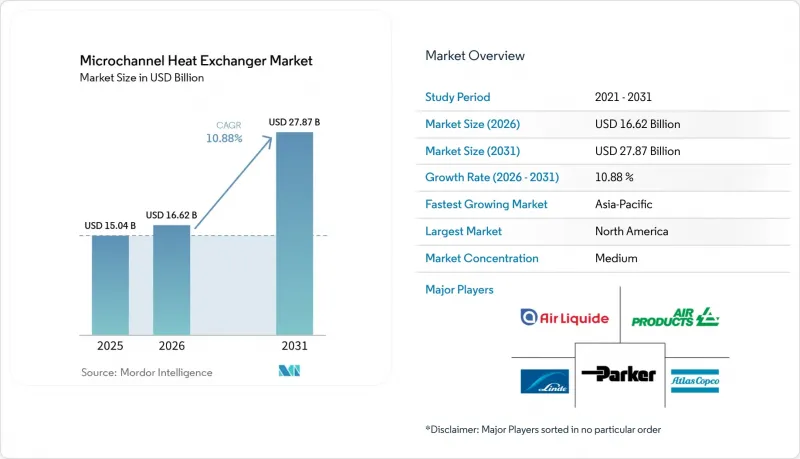
根據 Mordor Intelligence 預測,微通道熱交換器市場規模將從 2025 年的 150.4 億美元成長到 2026 年的 166.2 億美元,到 2031 年將達到 278.7 億美元,2026 年至 2031 年的複合年成長率為 10.88%。
全球微通道熱交換器市場趨勢及洞察
暖通空調升級和熱泵安裝
熱泵的廣泛應用正在微通道熱交換器市場形成持續的更新換代週期。國際能源總署(IEA)預測,在指定的政策情境下,到2035年,全球熱泵銷售量將成長一倍以上。到2026年,超過20%的美國家庭將熱泵作為其主要暖氣系統。日本工業熱泵裝置容量在2024年達到650兆瓦,與十年前的290兆瓦相比,實現了顯著成長。由於熱泵盤管必須同時承擔冷凝器和蒸發器的功能,因此在結霜和除霜循環中保持穩定的排水性能已成為基本產品要求。為了因應這些運作條件,Kaltra於2025年10月推出了可逆式微通道蒸發器盤管。
汽車電氣化和熱負荷增加
汽車電氣化正在增加微通道熱交換器市場所面臨的熱負荷。典型的電動車 (EV) 平台在電池、逆變器和車內空調系統中使用了 3 到 5 個微通道組件。 2025 年的一項研究發現,與傳統微通道設計相比,最佳化的歧管式微通道散熱器可將熱阻降低 2.8%,泵浦輸出功率降低 27.3%。 2026 年 3 月,Hanon Systems 為BMW電動車 iX3 提供了一個重達 16 公斤的「高度整合冷卻單元」模組。該組件整合了電子壓縮機、水冷冷凝器、整合式熱交換器、冷卻器、管道、閥門和感測器。向這種整合系統的轉變使得採購集中化,供應商必須能夠滿足硬焊、洩漏測試和系統工程要求。
精密製造和特殊硬焊的成本
可控氣氛硬焊仍然是微通道熱交換器市場准入的一大障礙。此製程需要精確的爐溫控制,因為即使是微小的溫度偏差也會降低接頭的疲勞強度。大規模生產的可控氣氛硬焊線需要數百萬美元的投資和較長的設備交付週期。多端口管的擠壓成型也需要極高的前置作業時間,而許多鄰近的熱交換器製造商無法滿足此要求。北美和歐洲的人事費用、設備和材料成本尤其高。雖然翅片疊層和管材插入的自動化可以降低成本,但自動化的投資也受到可用資金的限制。
細分市場分析
到2025年,冷凝器將佔據微通道熱交換器市場46.4%的佔有率。這一領先地位反映了冷凝器在分離式空調系統、屋頂設備和輕工業製冷系統中作為空氣側散熱關鍵部件的重要作用。已安裝設備的充足供應確保了冷凝器供應商擁有充足的更換週期,即使在新建專案需求放緩的情況下也能滿足市場需求。蒸發器是第二大組件類別。它們用於熱泵的內部盤管、電動車的車載空調系統以及商用冷凍機組。其他組件還包括輔助散熱迴路和過冷器迴路等。
預計2026年至2031年間,水冷盤管將以11.6%的複合年成長率成長,成為微通道熱交換器市場中最具成長潛力的產品。這一成長主要得益於資料中心水冷技術的日益普及以及熱泵中液冷迴路的整合。與住宅開工量或季節性建築週期相比,市場需求與超大規模資本投資的關聯性更為密切。 2026年5月,Kaltra公司擴展了其水冷盤管產品線,採用了厚壁多端口管、犧牲陽極鋅層、奈米塗層和整合集管等技術。這些產品主要面向美國的資料中心、空調和自然冷卻系統。自然冷卻設計由於減少了機械冷卻器的運作,因此對可靠的水側性能要求更高。
到2025年,暖通空調(HVAC)將佔微通道熱交換器市場規模的41.2%。這項應用受益於高效能設備中傳統翅片管式熱交換器的持續替代。熱泵作為石化燃料加熱系統的替代方案,其普及也支撐了市場需求。冷凍是第二大應用領域,包括冷鏈物流、超級市場和製程冷卻。在許多冷凍系統中,減少冷媒充填量是關鍵考慮因素。工業製程冷卻和資料中心冷卻則屬於「其他應用」類別。
在微通道熱交換器市場,汽車應用預計到2031年將以10.9%的複合年成長率成長。電池溫度控管、逆變器冷卻和多迴路車內空調系統是推動整合系統需求的主要因素。電裝公司在電動車熱交換器設計和鋁製冷卻迴路腐蝕管理方面持續進行專利申請活動,直至2024年和2025年。三花和丹佛斯在杭州的合資企業為住宅和商用空調設備製造商提供微通道冷凝器和蒸發器產品。與許多暖通空調應用相比,汽車設計需要更高的耐壓循環壽命、更輕的重量、更廣泛的流體相容性和更複雜的整合。這些要求使得僅服務暖通空調客戶的供應商更難進入市場。
區域分析
到2025年,北美將佔據微通道熱交換器市場31.2%的佔有率。美國商用整體式空調和熱泵的能源效率標準支援持續的設備更換。到2026年,超過20%的美國家庭將使用熱泵作為主要暖氣系統。資料中心的製冷是另一個需求管道,與住宅趨勢關聯性不強。 Modine公司於2025年在威斯康辛州開設了一座15.5萬平方英尺的工廠,這是其1億美元投資計畫的一部分,旨在擴大產能。加拿大對住宅電暖的需求正在成長,而墨西哥對小規模商業和工業暖通空調系統的需求也在增加。
由於歐洲對冷媒的監管嚴格,微通道熱交換器市場仍是一個技術要求極高的地區。 2025年,法國、德國和義大利將引領歐洲熱泵銷售。國際能源總署(IEA)預測,歐洲熱泵市場在經歷了2024年的萎縮後,將於2026年復甦,其中德國和瑞典的成長尤為強勁。德國的供暖法規正在推動對相容熱泵設備的需求。敦安的MPHX產品已被瑞典和歐洲其他地區的低填充量R290系統採用。將於2027年生效的關於限制在某些新型單體式熱泵中使用高全球暖化潛勢(GWP)冷媒的規定,正在加速合規產品的認證進程。
預計2026年至2031年,亞太地區微通道熱交換器市場將以12.2%的複合年成長率成長,在所有地區中成長率最高。中國是全球最大的熱泵市場,而印度、越南、印尼和泰國的都市化推動了商用暖通空調系統的安裝。中國2026年實施的標準可望提高整個供應商體系的產品一致性,並縮短認證流程。日本的工業熱泵裝置容量已達650兆瓦,滿足了特定產業的市場需求。 2026年1月,敦安在泰國開設了一家汽車溫度控管和熱交換器製造工廠。在南美洲,特定產業對冷凍空調系統的需求預計將會成長。同時,在中東和非洲,由於區域冷卻和沿海氣候的需要,需要採用耐腐蝕設計。
其他好處:
- Excel格式的市場預測(ME)表
- 3個月的分析師支持
目錄
第1章:引言
- 研究假設和市場定義
- 調查範圍
第2章:調查方法
第3章執行摘要
第4章 市場狀況
- 市場概覽
- 市場促進因素
- 能源效率法規和冷媒減量要求
- 暖通空調升級和熱泵安裝
- 汽車電氣化和熱負荷增加
- 人工智慧資料中心的冷卻和提高機架功率密度
- 耐腐蝕線圈,可進行改造,並設計用於承受惡劣的氣候條件。
- 積層製造和自動化生產,用於製造特定應用形狀。
- 市場限制因素
- 精密製造和特殊硬焊的成本
- 耐久性、污漬附著力及腐蝕風險
- 高密度流道中壓力損失與泵送功率之間的權衡
- 易燃冷媒和超低全球暖化潛值冷媒的合格差距
- 供應鏈分析
- 波特五力分析
- 科技趨勢
- 監理情勢
- 投資分析
第5章 市場規模與成長預測
- 按組件
- 蒸發器
- 冷凝器
- 水盤管
- 其他規則
- 透過使用
- HVAC
- 車
- 冰凍
- 其他
- 依產品類型
- 空調機組
- 熱泵
- 風機盤管機組
- 冷卻器
- 其他產品類型
- 材料
- 金屬
- 陶瓷製品
- 按地區
- 北美洲
- 美國
- 加拿大
- 墨西哥
- 歐洲
- 德國
- 法國
- 義大利
- 西班牙
- 英國
- 波蘭
- 俄羅斯
- 其他歐洲國家
- 亞太地區
- 中國
- 印度
- 日本
- 韓國
- 澳洲
- 印尼
- 越南
- 泰國
- 其他亞太國家
- 南美洲
- 巴西
- 阿根廷
- 智利
- 其他南美國家
- 中東和非洲
- 沙烏地阿拉伯
- 阿拉伯聯合大公國
- 埃及
- 南非
- 摩洛哥
- 其他中東和非洲國家
- 北美洲
第6章 競爭情勢
- 市場集中度
- 策略趨勢
- 市佔率分析
- 公司簡介
- Alfa Laval AB
- API Heat Transfer Inc.
- Brazeway Inc.
- Carrier Global Corporation
- Climetal SL
- Daikin Industries Ltd.
- Danfoss A/S
- DENSO Corporation
- Evapco Inc.
- Goldstone HVACR Inc.
- Hanon Systems
- Johnson Controls International plc
- Kaltra Innovativtechnik GmbH
- Kelvion Holding GmbH
- Kobelco(Kobe Steel, Ltd.)
- MAHLE GmbH
- Mitsubishi Heavy Industries, Ltd.
- Modine Manufacturing Company
- Sanhua Holding Group Co. Ltd.
- Zhejiang DUNAN Artificial Environment Co. Ltd.
第7章 市場機會與未來展望
According to Mordor Intelligence, the microchannel heat exchanger market size is expected to increase from USD 15.04 billion in 2025 to USD 16.62 billion in 2026 and reach USD 27.87 billion by 2031, at a CAGR of 10.88% over 2026-2031.
Global Microchannel Heat Exchanger Market Trends and Insights
HVACR Replacement and Heat Pump Deployment
Heat pump adoption is creating a durable replacement cycle for the microchannel heat exchanger market. The International Energy Agency projects that global heat pump sales will more than double by 2035 under stated policy scenarios. More than 20% of U.S. households used heat pumps as their primary heating equipment in 2026. Japan's industrial heat pump capacity reached 650 MW in 2024, compared with 290 MW a decade earlier. Heat pump coils must work as condensers and evaporators, so stable drainage through frosting and defrosting cycles is becoming a basic product requirement. Kaltra introduced a reversible microchannel evaporator coil in October 2025 to address this operating condition.
Automotive Electrification and Higher Thermal Loads
Vehicle electrification is increasing the thermal duties handled by the microchannel heat exchanger market. A typical electric vehicle platform uses 3-5 microchannel components across battery, inverter, and cabin-conditioning systems. A 2025 study found that optimized manifold microchannel heat sinks reduced thermal resistance by 2.8% and pumping power by 27.3% compared with conventional microchannel designs. Hanon Systems supplied a 16 kg Highly Integrated Cooling Entity module for BMW's electric iX3 in March 2026. The assembly combines an eCompressor, water-cooled condenser, internal heat exchanger, chiller, lines, valves, and sensors. This move toward integrated systems concentrates procurement among suppliers that can meet brazing, leak-testing, and system engineering requirements.
Precision Manufacturing and Specialized Brazing Cost
Controlled-atmosphere brazing remains a practical barrier to entry in the microchannel heat exchanger market. The process requires controlled furnace conditions, and narrow temperature deviations can weaken joint fatigue performance. A high-volume controlled-atmosphere brazing line requires multi-million-dollar investment and lengthy equipment lead times. Multiport tube extrusion also requires precise tolerances that many adjacent heat exchanger manufacturers do not have. Labor, equipment, and material costs are particularly high in North America and Europe. Automation can lower costs through fin stacking and tube insertion, but investment in automation is also limited by available capital.
Other drivers and restraints analyzed in the detailed report include:
- Energy Efficiency Regulations and Refrigerant Reduction Requirements
- AI Data Center Cooling and Rising Rack Power Density
- Durability, Fouling, and Corrosion Risk
For complete list of drivers and restraints, kindly check the Table Of Contents.
Segment Analysis
Condensers held 46.4% of the microchannel heat exchanger market share in 2025. Their leading position reflects their role as the main air-side heat rejection component in split systems, rooftop equipment, and light-industrial refrigeration. The installed base gives condenser suppliers a replacement cycle that can support demand when new construction slows. Evaporators form the second-largest component group. They are used in heat pump indoor coils, electric vehicle cabin conditioning, and commercial refrigeration banks. Other components include auxiliary heat-rejection and subcooler circuits.
Water coils are forecast to grow at 11.6% CAGR from 2026 to 2031, the strongest component outlook in the microchannel heat exchanger market. Growth follows hydronic cooling expansion in data centers and liquid-circuit integration in heat pumps. Demand is linked to hyperscale capital commitments more than to housing starts or seasonal construction cycles. Kaltra expanded its water coil portfolio in May 2026 with thicker-wall multiport tubes, sacrificial zinc layers, nano-scale coatings, and one-piece headers. The product targets U.S. data centers, air handling units, and free-cooling systems. Free-cooling designs can reduce mechanical chiller operation and raise the importance of reliable water-side performance.
HVAC held 41.2% of the microchannel heat exchanger market size in 2025. The application benefits from ongoing substitution of conventional fin-and-tube coils in efficient equipment. Heat pump installations replacing fossil-fuel heating systems also support demand. Refrigeration is the second application category and includes cold chain logistics, supermarkets, and process cooling. Lower refrigerant charge is important in many refrigeration installations. Industrial process cooling and data center cooling sit within the other applications category.
Automotive applications are projected to advance at a 10.9% CAGR through 2031 in the microchannel heat exchanger market. Battery thermal management, inverter cooling, and multi-circuit cabin conditioning create demand for integrated systems. DENSO maintained patent activity covering electric vehicle heat-exchanger designs and corrosion management for aluminum cooling circuits in 2024 and 2025. The Sanhua and Danfoss joint venture in Hangzhou serves residential and commercial air-conditioning equipment makers with microchannel condenser and evaporator products. Automotive designs require stronger pressure-cycle durability, lower weight, broader fluid compatibility, and more complex integration than many HVAC applications. These requirements make entry more difficult for suppliers that only serve HVAC customers.
Complete Report Scope:
- By Component
- Evaporator
- Condenser
- Water Coil
- Other Components
- By Application
- HVAC
- Automotive
- Refrigeration
- Others
- By Product Type
- Air Handling Units
- Heat Pumps
- Fan Coil Units
- Chillers
- Other Product Types
- By Material
- Metal-Based
- Ceramic-Based
- By Geography
- North America
- United States
- Canada
- Mexico
- Europe
- Germany
- France
- Italy
- Spain
- United Kingdom
- Poland
- Russia
- Rest of Europe
- Asia-Pacific
- China
- India
- Japan
- South Korea
- Australia
- Indonesia
- Vietnam
- Thailand
- Rest of Asia-Pacific
- South America
- Brazil
- Argentina
- Chile
- Rest of South America
- Middle East and Africa
- Saudi Arabia
- United Arab Emirates
- Egypt
- South Africa
- Morocco
- Rest of Middle East and Africa
- North America
Geography Analysis
North America held 31.2% of the microchannel heat exchanger market share in 2025. U.S. energy conservation standards for commercial package air conditioners and heat pumps support a continuing equipment replacement cycle. More than 20% of U.S. households used heat pumps as their primary heating equipment in 2026. Data center cooling adds another demand channel that does not closely follow residential construction. Modine opened a 155,000-square-foot facility in Wisconsin during 2025 as part of a USD 100 million capacity investment. Canada adds residential electrified-heating demand, while Mexico contributes light-commercial and industrial HVAC volume.
Europe remains a technically demanding region for the microchannel heat exchanger market because its refrigerant policy is stringent. France, Germany, and Italy led European heat pump unit sales in 2025. The IEA reported a recovery in European heat pump markets during 2026 after contraction in 2024, with strong growth in Germany and Sweden. Germany's heating rules reinforce demand for heat-pump-ready equipment. DunAn's MPHX product has been deployed in Sweden and other European locations for low-charge R290 systems. The 2027 restriction on higher-global-warming-potential refrigerants in certain new monoblock heat pumps is accelerating compliant product qualification.
Asia-Pacific is forecast to expand at 12.2% CAGR from 2026 to 2031, the fastest regional rate in the microchannel heat exchanger market. China is the world's largest heat pump market, and urbanization in India, Vietnam, Indonesia, and Thailand supports commercial HVAC installation. China's 2026 standard can raise product consistency and shorten qualification processes across its supplier base. Japan's industrial heat pump capacity of 650 MW supports specialized industrial demand. DunAn opened vehicle thermal management and heat exchanger facilities in Thailand in January 2026. South America offers targeted refrigeration and residential air-conditioning demand, while the Middle East and Africa require corrosion-protected designs for district cooling and coastal climates.
- Alfa Laval AB
- API Heat Transfer Inc.
- Brazeway Inc.
- Carrier Global Corporation
- Climetal S.L.
- Daikin Industries Ltd.
- Danfoss A/S
- DENSO Corporation
- Evapco Inc.
- Goldstone HVACR Inc.
- Hanon Systems
- Johnson Controls International plc
- Kaltra Innovativtechnik GmbH
- Kelvion Holding GmbH
- Kobelco (Kobe Steel, Ltd.)
- MAHLE GmbH
- Mitsubishi Heavy Industries, Ltd.
- Modine Manufacturing Company
- Sanhua Holding Group Co. Ltd.
- Zhejiang DUNAN Artificial Environment Co. Ltd.
Additional Benefits:
- The market estimate (ME) sheet in Excel format
- 3 months of analyst support
TABLE OF CONTENTS
1 INTRODUCTION
- 1.1 Study Assumptions and Market Definition
- 1.2 Scope of the Study
2 RESEARCH METHODOLOGY
3 EXECUTIVE SUMMARY
4 MARKET LANDSCAPE
- 4.1 Market Overview
- 4.2 Market Drivers
- 4.2.1 Energy-Efficiency Regulations and Refrigerant-Reduction Requirements
- 4.2.2 HVACR Replacement and Heat-Pump Deployment
- 4.2.3 Automotive Electrification and Higher Thermal Loads
- 4.2.4 AI Data-Center Cooling and Rising Rack Power Density
- 4.2.5 Retrofit-Ready Corrosion-Resistant Coils for Harsh Climates
- 4.2.6 Additive and Automated Manufacturing for Application-Specific Geometries
- 4.3 Market Restraints
- 4.3.1 Precision Manufacturing and Specialized Brazing Cost
- 4.3.2 Durability, Fouling, and Corrosion Risk
- 4.3.3 Pressure-Drop and Pumping-Power Trade-Offs in High-Density Channels
- 4.3.4 Qualification Gaps for Flammable and Ultra-Low-GWP Refrigerants
- 4.4 Supply-Chain Analysis
- 4.5 Porter's Five Forces Analysis
- 4.5.1 Bargaining Power of Suppliers
- 4.5.2 Bargaining Power of Buyers
- 4.5.3 Threat of New Entrants
- 4.5.4 Threat of Substitutes
- 4.5.5 Competitive Rivalry
- 4.6 Technology Outlook
- 4.7 Regulatory Landscape
- 4.8 Investment Analysis
5 MARKET SIZE AND GROWTH FORECASTS
- 5.1 By Component
- 5.1.1 Evaporator
- 5.1.2 Condenser
- 5.1.3 Water Coil
- 5.1.4 Other Components
- 5.2 By Application
- 5.2.1 HVAC
- 5.2.2 Automotive
- 5.2.3 Refrigeration
- 5.2.4 Others
- 5.3 By Product Type
- 5.3.1 Air Handling Units
- 5.3.2 Heat Pumps
- 5.3.3 Fan Coil Units
- 5.3.4 Chillers
- 5.3.5 Other Product Types
- 5.4 By Material
- 5.4.1 Metal-Based
- 5.4.2 Ceramic-Based
- 5.5 By Geography
- 5.5.1 North America
- 5.5.1.1 United States
- 5.5.1.2 Canada
- 5.5.1.3 Mexico
- 5.5.2 Europe
- 5.5.2.1 Germany
- 5.5.2.2 France
- 5.5.2.3 Italy
- 5.5.2.4 Spain
- 5.5.2.5 United Kingdom
- 5.5.2.6 Poland
- 5.5.2.7 Russia
- 5.5.2.8 Rest of Europe
- 5.5.3 Asia-Pacific
- 5.5.3.1 China
- 5.5.3.2 India
- 5.5.3.3 Japan
- 5.5.3.4 South Korea
- 5.5.3.5 Australia
- 5.5.3.6 Indonesia
- 5.5.3.7 Vietnam
- 5.5.3.8 Thailand
- 5.5.3.9 Rest of Asia-Pacific
- 5.5.4 South America
- 5.5.4.1 Brazil
- 5.5.4.2 Argentina
- 5.5.4.3 Chile
- 5.5.4.4 Rest of South America
- 5.5.5 Middle East and Africa
- 5.5.5.1 Saudi Arabia
- 5.5.5.2 United Arab Emirates
- 5.5.5.3 Egypt
- 5.5.5.4 South Africa
- 5.5.5.5 Morocco
- 5.5.5.6 Rest of Middle East and Africa
- 5.5.1 North America
6 COMPETITIVE LANDSCAPE
- 6.1 Market Concentration
- 6.2 Strategic Moves
- 6.3 Market Share Analysis
- 6.4 Company Profiles (includes Global Level Overview, Market Level Overview, Core Segments, Financials as available, Strategic Information, Products and Services, Recent Developments)
- 6.4.1 Alfa Laval AB
- 6.4.2 API Heat Transfer Inc.
- 6.4.3 Brazeway Inc.
- 6.4.4 Carrier Global Corporation
- 6.4.5 Climetal S.L.
- 6.4.6 Daikin Industries Ltd.
- 6.4.7 Danfoss A/S
- 6.4.8 DENSO Corporation
- 6.4.9 Evapco Inc.
- 6.4.10 Goldstone HVACR Inc.
- 6.4.11 Hanon Systems
- 6.4.12 Johnson Controls International plc
- 6.4.13 Kaltra Innovativtechnik GmbH
- 6.4.14 Kelvion Holding GmbH
- 6.4.15 Kobelco (Kobe Steel, Ltd.)
- 6.4.16 MAHLE GmbH
- 6.4.17 Mitsubishi Heavy Industries, Ltd.
- 6.4.18 Modine Manufacturing Company
- 6.4.19 Sanhua Holding Group Co. Ltd.
- 6.4.20 Zhejiang DUNAN Artificial Environment Co. Ltd.
7 MARKET OPPORTUNITIES AND FUTURE OUTLOOK
- 7.1 White-Space and Unmet-Need Assessment

 平行流微通道熱交換器市場:全球市場預測,2026-2032年
 全球微通道熱交換器市場微通道熱交換器市場:按類型、材質、流動佈局、通道形狀、冷卻能力、應用和銷售管道分類-2026-2032年全球市場預測
 微通道熱交換器市場規模、佔有率、成長及全球產業分析:依類型、應用和地區劃分的洞察與預測(2026-2034)
 2026年全球微通道熱交換器市場報告
 微通道熱交換器市場規模、佔有率及成長分析(依材料、組件、類型、終端用戶產業及地區分類)-2026-2033年產業預測
 亞太地區微通道熱交換器市場:按應用、按產品、按國家 - 分析和預測(2024-2033 年)
 歐洲微通道熱交換器市場:按應用、按產品、按國家 - 分析和預測(2024-2033)