


 |
市場調查報告書
商品編碼
2156901
鑽井液:市場佔有率分析、產業趨勢與統計、成長預測(2026-2031)Drilling Fluid - Market Share Analysis, Industry Trends & Statistics, Growth Forecasts (2026 - 2031) |
||||||

※ 本網頁內容可能與最新版本有所差異。詳細情況請與我們聯繫。
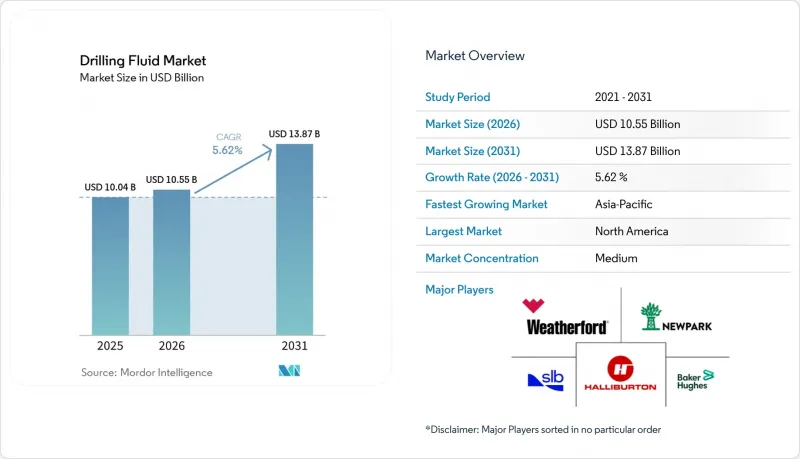
根據 Mordor Intelligence 預測,鑽井液市場規模預計在 2025 年達到 100.4 億美元,2026 年達到 105.5 億美元,到 2031 年達到 138.7 億美元,2026 年至 2031 年的複合年成長率為 5.62%。
全球鑽井液市場趨勢與洞察
深海和超深海鑽探項目
深水和超深水井需要高性能合成高密度水性鑽井液,這導致其單井鑽井液成本在鑽井液市場中居高不下。巴西、圭亞那和西非地區正在推動海上鑽井液供應的成長,並支撐著對高品質鑽井服務的需求。 2024年12月,SLB公司獲得一份契約,將為巴西石油公司在坎波斯盆地、桑托斯盆地和聖埃斯皮里圖盆地建造的100多口深水井提供支援。該合約將在多達9座超深水鑽井鑽機上使用鑽井液和水泥灌漿技術。同樣在2026年,貝克休斯公司擴大了在巴西桑托斯盆地的綜合油井建造業務,涵蓋鑽井液、水泥灌漿、纜線和地球科學服務。巴西鹽層下的油井可以穿透深度達2000公尺的鹽層,並承受超過10,000磅/平方英吋的壓力。這些條件縮小了鑽井液密度和井筒穩定性的操作範圍。它們也適用於頁岩地層和海上盆地的超長水平井鑽井和複雜的長水平井鑽井。這些要求有利於能夠在長而複雜的井段保持性能的服務供應商,從而提高每英尺鑽井的收入。此外,廢漿再利用和區域混合能力也支撐了鑽井液市場,這些能力減少了廢棄物處理負擔,並縮短了海上工程附近的供應前置作業時間。
傳統型頁岩和緻密儲存的開發
頁岩和緻密儲存的水平鑽井比傳統垂直鑽井每井消耗更多的鑽井液,持續支撐著鑽井液市場的需求。二疊紀盆地仍然是這項需求的核心,但油價下跌和資本紀律的加強減緩了美國石油產量的成長,導致該盆地部分地區的鑽井活動減少。超過10,000英尺的水平隧道和多個著陸點使得二疊紀盆地許多油井對鑽井液的需求居高不下。在阿根廷的瓦卡穆埃爾塔普雷(Vaca Muerta Prey)油田,水平鑽井計畫正在擴展,需要具有約束性能的水基鑽井液來應對高活性的侏羅紀頁岩地層。在中國四川盆地和塔里木盆地,計畫正朝著複雜的多分支井設計發展,採用先進的聚合物基水基鑽井液來應對深層和過壓地層。這些項目對具備現場配製能力、技術支援和可靠的特殊材料供應鏈的服務公司更有利。
鑽井預算的波動受原油價格的影響。
原油價格暴跌是鑽井液市場面臨的最迫切的需求風險。這是因為預期收益下降將導致營運商縮減鑽機運作並推遲鑽井專案。根據達拉斯聯邦儲備銀行2025年3月的一項調查,一些業者已暫停鑽井作業,預計WTI原油價格將跌破每桶50美元,受訪者表示,運作中油井數量已從10口減少到5口或更少。貝克休斯公司在2026年7月表示,由於拉丁美洲和非洲海上油氣產業的成長抵消了歐洲和中東地區的放緩,預計2026年全球探勘與生產(E&P)支出將略有下降。霍爾木茲海峽的交通中斷給該地區的設施帶來了物流和通膨壓力。原料供應仍然是一個令人擔憂的問題,因為特殊聚合物和重晶石可能會推高投入成本並帶來採購風險。壓力控制鑽井可以透過更精確的壓力控制,進一步減少某些油井的流體用量,但同時也增加了對能夠快速反應的流體系統和監控的需求。
細分市場分析
到2025年,水基鑽井液將引領市場,佔57.1%的銷售額。這主要歸功於其廣泛的監管認可以及對大規模陸上鑽井的適用性。此類別包括標準的膨潤土基體係以及高價值的聚合物增強型和奈米添加劑配方。水平井和超水平井的作業者越來越需要更強的流變控制和頁岩抑制能力,而這些是基礎配方無法提供的。合成鑽井液是成長最快的類型,預計到2031年,該細分市場的複合年成長率將達到5.9%。其熱穩定性、密度控制、潤滑性和排放性能使其適用於高壓高溫的海洋油井。在中東和中亞的成熟陸上油田,油基鑽井液仍有需求。在這些地區,對油井穩定性和潤滑性的需求可能超過了額外的監管要求。
「其他」類別包括用於儲存油藏和地熱井的氣動、泡沫和充氣系統,在這些情況下,傳統的鑽井液柱可能會損害地層。 2025年11月,雪佛龍菲利普斯化學和鑽井特種產品公司推出了NanoSlide,這是一種由石墨烯和Synfluid PAO潤滑劑組成的複合材料。本產品在摩擦試驗機測試中摩擦係數小於0.05。它專為長距離鑽井和高壓高溫鑽井條件而設計。已發表的研究表明,這種可生物分解的奈米複合材料可將濾餅厚度從2.5毫米減少到1.5毫米,並降低高壓濾失。這些進展正在部分縮小水性系統和合成系統之間的技術差距。因此,鑽井液的選擇越來越與總井成本、鑽井時間、廢棄物處理要求和作業風險密切相關。
區域分析
到2025年,北美將佔據37.7%的鑽井液市場佔有率,這主要得益於二疊紀盆地、鷹灘頁岩油氣田和巴肯頁岩油氣田的開發,墨西哥灣的項目以及加拿大西部地區的作業。該地區仍然是全球水平鑽井效率的中心。儘管由於原油價格下跌和鑽機數量減少,美國短期鑽井活動放緩,但二疊紀盆地的持續成長在一定程度上抵消了傳統型和海上鑽井領域的下滑。墨西哥灣的深水開發為合成和先進的水基鑽井液系統提供了更永續的需求基礎。加拿大Montney和杜弗內平原地區採用的池式鑽井技術,也支撐了對專為富含蒙脫石地層設計的水基鑽井液的需求。
儘管歐洲在鑽井液市場中的佔有率較小,但其應用領域涵蓋了海洋鑽井液最嚴苛的部分。挪威國家石油公司(Equinor)在挪威大陸棚的2026年合約選擇權表明,鑽井液和完井液仍然是長期油井服務計畫的重要組成部分。北海營運商必須滿足OSPAR排放標準,這推動了對能夠同時滿足高壓性能和生物分解性要求的高規格合成系統的需求。波蘭、俄羅斯和英國透過常規陸上作業、成熟的北海計畫和修井作業推動區域需求。俄羅斯的計畫在數量上推動了需求,但地緣政治限制了某些先進技術的取得。
亞太地區預計將成為成長最快的地區,鑽井液市場預計到2031年將以6.3%的複合年成長率成長。中國在南海的活動、印度的深水油田以及在印尼、越南、汶萊和澳洲的許可項目是推動這一成長的主要因素。中國佔該地區鑽井液消費量的43%,其中水基系統佔該地區需求的67%。此外,受東南亞深水開發活動增加的推動,2024年對合成複合產品的需求成長了18%。在南美洲,巴西的鹽鹽層下開發和阿根廷的瓦卡穆埃爾塔油田開發處於領先地位,需要環保海洋組合藥物和用於長頁岩地層的限制性鑽井液。在中東,沙烏地阿拉伯、阿拉伯聯合大公國和伊拉克大量使用常規鑽井液,而在西非近海,奈及利亞、阿爾及利亞和埃及對更高規格系統的需求正在增加。
其他好處:
- Excel格式的市場預測(ME)表
- 3個月的分析師支持
目錄
第1章:引言
- 研究假設和市場定義
- 調查範圍
第2章:調查方法
第3章執行摘要
第4章 市場狀況
- 市場概覽
- 市場促進因素
- 深海與超深海鑽探作業
- 傳統型頁岩和緻密油氣藏的開發
- 採用低毒性且符合環保標準的液體。
- 即時流變控制和數位化流體管理
- 廢泥的回收與再加工
- 國營石油公司的在地化和區域融合
- 市場限制因素
- 鑽井預算的波動受原油價格的影響。
- 關於含油鑽屑排放處置的規定
- 特種聚合物和重晶石供應短缺
- 透過控制壓力鑽井減少流體用量。
- 供應鏈分析
- 波特五力分析
- 科技趨勢
- 監理情勢
- 投資分析
第5章 市場規模與成長預測
- 按類型
- 水溶液
- 油基
- 合成系統
- 其他
- 透過使用
- 陸上
- 離岸
- 按地區
- 北美洲
- 美國
- 加拿大
- 墨西哥
- 歐洲
- 德國
- 法國
- 義大利
- 英國
- 波蘭
- 俄羅斯
- 其他歐洲國家
- 亞太地區
- 中國
- 印度
- 澳洲
- 印尼
- 越南
- 汶萊
- 泰國
- 其他亞太國家
- 南美洲
- 巴西
- 阿根廷
- 智利
- 其他南美國家
- 中東和非洲
- 沙烏地阿拉伯
- 阿拉伯聯合大公國
- 埃及
- 奈及利亞
- 阿爾及利亞
- 其他中東和非洲國家
- 北美洲
第6章 競爭情勢
- 市場集中度
- 策略趨勢
- 市佔率分析
- 公司簡介
- AES Drilling Fluids LLC
- Anchor Drilling Fluids USA Inc.
- Baker Hughes Company
- CES Energy Solutions Corp.
- Chevron Phillips Chemical Company LLC
- Flotek Industries Inc.
- Global Drilling Fluids and Chemical Limited
- Gumpro Drilling Fluids Pvt Ltd
- Halliburton Company
- IMDEX Limited
- National Oilwell Varco Inc.
- Newpark Resources Inc.
- Oilfield Chemical Co. Baker Petrolite
- Petrochem Performance Chemicals Ltd
- Q'Max Solutions Inc.
- Schlumberger Limited
- Scomi Energy Services Bhd
- TETRA Technologies Inc.
- Valence Drilling Fluids LLC
- Weatherford International plc
第7章 市場機會與未來展望
According to Mordor Intelligence, the drilling fluid market size is projected to be USD 10.04 billion in 2025, USD 10.55 billion in 2026, and reach USD 13.87 billion by 2031, at a CAGR of 5.62% from 2026 to 2031.
Global Drilling Fluid Market Trends and Insights
Deepwater and Ultra-Deepwater Campaigns
Deepwater and ultra-deepwater wells require high-performance synthetic and dense water-based systems, which creates the highest fluid spending per well in the drilling fluids market. Brazil, Guyana, and West Africa are contributing to offshore supply additions and are supporting demand for premium drilling services. SLB received a contract in December 2024 to support construction of more than 100 Petrobras deepwater wells in the Campos, Santos, and Espirito Santo basins, using drilling-fluid and cementing technologies on up to 9 ultra-deepwater rigs. Baker Hughes also extended integrated well construction work in Brazil's Santos Basin during 2026, covering fluids, cementing, wireline, and geosciences services. Brazil's pre-salt wells can pass through salt layers reaching 2,000 meters and face pressures above 10,000 psi, conditions that tighten the operating window for fluid density and wellbore stability. It also accommodates extended-reach drilling and complex long-lateral work in shale and offshore basins. These requirements raise revenue per drilled foot and favor providers that can maintain fluid performance during long, complex well sections. The drilling fluids market is also supported by spent-mud recycling and regional blending capacity, which can reduce waste obligations and shorten supply lead times near offshore projects.
Unconventional Shale and Tight-Reservoir Development
Horizontal drilling in shale and tight reservoirs uses more fluid per well than conventional vertical drilling and continues to support volume demand in the drilling fluids market. The Permian Basin remains central to this demand, although lower oil prices and capital discipline have slowed U.S. production growth and reduced activity across some basins. Long laterals above 10,000 feet and multiple landing targets keep fluid requirements high for many Permian wells. Argentina's Vaca Muerta play is also expanding horizontal programs that need inhibitive water-based fluids for reactive Jurassic shales. China's Sichuan and Tarim programs are moving toward complex multilateral well designs, where advanced polymer water-based fluids are used to manage deep and overpressured formations. These programs favor service companies with localized blending capacity, technical support, and reliable access to specialty materials.
Crude-Price-Driven Drilling-Budget Volatility
Oil-price weakness is the most immediate demand risk for the drilling fluids market because operators reduce rig activity and defer well programs when expected returns decline. The Dallas Federal Reserve's March 2025 survey reported that some operators were suspending drilling in response to potential WTI prices below USD 50 per barrel, with respondents citing reductions from 10 active wells to 5 or fewer. Baker Hughes stated in July 2026 that global E&P spending is expected to decline modestly in 2026, as growth in Latin America and offshore Africa offsets weakness in Europe and the Middle East. Strait of Hormuz disruptions added logistical and inflationary pressure at regional facilities. Raw-material availability also remains a concern because specialty polymers and barite can increase input costs and create procurement risk. Managed-pressure drilling may further reduce fluid intensity in some wells by controlling pressure more precisely, although it also increases the need for responsive fluid systems and monitoring.
Other drivers and restraints analyzed in the detailed report include:
- Low-Toxicity and Environmentally Compliant Fluid Adoption
- Real-Time Rheology Control and Digital Fluid Management
- Oil-Based-Cuttings Discharge and Disposal Restrictions
For complete list of drivers and restraints, kindly check the Table Of Contents.
Segment Analysis
Water-based drilling fluids led with 57.1% revenue share in 2025 as they are widely accepted by regulators and are suitable for high-volume onshore drilling. Their position includes standard bentonite systems as well as higher-value polymer-enhanced and nano-additive formulations. Operators in horizontal and extended-reach wells increasingly require stronger rheology control and shale inhibition than basic formulations can provide. Synthetic-based fluids are the fastest-growing type, with the drilling fluids market size for this segment forecast to increase at a 5.9% CAGR through 2031. Their thermal stability, density control, lubricity, and discharge credentials support use in high-pressure, high-temperature offshore wells. Oil-based fluids retain demand in mature Middle Eastern and Central Asian onshore plays, where wellbore-stability and lubricity needs can outweigh added compliance requirements.
The others category includes pneumatic, foam, and aerated systems used in depleted reservoirs and geothermal wells where conventional mud columns could damage the formation. Chevron Phillips Chemical and Drilling Specialties launched NanoSlide in November 2025, a graphene and Synfluid PAO lubricant that recorded a coefficient of friction below 0.05 in tribometer testing. The product was designed for extended-reach and high-pressure, high-temperature drilling conditions. Published research also found that biodegradable nanocomposites reduced filter-cake thickness from 2.5 mm to 1.5 mm while lowering high-pressure filtration loss. These developments narrow some technical gaps between water-based and synthetic systems. Fluid selection is therefore becoming more closely linked to total well cost, drilling time, waste requirements, and operating risk.
Complete Report Scope:
- By Type
- Water-Based
- Oil-Based
- Synthetic-Based
- Others
- By Application
- Onshore
- Offshore
- By Geography
- North America
- United States
- Canada
- Mexico
- Europe
- Germany
- France
- Italy
- United Kingdom
- Poland
- Russia
- Rest of Europe
- Asia-Pacific
- China
- India
- Australia
- Indonesia
- Vietnam
- Brunei
- Thailand
- Rest of Asia-Pacific
- South America
- Brazil
- Argentina
- Chile
- Rest of South America
- Middle East and Africa
- Saudi Arabia
- United Arab Emirates
- Egypt
- Nigeria
- Algeria
- Rest of Middle East and Africa
- North America
Geography Analysis
North America held 37.7% of drilling fluids market share in 2025, supported by Permian, Eagle Ford, and Bakken shale activity, Gulf of Mexico projects, and Western Canadian operations. The region remains a global center for horizontal drilling efficiency. Lower crude prices and reduced rig counts are slowing near-term U.S. activity, although continued Permian growth partly offsets declines in conventional and offshore areas. Gulf of Mexico deepwater developments provide a more durable demand base for synthetic and advanced water-based systems. Canada's use of pad drilling in the Montney and Duvernay plays supports demand for water-based fluids designed for montmorillonite-rich formations.
Europe is a smaller contributor to the drilling fluids market, but it includes some of the most demanding offshore fluid applications. Equinor's 2026 contract options on the Norwegian Continental Shelf show that drilling and completion fluids remain embedded in long-cycle well-service programs. North Sea operators must meet OSPAR discharge requirements, which supports high-specification synthetic systems that can meet both high-pressure performance and biodegradability needs. Poland, Russia, and the United Kingdom add regional demand through conventional onshore work, mature North Sea projects, and workover activity. Russian projects provide volume demand, while geopolitical constraints limit access to some advanced technologies.
Asia-Pacific is forecast to record the fastest growth, with the drilling fluids market size expected to advance at a 6.3% CAGR through 2031. China's South China Sea activity, India's deepwater blocks, and licensing programs in Indonesia, Vietnam, Brunei, and Australia support this expansion. China represents 43% of regional fluid consumption, while water-based systems account for 67% of regional demand and synthetic formulations grew 18% in 2024 as Southeast Asian deepwater activity increased. South America is led by Brazil's pre-salt work and Argentina's Vaca Muerta development, which require lower-impact offshore formulations and inhibitive fluids for long shale sections. The Middle East supports high volumes of conventional mud in Saudi Arabia, the United Arab Emirates, and Iraq, while offshore West Africa is building demand for higher-specification systems in Nigeria, Algeria, and Egypt.
- AES Drilling Fluids LLC
- Anchor Drilling Fluids USA Inc.
- Baker Hughes Company
- CES Energy Solutions Corp.
- Chevron Phillips Chemical Company LLC
- Flotek Industries Inc.
- Global Drilling Fluids and Chemical Limited
- Gumpro Drilling Fluids Pvt Ltd
- Halliburton Company
- IMDEX Limited
- National Oilwell Varco Inc.
- Newpark Resources Inc.
- Oilfield Chemical Co. Baker Petrolite
- Petrochem Performance Chemicals Ltd
- Q'Max Solutions Inc.
- Schlumberger Limited
- Scomi Energy Services Bhd
- TETRA Technologies Inc.
- Valence Drilling Fluids LLC
- Weatherford International plc
Additional Benefits:
- The market estimate (ME) sheet in Excel format
- 3 months of analyst support
TABLE OF CONTENTS
1 INTRODUCTION
- 1.1 Study Assumptions and Market Definition
- 1.2 Scope of the Study
2 RESEARCH METHODOLOGY
3 EXECUTIVE SUMMARY
4 MARKET LANDSCAPE
- 4.1 Market Overview
- 4.2 Market Drivers
- 4.2.1 Deepwater and Ultra-Deepwater Campaigns
- 4.2.2 Unconventional Shale and Tight-Reservoir Development
- 4.2.3 Low-Toxicity and Environmentally Compliant Fluid Adoption
- 4.2.4 Real-Time Rheology Control and Digital Fluid Management
- 4.2.5 Spent-Mud Recycling and Reconditioning
- 4.2.6 National Oil Company Localization and Regional Blending
- 4.3 Market Restraints
- 4.3.1 Crude-Price-Driven Drilling-Budget Volatility
- 4.3.2 Oil-Based-Cuttings Discharge and Disposal Restrictions
- 4.3.3 Specialty Polymer and Barite Supply Tightness
- 4.3.4 Managed-Pressure Drilling Reducing Fluid Intensity
- 4.4 Supply-Chain Analysis
- 4.5 Porter's Five Forces Analysis
- 4.5.1 Bargaining Power of Suppliers
- 4.5.2 Bargaining Power of Buyers
- 4.5.3 Threat of New Entrants
- 4.5.4 Threat of Substitutes
- 4.5.5 Competitive Rivalry
- 4.6 Technology Outlook
- 4.7 Regulatory Landscape
- 4.8 Investment Analysis
5 MARKET SIZE AND GROWTH FORECASTS
- 5.1 By Type
- 5.1.1 Water-Based
- 5.1.2 Oil-Based
- 5.1.3 Synthetic-Based
- 5.1.4 Others
- 5.2 By Application
- 5.2.1 Onshore
- 5.2.2 Offshore
- 5.3 By Geography
- 5.3.1 North America
- 5.3.1.1 United States
- 5.3.1.2 Canada
- 5.3.1.3 Mexico
- 5.3.2 Europe
- 5.3.2.1 Germany
- 5.3.2.2 France
- 5.3.2.3 Italy
- 5.3.2.4 United Kingdom
- 5.3.2.5 Poland
- 5.3.2.6 Russia
- 5.3.2.7 Rest of Europe
- 5.3.3 Asia-Pacific
- 5.3.3.1 China
- 5.3.3.2 India
- 5.3.3.3 Australia
- 5.3.3.4 Indonesia
- 5.3.3.5 Vietnam
- 5.3.3.6 Brunei
- 5.3.3.7 Thailand
- 5.3.3.8 Rest of Asia-Pacific
- 5.3.4 South America
- 5.3.4.1 Brazil
- 5.3.4.2 Argentina
- 5.3.4.3 Chile
- 5.3.4.4 Rest of South America
- 5.3.5 Middle East and Africa
- 5.3.5.1 Saudi Arabia
- 5.3.5.2 United Arab Emirates
- 5.3.5.3 Egypt
- 5.3.5.4 Nigeria
- 5.3.5.5 Algeria
- 5.3.5.6 Rest of Middle East and Africa
- 5.3.1 North America
6 COMPETITIVE LANDSCAPE
- 6.1 Market Concentration
- 6.2 Strategic Moves
- 6.3 Market Share Analysis
- 6.4 Company Profiles (includes Global Level Overview, Market Level Overview, Core Segments, Financials as available, Strategic Information, Products and Services, Recent Developments)
- 6.4.1 AES Drilling Fluids LLC
- 6.4.2 Anchor Drilling Fluids USA Inc.
- 6.4.3 Baker Hughes Company
- 6.4.4 CES Energy Solutions Corp.
- 6.4.5 Chevron Phillips Chemical Company LLC
- 6.4.6 Flotek Industries Inc.
- 6.4.7 Global Drilling Fluids and Chemical Limited
- 6.4.8 Gumpro Drilling Fluids Pvt Ltd
- 6.4.9 Halliburton Company
- 6.4.10 IMDEX Limited
- 6.4.11 National Oilwell Varco Inc.
- 6.4.12 Newpark Resources Inc.
- 6.4.13 Oilfield Chemical Co. Baker Petrolite
- 6.4.14 Petrochem Performance Chemicals Ltd
- 6.4.15 Q'Max Solutions Inc.
- 6.4.16 Schlumberger Limited
- 6.4.17 Scomi Energy Services Bhd
- 6.4.18 TETRA Technologies Inc.
- 6.4.19 Valence Drilling Fluids LLC
- 6.4.20 Weatherford International plc
7 MARKET OPPORTUNITIES AND FUTURE OUTLOOK
- 7.1 White-Space and Unmet-Need Assessment

 鑽井液市場:按應用、產品和地區分類
 井控液市場規模、佔有率和成長分析:按產品類型、應用、最終用戶和地區分類-2026-2033年產業預測
 全球鑽井液市場:市場規模、佔有率、成長、依類型和應用劃分的產業分析、區域洞察及未來預測(2026-2034)
 2026年全球鑽井液市場報告
 鑽井液市場-全球產業規模、佔有率、趨勢、機會與預測:按應用、流體系統、井型、地區和競爭格局分類,2021-2031年
 地熱鑽井液添加劑市場(依添加劑功能、流體類型、井筒溫度、井筒深度、應用階段、最終用途和通路分類)-全球預測,2026-2032年陸上鑽井液市場:依流體類型、作業方式、井型、井深及最終用戶分類,全球預測,2026-2032年
 鑽井液市場規模、佔有率和成長分析(按類型、應用、功能、最終用戶和地區分類)—2026-2033年產業預測