


 |
市場調查報告書
商品編碼
2156894
乘用車機油:市場佔有率分析、產業趨勢與統計、成長預測(2026-2031)Passenger Car Motor Oil - Market Share Analysis, Industry Trends & Statistics, Growth Forecasts (2026 - 2031) |
||||||

※ 本網頁內容可能與最新版本有所差異。詳細情況請與我們聯繫。
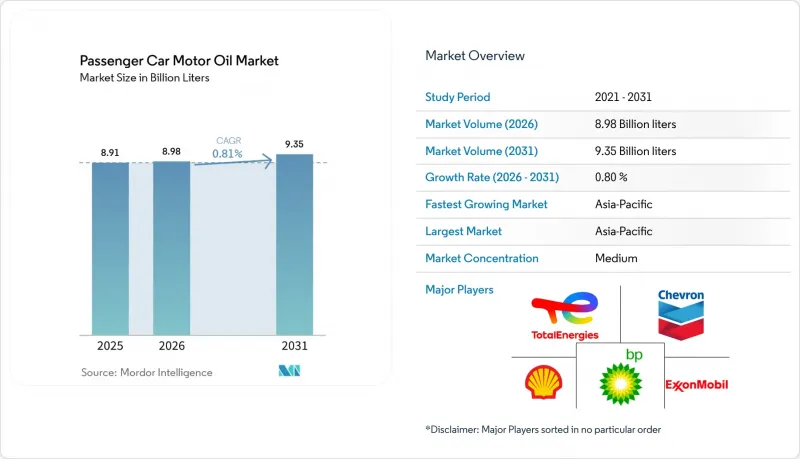
根據 Mordor Intelligence 預測,乘用車機油市場規模預計將從 2025 年的 89.1 億公升成長到 2026 年的 89.8 億公升,到 2031 年將達到 93.5 億公升。
預測期(2026-2031 年)的複合年成長率預計為 0.81%。
全球乘用車機油市場趨勢及洞察
新興經濟體乘用車保有量的成長
南亞和東南亞汽車保有量的快速成長將推動未來幾年需要定期更換機油的車輛數量增加。在印度,2025-2026會計年度乘用車銷量達464萬輛,上年度去年同期成長7.9%。多用途汽車(UV)佔印度乘用車銷量的68%,其中SUV在2026會計年度第四季的銷量成長了20.1%。印度的新車正逐漸轉向使用符合印度第六階段排放標準(BS-VI)的多級合成機油,從而提高了每公升機油的使用壽命價值。中國的乘用車保有量已超過2.46億輛,中國六號國六排放標準的實施推動了對低SAPS(硫酸鹽灰分、磷、硫)0W-20和5W-30機油產品的需求。乘用車的成長和更嚴格的標準導致潤滑油用戶數量不斷增加,乘用車機油市場對更高等級配方的需求也隨之成長。
採用優質合成油和低黏度油
從5W-XX系列產品轉向0W-XX系列產品的轉變正在改變乘用車機油市場的價值結構。國際潤滑油標準化與認證委員會(ILSAC)GF-7標準於2025年3月31日獲得許可,該標準指定0W-20、0W-16和5W-20為滿足當前性能要求的主要等級。這些等級有助於提高燃油效率,防止低速早燃(LSPI),並減少現代引擎正時鏈條的磨損。大眾汽車將於2025年將其TSI系列引擎的初始加註機油更換為0W-20,這將推動維修店對符合歐洲汽車製造商協會(ACEA)C5或C6標準的機油的需求增加。這些產品的價格比5W-30和10W-40產品高出20-30%。製造商正在加大對 III 類、IV 類和 V 類基礎油的投資,這些基礎油是低黏度配方所必需的。
電池式電動車(BEV)的普及
電池式電動車(BEV)將降低對引擎油的需求,但隨著道路上車輛組成的變化,這種影響將是漸進的。到2025年,全球電動車銷量將超過2,000萬輛,佔全球新車銷量的25%。預計這項銷售將取代每天120萬桶石油。中國將佔新電動車銷量的近55%,歐洲佔28%。由於混合動力汽車汽車和插電式混合動力汽車仍然需要潤滑油,因此短期內需求下降將是漸進的。
細分市場分析
到2025年,合成機油將佔據乘用車機油市場43.13%的佔有率。國際潤滑油標準化與認證委員會(ILSAC)GF-7標準和歐洲汽車製造商協會(ACEA)C5/C6標準的要求,鞏固了合成機油在新車出廠標配和已通過核准的售後市場應用中的地位。合成機油能夠滿足渦輪增壓車輛、汽油缸內直噴和混合動力傳動系統的嚴格性能要求。其穩固的地位使獲得技術認證的供應商擁有優勢。預計到2031年,半合成機油的複合年成長率將達到1.32%,使其成為服務中心在無需承擔全合成機油價格的情況下,幫助客戶從礦物油升級到合成機油的切實可行的選擇。
在以老舊車輛為主的新興市場售後管道中,礦物油仍佔據重要地位。這些車輛通常對潤滑油規格要求不高,維修廠也依然優先考慮產品初始成本低。生物基油潤滑油在乘用車機油市場仍是小規模品類。道達爾能源公司於2024年推出了一款採用100%回收基礎油製成的引擎油,並在獲得製造商批准後與Stellantis公司聯合品牌銷售。 2026年第三類基礎油的供應限制給半合成和許多全合成機油產品中使用的混合油帶來了成本壓力。因此,與第一類礦物油的成本差距正在擴大,導致配方差異化程度更高,對添加劑化學特性和原廠設備製造商(OEM)認證的需求也更大。
區域分析
亞太地區預計到2025年將佔據乘用車機油市場45.65%的佔有率,並預計到2031年將以1.27%的複合年成長率成長。中國的VI-b標準要求乘用車(保有量超過2.46億輛)使用低SAPS和低黏度的合成機油。在印度,2026年8月新增乘用車註冊量為396,269輛,較上年同期成長16%。 CRISIL預測,印度2027會計年度的乘用車年銷售量將達到590萬輛。印尼、泰國和越南仍有大規模車輛使用半合成機油和礦物油。區域排放氣體法規的協調統一以及印度BIS標準的實施正在提升產品規格和平均品質。
在北美,合成潤滑油的滲透率很高。由於電動車的普及和換油週期的延長導致換油需求下降,該地區潤滑油的銷售量呈下降趨勢。符合ILSAC GF-7標準的產品仍佔據售後市場的大部分需求,因為新型引擎需要經過認證的低黏度潤滑油。墨西哥仍是Dexos1和Motorcraft認證產品的重要市場,其工廠灌裝量也相當可觀。隨著中國汽車製造商在拉丁美洲擴大業務,中國供應商也開始瞄準墨西哥市場。
在歐洲,儘管產量下降,但對潤滑油的需求仍然強勁。大眾汽車計劃於2025年將其TSI系列引擎的原廠潤滑油升級為0W-20。2026年2月,嘉實多推出了“EDGE Euro 0W-20 M”,該產品已獲得寶馬、奔馳、保時捷和大眾/奧迪的認證。巴西的汽車保有量成長和授權售後市場管道的擴張推動了市場需求,而阿根廷則因經濟狀況而減少了自願性保養支出。在中東和非洲,假冒產品仍然是一個令人擔憂的問題。沙烏地阿拉伯的車輛現代化計畫預計將隨著新車的推出而提振對合成級潤滑油的需求。
其他好處:
- Excel格式的市場預測(ME)表
- 3個月的分析師支持
目錄
第1章:引言
- 研究假設和市場定義
- 調查範圍
第2章:調查方法
第3章執行摘要
第4章 市場狀況
- 市場概覽
- 市場促進因素
- 新興國家乘用車保有量的成長
- 採用優質合成油和低黏度油
- 有組織的售後市場和快速潤滑網路的發展
- 混合動力汽車潤滑油需求不斷成長
- VIN碼關聯的數位設備和減少錯裝
- 市場限制因素
- 電池式電動車滲透率
- 延長製造商建議的換油週期
- 假潤滑油及產品真偽驗證成本
- 價值鏈分析
- 波特五力分析
第5章 市場規模與成長預測
- 依基礎油類型
- 礦物
- 合成
- 半合成
- 生物基
- 按年級
- 0W-XX
- 5W-XX
- 10W-XX
- 15W-XX
- 單級
- 其他年級
- 按地區
- 亞太地區
- 中國
- 印度
- 日本
- 韓國
- 東南亞國協
- 其他亞太國家
- 北美洲
- 美國
- 加拿大
- 墨西哥
- 歐洲
- 德國
- 英國
- 法國
- 義大利
- 北歐國家
- 其他歐洲國家
- 南美洲
- 巴西
- 阿根廷
- 其他南美國家
- 中東和非洲
- 沙烏地阿拉伯
- 南非
- 其他中東和非洲國家
- 亞太地區
第6章 競爭情勢
- 市場集中度
- 策略趨勢
- 市佔率和排名分析
- 公司簡介
- BP plc
- Chevron Corporation
- ENEOS Corporation
- Exxon Mobil Corporation
- FUCHS
- Gulf Oil International Ltd
- Idemitsu Kosan Co., Ltd.
- Indian Oil Corporation Limited
- LIQUI MOLY GmbH
- Motul SA
- PETRONAS Lubricants International
- Shell plc
- Sinopec Lubricant Company
- TotalEnergies
- Valvoline Global Operations
第7章 市場機會與未來展望
According to Mordor Intelligence, the passenger car motor oil market size is expected to increase from 8.91 billion liters in 2025 to 8.98 billion liters in 2026 and reach 9.35 billion liters by 2031, at a CAGR of 0.81% during the forecast period (2026-2031).
Global Passenger Car Motor Oil Market Trends and Insights
Expansion of the Passenger Vehicle Parc in Emerging Economies
Rapid motorization in South and Southeast Asia is adding vehicles that will require regular oil changes for many years. India recorded passenger vehicle sales of 4.64 million units in FY2025-26, an increase of 7.9% from the previous year. Utility vehicles represented 68% of India's passenger vehicle sales, while SUVs grew 20.1% during Q4 FY2026. Newer Indian vehicles are moving toward multigrade synthetic products under Bharat Stage VI (BS-VI) requirements, which raises lifetime value per liter. China's passenger car stock exceeded 246 million vehicles, and the rollout of China VI-b supported demand for low-SAPS (Sulfated Ash, Phosphorus, and Sulfur) 0W-20 and 5W-30 products. Passenger vehicle growth and tighter specifications are creating demand for both more lubricant users and higher-grade formulations in the Passenger Car Motor Oil Market.
Premium Synthetic and Low-Viscosity Oil Adoption
The transition from 5W-XX products to 0W-XX grades is changing the value mix in the Passenger Car Motor Oil Market. The International Lubricant Standardization and Approval Committee (ILSAC) GF-7 was licensed on March 31, 2025, identifying 0W-20, 0W-16, and 5W-20 as key grades for current performance requirements. These grades support fuel economy, protection against Low Speed Pre-Ignition (LSPI), and timing-chain wear in modern engines. Volkswagen moved its TSI engine family to 0W-20 service fills in 2025, increasing workshop demand for oils that meet European Automobile Manufacturers' Association (ACEA) C5 or C6 specifications. Such products carry a 20-30% price premium over 5W-30 and 10W-40 products. Manufacturers are directing investment toward Group III, Group IV, and Group V base stocks required for low-viscosity formulations.
Battery Electric Vehicle Penetration
Battery electric vehicles (BEVs) reduce the need for engine oil, though this effect emerges gradually as the installed vehicle base changes. Global electric car sales exceeded 20 million units in 2025, representing 25% of new car sales worldwide. These sales displaced an estimated 1.2 million barrels of oil per day. China accounted for nearly 55% of new electric car sales, while Europe accounted for 28%. Hybrid and plug-in hybrid vehicles still require lubricants, which moderates the near-term decline in demand.
Other drivers and restraints analyzed in the detailed report include:
- Growth of Organized Aftermarket and Quick-Lube Networks
- Increasing Hybrid Vehicle Lubricant Requirements
- Extended Manufacturer-Recommended Drain Intervals
For complete list of drivers and restraints, kindly check the Table Of Contents.
Segment Analysis
Synthetic oils held 43.13% of the Passenger Car Motor Oil Market share in 2025. The International Lubricant Standardization and Approval Committee (ILSAC) GF-7 and the Association des Constructeurs Europeens d'Automobiles (ACEA) C5/C6 requirements have strengthened their role in new-vehicle factory fill and approved aftermarket applications. Synthetic formulations serve turbocharged, gasoline direct injection, and hybrid powertrains with demanding performance requirements. Their established position gives suppliers with technical approvals an advantage. Semi-synthetic oils are forecast to grow at a 1.32% CAGR through 2031, offering service centers a practical path to upgrade customers from mineral oils without requiring the full-synthetic price point.
Mineral oils remain relevant in developing-market aftermarket channels with older vehicle fleets. These vehicles often have less demanding specifications, and workshops continue to prioritize lower initial product costs. Bio-based oils remain a smaller emerging category in the Passenger Car Motor Oil Market. TotalEnergies launched an engine oil made from 100% regenerated base oils that received manufacturer approval and was co-branded with Stellantis in 2024. Group III supply constraints in 2026 added cost pressure to blends used in semi-synthetic and many full-synthetic products. The resulting cost difference from Group I mineral oils increases formulation differentiation and reinforces the need for additive chemistry and OEM approvals.
Complete Report Scope:
- By Base-Stock Type
- Mineral
- Synthetic
- Semi-Synthetic
- Bio-Based
- By Grade
- 0W-XX
- 5W-XX
- 10W-XX
- 15W-XX
- Monogrades
- Other Grades
- By Geography
- Asia-Pacific
- China
- India
- Japan
- South Korea
- ASEAN Countries
- Rest of Asia-Pacific
- North America
- United States
- Canada
- Mexico
- Europe
- Germany
- United Kingdom
- France
- Italy
- NORDIC Countries
- Rest of Europe
- South America
- Brazil
- Argentina
- Rest of South America
- Middle East and Africa
- Saudi Arabia
- South Africa
- Rest of Middle East and Africa
- Asia-Pacific
Geography Analysis
Asia-Pacific held 45.65% of the Passenger Car Motor Oil market share in 2025 and is forecast to grow at a 1.27% CAGR through 2031. China's VI-b standards require low-SAPS, low-viscosity synthetic formulations across a passenger car base exceeding 246 million vehicles. India recorded 396,269 passenger vehicle registrations in August 2026, a 16% year-over-year increase. CRISIL expects India's annual passenger vehicle sales to reach 5.9 million in FY2027. Indonesia, Thailand, and Vietnam have large vehicle fleets that still use semi-synthetic and mineral grades. Regional emissions alignment and India's BIS requirements are raising product specifications and average quality.
North America has a high penetration of synthetic lubricants by volume. The region is experiencing lower lubricant sales volumes as electric vehicle adoption and longer drain intervals reduce demand for oil changes. ILSAC GF-7 products continue to account for aftermarket demand, as newer engines require approved low-viscosity oils. Mexico remains an important market for factory-fill volumes of Dexos1- and Motorcraft-approved products. Chinese suppliers are also targeting Mexico as Chinese automakers expand across Latin America.
Europe supports lubricant demand despite lower output volumes. Volkswagen transitioned its TSI engine family to 0W-20 factory-fill lubricants in 2025. In February 2026, Castrol launched EDGE Euro 0W-20 M, with approvals from BMW, Mercedes-Benz, Porsche, and Volkswagen/Audi. Brazil benefits from fleet expansion and increased participation in the formal aftermarket, while Argentina's economic conditions constrain discretionary maintenance spending. In the Middle East and Africa, counterfeit products remain an ongoing concern. Saudi Arabia's fleet modernization programs are expected to support demand for synthetic-grade products as newer vehicles enter service.
- BP p.l.c.
- Chevron Corporation
- ENEOS Corporation
- Exxon Mobil Corporation
- FUCHS
- Gulf Oil International Ltd
- Idemitsu Kosan Co., Ltd.
- Indian Oil Corporation Limited
- LIQUI MOLY GmbH
- Motul S.A.
- PETRONAS Lubricants International
- Shell plc
- Sinopec Lubricant Company
- TotalEnergies
- Valvoline Global Operations
Additional Benefits:
- The market estimate (ME) sheet in Excel format
- 3 months of analyst support
TABLE OF CONTENTS
1 Introduction
- 1.1 Study Assumptions and Market Definition
- 1.2 Scope of the Study
2 Research Methodology
3 Executive Summary
4 Market Landscape
- 4.1 Market Overview
- 4.2 Market Drivers
- 4.2.1 Expansion of the Passenger Vehicle Parc in Emerging Economies
- 4.2.2 Premium Synthetic and Low-Viscosity Oil Adoption
- 4.2.3 Growth of Organized Aftermarket and Quick-Lube Networks
- 4.2.4 Increasing Hybrid Vehicle Lubricant Requirements
- 4.2.5 VIN-Linked Digital Fitment and Misfill Reduction
- 4.3 Market Restraints
- 4.3.1 Battery Electric Vehicle Penetration
- 4.3.2 Extended Manufacturer-Recommended Drain Intervals
- 4.3.3 Counterfeit Lubricants and Product-Authentication Costs
- 4.4 Value Chain Analysis
- 4.5 Porter's Five Forces Analysis
- 4.5.1 Bargaining Power of Suppliers
- 4.5.2 Bargaining Power of Buyers
- 4.5.3 Threat of New Entrants
- 4.5.4 Threat of Substitutes
- 4.5.5 Rivalry Among Existing Competitors
5 Market Size and Growth Forecasts (Volume)
- 5.1 By Base-Stock Type
- 5.1.1 Mineral
- 5.1.2 Synthetic
- 5.1.3 Semi-Synthetic
- 5.1.4 Bio-Based
- 5.2 By Grade
- 5.2.1 0W-XX
- 5.2.2 5W-XX
- 5.2.3 10W-XX
- 5.2.4 15W-XX
- 5.2.5 Monogrades
- 5.2.6 Other Grades
- 5.3 By Geography
- 5.3.1 Asia-Pacific
- 5.3.1.1 China
- 5.3.1.2 India
- 5.3.1.3 Japan
- 5.3.1.4 South Korea
- 5.3.1.5 ASEAN Countries
- 5.3.1.6 Rest of Asia-Pacific
- 5.3.2 North America
- 5.3.2.1 United States
- 5.3.2.2 Canada
- 5.3.2.3 Mexico
- 5.3.3 Europe
- 5.3.3.1 Germany
- 5.3.3.2 United Kingdom
- 5.3.3.3 France
- 5.3.3.4 Italy
- 5.3.3.5 NORDIC Countries
- 5.3.3.6 Rest of Europe
- 5.3.4 South America
- 5.3.4.1 Brazil
- 5.3.4.2 Argentina
- 5.3.4.3 Rest of South America
- 5.3.5 Middle East and Africa
- 5.3.5.1 Saudi Arabia
- 5.3.5.2 South Africa
- 5.3.5.3 Rest of Middle East and Africa
- 5.3.1 Asia-Pacific
6 Competitive Landscape
- 6.1 Market Concentration
- 6.2 Strategic Moves
- 6.3 Market Share (%)/Ranking Analysis
- 6.4 Company Profiles (includes Global Overview, Market Overview, Core Segments, Financials as available, Strategic Information, Products and Services, and Recent Developments)
- 6.4.1 BP p.l.c.
- 6.4.2 Chevron Corporation
- 6.4.3 ENEOS Corporation
- 6.4.4 Exxon Mobil Corporation
- 6.4.5 FUCHS
- 6.4.6 Gulf Oil International Ltd
- 6.4.7 Idemitsu Kosan Co., Ltd.
- 6.4.8 Indian Oil Corporation Limited
- 6.4.9 LIQUI MOLY GmbH
- 6.4.10 Motul S.A.
- 6.4.11 PETRONAS Lubricants International
- 6.4.12 Shell plc
- 6.4.13 Sinopec Lubricant Company
- 6.4.14 TotalEnergies
- 6.4.15 Valvoline Global Operations
7 Market Opportunities and Future Outlook
- 7.1 White-Space and Unmet-Need Assessment


