


 |
市場調查報告書
商品編碼
2155619
消防材料:市場佔有率分析、行業趨勢和統計數據、成長預測(2026-2031 年)Fire Stopping Materials - Market Share Analysis, Industry Trends & Statistics, Growth Forecasts (2026 - 2031) |
||||||

※ 本網頁內容可能與最新版本有所差異。詳細情況請與我們聯繫。
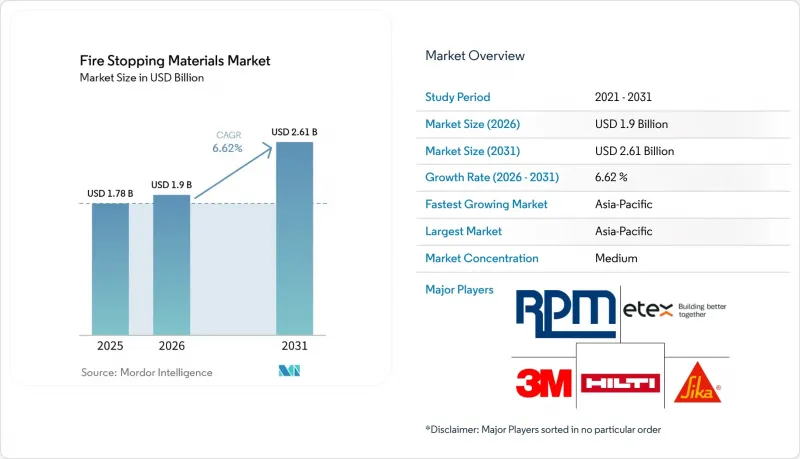
據 Mordor Intelligence 稱,2025 年消防市場價值 17.8 億美元,預計到 2031 年將達到 26.1 億美元,而 2026 年為 19 億美元,預測期內(2026-2031 年)的複合年成長率預計為 6.62%。
全球消防市場趨勢及洞察
更嚴格的消防安全法規和更強力的執法。
2025年4月,美國保險商實驗室(UL)發布了第四版1479標準,提高了穿透部位防火防水系統的性能標準。製造商必須對相關系統進行重新認證,這使得最新的測試結果在商業規範中顯得尤為重要。國際建築規範(IBC)也要求在相關項目中依照特定條件安裝和檢驗防火防水系統。這些要求縮小了在專案接受書面檢驗時使用未經測試的填充材的範圍。在印度,SP 7:2026引入了資料中心專用用途類別,並更新了消防安全法規,進一步提升了新建建築中防火分區規劃的重要性。主要建築領域採用ASTM、UL和EN測試方法也提高了供應商獲得多種認證的重要性。隨著建築規範的執行和專案文件的標準化程度不斷提高,這有利於防火材料市場的發展。
高層建築和基礎建設
高層建築包含多個設備豎井、樓梯間和配電線路,這些設施會穿過防火牆和樓板。每個開口都需要經過測試的耐火防水結構,其耐火等級必須符合基材、穿透部位和構件的耐火等級要求。地鐵系統、機場和隧道也包含密集的暖氣、通風、暖通空調、訊號和電力網路。因此,與結構較簡單的建築相比,這些項目每平方英尺所需的耐火防水結構用量更大。印度的 SP 7:2026 調整了多個用途類別的消防安全標準,進一步提升了公共建築施工中消防安全規劃的重要性。高層建築通常需要耐火等級為 2 小時或 4 小時的系統,而不是標準的 1 小時耐火組裝結構。這推動了對滿足更高性能要求並提供更高建築價值的產品的需求。
認證體系及建設成本負擔
由於認證系統要求使用認證材料、專業安裝,並且在某些情況下,每個項目都需要第三方檢驗,因此其成本高於普通建築填充材。安裝必須符合經過測試的開口和穿透點配置。建築規範執行不一致可能導致使用成本較低但未經認證的發泡材或密封膠產品。這造成了一種風險,即對認證產品的需求可能無法與新建築物中穿透點的總數完全匹配。此外,UL 1479 2025 年修訂版強制要求體系重新認證,這增加了實驗室測試和文件編制的成本。雖然大型供應商可以將這些成本分攤到廣泛的產品系列中,但對於中小企業而言,這可能是一個更大的負擔。這種限制在對價格敏感的住宅和新興建築地區的小規模商業項目中尤其明顯。
細分市場分析
密封膠應用廣泛,包括電纜束、管道、風管和建築接縫等,預計到2025年將佔防火密封市場佔有率的31.24%。柔軟性使其廣泛應用於商業、工業和住宅建築。膨脹型密封膠遇熱膨脹,有助於密封易燃管道和電纜軟化後形成的開口。 2025年修訂的UL 1479標準提高了經認證的穿透式防火系統中測試配方的重要性。低揮發性有機化合物(VOC)和無鹵產品在醫療、教育和公共建築中日益受到重視。這些採購方傾向於將環保採購要求與消防安全規範結合。砂漿在高荷載機械和管道穿透中繼續發揮至關重要的作用,在這些場合,抗壓強度和尺寸穩定性至關重要。
預計到2031年,電路板市場將以7.07%的複合年成長率成長。在資料中心和大型商業設施中,電路板用於電纜佈線在初始安裝後可能需要更改的區域。如果電路板採用可重新密封的形式,則無需移除和重建整個永久密封即可進行更改。此外,由於可以在混凝土澆築前安裝,嵌入式設備在新商業設施和資料中心專案中的應用日益廣泛。在亞太地區的住宅高層建築中,金屬管道正逐漸被塑膠排水管取代,因此套管發揮重要作用。包覆層、條帶、膩子和膩子墊則用於專用電纜配線架和鎧裝電纜應用。
區域分析
預計到2025年,亞太地區將佔全球防火防水材料市場44.58%的佔有率,並在2031年之前以7.16%的複合年成長率持續成長。推動市場需求成長的主要因素包括中國、印度、韓國、日本以及東協國家城市建設和建築規範的調整。印度的SP 7:2026規範引入了資料中心專用用途分類和額外的隔間分類規定。中國的高層住宅和商業建築繼續支持著色劑和密封劑的使用,尤其是在使用塑膠排水管的情況下。越南、印尼和菲律賓在發生高密度建築事故後,正在加強建築消防安全法規。在日本和韓國,抗震和防火安全要求的結合推動了對更高規格規範的需求。這些因素共同促進了商業和公共設施項目中對更高耐火性能的穿透系統的需求。
北美地區在防火防水密封市場已趨於成熟,建築規範和規範化施工流程已廣泛應用。建築資訊模型 (BIM) 被廣泛用於協調專案早期階段的設備開口。國際建築規範 (IBC) 對相關高層建築和風險類別項目的檢驗要求,進一步提升了對規範化認證系統的需求。資料中心建設由於其內部需要大規模的電力和數據佈線,因此對電氣穿孔的需求也隨之成長。在加拿大,相關要求透過 CAN/ULC-S115 標準與美國的要求緊密銜接,全部區域也要求類似的產品。在墨西哥,隨著城市快速發展,商業建築的需求不斷成長,但監管執行力度並不統一。資料中心和公共設施的混合使用,也推動了對高品質防火防水密封應用的需求。
在歐洲,建築產品法規 (Building Products Regulation) 和 EN 1366 系列穿透和連接系統測試標準是業界標準。在英國,國家標準 BS 476 分類正逐步過渡到基於「批准文件 B」的 EN 13501 系列分類,預計這將促使企業重新審視現有的產品選擇。德國、法國和北歐國家擁有完善的合規體系,在公共採購中對低揮發性有機化合物 (VOC) 產品的需求不斷成長。南美市場雖然規模仍然較小,但隨著巴西和阿根廷商業建築的擴張而持續成長。西卡集團 (Sika AG) 於 2026 年 2 月在阿根廷和哥倫比亞開設了製造工廠,從而增強了其在該地區的生產能力。中東和非洲市場則受到沙烏地阿拉伯「2030 願景」計畫的推動,這些計畫包括資料中心、醫院和綜合用途大樓。能夠同時具備區域認證和技術支援的供應商可以在這些新興分銷市場中抓住商機。
其他好處:
- Excel格式的市場預測(ME)表
- 3個月的分析師支持
目錄
第1章:引言
- 研究假設和市場定義
- 調查範圍
第2章:調查方法
第3章執行摘要
第4章 市場狀況
- 市場概覽
- 市場促進因素
- 更嚴格地執行和加強消防安全法規。
- 高層建築和基礎建設
- MEP滲透密度增加
- 老舊建築的維修和維修措施
- 資料中心、模組化建築和預製機電系統的擴建。
- 市場限制因素
- 認證系統和安裝成本
- 熟練工人短缺和施工過程複雜。
- 再次滲透、遷移和組裝相容性風險
- 價值鏈分析
- 波特五力分析
第5章 市場規模與成長預測
- 按類型
- 密封劑
- 砂漿
- 鑄造式裝置
- 基板
- 膩子和膩子墊
- 顏色
- 包裝/條
- 其他類型
- 透過使用
- 電
- 機械的
- 管道
- 其他用途
- 按最終用途行業分類
- 商業的
- 產業
- 住宅
- 其他終端用戶產業
- 按地區
- 亞太地區
- 中國
- 印度
- 日本
- 韓國
- 東南亞國協
- 其他亞太國家
- 北美洲
- 美國
- 加拿大
- 墨西哥
- 歐洲
- 德國
- 英國
- 法國
- 義大利
- 北歐國家
- 其他歐洲國家
- 南美洲
- 巴西
- 阿根廷
- 其他南美國家
- 中東和非洲
- 沙烏地阿拉伯
- 南非
- 其他中東和非洲國家
- 亞太地區
第6章 競爭情勢
- 市場集中度
- 策略趨勢
- 市佔率和排名分析
- 公司簡介
- 3M
- BASF
- Etex Group
- Hilti Corporation
- Knauf Insulation
- Morgan Advanced Materials plc
- Quelfire
- RectorSeal
- ROCKWOOL A/S
- RPM International Inc.
- Sika AG
- Specified Technologies Inc.
- TENMAT Ltd.
第7章 市場機會與未來展望
According to Mordor Intelligence, the fire stopping materials market size was valued at USD 1.78 billion in 2025 and is estimated to grow from USD 1.90 billion in 2026 to reach USD 2.61 billion by 2031, at a CAGR of 6.62% during the forecast period (2026-2031).
Global Fire Stopping Materials Market Trends and Insights
Tightening Fire-Safety Codes and Enforcement
Underwriters Laboratories (UL) 1479 Edition 4 was released in April 2025 and raised the performance benchmarks for through-penetration firestop systems. Manufacturers had to requalify affected system listings, which increased the importance of current test evidence in commercial specifications. International Building Code requirements also call for firestop systems to be installed and inspected under specified conditions in relevant projects. These requirements reduce the scope for using untested fillers when a project is subject to documented inspection. India's SP 7:2026 introduced a dedicated data-center occupancy class and updated fire-safety provisions, extending the relevance of compartmentation planning in new buildings. The use of ASTM, UL, and EN test approaches across major construction regions also makes broad certification coverage more important for suppliers. This supports the fire stopping materials market where code enforcement and project documentation are becoming more formal.
High-Rise and Infrastructure Construction
High-rise buildings contain multiple service risers, staircase enclosures, and electrical distribution routes that pass-through fire-rated walls and floors. Each opening requires a tested firestop configuration that matches the substrate, penetrant, and rating of the assembly. Metro systems, airports, and tunnels also contain dense heating, ventilation, air conditioning, signaling, and power networks. These projects therefore require more firestop work per square foot than less complex structures. India's SP 7:2026 adjusted fire-safety thresholds for several occupancy types, broadening the relevance of fire protection planning in institutional construction. Taller structures often require 2-hour or 4-hour rated systems rather than standard 1-hour assemblies. This shifts demand toward products that meet higher performance requirements and carry higher installation value.
Certified System and Installation Cost Burden
Certified systems cost more than general construction fillers because they require listed materials, trained installation, and, on some projects, third-party inspection. The installation must follow the tested configuration for the opening and penetrant combination. Inconsistently enforced codes can leave room for lower-cost, non-rated foam or mastic products. This creates a risk that certified-product demand does not fully match the total number of penetrations in new construction. The 2025 revision of UL 1479 also required system requalification, which added laboratory testing and documentation costs. Large suppliers can spread these costs across wider portfolios, while smaller companies may face a higher burden. The constraint is most visible in price-sensitive residential and small commercial projects in emerging construction regions.
Other drivers and restraints analyzed in the detailed report include:
- Increasing MEP Penetration Density
- Data-Center, Modular-Construction, and Prefabricated-MEP Expansion
- Skilled-Applicator Shortages and Installation Complexity
For complete list of drivers and restraints, kindly check the Table Of Contents.
Segment Analysis
Sealants held 31.24% of the fire stopping materials market share in 2025 because they can be used across cable bundles, pipes, ducts, and construction joints. Their flexibility across different substrates supports broad use in commercial, industrial, and residential installations. Intumescent sealants expand under heat and help close openings created when combustible pipes or cable materials soften. The 2025 update to UL 1479 increased the importance of tested formulations in listed through-penetration systems. Low-volatile-organic-compound and halogen-free products have relevance in healthcare, education, and public buildings. These buyers often align environmental purchasing requirements with fire-safety specifications. Mortar remains relevant in high-load mechanical and plumbing penetrations where compressive strength and dimensional stability are important.
Boards are projected to advance at a 7.07% CAGR through 2031. Data centers and large commercial facilities use boards where cable routes are likely to change after the initial installation. Re-enterable formats allow changes without removing and rebuilding an entire permanent seal. Cast-in devices are also gaining use in new commercial and data-center projects because they can be placed before concrete is poured. Collars have a strong role in Asia-Pacific residential towers where plastic drainage pipes are replacing metal pipework. Wraps, strips, putty, and putty pads serve specialized cable-tray and armored-cable applications.
Complete Report Scope:
- By Type
- Sealant
- Mortar
- Cast-in Devices
- Boards
- Putty and Putty Pads
- Collars
- Wraps/Strips
- Other Types
- By Application
- Electrical
- Mechanical
- Plumbing
- Other Applications
- By End-Use Industry
- Commercial
- Industrial
- Residential
- Other End-Use Industries
- By Geography
- Asia-Pacific
- China
- India
- Japan
- South Korea
- ASEAN Countries
- Rest of Asia-Pacific
- North America
- United States
- Canada
- Mexico
- Europe
- Germany
- United Kingdom
- France
- Italy
- NORDIC Countries
- Rest of Europe
- South America
- Brazil
- Argentina
- Rest of South America
- Middle East and Africa
- Saudi Arabia
- South Africa
- Rest of Middle East and Africa
- Asia-Pacific
Geography Analysis
Asia-Pacific held 44.58% of the fire stopping materials market share in 2025 and is projected to advance at a 7.16% CAGR through 2031. China, India, South Korea, Japan, and Association of Southeast Asian Nations countries support demand through urban construction and changing building requirements. India's SP 7:2026 introduced a dedicated data-center occupancy class and additional compartmentation provisions. High-rise residential and commercial construction in China continues to support collar and sealant use, particularly where plastic drainage pipes are used. Vietnam, Indonesia, and the Philippines are tightening building-fire provisions after incidents in high-occupancy structures. Japan and South Korea support premium specification demand through combined seismic and fire-safety requirements. These conditions support demand for higher-rated penetration systems in commercial and institutional projects.
North America is a mature area for the fire stopping materials market, with strong use of code-based specifications and documented installation workflows. Building Information Modeling is widely used to coordinate service openings earlier in the project process. International Building Code inspection requirements for relevant high-rise and risk-category projects strengthen the need for documented listed systems. Data-center construction supports electrical penetration demand because facilities require extensive power and data routing. Canada aligns closely with United States requirements through CAN/ULC-S115, supporting similar product expectations across the region. Mexico offers added commercial construction demand in growing cities, although enforcement is not uniform. The mix of data centers and institutional facilities supports demand for premium firestop applications.
Europe is shaped by Construction Products Regulation requirements and the EN 1366 test series for penetration and joint systems. The United Kingdom is moving from national BS 476 classifications toward EN 13501-series classifications under Approved Document B, which is expected to prompt review of existing product choices. Germany, France, and Nordic countries have strong compliance practices and demand for low-volatile-organic-compound formulations in public procurement. South America remains smaller but is expanding through commercial construction in Brazil and Argentina. Sika AG opened manufacturing facilities in Argentina and Colombia in February 2026, improving its regional production footprint. The Middle East and Africa are supported by Saudi Arabia's Vision 2030 projects, including data centers, hospitals, and mixed-use towers. Suppliers that combine regional certification coverage with technical support have an opportunity in these developing distribution markets.
- 3M
- BASF
- Etex Group
- Hilti Corporation
- Knauf Insulation
- Morgan Advanced Materials plc
- Quelfire
- RectorSeal
- ROCKWOOL A/S
- RPM International Inc.
- Sika AG
- Specified Technologies Inc.
- TENMAT Ltd.
Additional Benefits:
- The market estimate (ME) sheet in Excel format
- 3 months of analyst support
TABLE OF CONTENTS
1 Introduction
- 1.1 Study Assumptions and Market Definition
- 1.2 Scope of the Study
2 Research Methodology
3 Executive Summary
4 Market Landscape
- 4.1 Market Overview
- 4.2 Market Drivers
- 4.2.1 Tightening Fire-Safety Codes and Enforcement
- 4.2.2 High-Rise and Infrastructure Construction
- 4.2.3 Increasing MEP Penetration Density
- 4.2.4 Aging-Building Retrofit and Firestop Remediation
- 4.2.5 Data-Center, Modular-Construction, and Prefabricated-MEP Expansion
- 4.3 Market Restraints
- 4.3.1 Certified System and Installation Cost Burden
- 4.3.2 Skilled-Applicator Shortages and Installation Complexity
- 4.3.3 Re-Penetration, Movement, and Assembly-Compatibility Risk
- 4.4 Value Chain Analysis
- 4.5 Porter's Five Forces Analysis
- 4.5.1 Threat of New Entrants
- 4.5.2 Bargaining Power of Suppliers
- 4.5.3 Bargaining Power of Buyers
- 4.5.4 Threat of Substitutes
- 4.5.5 Competitive Rivalry
5 Market Size and Growth Forecasts (Value)
- 5.1 By Type
- 5.1.1 Sealant
- 5.1.2 Mortar
- 5.1.3 Cast-in Devices
- 5.1.4 Boards
- 5.1.5 Putty and Putty Pads
- 5.1.6 Collars
- 5.1.7 Wraps/Strips
- 5.1.8 Other Types
- 5.2 By Application
- 5.2.1 Electrical
- 5.2.2 Mechanical
- 5.2.3 Plumbing
- 5.2.4 Other Applications
- 5.3 By End-Use Industry
- 5.3.1 Commercial
- 5.3.2 Industrial
- 5.3.3 Residential
- 5.3.4 Other End-Use Industries
- 5.4 By Geography
- 5.4.1 Asia-Pacific
- 5.4.1.1 China
- 5.4.1.2 India
- 5.4.1.3 Japan
- 5.4.1.4 South Korea
- 5.4.1.5 ASEAN Countries
- 5.4.1.6 Rest of Asia-Pacific
- 5.4.2 North America
- 5.4.2.1 United States
- 5.4.2.2 Canada
- 5.4.2.3 Mexico
- 5.4.3 Europe
- 5.4.3.1 Germany
- 5.4.3.2 United Kingdom
- 5.4.3.3 France
- 5.4.3.4 Italy
- 5.4.3.5 NORDIC Countries
- 5.4.3.6 Rest of Europe
- 5.4.4 South America
- 5.4.4.1 Brazil
- 5.4.4.2 Argentina
- 5.4.4.3 Rest of South America
- 5.4.5 Middle East and Africa
- 5.4.5.1 Saudi Arabia
- 5.4.5.2 South Africa
- 5.4.5.3 Rest of Middle East and Africa
- 5.4.1 Asia-Pacific
6 Competitive Landscape
- 6.1 Market Concentration
- 6.2 Strategic Moves
- 6.3 Market Share (%)/Ranking Analysis
- 6.4 Company Profiles (includes Global Overview, Market Overview, Core Segments, Financials as available, Strategic Information, Products and Services, and Recent Developments)
- 6.4.1 3M
- 6.4.2 BASF
- 6.4.3 Etex Group
- 6.4.4 Hilti Corporation
- 6.4.5 Knauf Insulation
- 6.4.6 Morgan Advanced Materials plc
- 6.4.7 Quelfire
- 6.4.8 RectorSeal
- 6.4.9 ROCKWOOL A/S
- 6.4.10 RPM International Inc.
- 6.4.11 Sika AG
- 6.4.12 Specified Technologies Inc.
- 6.4.13 TENMAT Ltd.
7 Market Opportunities and Future Outlook
- 7.1 White-Space and Unmet-Need Assessment

 2026-2030年全球被動防火材料市場
 消防材料市場規模、佔有率和趨勢分析報告:按產品、最終用途、地區和細分市場分類(2026-2033 年)
 消防材料市場-2026-2032年全球市場預測
 消防材料市場:策略性洞察與預測(2026-2031年)
 電動車電池防火材料市場:分析與預測(至2035年)-按類型、產品、技術、組件、應用、材料類型、最終用戶、功能和安裝類型分類
 消防材料市場規模、佔有率和成長分析:按產品類型、材料類型、應用、最終用戶、安裝類型、分銷管道和地區分類 - 產業預測,2026-2033年
 消防材料市場:依材料、應用、終端使用者產業及地區分類
 2026年全球建築防火材料市場報告
 全球防火材料市場:按類型、應用、終端用戶產業和地區分類-預測(至2030年)建築防火材料市場:2026-2032年全球市場預測(依產品類型、材料成分、安裝方法、應用、最終用途及分銷管道分類)