


 |
市場調查報告書
商品編碼
2155617
複合樹脂:市場佔有率分析、產業趨勢與統計、成長預測(2026-2031)Composite Resin - Market Share Analysis, Industry Trends & Statistics, Growth Forecasts (2026 - 2031) |
||||||

※ 本網頁內容可能與最新版本有所差異。詳細情況請與我們聯繫。
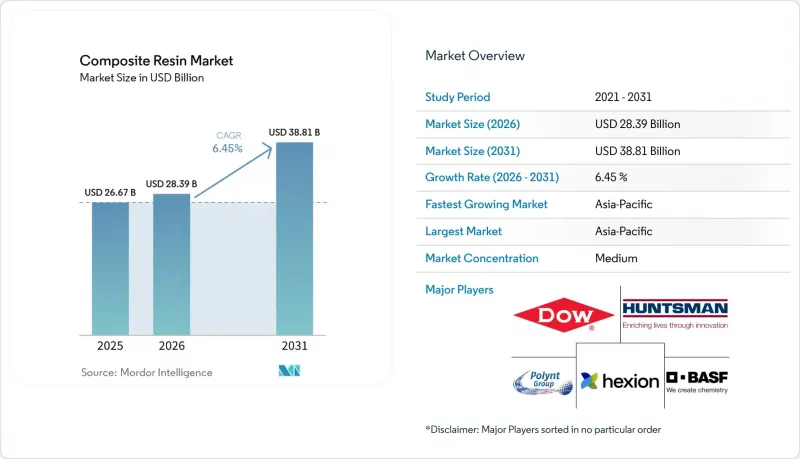
據 Mordor Intelligence 稱,2025 年複合樹脂市場價值為 266.7 億美元,預計到 2031 年將達到 388.1 億美元,而 2026 年為 283.9 億美元,預測期內(2026-2031 年)的複合年成長率為 6.45%預計為 6.45%。
全球複合樹脂市場趨勢及洞察
減輕重量和提高燃油效率的要求
輕量化仍然是汽車製造商在內燃機汽車和電池式電動車中採用複合材料的核心原因。與同等鋼材應用相比,複合樹脂可將結構重量減輕30%至40%。電池式電動車所需的樹脂重量比同等內燃機汽車多15%至25%。這種額外的需求主要來自電池外殼、電力電子設備外殼和輕量化結構部件。這些部件還需要具備介電性能和阻燃性。由於樹脂等級必須針對特定車輛項目進行認證,而此過程可能需要18至36個月,因此複合樹脂市場從中受益匪淺。
汽車和交通平台的電氣化
電氣化進程提升了特種樹脂在交通運輸應用領域的性能重要性。 2024年,全球電動車銷量超過1700萬輛。電池相關應用需要樹脂具備180 度C以上的熱穩定性、低離子污染以及符合美國保險商實驗室(UL)94 V-0阻燃等級。 2025年2月,沙烏地基礎工業公司(SABIC)推出了電動車維修擋板的NORYL GTX LMX310,該材料可進行線上噴塗。據該公司稱,該材料的平衡吸濕率比現有聚醯胺化合物低85%。汽車製造商繼續使用熱固性樹脂製造主要結構件,同時採用熱塑性複合材料製造內裝零件和半結構件,這拓寬了整個複合樹脂市場的需求範圍。
複合材料的製造和認證高成本
從配方設計到大量生產部署,樹脂系統的認證可能需要 18 到 36 個月。在航太、汽車和風電行業,每種樹脂等級和每個客戶專案可能需要額外花費 50 萬至 500 萬美元。對於必須同時為多個客戶專案提供資金的中型供應商而言,這筆費用尤其沉重。此外,環氧樹脂、聚酯和乙烯基酯的原料價格會受到原油和石腦油價格波動的影響。這些價格波動會透過雙酚 A、順丁烯二酸酐和環氧氯丙烷等原料,最終影響製造商的利潤。對於密度相近的應用,複合樹脂的成本可能是傳統工程熱塑性塑膠的三到五倍,這限制了它們在價格敏感型應用中的使用。
細分市場分析
2025年,熱固性樹脂佔了複合樹脂市場64.23%的佔有率。這一地位得益於其在風力渦輪機葉片、航太面板和工業管道等領域的成熟合格。交聯基體在許多關鍵結構應用中仍然是經過商業性驗證的選擇。即使在嚴苛的工況下,熱固性樹脂也具有良好的熱穩定性和耐化學性。與熱塑性樹脂系統相比,熱固性樹脂的加工和使用後管理難度更高。儘管有這些局限性,客戶仍然信賴其久經考驗的性能和經過認證的供應鏈,這使得在核心結構應用領域尋找替代品變得困難。
預計到2031年,熱塑性樹脂的年複合成長率將達到7.23%。其射出成型和壓縮成型週期短,推動了其在汽車子結構、電子設備機殼和運動用品等領域的應用。此外,其可返工性符合歐洲和北美對報廢產品處理的要求。隨著這些要求被納入材料規範,原始設備製造商(OEM)正在加快認證流程。在2026年JEC世界電子製造展上,阿科瑪公司發表了一款採用Elium樹脂和再生碳纖維製成的可回收速滑板。原型展示了透過解聚實現化學可回收的潛力,並展示了液態熱塑性樹脂體系在註塑成型結構部件中的應用。
區域分析
預計到2025年,亞太地區將佔據複合樹脂市場42.79%的佔有率,並在2031年之前以7.37%的複合年成長率持續成長。中國一體化的樹脂生產和複合材料製造地支撐了這一市場地位。山東、江蘇和廣東等省份的製造群整合了石化原料供應和下游加工環節。在印度,預計2025年陸上風電裝置容量將增加6.34吉瓦,年增85%。這將帶動泰米爾納德邦、古吉拉突邦和拉賈斯坦邦對用於風力發電機葉片的環氧樹脂和乙烯基酯樹脂的需求。日本和韓國仍然是碳纖維預浸料和特殊複合樹脂的重要市場。
在北美,航太專案、風力發電開發和汽車重新設計正在推動複合材料的需求。德克薩斯州和中西部地區的風力發電工程支撐著葉片用複合材料的需求。五大湖地區的汽車生產也支撐著複合材料子組件的需求。 《通膨控制法案》持續促進對國內清潔能源生產的投資。歐洲複合樹脂市場正受到可再生能源目標和化學品法規的影響。 REACH法規正在推動用於不飽和聚酯和乙烯基酯的低苯乙烯和無苯乙烯配方的開發。
德國、英國、法國、義大利和北歐國家仍然是歐洲重要的終端使用者製造地。由歐洲化學工業聯合會(Cefic)UP/VE產業組成員委託進行的2025年生命週期清單調查報告顯示,不飽和聚酯和乙烯基酯樹脂的全球暖化潛勢(GWP)比先前的數據降低了2%至8%。調查也顯示,再生聚對苯二甲酸乙二醇酯(rPET)基樹脂的GWP降低了16%。南美洲、中東和非洲仍然是規模較小的市場,其需求促進因素各不相同。在巴西,玻璃纖維產業和風電產業支撐著區域消費。斯科特·巴德公司於2024年6月在聖埃斯皮里圖州塞拉市成立了“斯科特·巴德巴西公司”,並開始在當地生產水晶膠衣和模具產品。
其他好處:
- Excel格式的市場預測(ME)表
- 3個月的分析師支持
目錄
第1章:引言
- 研究假設和市場定義
- 調查範圍
第2章:調查方法
第3章執行摘要
第4章 市場狀況
- 市場概覽
- 市場促進因素
- 減輕重量和提高燃油效率的要求
- 汽車和交通平台的電氣化
- 擴大風力發電能力
- 基礎設施對耐腐蝕材料的需求
- 自動化高通量複合材料加工
- 市場限制因素
- 複合材料的高製造成本和認證成本
- 交聯熱固性基體回收的困難
- 缺乏維修、檢查和處置舊設備的必要基礎設施。
- 價值鏈分析
- 波特五力分析
第5章 市場規模與成長預測
- 依樹脂類型
- 熱固性樹脂
- 熱塑性樹脂
- 透過製造程序
- 積層法
- 纏繞成型
- 射出成型
- 冥王星
- 壓縮成型
- 樹脂轉注成形
- 其他製造程序
- 透過使用
- 汽車和運輸業
- 建築和基礎設施
- 電氣和電子設備
- 管道和儲罐
- 風力
- 海上
- 航太/國防
- 其他用途
- 按地區
- 亞太地區
- 中國
- 印度
- 日本
- 韓國
- 東南亞國協
- 其他亞太國家
- 北美洲
- 美國
- 加拿大
- 墨西哥
- 歐洲
- 德國
- 英國
- 法國
- 義大利
- 北歐國家
- 其他歐洲國家
- 南美洲
- 巴西
- 阿根廷
- 其他南美國家
- 中東和非洲
- 沙烏地阿拉伯
- 南非
- 其他中東和非洲國家
- 亞太地區
第6章 競爭情勢
- 市場集中度
- 策略趨勢
- 市佔率和排名分析
- 公司簡介
- Arkema
- Ashland
- BASF
- Dow
- Evonik Industries AG
- Hexion Inc.
- Huntsman International LLC
- KUKDO CHEMICAL CO., LTD.
- Polynt SpA
- SABIC
- Scott Bader Company Limited
- Sumitomo Bakelite Co., Ltd.
- TORAY INDUSTRIES, INC.
第7章 市場機會與未來展望
According to Mordor Intelligence, the composite resin market size was valued at USD 26.67 billion in 2025 and is estimated to grow from USD 28.39 billion in 2026 to reach USD 38.81 billion by 2031, at a CAGR of 6.45% during the forecast period (2026-2031).
Global Composite Resin Market Trends and Insights
Lightweighting and Fuel-Efficiency Requirements
Mass reduction remains a central reason for vehicle manufacturers to use composite materials in both combustion and battery-electric platforms. Composite resins can support structural weight savings of 30% to 40% compared with equivalent steel applications. Battery-electric vehicles require 15% to 25% more resin content by weight than comparable combustion-engine vehicles. Battery enclosures, power-electronics housings, and lightweight structural components create this added need. These components also require dielectric performance and flame resistance. The composite resin market benefits because resin grades must be qualified for specific vehicle programs, and qualification can take 18 to 36 months.
Electrification of Automotive and Transportation Platforms
Electrification increases the importance of specialty resin performance in transportation applications. Global electric-vehicle sales exceeded 17 million units in 2024. Battery-adjacent applications require thermal stability above 180 °C, low ionic contamination, and Underwriters Laboratories (UL) 94 V-0 flame ratings. SABIC introduced NORYL GTX LMX310 in February 2025 for inline-paintable electric-vehicle service flaps. The company stated that the material had 85% lower equilibrium moisture absorption than incumbent polyamide compounds. Vehicle makers continue to use thermosets in primary structures while adopting thermoplastic composites for interior and semi-structural parts, widening requirements across the composite resin market
High Composite Manufacturing and Qualification Costs
Qualifying a resin system from formulation through production deployment can take 18 to 36 months. Aerospace, automotive, and wind-energy testing can add USD 500,000 to USD 5 million for each resin grade and customer program. This burden is especially difficult for mid-tier suppliers that must fund several customer programs at the same time. Epoxy, polyester, and vinyl ester feedstocks are also exposed to crude-oil and naphtha cycles. Bisphenol-A, maleic anhydride, and epichlorohydrin transmit this volatility into producer margins. Composite resins can cost 3x to 5x more than conventional engineering thermoplastics in equivalent-density applications, which limits adoption in price-sensitive applications.
Other drivers and restraints analyzed in the detailed report include:
- Wind-Energy Capacity Expansion
- Automated High-Throughput Composite Processing
- Difficult Recycling of Cross-Linked Thermoset Matrices
For complete list of drivers and restraints, kindly check the Table Of Contents.
Segment Analysis
Thermoset resin held 64.23% of the composite resin market share in 2025. Its position was supported by established qualification in wind blades, aerospace panels, and industrial piping. Cross-linked matrices remain the commercially proven choice for many primary structural applications. Thermosets provide thermal stability and chemical resistance for demanding service conditions. They also involve more difficult processing and end-of-life management than thermoplastic systems. Despite these limits, replacement in core structural uses remains difficult because customers rely on tested performance and qualified supply chains.
Thermoplastic resin is projected to advance at a 7.23% CAGR through 2031. Shorter injection-molding and compression-molding cycles support its adoption in automotive substructures, electronics housings, and sports equipment. Its reprocessability is also aligned with end-of-life requirements in Europe and North America. Original equipment manufacturers are accelerating qualification as these requirements enter material specifications. Arkema presented a recyclable speed board at JEC World 2026 using Elium resin and recycled carbon fiber. The prototype demonstrated chemical recyclability through depolymerization and showed how liquid thermoplastic systems could serve infused structural parts.
Complete Report Scope:
- By Resin Type
- Thermoset Resin
- Thermoplastic Resin
- By Manufacturing Process
- Layup
- Filament Winding
- Injection Molding
- Pultrusion
- Compression Molding
- Resin Transfer Molding
- Other Manufacturing Processes
- By Application
- Automotive and Transportation
- Construction and Infrastructure
- Electrical and Electronics
- Pipes and Tanks
- Wind Energy
- Marine
- Aerospace and Defense
- Other Applications
- By Geography
- Asia-Pacific
- China
- India
- Japan
- South Korea
- ASEAN Countries
- Rest of Asia-Pacific
- North America
- United States
- Canada
- Mexico
- Europe
- Germany
- United Kingdom
- France
- Italy
- NORDIC Countries
- Rest of Europe
- South America
- Brazil
- Argentina
- Rest of South America
- Middle East and Africa
- Saudi Arabia
- South Africa
- Rest of Middle East and Africa
- Asia-Pacific
Geography Analysis
Asia-Pacific held 42.79% of the composite resin market share in 2025 and is projected to advance at a 7.37% CAGR through 2031. China's integrated resin production and composite manufacturing base support this position. Manufacturing clusters in Shandong, Jiangsu, and Guangdong combine petrochemical feedstock supply with downstream fabrication. India added 6.34 GW of onshore wind capacity in 2025, an 85% increase from the prior year. This supports demand for blade-grade epoxy and vinyl ester resins in Tamil Nadu, Gujarat, and Rajasthan. Japan and South Korea remain important for carbon-fiber prepregs and specialty formulations.
North America drives demand through aerospace programs, wind development, and vehicle redesign. Wind projects in Texas and the Midwest support blade-grade composite requirements. Automotive production in the Great Lakes corridor also supports demand for composite subassemblies. The Inflation Reduction Act continues to support domestic clean-energy manufacturing investment. Europe's composite resin market is shaped by renewable-energy targets and chemical regulation. REACH requirements are directing development toward low-styrene and styrene-free formulations in unsaturated polyester and vinyl ester uses.
Germany, the United Kingdom, France, Italy, and the Nordic countries remain important European end-user manufacturing locations. A 2025 Life Cycle Inventory study commissioned by members of the Cefic UP/VE Sector Group reported global-warming-potential values for unsaturated polyester and vinyl ester resins that were 2% to 8% lower than prior figures. The study reported a 16% lower global warming potential for recycled polyethylene terephthalate (rPET)-based resins. South America and the Middle East and Africa remain smaller revenue areas with specific demand drivers. Brazil's fiberglass base and wind sector support regional consumption. Scott Bader established Scott Bader Brasil in Serra, Espirito Santo, in June 2024 to produce Crystic gelcoats and tooling products locally.
- Arkema
- Ashland
- BASF
- Dow
- Evonik Industries AG
- Hexion Inc.
- Huntsman International LLC
- KUKDO CHEMICAL CO., LTD.
- Polynt S.p.A.
- SABIC
- Scott Bader Company Limited
- Sumitomo Bakelite Co., Ltd.
- TORAY INDUSTRIES, INC.
Additional Benefits:
- The market estimate (ME) sheet in Excel format
- 3 months of analyst support
TABLE OF CONTENTS
1 Introduction
- 1.1 Study Assumptions and Market Definition
- 1.2 Scope of the Study
2 Research Methodology
3 Executive Summary
4 Market Landscape
- 4.1 Market Overview
- 4.2 Market Drivers
- 4.2.1 Lightweighting and Fuel-Efficiency Requirements
- 4.2.2 Electrification of Automotive and Transportation Platforms
- 4.2.3 Wind-Energy Capacity Expansion
- 4.2.4 Infrastructure Demand for Corrosion-Resistant Materials
- 4.2.5 Automated High-Throughput Composite Processing
- 4.3 Market Restraints
- 4.3.1 High Composite Manufacturing and Qualification Costs
- 4.3.2 Difficult Recycling of Cross-Linked Thermoset Matrices
- 4.3.3 Limited Repair, Inspection, and End-of-Life Infrastructure
- 4.4 Value Chain Analysis
- 4.5 Porter's Five Forces Analysis
- 4.5.1 Bargaining Power of Suppliers
- 4.5.2 Bargaining Power of Buyers
- 4.5.3 Threat of New Entrants
- 4.5.4 Threat of Substitutes
- 4.5.5 Competitive Rivalry
5 Market Size and Growth Forecasts (Value)
- 5.1 By Resin Type
- 5.1.1 Thermoset Resin
- 5.1.2 Thermoplastic Resin
- 5.2 By Manufacturing Process
- 5.2.1 Layup
- 5.2.2 Filament Winding
- 5.2.3 Injection Molding
- 5.2.4 Pultrusion
- 5.2.5 Compression Molding
- 5.2.6 Resin Transfer Molding
- 5.2.7 Other Manufacturing Processes
- 5.3 By Application
- 5.3.1 Automotive and Transportation
- 5.3.2 Construction and Infrastructure
- 5.3.3 Electrical and Electronics
- 5.3.4 Pipes and Tanks
- 5.3.5 Wind Energy
- 5.3.6 Marine
- 5.3.7 Aerospace and Defense
- 5.3.8 Other Applications
- 5.4 By Geography
- 5.4.1 Asia-Pacific
- 5.4.1.1 China
- 5.4.1.2 India
- 5.4.1.3 Japan
- 5.4.1.4 South Korea
- 5.4.1.5 ASEAN Countries
- 5.4.1.6 Rest of Asia-Pacific
- 5.4.2 North America
- 5.4.2.1 United States
- 5.4.2.2 Canada
- 5.4.2.3 Mexico
- 5.4.3 Europe
- 5.4.3.1 Germany
- 5.4.3.2 United Kingdom
- 5.4.3.3 France
- 5.4.3.4 Italy
- 5.4.3.5 NORDIC Countries
- 5.4.3.6 Rest of Europe
- 5.4.4 South America
- 5.4.4.1 Brazil
- 5.4.4.2 Argentina
- 5.4.4.3 Rest of South America
- 5.4.5 Middle East and Africa
- 5.4.5.1 Saudi Arabia
- 5.4.5.2 South Africa
- 5.4.5.3 Rest of Middle East and Africa
- 5.4.1 Asia-Pacific
6 Competitive Landscape
- 6.1 Market Concentration
- 6.2 Strategic Moves
- 6.3 Market Share (%)/Ranking Analysis
- 6.4 Company Profiles (includes Global Overview, Market Overview, Core Segments, Financials as available, Strategic Information, Products and Services, and Recent Developments)
- 6.4.1 Arkema
- 6.4.2 Ashland
- 6.4.3 BASF
- 6.4.4 Dow
- 6.4.5 Evonik Industries AG
- 6.4.6 Hexion Inc.
- 6.4.7 Huntsman International LLC
- 6.4.8 KUKDO CHEMICAL CO., LTD.
- 6.4.9 Polynt S.p.A.
- 6.4.10 SABIC
- 6.4.11 Scott Bader Company Limited
- 6.4.12 Sumitomo Bakelite Co., Ltd.
- 6.4.13 TORAY INDUSTRIES, INC.
7 Market Opportunities and Future Outlook
- 7.1 White-Space and Unmet-Need Assessment


