


 |
市場調查報告書
商品編碼
2155597
基頻單元:市場佔有率分析、產業趨勢與統計、成長預測(2026-2031 年)Baseband Unit - Market Share Analysis, Industry Trends & Statistics, Growth Forecasts (2026 - 2031) |
||||||

※ 本網頁內容可能與最新版本有所差異。詳細情況請與我們聯繫。
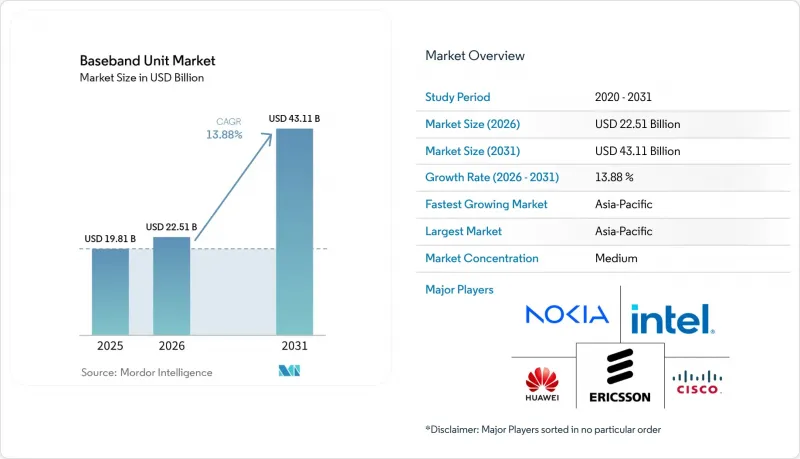
根據 Mordor Intelligence 預測,基頻單元市場規模將從 2025 年的 198.1 億美元成長到 2026 年的 225.1 億美元,然後在 2031 年達到 431.1 億美元,2026 年至 2031 年的複合年成長率為 13.8%。
全球基頻單元市場趨勢與洞察
全球5G獨立組網(SA)網路的擴展
獨立組網(SA)5G的部署是基頻單元市場的主要驅動力,因為它需要專為獨立5G網路設計的5G核心網和基頻功能。根據全球行動供應商協會(GSA)預測,到2026年第一季,將有95家營運商推出商用5G獨立網路服務,較2025年第一季成長42%。獨立組網支援網路切片、低延遲服務以及傳統網路配置難以實現的差異化企業服務。這種轉型通常不僅需要無線設備的升級,因為現有的基頻設備和核心網路整合必須適應新的架構。此外,營運商需要在部署獨立網路功能的同時保持現有服務的效能,這促使他們分階段採購設備。隨著現有覆蓋網路被用作工業和企業客戶的服務平台,基頻單元市場也將從中受益。
對網路容量和低延遲的需求日益成長
隨著流量的成長,無線存取層對更高處理能力的需求推動了基頻單元市場的發展。愛立信的報告顯示,到2025年底,5G將佔全球行動數據流量的48%,預計2031年將達到85%。該報告還指出,一些營運商發現,與人工智慧工作負載、視訊監控和工業聯網感測器相關的上行鏈路流量正在加速成長。這些應用比傳統的消費寬頻流量需要更多的調度和處理資源,尤其是在眾多裝置同時傳輸資料的情況下。 2026年7月,NTT DOCOMO在日本完成了愛立信RAN處理器6672的首次商用部署,與上一代產品相比,其容量效率提升高達四倍,能耗降低超過50%。此次部署表明,容量升級正逐漸轉向基於新一代設備,而非簡單的軟體更新。
高功耗和溫度控管要求
功耗和溫度控管可能成為基頻單元 (BBU) 市場成長的限制因素,尤其是在高密度集中式無線接取網路 (RAN) 的部署中。華為報告稱,5G BBU 在集中式 RAN 模式下的最大功耗為 2000 瓦。電訊(ITU) 已製定了集中式 RAN 模式下 5G BBU 系統的液冷要求。歐洲電信標準化協會 (ETSI) 也針對此配置下的 5G BBU 安裝,制定了液冷和高能源效率解決方案的要求和應用情境。溫暖的氣候和高密度的室內叢集增加冷卻成本、站點基礎設施需求、設備安裝和維運複雜性。供應商必須在滿足各站點物理和電力限制的前提下,提供低功耗且冷卻設計合理的容量提升方案。
細分市場分析
預計到2025年,硬體將佔基頻單元市場的48.76%。這反映了覆蓋範圍擴展階段實體部署的資本密集特點,尤其是在亞太和北美地區建造宏基站。隨著AI原生和雲端原生RAN平台從產品開發階段過渡到商用網路部署階段,預計2026年至2031年軟體市場將以14.77%的複合年成長率成長。諾基亞預計2026年7月推出AI原生RAN平台,該平台包含具備AI加速功能的AirScale插件卡、GPU驅動的AI-RAN節點以及支援4G、5G和未來6G工作負載的anyRAN軟體基礎架構。這種設計將有助於從一次性設備銷售轉向可跨多個網路升級週期持續使用的軟體合約。服務也是重要的收入來源,因為企業通常需要安裝、整合、生命週期管理和營運支援。
隨著虛擬化功能在基頻單元市場中的應用日益廣泛,預計在預測期內硬體和軟體之間的收入差距將縮小。愛立信的「無線接取網人工智慧 (AI in RAN)」軟體將人工智慧模型整合到基頻和無線設備中,以實現即時最佳化和能源管理。三星已證明,商用伺服器能夠支援基頻運算工作負載,他們使用英特爾至強 6 硬體在美國一級電信業者的運作網路上成功進行了商用虛擬無線存取網 (vRAN) 通話。因此,軟體授權可以獨立於部署在特定站點的專用底盤而創造價值。此外,多廠商部署需要整合和生命週期支持,隨著網路配置日益複雜,服務的角色也變得越來越重要。
預計到2025年,大規模MIMO將佔據基頻市場49.11%的佔有率(按配置分類),這主要得益於高密度都市區和6GHz以下頻段對更高頻譜效率的需求。隨著營運商將天線數量增加到傳統32T32R和64T64R配置之外,預計大規模MIMO在2026年至2031年間的複合年成長率將達到15.01%。這些系統無需購買額外的頻寬即可實現更高的吞吐量密度。愛立信預計將於2025年12月開始為NTT DOCOMO商用部署AIR 3255 4.5GHz大規模MIMO無線電,標誌著這種新配置的正式商用。隨著天線數量的增加,對基頻能力的需求也將隨之成長,從而滿足了對專為矩陣密集型工作負載設計的處理器的需求。
在農村和郊區部署中,降低站點成本比最大化頻譜效率更為重要,因此非大規模MIMO配置將繼續發揮關鍵作用。由於傳輸限制可能導致先進天線系統無法按設計運行,因此運營商需要評估去程傳輸和中傳容量。 NTT DOCOMO的RAN處理器6672整合了橫跨3.5 GHz、3.7 GHz和4.5 GHz頻段的280 MHz頻寬,以支援大規模MIMO單元。該系統表明,基頻平台不僅可以作為訊號路由設備,還可以作為頻譜聚合和控制層。此外,隨著射頻鏈路數量的增加,功耗和散熱管理要求也會增加,因此需要對傳輸容量、電源供給能力和冷卻成本進行全面評估。
區域分析
預計到2025年,亞太地區將佔據基頻單元市場30.12%的佔有率,並在預測期(2026年至2031年)內以15.87%的複合年成長率成長。預計到2025年底,中國將部署超過350萬個5G基地台,這將支撐該地區的市場規模。在涵蓋範圍擴展的初期階段之後,該地區仍需持續投入資金,以進一步提升網路密度並進行5G-Advanced的商用前準備工作。預計印度將在2024年和2025年進行頻譜競標後,進入5G快速擴張期。韓國仍然是技術應用的重要市場,其「超人工智慧網路基礎設施」計畫正在工業環境中進行AI-RAN和獨立組網5G的試驗。 NTT Docomo、Softbank Corporation和KDDI預計將在2026年與愛立信相繼簽署RAN協議,顯示日本的供應商重組時機已經到來。
儘管北美和歐洲的需求趨勢有所不同,但它們相輔相成。在美國,三大一級營運商的全國性獨立組網(SA5)5G部署預計將完成,短期投資將從最初的覆蓋範圍擴大轉向容量提升和人工智慧賦能的升級。加拿大和墨西哥仍處於容量擴展的早期階段,正在建構中波5G頻段的框架。在歐洲,獨立組網5G的投資正透過多年框架協議穩步推進,其中包括愛立信和諾基亞與沃達豐Three和Virgin Media O2合作制定的2026年計畫。
南美洲仍處於「容量優先」的部署階段,巴西和阿根廷在區域發展方面處於領先地位。隨著頻段分配和網路現代化資金的增加,該地區有望迎來長期發展機會。
中東和非洲的需求格局截然不同。波灣合作理事會(GCC)成員國率先採用獨立組網(SA)5G,優質頻段分配和智慧城市計畫需要高容量的網路基礎設施。沙烏地阿拉伯的數位基礎設施建設和阿拉伯聯合大公國的智慧城市連接計畫預計將支撐未來多年的設備需求。非洲仍處於發展初期,南非和奈及利亞在部署方面處於領先地位,而該地區大部分地區仍專注於4G基礎設施建設。隨著頻率競標和光纖回程傳輸計畫的成熟,預計選擇性的5G投資將會增加。沿岸地區雖然規模小於其他大規模的區域市場,但由於其單站點需求密度高,因此支撐著該地區基頻單元市場的規模。這種環境為能夠滿足性能、能源效率和服務要求的供應商創造了高價值的市場。
其他好處:
- Excel格式的市場預測(ME)表
- 3個月的分析師支持
目錄
第1章:引言
- 研究假設和市場定義
- 調查範圍
第2章:調查方法
第3章執行摘要
第4章 市場狀況
- 市場概覽
- 市場促進因素
- 5G獨立組網的全球擴展
- 對網路容量和更低延遲的需求日益成長
- 私有5G和工業網路的成長
- 開放式無線存取網和虛擬化無線存取網的部署
- 利用人工智慧最佳化無線資源
- 採用邊緣運算和雲端原生無線存取網
- 市場限制因素
- 高功耗和溫度控管要求
- 半導體供應擁塞和元件前置作業時間風險
- 棕地整合的複雜性
- 地緣政治因素導致供應商受到限制,供應鏈中斷。
- 宏觀經濟因素對市場的影響
- 產業價值鏈分析
- 監理情勢
- 技術展望
- 波特五力分析
第5章 市場規模與成長預測
- 按組件
- 硬體
- 軟體
- 服務
- MIMO配置
- 非大規模MIMO
- Massive MIMO
- 大型天線單元
- 不同的發展
- 室內的
- 戶外的
- 其他部署方法
- 透過網路架構
- 獨立版
- 非獨立式
- 其他網路架構
- 最終用戶
- 電信營運商
- 企業及私人網路
- 政府/國防
- 託管服務供應商
- 按地區
- 北美洲
- 美國
- 加拿大
- 墨西哥
- 南美洲
- 巴西
- 阿根廷
- 其他南美國家
- 歐洲
- 英國
- 德國
- 法國
- 義大利
- 西班牙
- 其他歐洲國家
- 亞太地區
- 中國
- 印度
- 日本
- 韓國
- 其他亞太國家
- 中東
- 沙烏地阿拉伯
- 阿拉伯聯合大公國
- 其他中東國家
- 非洲
- 南非
- 奈及利亞
- 其他非洲國家
- 北美洲
第6章 競爭情勢
- 市場集中度
- 策略趨勢
- 市佔率分析
- 公司簡介
- Huawei Technologies Co., Ltd.
- Ericsson AB
- Nokia Corporation
- Samsung Electronics Co., Ltd.
- ZTE Corporation
- Qualcomm Technologies, Inc.
- Intel Corporation
- Fujitsu Limited
- NEC Corporation
- Cisco Systems, Inc.
- Mavenir Systems, Inc.
- Radisys Corporation
- Parallel Wireless, Inc.
- CommScope Holding Company, Inc.
- Airspan Networks Inc.
- JMA Wireless
- Sercomm Corporation
- Rakuten Symphony
- Viettel High-Tech Industries Corporation
- CICT Mobile Communications Equipment Co., Ltd.
- Marvell Technology, Inc.
- Broadcom Inc.
第7章 市場機會與未來展望
According to Mordor Intelligence, the baseband unit market size is expected to grow from USD 19.81 billion in 2025 to USD 22.51 billion in 2026 and is forecast to reach USD 43.11 billion by 2031 at 13.88% CAGR over 2026-2031.
Global Baseband Unit Market Trends and Insights
Global 5G Standalone Network Expansion
Standalone 5G deployment is a central driver for the Baseband Unit Market because it requires a 5G core and baseband functions designed for an independent 5G network. The Global Mobile Suppliers Association reported that 95 operators had launched commercial 5G standalone services by Q1 2026, a 42% increase from Q1 2025. Standalone networks support network slicing, lower-latency services, and differentiated enterprise offerings that are difficult to deliver through legacy network arrangements. The transition often requires more than a radio upgrade because the installed baseband equipment and core integration must support the new architecture. Operators also need to maintain existing service performance while introducing standalone capabilities, which encourages phased equipment procurement. The Baseband Unit Market benefits when established coverage networks are adapted into service platforms for industrial and enterprise customers.
Rising Demand for Network Capacity and Lower Latency
Rising traffic volumes require more processing capacity at the radio access layer, supporting demand in the Baseband Unit Market. Ericsson reported that 5G accounted for 48% of global mobile data traffic at the end of 2025 and projected that share would reach 85% by 2031. The report also identified faster uplink traffic growth for some providers, linked to AI workloads, video surveillance, and industrial internet-connected sensors. These applications require more scheduling and processing resources than conventional consumer broadband traffic does, especially when many devices transmit data simultaneously. In July 2026, NTT DOCOMO completed Japan's first commercial deployment of Ericsson's RAN Processor 6672, delivering up to 4 times higher capacity efficiency and more than 50% lower energy consumption than the earlier generation. The deployment shows why capacity upgrades are increasingly based on new equipment generations instead of minor software changes.
High Power Consumption and Thermal Management Requirements
Power consumption and thermal management can restrain the Baseband Unit Market, especially in dense centralized-RAN deployments. Huawei documented a maximum 5G BBU power consumption of 2,000 W in centralized-RAN mode. The International Telecommunication Union identifies the liquid-cooling requirements for 5G BBU systems used in centralized RAN mode. ETSI also set requirements and use cases for liquid cooling and high-energy-efficiency solutions designed for 5G BBU installations in this configuration. Warm climates and high-density indoor clusters can increase cooling costs, site infrastructure requirements, equipment installation, and operating complexity. Vendors must combine capacity improvements with lower energy consumption and cooling designs that can be deployed within each site's physical and power limits.
Other drivers and restraints analyzed in the detailed report include:
- Growth of Private 5G and Industrial Networks
- Open RAN and Virtualized RAN Adoption
- Semiconductor Supply Concentration and Component Lead-Time Risk
For complete list of drivers and restraints, kindly check the Table Of Contents.
Segment Analysis
Hardware is projected to account for 48.76% of the Baseband Unit Market in 2025, reflecting the capital intensity of physical deployments during the coverage expansion phase, particularly for macro-site buildouts in Asia-Pacific and North America. Software is projected to grow at a 14.77% CAGR from 2026 to 2031 as AI-native and cloud-native RAN platforms progress from product development to commercial network deployment. Nokia is expected to launch an AI-native RAN platform in July 2026, comprising an AI-accelerated AirScale plug-in card, a GPU-powered AI-RAN node, and an anyRAN software foundation that supports 4G, 5G, and future 6G workloads. This design supports a transition from one-time equipment sales to software agreements that can remain in place across multiple network upgrade cycles. Services also represent a significant revenue stream, as enterprises often require installation, integration, lifecycle management, and operational support.
The revenue gap between hardware and software is expected to narrow during the forecast period as the Baseband Unit Market increases its adoption of virtualized functions. Ericsson's AI in RAN software embeds AI models within baseband and radio equipment to enable real-time optimization and energy management. Samsung completed a commercial vRAN call on a Tier-1 US operator's live network using Intel Xeon 6 hardware, demonstrating that commercial servers can support baseband compute workloads. Software licensing can therefore generate value independently of the proprietary chassis deployed at a specific site. Multi-vendor deployments also require integration and lifecycle support, increasing the role of services as network configurations become more complex.
Massive MIMO is projected to account for 49.11% of the Baseband Unit Market by configuration in 2025, supported by demand for greater spectral efficiency in dense urban areas and sub-6 GHz spectrum bands. Massive MIMO is projected to grow at a 15.01% CAGR from 2026 to 2031 as operators increase antenna counts beyond conventional 32T32R and 64T64R configurations. These systems enable higher throughput density without requiring additional spectrum purchases. Ericsson is expected to begin commercial deployment of its AIR 3255 4.5 GHz Massive MIMO radio for NTT DOCOMO in December 2025, demonstrating the commercial adoption of newer configurations. The shift toward higher antenna counts requires greater baseband processing capacity and supports demand for processors designed for matrix-intensive workloads.
Non-Massive MIMO configurations will retain relevance in rural and suburban deployments, where lower site costs are more important than maximum spectral efficiency. Operators must evaluate fronthaul and midhaul capacity, as transport constraints can prevent advanced antenna systems from achieving their designed performance. NTT DOCOMO's RAN Processor 6672 aggregates 280 MHz of spectrum across the 3.5 GHz, 3.7 GHz, and 4.5 GHz bands and supports Massive MIMO units. The system demonstrates how the baseband platform serves as a spectrum aggregation and control layer rather than solely as a signal router. Higher radio-frequency chain counts also increase energy consumption and thermal requirements, necessitating a collective assessment of transport capacity, power availability, and cooling costs.
Complete Report Scope:
- By Component
- Hardware
- Software
- Services
- By MIMO Configuration
- Non-Massive MIMO
- Massive MIMO
- Massive Antenna Element
- By Deployment
- Indoor
- Outdoor
- Other Deployments
- By Network Architecture
- Standalone
- Non-Standalone
- Other Network Architectures
- By End User
- Telecom Operators
- Enterprises and Private Networks
- Government and Defense
- Managed Service Providers
- By Geography
- North America
- United States
- Canada
- Mexico
- South America
- Brazil
- Argentina
- Rest of South America
- Europe
- United Kingdom
- Germany
- France
- Italy
- Spain
- Rest of Europe
- Asia-Pacific
- China
- India
- Japan
- South Korea
- Rest of Asia-Pacific
- Middle East
- Saudi Arabia
- United Arab Emirates
- Rest of Middle East
- Africa
- South Africa
- Nigeria
- Rest of Africa
- North America
Geography Analysis
Asia-Pacific is projected to hold a 30.12% share of the Baseband Unit Market in 2025 and expand at a CAGR of 15.87% during the forecast period (2026 to 2031). China's deployment of more than 3.5 million 5G base stations by the end of 2025 is expected to support the region's volume position. Following the initial coverage phase, the region will continue to require capital equipment for network densification and pre-commercial 5G-Advanced activities. India is expected to enter a period of rapid 5G expansion following spectrum auctions in 2024 and 2025. South Korea remains a key market for technology adoption, with its Hyper AI Network Infrastructure project testing AI-RAN and standalone 5G in industrial environments. NTT DOCOMO, SoftBank, and KDDI are expected to establish successive Ericsson RAN agreements in 2026, indicating a period of vendor consolidation in Japan.
North America and Europe have distinct yet complementary demand profiles. The United States is expected to complete nationwide standalone 5G deployments across its three Tier-1 operators, shifting near-term spending from initial coverage toward capacity densification and AI-ready upgrades. Canada and Mexico remain at earlier stages of densification and continue to develop mid-band 5G spectrum frameworks. Europe is advancing standalone 5G investment through multi-year framework agreements, including planned 2026 work involving Ericsson and Nokia with VodafoneThree and Virgin Media O2.
South America remains in a capacity-first deployment phase, with Brazil and Argentina leading regional rollouts. The region presents a longer-term opportunity as spectrum availability and network modernization budgets develop.
The Middle East and Africa have contrasting demand conditions. Gulf Cooperation Council (GCC) countries are early adopters of standalone 5G, as premium spectrum allocations and smart-city programs require high-capacity network infrastructure. Saudi Arabia's digital infrastructure commitments and the UAE's smart-city connectivity programs are expected to support multi-year equipment demand. Africa remains at an earlier stage of development, with South Africa and Nigeria leading deployments while much of the region continues to focus on 4G consolidation. Selective 5G investment is expected to increase as spectrum auctions and fiber backhaul programs mature. Although the Gulf is more compact than larger regional markets, high per-site demand intensity supports the Baseband Unit Market size in the region. This environment creates a high-value segment for suppliers capable of meeting performance, energy-efficiency, and service requirements.
- Huawei Technologies Co., Ltd.
- Ericsson AB
- Nokia Corporation
- Samsung Electronics Co., Ltd.
- ZTE Corporation
- Qualcomm Technologies, Inc.
- Intel Corporation
- Fujitsu Limited
- NEC Corporation
- Cisco Systems, Inc.
- Mavenir Systems, Inc.
- Radisys Corporation
- Parallel Wireless, Inc.
- CommScope Holding Company, Inc.
- Airspan Networks Inc.
- JMA Wireless
- Sercomm Corporation
- Rakuten Symphony
- Viettel High-Tech Industries Corporation
- CICT Mobile Communications Equipment Co., Ltd.
- Marvell Technology, Inc.
- Broadcom Inc.
Additional Benefits:
- The market estimate (ME) sheet in Excel format
- 3 months of analyst support
TABLE OF CONTENTS
1 INTRODUCTION
- 1.1 Study Assumptions and Market Definition
- 1.2 Scope of the Study
2 RESEARCH METHODOLOGY
3 EXECUTIVE SUMMARY
4 MARKET LANDSCAPE
- 4.1 Market Overview
- 4.2 Market Drivers
- 4.2.1 Global 5G Standalone Network Expansion
- 4.2.2 Rising Demand for Network Capacity and Lower Latency
- 4.2.3 Growth of Private 5G and Industrial Networks
- 4.2.4 Open RAN and Virtualized RAN Adoption
- 4.2.5 AI-Enabled Radio Resource Optimization
- 4.2.6 Edge Computing and Cloud-Native RAN Deployment
- 4.3 Market Restraints
- 4.3.1 High Power Consumption and Thermal Management Requirements
- 4.3.2 Semiconductor Supply Concentration and Component Lead-Time Risk
- 4.3.3 Brownfield Integration Complexity
- 4.3.4 Geopolitical Vendor Restrictions and Supply-Chain Fragmentation
- 4.4 Impact of Macroeconomic Factors on the Market
- 4.5 Industry Value Chain Analysis
- 4.6 Regulatory Landscape
- 4.7 Technological Outlook
- 4.8 Porter's Five Forces Analysis
- 4.8.1 Bargaining Power of Suppliers
- 4.8.2 Bargaining Power of Buyers
- 4.8.3 Threat of New Entrants
- 4.8.4 Threat of Substitutes
- 4.8.5 Competitive Rivalry
5 MARKET SIZE AND GROWTH FORECASTS (VALUE)
- 5.1 By Component
- 5.1.1 Hardware
- 5.1.2 Software
- 5.1.3 Services
- 5.2 By MIMO Configuration
- 5.2.1 Non-Massive MIMO
- 5.2.2 Massive MIMO
- 5.2.3 Massive Antenna Element
- 5.3 By Deployment
- 5.3.1 Indoor
- 5.3.2 Outdoor
- 5.3.3 Other Deployments
- 5.4 By Network Architecture
- 5.4.1 Standalone
- 5.4.2 Non-Standalone
- 5.4.3 Other Network Architectures
- 5.5 By End User
- 5.5.1 Telecom Operators
- 5.5.2 Enterprises and Private Networks
- 5.5.3 Government and Defense
- 5.5.4 Managed Service Providers
- 5.6 By Geography
- 5.6.1 North America
- 5.6.1.1 United States
- 5.6.1.2 Canada
- 5.6.1.3 Mexico
- 5.6.2 South America
- 5.6.2.1 Brazil
- 5.6.2.2 Argentina
- 5.6.2.3 Rest of South America
- 5.6.3 Europe
- 5.6.3.1 United Kingdom
- 5.6.3.2 Germany
- 5.6.3.3 France
- 5.6.3.4 Italy
- 5.6.3.5 Spain
- 5.6.3.6 Rest of Europe
- 5.6.4 Asia-Pacific
- 5.6.4.1 China
- 5.6.4.2 India
- 5.6.4.3 Japan
- 5.6.4.4 South Korea
- 5.6.4.5 Rest of Asia-Pacific
- 5.6.5 Middle East
- 5.6.5.1 Saudi Arabia
- 5.6.5.2 United Arab Emirates
- 5.6.5.3 Rest of Middle East
- 5.6.6 Africa
- 5.6.6.1 South Africa
- 5.6.6.2 Nigeria
- 5.6.6.3 Rest of Africa
- 5.6.1 North America
6 COMPETITIVE LANDSCAPE
- 6.1 Market Concentration
- 6.2 Strategic Moves
- 6.3 Market Share Analysis
- 6.4 Company Profiles (includes Global Level Overview, Market Level Overview, Core Segments, Financials as available, Strategic Information, Market Rank/Share, Products and Services, Recent Developments)
- 6.4.1 Huawei Technologies Co., Ltd.
- 6.4.2 Ericsson AB
- 6.4.3 Nokia Corporation
- 6.4.4 Samsung Electronics Co., Ltd.
- 6.4.5 ZTE Corporation
- 6.4.6 Qualcomm Technologies, Inc.
- 6.4.7 Intel Corporation
- 6.4.8 Fujitsu Limited
- 6.4.9 NEC Corporation
- 6.4.10 Cisco Systems, Inc.
- 6.4.11 Mavenir Systems, Inc.
- 6.4.12 Radisys Corporation
- 6.4.13 Parallel Wireless, Inc.
- 6.4.14 CommScope Holding Company, Inc.
- 6.4.15 Airspan Networks Inc.
- 6.4.16 JMA Wireless
- 6.4.17 Sercomm Corporation
- 6.4.18 Rakuten Symphony
- 6.4.19 Viettel High-Tech Industries Corporation
- 6.4.20 CICT Mobile Communications Equipment Co., Ltd.
- 6.4.21 Marvell Technology, Inc.
- 6.4.22 Broadcom Inc.
7 MARKET OPPORTUNITIES AND FUTURE OUTLOOK
- 7.1 White-Space and Unmet-Need Assessment

 北美基頻單元:市場佔有率分析、行業趨勢和統計數據以及成長預測(2026-2031 年)
 大型基地台基頻單元市場規模、佔有率和成長分析(按技術、組件、部署類型和地區分類)-2026-2033年產業預測
 全球宏蜂窩天線市場分析與預測(2024-2028)