


 |
市場調查報告書
商品編碼
2155323
結構光投影機:市場佔有率分析、產業趨勢與統計資料、成長預測(2026-2031 年)Structured Light Projector - Market Share Analysis, Industry Trends & Statistics, Growth Forecasts (2026 - 2031) |
||||||

※ 本網頁內容可能與最新版本有所差異。詳細情況請與我們聯繫。
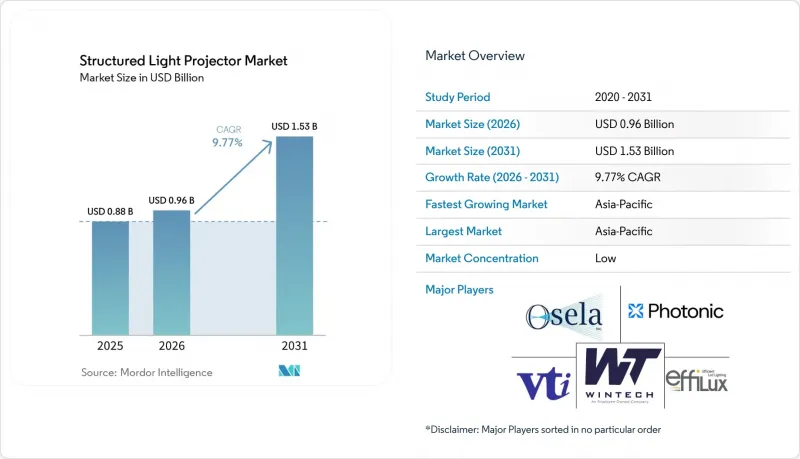
根據 Mordor Intelligence 預測,結構光投影機市場規模預計在 2025 年達到 8.8 億美元,2026 年達到 9.6 億美元,到 2031 年達到 15.3 億美元,2026 年至 2031 年的複合年成長率為 9.77%。
全球結構光投影機市場趨勢及洞察
在工業自動化和線上3D檢測的應用。
在混合型組裝,需要在不降低輸送機作業速度的前提下,快速進行形狀檢驗。接觸式測量無法達到相同的偵測頻率,也無法在每個生產階段提供非接觸式全區域測量方法,因此,結構化光學投影機的需求日益成長。根據IEEE 2025框架,3D結構化光學輪廓分析和邊緣分析已被證明能夠監測鋰離子電池連續製造過程中的塗層均勻性、壓延完整性、電極對準和焊接品質。來自已安裝感測器的資料流支援製程控制和最終品質檢查,使生產團隊能夠更清晰地了解偏差最初出現的位置。由於其廣泛的應用,該設備可以整合到生產設備中,而無需作為獨立的檢測站。
需要在屏蔽工作空間內獲取高密度深度資料的機器人技術。
基於機器人的揀選和協作機器人引導需要在雜亂的工作環境中獲取可靠的深度資訊。結構光技術能夠提供高密度點雲資料和像素級深度置信度,即使對於部分遮蔽或黑暗的物體也能如此,從而幫助機器人區分選定的物品和相鄰部件。 2025年5月,Photoneo公司發布了MotionCam-3D Color Blue,該產品能夠對速度高達144公里/小時的物體進行即時並行結構光掃描。該公司表示,該技術已將每個揀選箱的處理時間縮短了多達2秒,並且無需預先分類即可揀選汽車和物流行業97%的物品。這些需求正在改變結構光投影機市場的供應商選擇標準,使其更加重視處理能力、重建點雲的可靠性和板載運算能力。
熱應力和機械應力引起的校準漂移
熱環境和機械環境條件會影響投影機和攝影機系統在運作環境中的校準。這使得在工業環境中部署投影機比在受控的實驗室環境中部署更為困難,並可能減緩結構光投影機在溫度波動較大的工廠中的普及。雖然軟體校正可以緩解這些影響,但這需要投影機內部具備校準資訊和即時溫度感測功能。這些功能會增加硬體成本,因此通常不會在入門級系統中採用。因此,對於在波動環境下運作的系統整合商而言,維護需求可能會成為額外的成本和責任。
細分市場分析
預計到2025年,嵌入式投影模組將佔據結構化光學投影機市場40.27%的佔有率,並將在2031年之前以11.73%的複合年成長率持續成長。這一領先的市場佔有率和成長勢頭反映了從獨立組件到板級整合的轉變,使供應商能夠為單一主機系統設計光學、電子和機械元件。智慧型手機OEM廠商、機器人製造商和消費性電子產品製造商不僅可以將熟悉的組件成本管理技術應用於模組採購,還可以減少將單一投影機與攝影機和處理硬體整合所需的工作量。此外,模組尺寸更小,使其適用於重量和安裝空間受限的設備,從而簡化手持設備、機械臂、緊湊型接入設備和固定式自動化工作站的產品設計。
在2026年自動化展(Automate 2026)上,Orbbec公司發表了一款DLP結構光相機,其VDI/VDE精度達到0.07毫米,Z軸重複性在0.5公尺距離下達到0.05毫米。這款緊湊型設計旨在整合到機械臂中。獨立投影機在大批量掃描和航太測量中繼續發揮至關重要的作用。同時,整合投影機和相機系統在固定站點的品管中仍然很受歡迎。超表面光學技術可以將多種傳統光學功能整合到更薄的組件中,從而加速結構光投影機產業的模組小型化進程。
基於雷射二極體的系統憑藉其成熟的設計和高光功率密度,在2025年佔據了44.83%的銷售額。預計到2031年,基於垂直腔面發射雷射(VCSEL)的系統將以12.27%的複合年成長率成長,成為結構光投影機市場中光源技術中成長最快的。多結VCSEL陣列可提高光輸出,同時抑制熱滾降,而熱滾降歷來限制了其在高效能系統中的應用。這項特性在汽車座艙監控和遠端機器人導航等應用中至關重要,因為穩定的光源能夠確保在正常工作週期內實現一致的深度性能。
2025年3月,英飛凌推出了一款整合熱擴散層的VCSEL陣列,旨在實現更高的持續光輸出和穩定的動作溫度。 LED光源繼續應用於低成本、短距離應用,例如食品檢測和物流中的高度測量。隨著整個結構光投影機市場對精度要求的不斷提高,其市場擴張受到限制。超輻射發光二極體(SLD)系統仍屬於小規模眾產品,主要用於需要抑制散斑的測量和生物成像應用。在這些應用中,散斑抑制並非一項選用功能,而是一項技術要求。
區域分析
預計到2025年,亞太地區將佔據結構化光學投影機市場39.27%的佔有率,並在2031年之前以11.47%的複合年成長率持續成長。該地區匯集了全球最大的消費市場和主要的投影機技術生產中心,使系統供應商能夠接觸到電子、汽車和自動化行業的大規模客戶群。中國的電子設備組裝和電動車電池製造正在推動工業檢測的需求。韓國的顯示器和記憶體生產需要高精度的晶圓和麵板測量。日本的精密機器人生態系統支援在組裝引導中使用嵌入式投影儀,並持續成為結構化光學投影機需求的重要驅動力。
台灣先進的邏輯半導體製造技術滿足了製程控制領域對光學測量的需求。隨著全球原始設備製造商(OEM)加大投資,印度正崛起為電子製造中心。在北美,汽車自動化、本土半導體製造以及3D視覺引導物流系統的需求正在擴大結構化光學投影機的基本客群。臉部認證在北美高階智慧型手機中繼續發揮至關重要的作用,滿足了高安全性生物識別的要求。在歐洲,德國的精密工程和汽車測量技術為市場提供了支持,由於VDI/VDE 2634和ISO/IEC 17025標準的要求,精度認證系統備受重視。
2026年7月,FARO CREAFORM發布了用於測量航太和汽車行業大型零件的「HandySCAN 3D MAX EVO」和「MAX EVO Elite」兩款型號。據該公司稱,根據VDI/VDE 2634標準檢驗,Elite型號的體積測量精度達到0.075毫米 + 0.010毫米/米。雖然在南美、中東和非洲的銷售規模較小,但這些地區的應用領域涵蓋航太、智慧工廠、汽車和採礦。全部區域通用面臨的限制因素是缺乏足夠的3D視覺整合技術。
其他好處:
- Excel格式的市場預測(ME)表
- 3個月的分析師支持
目錄
第1章:引言
- 研究假設和市場定義
- 調查範圍
第2章:調查方法
第3章執行摘要
第4章 市場狀況
- 市場概覽
- 市場促進因素
- 工業自動化和線上3D檢測的實施
- 需要在屏蔽工作空間內獲取高密度深度資料的機器人技術。
- 智慧型手機和消費性電子設備中的臉部認證
- 擴大電動車電池和半導體的生產
- 設備內深度處理保護隱私
- 利用散斑抑制光學元件提高圖案投影的可靠性
- 市場限制因素
- 熱應力和機械應力引起的校準漂移
- 反射率、透明度和低紋理表面的局限性
- 眼部安全和雷射分類方面的合規負擔。
- 整合成本和 3D 視覺技術人員短缺。
- 宏觀經濟因素對市場的影響
- 產業供應鏈分析
- 科技趨勢
- 監理情勢
- 波特五力分析
第5章 市場規模與成長預測
- 投影機架構
- 獨立投影儀
- 嵌入式投影模組
- 整合投影機和攝影機系統
- 透過光源技術
- LED底座
- 雷射二極體基座
- 基於VCSEL的
- 超輻射發光二極體基座
- 按模式類型
- 條紋/相移圖案
- 二進位編碼模式
- 點/隨機點圖案
- 直線/多線/十字圖案
- 混合/多模式系統
- 最終用戶
- 電子和半導體
- 車
- 航太/國防
- 醫療保健和生命科學
- 一般製造業和機械製造商
- 研究機構和大學
- 家用電子產品
- 其他最終用戶
- 按地區
- 北美洲
- 美國
- 加拿大
- 墨西哥
- 南美洲
- 巴西
- 阿根廷
- 其他南美國家
- 歐洲
- 德國
- 英國
- 法國
- 義大利
- 西班牙
- 其他歐洲國家
- 亞太地區
- 中國
- 日本
- 印度
- 韓國
- 其他亞太國家
- 中東
- 阿拉伯聯合大公國
- 沙烏地阿拉伯
- 其他中東國家
- 非洲
- 南非
- 其他非洲國家
- 北美洲
第6章 競爭情勢
- 市場集中度
- 策略趨勢
- 市佔率分析
- 公司簡介
- Wintech Digital Systems Technology Corp.
- Keynote Photonics Inc.
- Osela Inc.
- EFFILUX SAS
- RODER Vision GmbH
- Visitech International Ltd.
- Mantis Vision Ltd.
- Orbbec Inc.
- LMI Technologies Inc.
- Basler AG
- Cognex Corporation
- FARO Technologies, Inc.
- ZEISS Industrial Quality Solutions
- Hexagon AB
- GOM GmbH
- ATOS SE
- Photoneo sro
- MetraSCAN 3D Technologies Inc.
- MagikEye Inc.
- Metalenz, Inc.
第7章 市場機會與未來展望
According to Mordor Intelligence, the structured light projector market size was USD 0.88 billion in 2025, USD 0.96 billion in 2026, and is forecast to reach USD 1.53 billion by 2031, expanding at a CAGR of 9.77% over 2026-2031.
Global Structured Light Projector Market Trends and Insights
Industrial Automation and Inline 3D Inspection Adoption
Mixed-model assembly lines need fast geometric verification without slowing conveyor-based operations. This requirement supports demand for Structured Light Projectors because contact metrology cannot provide the same inspection cadence or offer a noncontact, full-field measurement method at each production stage. An IEEE-published 2025 framework showed that 3D structured-light profiling and edge analytics can monitor coating uniformity, calendering integrity, electrode alignment, and weld quality in a continuous lithium-ion battery workflow. The data stream from an installed sensor can support process control and final quality checks, giving production teams a clearer record of where deviations first appear. That broader role can make the equipment part of a production machine rather than a separate inspection station.
Robotics Requiring Dense Depth Data in Occluded Workspaces
Robotic bin picking and collaborative robot guidance require reliable depth information in cluttered work areas. Structured light can provide dense point clouds and per-pixel depth confidence for partially hidden or dark objects, which helps a robot distinguish the selected item from adjacent components. Photoneo introduced MotionCam-3D Color Blue in May 2025, featuring real-time, parallel structured-light scanning for objects moving at up to 144 km/h. The company reported a reduction of up to 2 seconds per bin-picking event and stated that 97% of automotive and logistics items could be picked without presorting. These requirements are shifting supplier selection in the Structured Light Projector Market toward throughput, reconstructed-point confidence, and onboard computing capability.
Calibration Drift from Thermal and Mechanical Stress
Thermal and mechanical conditions can affect the calibration of projector-camera systems in operating environments. This can make industrial deployment more demanding than controlled laboratory use and delay the wider adoption of the Structured Light Projector Market in factories with changing temperatures. Software compensation can reduce the effect, but it requires calibration information and real-time thermal sensing in the projector. Those features increase hardware costs and are uncommon in entry-level systems. Service requirements can therefore create added cost and liability for integrators operating in variable conditions.
Other drivers and restraints analyzed in the detailed report include:
- Smartphone and Consumer Device Face Authentication
- EV Battery and Semiconductor Manufacturing Expansion
- Reflective, Transparent, and Low-Texture Surface Limitations
For complete list of drivers and restraints, kindly check the Table Of Contents.
Segment Analysis
Embedded projector modules held 40.27% of the Structured Light Projector Market share in 2025 and are projected to expand at an 11.73% CAGR through 2031. This combination of leading share and expansion reflects a shift from discrete assemblies to board-level integration, in which suppliers can design the optical, electronic, and mechanical elements for a single intended host system. Smartphone OEMs, robotics builders, and consumer device makers can apply familiar component-cost disciplines to module procurement while also reducing the effort required to align a separate projector with cameras and processing hardware. Smaller modules also fit equipment where weight and installation space are limited, and they simplify product design for handheld equipment, robotic arms, compact access devices, and fixed automation stations.
Orbbec presented a DLP structured light camera at Automate 2026 with 0.07 mm VDI/VDE accuracy and 0.05 mm Z-repeatability at 0.5 m. The compact design was intended for robotic-arm integration. Standalone projectors remain relevant for large-volume scanning and aerospace metrology. Integrated projector-camera systems continue to serve fixed-station quality control. Metasurface optics can consolidate several conventional optical functions into a flatter component, which supports module miniaturization across the Structured Light Projector Industry.
Laser diode-based systems accounted for 44.83% of revenue in 2025 because they offer mature designs and high optical power density. VCSEL-based systems are projected to expand at a 12.27% CAGR through 2031, the highest rate among light source technologies in the Structured Light Projector Market. Multi-junction VCSEL arrays can increase optical power while mitigating thermal rollover, which has historically limited their use in higher-performance systems. This capability is relevant to automotive cabin monitoring and longer-range robotic guidance, where a stable source can support consistent depth performance through normal operating cycles.
Infineon released VCSEL arrays with integrated heat-spreading layers in March 2025 to enable higher sustained optical output at stable operating temperatures. LED-based sources continue to serve lower-cost and short-range tasks, including food inspection and logistics height measurement. Their expansion is more limited as precision requirements increase across the Structured Light Projector Market. Superluminescent diode systems remain a small premium category for speckle-suppressed metrology and biological imaging. In these applications, reduced speckle is a technical requirement rather than an optional feature.
Complete Report Scope:
- By Projector Architecture
- Standalone Projectors
- Embedded Projector Modules
- Integrated Projector-Camera Systems
- By Light Source Technology
- LED-Based
- Laser Diode-Based
- VCSEL-Based
- Superluminescent Diode-Based
- By Pattern Type
- Fringe / Phase-Shift Patterns
- Binary-Coded Patterns
- Dot / Random-Dot Patterns
- Line / Multi-Line / Cross Patterns
- Hybrid / Multi-Pattern Systems
- By End-User
- Electronics and Semiconductor
- Automotive
- Aerospace and Defense
- Healthcare and Life Sciences
- General Manufacturing and Machine Builders
- Research Institutes and Universities
- Consumer Electronics
- Other End-Users
- By Geography
- North America
- United States
- Canada
- Mexico
- South America
- Brazil
- Argentina
- Rest of South America
- Europe
- Germany
- United Kingdom
- France
- Italy
- Spain
- Rest of Europe
- Asia-Pacific
- China
- Japan
- India
- South Korea
- Rest of Asia-Pacific
- Middle East
- United Arab Emirates
- Saudi Arabia
- Rest of Middle East
- Africa
- South Africa
- Rest of Africa
- North America
Geography Analysis
Asia-Pacific held 39.27% of the Structured Light Projector Market share in 2025 and is projected to expand at an 11.47% CAGR through 2031. The region combines the largest consumption base with a major production base for projector technology, which gives system suppliers access to large electronics, automotive, and automation customer groups. China's electronics assembly and EV battery manufacturing support demand for industrial inspection. South Korean display and memory production requires high-specification wafer and panel measurement. Japan's precision robotics ecosystem supports the use of embedded projectors in assembly guidance and remains an important driver of demand for the Structured Light Projector Market.
Taiwan's advanced logic fabrication supports the demand for optical metrology in process control. India is emerging as an electronics manufacturing hub as global OEMs ' investment increases. North America has demand from automotive automation, domestic semiconductor construction, and 3D vision-guided logistics systems, which broadens the Structured Light Projector Market customer base. Face authentication remains important in North American premium smartphones with high-security biometric requirements. Europe is supported by German precision engineering and automotive metrology, where VDI/VDE 2634 and ISO/IEC 17025 requirements favor accuracy-certified systems.
FARO CREAFORM introduced HandySCAN 3D MAX EVO and MAX EVO Elite models in July 2026 for large-part aerospace and automotive work. The company stated that the Elite model achieved a volumetric accuracy of 0.075 mm + 0.010 mm/m after validation against the VDI/VDE 2634 standards. South America, the Middle East, and Africa have smaller revenue bases but include aerospace, smart factory, automotive, and mining applications. Limited availability of 3D vision integration skills remains a common constraint across these regions.
- Wintech Digital Systems Technology Corp.
- Keynote Photonics Inc.
- Osela Inc.
- EFFILUX SAS
- RODER Vision GmbH
- Visitech International Ltd.
- Mantis Vision Ltd.
- Orbbec Inc.
- LMI Technologies Inc.
- Basler AG
- Cognex Corporation
- FARO Technologies, Inc.
- ZEISS Industrial Quality Solutions
- Hexagon AB
- GOM GmbH
- ATOS SE
- Photoneo s.r.o.
- MetraSCAN 3D Technologies Inc.
- MagikEye Inc.
- Metalenz, Inc.
Additional Benefits:
- The market estimate (ME) sheet in Excel format
- 3 months of analyst support
TABLE OF CONTENTS
1 INTRODUCTION
- 1.1 Study Assumptions and Market Definition
- 1.2 Scope of the Study
2 RESEARCH METHODOLOGY
3 EXECUTIVE SUMMARY
4 MARKET LANDSCAPE
- 4.1 Market Overview
- 4.2 Market Drivers
- 4.2.1 Industrial Automation and In-Line 3D Inspection Adoption
- 4.2.2 Robotics Requiring Dense Depth Data in Occluded Workspaces
- 4.2.3 Smartphone and Consumer Device Face Authentication
- 4.2.4 EV Battery and Semiconductor Manufacturing Expansion
- 4.2.5 Privacy-Preserving On-Device Depth Processing
- 4.2.6 Pattern-Projection Reliability Gains From Speckle-Reduced Optics
- 4.3 Market Restraints
- 4.3.1 Calibration Drift From Thermal and Mechanical Stress
- 4.3.2 Reflective, Transparent, and Low-Texture Surface Limitations
- 4.3.3 Eye-Safety and Laser-Classification Compliance Burden
- 4.3.4 Integration Cost and Scarcity of 3D-Vision Engineering Talent
- 4.4 Impact of Macroeconomic Factors on the Market
- 4.5 Industry Supply-Chain Analysis
- 4.6 Technology Outlook
- 4.7 Regulatory Landscape
- 4.8 Porter's Five Forces Analysis
- 4.8.1 Threat of New Entrants
- 4.8.2 Bargaining Power of Suppliers
- 4.8.3 Bargaining Power of Buyers
- 4.8.4 Threat of Substitutes
- 4.8.5 Intensity of Competitive Rivalry
5 MARKET SIZE AND GROWTH FORECASTS (VALUE)
- 5.1 By Projector Architecture
- 5.1.1 Standalone Projectors
- 5.1.2 Embedded Projector Modules
- 5.1.3 Integrated Projector-Camera Systems
- 5.2 By Light Source Technology
- 5.2.1 LED-Based
- 5.2.2 Laser Diode-Based
- 5.2.3 VCSEL-Based
- 5.2.4 Superluminescent Diode-Based
- 5.3 By Pattern Type
- 5.3.1 Fringe / Phase-Shift Patterns
- 5.3.2 Binary-Coded Patterns
- 5.3.3 Dot / Random-Dot Patterns
- 5.3.4 Line / Multi-Line / Cross Patterns
- 5.3.5 Hybrid / Multi-Pattern Systems
- 5.4 By End-User
- 5.4.1 Electronics and Semiconductor
- 5.4.2 Automotive
- 5.4.3 Aerospace and Defense
- 5.4.4 Healthcare and Life Sciences
- 5.4.5 General Manufacturing and Machine Builders
- 5.4.6 Research Institutes and Universities
- 5.4.7 Consumer Electronics
- 5.4.8 Other End-Users
- 5.5 By Geography
- 5.5.1 North America
- 5.5.1.1 United States
- 5.5.1.2 Canada
- 5.5.1.3 Mexico
- 5.5.2 South America
- 5.5.2.1 Brazil
- 5.5.2.2 Argentina
- 5.5.2.3 Rest of South America
- 5.5.3 Europe
- 5.5.3.1 Germany
- 5.5.3.2 United Kingdom
- 5.5.3.3 France
- 5.5.3.4 Italy
- 5.5.3.5 Spain
- 5.5.3.6 Rest of Europe
- 5.5.4 Asia-Pacific
- 5.5.4.1 China
- 5.5.4.2 Japan
- 5.5.4.3 India
- 5.5.4.4 South Korea
- 5.5.4.5 Rest of Asia-Pacific
- 5.5.5 Middle East
- 5.5.5.1 United Arab Emirates
- 5.5.5.2 Saudi Arabia
- 5.5.5.3 Rest of Middle East
- 5.5.6 Africa
- 5.5.6.1 South Africa
- 5.5.6.2 Rest of Africa
- 5.5.1 North America
6 COMPETITIVE LANDSCAPE
- 6.1 Market Concentration
- 6.2 Strategic Moves
- 6.3 Market Share Analysis
- 6.4 Company Profiles (includes Global Level Overview, Market Level Overview, Core Segments, Financials as available, Strategic Information, Market Rank/Share, Products and Services, Recent Developments)
- 6.4.1 Wintech Digital Systems Technology Corp.
- 6.4.2 Keynote Photonics Inc.
- 6.4.3 Osela Inc.
- 6.4.4 EFFILUX SAS
- 6.4.5 RODER Vision GmbH
- 6.4.6 Visitech International Ltd.
- 6.4.7 Mantis Vision Ltd.
- 6.4.8 Orbbec Inc.
- 6.4.9 LMI Technologies Inc.
- 6.4.10 Basler AG
- 6.4.11 Cognex Corporation
- 6.4.12 FARO Technologies, Inc.
- 6.4.13 ZEISS Industrial Quality Solutions
- 6.4.14 Hexagon AB
- 6.4.15 GOM GmbH
- 6.4.16 ATOS SE
- 6.4.17 Photoneo s.r.o.
- 6.4.18 MetraSCAN 3D Technologies Inc.
- 6.4.19 MagikEye Inc.
- 6.4.20 Metalenz, Inc.
7 MARKET OPPORTUNITIES AND FUTURE OUTLOOK
- 7.1 White-Space and Unmet-Need Assessment


