


 |
市場調查報告書
商品編碼
2155318
油墨溶劑:市場佔有率分析、產業趨勢與統計、成長預測(2026-2031)Ink Solvent - Market Share Analysis, Industry Trends & Statistics, Growth Forecasts (2026 - 2031) |
||||||

※ 本網頁內容可能與最新版本有所差異。詳細情況請與我們聯繫。
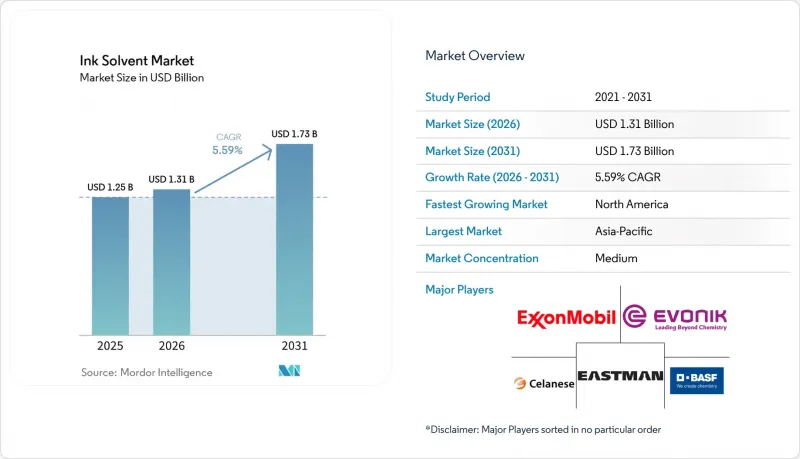
據 Mordor Intelligence 稱,2025 年油墨溶劑市值為 12.5 億美元,預計到 2031 年將從 2026 年的 13.1 億美元成長至 17.3 億美元,預測期(2026-2031 年)複合年成長率為 5.59%。
全球油墨溶劑市場趨勢與分析
來自電子商務和消費品的包裝需求。
小包裹數量的成長使得包裝需求比傳統印刷週期更穩定地成為溶劑型油墨市場的需求來源。 2026年第一季美國零售電商銷售額較2025年同期成長9.8%。隨著訂單履行速度的加快,生產履約縮短和印刷交付速度加快變得日益重要。這種商業環境持續推動溶劑型油墨在聚烯和複合薄膜領域的應用。此外,庫存單位(SKU)數量的增加導致加工商需要印刷的包裝種類更加多樣化,從而縮短了單一生產批次的週期,但增加了印刷機換版和油墨補充的頻率。食品、個人護理用品和非處方藥的包裝仍然需要精確的多色印刷和可控的色彩一致性。在需要可預測的蒸發速率和穩定的黏度的印刷過程中,醇類和醋酸酯混合物仍然發揮著重要作用。
在無孔薄膜和箔材上進行高速印刷
由於對溶劑性能的控制要求,雙軸延伸聚丙烯(BOPP)、聚對苯二甲酸乙二醇酯 (PET)、金屬化聚酯和鋁箔等基材上的高速柔版印刷和凹版印刷支撐了油墨溶劑市場。這些基材不像紙張或紙板那樣吸收油墨。因此,溶劑必須在有限的生產時限內確保良好的潤濕性、顏料轉移、乾燥和成膜性能。凹版印刷機的運作速度為每分鐘 200-400 米,進一步凸顯了蒸發平衡的重要性。乙酸乙酯和乙酸正丙酯在溶劑混合物中仍然非常有用,因為它們有助於顏料快速輸送到基材。低揮發性組分有助於防止表面缺陷並促進成膜。隨著甲苯在食品接觸應用中的禁用,對受監管的醇-乙酸混合物的需求日益成長。擁有符合食品接觸標準且不含有害空氣污染物 (HAP) 的產品線的供應商能夠滿足更嚴格的加工商認證要求。
關於揮發性有機化合物(VOCs)、危險化學品和工人安全的法規
監管要求正在減少印刷商無需採取額外控制措施即可使用的溶劑等級數量。歐盟工業排放指令將適用印刷作業中淨化後的揮發性有機化合物(VOC)總濃度限制在100 mg C/Nm³以內。美國環保署(EPA)《聯邦法規彙編》(CFR)第40篇第63部分KK子部分規定,相關印刷和出版作業必須採用最大可行控制技術(MACT)。中國GB 38507-2020標準將食品包裝油墨中的甲苯含量限制在3%(品質分數)或以下。這些法規正在推動配方需求轉向乙酸乙酯、乙酸正丙酯、異丙醇和乙醇。這些溶劑等級可能比傳統的芳香族化合物和酮替代品更昂貴,從而擠壓加工商的利潤空間。如果小規模印刷商缺乏資金來實施減排設備和建立詳細的合規體系,則可能面臨更高的合規成本。
細分市場分析
至2025年,醇類仍將佔據油墨溶劑市場最大佔有率,達38.68%。這一地位反映了醇類與多種樹脂的相容性、快速揮發性以及在包裝油墨體系中的應用。乙醇、異丙醇和正丙醇可作為柔版印刷和凹版印刷配方中的載體組成。異丙醇還可以抑制硝化纖維素油墨的凝膠化,並調節混合物的黏度。這些特性確保了醇類除了作為基礎稀釋劑之外,仍有重要的應用價值。在需要控制食品接觸包裝溶劑成分的情況下,醇類混合物尤其重要。從監管角度來看,在旨在避免有害空氣污染物的配方中使用醇類也得到了支持。對醇類的需求持續受到軟包裝產量成長以及配方向芳香族溶劑替代方向轉變的推動。
碳氫化合物是成長最快的化學品類別,預計到2031年,碳氫化合物油墨溶劑市場將以6.13%的複合年成長率成長。這一成長反映了從芳烴類溶劑轉變為低氣味異烷烴類溶劑的轉變。這些溶劑用於熱固型出版物印刷和特殊工業印刷。埃克森美孚的「Isopar」和「Exxsol」產品平台旨在提供可控的蒸發、低芳烴含量以及在寬溫度範圍內優異的性能。從芳烴類溶劑到異烷烴的轉變主要是由於碳氫化合物類別內部為符合法規要求而進行的配方變更,但這並不意味著印刷應用對碳氫化合物的需求完全消失。乙二醇醚和二丙酮醇雖然仍是小規模的化學品類別,但它們滿足了對尾部溶劑和慢速蒸發混合物的需求。它們的作用表明,技術性能通常取決於平衡的混合物,而不是單一的溶劑類別。
截至2025年,傳統溶劑佔油墨溶劑市場64.13%的佔有率。完善的生產基礎設施和廣泛的供應管道支撐了這一地位。這些產品通常與現有的印刷機、乾燥機和油墨生產設備相容。此外,石油基溶劑在成本上優於許多生物基替代品。對於許多大量包裝企業而言,傳統溶劑仍然是切實可行的選擇,因為加工商無需更換設備或操作方法即可繼續使用現有製程。在價格、供應可靠性和已通過核准是採購重點的市場中,傳統溶劑的規模經濟優勢依然十分重要。目前,傳統溶劑在油墨溶劑產業的產量中佔最大佔有率。
在油墨溶劑市場,環保和生物基溶劑預計到2031年將以6.32%的複合年成長率成長。這一成長主要受監管要求以及包裝材料供應合約中對可再生成分的期望所驅動。塞拉尼斯和西格維克於2026年共同開發的生物基乙酸乙酯表明,某些產品無需更改配方即可直接使用。這種直接替代的兼容性可以降低傳統加工商採用新溶劑的風險。生物基原料的採購也需要提供原料來源和產品可追溯性的證據。歐盟包裝法規越來越關注可回收性以及影響可回收性的設計選擇。隨著知名品牌所有者將可再生成分要求納入供應商選擇,傳統溶劑的市場佔有率可能會下降。這項變化的速度將取決於生物基產品能否保持技術可靠性和商業性競爭力。
區域分析
到2025年,亞太地區將佔全球市場佔有率的43.70%。該地區聚集了許多服務於食品、消費品和電子商務行業的軟包裝加工企業。中國、印度和東協市場對包裝的需求龐大,並帶動了當地油墨生產的發展。 2024年,印度印刷油墨市場成長超過12%,而印尼、菲律賓、越南和泰國同年均實現了超過20%的成長。BASF已投資87億歐元(約95億美元)以加強其在基礎化學品、中間體和特種產品領域的區域化學品供應鏈,其位於中國湛江的工廠運作營運。在日本和韓國,用於食品和藥品包裝的高純度醇類和醋酸鹽的需求也在增加。這些國家的合規要求推動了對符合國內和國際過渡標準的認證產品的需求。
預計到2031年,北美油墨溶劑市場將以6.27%的複合年成長率成長。該地區油墨溶劑市場受益於電子商務包裝需求的成長,以及對低遷移性、生物基和符合有害空氣污染物(HAP)標準的配方的需求。美國包裝製造商,尤其是五大湖走廊地區的製造商,是符合空氣品質法規的特殊產品的主要買家。州和地方政府的空氣品質法規也在推動減少高芳香族化合物和酮類混合物的使用。 2024年,內華達州克拉克縣針對其相關印刷業務採用了符合美國環保署(EPA)標準的空氣品質法規,支持使用乙酸正丙酯、異丙醇和乙醇基系統。加拿大和墨西哥透過食品包裝和出口供應鏈進一步推動了需求。通用的食品接觸要求正在推動全部區域經批准的無HAP溶劑的需求。
在歐洲,企業營運須遵守一套全面的排放法規和包裝合規要求。歐盟的《工業排放指令》和《包裝及包裝廢棄物法規》正在重塑配方選擇。西歐加工商優先考慮符合脫墨和可回收要求的溶劑型材料。德國、英國、法國和義大利已建立起高規格包裝材料的加工能力。在南美,市場正在擴張,尤其是在巴西和阿根廷,食品和農產品消費品的需求尤其旺盛。在中東和非洲,消費品包裝的印刷能力正在逐步提升,沙烏地阿拉伯和南非是區域中心,但進口溶劑在供應中仍扮演著重要角色。
其他好處:
- Excel格式的市場預測(ME)表
- 3個月的分析師支持
目錄
第1章:引言
- 研究假設和市場定義
- 調查範圍
第2章:調查方法
第3章執行摘要
第4章 市場狀況
- 市場概覽
- 市場促進因素
- 電子商務和消費品行業的包裝需求。
- 在無孔薄膜和箔材上進行高速印刷
- 軟性包裝和可折疊紙盒的成長
- 擴大亞太地區的印刷能力
- 使用低揮發性有機化合物和生物基溶劑的配方變更
- 市場限制因素
- 關於揮發性有機化合物、危險化學品和工人安全的法規
- 水性油墨、UV固化油墨和數位油墨的替代品
- 原物料價格和供應的波動
- 價值鏈分析
- 波特五力分析
第5章 市場規模與成長預測
- 依化學類型
- 酒精飲料
- 乙酸鹽
- 碳氫化合物
- 其他化學類型
- 依產品類型
- 傳統的
- 綠色和生物基
- 透過流程
- 柔版印刷
- 凹版印刷
- 其他流程
- 透過使用
- 軟包裝
- 紙板和折疊式紙箱
- 出版品
- 其他用途
- 按地區
- 亞太地區
- 中國
- 印度
- 日本
- 韓國
- 東南亞國協
- 其他亞太國家
- 北美洲
- 美國
- 加拿大
- 墨西哥
- 歐洲
- 德國
- 英國
- 法國
- 義大利
- 北歐國家
- 其他歐洲國家
- 南美洲
- 巴西
- 阿根廷
- 其他南美國家
- 中東和非洲
- 沙烏地阿拉伯
- 南非
- 其他中東和非洲國家
- 亞太地區
第6章 競爭情勢
- 市場集中度
- 策略趨勢
- 市佔率和排名分析
- 公司簡介
- ADM
- Arkema
- Ashland
- BASF
- Cargill
- Celanese Corporation
- Dow
- Eastman Chemical Company
- Evonik Industries AG
- Exxon Mobil Corporation
- GODAVARI BIOREFINERIES LTD.
- INEOS
- Sasol
- Solvay
- Vertec BioSolvents Inc.
第7章 市場機會與未來展望
According to Mordor Intelligence, the ink solvent market size was valued at USD 1.25 billion in 2025 and is estimated to grow from USD 1.31 billion in 2026 to reach USD 1.73 billion by 2031, at a CAGR of 5.59% during the forecast period (2026-2031).
Global Ink Solvent Market Trends and Insights
Packaging Demand from E-Commerce and Consumer Goods
Parcel growth is making packaging demand a more consistent source of demand for the ink solvent market than traditional print cycles. First-quarter 2026 U.S. retail e-commerce sales increased 9.8% from the same quarter of 2025. Faster fulfillment places greater emphasis on short production windows and quick print turnaround. These operating conditions continue to favor solvent-based inks on polyolefin and laminate films. More stock-keeping units also increase the number of packaging variants that converters must print, which increases press changeovers and replenishment needs, even as individual production runs become shorter. Food, personal care, and over-the-counter pharmaceutical packaging still require accurate multicolor printing and controlled color consistency. Alcohol and acetate blends remain relevant where printers need predictable evaporation and stable viscosity during these runs.
High-Speed Printing on Non-Porous Films and Foils
High-speed flexographic and gravure printing on Biaxially Oriented Polypropylene (BOPP), Polyethylene Terephthalate (PET), metalized polyester, and aluminum foil supports the ink solvent market because it requires controlled solvent performance. These substrates do not absorb ink the way paper and board do. Solvents must therefore support wetting, pigment transfer, drying, and film formation within a limited production window. Gravure presses can operate at 200-400 meters per minute, which increases the importance of evaporation balance. Ethyl acetate and n-propyl acetate remain useful in solvent blends because they help move pigment quickly to the substrate. Slower components can help prevent surface defects and support film coalescence. The removal of toluene from food-contact applications increases the need for compliant alcohol-acetate blends. Suppliers with documented food-contact compliance and Hazardous Air Pollutant (HAP)-free portfolios can meet stricter converter qualification requirements.
Volatile Organic Compound (VOC), Hazardous-Chemical, and Worker-Safety Regulation
Regulatory requirements are reducing the number of solvent grades printers can use without additional controls. The EU Industrial Emissions Directive sets a 100 mg C/Nm3 total VOC limit after abatement for qualifying printing operations. US EPA rules under 40 Code of Federal Regulations (CFR) Part 63, Subpart KK, apply maximum achievable control technology requirements to relevant printing and publishing operations. China GB 38507-2020 limits toluene in food-packaging inks to 3% by mass. These rules are shifting the demand for formulation toward ethyl acetate, n-propyl acetate, isopropanol, and ethanol. Such grades can cost more than older aromatic or ketone alternatives, placing pressure on converter margins. Smaller printers may face higher compliance costs where they lack capital for abatement equipment and detailed compliance systems.
Other drivers and restraints analyzed in the detailed report include:
- Growth of Flexible Packaging and Folding Cartons
- Expansion of Printing Capacity in Asia-Pacific
- Substitution by Water-Based, UV-Curable, and Digital Inks
For complete list of drivers and restraints, kindly check the Table Of Contents.
Segment Analysis
Alcohols accounted for 38.68% of the ink solvent market share in 2025, maintaining the largest share. Their position reflects broad resin compatibility, rapid evaporation, and use in packaging ink systems. Ethanol, isopropanol, and n-propanol are used as carrier components in flexographic and gravure formulations. Isopropanol can limit gelation in nitrocellulose systems and can also adjust blend viscosity. These properties keep alcohols relevant beyond their role as basic diluents. Alcohol-based blends are particularly important where food-contact packaging requires a controlled solvent profile. Their regulatory position supports use in formulations designed to avoid hazardous air pollutants. Alcohol demand remains tied to flexible packaging output and the pace of reformulation away from aromatic solvents.
Hydrocarbons are the fastest-growing chemistry segment, with the ink solvent market size for hydrocarbons projected to grow at a 6.13% CAGR through 2031. Growth reflects a shift away from aromatic grades toward low-odor isoparaffinic fluids. These fluids are used in heat-set publication printing and specialty industrial printing. ExxonMobil's Isopar and Exxsol product platforms are designed for controlled evaporation, low aromatic content, and performance across a wide temperature range. The shift from aromatics to isoparaffins is primarily a compliant reformulation within the hydrocarbon category and does not necessarily eliminate all hydrocarbon demand from printing applications. Glycol ethers and diacetone alcohol remain smaller chemistry groups, but they support tail-solvent and slow-evaporation blending needs. Their role indicates that technical performance often depends on a balanced blend rather than a single solvent family.
Conventional solvents held 64.13% of the ink solvent market share in 2025. Established production infrastructure and broad availability support this position. These products are generally compatible with existing presses, dryers, and ink production equipment. Petroleum-derived grades have also retained a cost advantage over many bio-derived alternatives. Converters can continue using established processes without changing equipment or operating practices, making conventional products the practical choice for many high-output packaging operations. Their scale advantage remains important across markets where price, supply reliability, and approved formulations are purchasing priorities. Conventional grades account for the largest share of current output in the ink solvent industry.
Green and bio-based solvents are forecast to expand at a 6.32% CAGR through 2031 within the ink solvent market. Their growth is supported by regulatory requirements and expectations for renewable content in packaging supply agreements. Celanese and Siegwerk's 2026 collaboration on bio-based ethyl acetate demonstrates that some products can be adopted without reformulation. Drop-in compatibility can reduce adoption risk for conservative converter operations. Bio-based sourcing also requires evidence of feedstock origin and product traceability. The EU's packaging rules are increasing attention to recyclability and the design choices that affect it. Conventional solvent share may decline as larger brand owners include renewable-content requirements in supplier selection. The pace of this change depends on whether bio-based products can remain technically reliable and commercially competitive.
Complete Report Scope:
- By Chemistry Type
- Alcohols
- Acetates
- Hydrocarbons
- Other Chemistries
- By Product Type
- Conventional
- Green and Bio-Based
- By Process
- Flexographic
- Gravure
- Other Processes
- By Application
- Flexible Packaging
- Corrugated Cardboard and Folding Cartons
- Publication
- Other Applications
- By Geography
- Asia-Pacific
- China
- India
- Japan
- South Korea
- ASEAN Countries
- Rest of Asia-Pacific
- North America
- United States
- Canada
- Mexico
- Europe
- Germany
- United Kingdom
- France
- Italy
- NORDIC Countries
- Rest of Europe
- South America
- Brazil
- Argentina
- Rest of South America
- Middle East and Africa
- Saudi Arabia
- South Africa
- Rest of Middle East and Africa
- Asia-Pacific
Geography Analysis
Asia-Pacific accounted for 43.70% of the global share in 2025. The region has a large concentration of flexible packaging converters serving the food, consumer goods, and e-commerce sectors. China, India, and ASEAN markets generate significant packaging demand and support local ink production. India's printing ink market grew by more than 12% in 2024, while Indonesia, the Philippines, Vietnam, and Thailand each recorded growth of more than 20% in the same year. BASF inaugurated its Zhanjiang site in China in March 2026 following an investment of EUR 8.7 billion (USD 9.5 billion), strengthening regional chemical supply across basic, intermediate, and specialty products. Japan and South Korea also demand high-purity alcohol and acetate grades for food and pharmaceutical packaging. Their compliance requirements support demand for certified products that meet domestic and international migration standards.
North America is forecast to advance at a 6.27% CAGR through 2031 in the ink solvent market. The regional ink solvent market benefits from e-commerce packaging demand and demand for low-migration, bio-based, and Hazardous Air Pollutants (HAP)-compliant formulations. Packaging converters in the United States, particularly in the Great Lakes corridor, are major buyers of specialty grades that comply with air quality regulations. State and local air requirements are also driving a shift away from aromatic and ketone-heavy blends. Clark County, Nevada, adopted EPA-aligned air rules for relevant printing operations in 2024, supporting the use of n-propyl acetate, isopropanol, and ethanol-based systems. Canada and Mexico provide additional demand through food packaging and export supply chains. Shared food-contact requirements increase the need for approved HAP-free solvent grades across the region.
Europe operates under a comprehensive emissions and packaging compliance framework. The EU Industrial Emissions Directive and Packaging and Packaging Waste Regulation are reshaping formulation choices. Western European converters prioritize solvent systems that support deinkability and recyclability requirements. Germany, the United Kingdom, France, and Italy have established converter capabilities for high-specification packaging. South America is expanding through food and agriculture-linked consumer goods, led by Brazil and Argentina. The Middle East and Africa are seeing incremental growth in printing capacity for fast-moving consumer goods packaging, with Saudi Arabia and South Africa serving as regional focal points, while imported solvents remain important for supply.
- ADM
- Arkema
- Ashland
- BASF
- Cargill
- Celanese Corporation
- Dow
- Eastman Chemical Company
- Evonik Industries AG
- Exxon Mobil Corporation
- GODAVARI BIOREFINERIES LTD.
- INEOS
- Sasol
- Solvay
- Vertec BioSolvents Inc.
Additional Benefits:
- The market estimate (ME) sheet in Excel format
- 3 months of analyst support
TABLE OF CONTENTS
1 Introduction
- 1.1 Study Assumptions and Market Definition
- 1.2 Scope of the Study
2 Research Methodology
3 Executive Summary
4 Market Landscape
- 4.1 Market Overview
- 4.2 Market Drivers
- 4.2.1 Packaging Demand From E-Commerce and Consumer Goods
- 4.2.2 High-Speed Printing on Non-Porous Films and Foils
- 4.2.3 Growth of Flexible Packaging and Folding Cartons
- 4.2.4 Expansion of Printing Capacity in Asia-Pacific
- 4.2.5 Low-VOC and Bio-Based Solvent Reformulation
- 4.3 Market Restraints
- 4.3.1 VOC, Hazardous-Chemical, and Worker-Safety Regulation
- 4.3.2 Substitution by Water-Based, UV-Curable, and Digital Inks
- 4.3.3 Feedstock Price and Supply Volatility
- 4.4 Value Chain Analysis
- 4.5 Porter's Five Forces Analysis
- 4.5.1 Bargaining Power of Suppliers
- 4.5.2 Bargaining Power of Buyers
- 4.5.3 Threat of New Entrants
- 4.5.4 Threat of Substitutes
- 4.5.5 Competitive Rivalry
5 Market Size and Growth Forecasts (Value)
- 5.1 By Chemistry Type
- 5.1.1 Alcohols
- 5.1.2 Acetates
- 5.1.3 Hydrocarbons
- 5.1.4 Other Chemistries
- 5.2 By Product Type
- 5.2.1 Conventional
- 5.2.2 Green and Bio-Based
- 5.3 By Process
- 5.3.1 Flexographic
- 5.3.2 Gravure
- 5.3.3 Other Processes
- 5.4 By Application
- 5.4.1 Flexible Packaging
- 5.4.2 Corrugated Cardboard and Folding Cartons
- 5.4.3 Publication
- 5.4.4 Other Applications
- 5.5 By Geography
- 5.5.1 Asia-Pacific
- 5.5.1.1 China
- 5.5.1.2 India
- 5.5.1.3 Japan
- 5.5.1.4 South Korea
- 5.5.1.5 ASEAN Countries
- 5.5.1.6 Rest of Asia-Pacific
- 5.5.2 North America
- 5.5.2.1 United States
- 5.5.2.2 Canada
- 5.5.2.3 Mexico
- 5.5.3 Europe
- 5.5.3.1 Germany
- 5.5.3.2 United Kingdom
- 5.5.3.3 France
- 5.5.3.4 Italy
- 5.5.3.5 NORDIC Countries
- 5.5.3.6 Rest of Europe
- 5.5.4 South America
- 5.5.4.1 Brazil
- 5.5.4.2 Argentina
- 5.5.4.3 Rest of South America
- 5.5.5 Middle East and Africa
- 5.5.5.1 Saudi Arabia
- 5.5.5.2 South Africa
- 5.5.5.3 Rest of Middle East and Africa
- 5.5.1 Asia-Pacific
6 Competitive Landscape
- 6.1 Market Concentration
- 6.2 Strategic Moves
- 6.3 Market Share (%)/Ranking Analysis
- 6.4 Company Profiles (includes Global Overview, Market Overview, Core Segments, Financials as available, Strategic Information, Products and Services, and Recent Developments)
- 6.4.1 ADM
- 6.4.2 Arkema
- 6.4.3 Ashland
- 6.4.4 BASF
- 6.4.5 Cargill
- 6.4.6 Celanese Corporation
- 6.4.7 Dow
- 6.4.8 Eastman Chemical Company
- 6.4.9 Evonik Industries AG
- 6.4.10 Exxon Mobil Corporation
- 6.4.11 GODAVARI BIOREFINERIES LTD.
- 6.4.12 INEOS
- 6.4.13 Sasol
- 6.4.14 Solvay
- 6.4.15 Vertec BioSolvents Inc.
7 Market Opportunities and Future Outlook
- 7.1 White-Space and Unmet-Need Assessment

 墨水及墨水補充裝市場:全球市場預測,2026-2032年
 生物基油墨和塗料印刷市場預測至 2034 年—按生物基原料、印刷技術、配方類型、應用、最終用戶和地區進行全球分析。
 化學指示劑油墨市場:按類型、應用、終端用戶產業和地區分類
 2026年全球溶劑型裝飾墨水市場報告化學指示劑油墨市場:2026-2032年全球市場預測(按技術、形態、分銷管道、應用和最終用途行業分類)裝飾油墨市場:依油墨類型、技術、應用、終端用戶產業和銷售管道-全球預測,2026-2032年功能性油墨市場:依功能化學、印刷技術、固化機制、配方及應用分類,全球預測(2026-2032)高生物基含量UV油墨市場:按類型、技術、基材、應用、終端用戶產業和分銷管道分類,全球預測(2026-2032年)
 全球食用墨水及相關配件市場規模、佔有率、趨勢及成長分析報告(2026-2034年)2026年全球乳膠油墨市場報告