


 |
市場調查報告書
商品編碼
2155316
美國城市物流:市場佔有率分析、產業趨勢與統計、成長預測(2026-2031)United States Urban Logistics - Market Share Analysis, Industry Trends & Statistics, Growth Forecasts (2026 - 2031) |
||||||

※ 本網頁內容可能與最新版本有所差異。詳細情況請與我們聯繫。
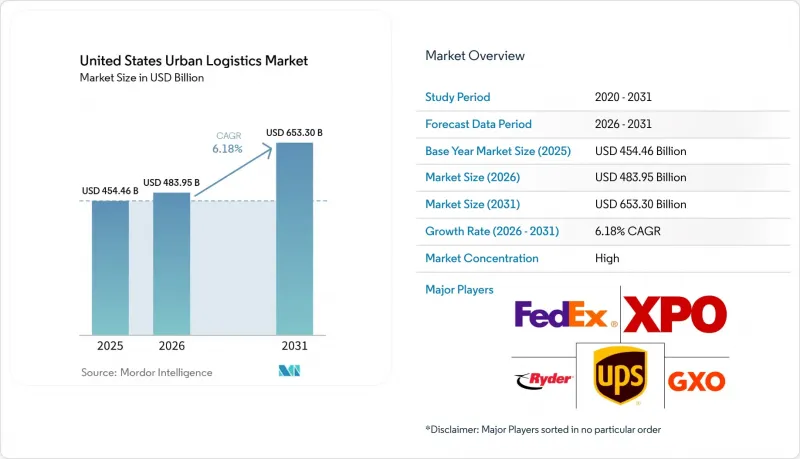
據 Mordor Intelligence 稱,2025 年美國城市物流市場價值 4,544.6 億美元,預計到 2031 年將達到 6,533 億美元,而 2026 年為 4,839.5 億美元,預測期(2026-2031 年)複合年成長率為 6.18%。
電子商務已成為家庭支出的重要組成部分,導致主要城市小包裹密度增加,配送時間要求也更加嚴格。本報告按服務類型(運輸服務、履約服務等)、配送速度(即時/當日達、隔日達等)、客戶類型(B2B、B2C、C2C)、終端用戶行業(電子商務/零售、食品飲料、其他)以及城市(紐約、洛杉磯、其他)進行細分。市場預測以美元計價。
美國城市物流市場的趨勢與洞察
電子商務和全通路訂單的成長
電子商務的擴張持續推動美國城市物流市場貨物吞吐量的成長。 2026年第一季,美國電子商務銷售額達3,267億美元,佔零售總額的16.9%。如今,線上零售不再只是補充管道,而是消費的常態化組成部分,這要求都市區物流供應商能夠預測更廣泛的產品類型、區域收入水平和訂單金額,從而導致更頻繁的住宅小包裹配送。零售商正在將來自門市、路邊取貨點和應用程式的訂單整合到通用的庫存管理系統中,以便應對不斷變化的本地庫存水平,並降低因庫存不足而導致在不同銷售管道出現庫存假象的風險。如今,門市可以在一天之內同時扮演取貨點、退貨點和本地庫存中心的角色。由此產生的物流流程要求承運商處理從倉庫到家庭、從門市到車輛、從退貨點到物流網路以及在同一都會區內進行的點對點(P2P)運輸。
人們越來越希望當天送達以及按指定日期和時間送達。
在美國城市物流市場,消費者期望的配送速度成長速度已經超過了城市基礎設施的反應速度。亞馬遜預測,到2025年,當日達商品數量將比2024年成長近70%,這提高了整個零售業的消費者期望。快速配送要求庫存更靠近消費者,從而改變了設施位置的經濟效益。無法滿足快速配送需求的零售商在獲取和留住客戶方面可能處於劣勢,尤其是在競爭對手能夠在結帳前提供庫存狀態和預計送達時限,並在收貨後提供便捷的本地化退貨服務的情況下。這種轉變也推動了對規模小規模、在地化的設施、更完善的庫存規劃和可靠的配送可視性的需求。在消費者和企業更重視明確送達時限而非即時送達的地區,定時配送仍然至關重要。
都市區營運成本高,配送利潤率低
由於承運商面臨人事費用、房地產和服務成本飆升的困境,都市區的配送利潤依然十分微薄。小包裹承運商計劃在2025年和2026年提高整體運費,同時擴大住宅配送、旺季配送和超大包裹的附加收費範圍。雖然提供加急配送服務的承運商需要在城市內設立本地樞紐,但這些樞紐的租金可能遠高於郊區倉庫。這種成本結構使得維持1小時內送達的目標變得困難,尤其是在美國城市物流市場,訂單分散在出入規則、取貨方式和停車限制各不相同的建築物中,且路線密度不足。司機的人事費用和揀貨成本進一步加重了每次配送的負擔。未能充分實現營運自動化和整合配送目的地的承運商,即使業務量增加,其利潤率也將持續下降。訂單量的增加並不會轉化為盈利的提升;相反,它會增加成本高昂的交接流程、本地設施的處理次數以及配送失敗的機率。
細分市場分析
到2025年,運輸服務將占美國城市物流市場佔有率的40.39%。在任何本地履約模式中,實體小包裹和貨物的運輸仍然至關重要。電子商務訂單、退貨小包裹和全通路交易都促進了運輸業務的成長。履約服務是成長最快的服務領域,預計到2031年將以8.10%的複合年成長率成長。零售商和品牌商正在將更多庫存轉移到都市區微節點,以縮短庫存與客戶之間的距離。在美國城市物流市場,運輸和履約並非相互替代,而是相互關聯的活動。最佳化庫存佈局可以縮短各環節之間的運輸距離,同時增加短程運輸環節的數量。能夠同時提供運輸和配送服務的供應商可以透過單一的營運模式管理庫存可用性和交付執行,從而提高美國城市物流市場應對區域庫存短缺、交付異常和不可預測的退貨量的應對力。
倉儲和城市儲存服務提供緩衝容量,以履行當日達和隔日達的承諾。這使得企業無需將所有貨物永久存放在成本最高的本地設施中。隨著電子商務退貨不斷流入物流網路,逆向物流服務的重要性日益凸顯。加值物流服務包括套件組裝、貼標、聯合包裝和退貨商品評級。這些服務為第三方物流供應商提供了除運輸和倉儲費用之外的商機。藥品和溫控食品的配送也對基於FDA冷鏈標準的差異化服務提出了要求。供應商必須協調包裝、交接、文件記錄和退貨流程,同時確保不影響緊湊的都市區配送時間表。因此,整合服務模式可以減少傳輸次數,明確溫控訂單的責任歸屬,並為零售商提供更清晰的貨物在美國城市物流市場中的儲存、加工和配送記錄。
截至2025年,以配送速度分類,標準配送占美國城市物流市場規模的71.92%。準時、低成本的配送仍然是電子商務交易的主要組成部分。預計到2031年,即時和當日達的複合年成長率將達到7.27%。承運商正在投資建造暗店和微型倉配中心,以實現大規模、快速的配送。亞馬遜2025年當日達業務的成長表明,消費者越來越頻繁地使用更快捷的配送方式。隨著消費者將不太緊急的商品合併購買,減少規劃配送次數,標準配送仍可從中受益。這種行為使得承運商能夠透過合併同一區域的訂單來提高車輛利用率。在美國城市物流市場,服務設計必須透過規劃路線密度來平衡快速履約和低成本。
次日達為那些需要速度但並非即時送達的消費者提供了一種折衷選擇。它也為那些產品種類繁多、無法在兩小時內送達的零售商提供了一種切實可行的服務水平。在醫療保健和工業領域,準時送達至關重要,因為在這些領域,送達時間比速度更為重要。人工智慧驅動的路線最佳化可以縮小不同配送等級之間的營運差異。承諾隔日達的訂單可以在幾小時內完成,而無需改變既定的服務水準。藥品配送涉及額外的監管鏈要求,這使得具備專業能力的業者更具優勢。如果產品需要溫度控制或受管制物質,操作員必須謹慎管理交接和時間表。在美國城市物流市場,醫療保健和工業領域的交接失誤可能比一般零售貨物的延誤造成更嚴重的後果,因此,即使消費者可選擇的更快配送方式越來越多,這些要求也提升了可靠的準時送達服務的價值。
其他好處:
- Excel格式的市場預測(ME)表
- 3個月的分析師支持
目錄
第1章:引言
- 研究假設和市場定義
- 調查範圍
第2章:調查方法
第3章執行摘要
第4章 市場狀況
- 市場概況及城市物流的重要性
- 市場促進因素
- 透過電子商務和全通路通路實現訂單成長
- 人們越來越希望當天送達以及按指定日期和時間送達。
- 零售商店網路作為微型倉配中心
- 人工智慧驅動的配送路線最佳化和配送狀態視覺化。
- 市政微型樞紐和低排放量城市配送方式
- 再交易和高頻逆向流動
- 市場限制因素
- 都市區營運成本高,利潤率低
- 保障司機及留住零工人員
- 路肩通行困難、交通壅塞、送貨時間受限。
- 對平台間資料共用、隱私和互通性的限制
- 產業法規結構
- 價值鍊和分銷管道的結構分析
- 城市物流技術的大趨勢和結構性變化
- 波特五力分析
- 成本結構分析
- 城市基礎設施評估
- 永續性和綠色物流
- 地緣政治事件對供應鏈變化的影響
第5章 市場規模及成長預測(價值,2026-2031 年)
- 按服務類型
- 交通運輸服務
- 倉儲和城市儲存服務
- 履約服務
- 逆向物流服務
- 加值物流(VAL)服務
- 配送速度
- 即時出貨及當日送達
- 隔日送達
- 預定交付
- 標準配送
- 依客戶類型
- 企業對企業 (B2B) 交易
- B2C(Business-to-Consumer)
- 個人對個人(C2C)交易
- 按最終用途行業分類
- 電子商務與零售
- 食品/飲料
- 醫療和藥品
- 家用電子產品
- 時尚與服裝
- 汽車零件
- 工業和製造業
- 其他
- 按城市
- 紐約
- 洛杉磯
- 芝加哥
- 休士頓
- 鳳凰
- 費城
- 聖安東尼奧
- 聖地牙哥
- 達拉斯
- 其他城市
第6章 競爭情勢
- 市場集中度
- 關鍵策略趨勢
- 市佔率分析
- 公司簡介
- United Parcel Service, Inc.
- FedEx Corporation
- Ryder System, Inc.
- XPO, Inc.
- GXO Logistics, Inc.
- CH Robinson Worldwide, Inc.
- JB Hunt Transport Services, Inc.
- DHL Group
- OnTrac Logistics, Inc.
- AIT Worldwide Logistics, Inc.
- Hub Group, Inc.
- Capstone Logistics, LLC
- Amazon.com, Inc.
- Veho Logistics LLC
- General Logistics Systems US Inc.
- Lone Star Overnight, LLC
- ShipBob, Inc.
- BedaBox, LLC(ShipMonk)
- US Pack Logistics, LLC
- Dropoff, Inc.
- Courier Express US Inc.
第7章 市場機會與未來展望
According to Mordor Intelligence, the United States urban logistics market size was valued at USD 454.46 billion in 2025 and is estimated to grow from USD 483.95 billion in 2026 to reach USD 653.30 billion by 2031, at a CAGR of 6.18% during the forecast period (2026-2031).
E-commerce has become a durable part of household spending, which increases parcel density and tightens delivery windows in major cities. This report is Segmented by Service Type (Transportation Services, Fulfillment Services, and More), by Delivery Speed (Instant and Same-Day Delivery, Next-Day Delivery, and More), by Customer Type (B2B, B2C, and C2C), by End-Use Industry (E-Commerce and Retail, Food and Beverage, and More), and by City (New York, Los Angeles, and More). The Market Forecasts are Provided in Terms of Value (USD).
United States Urban Logistics Market Trends and Insights
E-Commerce and Omnichannel Order Growth
E-commerce expansion continues to increase the volume available to the United States urban logistics market. United States e-commerce sales reached USD 326.7 billion in the first quarter of 2026 and represented 16.9% of total retail sales. That level makes online retail a lasting part of consumption instead of a supplementary channel, and it means that urban providers must plan for regular residential parcel activity across a wider range of product types, neighborhood income levels, and order values. Retailers are linking store, curbside, and app orders with shared inventory systems, which helps them respond to local availability changes and reduce the risk that separate sales channels promise stock that is no longer accessible. A store can now act as a pickup point, a return site, and a local stock location during the same day. The resulting flows require carriers to handle warehouse-to-home, store-to-vehicle, return-to-network, and peer-to-peer movements within the same urban area.
Rising Expectations for Same-Day and Scheduled Delivery
The expected delivery speed in the United States urban logistics market is rising faster than city infrastructure can adapt. Amazon delivered nearly 70% more same-day items in 2025 than in 2024, which raised customer expectations across retail categories. Fast delivery requires stock to be positioned close to consumers and changes the economics of facility location. Retailers that cannot support short delivery windows can face a disadvantage in acquiring and retaining customers, particularly when competing retailers can make stock availability and estimated arrival time visible before checkout and provide convenient local return options after delivery. The shift also increases demand for small local facilities, precise inventory planning, and reliable delivery visibility. Scheduled delivery remains important where consumers and businesses value a defined arrival window over immediate fulfillment.
High Urban Operating Costs and Narrow Delivery Margins
Urban delivery margins remain narrow because carriers face higher labor, real estate, and service costs. Parcel carriers raised general rates in 2025 and 2026 while extending charges for residential, peak-period, and oversize deliveries. Fast delivery providers need local facilities within city boundaries, where rents can be materially higher than at suburban warehouses. This cost structure makes sub-hour delivery harder to sustain without enough route density, especially when orders are dispersed across buildings with different access rules, delivery reception practices, and parking limitations in the United States urban logistics market. Driver replacement and picking costs add further pressure on each delivery. Operators that cannot automate work or consolidate enough stops will continue to face weaker margins even when volumes grow, as more orders can simply increase the number of costly handoffs, local facility touches, and unsuccessful delivery attempts rather than improve returns.
Other drivers and restraints analyzed in the detailed report include:
- AI-Powered Routing and Delivery Visibility
- Retail Store Networks as Micro-Fulfillment Nodes
- Driver Availability and Gig-Worker Retention
For complete list of drivers and restraints, kindly check the Table Of Contents.
Segment Analysis
Transportation services held 40.39% of the United States urban logistics market share in 2025. Physical parcel and freight movement remains necessary across every local fulfillment model. Each e-commerce order, return parcel, and omnichannel transaction adds transportation activity. The fulfillment services segment is the fastest-growing service at an 8.10% CAGR through 2031. Retailers and brands are moving more inventory into urban micro-nodes to reduce the distance between stock and customers. Transportation and fulfillment are sequential activities, rather than substitutes, within the United States urban logistics market. Better inventory placement can increase the number of short transport legs even as it reduces the distance traveled on each leg. Providers that combine both capabilities can manage inventory availability and delivery execution through a single operating model, which can improve response to local stock shortages, delivery exceptions, and unpredictable return volumes in the United States urban logistics market.
Warehousing and urban storage Services provide buffer capacity for same-day and next-day commitments. They allow operators to avoid the permanent placement of every item in the most expensive local facilities. Reverse logistics services are gaining importance as e-commerce returns create recurring flows back into networks. Value-added logistics services include kitting, labeling, co-packing, and returns grading. These services give 3PLs opportunities beyond transportation and storage fees. Pharmaceutical and temperature-sensitive food deliveries also create requirements that can support differentiated services under FDA cold-chain standards. Providers must coordinate packaging, handoffs, documentation, and returns without disrupting tight urban delivery schedules. Integrated service models can therefore reduce the number of transfers and improve accountability for sensitive orders, while providing retailers with a clearer record of where goods are held, processed, and delivered within the United States urban logistics market.
Standard delivery accounted for 71.92% of the United States urban logistics market size by delivery speed in 2025. Scheduled, lower-cost delivery still serves most e-commerce volume. Instant and same-day delivery is forecast to expand at a 7.27% CAGR through 2031. Carriers are investing in dark stores and micro-fulfillment capacity to make rapid delivery workable at scale. Amazon's 2025 same-day delivery growth demonstrates that customers are using faster options more often. The standard tier can still benefit when shoppers group nonurgent items into fewer planned deliveries. This behavior can improve vehicle utilization when carriers consolidate orders going to the same neighborhood. In the United States urban logistics market, service design must balance rapid fulfillment with the lower cost of planned route density.
Next-day delivery provides a middle option for consumers who need speed but not immediate fulfillment. It also gives retailers a practical service level when their catalog cannot support sub-2-hour delivery. Scheduled delivery has a role in healthcare and industrial uses where timed arrival matters more than speed. AI routing can reduce the operational difference among these delivery tiers. An order promised for the next day can sometimes be fulfilled in hours without changing the stated service level. Pharmaceutical deliveries add chain-of-custody requirements that favor providers with dedicated capabilities. Operators need to manage handoffs and timing carefully when the product has temperature or controlled-substance requirements. These requirements make reliable scheduled service valuable even as faster consumer delivery options expand, because a missed clinical or industrial handoff can carry greater consequences than a delayed general retail parcel in the United States urban logistics market.
Complete Report Scope:
- By Service Type
- Transportation Services
- Warehousing and Urban Storage Services
- Fulfillment Services
- Reverse Logistics Services
- Value-Added Logistics (VAL) Services
- By Delivery Speed
- Instant and Same-Day Delivery
- Next-Day Delivery
- Scheduled Delivery
- Standard Delivery
- By Customer Type
- Business-to-Business (B2B)
- Business-to-Consumer (B2C)
- Consumer-to-Consumer (C2C)
- By End-Use Industry
- E-commerce and Retail
- Food and Beverage
- Healthcare and Pharmaceuticals
- Consumer Electronics
- Fashion and Apparel
- Automotive Parts
- Industrial and Manufacturing
- Others
- By City
- New York
- Los Angeles
- Chicago
- Houston
- Phoenix
- Philadelphia
- San Antonio
- San Diego
- Dallas
- Rest of Cities
List of Companies Covered in this Report:
- United Parcel Service, Inc.
- FedEx Corporation
- Ryder System, Inc.
- XPO, Inc.
- GXO Logistics, Inc.
- C.H. Robinson Worldwide, Inc.
- J.B. Hunt Transport Services, Inc.
- DHL Group
- OnTrac Logistics, Inc.
- AIT Worldwide Logistics, Inc.
- Hub Group, Inc.
- Capstone Logistics, LLC
- Amazon.com, Inc.
- Veho Logistics LLC
- General Logistics Systems US Inc.
- Lone Star Overnight, LLC
- ShipBob, Inc.
- BedaBox, LLC (ShipMonk)
- US Pack Logistics, LLC
- Dropoff, Inc.
- Courier Express US Inc.
Additional Benefits:
- The market estimate (ME) sheet in Excel format
- 3 months of analyst support
TABLE OF CONTENTS
1 Introduction
- 1.1 Study Assumptions and Market Definition
- 1.2 Scope of the Study
2 Research Methodology
3 Executive Summary
4 Market Landscape
- 4.1 Market Overview and Importance of Urban Logistics
- 4.2 Market Drivers
- 4.2.1 E-Commerce and Omnichannel Order Growth
- 4.2.2 Rising Expectations for Same-Day and Scheduled Delivery
- 4.2.3 Retail Store Networks as Micro-Fulfillment Nodes
- 4.2.4 AI-Powered Routing and Delivery Visibility
- 4.2.5 Municipal Microhubs and Low-Emission Urban Delivery Modes
- 4.2.6 Recommerce and Higher-Frequency Reverse Flows
- 4.3 Market Restraints
- 4.3.1 High Urban Operating Costs and Narrow Delivery Margins
- 4.3.2 Driver Availability and Gig-Worker Retention
- 4.3.3 Curb Access, Congestion and Delivery-Time Restrictions
- 4.3.4 Data-Sharing, Privacy and Platform-Interoperability Constraints
- 4.4 Industry Regulatory Framework
- 4.5 Value Chain and Distribution Channel Architecture Analysis
- 4.6 Technology Megatrends and Structural Shifts in Urban Logistics
- 4.7 Porter's Five Forces Analysis
- 4.7.1 Threat of New Entrants
- 4.7.2 Bargaining Power of Suppliers
- 4.7.3 Bargaining Power of Buyers
- 4.7.4 Threat of Substitutes
- 4.7.5 Rivalry Among Competitors
- 4.8 Cost Structure Analysis
- 4.9 Urban Infrastructure Assessment
- 4.10 Sustainability and Green Logistics
- 4.11 Impact of Geo-Political Events on Supply Chain Shifts
5 Market Size and Growth Forecasts (Value, 2026-2031)
- 5.1 By Service Type
- 5.1.1 Transportation Services
- 5.1.2 Warehousing and Urban Storage Services
- 5.1.3 Fulfillment Services
- 5.1.4 Reverse Logistics Services
- 5.1.5 Value-Added Logistics (VAL) Services
- 5.2 By Delivery Speed
- 5.2.1 Instant and Same-Day Delivery
- 5.2.2 Next-Day Delivery
- 5.2.3 Scheduled Delivery
- 5.2.4 Standard Delivery
- 5.3 By Customer Type
- 5.3.1 Business-to-Business (B2B)
- 5.3.2 Business-to-Consumer (B2C)
- 5.3.3 Consumer-to-Consumer (C2C)
- 5.4 By End-Use Industry
- 5.4.1 E-commerce and Retail
- 5.4.2 Food and Beverage
- 5.4.3 Healthcare and Pharmaceuticals
- 5.4.4 Consumer Electronics
- 5.4.5 Fashion and Apparel
- 5.4.6 Automotive Parts
- 5.4.7 Industrial and Manufacturing
- 5.4.8 Others
- 5.5 By City
- 5.5.1 New York
- 5.5.2 Los Angeles
- 5.5.3 Chicago
- 5.5.4 Houston
- 5.5.5 Phoenix
- 5.5.6 Philadelphia
- 5.5.7 San Antonio
- 5.5.8 San Diego
- 5.5.9 Dallas
- 5.5.10 Rest of Cities
6 Competitive Landscape
- 6.1 Market Concentration
- 6.2 Key Strategic Moves
- 6.3 Market Share Analysis
- 6.4 Company Profiles (includes Global level Overview, Market level overview, Core Segments, Financials as available, Strategic Information, Geographic Presence, Products and Services, and Recent Developments)
- 6.4.1 United Parcel Service, Inc.
- 6.4.2 FedEx Corporation
- 6.4.3 Ryder System, Inc.
- 6.4.4 XPO, Inc.
- 6.4.5 GXO Logistics, Inc.
- 6.4.6 C.H. Robinson Worldwide, Inc.
- 6.4.7 J.B. Hunt Transport Services, Inc.
- 6.4.8 DHL Group
- 6.4.9 OnTrac Logistics, Inc.
- 6.4.10 AIT Worldwide Logistics, Inc.
- 6.4.11 Hub Group, Inc.
- 6.4.12 Capstone Logistics, LLC
- 6.4.13 Amazon.com, Inc.
- 6.4.14 Veho Logistics LLC
- 6.4.15 General Logistics Systems US Inc.
- 6.4.16 Lone Star Overnight, LLC
- 6.4.17 ShipBob, Inc.
- 6.4.18 BedaBox, LLC (ShipMonk)
- 6.4.19 US Pack Logistics, LLC
- 6.4.20 Dropoff, Inc.
- 6.4.21 Courier Express US Inc.
7 Market Opportunities and Future Outlook
- 7.1 White-space and Unmet-Need Assessment

 全球災害救援物流市場(2026-2030 年)
 寵物物流市場:全球市場預測,2026-2032年
 本地配送網路市場預測至2034年-按服務地點類型、網路模型、服務、技術、位置類型和區域分類的全球分析伸縮式整平機市場:全球市場預測,2026-2032年2026-2030年全球工業物流市場2026-2030年全球電子商務及物流市場城市物流市場預測至2034年-按服務類型、配送模式、車輛類型、技術、最終用戶和地區分類的全球分析智慧物流市場預測至2034年-按解決方案類型、技術、部署模式、組織規模、最終用戶和地區分類的全球分析
 JIT(即時)物流市場規模、佔有率和成長分析:按服務類型、運輸方式、最終用戶、公司規模、部署和地區分類 - 行業預測,2026-2033 年碼頭邊緣整平機市場:全球市場預測,2026-2032年