


 |
市場調查報告書
商品編碼
2155314
扁鋼:市場佔有率分析、產業趨勢與統計、成長預測(2026-2031)Flat Steel - Market Share Analysis, Industry Trends & Statistics, Growth Forecasts (2026 - 2031) |
||||||

※ 本網頁內容可能與最新版本有所差異。詳細情況請與我們聯繫。
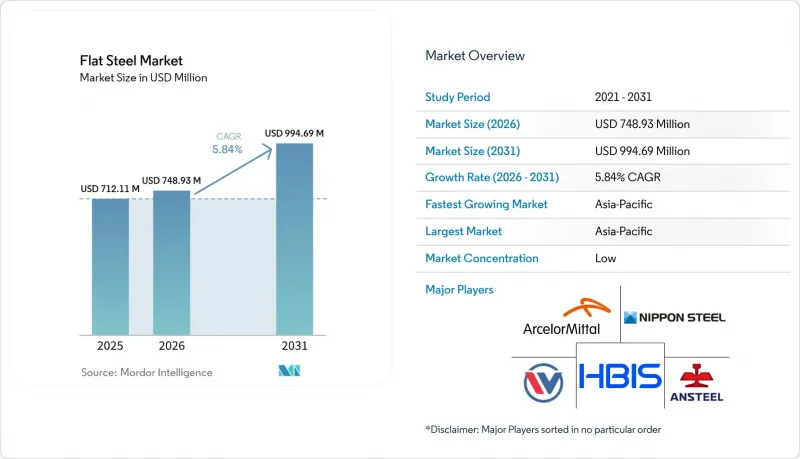
根據 Mordor Intelligence 估計,2025 年扁鋼市場規模為 7.1211 億美元,預計在預測期(2026-2031 年)內將以 5.84% 的複合年成長率成長,從 2026 年的 7.4893 億美元成長到 2031 年的 9.9469 億美元。
全球扁鋼市場趨勢及洞察
基礎設施更新和產業建設
政府主導的資本支出仍是建築外牆、橋面、倉庫和工業設施用扁鋼產品需求的可靠來源。在國家基礎建設項目和汽車生產的推動下,印度的鋼鐵需求在2025年有所增加。美國正將其公共基礎設施支出和造船計畫的重點放在結構鋼的應用上。美國於2026年2月宣布的《海事行動計畫》將進一步刺激該產業的需求。在預製和模組化建築中,塗層和塗漆鋼板的使用頻率高於現場成型構件,這使得扁鋼市場對產品品質和表面處理的要求日益提高。
汽車輕量化和電動車生產
由於電動車(EV)平台的發展導致電池組重量增加400-800公斤,對扁鋼的需求模式正在改變。汽車製造商正在使用熱壓硬化鋼、冷軋雙相鋼和先進高抗張強度鋼來控制車身重量並保護電池系統。與傳統鋼材相比,先進高抗張強度鋼可將車輛結構重量減輕15-25%。這些鋼材等級允許使用更薄的車身結構部件,同時保持碰撞安全性能。因此,產品組合正從傳統的熱軋鋼卷轉向滿足更嚴格認證要求的特殊材料。這有利於那些能夠在主要汽車製造地附近可靠地供應汽車級產品的製造商。
全球鋼鐵產量過剩和出口壓力
預計到2025年,全球鋼鐵產能過剩將達6.4億噸,2028年將增加至7.45億噸。受房地產市場低迷的影響,中國鋼鐵生產轉向出口市場,2025年中國鋼鐵出口量創下1.312億噸的歷史新高。這項轉變對東協、南美洲和歐洲的熱軋和冷軋扁平材生產商產生了特別顯著的影響。 2025年,中國對東南亞的半成品鋼鐵出口成長了300%,其中部分產品經加工後再次出口。根據經合組織的數據,2025年共進行了75項新的反傾銷和反補貼調查。儘管貿易措施可能限制部分進口,但並不能解決產能過剩的根本問題及其對價格的影響。
細分市場分析
2025年,板材和帶材在扁平鋼市場以金額為準佔高達74.73%。這反映了它們在汽車車身面板、家用電器機殼、建築外牆和太陽能發電支架框架等領域的廣泛應用。鋼板則用於壓力容器、造船和重型機械框架等較專業的領域。板材和帶材廣泛的終端應用解釋了它們佔據主導地位的原因。通用熱軋鋼卷是該產品系列中銷量大但利潤率低的細分市場。而冷軋和塗層產品則由於對錶面品質、成形性和耐腐蝕性有更嚴格的要求,因此具有更高的附加價值。
預計2026年至2031年,板材和帶材市場將以6.34%的複合年成長率成長。這一成長主要得益於用於屋頂材料、太陽能板基板和電動車結構件的鋅鋁鎂塗層產品。隨著日本工業標準的製定,國內生產越來越符合汽車OEM廠商對先進高強度鋼材的要求。為了應對通用捲材市場的競爭壓力,供應商正轉向更高附加價值的表面處理和更高等級的產品。由於板材和帶材的重要性,捲材價格的波動持續影響整個扁鋼市場。生產商可以透過增加塗層產品、汽車級鋼材和其他差異化產品類型的銷售來緩解這種影響。
區域分析
預計到2025年,亞太地區將佔據全球鋼板市場佔有率的44.39%,並在2031年之前以6.27%的複合年成長率成長。在中國,受房地產市場持續低迷的影響,2025年國內鋼板消費量下降了6.9%。印度的鋼鐵需求在2025年增加了9.8%。東協地區的鋼鐵需求在2025年增加了4.3%,這主要得益於製造業和公共基礎設施項目的投資。韓國和日本的鋼鐵需求在2025年合計下降了5.1%。
北美是扁鋼市場第二大區域。 2025年,美國扁鋼需求成長0.7%,工業活動和公共基礎設施支出抵銷了住宅建設放緩的影響。加拿大2025年扁鋼需求成長2.7%,而墨西哥則下降4.6%。 2025年6月起,美國對扁鋼徵收的232條款關稅提高至50%,在一定程度上緩解了國內生產商的進口壓力。美國海事行動計畫預計也將支撐造船業的鋼板需求。 2025年,電弧爐製造商占美國國內扁鋼出貨量的60%,該地區在該生產領域佔據了穩固地位。
預計2025年歐洲扁鋼需求將下降1.2%,其中法國將下降12.6%,德國將下降6.1%。 2026年4月,歐盟將把過剩鋼材的關稅從25%提高到50%,並將扁鋼進口配額限制在歐盟消費量的15%。預計2025年南美洲扁鋼需求將成長0.7%。預計2025年中東扁鋼需求將成長6.4%,而非洲扁鋼需求預計將成長16.1%,主要得益於建築和能源基礎設施投資的推動。
其他好處:
- Excel格式的市場預測(ME)表
- 3個月的分析師支持
目錄
第1章:引言
- 研究假設和市場定義
- 調查範圍
第2章:調查方法
第3章執行摘要
第4章 市場狀況
- 市場概覽
- 市場促進因素
- 基礎設施更新和工業建設
- 汽車輕量化和電動車生產
- 可再生能源以及輸配電設施的擴建
- 塗層鋼和耐腐蝕扁鋼的成長
- 採用先進的高抗張強度鋼
- 市場限制因素
- 全球鋼鐵業供應過剩和出口壓力
- 鐵礦石、焦結煤和廢金屬價格的波動。
- 應對碳排放法規和脫碳所需的資本
- 價值鏈分析
- 波特五力分析
第5章 市場規模與成長預測
- 依產品類型
- 片材和條帶
- 盤子
- 透過生產過程
- 鹼性氧反應器
- 電弧爐
- 其他
- 按最終用戶行業分類
- 架構和基礎設施
- 機械設備
- 汽車和其他運輸設備
- 可再生能源和電力設施
- 其他最終用途領域
- 按地區
- 亞太地區
- 中國
- 印度
- 日本
- 韓國
- 東南亞國協
- 其他亞太國家
- 北美洲
- 美國
- 加拿大
- 墨西哥
- 歐洲
- 德國
- 英國
- 法國
- 義大利
- 北歐國家
- 俄羅斯
- 其他歐洲國家
- 南美洲
- 巴西
- 阿根廷
- 其他南美國家
- 中東和非洲
- 沙烏地阿拉伯
- 南非
- 其他中東和非洲國家
- 亞太地區
第6章 競爭情勢
- 市場集中度
- 策略趨勢
- 市佔率和排名分析
- 公司簡介
- Ansteel Group Corporation Limited
- ARCELORMITTAL
- BAOWU Metal
- Cleveland-Cliffs Inc.
- HBIS GROUP
- HYUNDAI Corporation
- JFE Steel Corporation
- JSW Steel Limited
- NIPPON STEEL CORPORATION
- Nucor Corporation
- Posco Group
- SHAGANG GROUP Inc.
- Shandong Jianlong Steel Co.
- Shougang Group Co., Ltd.
- Tata Steel Limited
- United States Steel Corporation
第7章 市場機會與未來展望
According to Mordor Intelligence, the flat steel market size was estimated at USD 712.11 million in 2025 and is estimated to grow from USD 748.93 million in 2026 to USD 994.69 million by 2031, at a CAGR of 5.84% during the forecast period (2026-2031).
Global Flat Steel Market Trends and Insights
Infrastructure Renewal and Industrial Construction
Government-backed capital spending remains a reliable source of demand for flat steel products used in building envelopes, bridge decks, warehouses, and industrial facilities. India's steel demand grew in 2025, supported by the National Infrastructure Pipeline and automotive production. The United States is directing public infrastructure spending and shipbuilding plans toward applications that use structural plate. America's Maritime Action Plan, released in February 2026, provides an additional channel for this demand. Prefabricated and modular construction uses coated and pre-painted sheets more frequently than site-formed sections, increasing the importance of product quality and finishing within the flat steel market.
Automotive Lightweighting and Electric Vehicle Production
Electric vehicle platforms create a different demand pattern for flat steel because battery packs add 400 to 800 kilograms of weight. Automakers use press-hardened steel, cold-rolled dual-phase grades, and advanced high-strength steel to manage vehicle weight and protect battery systems. Advanced high-strength steel can reduce vehicle structural weight by 15% to 25% compared with conventional steel. These grades support crash performance while allowing thinner components in body structures. The product mix, therefore, shifts away from conventional hot-rolled coil and toward specialized materials with tighter certification requirements. This favors producers that can consistently supply automotive-grade products near major vehicle manufacturing centers.
Global Steel Overcapacity and Export Pressure
Global excess steelmaking capacity reached 640 million tons in 2025 and is projected to rise to 745 million tons by 2028. China exported a record 131.2 million tons of steel in 2025, as weaker real estate activity redirected output toward export markets. This shift particularly affects producers in ASEAN, South America, and Europe that sell hot-rolled and cold-rolled flat products. China's semi-finished steel exports to Southeast Asia increased by 300% in 2025, and some of the material was re-exported after processing. The OECD recorded 75 new antidumping and countervailing duty investigations in 2025. Trade actions may limit some imports, but they do not address the underlying surplus or its effect on prices.
Other drivers and restraints analyzed in the detailed report include:
- Renewable Energy and Grid Equipment Expansion
- Advanced High-Strength Steel Adoption
- Volatile Iron Ore, Coking Coal, and Scrap Costs
For complete list of drivers and restraints, kindly check the Table Of Contents.
Segment Analysis
Sheets and strips held 74.73% of the flat steel market share by value in 2025. This reflects their use in automotive body panels, appliance casings, building envelopes, and solar racking frames. Plates are used in more specialized applications, including pressure vessels, shipbuilding, and heavy machinery frames. The wider range of end uses for sheets and strips explains their dominant position. Commodity hot-rolled coil represents the larger-output, lower-margin segment within this product group. Cold-rolled and coated variants carry a higher value due to tighter requirements for surface quality, forming, and corrosion performance.
Sheets and strips are forecast to grow at a 6.34% CAGR from 2026 to 2031. This growth is supported by zinc-aluminum-magnesium-coated products used in roofing, solar substrates, and electric vehicle structures. Japan's industrial standards work has more closely aligned domestic production with automotive original equipment manufacturer requirements for advanced high-strength grades. Suppliers are responding to competitive pressure in commodity coil by expanding into value-added finishes and higher-grade products. The heavy reliance on sheets and strips means changes in coil prices continue to influence the broader flat steel market. Producers can reduce this exposure by growing sales in coatings, automotive grades, and other differentiated product categories.
Complete Report Scope:
- By Product Type
- Sheets and Strips
- Plates
- By Production Process
- Basic Oxygen Furnace
- Electric Arc Furnace
- Others
- By End-User Industry
- Building and Infrastructure
- Mechanical Equipment
- Automotive and Other Transport
- Renewable Energy and Power Equipment
- Other End-Use Sectors
- By Geography
- Asia-Pacific
- China
- India
- Japan
- South Korea
- ASEAN Countries
- Rest of Asia-Pacific
- North America
- United States
- Canada
- Mexico
- Europe
- Germany
- United Kingdom
- France
- Italy
- NORDIC Countries
- Russia
- Rest of Europe
- South America
- Brazil
- Argentina
- Rest of South America
- Middle East and Africa
- Saudi Arabia
- South Africa
- Rest of Middle East and Africa
- Asia-Pacific
Geography Analysis
Asia-Pacific held 44.39% of the flat steel market share in 2025 and is forecast to grow at a 6.27% CAGR through 2031. China's domestic flat steel consumption declined 6.9% in 2025 as its real estate downturn continued. India's steel demand grew 9.8% in 2025. ASEAN demand grew 4.3% in 2025, supported by manufacturing investment and public infrastructure programs. South Korea and Japan recorded a combined 5.1% decline in demand in 2025.
North America is the second-largest region in the flat steel market. United States demand grew 0.7% in 2025, with industrial activity and public infrastructure spending helping to offset weak residential construction. Canada recorded 2.7% demand growth in 2025, while Mexico recorded a 4.6% decline. Section 232 tariffs, increased to 50% in June 2025, limited some import pressure on domestic producers. America's Maritime Action Plan is also expected to support plate demand from shipbuilding. Electric arc furnace producers accounted for 60% of domestic flat steel shipments in 2025, positioning the region strongly in this production route.
Europe's flat steel demand declined 1.2% in 2025, with France down 12.6% and Germany down 6.1%. The European Union raised above-quota steel tariffs from 25% to 50% in April 2026 and capped flat steel import quotas at 15% of European Union consumption. South America's demand grew 0.7% in 2025. Middle East demand grew 6.4% in 2025, while Africa grew 16.1%, supported by construction and energy infrastructure investment.
- Ansteel Group Corporation Limited
- ARCELORMITTAL
- BAOWU Metal
- Cleveland-Cliffs Inc.
- HBIS GROUP
- HYUNDAI Corporation
- JFE Steel Corporation
- JSW Steel Limited
- NIPPON STEEL CORPORATION
- Nucor Corporation
- Posco Group
- SHAGANG GROUP Inc.
- Shandong Jianlong Steel Co.
- Shougang Group Co., Ltd.
- Tata Steel Limited
- United States Steel Corporation
Additional Benefits:
- The market estimate (ME) sheet in Excel format
- 3 months of analyst support
TABLE OF CONTENTS
1 Introduction
- 1.1 Study Assumptions and Market Definition
- 1.2 Scope of the Study
2 Research Methodology
3 Executive Summary
4 Market Landscape
- 4.1 Market Overview
- 4.2 Market Drivers
- 4.2.1 Infrastructure Renewal and Industrial Construction
- 4.2.2 Automotive Lightweighting and Electric Vehicle Production
- 4.2.3 Renewable Energy and Grid Equipment Expansion
- 4.2.4 Growth of Coated and Corrosion-Resistant Flat Steel
- 4.2.5 Advanced High-Strength Steel Adoption
- 4.3 Market Restraints
- 4.3.1 Global Steel Overcapacity and Export Pressure
- 4.3.2 Volatile Iron Ore, Coking Coal and Scrap Costs
- 4.3.3 Carbon Compliance and Decarbonization Capital Requirements
- 4.4 Value Chain Analysis
- 4.5 Porter's Five Forces Analysis
- 4.5.1 Bargaining Power of Suppliers
- 4.5.2 Bargaining Power of Buyers
- 4.5.3 Threat of New Entrants
- 4.5.4 Threat of Substitutes
- 4.5.5 Competitive Rivalry
5 Market Size and Growth Forecasts (Value)
- 5.1 By Product Type
- 5.1.1 Sheets and Strips
- 5.1.2 Plates
- 5.2 By Production Process
- 5.2.1 Basic Oxygen Furnace
- 5.2.2 Electric Arc Furnace
- 5.2.3 Others
- 5.3 By End-User Industry
- 5.3.1 Building and Infrastructure
- 5.3.2 Mechanical Equipment
- 5.3.3 Automotive and Other Transport
- 5.3.4 Renewable Energy and Power Equipment
- 5.3.5 Other End-Use Sectors
- 5.4 By Geography
- 5.4.1 Asia-Pacific
- 5.4.1.1 China
- 5.4.1.2 India
- 5.4.1.3 Japan
- 5.4.1.4 South Korea
- 5.4.1.5 ASEAN Countries
- 5.4.1.6 Rest of Asia-Pacific
- 5.4.2 North America
- 5.4.2.1 United States
- 5.4.2.2 Canada
- 5.4.2.3 Mexico
- 5.4.3 Europe
- 5.4.3.1 Germany
- 5.4.3.2 United Kingdom
- 5.4.3.3 France
- 5.4.3.4 Italy
- 5.4.3.5 NORDIC Countries
- 5.4.3.6 Russia
- 5.4.3.7 Rest of Europe
- 5.4.4 South America
- 5.4.4.1 Brazil
- 5.4.4.2 Argentina
- 5.4.4.3 Rest of South America
- 5.4.5 Middle East and Africa
- 5.4.5.1 Saudi Arabia
- 5.4.5.2 South Africa
- 5.4.5.3 Rest of Middle East and Africa
- 5.4.1 Asia-Pacific
6 Competitive Landscape
- 6.1 Market Concentration
- 6.2 Strategic Moves
- 6.3 Market Share (%)/Ranking Analysis
- 6.4 Company Profiles (includes Global Overview, Market Overview, Core Segments, Financials as available, Strategic Information, Products and Services, and Recent Developments)
- 6.4.1 Ansteel Group Corporation Limited
- 6.4.2 ARCELORMITTAL
- 6.4.3 BAOWU Metal
- 6.4.4 Cleveland-Cliffs Inc.
- 6.4.5 HBIS GROUP
- 6.4.6 HYUNDAI Corporation
- 6.4.7 JFE Steel Corporation
- 6.4.8 JSW Steel Limited
- 6.4.9 NIPPON STEEL CORPORATION
- 6.4.10 Nucor Corporation
- 6.4.11 Posco Group
- 6.4.12 SHAGANG GROUP Inc.
- 6.4.13 Shandong Jianlong Steel Co.
- 6.4.14 Shougang Group Co., Ltd.
- 6.4.15 Tata Steel Limited
- 6.4.16 United States Steel Corporation
7 Market Opportunities and Future Outlook
- 7.1 White-Space and Unmet-Need Assessment

 厚壁抗裂鋼市場:全球市場預測(2026-2032年)工業熱軋中等重量鋼板市場:全球市場預測,2026-2032年用於烘焙的熱處理麵粉市場:全球市場預測,2026-2032年超厚抗裂鋼板市場:全球市場預測(2026-2032年)
 鋼板市場-全球產業規模、佔有率、趨勢、機會、預測:銷售管道、最終用途、地區和競爭格局(2021-2031年)
 扁鋼市場規模、佔有率、趨勢及預測(依產品、材質、應用及地區分類),2026-2034年
 2026年全球扁鋼市場報告全球耐磨堆焊鋼板市場(依材質類型、製程類型、焊接技術、塗層厚度、最終用途產業和應用分類)-2026-2032年預測按木材類型、處理方法、用途和通路分類的熱處理木材市場-2026年至2032年全球預測按連接方式、材料組合、應用、通路和最終用途產業分類的複合鋼板市場-2026年至2032年全球預測