


 |
市場調查報告書
商品編碼
2155307
中國工業製造物流:市場佔有率分析、產業趨勢與統計、成長預測(2026-2031年)China Industrial Manufacturing Logistics - Market Share Analysis, Industry Trends & Statistics, Growth Forecasts (2026 - 2031) |
||||||

※ 本網頁內容可能與最新版本有所差異。詳細情況請與我們聯繫。
根據 Mordor Intelligence 的數據顯示,2025 年中國工業製造物流市場規模為 5,245.4 億美元,預計到 2031 年將達到 7,499.9 億美元,而 2026 年為 5,618.3 億美元,預測期內(2026-2031 年)複合年成長率為 5.95%。
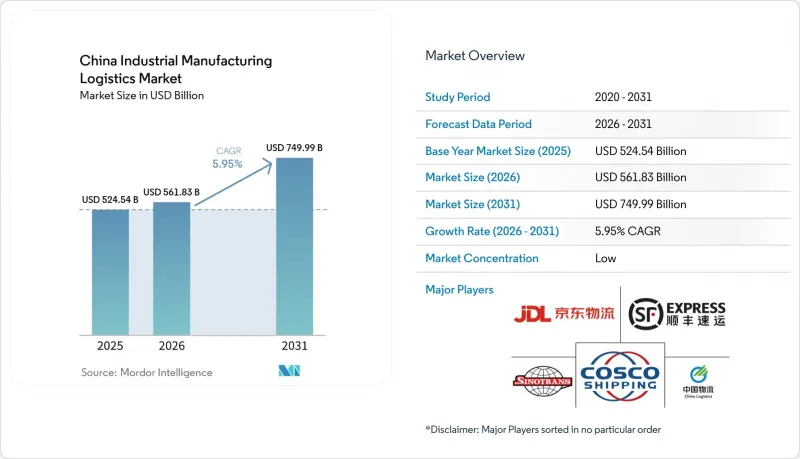
中國工業製造物流市場趨勢與洞察
設備和高科技製造業的工業進步
先進製造技術的普及催生了新的物流需求,而這些需求並非總是能透過標準的貨運代理服務來滿足。精密儀器、航太零件和半導體基板等產品需要溫控、保稅倉儲和完善的儲存系統。這些需求凸顯了專業化處理和可靠流程管理的重要性。採用更整合化生產系統的製造企業也需要能夠與其工廠系統協同工作的物流合作夥伴。因此,供應商的選擇標準不再局限於貨運和交貨時間。擁有可互通的倉儲系統和協調的數位化營運能力的供應商,在中國工業製造物流市場中佔據優勢,能夠更好地服務這些客戶。
製造商將非核心物流職能外包
汽車、醫療設備和新能源設備製造商正將越來越多的供應鏈營運外包給專業的物流供應商。這種轉變使製造商能夠專注於生產、產品研發和客戶承諾。順豐控股的報告預測,到2025年,高科技、工業設備、汽車和食品業的物流總收入預計將成長超過20%。這一成長率超過了相關產業的物流成長率,顯示價值鏈中對高附加價值服務的需求日益成長。製造商也在尋求能夠支援其生產計畫和庫存管理決策的可視化數據。這使得在中國工業製造物流市場更容易獲得規模更大、期限更長的服務合約。
內陸製造地物流基礎設施不平衡
在中國中西部部分地區,產業遷移速度超過了物流基礎設施的發展速度。儘管「十四五」期間鐵路和公路網路得到改善,但工業園區與多式聯運樞紐之間的連接仍然不均衡。低度開發內陸地區的業者可能面臨路線碎片化、回程運輸能力利用不足以及營運成本高等挑戰。這些問題可能會阻礙中國工業製造物流市場服務的擴張。
細分市場分析
至2025年,運輸業將佔中國工業製造物流市場的59.50%。由於工業產品仍需要在供應商、工廠、倉庫、港口和客戶之間進行實體運輸,因此該領域仍佔據主導地位。公路貨運在製造群之間的中短途配送中繼續發揮著至關重要的作用。鐵路在連接沿海和內陸生產基地的長途國內線路上日益重要。空運主要用於運輸電子設備和藥品,因為在這些運輸中,速度和裝卸控制比運費更為重要。內河和海運也正被用作低碳多式聯運方式。中國首條零碳內河海運走廊於2026年6月30日投入運營,該走廊使用電動內河船舶連接嘉興港和寧波舟山港。據專案資料顯示,該走廊每個貨櫃可減少60公斤二氧化碳排放。
預計到2031年,附加價值服務及其他細分領域將以7.90%的複合年成長率成長。這些細分領域包括套件組裝、逆向物流、冷鏈管理和供應鏈金融整合。製造商擴大將貨運以外的更複雜的營運外包出去。這推動了對能夠管理生產和分銷相關服務的供應商的需求。倉儲仍然是連接運輸樞紐和工廠入庫的關鍵環節。將倉儲營運與專業服務結合的供應商可以與客戶建立長期合作關係。因此,中國工業製造物流行業存在著發展滿足客戶複雜需求的服務組合的空間。這種成長不會削弱運輸的核心作用,反而會提升圍繞運輸服務的附加價值。
其他好處:
- Excel格式的市場預測(ME)表
- 3個月的分析師支持
目錄
第1章:引言
- 研究假設和市場定義
- 調查範圍
第2章:調查方法
第3章執行摘要
第4章 市場狀況
- 市場概覽
- 市場促進因素
- 設備和高科技製造領域的工業進步
- 製造商將非核心物流職能外包
- 數位化貨物可視性和智慧倉庫的快速普及
- 綠色物流的投資是基於「達到碳排放高峰並實現碳中和」的承諾。
- 區域產業向中國中西部轉移
- 出口導向製造業需要強大的入境出境物流系統。
- 市場限制因素
- 位於內陸地區的製造地之間的物流基礎設施存在不一致之處。
- 跨產業服務標準化程度低
- 企業間的價格競爭仍在持續。
- 商業、產業流程和數位系統中的混合型人才短缺
- 價值供應鏈分析
- 監理情勢
- 技術展望
- 波特五力分析
- 地緣政治事件對市場的影響
第5章 市場規模與成長預測
- 按服務
- 運輸
- 路
- 鐵路
- 航空
- 海/沿海船舶
- 倉庫/存儲
- 附加價值服務及其他
- 運輸
- 按最終用戶行業分類
- 車
- 電子和半導體
- 機械和工業設備
- 藥品和醫療設備
- 航太/國防
- 其他終端用戶產業
- 物流模型
- 輕資產
- 資產密集型
- 混合
- 按地區
- 中國北方
- 中國東部
- 華南
- 華中地區
- 中國西部
第6章 競爭情勢
- 市場集中度
- 策略趨勢
- 市佔率分析
- 公司簡介
- JD Logistics, Inc.
- Sinotrans Limited
- SF Holding Co., Ltd.
- China Logistics Group Co., Ltd.
- Kuehne+Nagel International AG
- Deutsche Post AG
- DSV A/S
- AP Moller-Maersk A/S
- CMA CGM SA
- CH Robinson Worldwide, Inc.
- GEODIS SA
- NYK Line
- Nippon Express Holdings, Inc.
- Hankyu Hanshin Express Co., Ltd.
- BEST Inc.
- Annto Supply Chain Technology Co., Ltd.
- Rokin Logistics Supply Chain Co., Ltd.
- China COSCO SHIPPING
- CIMC Wetrans Logistics Technology
- JUSDA Supply Chain Management Co., Ltd.
- SAIC Anji Logistics Co., Ltd.
- Kintetsu World Express, Inc.(KWE)
- Expeditors International of Washington, Inc.
- Dachser SE
第7章 市場機會與未來展望
According to Mordor Intelligence, the China industrial manufacturing logistics market size was valued at USD 524.54 billion in 2025 and estimated to grow from USD 561.83 billion in 2026 to reach USD 749.99 billion by 2031, at a CAGR of 5.95% during the forecast period (2026-2031).
China Industrial Manufacturing Logistics Market Trends and Insights
Industrial Upgrading in Equipment and High-Tech Manufacturing
Advanced manufacturing is creating logistics requirements that standard freight services do not always meet. Precision instruments, aerospace components, and semiconductor substrates need temperature control, bonded warehousing, and documented custody arrangements. These requirements raise the importance of specialized handling and reliable process control. Manufacturing companies that use more integrated production systems also need logistics partners to connect with factory systems. This changes vendor selection beyond freight price and delivery time. Providers with interoperable warehouse systems and coordinated digital operations are better positioned to serve these accounts in China's industrial manufacturing logistics market.
Outsourcing of Non-Core Logistics Functions by Manufacturers
Manufacturers in automotive, medical devices, and new energy equipment are assigning more supply chain work to specialist logistics providers. The shift allows manufacturing companies to concentrate on production, product development, and customer commitments. SF Holding reported that comprehensive logistics revenue from high-tech, industrial equipment, automotive, and food sectors grew more than 20% in 2025. The reported growth exceeded the related industry's logistics growth rate, indicating stronger demand for value-added supply chain services. Manufacturers also want visibility data that can support production planning and inventory decisions. This supports larger, more durable service contracts in the China industrial manufacturing logistics market.
Uneven Logistics Infrastructure Across Inland Manufacturing Hubs
Industrial relocation is outpacing logistics infrastructure in several regions of Central and West China. Rail and expressway coverage improved during the 14th Five-Year Plan, but connections between industrial parks and intermodal terminals remain inconsistent. Providers in less developed inland zones can face fragmented routes, underused return capacity, and higher operating costs. These issues can slow service expansion in the China industrial manufacturing logistics market.
Other drivers and restraints analyzed in the detailed report include:
- Rapid Adoption of Digital Freight Visibility and Smart Warehousing
- Cross-Regional Industrial Transfer Into Central and Western China
- Shortage of Hybrid Talent in Operations, Industry Processes, and Digital Systems
For complete list of drivers and restraints, kindly check the Table Of Contents.
Segment Analysis
Transportation accounted for 59.50% of the China industrial manufacturing logistics market share in 2025. The segment leads because industrial goods still need physical movement between suppliers, factories, warehouses, ports, and customers. Road freight remains important for short- and medium-distance distribution across manufacturing clusters. Rail is increasingly relevant for longer domestic routes that link coastal and inland production centers. Air freight serves electronics and pharmaceutical cargo, where delivery speed and handling controls are more important than freight cost. River and sea transport also support lower-carbon intermodal options. China's first river-sea zero-carbon shipping corridor began operations on June 30, 2026, linking Jiaxing Port and Ningbo-Zhoushan Port with electric inland vessels. The corridor reduced carbon emissions by 60 kilograms per container, according to the reported project data.
Value-added services and others segment is forecast to grow at a CAGR of 7.90% through 2031. The segment includes kitting, reverse logistics, cold-chain handling, and supply chain finance integration. Manufacturers are outsourcing more complex activities rather than only freight movement. This increases demand for providers that can manage services around production and distribution. Warehousing and storage remains the connection point between transport nodes and factory inbound flows. Providers that combine warehousing with specialized services can create retained customer relationships. The China industrial manufacturing logistics industry therefore has scope for service bundles that address complex customer requirements. This growth does not reduce the central role of transport, but it increases the value attached to the services that surround it.
Complete Report Scope:
- By Service
- Transportation
- Road
- Rail
- Air
- Sea/Barge
- Warehousing and Storage
- Value-added Services and Others
- Transportation
- By End-User Industry
- Automotive
- Electronics and Semiconductors
- Machinery and Industrial Equipment
- Pharmaceuticals and Medical Devices
- Aerospace and defense
- Other End-User Industries
- By Logistics Model
- Asset-Light
- Asset-Heavy
- Hybrid
- By Geography
- North China
- East China
- South China
- Central China
- West China
List of Companies Covered in this Report:
- JD Logistics, Inc.
- Sinotrans Limited
- SF Holding Co., Ltd.
- China Logistics Group Co., Ltd.
- Kuehne + Nagel International AG
- Deutsche Post AG
- DSV A/S
- A.P. Moller - Maersk A/S
- CMA CGM S.A.
- C.H. Robinson Worldwide, Inc.
- GEODIS SA
- NYK Line
- Nippon Express Holdings, Inc.
- Hankyu Hanshin Express Co., Ltd.
- BEST Inc.
- Annto Supply Chain Technology Co., Ltd.
- Rokin Logistics Supply Chain Co., Ltd.
- China COSCO SHIPPING
- CIMC Wetrans Logistics Technology
- JUSDA Supply Chain Management Co., Ltd.
- SAIC Anji Logistics Co., Ltd.
- Kintetsu World Express, Inc. (KWE)
- Expeditors International of Washington, Inc.
- Dachser SE
Additional Benefits:
- The market estimate (ME) sheet in Excel format
- 3 months of analyst support
TABLE OF CONTENTS
1 Introduction
- 1.1 Study Assumptions and Market Definition
- 1.2 Scope of the Study
2 Research Methodology
3 Executive Summary
4 Market Landscape
- 4.1 Market Overview
- 4.2 Market Drivers
- 4.2.1 Industrial Upgrading in Equipment and High-Tech Manufacturing
- 4.2.2 Outsourcing of Non-Core Logistics Functions by Manufacturers
- 4.2.3 Rapid Adoption of Digital Freight Visibility and Smart Warehousing
- 4.2.4 Green Logistics Investments Under Dual-Carbon Commitments
- 4.2.5 Cross-Regional Industrial Transfer Into Central and Western China
- 4.2.6 Export-Oriented Manufacturing Requires Resilient Inbound and Outbound Logistics
- 4.3 Market Restraints
- 4.3.1 Uneven Logistics Infrastructure Across Inland Manufacturing Hubs
- 4.3.2 Low Service Standardization Across Industrial Verticals
- 4.3.3 Persistent Price-Based Competition Among Providers
- 4.3.4 Shortage of Hybrid Talent in Operations, Industry Processes, and Digital Systems
- 4.4 Value / Supply-Chain Analysis
- 4.5 Regulatory Landscape
- 4.6 Technological Outlook
- 4.7 Porter's Five Forces Analysis
- 4.7.1 Bargaining Power of Suppliers
- 4.7.2 Bargaining Power of Buyers
- 4.7.3 Threat of New Entrants
- 4.7.4 Threat of Substitutes
- 4.7.5 Industry Rivalry
- 4.8 Impact of Geopolitical Events on the Market
5 Market Size & Growth Forecasts (Value in USD)
- 5.1 By Service
- 5.1.1 Transportation
- 5.1.1.1 Road
- 5.1.1.2 Rail
- 5.1.1.3 Air
- 5.1.1.4 Sea/Barge
- 5.1.2 Warehousing and Storage
- 5.1.3 Value-added Services and Others
- 5.1.1 Transportation
- 5.2 By End-User Industry
- 5.2.1 Automotive
- 5.2.2 Electronics and Semiconductors
- 5.2.3 Machinery and Industrial Equipment
- 5.2.4 Pharmaceuticals and Medical Devices
- 5.2.5 Aerospace and defense
- 5.2.6 Other End-User Industries
- 5.3 By Logistics Model
- 5.3.1 Asset-Light
- 5.3.2 Asset-Heavy
- 5.3.3 Hybrid
- 5.4 By Geography
- 5.4.1 North China
- 5.4.2 East China
- 5.4.3 South China
- 5.4.4 Central China
- 5.4.5 West China
6 Competitive Landscape
- 6.1 Market Concentration
- 6.2 Strategic Moves
- 6.3 Market Share Analysis
- 6.4 Company Profiles (includes Global Level Overview, Market Level Overview, Core Segments, Financials as available, Strategic Information, Market Rank/Share, Products and Services, Recent Developments)
- 6.4.1 JD Logistics, Inc.
- 6.4.2 Sinotrans Limited
- 6.4.3 SF Holding Co., Ltd.
- 6.4.4 China Logistics Group Co., Ltd.
- 6.4.5 Kuehne + Nagel International AG
- 6.4.6 Deutsche Post AG
- 6.4.7 DSV A/S
- 6.4.8 A.P. Moller - Maersk A/S
- 6.4.9 CMA CGM S.A.
- 6.4.10 C.H. Robinson Worldwide, Inc.
- 6.4.11 GEODIS SA
- 6.4.12 NYK Line
- 6.4.13 Nippon Express Holdings, Inc.
- 6.4.14 Hankyu Hanshin Express Co., Ltd.
- 6.4.15 BEST Inc.
- 6.4.16 Annto Supply Chain Technology Co., Ltd.
- 6.4.17 Rokin Logistics Supply Chain Co., Ltd.
- 6.4.18 China COSCO SHIPPING
- 6.4.19 CIMC Wetrans Logistics Technology
- 6.4.20 JUSDA Supply Chain Management Co., Ltd.
- 6.4.21 SAIC Anji Logistics Co., Ltd.
- 6.4.22 Kintetsu World Express, Inc. (KWE)
- 6.4.23 Expeditors International of Washington, Inc.
- 6.4.24 Dachser SE
7 Market Opportunities & Future Outlook
- 7.1 White-Space and Unmet-Need Assessment

 全球災害救援物流市場(2026-2030 年)
 寵物物流市場:全球市場預測,2026-2032年
 本地配送網路市場預測至2034年-按服務地點類型、網路模型、服務、技術、位置類型和區域分類的全球分析伸縮式整平機市場:全球市場預測,2026-2032年2026-2030年全球工業物流市場2026-2030年全球電子商務及物流市場城市物流市場預測至2034年-按服務類型、配送模式、車輛類型、技術、最終用戶和地區分類的全球分析智慧物流市場預測至2034年-按解決方案類型、技術、部署模式、組織規模、最終用戶和地區分類的全球分析
 JIT(即時)物流市場規模、佔有率和成長分析:按服務類型、運輸方式、最終用戶、公司規模、部署和地區分類 - 行業預測,2026-2033 年碼頭邊緣整平機市場:全球市場預測,2026-2032年