


 |
市場調查報告書
商品編碼
2155301
焊接檢測成像系統:市場佔有率分析、產業趨勢與統計、成長預測(2026-2031)Weld Inspection Imaging Systems - Market Share Analysis, Industry Trends & Statistics, Growth Forecasts (2026 - 2031) |
||||||

※ 本網頁內容可能與最新版本有所差異。詳細情況請與我們聯繫。
據 Mordor Intelligence 稱,2025 年焊接檢測成像系統的市場規模為 5.4094 億美元,預計到 2031 年將達到 9.5057 億美元,而 2026 年為 5.8828 億美元,預測期(2026-2031 年)的複合年成長率為 10.7%。
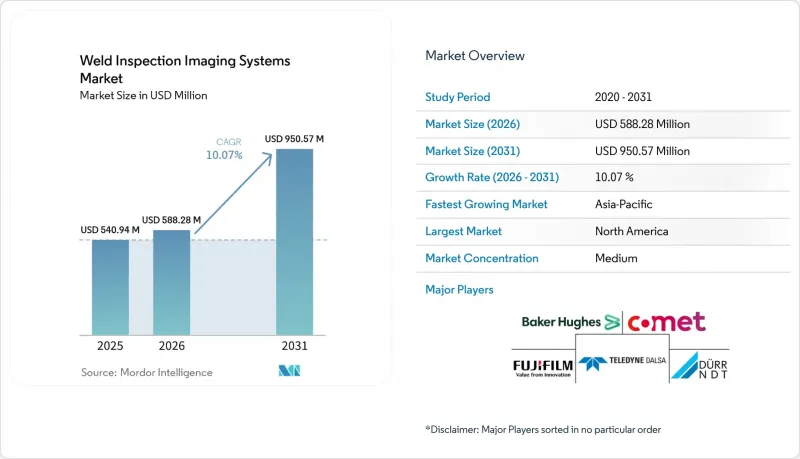
全球焊接檢測成像系統市場趨勢及洞察。
從膠片到直接電腦斷層掃描(CR)的數位轉型
隨著數位化製程在營運成本、文件管理和客戶品質要求方面展現出優勢,焊接檢測成像系統市場正逐漸擺脫底片放射線技術。作為X光膠片關鍵原料的銀的價格預計將在2025年達到歷史新高,並在2026年繼續上漲,這將給仍然依賴頻繁採購膠片的檢測項目帶來沉重負擔。這種轉變正在削弱底片的長期經濟效益,尤其對於那些執行重複性任務且需要穩定耗材供應的機構更是如此。多家供應商正優先投資於數位化產品的研發,這降低了企業維護和升級傳統膠片工作流程的獎勵。數位影像嵌入了元資料,可以儲存在資產管理系統中,使授權團隊能夠輕鬆搜尋、共用和查看檢測記錄,以便與後續檢測結果進行比較。當操作人員需要易於存取的檢測記錄以支援遠端驗證、文件管理、預測性維護工作流程和快速品質決策時,焊接檢測成像系統市場將從中受益。
對焊接完整性和可追溯性提出了更嚴格的要求。
焊接檢測成像系統市場正受益於受監管工業項目對可追溯焊接記錄日益嚴格的要求以及日益複雜的供應鏈。在管道、製程管道、航太和其他高影響應用領域,需要清晰的檢測證據,並將其與零件、程序、人員和核准決策聯繫起來。與實體膠片相比,數位放射線射線照相記錄更易於儲存、檢視、傳輸和搜尋,這在多個組織共同承擔製造和最終驗收責任時至關重要。隨著受監管的營運商擴大使用數位入口網站和正式記錄系統來管理檢測文檔,電子提交的重要性日益凸顯。大型航太承包商正在將DICONDE的記錄要求擴展到其分包商,即使個別供應商沒有計劃進行技術升級,也可能需要更換設備。隨著可追溯性需求從主承包商擴展到整個供應鏈,焊接檢測成像系統市場可以從這種下游溢出效應中受益。
CT系統需要高額的資本投資和設施開發成本。
工業電腦斷層掃描(CT)仍然是焊接檢測成像系統市場中最昂貴的設備類別,但其普及受到成本的限制,這些成本遠遠超過掃描儀本身的購買價格。完整的安裝可能需要專門設計的屏蔽罩、大容量電源、隔振裝置、溫控系統、安全物料輸送以及專門的操作規程。這些要求加起來可能會使總安裝成本翻倍,使得中型製造商和僅承接單專案合約的獨立檢測公司難以證明其購買的合理性。在基礎設施、專業工程支援或長期融資機會有限的地區,這些財務負擔尤其沉重。與成熟的無損檢測中心相比,東南亞、南美洲和非洲部分地區的情況更為突出。因此,焊接檢測成像系統市場仍呈現出高價值電腦斷層掃描(CT)設備集中在大型製造商、集團公司和能夠將成本分攤到多個專案中的專業服務供應商手中的趨勢。
細分市場分析
2025年,硬體設備在焊接檢測成像系統市佔率中佔比47.85%。這反映了平板檢測器陣列、X光管、CT機架及相關成像基礎設施的高價值。實體設備仍然至關重要,因為所有數位化工作流程都依賴現場可靠的影像擷取。此外,硬體採購通常涉及認證、安裝和整合工作,這些工作可能超出基本設備訂購的範圍。現場校準、X光管更換、輻射源管理以及與檢測機構簽訂的合約等服務是重要的輔助資訊。這些活動在系統安裝後仍需持續進行,以確保系統效能符合客戶要求的偵測程序。
預計到2031年,軟體產業將以13.85%的複合年成長率成長,成為所有產品類別中成長最快的產業。人工智慧驅動的缺陷檢測、基於雲端的影像管理以及符合DICONDE標準的歸檔在企業檢測專案中扮演著日益重要的角色。自動化工具能夠幫助操作人員從數位影像中識別異常徵兆並了解其特徵,從而減少日常的人工審核工作。雲端系統支援跨機構共用已通過核准的記錄,而託管歸檔功能則支援客戶、審核員和供應商的存取。在2026年歐洲焊接檢測與測試大會(ECNDT 2026)上發表的研究描述了電腦斷層掃描(CT)和人工智慧框架,這些框架能夠從斷層掃描資料中提取裂縫的形狀、方向和連接性,並將結果與結構模型關聯起來。焊接檢測成像系統市場為軟體供應商提供了建立長期合作關係的途徑,因為影像管理和分析在已部署硬體的整個運作內都將至關重要。
預計到2025年,直接射線照相技術將佔焊接檢測成像系統市場45.10%的佔有率。這主要歸功於用戶優先考慮即時螢幕確認、與各種流程的兼容性以及相比膠片方法更快的決策速度。該技術使需要在生產、維護或現場作業期間查看影像而無需等待膠片顯影的檢測團隊受益。其在數位化檢測流程中累積的良好口碑也推動了其在各種工業環境中的應用。由於成像板的可重複使用性以及操作人員對現有工作流程的熟悉程度,電腦射線照相技術仍然是檢測服務提供者的重要應用領域。雖然膠片射線照相技術在一些需要客戶指定傳統流程連續性和存檔功能的特定應用中仍然發揮作用,但由於膠片成本的上漲,其應用正在減少。
電腦斷層掃描 (CT) 預計到 2031 年將以 12.18% 的複合年成長率成長,因為它能夠檢測2D射線照相無法獲得的詳細資訊的內部幾何結構,以及難以檢測的材料組合。這項技術在銅、鋁和鋼緊密結合的組件中變得越來越重要,包括電動車動力傳動系統和電池製造中使用的零件。光子計數檢測器平台和人工智慧驅動的重建技術正在緩解這些多材料部件中的偽影問題。 2026 年,Varex Imaging 公司發布了 TrueSpectrum,它採用雙能量光子計數方法,據該公司稱,無需校準材料或單獨的處理步驟即可消除束硬化偽影。掃描速度的提高和重建影像的清晰度增強了 CT 在需要檢驗內部焊接的生產應用中的適用性。因此,在焊接檢測成像系統市場,CT 的應用正從專業的分析應用轉向更高附加價值的製造應用。
區域分析
預計到2025年,北美將佔據35.75%的銷售佔有率。這主要歸功於該地區集中了大量的管道運營商、航太設備製造商、維護服務供應商以及煉油廠資產,這些企業都需要持續的無損檢測項目。人事費用的上升提升了自動化和人工智慧驅動的缺陷評估的價值,而管道安全要求和煉油廠檢修也推動了對持續成像診斷的投入。加拿大油砂和中游基礎設施的需求,以及墨西哥石化和汽車設施的需求,都在不斷成長。該地區還擁有成熟的檢測服務網路,以及有能力投資整合數位設備的客戶。這些因素確保了北美仍然是焊接檢測成像系統市場的主要應用市場。
受中國電池製造、石化項目和重工業建設擴張的推動,亞太地區預計到2031年將以13.90%的複合年成長率成長。根據ECNDT 2026的研究,中國超級工廠建設的擴張催生了對極耳焊接和匯流排連接的線上CT檢測的需求,而能夠每天進行數千次全電池掃描的高速系統尤為重要。此外,新建工業設施在施工和試運行也需要現場成像進行焊接檢驗。因此,該地區對焊接檢測成像系統的需求涵蓋電池製造、煉油和重工業等多個領域。
2025年,歐洲將繼續保持其技術領先地位,德國的汽車和航太工業、法國的核能發電廠以及英國的海上能源和核能發電廠退役作業都對精細的焊接檢測技術提供了支持。在義大利的航太複合材料叢集中,電腦斷層掃描(CT)技術正被用於檢測複雜形狀;而在中東,沙烏地阿拉伯和阿拉伯聯合大公國(阿拉伯聯合大公國)的煉油廠維修和液化天然氣(LNG)基礎設施建設正在推動市場需求。這些活動既需要用於受控設施的固定系統,也需要用於現場作業的攜帶式設備。這使得焊接檢測成像系統市場在成熟的工業經濟體和能源投資領域中保持著重要地位。
其他好處:
- Excel格式的市場預測(ME)表
- 3個月的分析師支持
目錄
第1章:引言
- 研究假設和市場定義
- 調查範圍
第2章:調查方法
第3章執行摘要
第4章 市場狀況
- 市場概覽
- 市場促進因素
- 從膠片到直接放射成像和電腦放射成像的數位轉型
- 對焊接完整性和可追溯性提出了更嚴格的要求。
- 實施工業自動化和100%線上檢測。
- 航太、能源和先進製造業領域無損檢測 (NDT) 的頻率。
- 攜帶式數位X光成像技術在現場管道檢測的廣泛應用。
- 電池和半導體焊接品質檢驗
- 市場限制因素
- 引進CT系統需要高額的資本投資和設施開發成本。
- 輻射安全、許可和暴露管理的負擔。
- 合格的輻射偵測人員短缺
- 數位系統的同位素供應風險與網路安全風險
- 產業價值鏈分析
- 宏觀經濟因素對市場的影響
- 監理情勢
- 技術展望
- 波特五力分析
第5章 市場規模與成長預測
- 報價
- 硬體設備
- 軟體
- 服務
- 透過技術
- 直接放射成像
- 電腦X光照相術
- 底片放射攝影
- 電腦斷層掃描(CT)
- 按外形規格
- 固定和靜止系統
- 可攜式和手持式系統
- 離線實驗室系統
- 按最終用戶行業分類
- 石油和天然氣
- 化工/石油化工
- 航太/國防
- 汽車和運輸業
- 能源和發電
- 製造業和重工業
- 建築和基礎設施
- 電子和半導體
- 海洋/造船
- 其他終端用戶產業
- 按地區
- 北美洲
- 美國
- 加拿大
- 墨西哥
- 南美洲
- 巴西
- 阿根廷
- 其他南美國家
- 歐洲
- 德國
- 英國
- 法國
- 義大利
- 西班牙
- 其他歐洲國家
- 亞太地區
- 中國
- 日本
- 印度
- 韓國
- ASEAN
- 其他亞太國家
- 中東
- 沙烏地阿拉伯
- 阿拉伯聯合大公國
- 土耳其
- 其他中東國家
- 非洲
- 南非
- 奈及利亞
- 其他非洲國家
- 北美洲
第6章 競爭情勢
- 市場集中度
- 策略趨勢
- 市佔率分析
- 公司簡介
- Baker Hughes Company
- Comet Technologies AG
- Nikon Metrology NV
- FUJIFILM Holdings Corporation
- DURR NDT GmbH & Co. KG
- Varex Imaging Corporation
- Teledyne DALSA, Inc.
- Hamamatsu Photonics KK
- Shimadzu Corporation
- Rigaku Corporation
- North Star Imaging, Inc.
- Vidisco Ltd.
- Bosello High Technology Srl
- DIONDO GmbH
- Pexraytech Oy
- Industrial Control X-Ray, Inc.
- 3DX-Ray Ltd
- VJ Technologies, Inc.
- RX Solutions SAS
- SERVO-ROBOT Inc.
- Xiris Automation Inc.
- SmartRay GmbH
- VITRONIC Dr.-Ing. Stein Bildverarbeitungssysteme GmbH
- Precitec GmbH & Co. KG
- Carestream Health, Inc.
第7章 市場機會與未來展望
According to Mordor Intelligence, the weld inspection imaging systems market size was valued at USD 540.94 million in 2025 and is estimated to grow from USD 588.28 million in 2026 to reach USD 950.57 million by 2031, at a CAGR of 10.07% during the forecast period (2026-2031).
Global Weld Inspection Imaging Systems Market Trends and Insights
Digital Migration From Film to Direct and Computed Radiography
The weld inspection imaging systems market is moving away from film radiography because operating costs, document handling, and customer quality requirements now favor digital processes. Silver, a core input for X-ray film, reached historic highs in 2025 and continued rising in 2026, adding a material cost pressure to inspection programs that still rely on frequent film purchases. This change weakens the long-term economics of film, especially for organizations that perform repeat work and need a predictable supply of consumables. Several suppliers are directing development investment toward digital products, which reduces the incentive to maintain and upgrade traditional film workflows. Digital images carry embedded metadata and can be retained in asset management systems, giving authorized teams a record that is easier to locate, share, review, and compare with later inspections. The weld inspection imaging systems market benefits when operators need accessible inspection records that can support remote review, documentation control, predictive maintenance workflows, and faster quality decisions.
Tightening Weld Integrity and Traceability Requirements
The weld inspection imaging systems market benefits from stronger requirements for traceable weld records across regulated industrial programs and increasingly complex supply arrangements. Pipeline, process piping, aerospace, and other high-consequence applications need clear inspection evidence that can be associated with a component, procedure, operator, and approval decision. Digital radiographic records can be stored, reviewed, transferred, and searched more readily than physical film, which is important when several organizations share responsibility for fabrication and final acceptance. Electronic submission is becoming more relevant as regulated operators use digital portals and formal record systems to manage inspection documentation. Large aerospace contractors are extending DICONDE record requirements to lower-tier fabricators, so equipment replacement may be required even when an individual supplier has not planned a technology upgrade. The weld inspection imaging systems market can gain from this downstream effect because traceability needs spread through the supply chain rather than remaining limited to the prime contractor.
High Capital and Facility Preparation Costs for CT Systems
Industrial computed tomography remains the highest-value equipment category in the weld inspection imaging systems market, but its adoption is limited by costs that extend beyond the scanner purchase price. A complete installation may require a purpose-built shielded enclosure, high-capacity electrical supply, vibration isolation, climate control, safe material handling, and specialized operating procedures. Together, these requirements can double the total installed cost, which makes a purchase difficult to justify for mid-sized fabricators or independent inspection firms serving only one project contract. The financial commitment is especially challenging where access to infrastructure, specialist engineering support, or long-term financing is more limited. These conditions are more pronounced in parts of Southeast Asia, South America, and Africa than in mature nondestructive testing centers. The weld inspection imaging systems market consequently retains a concentration of high-value computed tomography installations among large manufacturers, conglomerates, and specialist service providers that can spread the cost across multiple programs.
Other drivers and restraints analyzed in the detailed report include:
- Industrial Automation and 100% Inline Inspection Adoption
- Aerospace, Energy, and Advanced Manufacturing NDT Intensity
- Radiation Safety, Licensing, and Exposure-Control Burden
For complete list of drivers and restraints, kindly check the Table Of Contents.
Segment Analysis
Hardware equipment held 47.85% of the weld inspection imaging systems market share in 2025, reflecting the high value of flat-panel detector arrays, X-ray tubes, computed tomography gantries, and related imaging infrastructure. Physical equipment remains essential because every digital workflow depends on reliable image capture at the inspection point. Hardware purchases also involve qualification, installation, and integration work that can extend beyond the base equipment order. Services form a significant secondary source of revenue through field calibration, tube replacement, radiation source management, and inspection bureau contracts. These activities continue after a system is installed and help customers maintain performance against the required inspection procedures.
Software is projected to record a 13.85% CAGR through 2031, the fastest rate among offerings, as AI-enabled defect recognition, cloud-based image management, and DICONDE-compliant archiving become more central to enterprise inspection programs. Automated tools can reduce routine manual review by helping operators identify and characterize indications from digital images. Cloud systems allow approved records to be shared across facilities, while controlled archiving supports customer, auditor, and supplier access. Research presented at ECNDT 2026 described computed tomography and AI frameworks that extracted crack geometry, orientation, and connectivity from tomographic data and linked findings with structural models. The weld inspection imaging systems market gives software providers a route to recurring relationships because image management and analysis remain relevant through the operating life of installed hardware.
Direct radiography commanded 45.10% of the weld inspection imaging systems market size in 2025, as users valued immediate on-screen review, broad procedural compatibility, and faster decisions than film-based methods can provide. The technology serves inspection teams that need to check images during production, maintenance, or field work without waiting for film processing. Its established use in digital inspection procedures also supports adoption across a broad set of industrial settings. Computed radiography retains a significant installed base among inspection service bureaus because imaging plates can be reused, and existing workflows remain familiar to operators. Film radiography still has a role in narrow applications with client-mandated legacy processes or archive continuity needs, although the installed base is declining as film costs rise.
Computed tomography is projected to advance at a 12.18% CAGR through 2031 because it can examine internal geometry and difficult material combinations that need more information than two-dimensional radiography provides. The approach is increasingly relevant for assemblies that contain copper, aluminum, and steel close together, including components used in EV powertrains and battery production. Photon-counting detector platforms and AI-driven reconstruction are reducing artifact burden in these multi-material parts. Varex Imaging presented TrueSpectrum in 2026 as a dual-energy photon-counting approach that it said can eliminate beam-hardening artifacts without calibration materials or separate processing steps. Faster scanning and clearer reconstructions improve the fit of computed tomography for production applications that require internal weld verification. The weld inspection imaging systems market is consequently seeing computed tomography move from specialized analysis toward higher-value manufacturing use cases.
Complete Report Scope:
- By Offering
- Hardware Equipment
- Software
- Services
- By Technology
- Direct Radiography
- Computed Radiography
- Film Radiography
- Computed Tomography
- By Form Factor
- Fixed and Stationary Systems
- Portable and Handheld Systems
- Offline Laboratory Systems
- By End-User Industry
- Oil and Gas
- Chemicals and Petrochemicals
- Aerospace and Defense
- Automotive and Transportation
- Energy and Power Generation
- Manufacturing and Heavy Engineering
- Construction and Infrastructure
- Electronics and Semiconductors
- Marine and Shipbuilding
- Other End-User Industries
- By Geography
- North America
- United States
- Canada
- Mexico
- South America
- Brazil
- Argentina
- Rest of South America
- Europe
- Germany
- United Kingdom
- France
- Italy
- Spain
- Rest of Europe
- Asia-Pacific
- China
- Japan
- India
- South Korea
- ASEAN
- Rest of Asia-Pacific
- Middle East
- Saudi Arabia
- United Arab Emirates
- Turkey
- Rest of the Middle East
- Africa
- South Africa
- Nigeria
- Rest of Africa
- North America
Geography Analysis
North America held 35.75% revenue share in 2025, supported by a dense base of pipeline operators, aerospace original equipment manufacturers, maintenance providers, and refinery assets that require continuing nondestructive testing programs. High labor costs increase the value of automation and AI-supported defect review, while pipeline safety requirements and refinery turnarounds support recurring imaging expenditure. Canada adds demand through oil sands and midstream infrastructure, while Mexico adds demand through petrochemical and automotive facilities. The region also has mature inspection service networks and customers that can invest in integrated digital equipment. These factors keep North America a major installed base for the weld inspection imaging systems market.
Asia-Pacific is projected to advance at a 13.90% CAGR through 2031, supported by China's battery manufacturing expansion, petrochemical projects, and heavy industrial construction. China's gigafactory build-out is creating demand for inline computed tomography inspection of tab welds and busbar connections, while ECNDT 2026 research showed that high-speed systems can support thousands of full-cell scans per day. New industrial facilities also need field imaging for weld verification during construction and commissioning. The regional weld inspection imaging systems market therefore has demand across battery manufacturing, refineries, and heavy industry.
Europe retained a technically advanced position in 2025, with Germany's automotive and aerospace base, France's nuclear fleet, and the United Kingdom's offshore energy and nuclear decommissioning work supporting detailed weld inspection. Italy's aerospace composite cluster is using computed tomography for complex geometries, while the Middle East draws demand from refinery upgrades and LNG infrastructure in Saudi Arabia and the United Arab Emirates. These activities require both fixed systems for controlled facilities and portable equipment for field programs. They keep the weld inspection imaging systems market relevant across mature industrial economies and energy investment areas.
- Baker Hughes Company
- Comet Technologies AG
- Nikon Metrology NV
- FUJIFILM Holdings Corporation
- DURR NDT GmbH & Co. KG
- Varex Imaging Corporation
- Teledyne DALSA, Inc.
- Hamamatsu Photonics K.K.
- Shimadzu Corporation
- Rigaku Corporation
- North Star Imaging, Inc.
- Vidisco Ltd.
- Bosello High Technology S.r.l.
- DIONDO GmbH
- Pexraytech Oy
- Industrial Control X-Ray, Inc.
- 3DX-Ray Ltd
- VJ Technologies, Inc.
- RX Solutions SAS
- SERVO-ROBOT Inc.
- Xiris Automation Inc.
- SmartRay GmbH
- VITRONIC Dr.-Ing. Stein Bildverarbeitungssysteme GmbH
- Precitec GmbH & Co. KG
- Carestream Health, Inc.
Additional Benefits:
- The market estimate (ME) sheet in Excel format
- 3 months of analyst support
TABLE OF CONTENTS
1 INTRODUCTION
- 1.1 Study Assumptions and Market Definition
- 1.2 Scope of the Study
2 RESEARCH METHODOLOGY
3 EXECUTIVE SUMMARY
4 MARKET LANDSCAPE
- 4.1 Market Overview
- 4.2 Market Drivers
- 4.2.1 Digital Migration from Film to Direct and Computed Radiography
- 4.2.2 Tightening Weld Integrity and Traceability Requirements
- 4.2.3 Industrial Automation and 100% Inline Inspection Adoption
- 4.2.4 Aerospace, Energy, and Advanced Manufacturing NDT Intensity
- 4.2.5 Portable Digital Radiography Acceptance for Field Pipeline Inspection
- 4.2.6 Battery and Semiconductor Weld-Quality Verification
- 4.3 Market Restraints
- 4.3.1 High Capital and Facility Preparation Costs for CT Systems
- 4.3.2 Radiation Safety, Licensing, and Exposure-Control Burden
- 4.3.3 Shortage of Certified Radiographic Testing Personnel
- 4.3.4 Isotope Supply Exposure and Digital-System Cybersecurity Risk
- 4.4 Industry Value Chain Analysis
- 4.5 Impact of Macroeconomic Factors on the Market
- 4.6 Regulatory Landscape
- 4.7 Technological Outlook
- 4.8 Porter's Five Forces Analysis
- 4.8.1 Bargaining Power of Suppliers
- 4.8.2 Bargaining Power of Buyers
- 4.8.3 Threat of New Entrants
- 4.8.4 Threat of Substitutes
- 4.8.5 Intensity of Competitive Rivalry
5 MARKET SIZE AND GROWTH FORECASTS (VALUE)
- 5.1 By Offering
- 5.1.1 Hardware Equipment
- 5.1.2 Software
- 5.1.3 Services
- 5.2 By Technology
- 5.2.1 Direct Radiography
- 5.2.2 Computed Radiography
- 5.2.3 Film Radiography
- 5.2.4 Computed Tomography
- 5.3 By Form Factor
- 5.3.1 Fixed and Stationary Systems
- 5.3.2 Portable and Handheld Systems
- 5.3.3 Offline Laboratory Systems
- 5.4 By End-User Industry
- 5.4.1 Oil and Gas
- 5.4.2 Chemicals and Petrochemicals
- 5.4.3 Aerospace and Defense
- 5.4.4 Automotive and Transportation
- 5.4.5 Energy and Power Generation
- 5.4.6 Manufacturing and Heavy Engineering
- 5.4.7 Construction and Infrastructure
- 5.4.8 Electronics and Semiconductors
- 5.4.9 Marine and Shipbuilding
- 5.4.10 Other End-User Industries
- 5.5 By Geography
- 5.5.1 North America
- 5.5.1.1 United States
- 5.5.1.2 Canada
- 5.5.1.3 Mexico
- 5.5.2 South America
- 5.5.2.1 Brazil
- 5.5.2.2 Argentina
- 5.5.2.3 Rest of South America
- 5.5.3 Europe
- 5.5.3.1 Germany
- 5.5.3.2 United Kingdom
- 5.5.3.3 France
- 5.5.3.4 Italy
- 5.5.3.5 Spain
- 5.5.3.6 Rest of Europe
- 5.5.4 Asia-Pacific
- 5.5.4.1 China
- 5.5.4.2 Japan
- 5.5.4.3 India
- 5.5.4.4 South Korea
- 5.5.4.5 ASEAN
- 5.5.4.6 Rest of Asia-Pacific
- 5.5.5 Middle East
- 5.5.5.1 Saudi Arabia
- 5.5.5.2 United Arab Emirates
- 5.5.5.3 Turkey
- 5.5.5.4 Rest of the Middle East
- 5.5.6 Africa
- 5.5.6.1 South Africa
- 5.5.6.2 Nigeria
- 5.5.6.3 Rest of Africa
- 5.5.1 North America
6 COMPETITIVE LANDSCAPE
- 6.1 Market Concentration
- 6.2 Strategic Moves
- 6.3 Market Share Analysis
- 6.4 Company Profiles (includes Global Level Overview, Market Level Overview, Core Segments, Financials as available, Strategic Information, Market Rank/Share, Products and Services, Recent Developments)
- 6.4.1 Baker Hughes Company
- 6.4.2 Comet Technologies AG
- 6.4.3 Nikon Metrology NV
- 6.4.4 FUJIFILM Holdings Corporation
- 6.4.5 DURR NDT GmbH & Co. KG
- 6.4.6 Varex Imaging Corporation
- 6.4.7 Teledyne DALSA, Inc.
- 6.4.8 Hamamatsu Photonics K.K.
- 6.4.9 Shimadzu Corporation
- 6.4.10 Rigaku Corporation
- 6.4.11 North Star Imaging, Inc.
- 6.4.12 Vidisco Ltd.
- 6.4.13 Bosello High Technology S.r.l.
- 6.4.14 DIONDO GmbH
- 6.4.15 Pexraytech Oy
- 6.4.16 Industrial Control X-Ray, Inc.
- 6.4.17 3DX-Ray Ltd
- 6.4.18 VJ Technologies, Inc.
- 6.4.19 RX Solutions SAS
- 6.4.20 SERVO-ROBOT Inc.
- 6.4.21 Xiris Automation Inc.
- 6.4.22 SmartRay GmbH
- 6.4.23 VITRONIC Dr.-Ing. Stein Bildverarbeitungssysteme GmbH
- 6.4.24 Precitec GmbH & Co. KG
- 6.4.25 Carestream Health, Inc.
7 MARKET OPPORTUNITIES AND FUTURE OUTLOOK
- 7.1 White-Space and Unmet-Need Assessment

 黑白相機市場:全球市場預測,2026-2032年CMOS影像感測器測試系統解決方案市場:全球市場預測,2026-2032年熱電冷卻工業相機市場:全球市場預測,2026-2032年燃料室影像系統市場:全球市場預測(2026-2032年)隨機圖案投影機市場:全球市場預測,2026-2032年高溫爐攝影系統市場:全球市場預測,2026-2032年攜帶式焊接檢測市場:全球市場預測,2026-2032年地面標記投影機市場:全球市場預測,2026-2032年金屬箔視覺檢測機市場:全球市場預測,2026-2032年鋰電池隔膜目視檢測系統市場:全球市場預測,2026-2032年