


 |
市場調查報告書
商品編碼
2155267
自主移動機器人視覺系統:市場佔有率分析、產業趨勢與統計及成長預測(2026-2031)Autonomous Mobile Robot Vision Systems - Market Share Analysis, Industry Trends & Statistics, Growth Forecasts (2026 - 2031) |
||||||

※ 本網頁內容可能與最新版本有所差異。詳細情況請與我們聯繫。
根據 Mordor Intelligence 預測,自主移動機器人視覺系統的市場規模預計將從 2025 年的 2.4711 億美元和 2026 年的 3.0261 億美元成長到 2031 年的 9.0379 億美元,2026 年至 2031 年的年複合成長率(CAGR)為 24.46%。
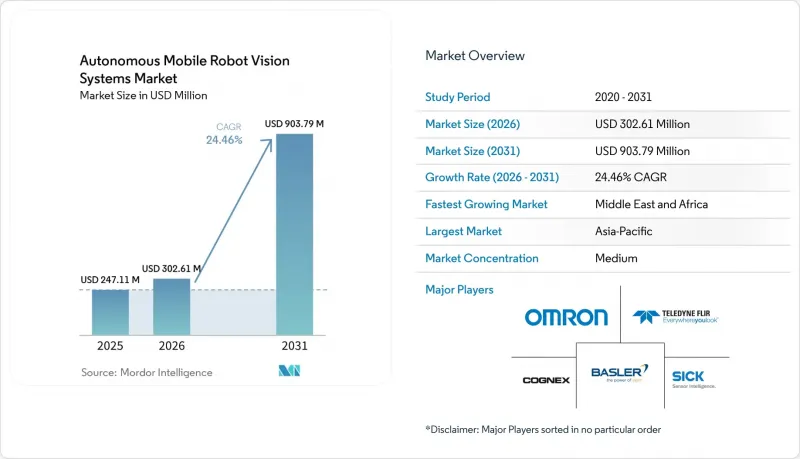
全球自主移動機器人視覺系統市場趨勢及洞察。
電子商務履約自動化
電子商務交易量的持續成長推動了競爭激烈的履約領域對配備視覺系統的自主移動機器人(AMR)的持續需求。北美倉庫業者在2026年上半年購買了大量機器人。這些採購的市場價值龐大,超過了2025年同期水準。這一趨勢也推動了對能夠支援連續運行的組件的需求。高密度的「貨到人(GTP)」操作需要能夠精確識別相鄰貨架位置的導航系統。在複雜的設施中,這項需求使得先進的3D視覺系統比條碼引導系統更具優勢。馬士基新加坡的倉庫部署了大規模的海氏機器人A42T系統和AMR隊伍,並於2026年初投入運作。該隊伍的全年運作也推動了對能夠支援連續運作的組件的需求。
倉庫人手不足和人事費用上升
倉儲人手不足加劇了採用自主設備的必要性。 2026年6月,儘管美國倉儲業的平均薪資有所上漲,但運輸、倉儲和公共產業等行業仍存在大量職缺。空缺職位數高於2025年同期。員工離職率率高也是大規模物流中心的一項成本高昂的因素,因為它需要反覆進行培訓和新員工入職指導。截至2026年6月,Geekplus已在日本多家豐田工廠完成了移動式自主移動機器人(AMR)的大規模部署。此次部署反映了日本勞動年齡人口的減少以及對卡車駕駛人工作時間的監管。這些壓力正推動著從電子商務設施到要求嚴苛的物流營運等各個領域採用自主設備。
高昂的整合和協調成本
對於中型企業而言,整合有時比硬體採購更具挑戰性。在大規模設施中部署機器人集群可能需要大量的初期投資。視覺系統還需要進行設施測繪、與倉庫管理系統整合、配備充電基礎設施以及提供售後服務支援。每個攝影機都需要根據機器人的運動學參考系進行校準。進行硬體維護或更換時可能需要重新校準。由於每個供應商通常採用不同的校準框架,因此操作來自多個供應商的機器人會增加負擔。實施標準化的感知模組可以消除針對特定感測器的配置要求,並減少部署過程中涉及的工程工作量。
細分市場分析
至2025年,硬體將佔自主移動機器人(AMR)視覺系統市場62.33%的佔有率。深度攝影機、雷射雷達模組、嵌入式處理器及相關光學元件需要大量的初始資本投入。硬體仍然至關重要,因為機器人層面的物理感知能力對於每個AMR集群都至關重要。對於大規模部署而言,穩定的組件供應和校準支援必不可少。因此,感測器架構持續影響可靠性、維護需求和更換成本。低成本的競爭產品也對標準化硬體的利潤率構成了壓力。供應商正透過將感測器與專有處理技術、軟體或服務相結合來應對這項挑戰。即使基礎組件的供應日益普及,這種方法也能實現差異化。此外,它還能讓買家對整個系統的責任更加清晰。
預計到2031年,軟體產業將以24.92%的複合年成長率成長。模型管理平台支援在多個地點部署集中訓練的視覺模型。車隊編配軟體協調機器人運動,並將視覺輸出與營運系統整合。康耐視宣布,自2025年6月發布測試版以來,其OneVision平台的企業客戶已超過100家。該平台有助於從孤立的先導計畫過渡到多站點部署。隨著機器人即服務(RaaS)模式的興起,服務的重要性也日益凸顯,該模式下部分整合、校準和維護任務將轉移給供應商。因此,在自主移動機器人的視覺系統產業中,持續的軟體和支援收入價值正在不斷提升。此外,軟體還能減少與更新和車隊擴展相關的營運中斷,從而使買家受益。
2025年,3D雷射雷達和雷射視覺在自主移動機器人視覺系統中佔據了27.78%的市場。這項技術廣泛應用於大規模物流設施的導航和障礙物檢測,並在需要大規模可靠定位的任務中發揮重要作用。 RoboSense公司報告稱,在此期間,其機器人雷射雷達的銷售額實現了顯著的同比成長。該公司的全固態數位雷射雷達「E2」已投入量產並交付給客戶。 Hesai公司的「JT128」在緊湊的機殼內實現了寬廣的視野角,這種設計使其適用於小型自主移動機器人平台。這些趨勢表明,高效能和廣泛應用可以同時實現。
預計到2031年,結構化光學3D視覺將以25.11%的複合年成長率成長。在製藥和電子產品揀選作業中,需要詳細的表面映射才能實現精準的揀選。該技術支援物體形狀和位置不斷變化的搬運過程,並且無需依賴預先編程的抓取路徑即可輔助揀選。在有效載荷級深度估計就足夠的情況下,立體視覺和飛行時間(ToF)感測器仍然非常有用。這些系統適用於設備預算有限的部署。2D視覺也適用於條碼辨識和平面偵測。這些應用通常在相對結構化的環境中運作。在自主移動機器人的視覺系統市場中,多種感測器類型將繼續共存,因為不同的任務、環境和所需精確度會帶來不同的操作需求。
區域分析
到2025年,亞太地區將佔據自主移動機器人視覺系統38.65%的市場。中國擁有大規模的自主移動機器人(AMR)基本客群,且視覺硬體組件的生產成本低。海康威視機器人累積AMR出貨量已取得顯著里程碑式的成就,最新一批產品的交付週期遠短於首批產品。日本面臨人口結構和交通/勞動力方面的挑戰,Geekplus在豐田的大規模部署便印證了這一點。隨著國內履約能力的提升和智慧製造投資的增加,印度和東南亞國協正成為新興的需求區域。
在北美和歐洲,由於企業合約中通常包含軟體和整合服務,單位收入較高。繼去年大量採購機器人後,北美地區的倉儲採購依然強勁。德國憑藉其汽車和機械製造業,繼續保持歐洲主要的需求中心地位。在斯圖加特舉行的LogiMAT展會上,Geekplus推出了“RoboShuttle”,Locus Robotics推出了“Locus Array”。歐盟機械法規使得合規成本成為採購決策中越來越重要的考量。
預計到2031年,中東和非洲地區的複合年成長率將達到25.16%。阿拉伯聯合大公國和沙烏地阿拉伯的物流基礎設施專案正在推動自主移動機器人視覺系統市場的成長。 2026年9月,阿布達比代表團參觀了AMR Labs的「東原iFarm」工廠,考察了其在製藥生產和分銷基礎設施中基於雷射雷達的SLAM和3D視覺技術。隨著物流密度的提高和製造業投資的成長,南非、奈及利亞和埃及也日益受到關注。
其他好處:
- Excel格式的市場預測(ME)表
- 3個月的分析師支持
目錄
第1章:引言
- 研究假設和市場定義
- 調查範圍
第2章:調查方法
第3章執行摘要
第4章 市場狀況
- 市場概覽
- 市場促進因素
- 電子商務履約自動化
- 倉儲業人手不足和人事費用上升
- 利用邊緣人工智慧降低視覺處理的延遲和頻寬需求
- 靈活生產和工業4.0的引入
- 使用視覺SLAM的無標記導航
- 標準化感知模組助力棕地維修
- 市場限制因素
- 高昂的整合成本和調整成本
- 動態人機環境中的安全性檢驗
- 光照、表面和倉庫條件對資料集的影響
- 基於視覺的位置資料的網路安全風險
- 宏觀經濟因素對市場的影響
- 產業價值鏈分析
- 監理情勢
- 技術展望
- 波特五力分析
第5章 市場規模與成長預測
- 按組件
- 硬體
- 軟體
- 服務
- 視覺科技
- 2D視覺系統
- 立體視覺
- 結構光3D視覺
- 飛行時間(ToF)
- 3DLiDAR/雷射視覺
- 其他視覺技術
- 按功能
- 導航和定位
- 障礙物偵測與規避
- 目標檢測與識別
- 地圖繪製與環境意識
- 路線規劃與引導
- 其他功能
- 按機器人類型
- 貨物到人自動移動偵測
- 自主揀選 AMR
- 標記器/可拖曳式自主移動機器人
- 用於托盤運輸的自主移動機器人
- 單元貨載類型 AMR
- 其他類型的機器人
- 按最終用戶行業分類
- 電子商務與零售
- 倉儲/物流
- 車
- 電子和半導體
- 食品/飲料
- 藥品和醫療保健
- 其他終端用戶產業
- 按地區
- 北美洲
- 美國
- 加拿大
- 墨西哥
- 南美洲
- 巴西
- 阿根廷
- 其他南美國家
- 歐洲
- 德國
- 英國
- 法國
- 義大利
- 西班牙
- 其他歐洲國家
- 亞太地區
- 中國
- 日本
- 印度
- 韓國
- ASEAN
- 其他亞太國家
- 中東和非洲
- 中東
- 沙烏地阿拉伯
- 阿拉伯聯合大公國
- 土耳其
- 其他中東國家
- 非洲
- 南非
- 奈及利亞
- 埃及
- 其他非洲國家
- 中東
- 北美洲
第6章 競爭情勢
- 市場集中度
- 策略趨勢
- 市佔率分析
- 公司簡介
- ABB Ltd.
- Basler AG
- Cognex Corporation
- OMRON Corporation
- SICK AG
- Teledyne Technologies Incorporated
- Intel Corporation
- NVIDIA Corporation
- Sony Group Corporation
- Keyence Corporation
- Pepperl+Fuchs SE
- Orbbec Inc.
- Hesai Technology Co., Ltd.
- RoboSense Technology Co., Ltd.
- Teradyne, Inc.
- Geekplus Technology Co., Ltd.
- Locus Robotics Corporation
- Seegrid Corporation
- Clearpath Robotics Inc.
- KUKA AG
第7章 市場機會與未來展望
According to Mordor Intelligence, the autonomous mobile robot vision systems market size is projected to expand from USD 247.11 million in 2025 and USD 302.61 million in 2026 to USD 903.79 million by 2031, registering a CAGR of 24.46% between 2026 to 2031.
Global Autonomous Mobile Robot Vision Systems Market Trends and Insights
E-Commerce Fulfillment Automation
E-commerce volume has sustained demand for vision-equipped AMRs in competitive fulfillment operations. North American warehousing firms purchased a substantial volume of robots during the first half of 2026. These purchases represented a significant market value and exceeded the level recorded during the corresponding period in 2025. This trend also increases demand for components that can support continuous operations. Denser goods-to-person operations require navigation systems that distinguish adjacent shelf positions with precision. This requirement favors advanced 3D vision over barcode-guided systems in complex facilities. Maersk's Singapore facility began operations in early 2026 with a large fleet of A42T systems and AMRs from Hai Robotics. Year-round fleet use also increases demand for components that can support continuous operations.
Warehouse Labor Shortages and Rising Workforce Costs
Warehouse labor constraints are strengthening the business case for autonomous equipment. Average U.S. warehousing wages increased in June 2026, while a substantial number of positions remained unfilled across transportation, warehousing, and utilities. The number of unfilled positions was higher than in the corresponding period of 2025. High employee turnover also creates recurring training and onboarding costs for large distribution centers. Geekplus completed a large-scale deployment of mobile AMRs across several Toyota plants in Japan by June 2026. The deployment reflected Japan's declining working-age population and restrictions on truck-driver working hours. These pressures are extending adoption from e-commerce facilities to demanding intralogistics operations.
High Integration and Calibration Costs
Integration can be a larger barrier than hardware procurement for mid-market operators. A robot fleet in a large facility can require substantial initial capital investment. Vision systems also need facility mapping, warehouse management system integration, charging infrastructure, and service support. Each camera needs calibration against the robot's kinematic reference frame. Hardware servicing or replacement can require calibration again. Multi-vendor fleets raise the burden because vendors commonly use different calibration frameworks. Standardized perception modules can reduce deployment engineering work where they remove sensor-specific setup requirements.
Other drivers and restraints analyzed in the detailed report include:
- Edge AI Reducing Vision Latency and Bandwidth Requirements
- Flexible Manufacturing and Industry 4.0 Adoption
- Safety Validation in Dynamic Human-Robot Environments
For complete list of drivers and restraints, kindly check the Table Of Contents.
Segment Analysis
Hardware held 62.33% of the autonomous mobile robot vision systems market share in 2025. Depth cameras, LiDAR modules, embedded processors, and supporting optics create a large upfront equipment requirement. Hardware remains essential because each AMR fleet needs physical perception capability at the robot level. Large deployments require consistent component availability and calibration support. Sensor architecture, therefore, continues to affect reliability, maintenance requirements, and replacement costs. Lower-cost competition is also placing pressure on margins for standardized hardware. Suppliers are responding by pairing sensors with proprietary processing, software, or service offerings. This approach can protect differentiation when basic components become more widely available. It also gives buyers a clearer view of whole-system accountability.
The software segment is projected to expand at a 24.92% CAGR through 2031. Model-management platforms enable centrally trained vision models to be deployed across multiple sites. Fleet orchestration software coordinates robot movement and connects vision outputs with operational systems. Cognex stated that its OneVision platform had exceeded 100 enterprise customers since its June 2025 beta launch. The platform supports a move from isolated pilots to multi-site implementations. Services are also gaining importance through robotics-as-a-service models. These models shift some integration, calibration, and maintenance work to vendors. The autonomous mobile robot vision systems industry is therefore placing more value on recurring software and support revenue. Buyers benefit when software reduces the disruption associated with updates and fleet expansion.
3D LiDAR and laser vision held 27.78% of the autonomous mobile robot vision systems market share in 2025. The technology is widely used for navigation and obstacle detection in large logistics facilities. Its role is established where operations require reliable positional awareness across wide areas. RoboSense reported substantial year-over-year growth in robotics LiDAR sales volume during the period. Its E2 fully solid-state digital LiDAR entered full-scale production and customer delivery. Hesai's JT128 offered a wide field of view in a compact format. Such designs support use in smaller AMR platforms. These developments indicate that higher performance and broader availability can occur together.
Structured-light 3D vision is expected to expand at a 25.11% CAGR through 2031. Pharmaceutical and electronics picking tasks need detailed surface mapping for accurate bin picking. The technology supports handling processes where object shape and placement vary. It can assist picking without relying on pre-programmed grasp paths. Stereo vision and time-of-flight sensors remain relevant where payload-level depth estimation is sufficient. These systems can serve deployments with tighter equipment budgets. Two-dimensional vision also remains useful for barcode identification and flat-surface inspection. Those applications often operate in relatively structured surroundings. The autonomous mobile robot vision systems market will retain several sensor types because operating needs differ by task, environment, and required precision.
Complete Report Scope:
- By Component
- Hardware
- Software
- Services
- By Vision Technology
- 2D Vision Systems
- Stereo Vision
- Structured-Light 3D Vision
- Time-of-Flight (ToF)
- 3D LiDAR / Laser Vision
- Other Vision Technologies
- By Function
- Navigation and Localization
- Obstacle Detection and Avoidance
- Object Detection and Recognition
- Mapping and Environment Perception
- Path Planning and Guidance
- Other Functions
- By Robot Type
- Goods-to-Person AMRs
- Autonomous Picking AMRs
- Tugger / Towing AMRs
- Pallet-Transport AMRs
- Unit-Load AMRs
- Other Robot Types
- By End-User Industry
- E-commerce and Retail
- Warehousing and Logistics
- Automotive
- Electronics and Semiconductors
- Food and Beverage
- Pharmaceuticals and Healthcare
- Other End-User Industries
- By Geography
- North America
- United States
- Canada
- Mexico
- South America
- Brazil
- Argentina
- Rest of South America
- Europe
- Germany
- United Kingdom
- France
- Italy
- Spain
- Rest of Europe
- Asia-Pacific
- China
- Japan
- India
- South Korea
- ASEAN
- Rest of Asia-Pacific
- Middle East and Africa
- Middle East
- Saudi Arabia
- United Arab Emirates
- Turkey
- Rest of the Middle East
- Africa
- South Africa
- Nigeria
- Egypt
- Rest of Africa
- Middle East
- North America
Geography Analysis
Asia-Pacific held 38.65% of the autonomous mobile robot vision systems market share in 2025. China combines a large AMR customer base with lower-cost production of vision hardware components. Hikvision Robot reached a significant cumulative AMR shipment milestone, with its most recent shipment cohort completed substantially faster than its initial cohort. Japan faces demographic and transport-labor pressures, as reflected in Geekplus's large-scale Toyota deployment. India and ASEAN countries are emerging demand areas as domestic fulfillment capacity and smart-manufacturing investment expand.
North America and Europe command high per-unit revenue because enterprise contracts often include software and integration services. Warehouse purchases in North America remained strong, following substantial robot purchases in the previous year. Germany remains a key European demand center through automotive and machinery production. Geekplus presented RoboShuttle, and Locus Robotics presented Locus Array at LogiMAT in Stuttgart. The EU Machinery Regulation is making compliance costs more relevant to purchase decisions.
The Middle East and Africa is projected to expand at a 25.16% CAGR through 2031. Logistics infrastructure projects in the UAE and Saudi Arabia support this autonomous mobile robot vision systems market opportunity. A delegation from Abu Dhabi visited AMR Labs' Dongwon iFarm facility in September 2026 to examine LiDAR-based SLAM and 3D vision capabilities for pharmaceutical manufacturing and distribution infrastructure. South Africa, Nigeria, and Egypt are receiving more attention as logistics density and manufacturing investment develop.
- ABB Ltd.
- Basler AG
- Cognex Corporation
- OMRON Corporation
- SICK AG
- Teledyne Technologies Incorporated
- Intel Corporation
- NVIDIA Corporation
- Sony Group Corporation
- Keyence Corporation
- Pepperl+Fuchs SE
- Orbbec Inc.
- Hesai Technology Co., Ltd.
- RoboSense Technology Co., Ltd.
- Teradyne, Inc.
- Geekplus Technology Co., Ltd.
- Locus Robotics Corporation
- Seegrid Corporation
- Clearpath Robotics Inc.
- KUKA AG
Additional Benefits:
- The market estimate (ME) sheet in Excel format
- 3 months of analyst support
TABLE OF CONTENTS
1 INTRODUCTION
- 1.1 Study Assumptions and Market Definition
- 1.2 Scope of the Study
2 RESEARCH METHODOLOGY
3 EXECUTIVE SUMMARY
4 MARKET LANDSCAPE
- 4.1 Market Overview
- 4.2 Market Drivers
- 4.2.1 E-Commerce Fulfillment Automation
- 4.2.2 Warehouse Labor Shortages and Rising Workforce Costs
- 4.2.3 Edge AI Reducing Vision Latency and Bandwidth Requirements
- 4.2.4 Flexible Manufacturing and Industry 4.0 Adoption
- 4.2.5 Marker-Free Navigation Through Visual SLAM
- 4.2.6 Standardized Perception Modules Enabling Brownfield Retrofits
- 4.3 Market Restraints
- 4.3.1 High Integration and Calibration Costs
- 4.3.2 Safety Validation in Dynamic Human-Robot Environments
- 4.3.3 Dataset Shift Across Lighting, Surface, and Warehouse Conditions
- 4.3.4 Cybersecurity Exposure of Vision-Derived Localization Data
- 4.4 Impact of Macroeconomic Factors on the Market
- 4.5 Industry Value Chain Analysis
- 4.6 Regulatory Landscape
- 4.7 Technological Outlook
- 4.8 Porter's Five Forces Analysis
- 4.8.1 Bargaining Power of Suppliers
- 4.8.2 Bargaining Power of Buyers
- 4.8.3 Threat of New Entrants
- 4.8.4 Threat of Substitutes
- 4.8.5 Competitive Rivalry
5 MARKET SIZE AND GROWTH FORECASTS (VALUE)
- 5.1 By Component
- 5.1.1 Hardware
- 5.1.2 Software
- 5.1.3 Services
- 5.2 By Vision Technology
- 5.2.1 2D Vision Systems
- 5.2.2 Stereo Vision
- 5.2.3 Structured-Light 3D Vision
- 5.2.4 Time-of-Flight (ToF)
- 5.2.5 3D LiDAR / Laser Vision
- 5.2.6 Other Vision Technologies
- 5.3 By Function
- 5.3.1 Navigation and Localization
- 5.3.2 Obstacle Detection and Avoidance
- 5.3.3 Object Detection and Recognition
- 5.3.4 Mapping and Environment Perception
- 5.3.5 Path Planning and Guidance
- 5.3.6 Other Functions
- 5.4 By Robot Type
- 5.4.1 Goods-to-Person AMRs
- 5.4.2 Autonomous Picking AMRs
- 5.4.3 Tugger / Towing AMRs
- 5.4.4 Pallet-Transport AMRs
- 5.4.5 Unit-Load AMRs
- 5.4.6 Other Robot Types
- 5.5 By End-User Industry
- 5.5.1 E-commerce and Retail
- 5.5.2 Warehousing and Logistics
- 5.5.3 Automotive
- 5.5.4 Electronics and Semiconductors
- 5.5.5 Food and Beverage
- 5.5.6 Pharmaceuticals and Healthcare
- 5.5.7 Other End-User Industries
- 5.6 By Geography
- 5.6.1 North America
- 5.6.1.1 United States
- 5.6.1.2 Canada
- 5.6.1.3 Mexico
- 5.6.2 South America
- 5.6.2.1 Brazil
- 5.6.2.2 Argentina
- 5.6.2.3 Rest of South America
- 5.6.3 Europe
- 5.6.3.1 Germany
- 5.6.3.2 United Kingdom
- 5.6.3.3 France
- 5.6.3.4 Italy
- 5.6.3.5 Spain
- 5.6.3.6 Rest of Europe
- 5.6.4 Asia-Pacific
- 5.6.4.1 China
- 5.6.4.2 Japan
- 5.6.4.3 India
- 5.6.4.4 South Korea
- 5.6.4.5 ASEAN
- 5.6.4.6 Rest of Asia-Pacific
- 5.6.5 Middle East and Africa
- 5.6.5.1 Middle East
- 5.6.5.1.1 Saudi Arabia
- 5.6.5.1.2 United Arab Emirates
- 5.6.5.1.3 Turkey
- 5.6.5.1.4 Rest of the Middle East
- 5.6.5.2 Africa
- 5.6.5.2.1 South Africa
- 5.6.5.2.2 Nigeria
- 5.6.5.2.3 Egypt
- 5.6.5.2.4 Rest of Africa
- 5.6.5.1 Middle East
- 5.6.1 North America
6 COMPETITIVE LANDSCAPE
- 6.1 Market Concentration
- 6.2 Strategic Moves
- 6.3 Market Share Analysis
- 6.4 Company Profiles (includes Global Level Overview, Market Level Overview, Core Segments, Financials as available, Strategic Information, Market Rank/Share, Products and Services, Recent Developments)
- 6.4.1 ABB Ltd.
- 6.4.2 Basler AG
- 6.4.3 Cognex Corporation
- 6.4.4 OMRON Corporation
- 6.4.5 SICK AG
- 6.4.6 Teledyne Technologies Incorporated
- 6.4.7 Intel Corporation
- 6.4.8 NVIDIA Corporation
- 6.4.9 Sony Group Corporation
- 6.4.10 Keyence Corporation
- 6.4.11 Pepperl+Fuchs SE
- 6.4.12 Orbbec Inc.
- 6.4.13 Hesai Technology Co., Ltd.
- 6.4.14 RoboSense Technology Co., Ltd.
- 6.4.15 Teradyne, Inc.
- 6.4.16 Geekplus Technology Co., Ltd.
- 6.4.17 Locus Robotics Corporation
- 6.4.18 Seegrid Corporation
- 6.4.19 Clearpath Robotics Inc.
- 6.4.20 KUKA AG
7 MARKET OPPORTUNITIES AND FUTURE OUTLOOK
- 7.1 White-Space and Unmet-Need Assessment

 室內多機器人市場:全球市場預測,2026-2032年高爾夫練習場撿球機器人市場:全球市場預測(2026-2032年)核能環境AGV市場:全球市場預測,2026-2032年航太AGV市場:全球市場預測,2026-2032年
 2034年自主移動機器人市場預測-全球分析(按組件、機器人類型、酬載能力、導航技術、應用、最終用戶和地區分類)
 電動微型機器人市場:按類型、應用、材料、國家和地區分類-全球產業分析、市場規模、市場佔有率及2026年至2033年預測機器人道路清掃車市場:全球市場預測,2026-2032年個人桌面機器人市場-2026年至2032年全球市場預測戶外巡邏機器人市場:全球市場預測,2026-2032年
 電動微型機器人市場規模、佔有率和成長分析:按機器人類型、驅動技術、應用、環境、最終用戶和地區分類-2026-2033年產業預測