


 |
市場調查報告書
商品編碼
2155260
德國電動汽車CNC車床:市場佔有率分析、產業趨勢與統計及成長預測(2026-2031)Germany Electric Vehicle CNC Turning - Market Share Analysis, Industry Trends & Statistics, Growth Forecasts (2026 - 2031) |
||||||

※ 本網頁內容可能與最新版本有所差異。詳細情況請與我們聯繫。
據 Mordor Intelligence 稱,德國電動車用CNC車床市場預計將從 2025 年的 1.2 億美元和 2026 年的 1.31 億美元成長到 2031 年的 2.11 億美元,2026 年至 2031 年的年複合成長率(CAGR)為 10%。
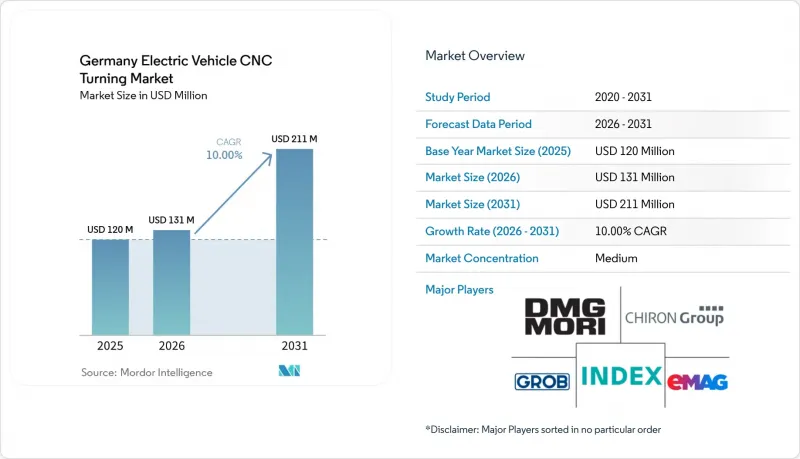
德國電動車用CNC車床市場趨勢及洞察。
高階電動車的生產正在加速對超精密車削中心的需求。
德國豪華汽車製造地正在推動對能夠滿足嚴格形狀和表面光潔度要求的車床中心的需求。梅賽德斯-賓士於2026年6月在其柏林馬里恩弗爾德工廠開始批量生產軸流式馬達。此製造流程包含98道精密加工工序,其中包括35道全球新開發的工序。透過即時品管,組裝過程可將定子位置精度控制在0.1毫米以內,從而帶動了對相關零件精密加工需求的成長。德國電動車數控車床市場受惠於供應商對用於製造馬達軸心、殼體和其他精密零件的直驅主軸和熱控制設備的需求。 BMW慕尼黑工廠將於2026年開始其「新級」車型的預生產,並計劃於2026年下半年全面量產,這將為動力傳動系統設備和生產系統開闢新的採購週期。 BMW預計,這種重新設計的生產方式將使每輛車的成本降低10%,這將提升整合多道工序並減少裝夾次數的工具機的價值。
汽車電氣化正在推動對高性能機械加工的投資。
汽車電氣化正在改變德國機械加工廠加工零件的組成。德國在2025年生產了122萬輛電池式電動車,預計2026年產量將達176萬輛。電動橋殼需要對薄壁鋁結構進行精密加工,而轉子軸則需要多道高精度車削工序。因此,德國電動車專用數控車床市場正在滿足一些無法透過簡單地改造現有內燃機械加工生產線來滿足的需求。 2025年,採埃孚(ZF)在其擴建後的薩爾布呂肯工廠開始大量生產電動橋驅動系統,增加了對電動橋殼和變速箱軸的需求。歐盟車輛排放氣體法規持續引導著汽車製造商(OEM)的產品規劃朝著低排放氣體車輛的方向發展,從而支持了對電動動力傳動系統產能的持續投資。
高昂的能源和營運成本推高了製造成本。
能源成本上漲正在抑制中小製造商擴大數控設備規模的意願。德國工商總會 (DIHK) 2026 年 6 月的一項調查顯示,電費和天然氣價格上漲直接影響了近 40% 的德國工業企業的競爭。調查也發現,三分之一的工業企業正在推遲對核心生產流程的投資。高速CNC車床在運作中需要消耗大量電力,因此能源效率是投資決策中的關鍵因素。在德國電動車數控車床市場,買家群體呈現兩極分化:大型整車製造商 (OEM) 能夠繼續推進其戰略性電氣化計劃,而中小契約製造則正在仔細審查其資本計劃。此外,歐盟能源效率指令 (EU Energy Efficiency Directive) 規定的能源審計和能源效率要求也加重了大規模工業用戶的規劃和合規負擔。
細分市場分析
2025年,臥式CNC車床在德國電動車CNC車床市場佔有38.3%的佔有率。這一佔有率反映了臥式數控車床在馬達軸、軸承滾道、轉子環及其他零件批量生產方面的適用性。德國一級供應商通常在自動化多班制系統中運作這些工具機。立式數控車床則適用於加工大直徑殼體和圓盤形零件,特別是薄壁鋁製電驅動橋殼體,在這些零件的加工中,工件定位的穩定性對最終形狀至關重要。
瑞士型CNC車床適用於加工小直徑零件,例如電池管理和電力電子組件中使用的連接器、緊固件和針狀元件。這些零件的公差可能小於 0.005 毫米,因此精確控制加工條件至關重要。在德國電動車數控車床市場,集車削和銑削於一體的多功能車床和銑削中心的市場規模預計將在 2026 年至 2031 年間以 12% 的複合年成長率成長。一次裝夾即可完成整合式電驅動橋殼體的車削、銑削、鑽孔和螺紋研磨,從而減少工序間的對準誤差。 2026 年 3 月,INDEX-Werke 推出了面向中等產量製造商的緊湊型 G 系列五軸車銑複合中心 G160。2025 年 9 月,DMG MORI 發布了第三代 NTX,其應用領域主要集中在電動車製造業。
其他好處:
- Excel格式的市場預測(ME)表
- 3個月的分析師支持
目錄
第1章:引言
- 研究假設和市場定義
- 調查範圍
第2章:調查方法
第3章執行摘要
- 市場概況(2025 年與 2031 年比較)
- 各細分市場的主要發現
- 投資重點領域與未開發領域
第4章 市場狀況
- 市場概覽
- 數控車床在電動車製造價值鏈中的作用
- 從內燃機零件加工到電動車專用加工需求的演變
- 市場促進因素
- 高階電動車產量的擴大正在加速對超精密車床的需求。
- 汽車電氣化正在推動對高性能機械加工領域投資的增加。
- 工業 4.0 和智慧工廠的普及正在推動 CNC(電腦數控)系統的自動化。
- 隨著電動驅動系統零件生產的擴大,車削加工的需求也隨之增加。
- 德國工具機的創新正在推動高速多軸加工。
- 精密汽車零件出口的成長正在推動先進數控技術的應用。
- 市場限制因素
- 高昂的能源和營運成本推高了製造成本。
- 經濟不確定性導致對新工具機的資本投資被推遲。
- 熟練的CNC操作員和自動化工程師短缺
- 高階精密設備的採購週期越來越長。
- 市場機遇
- 電池和電力電子產品的製造為機械加工帶來了新的需求。
- 人工智慧驅動的製程最佳化提高了CNC加工的生產效率和產品品質。
- 輕量化電動車零件的製造正在拓展高精度車床加工的應用範圍。
- 歐洲汽車供應鏈的近岸外包正在推動數控加工產能的擴張。
- 電動車製造價值鏈分析
- 原物料供應商
- 工具機製造商
- 電動汽車零件製造商
- 電動汽車製造商
- 製造流程分析
- 根據生產量選擇機器
- 原型製作和批量生產的要求
- 貿易趨勢和關稅影響分析
- 工具機的主要進出口路線
- 區域採購來源的變化和本地化趨勢
- 監理情勢
- 電動車生產的製造獎勵
- 在地採購要求
- 智慧製造政策
- 關於工具機能源效率的法規
- 科技趨勢
- 多功能車銑中心
- 人工智慧驅動的工具磨損監測
- 數位孿生整合
- 機器人自動化
- 人工智慧和數位化製造對CNC車床加工的影響
- 地緣政治對市場的影響
第5章 市場規模及成長預測(價值單位:美元)
- 按機器類型
- 臥式CNC車床
- 立式CNC車床
- 多功能車銑中心
- 瑞士型CNC車床
- 其他
- 按組件和應用程式
- 電動機零件
- 電力驅動橋和變速器部件
- 電池系統組件
- 其他
- 最終用戶
- 電動車製造商的製造工廠
- 一級汽車零件供應商
- 二級零件製造商
- 精密契約製造
第6章 競爭情勢
- Market Structure
- Strategic Developments(2022-2026)
- New Product Launches
- Automation Partnerships
- EV Manufacturing Projects
- Capacity Expansion
- Acquisitions
- Digital Manufacturing Collaborations
- 市佔率分析
- 公司簡介
- INDEX-Werke GmbH & Co. KG Hahn & Tessky
- EMAG GmbH & Co. KG
- DMG MORI AG
- CHIRON Group SE
- GROB-WERKE GmbH & Co. KG
- HELLER Maschinenfabrik GmbH
- SW Maschinen GmbH
- Spinner Werkzeugmaschinenfabrik GmbH
- TRAUB Werkzeugmaschinen GmbH
- NILES-SIMMONS Industrieanlagen GmbH
- MAG IAS GmbH
- Starrag GmbH
- Mazak Europe NV
- Okuma Europe GmbH
- Haas Automation Europe
- DN Solutions Europe GmbH
- Tsugami Europe GmbH
- Citizen Machinery Europe GmbH
- Star Micronics GmbH
- GF Machining Solutions GmbH
第7章 市場機會與未來展望
According to Mordor Intelligence, the Germany electric vehicle CNC turning market size is projected to expand from USD 120 million in 2025 and USD 131 million in 2026 to USD 211 million by 2031, registering a CAGR of 10% between 2026 and 2031.
Germany Electric Vehicle CNC Turning Market Trends and Insights
Premium EV Manufacturing Accelerates Demand for Ultra-Precision Turning Centers
Germany's premium vehicle manufacturing base supports demand for turning centers capable of meeting strict geometry and surface-finish requirements. Mercedes-Benz began series production of its axial-flux electric motor at Berlin-Marienfelde in June 2026, using 98 precision manufacturing steps, including 35 processes newly developed worldwide. The assembly process maintains stator positioning within 0.1 mm through real-time quality controls, which raises the need for accurate machining of related components. The German electric-vehicle CNC turning market benefits from suppliers' need for direct-drive spindles and thermal control to manufacture motor shafts, housings, and other precision parts. BMW Plant Munich entered pre-series production for the Neue Klasse in 2026 and plans full series production in the second half of 2026, creating a new procurement cycle for drivetrain equipment and production systems. BMW expects the redesigned production approach to reduce manufacturing costs per vehicle by 10%, which increases the value of machines that combine multiple processes in fewer setups.
Automotive Electrification Strengthens Investment in High-Performance Machining
Automotive electrification is changing the component mix processed by German machining facilities. Germany produced 1.22 million battery electric vehicles in 2025, while electrified vehicle production is expected to reach 1.76 million units in 2026. E-axle housings require controlled machining of thin-wall aluminum structures, and rotor shafts require several hard-turning steps. The Germany electric vehicle CNC turning market therefore serves requirements that cannot be met through simple reuse of many internal-combustion machining lines. ZF started series production of electric axle-drive variants at its expanded Saarbrucken facility in 2025, thereby increasing demand for e-axle housings and reduction gear shafts. EU fleet-emissions rules continue to direct OEM product plans toward lower-emission vehicles, supporting continued investment in electric drivetrain capacity.
High Energy and Operating Costs Increase Manufacturing Expenses
Energy costs limit smaller manufacturers' willingness to add CNC capacity. A June 2026 DIHK survey found that rising electricity and gas prices were a direct competitiveness concern for nearly 40% of German industrial enterprises. The same survey found that 1 in 3 industrial enterprises had deferred investment in core production processes. High-speed CNC turning centers can require substantial power during operation, making energy efficiency a material part of the investment case. The Germany electric vehicle CNC turning market faces a divided buyer base because large OEMs can continue strategic electrification programs while smaller contract manufacturers review capital plans more carefully. Energy audits and efficiency requirements also add planning and compliance work for larger industrial users under the EU Energy Efficiency Directive.
Other drivers and restraints analyzed in the detailed report include:
- Industry 4.0 and Smart Factory Adoption Enhance CNC Automation
- Growing Production of Electric Drivetrain Components Expands Turning Operations
- Shortage of Skilled CNC Operators and Automation Engineers
For complete list of drivers and restraints, kindly check the Table Of Contents.
Segment Analysis
Horizontal CNC turning centers held 38.3% of the Germany electric vehicle CNC turning market share in 2025. Their position reflects their suitability for high-volume production of motor shafts, bearing races, and rotor rings. German Tier-1 suppliers often operate these machines in automated, multi-shift configurations. Vertical CNC turning centers are well-suited to large-bore housings and disk-shaped parts, including thin-walled aluminum e-axle housings, where stable workpiece positioning can influence the final geometry.
Swiss-type CNC turning centers serve small-diameter parts, including connectors, fasteners, and pin-type components used in battery-management and power-electronics assemblies. These parts can require tolerances below 0.005 mm, increasing the importance of controlled machining conditions. The Germany electric vehicle CNC turning market size for multi-tasking turn-mill centers is projected to grow at a 12% CAGR between 2026 and 2031. A single setup can complete turning, milling, drilling, and thread grinding for integrated e-axle housings, reducing alignment errors between operations. INDEX-Werke introduced the G160 5-axis turn-mill center in March 2026 as a compact G-series model for mid-volume producers. DMG MORI introduced the NTX 3rd Generation in September 2025 and identified electric vehicle manufacturing as a target application.
Complete Report Scope:
- By Machine Type
- Horizontal CNC Turning Centers
- Vertical CNC Turning Centers
- Multi-Tasking Turn-Mill Centers
- Swiss-Type CNC Turning Centers
- Others
- By Component Application
- Electric Motor Components
- E-Axles & Transmission Components
- Battery System Components
- Others
- By End User
- EV OEM Manufacturing Plants
- Tier-1 Automotive Suppliers
- Tier-2 Component Manufacturers
- Precision Contract Manufacturers
List of Companies Covered in this Report:
- INDEX-Werke GmbH & Co. KG Hahn & Tessky
- EMAG GmbH & Co. KG
- DMG MORI AG
- CHIRON Group SE
- GROB-WERKE GmbH & Co. KG
- HELLER Maschinenfabrik GmbH
- SW Maschinen GmbH
- Spinner Werkzeugmaschinenfabrik GmbH
- TRAUB Werkzeugmaschinen GmbH
- NILES-SIMMONS Industrieanlagen GmbH
- MAG IAS GmbH
- Starrag GmbH
- Mazak Europe N.V.
- Okuma Europe GmbH
- Haas Automation Europe
- DN Solutions Europe GmbH
- Tsugami Europe GmbH
- Citizen Machinery Europe GmbH
- Star Micronics GmbH
- GF Machining Solutions GmbH
Additional Benefits:
- The market estimate (ME) sheet in Excel format
- 3 months of analyst support
TABLE OF CONTENTS
1 Introduction
- 1.1 Study Assumptions & Market Definition
- 1.2 Scope of the Study
2 Research Methodology
3 Executive Summary
- 3.1 Market Snapshot (2025 vs. 2031)
- 3.2 Key Findings by Segment
- 3.3 Investment Hotspots & White Space
4 Market Landscape
- 4.1 Market Overview
- 4.1.1 Role of CNC Turning Centers in the EV Manufacturing Value Chain
- 4.1.2 Evolution from ICE Component Machining to EV-Specific Machining Requirements
- 4.2 Market Drivers
- 4.2.1 Premium EV Manufacturing Accelerates Demand for Ultra-Precision Turning Centers
- 4.2.2 Automotive Electrification Strengthens Investment in High-Performance Machining
- 4.2.3 Industry 4.0 and Smart Factory Adoption Enhance CNC Automation
- 4.2.4 Growing Production of Electric Drivetrain Components Expands Turning Operations
- 4.2.5 German Machine Tool Innovation Supports High-Speed Multi-Axis Manufacturing
- 4.2.6 Rising Export of Precision Automotive Components Drives Advanced CNC Deployment
- 4.3 Market Restraints
- 4.3.1 High Energy and Operating Costs Increase Manufacturing Expenses
- 4.3.2 Economic Uncertainty Delays Capital Investment in New Machine Tools
- 4.3.3 Shortage of Skilled CNC Operators and Automation Engineers
- 4.3.4 Lengthy Procurement Cycles for High-End Precision Equipment
- 4.4 Market Opportunities
- 4.4.1 Battery Cell and Power Electronics Manufacturing Creates New Machining Demand
- 4.4.2 AI-Based Process Optimization Improves CNC Productivity and Quality
- 4.4.3 Lightweight EV Component Manufacturing Expands High-Precision Turning Applications
- 4.4.4 Nearshoring of European Automotive Supply Chains Encourages CNC Capacity Expansion
- 4.5 EV Manufacturing Value Chain Analysis
- 4.5.1 Raw Material Suppliers
- 4.5.2 Machine Tool Manufacturers
- 4.5.3 EV Component Manufacturers
- 4.5.4 EV OEMs
- 4.6 Manufacturing Process Analysis
- 4.6.1 Machine Selection by Production Volume
- 4.6.2 Prototype vs. Mass Production Requirements
- 4.7 Trade Flow & Tariff Impact Analysis
- 4.7.1 Key Machine Tool Export & Import Corridors
- 4.7.2 Regional Sourcing Shifts & Localization Trends
- 4.8 Regulatory Landscape
- 4.8.1 Manufacturing Incentives for EV Production
- 4.8.2 Local Content Requirements
- 4.8.3 Smart Manufacturing Policies
- 4.8.4 Energy Efficiency Regulations for Machine Tools
- 4.9 Technology Landscape
- 4.9.1 Multi-Tasking Turn-Mill Centers
- 4.9.2 AI-Based Tool Wear Monitoring
- 4.9.3 Digital Twin Integration
- 4.9.4 Robot Automation
- 4.10 Impact of AI & Digital Manufacturing on CNC Turning
- 4.11 Geopolitical Impact on Market
5 Market Size & Growth Forecasts Value (USD)
- 5.1 By Machine Type
- 5.1.1 Horizontal CNC Turning Centers
- 5.1.2 Vertical CNC Turning Centers
- 5.1.3 Multi-Tasking Turn-Mill Centers
- 5.1.4 Swiss-Type CNC Turning Centers
- 5.1.5 Others
- 5.2 By Component Application
- 5.2.1 Electric Motor Components
- 5.2.2 E-Axles & Transmission Components
- 5.2.3 Battery System Components
- 5.2.4 Others
- 5.3 By End User
- 5.3.1 EV OEM Manufacturing Plants
- 5.3.2 Tier-1 Automotive Suppliers
- 5.3.3 Tier-2 Component Manufacturers
- 5.3.4 Precision Contract Manufacturers
6 Competitive Landscape
- 6.1 Market Structure
- 6.2 Strategic Developments (2022-2026)
- 6.2.1 New Product Launches
- 6.2.2 Automation Partnerships
- 6.2.3 EV Manufacturing Projects
- 6.2.4 Capacity Expansion
- 6.2.5 Acquisitions
- 6.2.6 Digital Manufacturing Collaborations
- 6.3 Market Share Analysis
- 6.4 Company Profiles
- 6.4.1 INDEX-Werke GmbH & Co. KG Hahn & Tessky
- 6.4.2 EMAG GmbH & Co. KG
- 6.4.3 DMG MORI AG
- 6.4.4 CHIRON Group SE
- 6.4.5 GROB-WERKE GmbH & Co. KG
- 6.4.6 HELLER Maschinenfabrik GmbH
- 6.4.7 SW Maschinen GmbH
- 6.4.8 Spinner Werkzeugmaschinenfabrik GmbH
- 6.4.9 TRAUB Werkzeugmaschinen GmbH
- 6.4.10 NILES-SIMMONS Industrieanlagen GmbH
- 6.4.11 MAG IAS GmbH
- 6.4.12 Starrag GmbH
- 6.4.13 Mazak Europe N.V.
- 6.4.14 Okuma Europe GmbH
- 6.4.15 Haas Automation Europe
- 6.4.16 DN Solutions Europe GmbH
- 6.4.17 Tsugami Europe GmbH
- 6.4.18 Citizen Machinery Europe GmbH
- 6.4.19 Star Micronics GmbH
- 6.4.20 GF Machining Solutions GmbH
7 Market Opportunities & Future Outlook
- 7.1 White-Space Assessment
- 7.1.1 Emerging EV Manufacturing Hubs
- 7.1.2 Tier-2 Suppliers
- 7.1.3 Precision Machining for Next-Generation E-Mobility
- 7.1.4 AI-Driven Autonomous Machining
- 7.2 Strategic Recommendations

 臥式銑床市場:全球市場預測(2026-2032年)五軸數控滾齒機市場:全球市場預測,2026-2032年CNC加工服務市場:全球市場預測,2026-2032年雙輥數控紡絲機市場:全球市場預測,2026-2032年CNC側齒輪研磨市場:全球市場預測,2026-2032年五軸數控加工服務市場 - 全球預測(2026-2032年)花崗岩數控切割機市場:全球市場預測,2026-2032年多軸螺紋加工服務市場:全球市場預測,2026-2032年瑞士螺紋加工服務市場:全球市場預測,2026-2032年多軸自動化工具機市場:全球市場預測(2026-2032年)