


 |
市場調查報告書
商品編碼
2155230
微孔塑膠:市場佔有率分析、產業趨勢與統計、成長預測(2026-2031)Microcellular Plastics - Market Share Analysis, Industry Trends & Statistics, Growth Forecasts (2026 - 2031) |
||||||

※ 本網頁內容可能與最新版本有所差異。詳細情況請與我們聯繫。
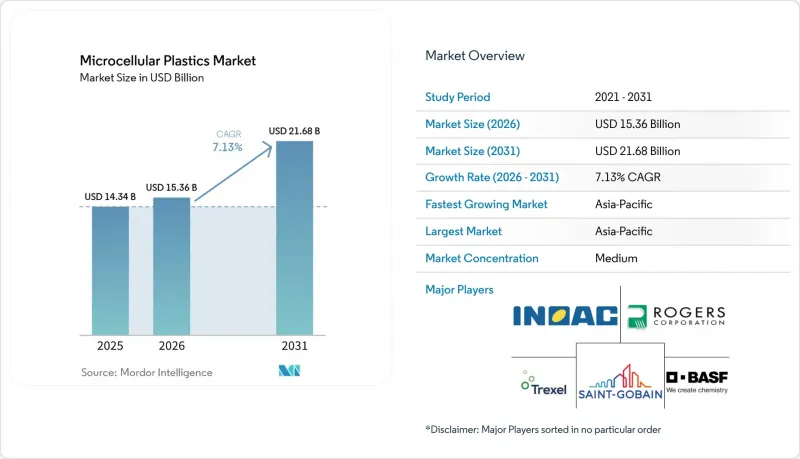
據 Mordor Intelligence 稱,2025 年微孔塑膠市場價值為 143.4 億美元,預計到 2031 年將達到 216.8 億美元,而 2026 年為 153.6 億美元,預測期(2026-2031 年)複合年成長率為 7.13%。
全球微孔塑膠市場趨勢與洞察
汽車和電動車的輕量化
由於電池式電動車) 的電池組重量達 400-700 公斤,因此其他車輛系統也越來越需要減輕重量。微孔發泡材射出成型可將零件密度降低 8-12%,大型內裝組件的重量可減輕 20-30%。在 K 2025 展會上,Trexel 展示了微孔泡棉射出成型技術在儀錶面板支架、車門面板和中央控制台等零件上的應用。預計到 2025 年,全球電動車銷量將超過 1,700 萬輛,隨著輕量化射出成型件在各種車輛平台上的應用不斷擴展,市場對輕量化注塑件的需求預計將持續成長。 FORVIA 宣布,其「Microject Advanced」製程將於 2025 年 10 月前與主要汽車製造商 (OEM) 實現量產,該製程可在零件的整個生命週期內減少高達 50% 的二氧化碳當量排放量。此外,該製程還透過省去某些噴漆工序和安全氣囊導槽工序,降低了擁有多道生產線的供應商的模具複雜性。
對高性能隔熱和隔音材料的需求
由於建築能耗要求,隔熱性能已成為開發商和建築商在購買建築物時的重要考量。修訂後的《建築能源性能指令》要求成員國提高住宅的能源性能,並將支持2030年維修3,500萬棟建築。硬質微孔聚氨酯泡棉的導熱係數可低至0.022 W/m*K,有助於牆體系統以更薄的厚度滿足更嚴格的隔熱要求。 2025年2月,BASF在印度達赫傑為其「Cellasto」微孔聚氨酯工廠舉行了奠基儀式,該工廠預計將於2026年下半年運作。這項投資旨在為印度汽車產業的噪音、振動和乘坐舒適性(NVH)應用提供解決方案。
高昂的材料成本、設備成本和檢驗成本
高昂的材料、設備和檢驗成本仍然是微孔發泡塑膠產業面臨的一大挑戰。超臨界流體射出成型需要專用的螺桿、混合單元和壓力控制硬體,而這些在傳統的成型平台上並不需要。汽車產業結構性微孔泡棉零件的認證通常需要18到24個月,這增加了小規模的二級供應商的營運資金需求。為了獲得原始設備製造商 (OEM) 的批准,測試必須檢驗零件的噪音、振動和粗糙度 (NVH) 性能、尺寸穩定性以及碰撞性能。 Moldex3D 和 Autodesk Moldflow 等模擬工具需要微孔成型製程的輸入數據,但小規模的製造商可能無法維護這些數據。 ENGEL 於 2025 年 10 月收購 Trexel,透過將 MuCell 硬體整合到製造商的成型機平台中,預計將降低部分製造商的整體擁有成本。
細分市場分析
預計到2025年,聚氨酯將佔據微孔塑膠市場28.57%的佔有率,並將以7.86%的複合年成長率持續成長至2031年。這一市場地位反映了其在汽車NVH(噪音、振動和聲振粗糙度)零件、建築隔熱材料、鞋墊和工業密封件等領域的應用。BASF的Cellasto系列材料應用於關節緩衝墊、頂部支架和螺旋彈簧隔振器等對硬度和柔韌性有指定要求的場合。建築維修需求和汽車電氣化推動了電池外殼和汽車內裝對低密度材料的需求成長。 2025年12月,BASF推出了Lupragen N 208,這是一種活性胺催化劑,旨在保留在聚氨酯網路中,並滿足汽車發泡材應用的低排放要求。
聚氯乙烯) 在對耐化學性和尺寸穩定性要求極高的應用中仍然發揮著至關重要的作用,例如電線電纜護套和地板材料。微發泡聚苯乙烯曾用於防護包裝和冷鏈物流,但由於一次性塑膠法規的實施,這些應用面臨壓力。聚碳酸酯和聚對苯二甲酸乙二醇酯 (PET) 為需要高透明度和阻隔性的食品和電子產品包裝應用提供了支援。 PET 也與飲料包裝中已使用的押金返還回收系統相容。其他材料包括聚丙烯、聚乳酸和工程熱塑性塑膠。積水化學的「Advancell」發泡微球技術可與聚氯乙烯。這些材料選擇使加工商能夠在剛性、緩衝性、外觀、可回收性和加工成本之間找到平衡。
區域分析
預計到2025年,亞太地區將佔微發泡塑膠市場40.16%的佔有率,並在2031年之前以8.06%的複合年成長率持續成長。中國電動車組裝活動的開展推動了電池外殼、座椅框架和儀表板組件的認證。印度汽車和住宅建築業對微發泡聚氨酯材料的需求不斷成長。BASF於2025年2月在達赫傑啟動了其Cellasto工廠的建設,預計將於2026年下半年運作。阿瑪塞爾於2025年6月在浦那開設了一家製造工廠,擴大了其用於高溫和低溫應用的ArmaGel XG的產能。日本和韓國在電子產品密封和緩衝材料領域提供了先進的加工技術。積水化學的「Advancell」平台在兩國精密電子產品製造商中發揮了關鍵作用。
北美和歐洲是成熟的微孔塑膠需求叢集,相關法規強化了微孔塑膠的應用情境。美國軟包裝產業年銷售額達415億美元,其中食品應用佔近50%的需求。這項基礎為微孔塑膠加工商創造了商機,他們可以透過微孔塑膠在食品和防護包裝領域實現材料節約。在美國,節能住宅和商業建築的稅收優惠政策促進了隔熱材料的更換週期。德國仍然是汽車零件供應商在研發和外部應用領域的重要樞紐。根據Pholbia的報告,Microject Advanced已與主要OEM製造商合作進入量產階段,並於2025年10月榮獲美國塑膠工程師協會(SPE)創新獎。 「包裝和包裝廢棄物法規」以及「建築能源性能指令」將包裝和建築應用領域的需求連結起來。
南美洲、中東和非洲地區對微發泡塑膠的需求仍處於早期階段。巴西擁有該地區最發達的汽車組裝基地,已開始為本地化的汽車平臺認證微發泡聚丙烯和聚氨酯零件。在包括阿根廷在內的南美市場,透過包裝和建築應用可以輕鬆進入市場。沙烏地阿拉伯的建設項目,包括NEOM新城和紅海開發區,支撐了高溫環境下工程對隔熱材料的需求。在南非,採礦和工業服務業對減震和密封材料的需求尤其突出。在上述兩個地區,有限的加工能力和專業知識限制了本地模塑的發展。因此,短期內的大部分需求由進口模塑件而非本地加工的發泡材滿足,這為在混煉和模塑領域進行投資留下了空間。
其他好處:
- Excel格式的市場預測(ME)表
- 3個月的分析師支持
目錄
第1章:引言
- 研究假設和市場定義
- 調查範圍
第2章:調查方法
第3章執行摘要
第4章 市場狀況
- 市場概覽
- 市場促進因素
- 汽車和電動車的輕量化
- 對高性能隔熱和隔音材料的需求
- 減少材料和碳排放強度的益處
- 擴大永續食品和防護包裝
- OEM整合實體發泡設備
- 市場限制因素
- 原料、設備和驗證成本高。
- 加工能力和專業知識有限
- 表面光潔度和尺寸穩定性風險
- 價值鏈分析
- 波特五力分析
第5章 市場規模與成長預測
- 材料類型
- 聚氨酯
- 聚氯乙烯
- 聚苯乙烯
- 聚碳酸酯
- 聚對苯二甲酸乙二酯
- 其他
- 按形式
- 硬質微發泡塑膠
- 柔軟性微孔塑膠
- 其他
- 按最終用戶行業分類
- 食品包裝
- 汽車和運輸業
- 建築/施工
- 衛生保健
- 電氣和電子設備
- 其他終端用戶產業
- 按地區
- 亞太地區
- 中國
- 印度
- 日本
- 韓國
- 東南亞國協
- 其他亞太國家
- 北美洲
- 美國
- 加拿大
- 墨西哥
- 歐洲
- 德國
- 英國
- 法國
- 義大利
- 北歐國家
- 其他歐洲國家
- 南美洲
- 巴西
- 阿根廷
- 其他南美國家
- 中東和非洲
- 沙烏地阿拉伯
- 南非
- 其他中東和非洲國家
- 亞太地區
第6章 競爭情勢
- 市場集中度
- 策略趨勢
- 市佔率和排名分析
- 公司簡介
- ARMACELL
- BASF
- Borealis AG
- Evonik Industries AG
- Formosa Plastics Corporation
- General Plastics Manufacturing Company
- INEOS
- INOAC CORPORATION
- LyondellBasell Industries NV
- Rogers Corporation
- Saint-Gobain
- Sekisui Chemical Co., Ltd.
- Trexel
第7章 市場機會與未來展望
According to Mordor Intelligence, the microcellular plastics market size was valued at USD 14.34 billion in 2025 and is estimated to grow from USD 15.36 billion in 2026 to reach USD 21.68 billion by 2031, at a CAGR of 7.13% during the forecast period (2026-2031).
Global Microcellular Plastics Market Trends and Insights
Automotive and Electric-Vehicle Lightweighting
Battery electric vehicles carry battery packs weighing 400-700 kg, increasing the need to reduce mass in other vehicle systems. Microcellular foam injection molding can lower component density by 8%-12% and reduce the weight of larger interior assemblies by 20%-30%. Trexel described applications for instrument panel carriers, door panels, and center consoles at K 2025. Global electric-vehicle sales exceeded 17 million units in 2025, and broader use across vehicle platforms can expand demand for lightweight molded parts. FORVIA stated that its Microject Advanced process was in serial production with leading original equipment manufacturers by October 2025 and reduced a part's lifetime carbon dioxide equivalent emissions by up to 50%. The process can also remove certain painting and airbag chute-channel steps, reducing tooling complexity for suppliers with multistep production lines.
Demand for High-Performance Thermal and Acoustic Insulation
Building energy requirements are making insulation performance a purchasing consideration for developers and contractors. The revised Energy Performance of Buildings Directive required member states to improve the energy performance of residential buildings and supported the renovation of 35 million buildings by 2030. Rigid microcellular polyurethane foam can reach thermal conductivity of 0.022 W/m*K, helping wall systems meet tighter thermal requirements with less thickness. BASF broke ground on a Cellasto microcellular polyurethane plant in Dahej, India, in February 2025, and the facility is expected to operate in the second half of 2026. The investment targets automotive noise, vibration, and harshness applications in India's vehicle sector.
High Material, Equipment, and Validation Costs
High material, equipment, and validation costs remain an immediate barrier for the microcellular plastics industry. Supercritical-fluid injection units need specialized screws, mixing sections, and pressure-control hardware that conventional molding platforms do not require. Automotive qualification for structural microcellular parts often takes 18-24 months, increasing the working-capital requirement for smaller Tier-2 suppliers. Testing must address noise, vibration, and harshness performance, dimensional stability, and crash behavior before an original equipment manufacturer can approve a component. Simulation tools such as Moldex3D and Autodesk Moldflow require microcellular process inputs that smaller processors may not maintain. ENGEL's October 2025 acquisition of Trexel could reduce total ownership cost for some processors by connecting MuCell hardware with machine platforms.
Other drivers and restraints analyzed in the detailed report include:
- Material Reduction and Carbon-Intensity Benefits
- Expansion of Sustainable Food and Protective Packaging
- Limited Processing Capacity and Specialist Know-How
For complete list of drivers and restraints, kindly check the Table Of Contents.
Segment Analysis
Polyurethane held 28.57% of the microcellular plastics market share in 2025 and is projected to expand at a 7.86% CAGR through 2031. Its position reflects use in automotive noise, vibration, and harshness components, building insulation, footwear midsoles, and industrial seals. BASF's Cellasto materials are used in jounce bumpers, top mounts, and coil spring isolators, where defined hardness and deflection behavior are required. Building renovation requirements and vehicle electrification support demand for low-density materials near battery enclosures and within vehicle interiors. BASF introduced Lupragen N 208 in December 2025, a reactive amine catalyst designed to remain in the polyurethane network and address low-emission requirements in interior foam applications.
Polyvinyl chloride retained relevance in wire and cable jacketing and flooring, where chemical resistance and dimensional stability are important. Polystyrene microcellular grades served protective packaging and cold-chain logistics, although the single-use plastics regulation created pressure on these applications. Polycarbonate and polyethylene terephthalate supported high-clarity and high-barrier food and electronics packaging applications. Polyethylene terephthalate can also fit deposit-return recycling systems that are already used for beverage packaging. Other materials included polypropylene, polylactic acid, and engineering thermoplastics. Sekisui Chemical's Advancell expandable microsphere technology can be used with polyvinyl chloride, polypropylene, polyethylene, thermoplastic vulcanizate, and ethylene propylene diene monomer, widening access to in-matrix foaming without supercritical-fluid equipment. These material options let processors select a balance of stiffness, cushioning, appearance, recyclability, and processing cost.
Complete Report Scope:
- By Material Type
- Polyurethane
- Polyvinyl Chloride
- Polystyrene
- Polycarbonate
- Polyethylene Terephthalate
- Others
- By Form
- Rigid Microcellular Plastics
- Flexible Microcellular Plastics
- Others
- By End-User Industry
- Food Packaging
- Automotive and Transportation
- Building and Construction
- Healthcare
- Electrical and Electronics
- Other End-User Industries
- By Geography
- Asia-Pacific
- China
- India
- Japan
- South Korea
- ASEAN Countries
- Rest of Asia-Pacific
- North America
- United States
- Canada
- Mexico
- Europe
- Germany
- United Kingdom
- France
- Italy
- NORDIC Countries
- Rest of Europe
- South America
- Brazil
- Argentina
- Rest of South America
- Middle East and Africa
- Saudi Arabia
- South Africa
- Rest of Middle East and Africa
- Asia-Pacific
Geography Analysis
Asia-Pacific held 40.16% of the microcellular plastics market share in 2025 and is projected to advance at an 8.06% CAGR through 2031. China's electric-vehicle assembly activity supported the qualification of components for battery enclosures, seat frames, and instrument panels. India's automotive and residential construction sectors increased demand for microcellular polyurethane materials. BASF began construction of its Dahej Cellasto plant in February 2025, and the plant is expected to operate in the second half of 2026. ARMACELL opened a manufacturing facility in Pune in June 2025, adding ArmaGel XG production capacity for high-temperature and cryogenic service. Japan and South Korea contributed advanced processing capabilities for electronics sealing and cushioning. Sekisui's Advancell platform was relevant to precision electronics manufacturers in both countries.
North America and Europe represented mature demand clusters where regulation strengthened the use case for microcellular plastics. The U.S. flexible packaging sector generated USD 41.5 billion in annual sales, and food applications accounted for nearly 50% of demand. This base creates an opportunity within the microcellular plastics market for converters that can achieve material savings in food and protective packaging. U.S. tax incentives for energy-efficient homes and commercial buildings supported insulation upgrade cycles. Germany remained an important location for automotive supplier development and visible-surface applications. FORVIA reported that Microject Advanced had reached serial production with leading original equipment manufacturers and had won a Society of Plastics Engineers innovation award in October 2025. The Packaging and Packaging Waste Regulation and the Energy Performance of Buildings Directive created aligned demand across packaging and construction applications.
South America and Middle East and Africa remained earlier-stage demand regions in the microcellular plastics market. Brazil had the region's most developed automotive assembly base and began qualifying microcellular polypropylene and polyurethane parts for localized vehicle platforms. Argentina and other South American markets were more accessible through packaging and construction applications. Saudi Arabia's construction pipeline, including NEOM and Red Sea development zones, supported demand for insulation in high-temperature projects. South Africa's mining and industrial services activities created niche demand for vibration-damping and sealing materials. Limited processing capacity and specialist know-how constrained local conversion in both regions. Imported fabricated parts, therefore, accounted for more near-term demand than locally processed foam, leaving an opening for compounding and conversion investment.
- ARMACELL
- BASF
- Borealis AG
- Evonik Industries AG
- Formosa Plastics Corporation
- General Plastics Manufacturing Company
- INEOS
- INOAC CORPORATION
- LyondellBasell Industries N.V.
- Rogers Corporation
- Saint-Gobain
- Sekisui Chemical Co., Ltd.
- Trexel
Additional Benefits:
- The market estimate (ME) sheet in Excel format
- 3 months of analyst support
TABLE OF CONTENTS
1 Introduction
- 1.1 Study Assumptions and Market Definition
- 1.2 Scope of the Study
2 Research Methodology
3 Executive Summary
4 Market Landscape
- 4.1 Market Overview
- 4.2 Market Drivers
- 4.2.1 Automotive and Electric-Vehicle Lightweighting
- 4.2.2 Demand for High-Performance Thermal and Acoustic Insulation
- 4.2.3 Material Reduction and Carbon-Intensity Benefits
- 4.2.4 Expansion of Sustainable Food and Protective Packaging
- 4.2.5 OEM Integration of Physical Foaming Equipment
- 4.3 Market Restraints
- 4.3.1 High Material, Equipment, and Validation Costs
- 4.3.2 Limited Processing Capacity and Specialist Know-How
- 4.3.3 Surface-Finish and Dimensional-Consistency Risk
- 4.4 Value Chain Analysis
- 4.5 Porter's Five Forces Analysis
- 4.5.1 Bargaining Power of Suppliers
- 4.5.2 Bargaining Power of Buyers
- 4.5.3 Threat of New Entrants
- 4.5.4 Threat of Substitutes
- 4.5.5 Competitive Rivalry
5 Market Size and Growth Forecasts (Value)
- 5.1 By Material Type
- 5.1.1 Polyurethane
- 5.1.2 Polyvinyl Chloride
- 5.1.3 Polystyrene
- 5.1.4 Polycarbonate
- 5.1.5 Polyethylene Terephthalate
- 5.1.6 Others
- 5.2 By Form
- 5.2.1 Rigid Microcellular Plastics
- 5.2.2 Flexible Microcellular Plastics
- 5.2.3 Others
- 5.3 By End-User Industry
- 5.3.1 Food Packaging
- 5.3.2 Automotive and Transportation
- 5.3.3 Building and Construction
- 5.3.4 Healthcare
- 5.3.5 Electrical and Electronics
- 5.3.6 Other End-User Industries
- 5.4 By Geography
- 5.4.1 Asia-Pacific
- 5.4.1.1 China
- 5.4.1.2 India
- 5.4.1.3 Japan
- 5.4.1.4 South Korea
- 5.4.1.5 ASEAN Countries
- 5.4.1.6 Rest of Asia-Pacific
- 5.4.2 North America
- 5.4.2.1 United States
- 5.4.2.2 Canada
- 5.4.2.3 Mexico
- 5.4.3 Europe
- 5.4.3.1 Germany
- 5.4.3.2 United Kingdom
- 5.4.3.3 France
- 5.4.3.4 Italy
- 5.4.3.5 NORDIC Countries
- 5.4.3.6 Rest of Europe
- 5.4.4 South America
- 5.4.4.1 Brazil
- 5.4.4.2 Argentina
- 5.4.4.3 Rest of South America
- 5.4.5 Middle East and Africa
- 5.4.5.1 Saudi Arabia
- 5.4.5.2 South Africa
- 5.4.5.3 Rest of Middle East and Africa
- 5.4.1 Asia-Pacific
6 Competitive Landscape
- 6.1 Market Concentration
- 6.2 Strategic Moves
- 6.3 Market Share (%)/Ranking Analysis
- 6.4 Company Profiles (includes Global Overview, Market Overview, Core Segments, Financials as available, Strategic Information, Products and Services, and Recent Developments)
- 6.4.1 ARMACELL
- 6.4.2 BASF
- 6.4.3 Borealis AG
- 6.4.4 Evonik Industries AG
- 6.4.5 Formosa Plastics Corporation
- 6.4.6 General Plastics Manufacturing Company
- 6.4.7 INEOS
- 6.4.8 INOAC CORPORATION
- 6.4.9 LyondellBasell Industries N.V.
- 6.4.10 Rogers Corporation
- 6.4.11 Saint-Gobain
- 6.4.12 Sekisui Chemical Co., Ltd.
- 6.4.13 Trexel
7 Market Opportunities and Future Outlook
- 7.1 White-Space and Unmet-Need Assessment

 仿生塑膠材料市場報告:趨勢、預測與競爭分析(至2035年)
 塑膠防潮盒市場:全球市場預測,2026-2032年
 2026-2034年全球塑膠分解細菌市場規模、佔有率、趨勢和成長分析報告2026-2034年全球家用電器塑膠市場規模、佔有率、趨勢和成長分析報告
 2026年全球多孔塑膠產品市場報告
 泰國塑膠市場:市場佔有率分析、產業趨勢與統計、成長預測(2026-2031)菲律賓塑膠市場:市場佔有率分析、產業趨勢與統計及成長預測(2026-2031)越南塑膠市場:市場佔有率分析、產業趨勢與統計、成長預測(2026-2031)馬來西亞塑膠市場:市場佔有率分析、產業趨勢與統計、成長預測(2026-2031)印度塑膠產業:市場佔有率分析、產業趨勢與統計及成長預測(2026-2031)