


 |
市場調查報告書
商品編碼
2155229
瀝青添加劑:市場佔有率分析、產業趨勢與統計、成長預測(2026-2031)Asphalt Additives - Market Share Analysis, Industry Trends & Statistics, Growth Forecasts (2026 - 2031) |
||||||

※ 本網頁內容可能與最新版本有所差異。詳細情況請與我們聯繫。
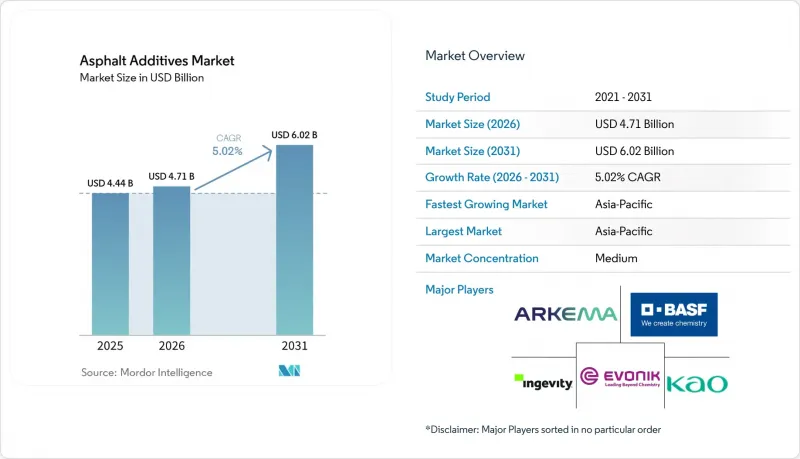
據 Mordor Intelligence 稱,2025 年瀝青添加劑市值為 44.4 億美元,預計到 2031 年將達到 60.2 億美元,而 2026 年為 47.1 億美元,預測期(2026-2031 年)的複合年成長率為 5.02%。
全球瀝青添加劑市場趨勢及洞察
基礎設施現代化和路面維修
由於每項鋪路工程都需要粘合劑體系,因此道路建設投資直接反映了對瀝青添加劑的需求。印度已為2026-2027會計年度向公路運輸和公路部撥款344億美元,比上一會計年度成長7.9%,用於支持在高海拔、凍融循環和路基潮濕等挑戰性地區開展的道路改善項目。中國已批准2026會計年度總額達2,950億元人民幣(約422億美元)的大型基礎建設項目,繼續在那些條件惡劣、需要增加聚合物添加劑用量的省份進行鋪路工作。隨著路網老化,對冷拌乳化劑、快乾劑和再生劑的需求不斷成長,使得道路管理部門的維護預算越來越重要。這些產品的採購週期比大規模新建設合約短,即使施工進度變化,也能有助於維持需求。如果道路管理部門開始將路面維護視為資產管理的必要措施,而不是需要推遲的支出,那麼瀝青添加劑市場將會受益。
裝訂機規格基於性能標準和高軸負載。
基於性能等級的瀝青結合料規範提高了貨運路線和高流量高速公路對聚合物添加劑的要求。性能等級 (PG) 76-22 或 PG 82-22 的瀝青結合料通常使用 5-7%(以結合料質量計)的苯乙烯-丁二烯-苯乙烯 (SBS),因此需要使用相容的加工穩定劑和分散劑。一項 2025 年的研究表明,在受控車轍試驗中,SBS 改性瀝青結合料的抗張強度比和彈性模量提高了 30-35%,同時車轍深度降低了 42%。這些結果支持優先考慮使用壽命和維護性能的規格。隨著公路管理部門採用更高性能等級的瀝青結合料,瀝青添加劑市場將從中受益,因為未改質的結合料系統將不再滿足所需的路面設計標準。巴基斯坦、東南亞和其他東南亞國協的道路系統採用這些等級的瀝青結合料不僅會增加瀝青產量,還會導致添加劑用量的增加。
揮發性聚合物、瀝青和生物基原料的成本
苯乙烯-丁二烯-苯乙烯(SBS)聚合物、基礎瀝青和芳烴增稠油在聚合物基改質劑和再生劑的成本中佔很大比例。 SBS價格與丁二烯原料及石腦油裂解利潤率掛鉤,因此極易受到石化裝置利用率運轉率的影響。丁二烯成本上漲可能會降低供應商的利潤率,並延緩規格升級,尤其是在公開合約價格每年確定的情況下。生物基原料面臨獨特的供應風險,例如焦油依賴牛皮紙漿的生產,植物油受天氣和生質燃料政策的影響,而木質素的供應則依賴造紙業。隨著環保意識的增強,對生物基再生劑的需求增加,這些趨勢可能會限制供應。如果小型特種化合物生產商應對原料價格波動的能力不如綜合性化工企業,那麼瀝青添加劑市場可能會進一步整合。
細分市場分析
至2025年,聚合物基改質劑將佔瀝青添加劑市場41.56%的佔有率。這主要得益於高性能瀝青中苯乙烯-丁二烯-苯乙烯(SBS)嵌段共聚物和苯乙烯-丁二烯橡膠(SBR)的廣泛應用。在要求嚴苛的應用中,SBS的含量通常佔瀝青品質的4%至7%。在亞洲、北美和中東的公路系統中,當交通量、溫度和設計壽命要求超過未改質瀝青的性能時,就會使用這些改質劑。一旦監管機構採用了某種高性能等級,去除改質劑可能會影響路面設計標準。在熱帶和多雨地區,骨材-瀝青分離是一種常見的失效模式,抗劃線劑和黏結促進劑也發揮類似的作用。乳化劑有助於冷拌維護工作,透過室溫修復方法,無需使用加熱攪拌站。瀝青添加劑市場繼續依賴這些成熟的產品線,因為它們符合普通道路和維護的規範。
預計到2031年,再生劑和回收劑的複合年成長率將達到5.45%,成為該產品細分市場中成長率最高的。隨著劣化瀝青路面(RAP)含量的增加,其使用量也將隨之成長。這是因為老化的瀝青黏合劑需要預處理才能達到與未使用材料相當的性能水平。 2024年的一項研究發現,在含有45% RAP的混合料中最佳化再生劑的用量,可使低溫抗裂性和中溫疲勞壽命恢復到與未使用黏合劑相當的水平。歐洲對再生材料含量的要求以及中國養護工作的擴展都支撐了對這些產品的需求。化學改質劑,例如費托蠟、反應性改質劑和特殊穩定劑,可滿足特定的性能要求。其他產品包括用於低噪音多孔路面的添加劑、防凍表面處理劑以及用於受污染機場路面的產品。這些應用雖然使用量不大,但由於其特殊的效能要求,具有很高的附加價值。
區域分析
預計到2025年,亞太地區將佔據瀝青添加劑市場38.78%的佔有率,並在2031年之前以5.94%的複合年成長率成長。在中國,隨著高速公路網總里程超過16萬公里,越來越多的路面進入首次大修週期,市場需求正從建設驅動轉向維修驅動。這種轉變使得維護方案越來越專注於恢復現有路面的性能,而非專門針對新路基指定材料,導致路面修復劑、乳化劑和快速修復添加劑的使用量增加。印度仍專注於新建道路,其國家基礎設施規劃包括3906個道路和橋樑項目,2026會計年度(FY26)的基礎設施資本支出預計為1,213億美元。這些截然不同的需求趨勢要求供應商既要為新建道路提供高劑量聚合物改質劑劑,也要為現有路網提供實用的修復系統。在日本和韓國,預防性維護計畫支撐著市場需求,道路管理機構尋求高耐久性的路面處理方案,以避免未來進行大規模維修。由播磨化學集團與公共工程研究所(PWRI)和日本大學聯合開展的「2025生質能衍生再生添加劑計畫」體現了日本對低碳路面更新技術和黏合劑重複修復的重視。在越南、泰國和印度尼西亞,潮濕環境下的路面施工也需要耐濕改質劑和分層抑制劑,骨材與黏合劑之間的黏結力是這些地區產品性能的關鍵要求。
由於北美和歐洲地區對性能有著嚴格的規範,且採購標準與減排掛鉤,因此這兩個地區對溫拌瀝青的需求量很高。在美國,聯邦公路管理局 (FHWA) 的技術指南支持溫拌瀝青的推廣應用,這些指南影響各州的交通規範,並推動對冷拌路面施工方法進行統一評估。在加拿大,溫拌瀝青需要具備抗寒裂性能、除冰性能和抗凍融耐久性,並且優先選擇適合當地季節性溫差較大的區域性添加劑配方。在歐洲,各國正逐步過渡到製定各自的溫拌瀝青規範,這對擁有核准配方、性能可靠且能夠滿足公共採購要求的供應商至關重要。德國計劃在 2026 年 12 月前完成向冷拌瀝青生產的過渡;在義大利,住宅周圍必須使用溫拌瀝青,遵守這些要求是合約義務。在法國、挪威和英國,溫拌瀝青的使用正透過採購獎勵、健康要求和自願性措施等多種方式推廣。在這些地區,瀝青添加劑市場的產品檢驗與原料供應同樣重要,因為核准和測試結果決定了供應商是否有資格參與專案。
南美洲、中東和非洲是重要的需求來源地,但各地區的需求模式有所不同。巴西的公路網總長達200萬公里,該地區對延長高流量道路路面壽命的產品需求主要來自於特許經營經營的城市快速道路維修和改造項目。由於瀝青價格波動和市政預算限制,二級公路使用高規格添加劑的情況有限,這使得主要幹道和區域路面項目之間存在明顯的差異。在阿根廷,財政限制導致主要農業出口走廊以外的地區路面規格較低。另一方面,在主要走廊,高軸荷使得採用聚合物改質劑更具成本效益。沙烏地阿拉伯的「2030願景」計畫和物流走廊正在推廣使用具有優異耐熱性和抗車轍性能的聚合物改質黏合劑,尤其是在路面因極端高溫而承受額外壓力的地區。 Sasobit型溫拌添加劑即使在炎熱的夏季鋪路期,當傳統施工條件難以控制時,也能改善路面施工性能。南非是特種添加劑配方和分銷的區域中心,而隨著埃及、衣索比亞和海灣國家主要公路走廊採用性能規範和養護標準,預計這些地區將帶來長期的商業機會。
其他好處:
- Excel格式的市場預測(ME)表
- 3個月的分析師支持
目錄
第1章:引言
- 研究假設和市場定義
- 調查範圍
第2章:調查方法
第3章執行摘要
第4章 市場狀況
- 市場概覽
- 市場促進因素
- 基礎設施現代化和路面維修
- 裝訂規格基於性能標準和高軸荷
- 採用再生瀝青路面和回收接合材料
- 溫拌瀝青和低碳建築要求
- 採用回收塑膠、輪胎和生物基原料,制定了特定規格的循環配方。
- 市場限制因素
- 聚合物、瀝青和生物基原料的價格波動
- 前期成本高昂以及承包商技術能力有限。
- 地方政府規範變更延遲和測試系統不一致
- 價值鏈分析
- 波特五力分析
第5章 市場規模與成長預測
- 依產品類型
- 聚合物基因改質劑
- 防剝落劑和黏合促進劑
- 乳化劑
- 化學改質劑
- 再生劑及回收劑
- 其他
- 透過技術
- 熱拌瀝青
- 溫拌瀝青
- 冷拌瀝青
- 其他
- 透過使用
- 道路建設和鋪路
- 機場跑道和機場跑道
- 停車處
- 屋頂材料
- 產業
- 其他
- 按地區
- 亞太地區
- 中國
- 印度
- 日本
- 韓國
- 其他亞太國家
- 北美洲
- 美國
- 加拿大
- 墨西哥
- 歐洲
- 德國
- 英國
- 法國
- 義大利
- 其他歐洲國家
- 南美洲
- 巴西
- 阿根廷
- 其他南美國家
- 中東和非洲
- 沙烏地阿拉伯
- 南非
- 其他中東和非洲國家
- 亞太地區
第6章 競爭情勢
- 市場集中度
- 策略趨勢
- 市佔率和排名分析
- 公司簡介
- Arkema
- BASF
- Cargill
- Dow
- Dynasol Group
- Evonik Industries AG
- Honeywell International Inc.
- Ingevity Corporation
- Iterchimica SpA
- Kao Corporation
- LCY Chemical Corp.
- LUCOBIT Aktiengesellschaft
- McAsphalt Industries Limited
- Nouryon
- Sripath Technologies, LLC
第7章 市場機會與未來展望
According to Mordor Intelligence, the asphalt additives market size was valued at USD 4.44 billion in 2025 and is estimated to grow from USD 4.71 billion in 2026 to reach USD 6.02 billion by 2031, at a CAGR of 5.02% during the forecast period (2026-2031).
Global Asphalt Additives Market Trends and Insights
Infrastructure Modernization and Pavement Rehabilitation
Road capital expenditure is a direct demand signal for the asphalt additives market, as each paving project requires binder systems suited to local traffic and climate conditions. India allocated USD 34.4 billion to the Ministry of Road Transport and Highways for 2026-27, a 7.9% increase over the preceding fiscal year, supporting road programs in areas with challenging high-altitude, freeze-thaw, and wet subgrade conditions. China approved major infrastructure projects worth CNY 295 billion (USD 42.2 billion) for 2026, sustaining pavement work in provinces where harsh conditions require higher polymer dosages. Maintenance budgets are becoming increasingly important in road authority spending, as aging networks require cold-mix emulsifiers, rapid-setting agents, and rejuvenators. These purchases follow shorter procurement cycles than large new-build contracts and can help sustain demand when construction schedules change. The asphalt additives market benefits when authorities treat pavement upkeep as an asset-management need rather than a deferred expense.
Performance-Based Binder Specifications and Heavy Axle Loads
Performance-graded binder specifications increase polymer additive requirements on freight corridors and heavily used highways. A Performance Grade (PG) 76-22 or PG 82-22 binder typically uses a Styrene-Butadiene-Styrene (SBS) content of 5-7% of the binder mass and requires compatible processing stabilizers and dispersants. A 2025 study reported that SBS-modified binders improved tensile strength ratio and resilient modulus by 30-35%, while rut depth declined by 42% in controlled wheel-tracking tests. These results support specifications that prioritize service life and maintenance outcomes. The asphalt additives market benefits when highway agencies adopt higher-performance grades, as unmodified binder systems no longer meet the required pavement design standards. Adoption in Pakistan, Southeast Asia, and other ASEAN road systems can raise additive intensity rather than merely add asphalt output.
Volatile Polymer, Bitumen, and Bio-Feedstock Costs
Styrene-Butadiene-Styrene (SBS) polymer, base bitumen, and aromatic extender oils account for a large share of the cost of polymeric modifiers and rejuvenating agents. SBS pricing moves with butadiene feedstock and naphtha cracking margins, making it sensitive to petrochemical capacity utilization. High butadiene costs can reduce supplier margins and delay specification upgrades where public contract prices are set annually. Bio-based inputs face separate supply risks because tall oil depends on kraft pulp output, vegetable oil responds to weather and biofuel policy, and lignin availability follows paper production. These dynamics can constrain supply as environmental procurement increases demand for bio-based rejuvenators. The asphalt additives market may see greater consolidation if smaller specialty formulators cannot manage feedstock volatility as effectively as integrated chemical suppliers.
Other drivers and restraints analyzed in the detailed report include:
- Reclaimed Asphalt Pavement Adoption and Binder Rejuvenation
- Warm-Mix Asphalt, Lower-Carbon Construction, and Circular Formulations
- High Initial Cost, Limited Contractor Capability, and Municipal Testing Gaps
For complete list of drivers and restraints, kindly check the Table Of Contents.
Segment Analysis
Polymeric modifiers accounted for 41.56% of the asphalt additives market share in 2025, supported by the broad use of Styrene-Butadiene-Styrene (SBS) block copolymers and Styrene-Butadiene Rubber (SBR) in performance-graded binders. SBS content commonly ranges from 4% to 7% of binder mass in demanding applications. Highway systems in Asia, North America, and the Middle East use these modifiers where traffic, temperature, and design-life requirements exceed the capability of unmodified binders. Once an agency adopts a performance grade, removing the modifier can compromise the pavement design basis. Anti-strip and adhesion promoters serve a related role in tropical and high-rainfall locations where aggregate-binder separation is a common failure mode. Emulsifiers support cold-mix and maintenance work, where ambient-temperature repair methods eliminate the need for heated mixing plants. The asphalt additives market continues to rely on these established product families because they meet routine highway and maintenance specifications.
Rejuvenators and recycling agents are projected to grow at a 5.45% CAGR through 2031, the highest rate within the product segment. Their use increases with reclaimed asphalt pavement (RAP) content because the aged binder requires restoration before it can perform comparably to virgin material. A 2024 review found that optimized rejuvenator dosing in mixtures containing 45% RAP restored low-temperature cracking resistance and mid-temperature fatigue life to levels comparable with virgin binder. European recycled-content requirements and China's expanding maintenance work both support demand for these products. Chemical modifiers, including Fischer-Tropsch waxes, reactive modifiers, and specialty stabilizers, address specific performance needs. Other products include additives for low-noise porous pavements, anti-icing surface treatments, and airport surfaces exposed to contamination. These applications represent smaller quantities but carry higher value due to their specific performance requirements.
Complete Report Scope:
- By Product Type
- Polymeric Modifiers
- Anti-Strip and Adhesion Promoters
- Emulsifiers
- Chemical Modifiers
- Rejuvenators and Recycling Agents
- Others
- By Technology
- Hot-Mix Asphalt
- Warm-Mix Asphalt
- Cold-Mix Asphalt
- Others
- By Application
- Road Construction and Paving
- Airport Runways and Airfield Pavements
- Parking Lots
- Roofing
- Industrial
- Others
- By Geography
- Asia-Pacific
- China
- India
- Japan
- South Korea
- Rest of Asia-Pacific
- North America
- United States
- Canada
- Mexico
- Europe
- Germany
- United Kingdom
- France
- Italy
- Rest of Europe
- South America
- Brazil
- Argentina
- Rest of South America
- Middle East and Africa
- Saudi Arabia
- South Africa
- Rest of Middle East and Africa
- Asia-Pacific
Geography Analysis
Asia-Pacific held 38.78% of the asphalt additives market share in 2025 and is projected to grow at a 5.94% CAGR through 2031. China is shifting from construction-led demand toward maintenance-led demand as its expressway network exceeds 160,000 km, bringing more pavement sections into their first major rehabilitation cycle. This transition is increasing the use of rejuvenators, emulsifiers, and rapid-repair additives, as maintenance programs must restore performance in existing pavements rather than specify materials only for new roadbeds. India remains more focused on new road construction, with its National Infrastructure Pipeline covering 3,906 road and bridge projects and Fiscal Year 2026 (FY26) infrastructure capital expenditure estimated at USD 121.3 billion. These contrasting demand profiles require suppliers to offer both high-dosage polymer modifier packages for new corridors and practical repair systems for established networks. Japan and South Korea support demand through preventive maintenance programs, in which road agencies seek durable treatments to avoid the need for more extensive rehabilitation later. Harima Chemical Group's 2025 biomass-derived recycling additive project with the Public Works Research Institute (PWRI) and Nihon University reflects Japan's focus on lower-carbon pavement renewal chemistry and repeated binder restoration. Vietnam, Thailand, and Indonesia also require moisture-resistant modifiers and anti-strip agents for paving in humid conditions, making aggregate-binder adhesion a regional product requirement.
North America and Europe are high-value demand areas due to performance-grade specifications and procurement criteria tied to lower emissions. The United States supports warm-mix adoption through Federal Highway Administration technical guidance, which has influenced state transportation specifications and encourages consistent evaluation of lower-temperature paving methods. Canada requires low-temperature cracking resistance, anti-icing performance, and freeze-thaw durability, supporting specialized regional additive packages suited to long seasonal temperature changes. Europe is shifting toward country-specific warm-mix requirements, which is significant for suppliers with approved formulations, verified performance, and the ability to meet public procurement conditions. Germany's transition to reduced-temperature production by December 2026 and Italy's warm-mix rule near residential areas are making compliance a contractual requirement. France, Norway, and the United Kingdom have also expanded warm-mix use through combinations of procurement incentives, health requirements, and voluntary commitments. In these regions, the asphalt additives market rewards product validation as much as basic material availability, as approval and test evidence can determine whether a supplier is eligible for a project.
South America, the Middle East, and Africa contribute meaningful demand but have distinct demand patterns. Brazil's road network spans 2 million km, and concession-funded rehabilitation and urban expressway upgrades support regional demand for products that extend pavement life on heavily used routes. Bitumen price volatility and constrained municipal budgets limit the use of higher-specification additives on secondary routes, creating a clear difference between major corridors and local paving work. Argentina's fiscal constraints reduce specification intensity outside major agricultural export corridors, where heavy axle loads provide a stronger cost case for polymeric modification. Saudi Arabia's Vision 2030 programs and logistics corridors support the use of high-temperature, rutting-resistant, polymer-modified binders, particularly where severe heat places additional stress on road surfaces. Sasobit-type warm-mix additives can also improve workability during hot summer paving periods, when traditional production conditions become more difficult to manage. South Africa serves as a regional center for specialty additive formulation and distribution, while Egypt, Ethiopia, and Gulf countries represent longer-term opportunities as primary road corridors adopt performance specifications and maintenance standards.
- Arkema
- BASF
- Cargill
- Dow
- Dynasol Group
- Evonik Industries AG
- Honeywell International Inc.
- Ingevity Corporation
- Iterchimica S.p.A.
- Kao Corporation
- LCY Chemical Corp.
- LUCOBIT Aktiengesellschaft
- McAsphalt Industries Limited
- Nouryon
- Sripath Technologies, LLC
Additional Benefits:
- The market estimate (ME) sheet in Excel format
- 3 months of analyst support
TABLE OF CONTENTS
1 Introduction
- 1.1 Study Assumptions and Market Definition
- 1.2 Scope of the Study
2 Research Methodology
3 Executive Summary
4 Market Landscape
- 4.1 Market Overview
- 4.2 Market Drivers
- 4.2.1 Infrastructure Modernization and Pavement Rehabilitation
- 4.2.2 Performance-Based Binder Specifications and Heavy Axle Loads
- 4.2.3 Reclaimed Asphalt Pavement Adoption and Binder Rejuvenation
- 4.2.4 Warm-Mix Asphalt and Lower-Carbon Construction Requirements
- 4.2.5 Specification-Ready Circular Formulations Using Recycled Plastics, Tires, and Bio-Based Feedstocks
- 4.3 Market Restraints
- 4.3.1 Volatile Polymer, Bitumen, and Bio-Feedstock Costs
- 4.3.2 High Initial Cost and Limited Contractor Technical Capability
- 4.3.3 Municipal Specification Inertia and Inconsistent Testing Infrastructure
- 4.4 Value Chain Analysis
- 4.5 Porter's Five Forces Analysis
- 4.5.1 Bargaining Power of Suppliers
- 4.5.2 Bargaining Power of Buyers
- 4.5.3 Threat of New Entrants
- 4.5.4 Threat of Substitutes
- 4.5.5 Competitive Rivalry
5 Market Size and Growth Forecasts (Value)
- 5.1 By Product Type
- 5.1.1 Polymeric Modifiers
- 5.1.2 Anti-Strip and Adhesion Promoters
- 5.1.3 Emulsifiers
- 5.1.4 Chemical Modifiers
- 5.1.5 Rejuvenators and Recycling Agents
- 5.1.6 Others
- 5.2 By Technology
- 5.2.1 Hot-Mix Asphalt
- 5.2.2 Warm-Mix Asphalt
- 5.2.3 Cold-Mix Asphalt
- 5.2.4 Others
- 5.3 By Application
- 5.3.1 Road Construction and Paving
- 5.3.2 Airport Runways and Airfield Pavements
- 5.3.3 Parking Lots
- 5.3.4 Roofing
- 5.3.5 Industrial
- 5.3.6 Others
- 5.4 By Geography
- 5.4.1 Asia-Pacific
- 5.4.1.1 China
- 5.4.1.2 India
- 5.4.1.3 Japan
- 5.4.1.4 South Korea
- 5.4.1.5 Rest of Asia-Pacific
- 5.4.2 North America
- 5.4.2.1 United States
- 5.4.2.2 Canada
- 5.4.2.3 Mexico
- 5.4.3 Europe
- 5.4.3.1 Germany
- 5.4.3.2 United Kingdom
- 5.4.3.3 France
- 5.4.3.4 Italy
- 5.4.3.5 Rest of Europe
- 5.4.4 South America
- 5.4.4.1 Brazil
- 5.4.4.2 Argentina
- 5.4.4.3 Rest of South America
- 5.4.5 Middle East and Africa
- 5.4.5.1 Saudi Arabia
- 5.4.5.2 South Africa
- 5.4.5.3 Rest of Middle East and Africa
- 5.4.1 Asia-Pacific
6 Competitive Landscape
- 6.1 Market Concentration
- 6.2 Strategic Moves
- 6.3 Market Share (%)/Ranking Analysis
- 6.4 Company Profiles (includes Global Overview, Market Overview, Core Segments, Financials as available, Strategic Information, Products and Services, and Recent Developments)
- 6.4.1 Arkema
- 6.4.2 BASF
- 6.4.3 Cargill
- 6.4.4 Dow
- 6.4.5 Dynasol Group
- 6.4.6 Evonik Industries AG
- 6.4.7 Honeywell International Inc.
- 6.4.8 Ingevity Corporation
- 6.4.9 Iterchimica S.p.A.
- 6.4.10 Kao Corporation
- 6.4.11 LCY Chemical Corp.
- 6.4.12 LUCOBIT Aktiengesellschaft
- 6.4.13 McAsphalt Industries Limited
- 6.4.14 Nouryon
- 6.4.15 Sripath Technologies, LLC
7 Market Opportunities and Future Outlook
- 7.1 White-Space and Unmet-Need Assessment

 碳負排放瀝青添加劑市場預測至2034年-按添加劑類型、原料來源、產品形式、功能、應用和地區分類的全球分析
 機場跑道瀝青添加劑市場規模、佔有率和成長分析:按添加劑類型、應用、瀝青混合料類型、最終用戶和地區分類 - 產業預測,2026-2033年
 瀝青添加劑市場:2026-2032年全球市場預測(依添加劑類型、形態、應用、最終用戶和銷售管道分類)
 全球瀝青添加劑市場規模、佔有率、趨勢和成長分析報告(2026-2034年)
 2026年全球瀝青添加劑市場報告
 瀝青添加劑市場-全球產業規模、佔有率、趨勢、機會及預測(按類型、技術、應用、地區和競爭格局分類,2021-2031年)
 瀝青添加劑市場規模、佔有率和成長分析(按類型、技術、應用和地區分類)—產業預測,2026-2033年
 全球瀝青添加劑市場(按類型、技術、應用和地區分類)-預測至2030年