


 |
市場調查報告書
商品編碼
2155211
南美洲乳製品包裝:市場佔有率分析、產業趨勢與統計及成長預測(2026-2031 年)South America Dairy Packaging - Market Share Analysis, Industry Trends & Statistics, Growth Forecasts (2026 - 2031) |
||||||

※ 本網頁內容可能與最新版本有所差異。詳細情況請與我們聯繫。
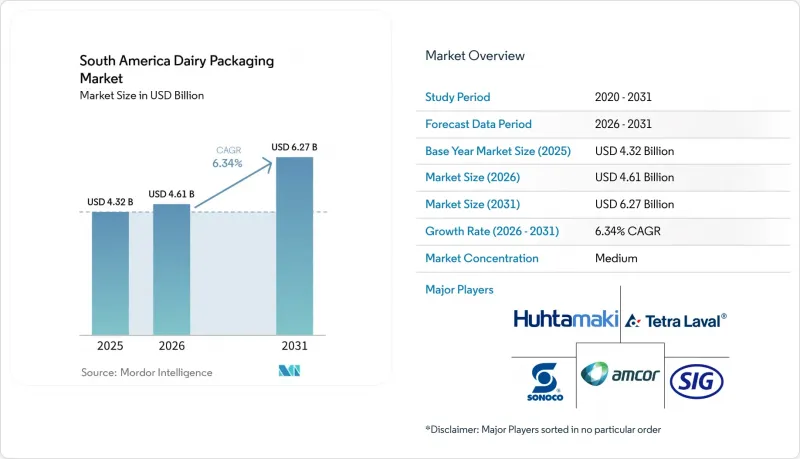
據 Mordor Intelligence 稱,2025 年南美乳製品包裝市場價值 43.2 億美元,預計到 2031 年將達到 62.7 億美元,而 2026 年為 45.9 億美元,預測期(2026-2031 年)複合年成長率為 6.34%。
南美洲乳製品包裝市場趨勢與洞察
擴大無菌包裝和超高溫滅菌乳製品的分銷
無菌包裝和超高溫滅菌(UHT)乳製品的分銷正在推動南美乳製品包裝市場的發展,使消費者能夠透過現有冷鏈以外的管道獲取乳製品。根據巴西長保存期限乳製品協會預測,2024年UHT牛奶市場將成長3.9%。這一成長支撐了對多層紙盒及相關無菌包裝材料的持續需求。學校供餐計畫也為包裝乳製品和紙盒裝產品提供了可靠的銷售管道。無菌灌裝設備需要大量的資本投入,這可能會使合作社在12-15年內只能使用特定的填充平台。因此,儘早與加工商建立合作關係將有助於確保對相容包裝系統的需求。
常規零售和冷鏈網路擴展
一般零售商正從銷售散裝乳製品轉向銷售採用專用包裝的品牌產品。到2025年,巴西的單人家庭將佔家庭總數的19.7%。這種家庭結構支撐了對小包裝產品的需求,而小包裝產品的每公升包裝用量較高。哥倫比亞內陸和巴西東北部的冷藏配送也促進了優格、新鮮起司、冷藏瓶裝產品和薄膜包裝產品的銷售。隨著零售通路日益標準化,食品接觸材料和標籤的合規性對於超級市場的產品陳列至關重要。當連鎖超市採用統一的供應商要求時,使用認證材料的加工商將獲得競爭優勢。
外匯波動和對進口樹脂的依賴
對進口塑膠的依賴仍然是南美洲乳製品包裝市場面臨的短期挑戰。預計巴西在2025年將進口332萬噸聚乙烯。由於預計2025年巴西國內化工產業的產能運轉率僅64%,本地產能不足以緩解供應壓力。自2026年3月起,巴西將對美國聚乙烯徵收每噸199.04美元的固定關稅,對加拿大聚乙烯徵收每噸238.49美元的固定關稅。塑膠成本上漲可能會擠壓加工商的利潤空間,導致乳製品加工商的價格上漲,或促使他們採用更輕的包裝設計。由於缺乏應對外匯風險的資源,小規模的區域性加工商面臨的風險更大。
細分市場分析
由於塑膠在牛奶瓶、軟包裝袋和優格容器等領域的廣泛應用,預計到2025年,塑膠將佔據南美乳製品包裝市場58.41%的佔有率。高密度聚乙烯(HDPE)瓶、低密度聚乙烯(LDPE)軟包裝袋和聚丙烯容器受益於現有加工商的產能以及零售業的高度認可。然而,進口樹脂成本的上漲以及品牌對塑膠廢棄物的擔憂,正給這些成熟的包裝形式帶來越來越大的壓力。巴西於2025年頒布的第12688號法令,對塑膠包裝的逆向物流提出了要求,並設定了2026年回收率達到32%的目標。該法令影響了採購過程中關於可追溯性、回收和材料選擇的討論。儘管如此,塑膠在乳製品包裝領域仍佔據核心地位。這是因為塑膠包裝成本低廉、產品可見度強,並且能夠相容於現有的灌裝製程。此外,由於塑膠材料的廣泛應用,在考慮包裝變更時,通常會優先考慮其與現有吹塑成型、成型、封口和填充設備的兼容性。因此,在食品接觸和供應條件允許的情況下,逐步減輕重量和增加再生材料含量等方法被優先考慮。因此,儘管買家正在探索替代方案,但南美洲乳製品包裝市場對塑膠的需求仍然十分旺盛。
預計到2031年,紙和紙板市場將以7.21%的複合年成長率成長。南美乳製品包裝市場對紙和紙板的需求成長主要受無菌紙盒包裝發展和品牌商對可回收包裝結構的需求所驅動。由於巴西法規並未強制要求在食品接觸包裝中使用再生材料,纖維紙盒的採用很大程度上取決於品牌策略。生物基塗層可望取代傳統的聚乙烯層,同時保持乳製品紙盒的保存期限。在智利和巴西的都市區,玻璃容器仍用於包裝高階和有機乳製品。金屬容器在濃縮濃縮乳的包裝中仍然發揮著重要作用,尤其是在常溫保存產品和商用管道中。纖維替代品若要取代現有包裝結構,必須符合食品安全、阻隔性、保存期限及填充線的要求。在無菌分銷和品牌回收工作重疊的地區,纖維替代品的應用最為廣泛。玻璃和金屬仍然是特殊用途的選擇,而非紙盒和塑膠的通用替代品。
其他好處:
- Excel格式的市場預測(ME)表
- 3個月的分析師支持
目錄
第1章:引言
- 研究假設和市場定義
- 調查範圍
第2章:調查方法
第3章執行摘要
第4章 市場狀況
- 市場概覽
- 市場促進因素
- 擴大超高溫滅菌乳製品的無菌包裝和分銷
- 擴大常規零售網路和冷鏈
- 對功能性和高蛋白乳製品的需求不斷成長
- 從散裝銷售過渡到衛生包裝乳製品
- 適用於成本受限分發的輕量、彈性格式。
- 品牌所有者在可回收性和再生材料含量方面的努力
- 市場限制因素
- 外匯波動及進口樹脂風險
- 農村物流和冷藏基礎設施不平衡
- 包裝材料的收集和回收面臨的挑戰
- 食品接觸材料法規的生產者責任延伸、標籤和合規成本
- 產業價值鏈分析
- 監理情勢
- 技術展望
- 波特五力分析
- 宏觀經濟因素對市場的影響
第5章 市場規模與成長預測
- 材料
- 塑膠
- 紙張和紙板
- 玻璃
- 金屬
- 依產品
- 牛奶
- 起司
- 冷凍食品
- 優格
- 培養產品
- 按包裝類型
- 瓶子
- 小袋
- 紙箱和盒子
- 袋子和包裝紙
- 其他包裝類型
- 按地區
- 巴西
- 阿根廷
- 智利
- 哥倫比亞
- 其他南美國家
第6章 競爭情勢
- 市場集中度
- 策略趨勢
- 市佔率分析
- 公司簡介
- Amcor plc
- SIG Group AG
- Tetra Laval Holdings & Finance SA
- Elopak ASA
- Mondi plc
- Huhtamaki Oyj
- Sonoco Products Company
- Sealed Air Corporation
- Winpak Ltd.
- AptarGroup, Inc.
- Silgan Holdings Inc.
- CANPACK SA
- Stora Enso Oyj
- Pactiv Evergreen Inc.
- Coveris Management GmbH
- Goglio SpA
- Ecolean AB
- Greatview Aseptic Packaging Co., Ltd.
- Klockner Pentaplast Group
- Videplast Industria de Embalagens Ltda.
- Canguru Embalagens Ltda.
- Zaraplast SA
- Santa Rosa Embalagens Flexiveis Ltda.
第7章 市場機會與未來趨勢
- 評估閒置頻段和未滿足的需求
According to Mordor Intelligence, the South America dairy packaging market size was valued at USD 4.32 billion in 2025 and estimated to grow from USD 4.59 billion in 2026 to reach USD 6.27 billion by 2031, at a CAGR of 6.34% during the forecast period (2026-2031).
South America Dairy Packaging Market Trends and Insights
Growth of Aseptic and UHT Dairy Distribution
Aseptic and UHT distribution supports the South America dairy packaging market by expanding dairy access beyond well-developed cold chains. Brazil's long-life dairy association reported 3.9% growth in the UHT milk segment during 2024. This growth supports continued demand for multilayer cartons and related aseptic materials. School nutrition programs also provide a dependable channel for packaged dairy and carton formats. Aseptic equipment requires significant capital spending, which can keep a cooperative tied to a filling platform for 12-15 years. Early relationships with processors can therefore protect demand for the compatible package system.
Expansion of Formal Retail and Cold-Chain Coverage
Formal retail converts bulk dairy sales into branded units with dedicated packaging. In 2025, single-person households represented 19.7% of Brazilian households. This household structure supports smaller packs with greater packaging use per liter. Refrigerated distribution in inland Colombia and northeastern Brazil also supports the distribution of yogurt, fresh cheese, chilled bottles, and films. Food-contact and labeling compliance becomes necessary for supermarket placement as retail channels formalize. Converters with certified substrates can gain an advantage when chains apply consistent supplier requirements.
Currency Volatility and Imported Resin Exposure
Imported resin exposure remains a near-term challenge for the South America dairy packaging market. Brazil imported 3.32 million tonnes of polyethylene in 2025. Domestic chemical capacity utilization was 64% in 2025, limiting the local output's ability to cushion the impact of supply pressure. Brazil imposed definitive duties of USD 199.04 per tonne on U.S. polyethylene and USD 238.49 per tonne on Canadian polyethylene from March 2026. Higher resin costs can compress converter margins, raise prices for dairy processors, or encourage lighter package designs. Smaller regional converters face greater exposure because they have fewer resources for foreign-exchange risk management.
Other drivers and restraints analyzed in the detailed report include:
- Rising Demand for Functional and High-Protein Dairy Products
- Shift From Loose to Hygienically Packaged Dairy
- Uneven Rural Logistics and Refrigeration Infrastructure
For complete list of drivers and restraints, kindly check the Table Of Contents.
Segment Analysis
Plastic accounted for 58.41% of the 2025 South America Dairy Packaging Market share, supported by its established use in milk bottles, flexible pouches, and yogurt containers. HDPE bottles, LDPE pouches, and polypropylene containers benefit from existing converter capacity and retail familiarity. Imported resin costs and brand concerns about plastic waste are increasing pressure on these established formats. Brazil's Decree No. 12,688, issued in 2025, established reverse logistics requirements for plastic packaging and a 32% recovery target for 2026. The decree is influencing procurement discussions around traceability, recovery, and material choice. Plastic nevertheless remains central to dairy packaging because its formats address low cost, product visibility, and established filling processes. The material's broad installed base also means that package changes are usually considered alongside existing blowing, forming, sealing, and filling equipment. This favors incremental lightweighting or recycled-content approaches where food-contact and supply conditions allow them. The South America dairy packaging market, therefore, retains a substantial plastic requirement even as buyers assess alternatives.
Paper and paperboard are projected to grow at a 7.21% CAGR through 2031. The South America Dairy Packaging Market size for paper and paperboard is driven by growth in aseptic carton packaging and brand owners' interest in recyclable structures. The recovery target under Brazil's decree does not require recycled content in food-contact packaging, so adoption of fiber-based cartons depends substantially on brand strategy. Biobased coatings may replace conventional polyethylene layers while preserving shelf-life performance in dairy cartons. Glass continues to serve premium and organic dairy products in urban Chile and Brazil. Metal remains relevant for condensed and evaporated milk, particularly in shelf-stable and institutional channels. Fiber-based alternatives need to meet food safety, barrier, shelf-life, and filling-line requirements before they can replace established structures. Their adoption is strongest where aseptic distribution and brand recycling commitments overlap. Glass and metal remain specialized choices rather than broad substitutes for cartons or plastic.
Complete Report Scope:
- By Material
- Plastic
- Paper and Paperboard
- Glass
- Metal
- By Product
- Milk
- Cheese
- Frozen Foods
- Yogurt
- Cultured Products
- By Package Type
- Bottles
- Pouches
- Cartons and Boxes
- Bags and Wraps
- Other Package Types
- By Geography
- Brazil
- Argentina
- Chile
- Colombia
- Rest of South America
List of Companies Covered in this Report:
- Amcor plc
- SIG Group AG
- Tetra Laval Holdings & Finance S.A.
- Elopak ASA
- Mondi plc
- Huhtamaki Oyj
- Sonoco Products Company
- Sealed Air Corporation
- Winpak Ltd.
- AptarGroup, Inc.
- Silgan Holdings Inc.
- CANPACK S.A.
- Stora Enso Oyj
- Pactiv Evergreen Inc.
- Coveris Management GmbH
- Goglio S.p.A.
- Ecolean AB
- Greatview Aseptic Packaging Co., Ltd.
- Klockner Pentaplast Group
- Videplast Industria de Embalagens Ltda.
- Canguru Embalagens Ltda.
- Zaraplast S.A.
- Santa Rosa Embalagens Flexiveis Ltda.
Additional Benefits:
- The market estimate (ME) sheet in Excel format
- 3 months of analyst support
TABLE OF CONTENTS
1 INTRODUCTION
- 1.1 Study Assumptions and Market Definition
- 1.2 Scope of the Study
2 RESEARCH METHODOLOGY
3 EXECUTIVE SUMMARY
4 MARKET LANDSCAPE
- 4.1 Market Overview
- 4.2 Market Drivers
- 4.2.1 Growth of Aseptic and UHT Dairy Distribution
- 4.2.2 Expansion of Formal Retail and Cold-Chain Coverage
- 4.2.3 Rising Demand for Functional and High-Protein Dairy Products
- 4.2.4 Shift from Loose to Hygienically Packaged Dairy
- 4.2.5 Lightweight Flexible Formats for Cost-Constrained Distribution
- 4.2.6 Recyclability and Recycled-Content Commitments by Brand Owners
- 4.3 Market Restraints
- 4.3.1 Currency Volatility and Imported Resin Exposure
- 4.3.2 Uneven Rural Logistics and Refrigeration Infrastructure
- 4.3.3 Packaging Recovery and Recycling Gaps
- 4.3.4 Compliance Cost of EPR, Labeling, and Food-Contact Rules
- 4.4 Industry Value Chain Analysis
- 4.5 Regulatory Landscape
- 4.6 Technological Outlook
- 4.7 Porter's Five Forces Analysis
- 4.7.1 Bargaining Power of Suppliers
- 4.7.2 Bargaining Power of Buyers
- 4.7.3 Threat of New Entrants
- 4.7.4 Threat of Substitutes
- 4.7.5 Competitive Rivalry
- 4.8 Impact of Macroeconomic Factors on the Market
5 MARKET SIZE AND GROWTH FORECASTS (VALUES)
- 5.1 By Material
- 5.1.1 Plastic
- 5.1.2 Paper and Paperboard
- 5.1.3 Glass
- 5.1.4 Metal
- 5.2 By Product
- 5.2.1 Milk
- 5.2.2 Cheese
- 5.2.3 Frozen Foods
- 5.2.4 Yogurt
- 5.2.5 Cultured Products
- 5.3 By Package Type
- 5.3.1 Bottles
- 5.3.2 Pouches
- 5.3.3 Cartons and Boxes
- 5.3.4 Bags and Wraps
- 5.3.5 Other Package Types
- 5.4 By Geography
- 5.4.1 Brazil
- 5.4.2 Argentina
- 5.4.3 Chile
- 5.4.4 Colombia
- 5.4.5 Rest of South America
6 COMPETITIVE LANDSCAPE
- 6.1 Market Concentration
- 6.2 Strategic Moves
- 6.3 Market Share Analysis
- 6.4 Company Profiles (includes Global Level Overview, Market Level Overview, Core Segments, Financials as available, Strategic Information, Market Rank/Share, Products and Services, Recent Developments)
- 6.4.1 Amcor plc
- 6.4.2 SIG Group AG
- 6.4.3 Tetra Laval Holdings & Finance S.A.
- 6.4.4 Elopak ASA
- 6.4.5 Mondi plc
- 6.4.6 Huhtamaki Oyj
- 6.4.7 Sonoco Products Company
- 6.4.8 Sealed Air Corporation
- 6.4.9 Winpak Ltd.
- 6.4.10 AptarGroup, Inc.
- 6.4.11 Silgan Holdings Inc.
- 6.4.12 CANPACK S.A.
- 6.4.13 Stora Enso Oyj
- 6.4.14 Pactiv Evergreen Inc.
- 6.4.15 Coveris Management GmbH
- 6.4.16 Goglio S.p.A.
- 6.4.17 Ecolean AB
- 6.4.18 Greatview Aseptic Packaging Co., Ltd.
- 6.4.19 Klockner Pentaplast Group
- 6.4.20 Videplast Industria de Embalagens Ltda.
- 6.4.21 Canguru Embalagens Ltda.
- 6.4.22 Zaraplast S.A.
- 6.4.23 Santa Rosa Embalagens Flexiveis Ltda.
7 MARKET OPPORTUNITIES AND FUTURE TRENDS
- 7.1 White-Space and Unmet-Need Assessment

 奶油包裝紙市場:全球市場預測,2026-2032年
 乳製品包裝器材市場機會、成長要素、產業趨勢分析及2026-2035年預測
 乳製品包裝市場規模、佔有率、趨勢和預測:按包裝材料、包裝形式、產品類型、應用和地區分類,2026-2034年乳製品包裝市場:2026-2032年全球市場預測(依包裝類型、材料、技術、封裝方法及應用分類)
 全球乳製品包裝市場規模、佔有率、趨勢和成長分析報告(2026-2034年)
 乳製品包裝市場規模、佔有率及成長分析(依材料、包裝類型、產品類型及地區)-2025-2032 年產業預測乳製品包裝市場機會、成長動力、產業趨勢分析與預測 2025-2034
 乳製品包裝:市場佔有率分析、產業趨勢、成長預測(2025-2030)拉丁美洲乳製品包裝:市場佔有率分析、行業趨勢和成長預測(2025-2030 年)美國乳製品包裝:市場佔有率分析、產業趨勢、產業趨勢、成長預測(2025-2030)