


 |
市場調查報告書
商品編碼
2154959
南美洲自動化物料搬運和儲存系統:市場佔有率分析、行業趨勢和統計數據以及成長預測(2026-2031 年)South America Automated Material Handling and Storage Systems - Market Share Analysis, Industry Trends & Statistics, Growth Forecasts (2026 - 2031) |
||||||

※ 本網頁內容可能與最新版本有所差異。詳細情況請與我們聯繫。
據 Mordor Intelligence 稱,2025 年南美自動化物料輸送和儲存系統市場價值為 34.2 億美元,預計將從 2026 年的 36.9 億美元成長到 2031 年的 59.1 億美元。
預測期(2026-2031 年)的複合年成長率預計為 9.88%。
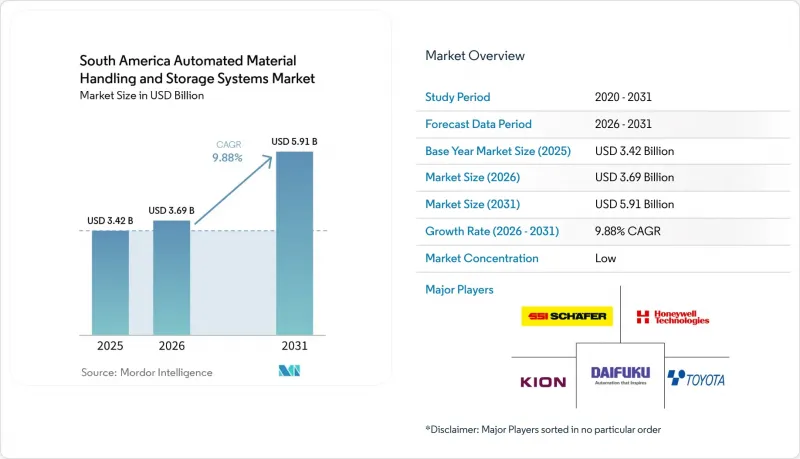
南美自動化物料輸送與儲存系統市場趨勢與洞察。
電子商務與全通路履約的拓展
南美洲活性化的電子商務市場對區域物流網路的速度和穩定性提出了新的要求。預計到2026年,該地區的電子商務市場規模將超過2,150億美元,成長速度是全球平均的1.5倍。 MercadoLibre宣布計畫於2026年在巴西投資570億巴西雷亞爾(約100億美元),其中包括新建14個物流中心,使其網路覆蓋範圍擴展至42個地點。此次擴張將使履約能力從僅在訂單量增加時才購買的服務轉變為常態化的營運能力。聖保羅和里約熱內盧的企業需要緊湊型系統,以縮短都市區履約中心的訂單到出貨週期。因此,輸送機式分類系統和自主移動機器人揀選系統在訂單量和產品頻繁變化的環境中非常有效。此外,巴西的「Pix」支付系統降低了支付處理成本,這將使企業能夠釋放更多營運資金用於自動化專案。
人手不足和處理成本上升
巴西的勞動力結構推高了人工搬運的實際成本,從而強化了自動化帶來的商業價值。由於該國與就業相關的義務,實際時薪可能比基本工資高出70%至100%。此外,進口關稅可能使自動化設備的交付達到美國同類價格的兩到三倍。在這種環境下,不僅在設備價格方面,而且在營運成本、整合支援和服務可用性方面都具有競爭優勢的本地供應商將擁有顯著優勢。 WEG和Senior Sistemas展示了到2025年巴西自主研發的自動移動機器人(AMR)和倉庫管理系統(WMS)的整合方案,兩家公司均表示通常可在18個月內收回投資。巴西國家經濟社會發展銀行(BNDES)的融資可以進一步降低符合條件項目的前期成本,尤其是在自動化與工業現代化相結合的情況下。
初始投資額高,投資回收期長
對於機器人物料輸送單元而言,成本可能是基礎設備價格的2.5到4倍,其中包括工具、安全圍欄、編程和試運行。在巴西,交付的系統會被徵收多重關稅,這增加了進口設備的成本負擔。巴西和阿根廷的高利率延長了那些無法自行融資的企業的投資回收期。阿根廷的外匯波動迫使一些紡織和工業製造商推遲了原定於2024年和2025年進行的設備升級。供應商正在推出售價低於5萬美元的入門級機型以及機器人領域新興的訂閱模式,但這些合約的複雜性可能會讓謹慎的買家望而卻步。巴西正在進行的向雙重增值稅(VAT)結構的過渡一旦完成,預計將解決採購延誤問題並降低進口成本。
細分市場分析
2025年,硬體在南美洲物料輸送和儲存系統市場佔有率中佔68.83%。在部署初期,輸送機、移動機器人、儲存設備和自動化儲存系統佔據了大部分支出。硬體仍然至關重要,因為僅靠軟體無法實現實體移動、儲存和分類。其領先地位也反映了高吞吐量物流和生產場所所需的大規模資本投資。預計2026年至2031年,軟體市場將以10.48%的複合年成長率成長。目前,倉庫管理、執行、控制和車隊管理平台通常整合到自主移動機器人(AMR)和自動化倉庫系統(ASRS)專案中。南美物料輸送和儲存系統軟體市場規模的成長得益於買家對設備和操作流程可視性的需求。整合提案擴大將設備、控制層和營運資料整合到單一供應商關係中。
服務內容包括安裝、系統整合、維護和現場運作支援。由於許多企業缺乏擁有豐富自動化工程經驗的內部團隊,這些服務仍然至關重要。隨著巴西和哥倫比亞部署量的不斷增加,主動維護的需求也日益成長。在設備透過工業網際網路系統連接的環境中,遠端監控和預防性保養維護也變得越來越重要。這些服務合約使營運商能夠在性能問題中斷履約或生產營運之前識別它們。 SENAI 正在與設備供應商合作,擴展其自動化技術人員認證計劃,從而幫助本地服務人員的培養。 WEG 和 Senior Sistemas 也已證明,與本地軟體和設備供應商的合作能夠為巴西的買家提供更具吸引力的捆綁式提案。
2025年,自動化輸送機佔設備銷售額的29.31%。這些設備繼續廣泛應用於高容量零售、電子商務、機場以及食品飲料行業。皮帶輸送機、滾筒輸送機、托盤輸送機和架空輸送系統分別滿足不同的處理能力和設施佈局要求。它們的強勁市場地位反映了大規模分類和履約中心對可預測運輸的持續需求。移動機器人包括自動導引車 (AGV) 和自主移動機器人,它們各自適用於不同的運作條件。 AGV 非常適合港口和汽車行業中高度重複、高負載的路線。預計從2026年到2031年,自主移動機器人的複合年成長率將達到10.87%。在南美物料輸送和儲存系統市場,這些設備能夠在缺乏固定基礎設施的現有設施(棕地)中部署,這推動了它們的普及應用。
在儲存密度和可追溯性至關重要的場所,自動化倉庫系統正日益普及。固定巷道起重機、旋轉貨架和垂直升降模組適用於製藥、食品飲料和電子產品等行業的倉庫。在HAI Robotics為RD Saude公司實施的系統中,現有的維亞納物流中心利用了85台機器人和62,000個儲存位。堆垛機在消費品營運中繼續發揮關鍵作用,因為這類營運需要反覆處理大量包裹。隨著宅配網路擴展其區域樞紐並處理更多種類的小包裹,分類設備也日益受到關注。 2025年,Ype公司在安帕羅建造了一座自動化物流中心,配備了77台自主機器人和50,000個托盤儲存空間。在該設施中,分層揀選系統實現了混合SKU的碼垛。隨著買家對能夠支援穩定高容量處理和波動訂單流的系統的需求不斷成長,設備的組合方式也變得越來越多樣化。
其他好處:
- Excel格式的市場預測(ME)表
- 3個月的分析師支持
目錄
第1章:引言
- 研究假設和市場定義
- 調查範圍
第2章:調查方法
第3章執行摘要
第4章 市場狀況
- 市場概覽
- 宏觀經濟因素對市場的影響
- 市場促進因素
- 電子商務與全通路履約的拓展
- 人手不足和處理成本上升
- 最佳化倉庫空間和庫存準確性
- 製造業現代化與工業4.0的引入
- 利用模組化移動機器人實現棕地自動化
- 加大對區域履約基礎設施的投資,其中巴西處於領先地位。
- 市場限制因素
- 初始投資額大,投資回收期長
- WMS、ERP 和管理系統整合的複雜性。
- 電源可靠性和維護/服務限制
- 本地難以找到專業的自動化技術人員。
- 產業價值鏈分析
- 監理情勢
- 技術展望
- 波特五力分析
第5章 市場規模與成長預測
- 依產品類型
- 硬體
- 軟體
- 服務
- 依設備類型
- 移動機器人
- 自動導引運輸車(AGV)
- 自動堆高機
- 自動牽引車/曳引機/拖輪
- 單元貨載
- 組裝
- 特殊用途
- 自主移動機器人(AMR)
- 自動導引運輸車(AGV)
- 自動化倉庫系統(ASRS)
- 固定通道類型
- 旋轉木馬
- 垂直升降模組
- 自動輸送機
- 腰帶
- 滾筒
- 調色盤
- 開賣
- 堆垛機
- 傳統的
- 機器人
- 分類系統
- 移動機器人
- 按最終用戶行業分類
- 飛機場
- 車
- 食品/飲料
- 零售/倉儲/物流中心/物流樞紐
- 一般製造業
- 製藥
- 郵件和小包裹
- 電子和半導體製造
- 其他終端用戶產業
- 按功能
- 貯存
- 運輸
- 排序
- 包裝
- 組裝
- 按地區
- 巴西
- 阿根廷
- 哥倫比亞
- 其他南美國家
第6章 競爭情勢
- 市場集中度
- 策略趨勢
- 市佔率分析
- 公司簡介
- DAIFUKU CO., LTD.
- KION GROUP AG
- SSI SCHAEFER GROUP
- Toyota Industries Corporation
- Honeywell International Inc.
- Vanderlande Industries BV
- Murata Machinery, Ltd.
- Mecalux, SA
- BEUMER Group GmbH & Co. KG
- KNAPP AG
- TGW Logistics Group GmbH
- Kardex Holding AG
- Swisslog Holding AG
- Fives Group
- Interroll Holding AG
- Jungheinrich AG
- Elettric 80 SpA
- Scheffer Logistica e Automacao Ltda.
- Automni Tecnologia Ltda.
- Translift Sistemas de Movimentacao Ltda.
第7章 市場機會與未來展望
According to Mordor Intelligence, the South America automated material handling and storage systems market size was valued at USD 3.42 billion in 2025 and estimated to expand from USD 3.69 billion in 2026 to reach USD 5.91 billion by 2031, at a CAGR of 9.88% during the forecast period (2026-2031).
South America Automated Material Handling and Storage Systems Market Trends and Insights
E-Commerce and Omnichannel Fulfillment Expansion
South American e-commerce activity is placing new demands on the speed and consistency of regional distribution networks. The regional e-commerce sector is projected to exceed USD 215 billion in 2026, with an expansion rate 1.5 times the global average. MercadoLibre announced a BRL 57 billion (USD 10 billion) investment plan for Brazil in 2026, including 14 new distribution centers, bringing its network to 42 locations. This expansion makes fulfillment capacity a fixed operating capability rather than a service purchased only when volumes rise. Operators in Sao Paulo and Rio de Janeiro need compact systems that can support short order-to-dispatch cycles in urban fulfillment sites. Conveyor sortation and autonomous mobile robot picking systems are therefore relevant where order volumes and product ranges change frequently. Lower payment processing costs through Brazil's Pix system can also leave operators with more working capital for automation projects.
Labor Scarcity and Rising Handling Costs
Brazil's labor structure raises the effective cost of manual handling and strengthens the business case for automation. The reported effective hourly cost can be 70% to 100% higher than base wages because of the country's employment-related obligations. Import levies can also raise the delivered price of automation equipment to 2 to 3 times comparable prices in the United States. These conditions favor local suppliers that can compete on operating cost, integration support, and service availability rather than equipment price alone. WEG and Senior Sistemas demonstrated a Brazilian-developed AMR-WMS integration in 2025, and the companies reported typical returns in under 18 months. Financing from BNDES can further reduce the upfront burden for eligible projects, particularly where automation is linked to industrial modernization.
High Upfront Capital and Extended Payback Periods
A robotic material handling cell can cost 2.5 to 4 times the base equipment price once tooling, guarding, programming, and commissioning are included. Imported equipment can carry an additional cost burden in Brazil because several duties apply to the delivered system. High interest rates in Brazil and Argentina lengthen the financial return period for operators that cannot fund projects internally. Currency volatility in Argentina caused some textile and industrial manufacturers to postpone planned upgrades during 2024 and 2025. Suppliers are responding with starter systems below USD 50,000 and emerging subscription models for robotics, but contract complexity can discourage cautious buyers. Brazil's ongoing move to a dual value-added tax structure could reduce procurement delays and lower import costs once the transition is complete.
Other drivers and restraints analyzed in the detailed report include:
- Warehouse Space Optimization and Inventory Accuracy
- Manufacturing Modernization and Industry 4.0 Adoption
- Integration Complexity Across WMS, ERP, and Controls
For complete list of drivers and restraints, kindly check the Table Of Contents.
Segment Analysis
Hardware accounted for 68.83% of the South America automated material handling and storage systems market share in 2025. Conveyors, mobile robots, storage equipment, and automated storage systems accounted for the largest share of spending during the early phase of adoption. Hardware remains essential because physical movement, storage, and sorting cannot be delivered through software alone. Its leading position also reflects the large equipment purchases required for high-throughput distribution and production sites. Software is projected to expand at a 10.48% CAGR from 2026 to 2031. Warehouse management, execution, control, and fleet management platforms are now commonly included in AMR and ASRS projects. The South America automated material handling and storage systems market size for software is supported by buyers who need visibility across equipment and operating workflows. Integrated bids increasingly combine equipment, control layers, and operating data under a single supplier relationship.
Services cover installation, systems integration, maintenance, and support after a site begins operating. These activities remain important because many operators lack internal teams with deep automation engineering experience. The installed base is expanding in Brazil and Colombia, which creates a need for preventive maintenance arrangements. Remote monitoring and predictive maintenance are also becoming more relevant where equipment is connected through industrial internet systems. The service relationship can help operators identify performance issues before they interrupt fulfillment or production work. SENAI has expanded automation technician certification programs in partnership with equipment vendors, helping to develop the local service talent pipeline. WEG and Senior Sistemas also show how local software and equipment partnerships can make a bundled offer more relevant to Brazilian buyers.
Automated conveyors held 29.31% of equipment revenue in 2025. They remain widely used in high-volume retail, e-commerce, airport, food, and beverage operations. Belt, roller, pallet, and overhead conveyor systems address different throughput and facility-layout requirements. Their established position reflects the continuing need for predictable movement across large sorting and fulfillment sites. Mobile robots include automated guided vehicles and autonomous mobile robots, which operate under distinct conditions. Automated guided vehicles are suitable for repeatable high-load routes in port and automotive environments. Autonomous mobile robots are projected to expand at a 10.87% CAGR from 2026 to 2031. The South America automated material handling and storage systems market supports their use because these units can be deployed in brownfield locations with less fixed infrastructure.
Automated storage and retrieval systems are being adopted where storage density and traceability are essential. Fixed-aisle cranes, carousels, and vertical lift modules are relevant to pharmaceutical, food and beverage, and electronics sites. HAI Robotics' deployment at RD Saude used 85 robots and 62,000 storage locations within the existing Viana distribution center. Palletizers remain important for consumer goods operations that need repetitive handling of large volumes. Sortation equipment is also gaining attention as courier networks add regional hubs and manage a wider variety of parcels. Ype completed an automated distribution center in Amparo in 2025, equipped with 77 autonomous robots and 50,000 pallet positions. Its layer-picking system supported mixed-SKU palletization at the facility. The equipment mix is widening as buyers seek systems that can support both stable high-volume work and more variable order flows.
Complete Report Scope:
- By Product Type
- Hardware
- Software
- Services
- By Equipment Type
- Mobile Robots
- Automated Guided Vehicle (AGV)
- Automated Forklift
- Automated Tow / Tractor / Tug
- Unit Load
- Assembly Line
- Special Purpose
- Autonomous Mobile Robots (AMR)
- Automated Guided Vehicle (AGV)
- Automated Storage and Retrieval System (ASRS)
- Fixed Aisle
- Carousel
- Vertical Lift Module
- Automated Conveyor
- Belt
- Roller
- Pallet
- Overhead
- Palletizer
- Conventional
- Robotic
- Sortation System
- Mobile Robots
- By End-user Industry
- Airport
- Automotive
- Food and Beverage
- Retail / Warehousing / Distribution Centers / Logistic Centers
- General Manufacturing
- Pharmaceuticals
- Post and Parcel
- Electronics and Semiconductor Manufacturing
- Other End-user Industries
- By Function
- Storage
- Transportation
- Sorting
- Packaging
- Assembly
- By Geography
- Brazil
- Argentina
- Colombia
- Rest of South America
List of Companies Covered in this Report:
- DAIFUKU CO., LTD.
- KION GROUP AG
- SSI SCHAEFER GROUP
- Toyota Industries Corporation
- Honeywell International Inc.
- Vanderlande Industries B.V.
- Murata Machinery, Ltd.
- Mecalux, S.A.
- BEUMER Group GmbH & Co. KG
- KNAPP AG
- TGW Logistics Group GmbH
- Kardex Holding AG
- Swisslog Holding AG
- Fives Group
- Interroll Holding AG
- Jungheinrich AG
- Elettric 80 S.p.A.
- Scheffer Logistica e Automacao Ltda.
- Automni Tecnologia Ltda.
- Translift Sistemas de Movimentacao Ltda.
Additional Benefits:
- The market estimate (ME) sheet in Excel format
- 3 months of analyst support
TABLE OF CONTENTS
1 INTRODUCTION
- 1.1 Study Assumptions and Market Definition
- 1.2 Scope of the Study
2 RESEARCH METHODOLOGY
3 EXECUTIVE SUMMARY
4 MARKET LANDSCAPE
- 4.1 Market Overview
- 4.2 Impact of Macroeconomic Factors on the Market
- 4.3 Market Drivers
- 4.3.1 E-Commerce and Omnichannel Fulfillment Expansion
- 4.3.2 Labor Scarcity and Rising Handling Costs
- 4.3.3 Warehouse Space Optimization and Inventory Accuracy
- 4.3.4 Manufacturing Modernization and Industry 4.0 Adoption
- 4.3.5 Brownfield Automation Through Modular Mobile Robotics
- 4.3.6 Brazil-Led Regional Fulfillment Infrastructure Investment
- 4.4 Market Restraints
- 4.4.1 High Upfront Capital and Extended Payback Periods
- 4.4.2 Integration Complexity Across WMS, ERP, and Controls
- 4.4.3 Power Reliability and Maintenance-Service Constraints
- 4.4.4 Limited Local Availability of Specialized Automation Talent
- 4.5 Industry Value Chain Analysis
- 4.6 Regulatory Landscape
- 4.7 Technological Outlook
- 4.8 Porter's Five Forces Analysis
- 4.8.1 Bargaining Power of Suppliers
- 4.8.2 Bargaining Power of Buyers
- 4.8.3 Threat of New Entrants
- 4.8.4 Threat of Substitutes
- 4.8.5 Intensity of Competitive Rivalry
5 MARKET SIZE AND GROWTH FORECASTS
- 5.1 By Product Type
- 5.1.1 Hardware
- 5.1.2 Software
- 5.1.3 Services
- 5.2 By Equipment Type
- 5.2.1 Mobile Robots
- 5.2.1.1 Automated Guided Vehicle (AGV)
- 5.2.1.1.1 Automated Forklift
- 5.2.1.1.2 Automated Tow / Tractor / Tug
- 5.2.1.1.3 Unit Load
- 5.2.1.1.4 Assembly Line
- 5.2.1.1.5 Special Purpose
- 5.2.1.2 Autonomous Mobile Robots (AMR)
- 5.2.1.1 Automated Guided Vehicle (AGV)
- 5.2.2 Automated Storage and Retrieval System (ASRS)
- 5.2.2.1 Fixed Aisle
- 5.2.2.2 Carousel
- 5.2.2.3 Vertical Lift Module
- 5.2.3 Automated Conveyor
- 5.2.3.1 Belt
- 5.2.3.2 Roller
- 5.2.3.3 Pallet
- 5.2.3.4 Overhead
- 5.2.4 Palletizer
- 5.2.4.1 Conventional
- 5.2.4.2 Robotic
- 5.2.5 Sortation System
- 5.2.1 Mobile Robots
- 5.3 By End-user Industry
- 5.3.1 Airport
- 5.3.2 Automotive
- 5.3.3 Food and Beverage
- 5.3.4 Retail / Warehousing / Distribution Centers / Logistic Centers
- 5.3.5 General Manufacturing
- 5.3.6 Pharmaceuticals
- 5.3.7 Post and Parcel
- 5.3.8 Electronics and Semiconductor Manufacturing
- 5.3.9 Other End-user Industries
- 5.4 By Function
- 5.4.1 Storage
- 5.4.2 Transportation
- 5.4.3 Sorting
- 5.4.4 Packaging
- 5.4.5 Assembly
- 5.5 By Geography
- 5.5.1 Brazil
- 5.5.2 Argentina
- 5.5.3 Colombia
- 5.5.4 Rest of South America
6 COMPETITIVE LANDSCAPE
- 6.1 Market Concentration
- 6.2 Strategic Moves
- 6.3 Market Share Analysis
- 6.4 Company Profiles (includes Global Level Overview, Market Level Overview, Core Segments, Financials as available, Strategic Information, Market Rank/Share, Products and Services, Recent Developments)
- 6.4.1 DAIFUKU CO., LTD.
- 6.4.2 KION GROUP AG
- 6.4.3 SSI SCHAEFER GROUP
- 6.4.4 Toyota Industries Corporation
- 6.4.5 Honeywell International Inc.
- 6.4.6 Vanderlande Industries B.V.
- 6.4.7 Murata Machinery, Ltd.
- 6.4.8 Mecalux, S.A.
- 6.4.9 BEUMER Group GmbH & Co. KG
- 6.4.10 KNAPP AG
- 6.4.11 TGW Logistics Group GmbH
- 6.4.12 Kardex Holding AG
- 6.4.13 Swisslog Holding AG
- 6.4.14 Fives Group
- 6.4.15 Interroll Holding AG
- 6.4.16 Jungheinrich AG
- 6.4.17 Elettric 80 S.p.A.
- 6.4.18 Scheffer Logistica e Automacao Ltda.
- 6.4.19 Automni Tecnologia Ltda.
- 6.4.20 Translift Sistemas de Movimentacao Ltda.
7 MARKET OPPORTUNITIES AND FUTURE OUTLOOK
- 7.1 White-space and Unmet-need Assessment

 園藝處理系統市場:全球市場預測,2026-2032年智慧磁力驅動輸送線系統市場:全球市場預測,2026-2032年磁力搬運系統市場:全球市場預測,2026-2032年自動化軌道包裝機市場:全球市場預測,2026-2032年生產線緩衝系統市場:全球市場預測,2026-2032年雙向資料儲存表市場:全球市場預測,2026-2032年轉盤式托盤纏繞機市場:全球市場預測,2026-2032年多品處理系統市場:全球市場預測(2026-2032年)推式托盤分類機市場:全球市場預測,2026-2032年直線螺旋灌裝機市場:全球市場預測,2026-2032年